“ Cyberinfrastructure to Support  Ocean Observatories" Invited Talk to the Oceans Studies Board National Research Council UCSD, La Jolla, CA March 18, 2005 Dr. Larry Smarr Director, California Institute for Telecommunications and Information Technology Harry E. Gruber Professor,  Dept. of Computer Science and Engineering Jacobs School of Engineering, UCSD Chair, NASA Earth System Science and Applications Advisory Committee
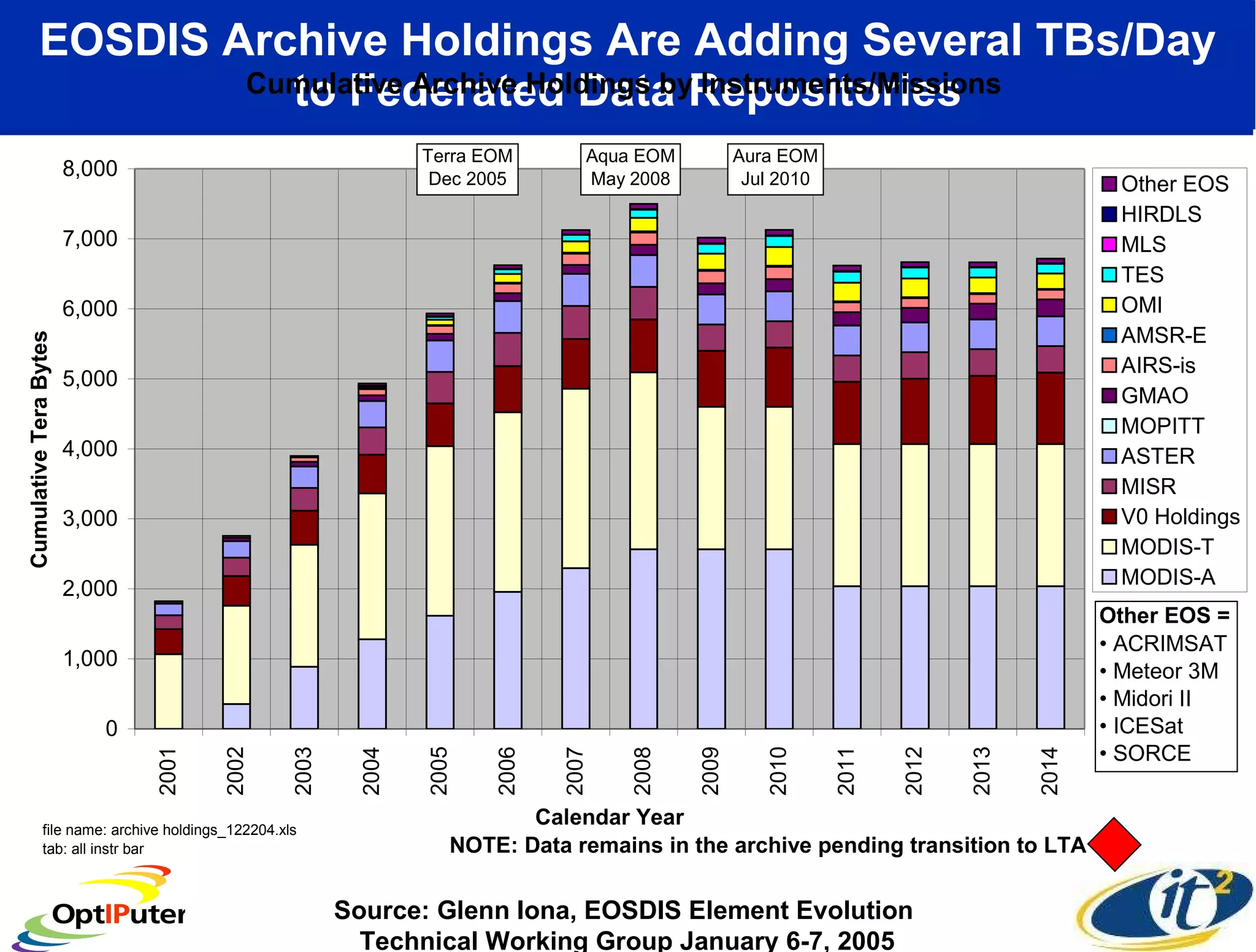
EOSDIS Archive Holdings Are Adding Several TBs/Day to Federated Data Repositories Source: Glenn Iona, EOSDIS Element Evolution  Technical Working Group January 6-7, 2005
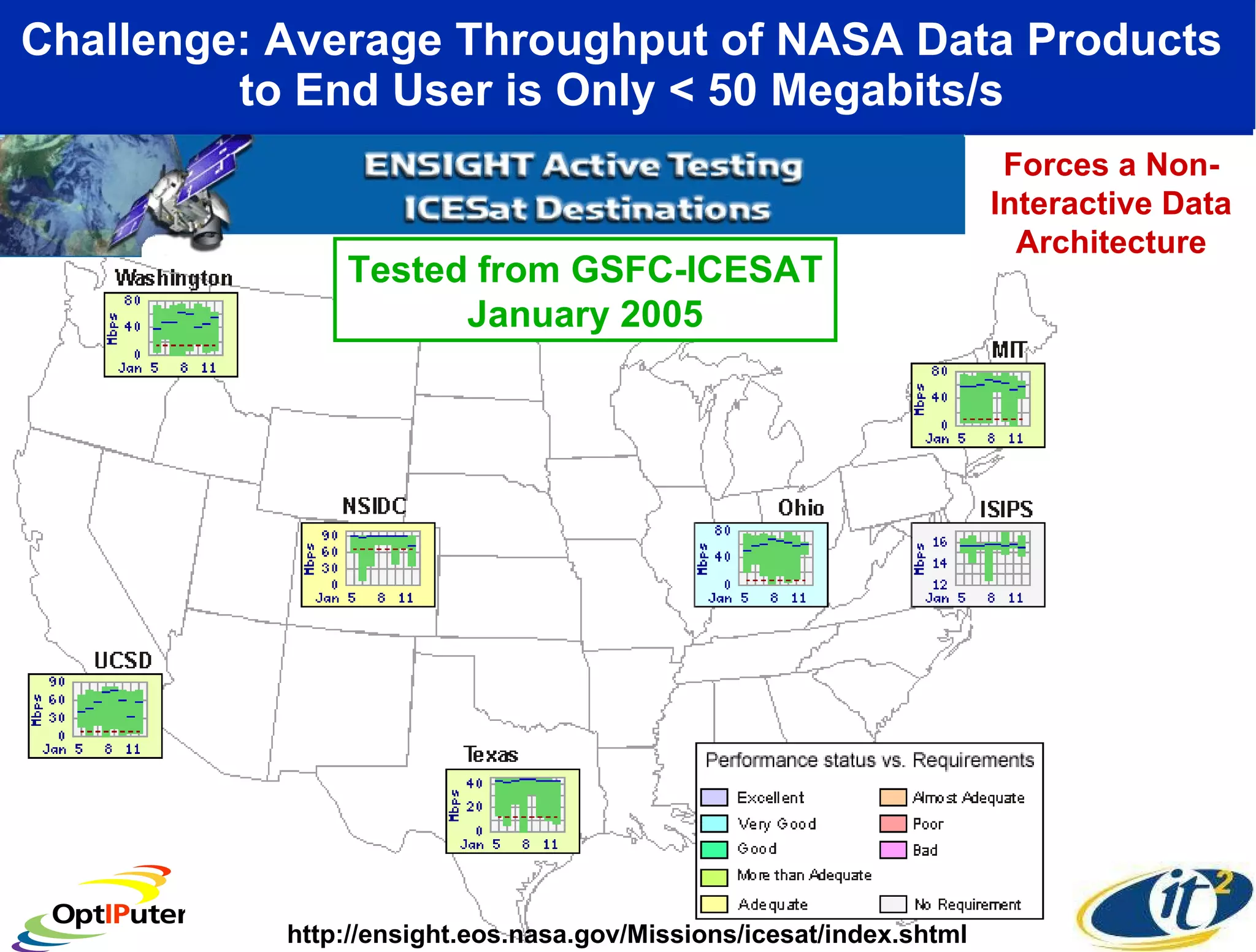
Challenge: Average Throughput of NASA Data Products  to End User is Only < 50 Megabits/s  Tested from GSFC-ICESAT January 2005 http://ensight.eos.nasa.gov/Missions/icesat/index.shtml Forces a Non-Interactive Data Architecture
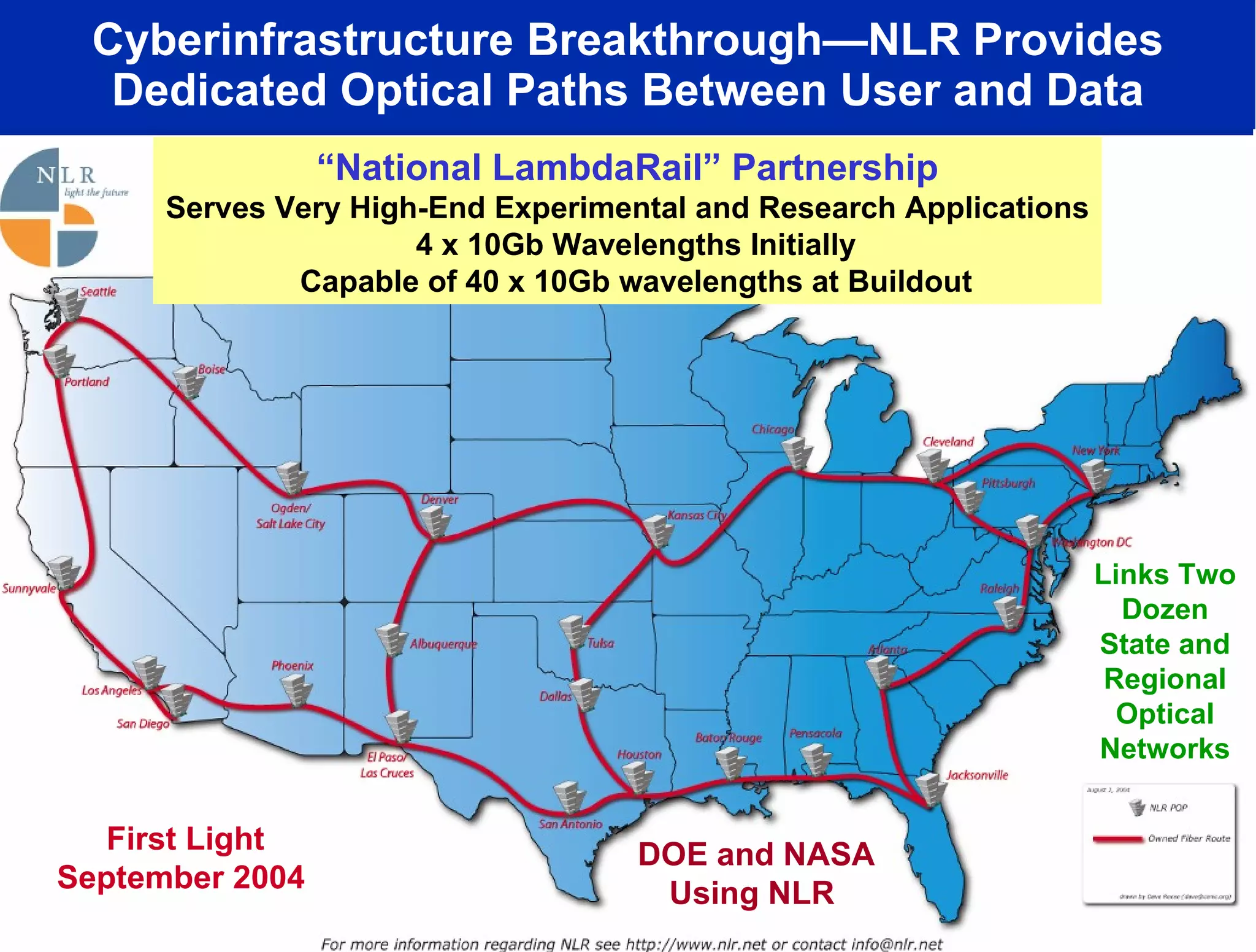
Cyberinfrastructure Breakthrough—NLR Provides Dedicated Optical Paths Between User and Data First Light September 2004  “ National LambdaRail” Partnership Serves Very High-End Experimental and Research Applications 4 x 10Gb Wavelengths Initially Capable of 40 x 10Gb wavelengths at Buildout Links Two Dozen State and Regional Optical Networks DOE and NASA Using NLR
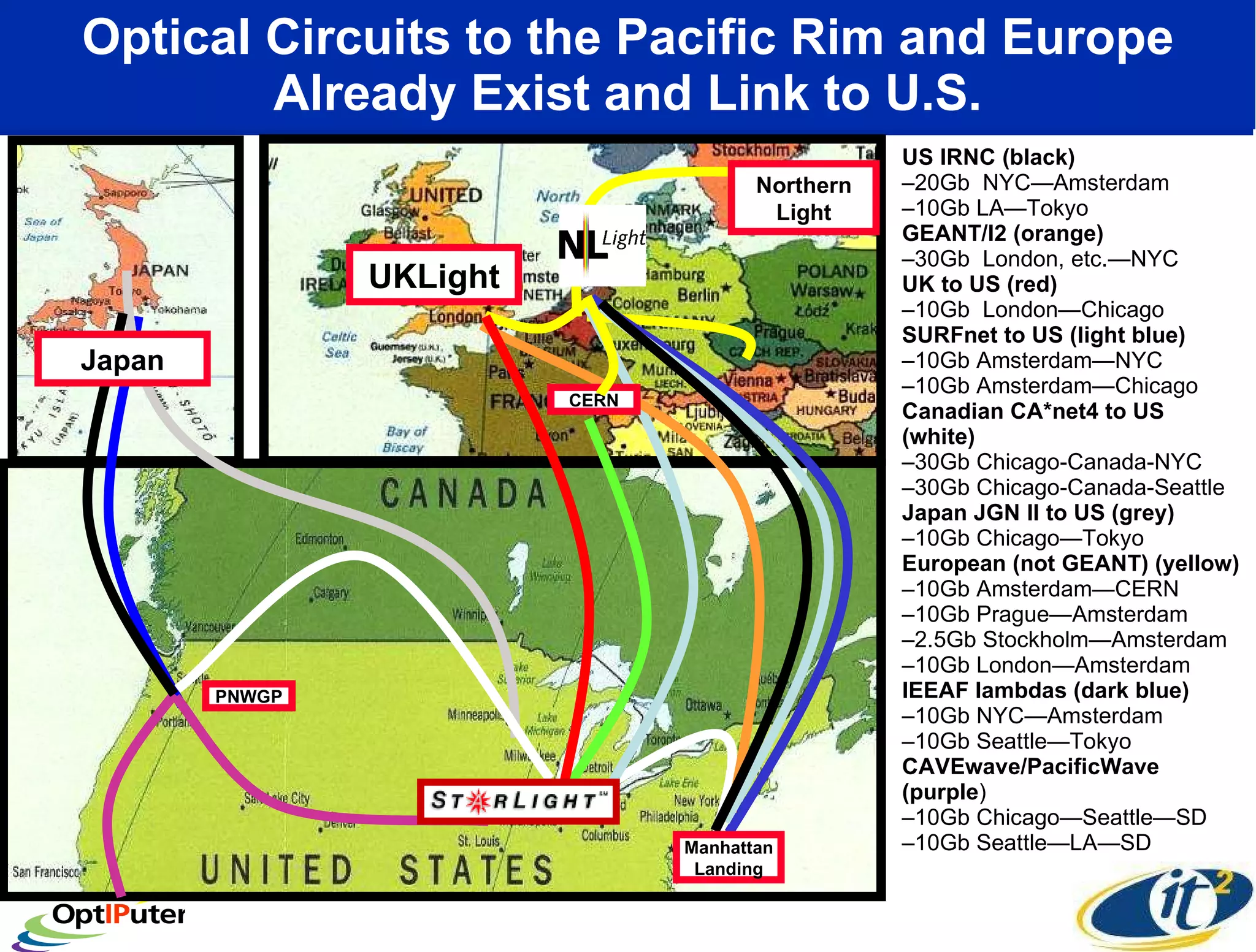
Optical Circuits to the Pacific Rim and Europe Already Exist and Link to U.S. US IRNC (black) – 20Gb  NYC—Amsterdam – 10Gb LA—Tokyo GEANT/I2 (orange)  – 30Gb  London, etc.—NYC UK to US (red) – 10Gb  London—Chicago SURFnet to US (light blue) – 10Gb Amsterdam—NYC – 10Gb Amsterdam—Chicago Canadian CA*net4 to US (white) – 30Gb Chicago-Canada-NYC – 30Gb Chicago-Canada-Seattle Japan JGN II to US (grey) – 10Gb Chicago—Tokyo European (not GEANT) (yellow) – 10Gb Amsterdam—CERN  – 10Gb Prague—Amsterdam – 2.5Gb Stockholm—Amsterdam – 10Gb London—Amsterdam IEEAF lambdas (dark blue) – 10Gb NYC—Amsterdam – 10Gb Seattle—Tokyo  CAVEwave/PacificWave (purple ) – 10Gb Chicago—Seattle—SD – 10Gb Seattle—LA—SD Northern Light UKLight PNWGP Japan Manhattan Landing CERN
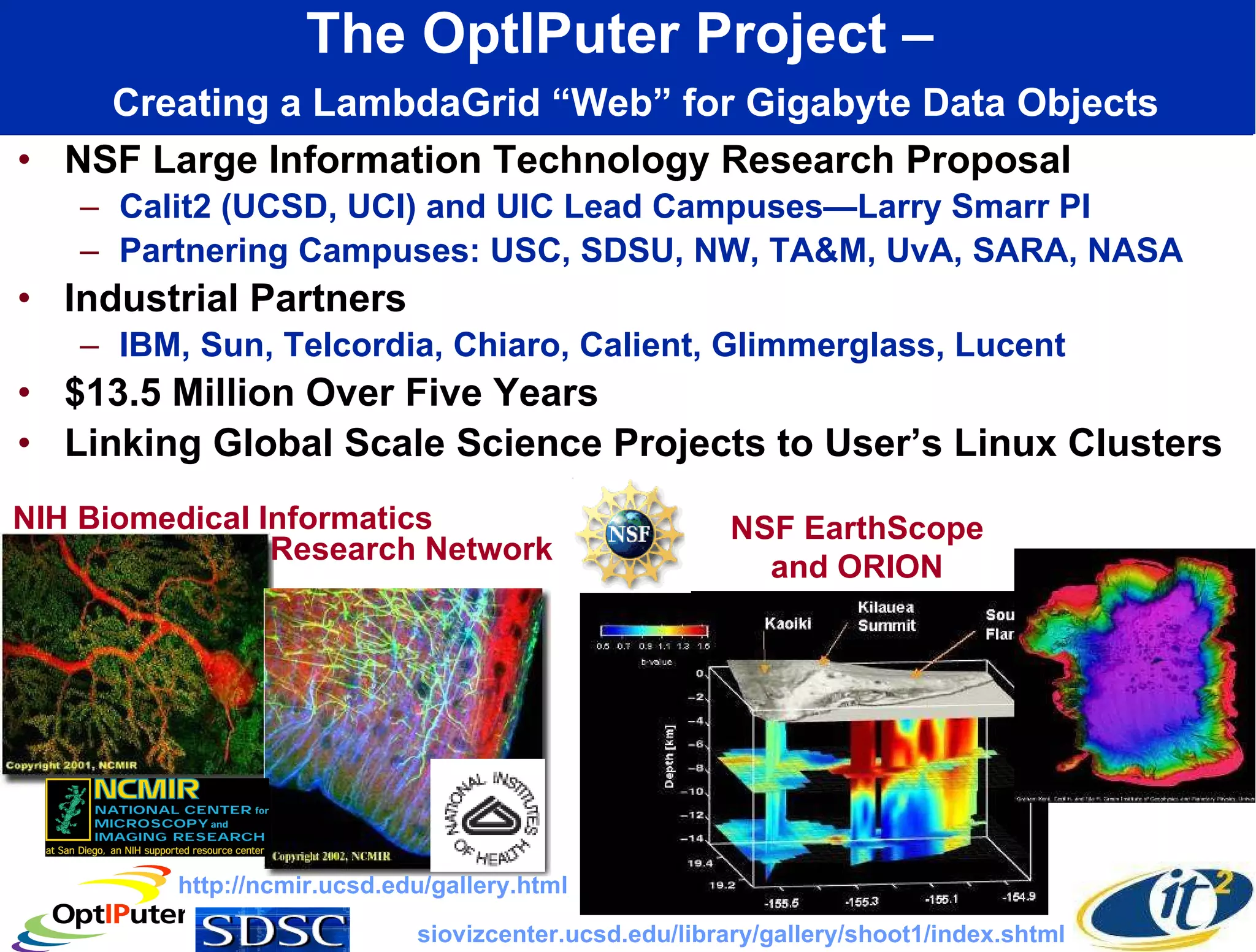
The OptIPuter Project –    Creating a LambdaGrid “Web” for Gigabyte Data Objects NSF Large Information Technology Research Proposal Calit2 (UCSD, UCI) and UIC Lead Campuses—Larry Smarr PI Partnering Campuses: USC, SDSU, NW, TA&M, UvA, SARA, NASA Industrial Partners IBM, Sun, Telcordia, Chiaro, Calient, Glimmerglass, Lucent $13.5 Million Over Five Years Linking Global Scale Science Projects to User’s Linux Clusters NIH Biomedical Informatics NSF EarthScope and ORION http://ncmir.ucsd.edu/gallery.html siovizcenter.ucsd.edu/library/gallery/shoot1/index.shtml Research Network
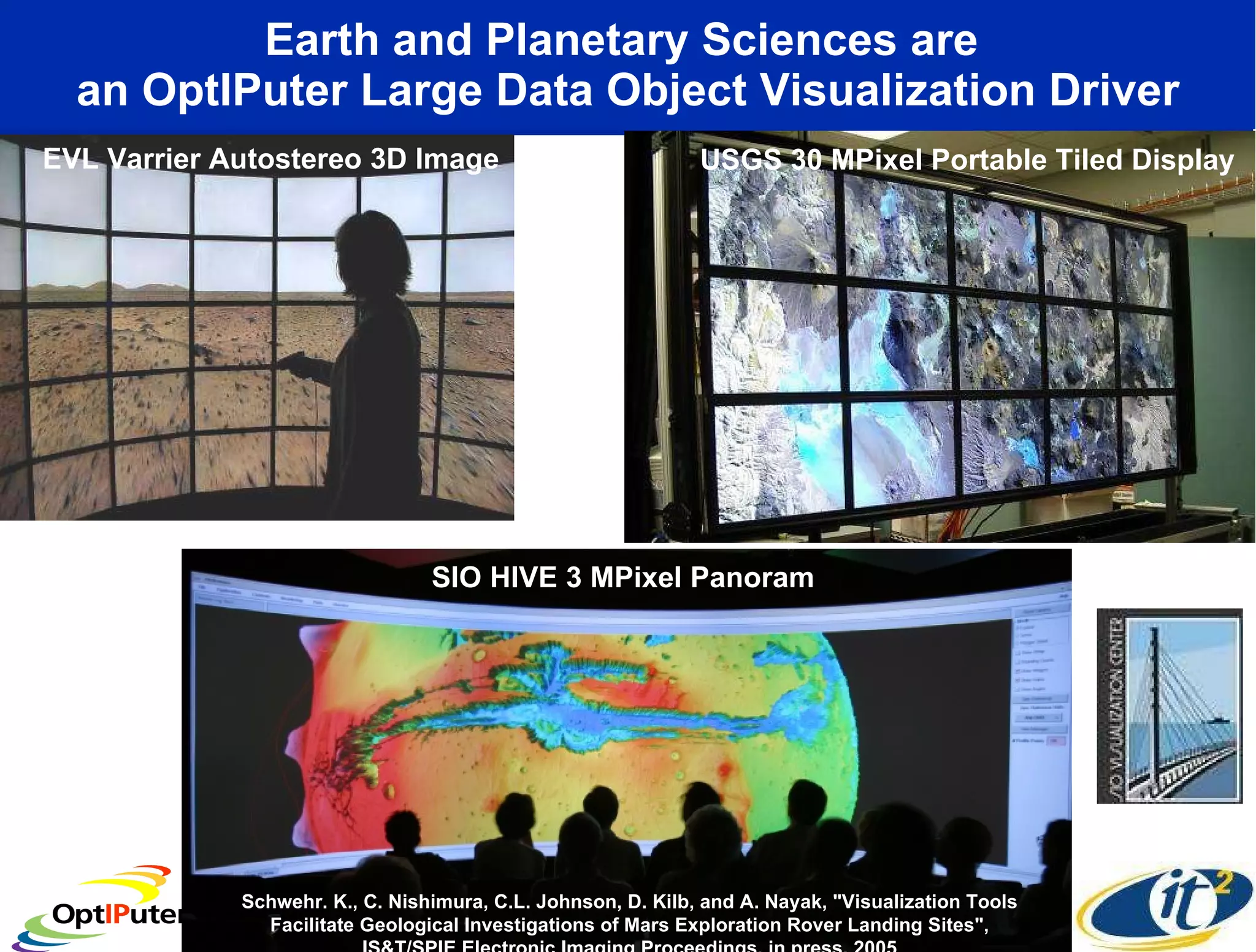
Earth and Planetary Sciences are  an OptIPuter Large Data Object Visualization Driver EVL Varrier Autostereo 3D Image  USGS 30 MPixel Portable Tiled Display  SIO HIVE 3 MPixel Panoram  Schwehr. K., C. Nishimura, C.L. Johnson, D. Kilb, and A. Nayak, &quot;Visualization Tools Facilitate Geological Investigations of Mars Exploration Rover Landing Sites&quot;, IS&T/SPIE Electronic Imaging Proceedings, in press, 2005
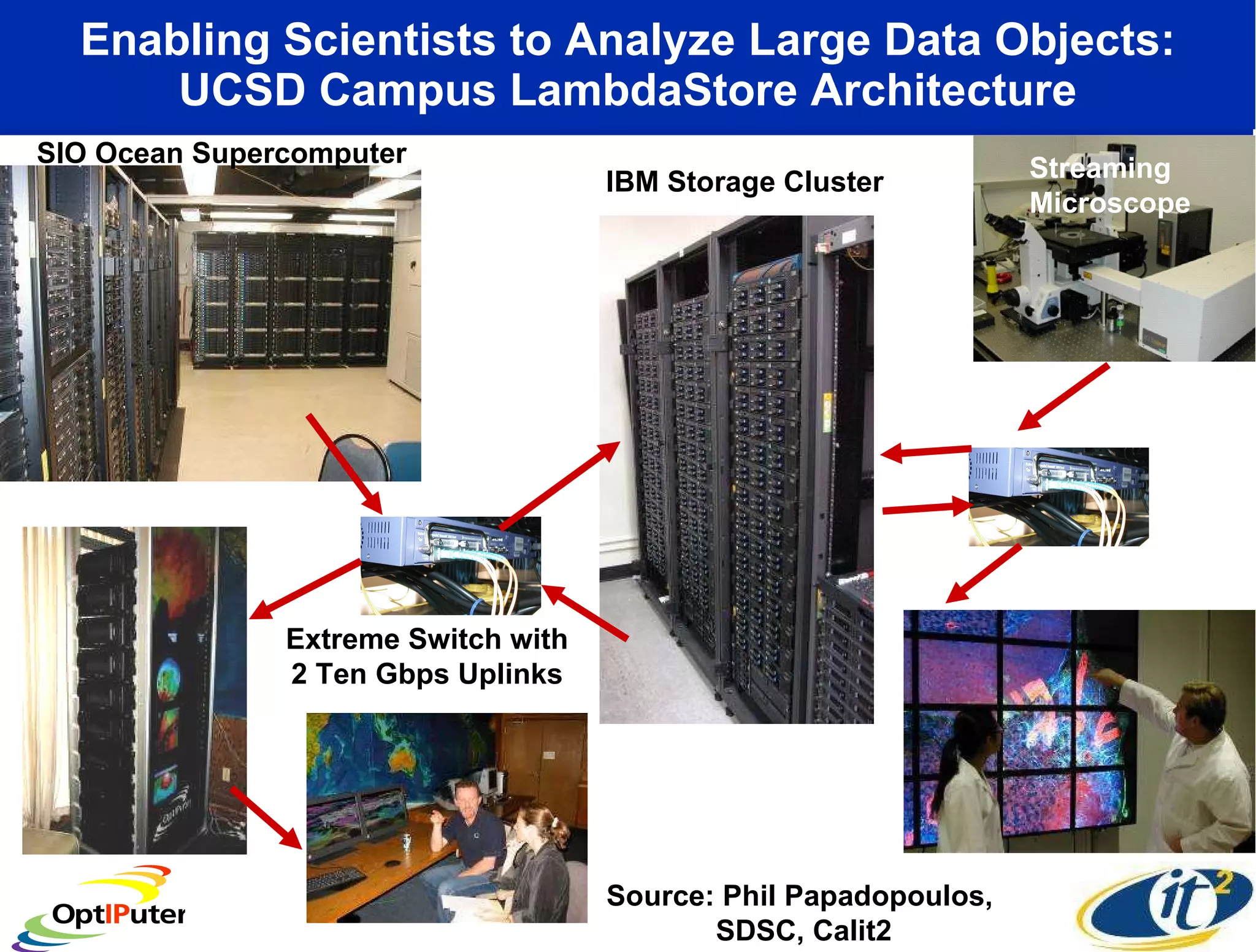
Enabling Scientists to Analyze Large Data Objects: UCSD Campus LambdaStore Architecture SIO Ocean Supercomputer IBM Storage Cluster Extreme Switch with 2 Ten Gbps Uplinks Streaming Microscope Source: Phil Papadopoulos,  SDSC, Calit2
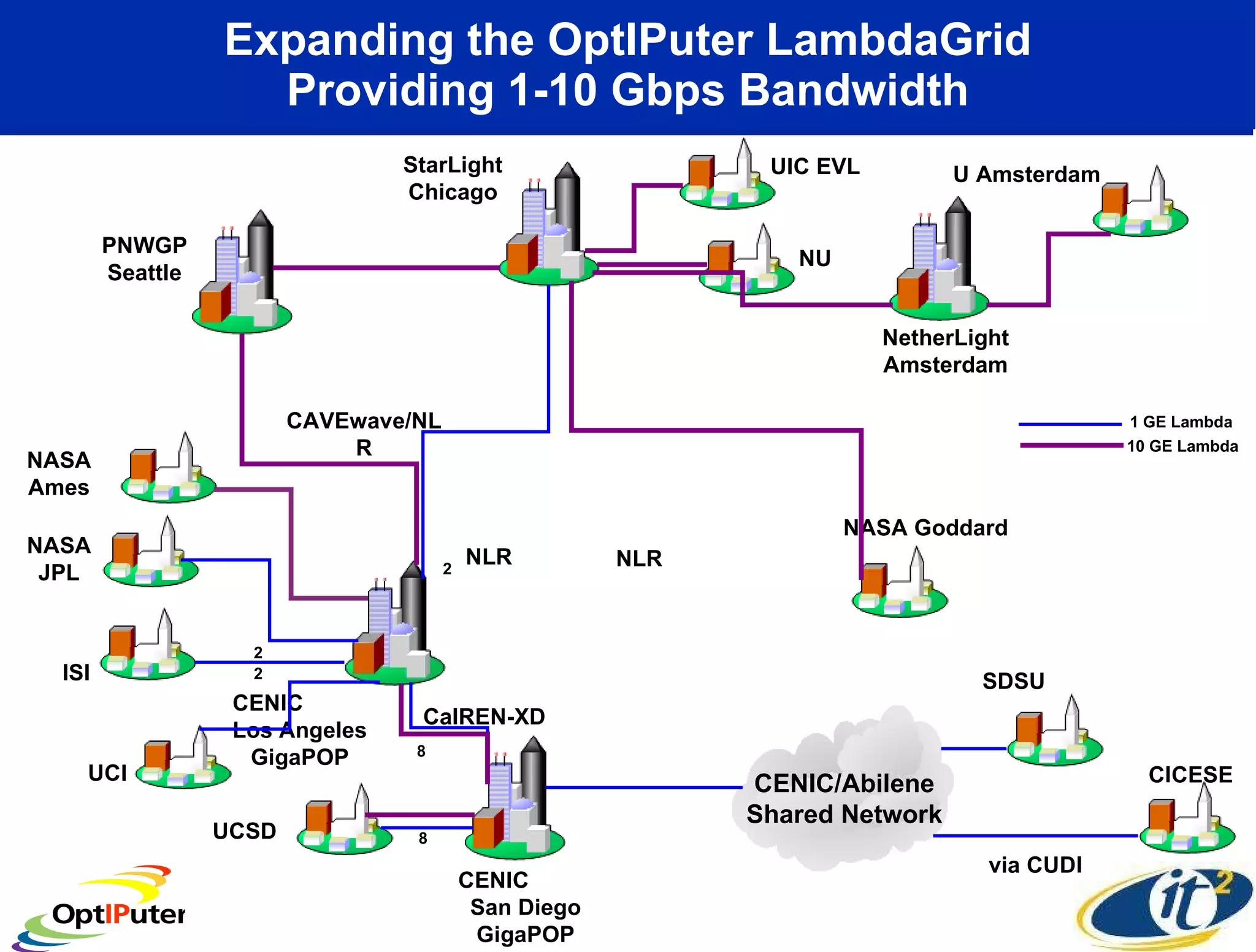
Expanding the OptIPuter LambdaGrid Providing 1-10 Gbps Bandwidth 1 GE Lambda 10 GE Lambda UCSD StarLight Chicago UIC EVL NU CENIC  San Diego GigaPOP CalREN-XD 8 8 NetherLight Amsterdam U Amsterdam NASA Ames NASA Goddard NLR NLR 2 SDSU CICESE via CUDI CENIC/Abilene Shared Network PNWGP Seattle CAVEwave/NLR NASA JPL ISI   UCI CENIC  Los Angeles GigaPOP 2 2
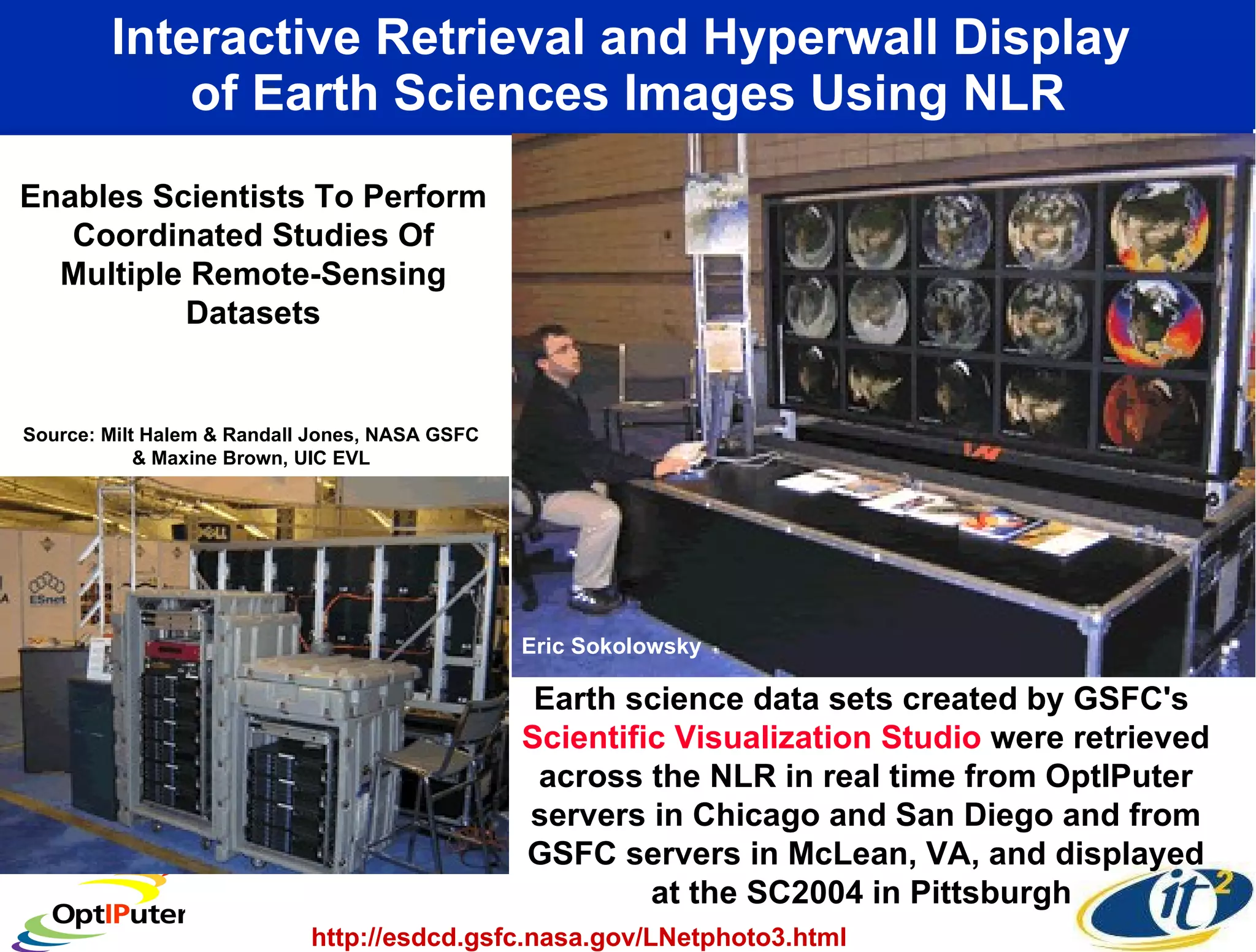
Interactive Retrieval and Hyperwall Display  of Earth Sciences Images Using NLR Earth science data sets created by GSFC's  Scientific Visualization Studio  were retrieved across the NLR in real time from OptIPuter servers in Chicago and San Diego and from GSFC servers in McLean, VA, and displayed at the SC2004 in Pittsburgh  Enables Scientists To Perform Coordinated Studies Of Multiple Remote-Sensing Datasets http://esdcd.gsfc.nasa.gov/LNetphoto3.html Source: Milt Halem & Randall Jones, NASA GSFC & Maxine Brown, UIC EVL Eric Sokolowsky
Calit2 is Partnering with the New SIO Center for Earth Observations and Applications Viewing and Analyzing Earth Satellite Data Sets High Accuracy Topographic Measurements Project Atmospheric Brown Clouds Climate Modeling  Coastal Zone Data Assimilation Ocean Observatories
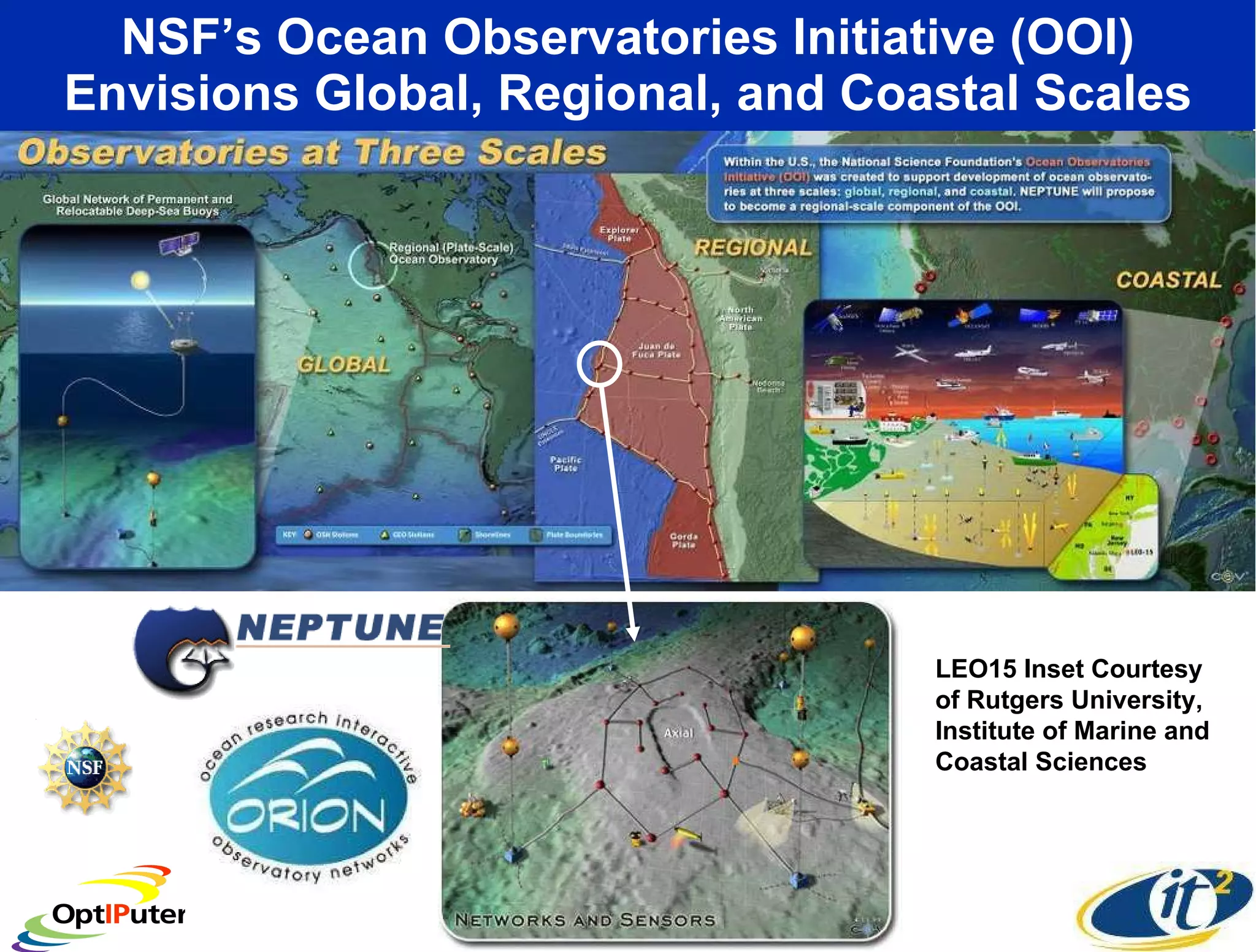
NSF’s Ocean Observatories Initiative (OOI) Envisions Global, Regional, and Coastal Scales LEO15 Inset Courtesy of Rutgers University, Institute of Marine and Coastal Sciences
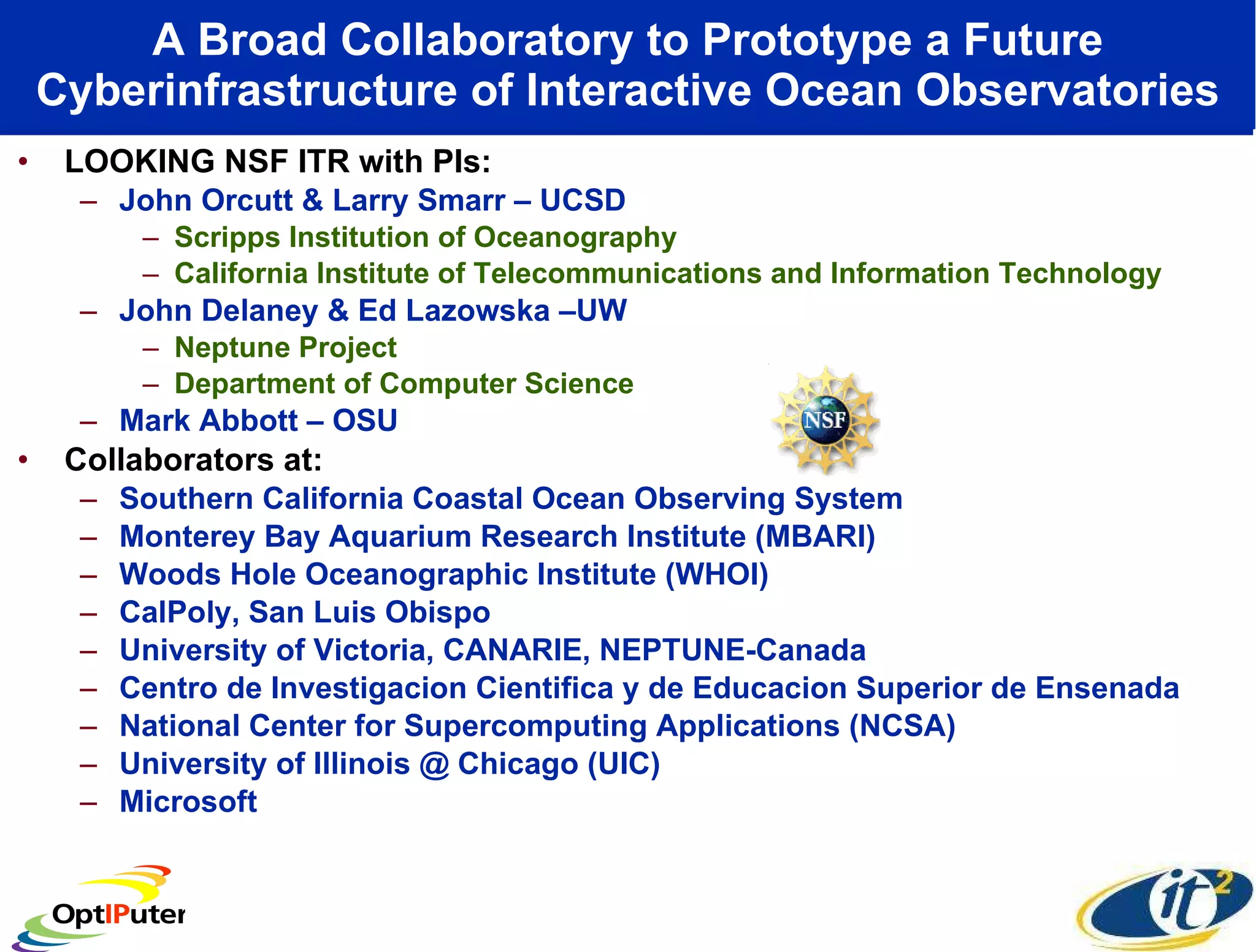
A Broad Collaboratory to Prototype a Future Cyberinfrastructure of Interactive Ocean Observatories LOOKING NSF ITR with PIs: John Orcutt & Larry Smarr – UCSD Scripps Institution of Oceanography California Institute of Telecommunications and Information Technology John Delaney & Ed Lazowska –UW Neptune Project Department of Computer Science Mark Abbott – OSU Collaborators at: Southern California Coastal Ocean Observing System Monterey Bay Aquarium Research Institute (MBARI)  Woods Hole Oceanographic Institute (WHOI)  CalPoly, San Luis Obispo University of Victoria, CANARIE, NEPTUNE-Canada  Centro de Investigacion Cientifica y de Educacion Superior de Ensenada National Center for Supercomputing Applications (NCSA) University of Illinois @ Chicago (UIC) Microsoft
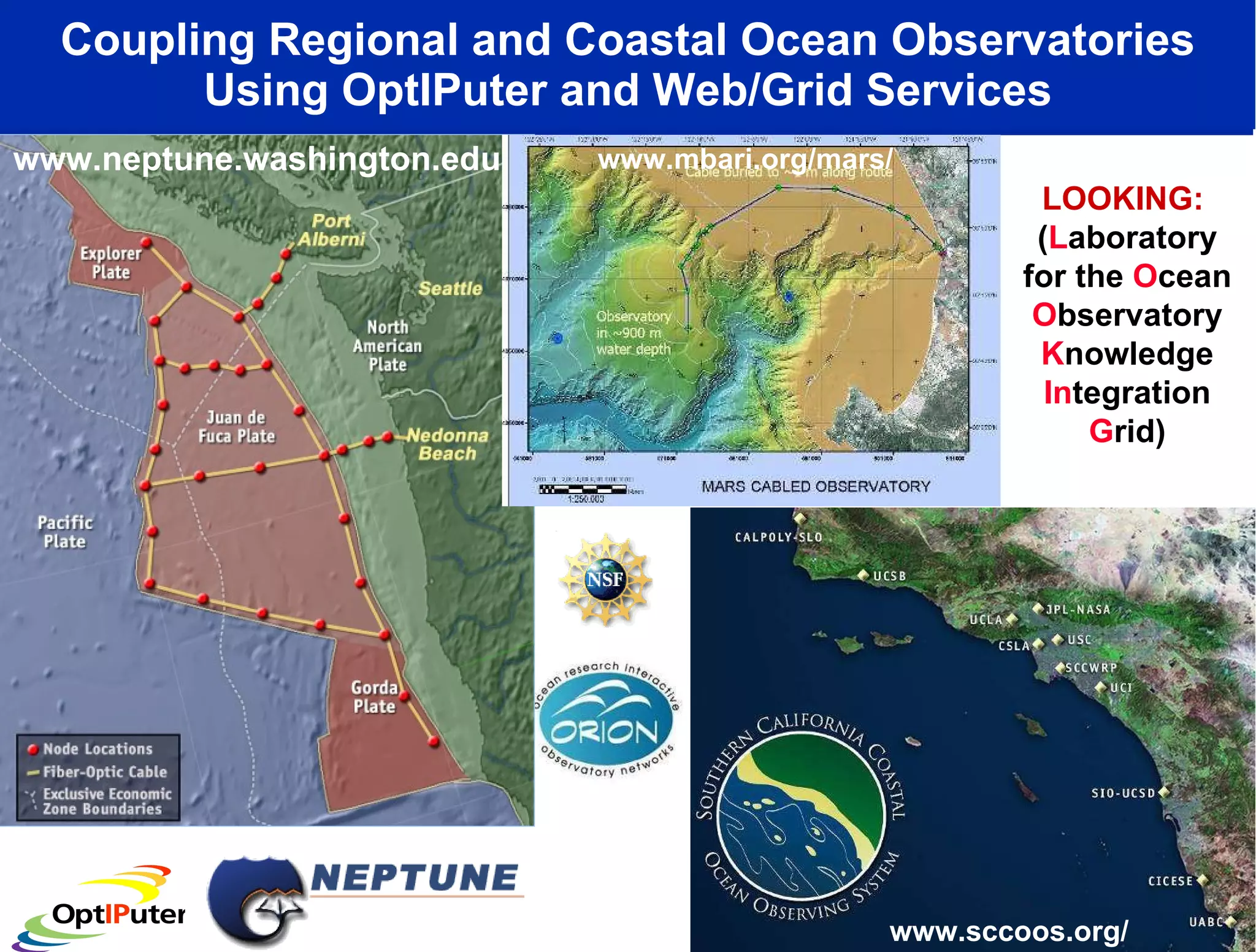
Coupling Regional and Coastal Ocean Observatories Using OptIPuter and Web/Grid Services LOOKING:  ( L aboratory for the  O cean  O bservatory  K nowledge  In tegration  G rid) www.neptune.washington.edu www.mbari.org/mars/ www.sccoos.org/
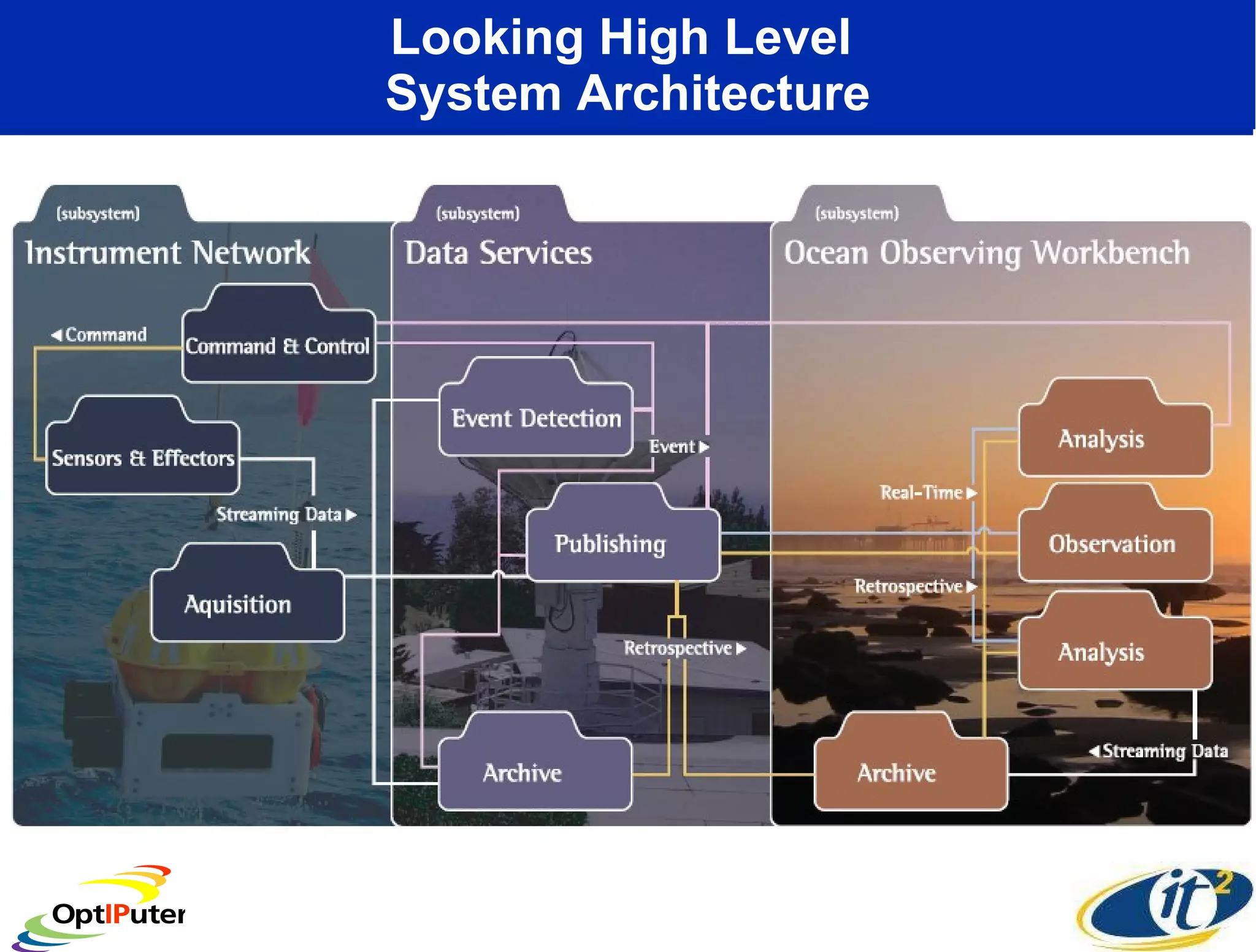
Looking High Level  System Architecture
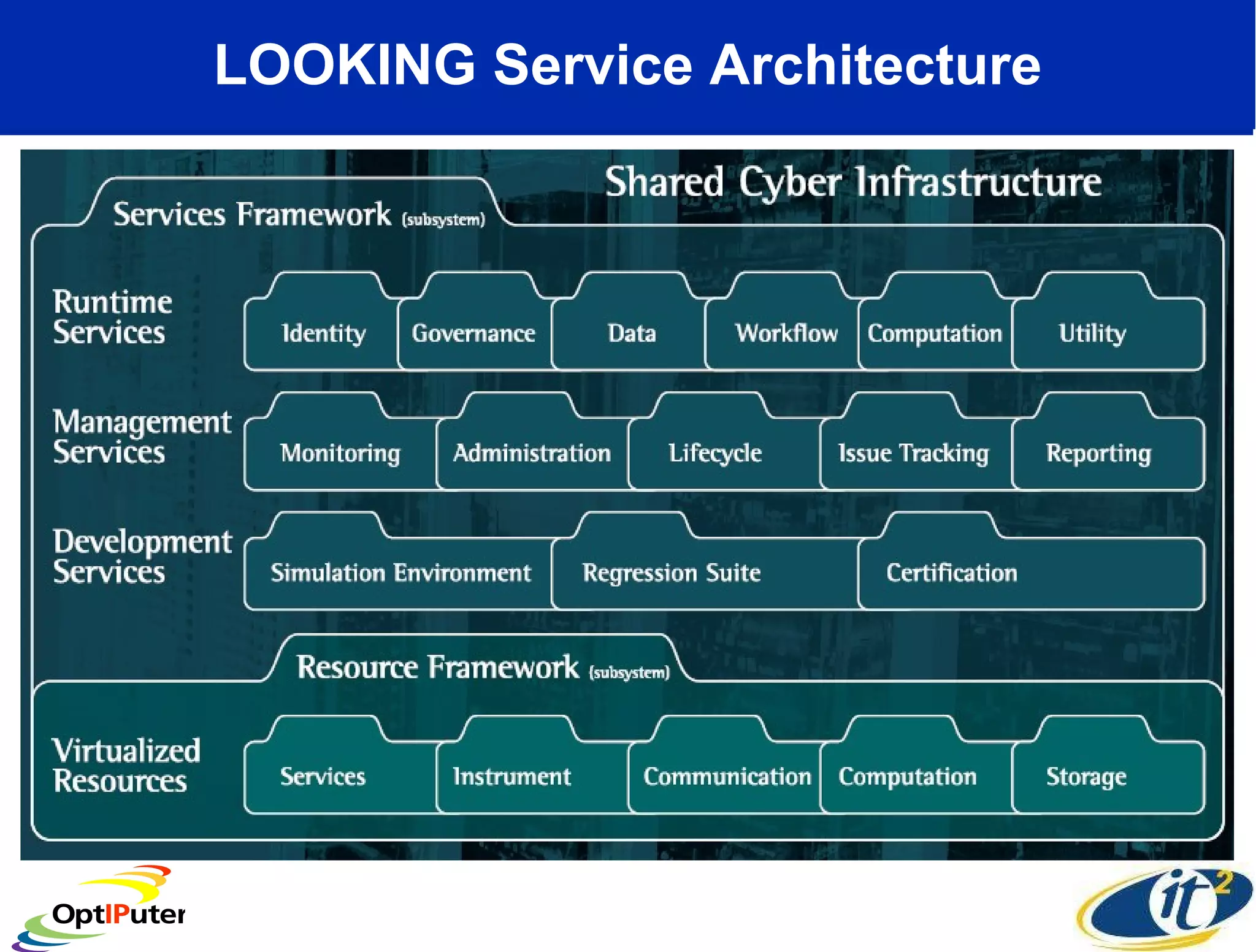
LOOKING Service Architecture
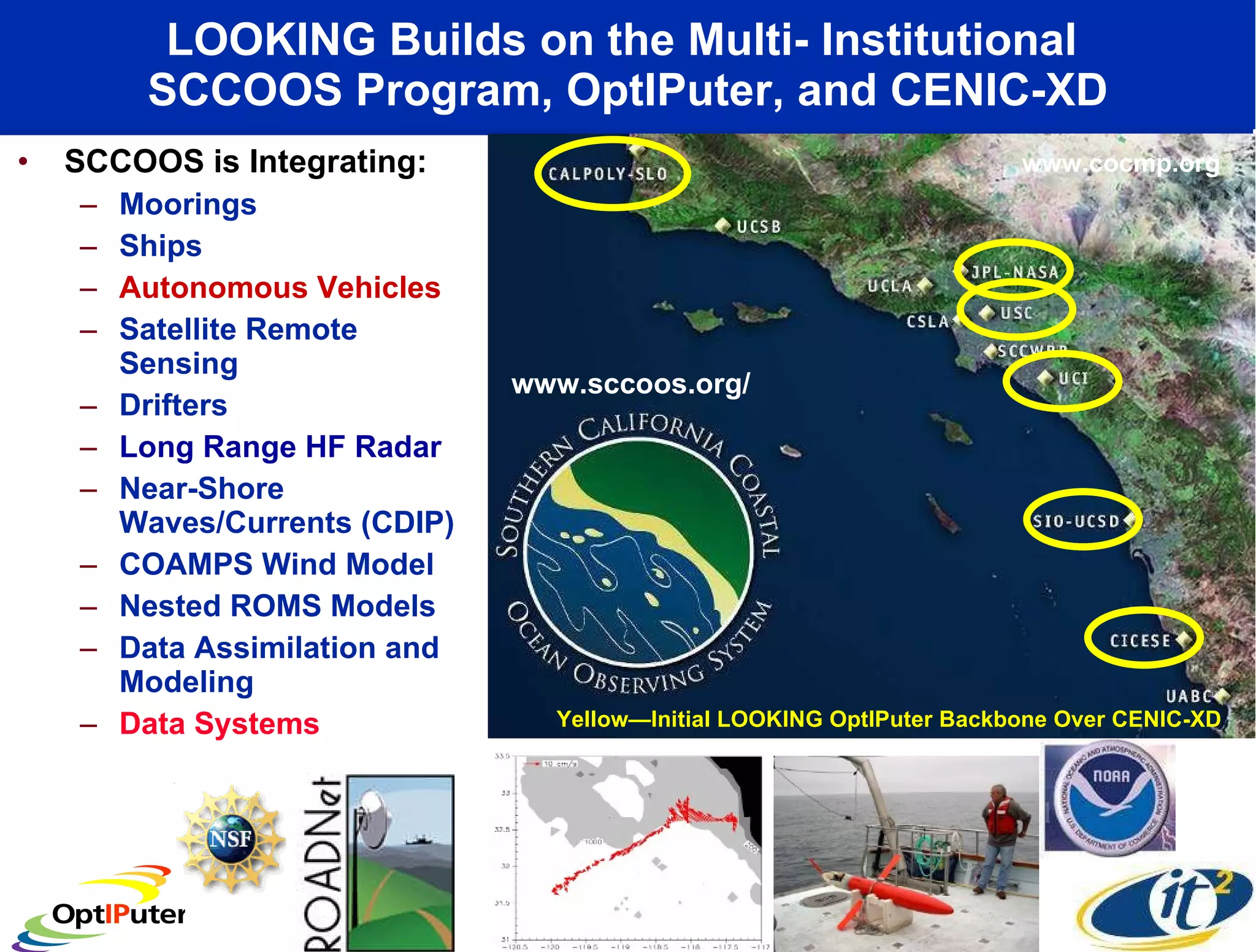
LOOKING Builds on the Multi- Institutional  SCCOOS Program, OptIPuter, and CENIC-XD SCCOOS is Integrating: Moorings Ships Autonomous Vehicles  Satellite Remote Sensing Drifters Long Range HF Radar   Near-Shore Waves/Currents (CDIP) COAMPS Wind Model Nested ROMS Models Data Assimilation and Modeling Data Systems Pilot Project Components www.sccoos.org/ www.cocmp.org Yellow—Initial LOOKING OptIPuter Backbone Over CENIC-XD
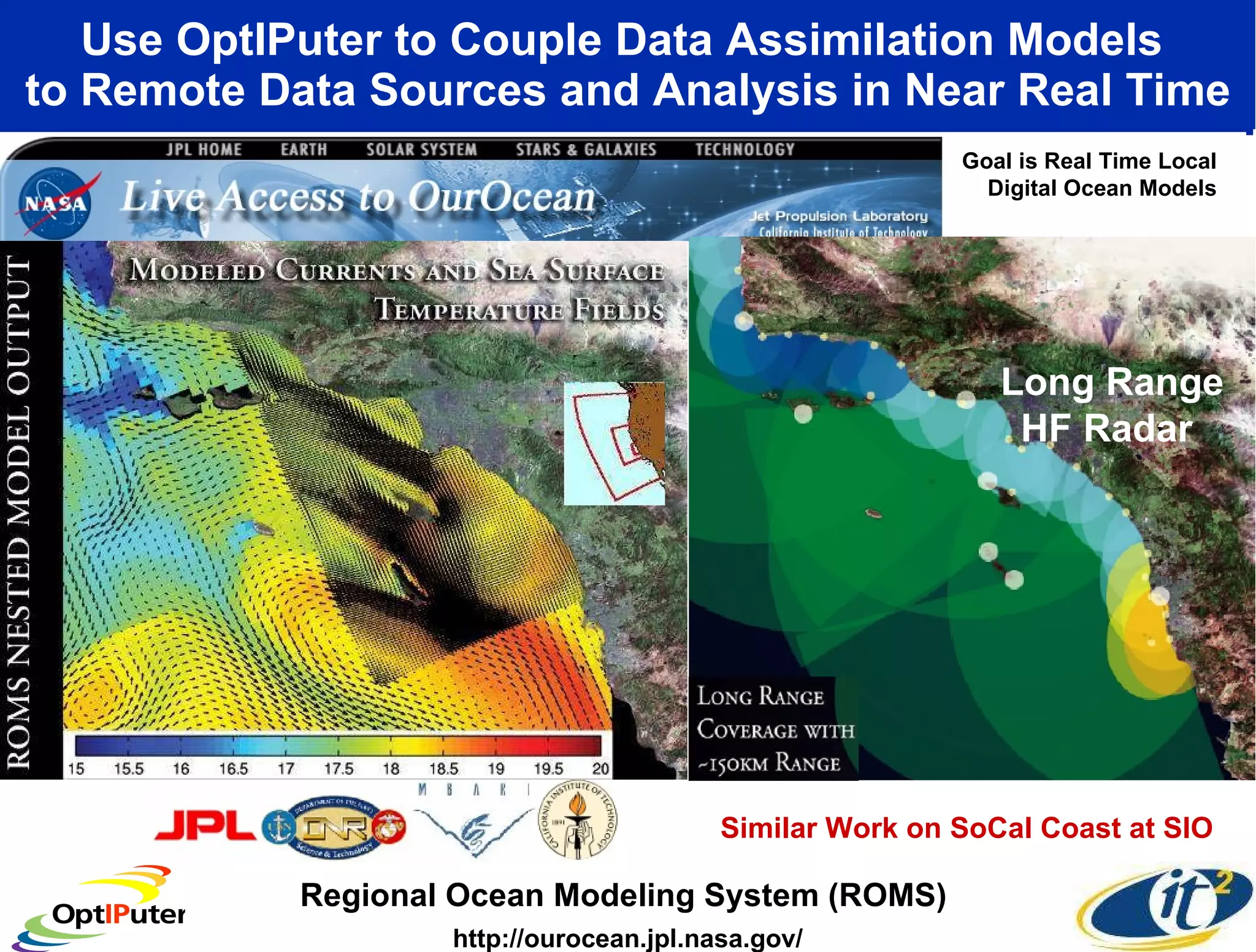
Use OptIPuter to Couple Data Assimilation Models  to Remote Data Sources and Analysis in Near Real Time Regional Ocean Modeling System (ROMS)  http://ourocean.jpl.nasa.gov/ Goal is Real Time Local Digital Ocean Models Long Range HF Radar  Similar Work on SoCal Coast at SIO
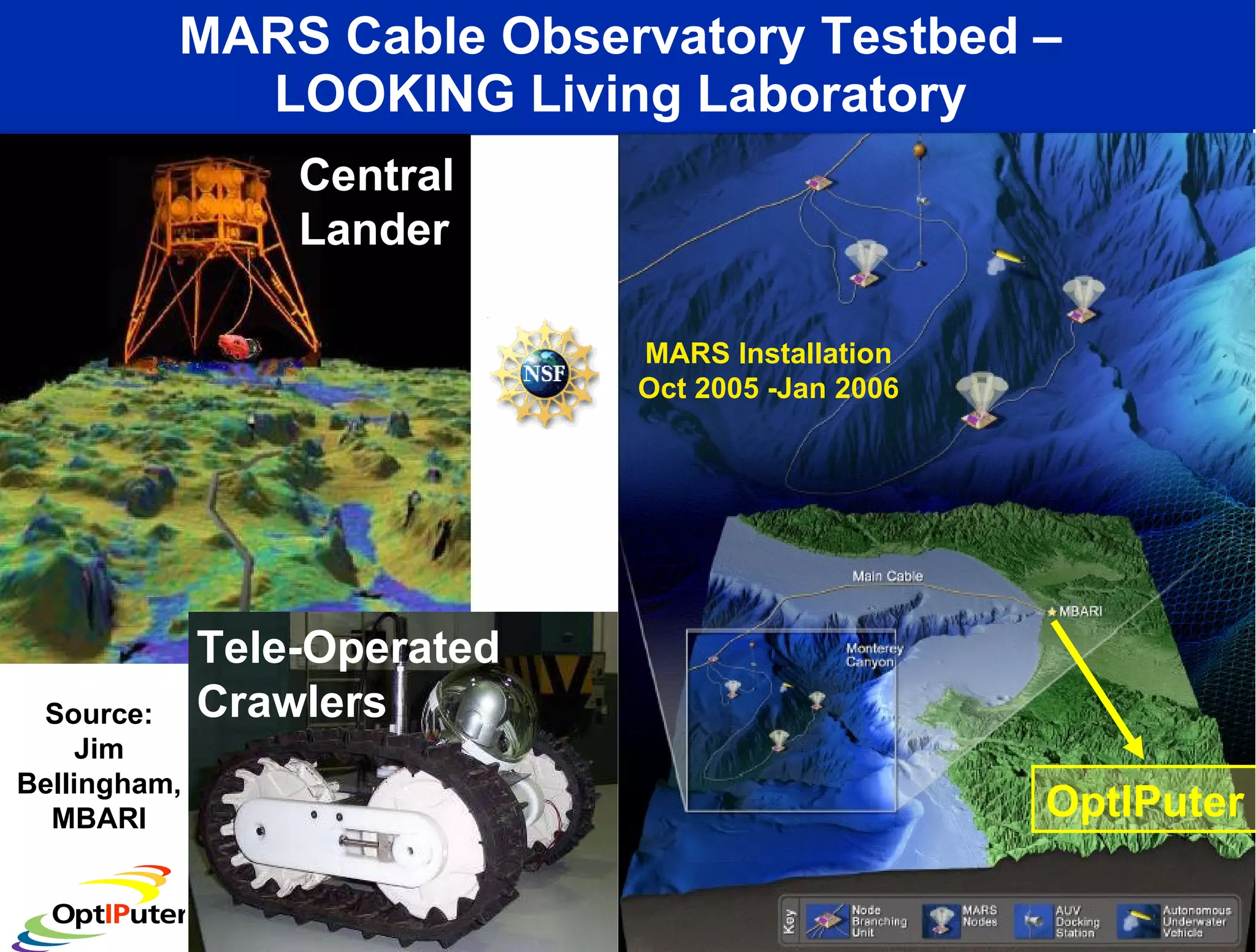
MARS Cable Observatory Testbed –  LOOKING Living Laboratory  Tele-Operated Crawlers Central Lander MARS Installation Oct 2005 -Jan 2006 Source: Jim Bellingham, MBARI OptIPuter
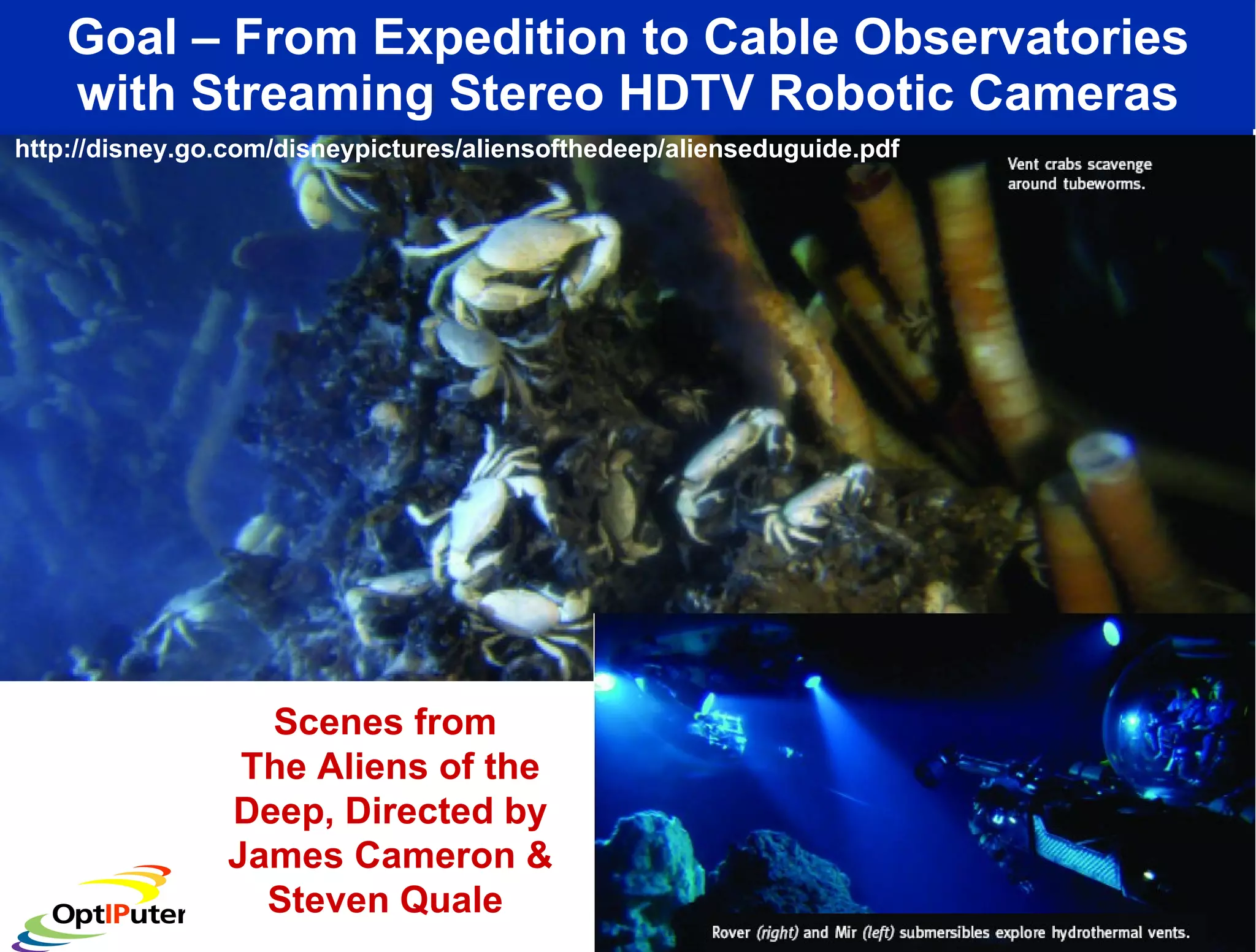
Goal – From Expedition to Cable Observatories with Streaming Stereo HDTV Robotic Cameras Scenes from  The Aliens of the Deep, Directed by James Cameron & Steven Quale  http://disney.go.com/disneypictures/aliensofthedeep/alienseduguide.pdf
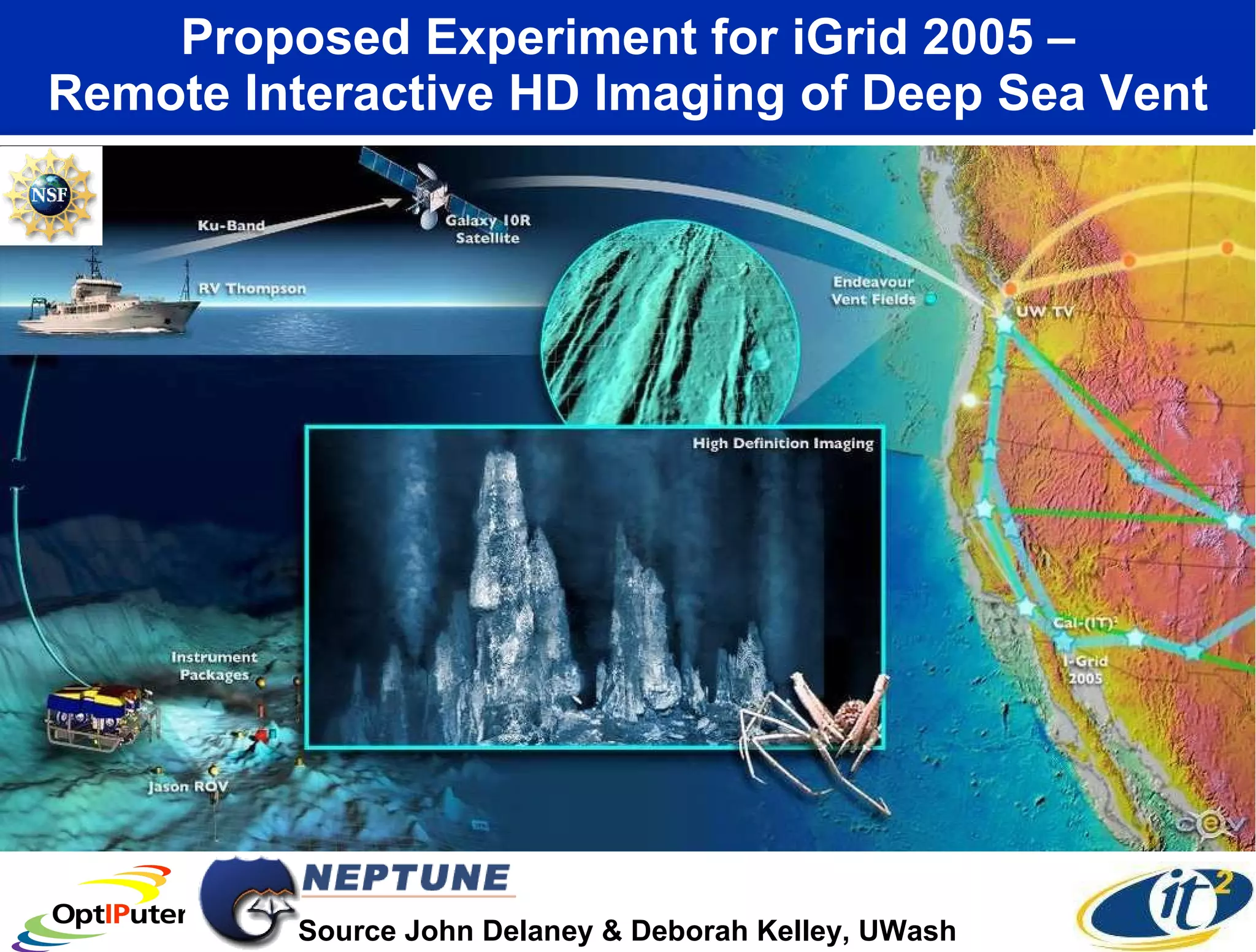
Proposed Experiment for iGrid 2005 – Remote Interactive HD Imaging of Deep Sea Vent Source John Delaney & Deborah Kelley, UWash

Cyberinfrastructure to Support Ocean Observatories

  • 1.
    “ Cyberinfrastructure toSupport Ocean Observatories&quot; Invited Talk to the Oceans Studies Board National Research Council UCSD, La Jolla, CA March 18, 2005 Dr. Larry Smarr Director, California Institute for Telecommunications and Information Technology Harry E. Gruber Professor, Dept. of Computer Science and Engineering Jacobs School of Engineering, UCSD Chair, NASA Earth System Science and Applications Advisory Committee
  • 2.
    EOSDIS Archive HoldingsAre Adding Several TBs/Day to Federated Data Repositories Source: Glenn Iona, EOSDIS Element Evolution Technical Working Group January 6-7, 2005
  • 3.
    Challenge: Average Throughputof NASA Data Products to End User is Only < 50 Megabits/s Tested from GSFC-ICESAT January 2005 http://ensight.eos.nasa.gov/Missions/icesat/index.shtml Forces a Non-Interactive Data Architecture
  • 4.
    Cyberinfrastructure Breakthrough—NLR ProvidesDedicated Optical Paths Between User and Data First Light September 2004 “ National LambdaRail” Partnership Serves Very High-End Experimental and Research Applications 4 x 10Gb Wavelengths Initially Capable of 40 x 10Gb wavelengths at Buildout Links Two Dozen State and Regional Optical Networks DOE and NASA Using NLR
  • 5.
    Optical Circuits tothe Pacific Rim and Europe Already Exist and Link to U.S. US IRNC (black) – 20Gb NYC—Amsterdam – 10Gb LA—Tokyo GEANT/I2 (orange) – 30Gb London, etc.—NYC UK to US (red) – 10Gb London—Chicago SURFnet to US (light blue) – 10Gb Amsterdam—NYC – 10Gb Amsterdam—Chicago Canadian CA*net4 to US (white) – 30Gb Chicago-Canada-NYC – 30Gb Chicago-Canada-Seattle Japan JGN II to US (grey) – 10Gb Chicago—Tokyo European (not GEANT) (yellow) – 10Gb Amsterdam—CERN – 10Gb Prague—Amsterdam – 2.5Gb Stockholm—Amsterdam – 10Gb London—Amsterdam IEEAF lambdas (dark blue) – 10Gb NYC—Amsterdam – 10Gb Seattle—Tokyo CAVEwave/PacificWave (purple ) – 10Gb Chicago—Seattle—SD – 10Gb Seattle—LA—SD Northern Light UKLight PNWGP Japan Manhattan Landing CERN
  • 6.
    The OptIPuter Project– Creating a LambdaGrid “Web” for Gigabyte Data Objects NSF Large Information Technology Research Proposal Calit2 (UCSD, UCI) and UIC Lead Campuses—Larry Smarr PI Partnering Campuses: USC, SDSU, NW, TA&M, UvA, SARA, NASA Industrial Partners IBM, Sun, Telcordia, Chiaro, Calient, Glimmerglass, Lucent $13.5 Million Over Five Years Linking Global Scale Science Projects to User’s Linux Clusters NIH Biomedical Informatics NSF EarthScope and ORION http://ncmir.ucsd.edu/gallery.html siovizcenter.ucsd.edu/library/gallery/shoot1/index.shtml Research Network
  • 7.
    Earth and PlanetarySciences are an OptIPuter Large Data Object Visualization Driver EVL Varrier Autostereo 3D Image USGS 30 MPixel Portable Tiled Display SIO HIVE 3 MPixel Panoram Schwehr. K., C. Nishimura, C.L. Johnson, D. Kilb, and A. Nayak, &quot;Visualization Tools Facilitate Geological Investigations of Mars Exploration Rover Landing Sites&quot;, IS&T/SPIE Electronic Imaging Proceedings, in press, 2005
  • 8.
    Enabling Scientists toAnalyze Large Data Objects: UCSD Campus LambdaStore Architecture SIO Ocean Supercomputer IBM Storage Cluster Extreme Switch with 2 Ten Gbps Uplinks Streaming Microscope Source: Phil Papadopoulos, SDSC, Calit2
  • 9.
    Expanding the OptIPuterLambdaGrid Providing 1-10 Gbps Bandwidth 1 GE Lambda 10 GE Lambda UCSD StarLight Chicago UIC EVL NU CENIC San Diego GigaPOP CalREN-XD 8 8 NetherLight Amsterdam U Amsterdam NASA Ames NASA Goddard NLR NLR 2 SDSU CICESE via CUDI CENIC/Abilene Shared Network PNWGP Seattle CAVEwave/NLR NASA JPL ISI UCI CENIC Los Angeles GigaPOP 2 2
  • 10.
    Interactive Retrieval andHyperwall Display of Earth Sciences Images Using NLR Earth science data sets created by GSFC's Scientific Visualization Studio were retrieved across the NLR in real time from OptIPuter servers in Chicago and San Diego and from GSFC servers in McLean, VA, and displayed at the SC2004 in Pittsburgh Enables Scientists To Perform Coordinated Studies Of Multiple Remote-Sensing Datasets http://esdcd.gsfc.nasa.gov/LNetphoto3.html Source: Milt Halem & Randall Jones, NASA GSFC & Maxine Brown, UIC EVL Eric Sokolowsky
  • 11.
    Calit2 is Partneringwith the New SIO Center for Earth Observations and Applications Viewing and Analyzing Earth Satellite Data Sets High Accuracy Topographic Measurements Project Atmospheric Brown Clouds Climate Modeling Coastal Zone Data Assimilation Ocean Observatories
  • 12.
    NSF’s Ocean ObservatoriesInitiative (OOI) Envisions Global, Regional, and Coastal Scales LEO15 Inset Courtesy of Rutgers University, Institute of Marine and Coastal Sciences
  • 13.
    A Broad Collaboratoryto Prototype a Future Cyberinfrastructure of Interactive Ocean Observatories LOOKING NSF ITR with PIs: John Orcutt & Larry Smarr – UCSD Scripps Institution of Oceanography California Institute of Telecommunications and Information Technology John Delaney & Ed Lazowska –UW Neptune Project Department of Computer Science Mark Abbott – OSU Collaborators at: Southern California Coastal Ocean Observing System Monterey Bay Aquarium Research Institute (MBARI) Woods Hole Oceanographic Institute (WHOI) CalPoly, San Luis Obispo University of Victoria, CANARIE, NEPTUNE-Canada Centro de Investigacion Cientifica y de Educacion Superior de Ensenada National Center for Supercomputing Applications (NCSA) University of Illinois @ Chicago (UIC) Microsoft
  • 14.
    Coupling Regional andCoastal Ocean Observatories Using OptIPuter and Web/Grid Services LOOKING: ( L aboratory for the O cean O bservatory K nowledge In tegration G rid) www.neptune.washington.edu www.mbari.org/mars/ www.sccoos.org/
  • 15.
    Looking High Level System Architecture
  • 16.
  • 17.
    LOOKING Builds onthe Multi- Institutional SCCOOS Program, OptIPuter, and CENIC-XD SCCOOS is Integrating: Moorings Ships Autonomous Vehicles Satellite Remote Sensing Drifters Long Range HF Radar Near-Shore Waves/Currents (CDIP) COAMPS Wind Model Nested ROMS Models Data Assimilation and Modeling Data Systems Pilot Project Components www.sccoos.org/ www.cocmp.org Yellow—Initial LOOKING OptIPuter Backbone Over CENIC-XD
  • 18.
    Use OptIPuter toCouple Data Assimilation Models to Remote Data Sources and Analysis in Near Real Time Regional Ocean Modeling System (ROMS) http://ourocean.jpl.nasa.gov/ Goal is Real Time Local Digital Ocean Models Long Range HF Radar Similar Work on SoCal Coast at SIO
  • 19.
    MARS Cable ObservatoryTestbed – LOOKING Living Laboratory Tele-Operated Crawlers Central Lander MARS Installation Oct 2005 -Jan 2006 Source: Jim Bellingham, MBARI OptIPuter
  • 20.
    Goal – FromExpedition to Cable Observatories with Streaming Stereo HDTV Robotic Cameras Scenes from The Aliens of the Deep, Directed by James Cameron & Steven Quale http://disney.go.com/disneypictures/aliensofthedeep/alienseduguide.pdf
  • 21.
    Proposed Experiment foriGrid 2005 – Remote Interactive HD Imaging of Deep Sea Vent Source John Delaney & Deborah Kelley, UWash