“Toward a National Research Platform
to Enable Data-Intensive Computing”
Virtual Data Science Seminar
Institute for Data Science
New Jersey Institute of Technology
October 27, 2021
1
Dr. Larry Smarr
Founding Director Emeritus, California Institute for Telecommunications and Information Technology;
Distinguished Professor Emeritus, Dept. of Computer Science and Engineering
Jacobs School of Engineering, UCSD
http://lsmarr.calit2.net
Abstract
Three current NSF grants [the Pacific Research Platform (PRP), the Cognitive Hardware and
Software Ecosystem Community Infrastructure (CHASE-CI), and Toward a National Research
Platform (TNRP)] create a regional, national, to global-scale cyberinfrastructure, optimized for
machine learning research and data analysis of large scientific datasets. This integrated
system, which is federated with the Open Science Grid and multiple supercomputer centers,
uses 10 to 100Gbps optical fiber networks to interconnect, across 30 campuses, nearly 200
Science DMZ Data Transfer Nodes (DTNs). The DTNs are rack-mounted PCs optimized for
high-speed data transfers, containing multicore-CPUs, two to eight GPUs, and up to 256TB of
disk each. Users’ containerized software applications are orchestrated across the highly
instrumented PRP by open-source Kubernetes, enabling easy access to commercial clouds
as needed. I will describe several of the most active of PRP’s 400 user namespaces, which
support a wide range of data-intensive disciplines.
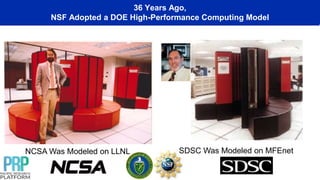
36 Years Ago,
NSF Adopted a DOE High-Performance Computing Model
NCSA Was Modeled on LLNL SDSC Was Modeled on MFEnet
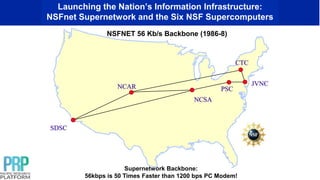
Launching the Nation’s Information Infrastructure:
NSFnet Supernetwork and the Six NSF Supercomputers
NCSA
NSFNET 56 Kb/s Backbone (1986-8)
PSC
NCAR
CTC
JVNC
SDSC
Supernetwork Backbone:
56kbps is 50 Times Faster than 1200 bps PC Modem!
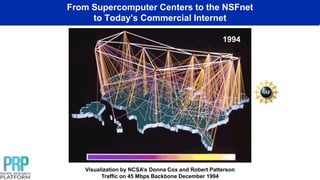
From Supercomputer Centers to the NSFnet
to Today’s Commercial Internet
Visualization by NCSA’s Donna Cox and Robert Patterson
Traffic on 45 Mbps Backbone December 1994
1994
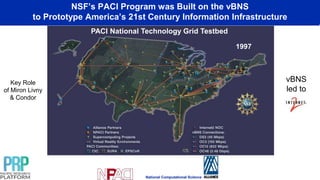
NSF’s PACI Program was Built on the vBNS
to Prototype America’s 21st Century Information Infrastructure
PACI National Technology Grid Testbed
National Computational Science
1997
vBNS
led to
Key Role
of Miron Livny
& Condor
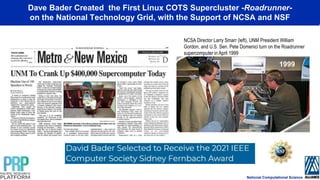
Dave Bader Created the First Linux COTS Supercluster -Roadrunner-
on the National Technology Grid, with the Support of NCSA and NSF
NCSA Director Larry Smarr (left), UNM President William
Gordon, and U.S. Sen. Pete Domenici turn on the Roadrunner
supercomputer in April 1999
1999
National Computational Science
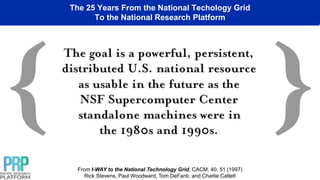
The 25 Years From the National Techology Grid
To the National Research Platform
From I-WAY to the National Technology Grid, CACM, 40, 51 (1997)
Rick Stevens, Paul Woodward, Tom DeFanti, and Charlie Catlett
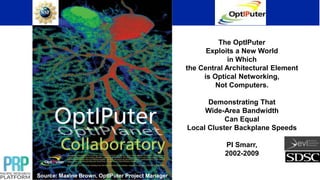
Source: Maxine Brown, OptIPuter Project Manager
The OptIPuter
Exploits a New World
in Which
the Central Architectural Element
is Optical Networking,
Not Computers.
Demonstrating That
Wide-Area Bandwidth
Can Equal
Local Cluster Backplane Speeds
PI Smarr,
2002-2009
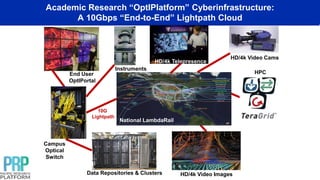
Academic Research “OptIPlatform” Cyberinfrastructure:
A 10Gbps “End-to-End” Lightpath Cloud
National LambdaRail
Campus
Optical
Switch
Data Repositories & Clusters
HPC
HD/4k Video Images
HD/4k Video Cams
End User
OptIPortal
10G
Lightpath
HD/4k Telepresence
Instruments
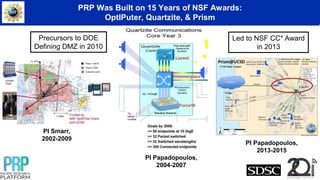
PRP Was Built on 15 Years of NSF Awards:
OptIPuter, Quartzite, & Prism
PI Papadopoulos,
2013-2015
PI Smarr,
2002-2009
PI Papadopoulos,
2004-2007
Precursors to DOE
Defining DMZ in 2010
Led to NSF CC* Award
in 2013
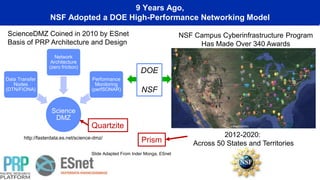
9 Years Ago,
NSF Adopted a DOE High-Performance Networking Model
Science
DMZ
Data Transfer
Nodes
(DTN/FIONA)
Network
Architecture
(zero friction)
Performance
Monitoring
(perfSONAR)
ScienceDMZ Coined in 2010 by ESnet
Basis of PRP Architecture and Design
http://fasterdata.es.net/science-dmz/
Slide Adapted From Inder Monga, ESnet
Quartzite
Prism
DOE
NSF
NSF Campus Cyberinfrastructure Program
Has Made Over 340 Awards
2012-2020:
Across 50 States and Territories
(GDC)
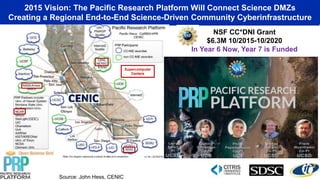
2015 Vision: The Pacific Research Platform Will Connect Science DMZs
Creating a Regional End-to-End Science-Driven Community Cyberinfrastructure
NSF CC*DNI Grant
$6.3M 10/2015-10/2020
In Year 6 Now, Year 7 is Funded
Source: John Hess, CENIC
Supercomputer
Centers
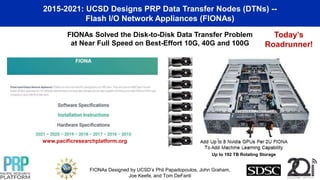
2015-2021: UCSD Designs PRP Data Transfer Nodes (DTNs) --
Flash I/O Network Appliances (FIONAs)
FIONAs Solved the Disk-to-Disk Data Transfer Problem
at Near Full Speed on Best-Effort 10G, 40G and 100G
FIONAs Designed by UCSD’s Phil Papadopoulos, John Graham,
Joe Keefe, and Tom DeFanti
Up to 192 TB Rotating Storage
www.pacificresearchplatform.org
Today’s
Roadrunner!
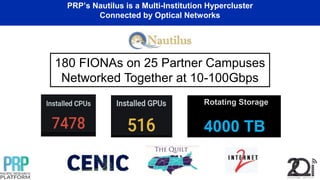
Rotating Storage
4000 TB
PRP’s Nautilus is a Multi-Institution Hypercluster
Connected by Optical Networks
180 FIONAs on 25 Partner Campuses
Networked Together at 10-100Gbps
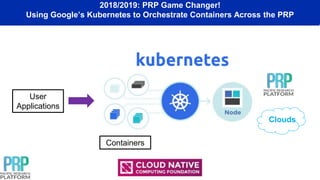
2018/2019: PRP Game Changer!
Using Google’s Kubernetes to Orchestrate Containers Across the PRP
User
Applications
Containers
Clouds
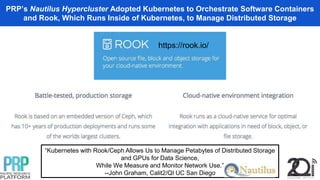
PRP’s Nautilus Hypercluster Adopted Kubernetes to Orchestrate Software Containers
and Rook, Which Runs Inside of Kubernetes, to Manage Distributed Storage
https://rook.io/
“Kubernetes with Rook/Ceph Allows Us to Manage Petabytes of Distributed Storage
and GPUs for Data Science,
While We Measure and Monitor Network Use.”
--John Graham, Calit2/QI UC San Diego
PRP Provides Widely-Used Kubernetes Services
For Application Research, Development and Collaboration
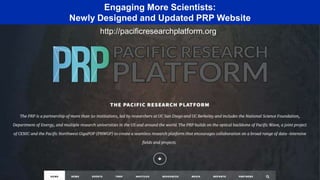
Engaging More Scientists:
Newly Designed and Updated PRP Website
http://pacificresearchplatform.org
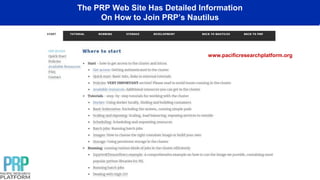
The PRP Web Site Has Detailed Information
On How to Join PRP’s Nautilus
www.pacificresearchplatform.org
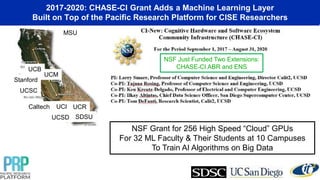
2017-2020: CHASE-CI Grant Adds a Machine Learning Layer
Built on Top of the Pacific Research Platform for CISE Researchers
Caltech
UCB
UCI UCR
UCSD
UCSC
Stanford
MSU
UCM
SDSU
NSF Grant for 256 High Speed “Cloud” GPUs
For 32 ML Faculty & Their Students at 10 Campuses
To Train AI Algorithms on Big Data
NSF Just Funded Two Extensions:
CHASE-CI ABR and ENS
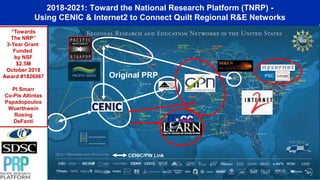
Original PRP
CENIC/PW Link
2018-2021: Toward the National Research Platform (TNRP) -
Using CENIC & Internet2 to Connect Quilt Regional R&E Networks
“Towards
The NRP”
3-Year Grant
Funded
by NSF
$2.5M
October 2018
Award #1826967
PI Smarr
Co-PIs Altintas
Papadopoulos
Wuerthwein
Rosing
DeFanti
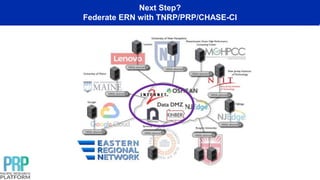
Next Step?
Federate ERN with TNRP/PRP/CHASE-CI
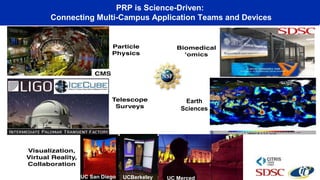
PRP is Science-Driven:
Connecting Multi-Campus Application Teams and Devices
Earth
Sciences
UC San Diego UCBerkeley UC Merced
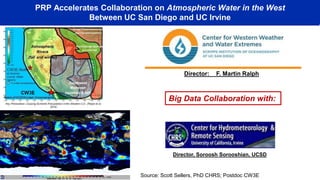
Director: F. Martin Ralph
Big Data Collaboration with:
Source: Scott Sellers, PhD CHRS; Postdoc CW3E
PRP Accelerates Collaboration on Atmospheric Water in the West
Between UC San Diego and UC Irvine
Director, Soroosh Sorooshian, UCSD
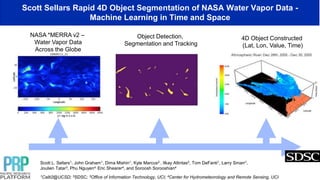
Scott Sellars Rapid 4D Object Segmentation of NASA Water Vapor Data -
Machine Learning in Time and Space
NASA *MERRA v2 –
Water Vapor Data
Across the Globe
4D Object Constructed
(Lat, Lon, Value, Time)
Object Detection,
Segmentation and Tracking
Scott L. Sellars1, John Graham1, Dima Mishin1, Kyle Marcus2 , Ilkay Altintas2, Tom DeFanti1, Larry Smarr1,
Joulien Tatar3, Phu Nguyen4, Eric Shearer4, and Soroosh Sorooshian4
1Calit2@UCSD; 2SDSC; 3Office of Information Technology, UCI; 4Center for Hydrometeorology and Remote Sensing, UCI
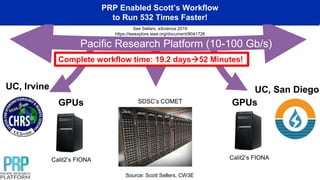
Calit2’s FIONA
SDSC’s COMET
Calit2’s FIONA
Pacific Research Platform (10-100 Gb/s)
GPUs
GPUs
Complete workflow time: 19.2 days52 Minutes!
UC, Irvine UC, San Diego
PRP Enabled Scott’s Workflow
to Run 532 Times Faster!
Source: Scott Sellers, CW3E
See Sellars, eScience 2019
https://ieeexplore.ieee.org/document/9041726
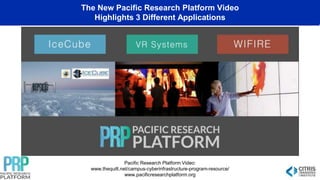
The New Pacific Research Platform Video
Highlights 3 Different Applications
Pacific Research Platform Video:
www.thequilt.net/campus-cyberinfrastructure-program-resource/
www.pacificresearchplatform.org
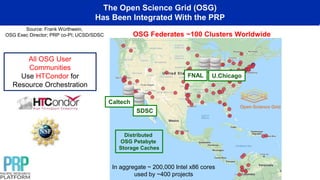
The Open Science Grid (OSG)
Has Been Integrated With the PRP
In aggregate ~ 200,000 Intel x86 cores
used by ~400 projects
Source: Frank Würthwein,
OSG Exec Director; PRP co-PI; UCSD/SDSC OSG Federates ~100 Clusters Worldwide
All OSG User
Communities
Use HTCondor for
Resource Orchestration
SDSC
U.Chicago
FNAL
Caltech
Distributed
OSG Petabyte
Storage Caches
Co-Existence of Interactive and
Non-Interactive Computing on PRP
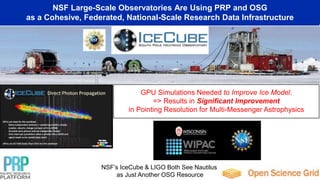
GPU Simulations Needed to Improve Ice Model.
=> Results in Significant Improvement
in Pointing Resolution for Multi-Messenger Astrophysics
NSF Large-Scale Observatories Are Using PRP and OSG
as a Cohesive, Federated, National-Scale Research Data Infrastructure
NSF’s IceCube & LIGO Both See Nautilus
as Just Another OSG Resource
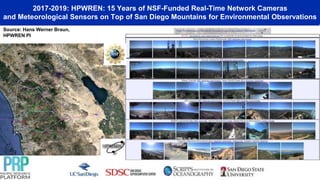
2017-2019: HPWREN: 15 Years of NSF-Funded Real-Time Network Cameras
and Meteorological Sensors on Top of San Diego Mountains for Environmental Observations
Source: Hans Werner Braun,
HPWREN PI
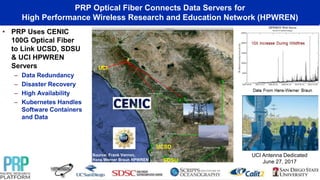
PRP Optical Fiber Connects Data Servers for
High Performance Wireless Research and Education Network (HPWREN)
• PRP Uses CENIC
100G Optical Fiber
to Link UCSD, SDSU
& UCI HPWREN
Servers
– Data Redundancy
– Disaster Recovery
– High Availability
– Kubernetes Handles
Software Containers
and Data
UCI
UCSD
SDSU
Source: Frank Vernon,
Hans Werner Braun HPWREN
UCI Antenna Dedicated
June 27, 2017
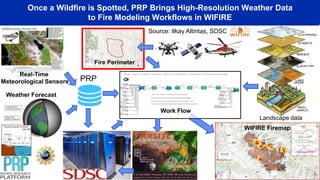
Once a Wildfire is Spotted, PRP Brings High-Resolution Weather Data
to Fire Modeling Workflows in WIFIRE
Real-Time
Meteorological Sensors
Weather Forecast
Landscape data
WIFIRE Firemap
Fire Perimeter
Work Flow
PRP
Source: Ilkay Altintas, SDSC
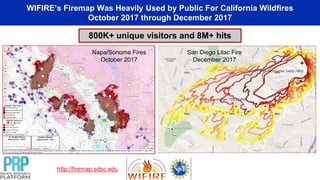
WIFIRE’s Firemap Was Heavily Used by Public For California Wildfires
October 2017 through December 2017
800K+ unique visitors and 8M+ hits
http://firemap.sdsc.edu
Napa/Sonoma Fires
October 2017
San Diego Lilac Fire
December 2017
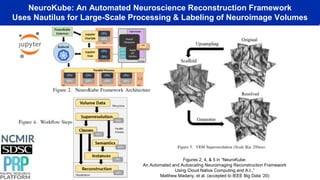
NeuroKube: An Automated Neuroscience Reconstruction Framework
Uses Nautilus for Large-Scale Processing & Labeling of Neuroimage Volumes
Figures 2, 4, & 5 in “NeuroKube:
An Automated and Autoscaling Neuroimaging Reconstruction Framework
Using Cloud Native Computing and A.I.,”
Matthew Madany, et al. (accepted to IEEE Big Data ’20)
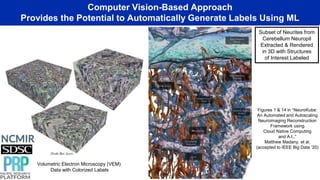
Computer Vision-Based Approach
Provides the Potential to Automatically Generate Labels Using ML
Subset of Neurites from
Cerebellum Neuropil
Extracted & Rendered
in 3D with Structures
of Interest Labeled
Figures 1 & 14 in “NeuroKube:
An Automated and Autoscaling
Neuroimaging Reconstruction
Framework using
Cloud Native Computing
and A.I.,”
Matthew Madany, et al.
(accepted to IEEE Big Data ’20)
Volumetric Electron Microscopy (VEM)
Data with Colorized Labels
Top 20 GPU Users Out of 400 Nautilus Namespace Applications:
Together They Consumed Nearly 500 GPUs in 2020
Frank Wuerthwein, UCSD
osggpus [IceCube]
Mark Alber, UCR
markalbergroup
Nuno Vasconcelos, UCSD
domain-adaptation
Ravi Ramamoorthi, UCSD
ucsd-ravigroup
Hao Su, UCSD
ucsd-haosulab
Folding@Home
folding
Igor Sfiligoi, UCSD
isfiligoi
Xiaolong Wang, UCSD
rl-multitask
Xiaolong Wang, UCSD
rl-multitask
Xiaolong Wang, UCSD
self-supervised-video
Xiaolong Wang, UCSD
hand-object-interaction
Dinesh Bharadia, UCSD
ecepxie
Manmohan Chandraker, UCSD
mc-lab
Frank Wuerthwein, UCSD
cms-ml
Nuno Vasconcelos, UCSD
svcl-oowl
Vineet Bafna, UCSD
ecdna
Larry Smarr, UCSD
jupyterlab
Rose Yu, UCSD
deep-forecast
Nuno Vasconcelos, UCSD
svcl-multimodal-learning
Gary Cottrell, UCSD
guru-research
PRP Y6Q4
Top 15 CPU Nautilus Namespace Users (>50,000 CPU Core Hours)
Ilkay Altintas, UCSD
wifire-quicfire
David Mobley, UCI
openforcefield
David Haussler, UCSC
braingeneers
Adam Smith, UCSC
baytemiz-navassist
Hao Su, UCSD
ucsd-haosulab
Xiaolong Wang, UCSD
rl-multitask
Ravi Ramamoorthi, UCSD
ucsd-ravigroup
Xiaolong Wang, UCSD
ece3d-vision
Frank Wuerthwein, UCSD
osggpus [IceCube]
Larry Smarr, UCSD
jupyterlab
Dinesh Bharadia, UCSD
ecepxie
John Dung Vu, UCSD
igrok-elastic
Xiaolong Wang, UCSD
Image-model
Dima Mishin, UCSD
perfsonar
Xiaolong Wang, UCSD
rl-self-sup
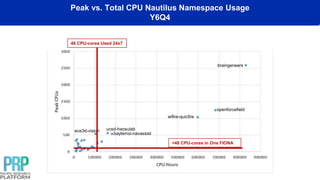
Peak vs. Total CPU Nautilus Namespace Usage
Y6Q4
braingeneers
openforcefield
wifire-quicfire
baytemiz-navassist
ece3d-vision
<48 CPU-cores in One FIONA
48 CPU-cores Used 24x7
ucsd-haosulab
ML/AI Namespace examples
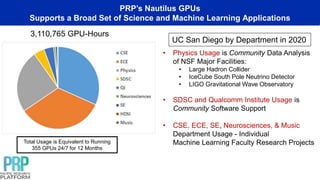
PRP’s Nautilus GPUs
Supports a Broad Set of Science and Machine Learning Applications
• Physics Usage is Community Data Analysis
of NSF Major Facilities:
• Large Hadron Collider
• IceCube South Pole Neutrino Detector
• LIGO Gravitational Wave Observatory
• SDSC and Qualcomm Institute Usage is
Community Software Support
• CSE, ECE, SE, Neurosciences, & Music
Department Usage - Individual
Machine Learning Faculty Research Projects
3,110,765 GPU-Hours
Total Usage is Equivalent to Running
355 GPUs 24/7 for 12 Months
UC San Diego by Department in 2020
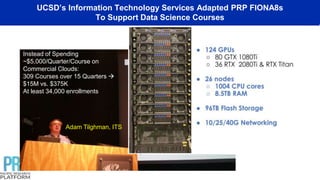
UCSD’s Information Technology Services Adapted PRP FIONA8s
To Support Data Science Courses
Instructional Data Science Machine
Learning Platform:
Instead of Spending
~$5,000/Quarter/Course on
Commercial Clouds:
309 Courses over 15 Quarters 
$15M vs. $375K
At least 34,000 enrollments
Adam Tilghman, ITS
Source: UCSD ITS
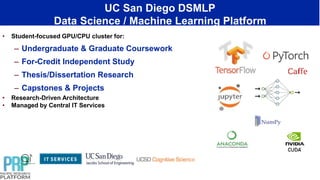
UC San Diego DSMLP
Data Science / Machine Learning Platform
• Student-focused GPU/CPU cluster for:
– Undergraduate & Graduate Coursework
– For-Credit Independent Study
– Thesis/Dissertation Research
– Capstones & Projects
• Research-Driven Architecture
• Managed by Central IT Services
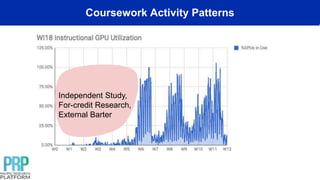
Coursework Activity Patterns
Independent Study,
For-credit Research,
External Barter
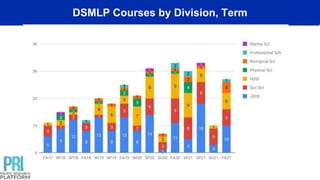
DSMLP Courses by Division, Term
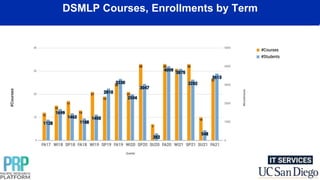
DSMLP Courses, Enrollments by Term
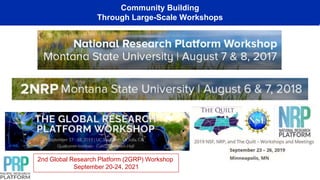
Community Building
Through Large-Scale Workshops
2nd Global Research Platform (2GRP) Workshop
September 20-24, 2021
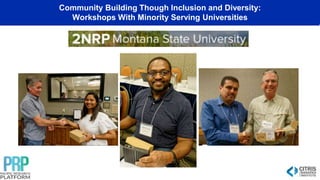
Community Building Though Inclusion and Diversity:
Workshops With Minority Serving Universities
The Next Three Phases
As We Approach a National Research Platform
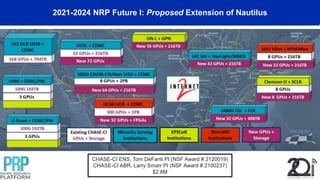
2021-2024 NRP Future I: Proposed Extension of Nautilus
CHASE-CI ENS, Tom DeFanti PI (NSF Award # 2120019)
CHASE-CI ABR, Larry Smarr PI (NSF Award # 2100237)
$2.8M
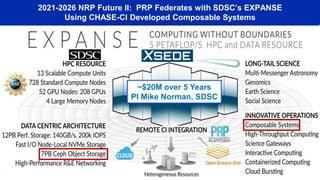
2021-2026 NRP Future II: PRP Federates with SDSC’s EXPANSE
Using CHASE-CI Developed Composable Systems
~$20M over 5 Years
PI Mike Norman, SDSC
2021-2026 NRP Future III: PRP Federates with
NSF-Funded Prototype National Research Platform
NSF Award OAC #2112167 (June 2021) [$5M Over 5 Years]
PI Frank Wuerthwein (UCSD, SDSC)
Co-PIs Tajana Rosing (UCSD), Thomas DeFanti (UCSD), Mahidhar Tatineni (SDSC), Derek Weitzel (UNL)
PRP’s Support and Community:
• National Science Foundation (NSF) awards to UCSD:
 CNS (1456638, 1730158, 2120019, 2100237) OAC (1540112, 1541349, 1826967, 2112167)
• UCSD; Calit2/Qualcomm Institute; and UCSD’s Research IT and Instructional IT
• UCB CITRIS and the Banatao Institute
• UC Office of the President
• Partner Campuses: UCSC, UCI, UCR, UCLA, UCD, UCM, UCSB, USC, Caltech, Stanford, NU, UW, UChicago,
UIC, UIUC, UHM, UWM, IU, NPS, CSUSB, CSUS, SDSU, SJSU, UMC, UM, MSU, NYU, UNL, UNM, UNC, UTA,
WSU, FAMU, FIU, Clemson, UD, UG, UU, JCU, KISTI, UVA, AIST, NTU, UQ, UTokyo
• Computing Partners: San Diego Supercomputer Center, LBNL/NERSC, NCAR/UCAR & Wyoming
Supercomputing Center, NASA NAS/USRA, Texas Advanced Computing Center, NSCC, Open Science Grid,
Chameleon Cloud, SLATE, AWS, Google Cloud, Microsoft
• Network Partners: CENIC, Pacific Wave/PNWGP, FRGP, StarLight/MREN, HPWREN, The Quilt, Great Plains
Network, KINBER, LEARN, NYSERNet, OARnet, FLR, Internet2, DOE Esnet, AMPATH, AARNet, CESnet,
KREOnet, PIREN, SURFnet, SCLR, SingAREN

Toward a National Research Platform to Enable Data-Intensive Computing

  • 1.
    “Toward a NationalResearch Platform to Enable Data-Intensive Computing” Virtual Data Science Seminar Institute for Data Science New Jersey Institute of Technology October 27, 2021 1 Dr. Larry Smarr Founding Director Emeritus, California Institute for Telecommunications and Information Technology; Distinguished Professor Emeritus, Dept. of Computer Science and Engineering Jacobs School of Engineering, UCSD http://lsmarr.calit2.net
  • 2.
    Abstract Three current NSFgrants [the Pacific Research Platform (PRP), the Cognitive Hardware and Software Ecosystem Community Infrastructure (CHASE-CI), and Toward a National Research Platform (TNRP)] create a regional, national, to global-scale cyberinfrastructure, optimized for machine learning research and data analysis of large scientific datasets. This integrated system, which is federated with the Open Science Grid and multiple supercomputer centers, uses 10 to 100Gbps optical fiber networks to interconnect, across 30 campuses, nearly 200 Science DMZ Data Transfer Nodes (DTNs). The DTNs are rack-mounted PCs optimized for high-speed data transfers, containing multicore-CPUs, two to eight GPUs, and up to 256TB of disk each. Users’ containerized software applications are orchestrated across the highly instrumented PRP by open-source Kubernetes, enabling easy access to commercial clouds as needed. I will describe several of the most active of PRP’s 400 user namespaces, which support a wide range of data-intensive disciplines.
  • 3.
    36 Years Ago, NSFAdopted a DOE High-Performance Computing Model NCSA Was Modeled on LLNL SDSC Was Modeled on MFEnet
  • 4.
    Launching the Nation’sInformation Infrastructure: NSFnet Supernetwork and the Six NSF Supercomputers NCSA NSFNET 56 Kb/s Backbone (1986-8) PSC NCAR CTC JVNC SDSC Supernetwork Backbone: 56kbps is 50 Times Faster than 1200 bps PC Modem!
  • 5.
    From Supercomputer Centersto the NSFnet to Today’s Commercial Internet Visualization by NCSA’s Donna Cox and Robert Patterson Traffic on 45 Mbps Backbone December 1994 1994
  • 6.
    NSF’s PACI Programwas Built on the vBNS to Prototype America’s 21st Century Information Infrastructure PACI National Technology Grid Testbed National Computational Science 1997 vBNS led to Key Role of Miron Livny & Condor
  • 7.
    Dave Bader Createdthe First Linux COTS Supercluster -Roadrunner- on the National Technology Grid, with the Support of NCSA and NSF NCSA Director Larry Smarr (left), UNM President William Gordon, and U.S. Sen. Pete Domenici turn on the Roadrunner supercomputer in April 1999 1999 National Computational Science
  • 8.
    The 25 YearsFrom the National Techology Grid To the National Research Platform From I-WAY to the National Technology Grid, CACM, 40, 51 (1997) Rick Stevens, Paul Woodward, Tom DeFanti, and Charlie Catlett
  • 9.
    Source: Maxine Brown,OptIPuter Project Manager The OptIPuter Exploits a New World in Which the Central Architectural Element is Optical Networking, Not Computers. Demonstrating That Wide-Area Bandwidth Can Equal Local Cluster Backplane Speeds PI Smarr, 2002-2009
  • 10.
    Academic Research “OptIPlatform”Cyberinfrastructure: A 10Gbps “End-to-End” Lightpath Cloud National LambdaRail Campus Optical Switch Data Repositories & Clusters HPC HD/4k Video Images HD/4k Video Cams End User OptIPortal 10G Lightpath HD/4k Telepresence Instruments
  • 11.
    PRP Was Builton 15 Years of NSF Awards: OptIPuter, Quartzite, & Prism PI Papadopoulos, 2013-2015 PI Smarr, 2002-2009 PI Papadopoulos, 2004-2007 Precursors to DOE Defining DMZ in 2010 Led to NSF CC* Award in 2013
  • 12.
    9 Years Ago, NSFAdopted a DOE High-Performance Networking Model Science DMZ Data Transfer Nodes (DTN/FIONA) Network Architecture (zero friction) Performance Monitoring (perfSONAR) ScienceDMZ Coined in 2010 by ESnet Basis of PRP Architecture and Design http://fasterdata.es.net/science-dmz/ Slide Adapted From Inder Monga, ESnet Quartzite Prism DOE NSF NSF Campus Cyberinfrastructure Program Has Made Over 340 Awards 2012-2020: Across 50 States and Territories
  • 13.
    (GDC) 2015 Vision: ThePacific Research Platform Will Connect Science DMZs Creating a Regional End-to-End Science-Driven Community Cyberinfrastructure NSF CC*DNI Grant $6.3M 10/2015-10/2020 In Year 6 Now, Year 7 is Funded Source: John Hess, CENIC Supercomputer Centers
  • 14.
    2015-2021: UCSD DesignsPRP Data Transfer Nodes (DTNs) -- Flash I/O Network Appliances (FIONAs) FIONAs Solved the Disk-to-Disk Data Transfer Problem at Near Full Speed on Best-Effort 10G, 40G and 100G FIONAs Designed by UCSD’s Phil Papadopoulos, John Graham, Joe Keefe, and Tom DeFanti Up to 192 TB Rotating Storage www.pacificresearchplatform.org Today’s Roadrunner!
  • 15.
    Rotating Storage 4000 TB PRP’sNautilus is a Multi-Institution Hypercluster Connected by Optical Networks 180 FIONAs on 25 Partner Campuses Networked Together at 10-100Gbps
  • 16.
    2018/2019: PRP GameChanger! Using Google’s Kubernetes to Orchestrate Containers Across the PRP User Applications Containers Clouds
  • 17.
    PRP’s Nautilus HyperclusterAdopted Kubernetes to Orchestrate Software Containers and Rook, Which Runs Inside of Kubernetes, to Manage Distributed Storage https://rook.io/ “Kubernetes with Rook/Ceph Allows Us to Manage Petabytes of Distributed Storage and GPUs for Data Science, While We Measure and Monitor Network Use.” --John Graham, Calit2/QI UC San Diego
  • 18.
    PRP Provides Widely-UsedKubernetes Services For Application Research, Development and Collaboration
  • 19.
    Engaging More Scientists: NewlyDesigned and Updated PRP Website http://pacificresearchplatform.org
  • 20.
    The PRP WebSite Has Detailed Information On How to Join PRP’s Nautilus www.pacificresearchplatform.org
  • 21.
    2017-2020: CHASE-CI GrantAdds a Machine Learning Layer Built on Top of the Pacific Research Platform for CISE Researchers Caltech UCB UCI UCR UCSD UCSC Stanford MSU UCM SDSU NSF Grant for 256 High Speed “Cloud” GPUs For 32 ML Faculty & Their Students at 10 Campuses To Train AI Algorithms on Big Data NSF Just Funded Two Extensions: CHASE-CI ABR and ENS
  • 22.
    Original PRP CENIC/PW Link 2018-2021:Toward the National Research Platform (TNRP) - Using CENIC & Internet2 to Connect Quilt Regional R&E Networks “Towards The NRP” 3-Year Grant Funded by NSF $2.5M October 2018 Award #1826967 PI Smarr Co-PIs Altintas Papadopoulos Wuerthwein Rosing DeFanti
  • 23.
    Next Step? Federate ERNwith TNRP/PRP/CHASE-CI
  • 24.
    PRP is Science-Driven: ConnectingMulti-Campus Application Teams and Devices Earth Sciences UC San Diego UCBerkeley UC Merced
  • 25.
    Director: F. MartinRalph Big Data Collaboration with: Source: Scott Sellers, PhD CHRS; Postdoc CW3E PRP Accelerates Collaboration on Atmospheric Water in the West Between UC San Diego and UC Irvine Director, Soroosh Sorooshian, UCSD
  • 26.
    Scott Sellars Rapid4D Object Segmentation of NASA Water Vapor Data - Machine Learning in Time and Space NASA *MERRA v2 – Water Vapor Data Across the Globe 4D Object Constructed (Lat, Lon, Value, Time) Object Detection, Segmentation and Tracking Scott L. Sellars1, John Graham1, Dima Mishin1, Kyle Marcus2 , Ilkay Altintas2, Tom DeFanti1, Larry Smarr1, Joulien Tatar3, Phu Nguyen4, Eric Shearer4, and Soroosh Sorooshian4 1Calit2@UCSD; 2SDSC; 3Office of Information Technology, UCI; 4Center for Hydrometeorology and Remote Sensing, UCI
  • 27.
    Calit2’s FIONA SDSC’s COMET Calit2’sFIONA Pacific Research Platform (10-100 Gb/s) GPUs GPUs Complete workflow time: 19.2 days52 Minutes! UC, Irvine UC, San Diego PRP Enabled Scott’s Workflow to Run 532 Times Faster! Source: Scott Sellers, CW3E See Sellars, eScience 2019 https://ieeexplore.ieee.org/document/9041726
  • 28.
    The New PacificResearch Platform Video Highlights 3 Different Applications Pacific Research Platform Video: www.thequilt.net/campus-cyberinfrastructure-program-resource/ www.pacificresearchplatform.org
  • 29.
    The Open ScienceGrid (OSG) Has Been Integrated With the PRP In aggregate ~ 200,000 Intel x86 cores used by ~400 projects Source: Frank Würthwein, OSG Exec Director; PRP co-PI; UCSD/SDSC OSG Federates ~100 Clusters Worldwide All OSG User Communities Use HTCondor for Resource Orchestration SDSC U.Chicago FNAL Caltech Distributed OSG Petabyte Storage Caches
  • 30.
    Co-Existence of Interactiveand Non-Interactive Computing on PRP GPU Simulations Needed to Improve Ice Model. => Results in Significant Improvement in Pointing Resolution for Multi-Messenger Astrophysics NSF Large-Scale Observatories Are Using PRP and OSG as a Cohesive, Federated, National-Scale Research Data Infrastructure NSF’s IceCube & LIGO Both See Nautilus as Just Another OSG Resource
  • 31.
    2017-2019: HPWREN: 15Years of NSF-Funded Real-Time Network Cameras and Meteorological Sensors on Top of San Diego Mountains for Environmental Observations Source: Hans Werner Braun, HPWREN PI
  • 32.
    PRP Optical FiberConnects Data Servers for High Performance Wireless Research and Education Network (HPWREN) • PRP Uses CENIC 100G Optical Fiber to Link UCSD, SDSU & UCI HPWREN Servers – Data Redundancy – Disaster Recovery – High Availability – Kubernetes Handles Software Containers and Data UCI UCSD SDSU Source: Frank Vernon, Hans Werner Braun HPWREN UCI Antenna Dedicated June 27, 2017
  • 33.
    Once a Wildfireis Spotted, PRP Brings High-Resolution Weather Data to Fire Modeling Workflows in WIFIRE Real-Time Meteorological Sensors Weather Forecast Landscape data WIFIRE Firemap Fire Perimeter Work Flow PRP Source: Ilkay Altintas, SDSC
  • 34.
    WIFIRE’s Firemap WasHeavily Used by Public For California Wildfires October 2017 through December 2017 800K+ unique visitors and 8M+ hits http://firemap.sdsc.edu Napa/Sonoma Fires October 2017 San Diego Lilac Fire December 2017
  • 35.
    NeuroKube: An AutomatedNeuroscience Reconstruction Framework Uses Nautilus for Large-Scale Processing & Labeling of Neuroimage Volumes Figures 2, 4, & 5 in “NeuroKube: An Automated and Autoscaling Neuroimaging Reconstruction Framework Using Cloud Native Computing and A.I.,” Matthew Madany, et al. (accepted to IEEE Big Data ’20)
  • 36.
    Computer Vision-Based Approach Providesthe Potential to Automatically Generate Labels Using ML Subset of Neurites from Cerebellum Neuropil Extracted & Rendered in 3D with Structures of Interest Labeled Figures 1 & 14 in “NeuroKube: An Automated and Autoscaling Neuroimaging Reconstruction Framework using Cloud Native Computing and A.I.,” Matthew Madany, et al. (accepted to IEEE Big Data ’20) Volumetric Electron Microscopy (VEM) Data with Colorized Labels
  • 37.
    Top 20 GPUUsers Out of 400 Nautilus Namespace Applications: Together They Consumed Nearly 500 GPUs in 2020 Frank Wuerthwein, UCSD osggpus [IceCube] Mark Alber, UCR markalbergroup Nuno Vasconcelos, UCSD domain-adaptation Ravi Ramamoorthi, UCSD ucsd-ravigroup Hao Su, UCSD ucsd-haosulab Folding@Home folding Igor Sfiligoi, UCSD isfiligoi Xiaolong Wang, UCSD rl-multitask Xiaolong Wang, UCSD rl-multitask Xiaolong Wang, UCSD self-supervised-video Xiaolong Wang, UCSD hand-object-interaction Dinesh Bharadia, UCSD ecepxie Manmohan Chandraker, UCSD mc-lab Frank Wuerthwein, UCSD cms-ml Nuno Vasconcelos, UCSD svcl-oowl Vineet Bafna, UCSD ecdna Larry Smarr, UCSD jupyterlab Rose Yu, UCSD deep-forecast Nuno Vasconcelos, UCSD svcl-multimodal-learning Gary Cottrell, UCSD guru-research
  • 38.
    PRP Y6Q4 Top 15CPU Nautilus Namespace Users (>50,000 CPU Core Hours) Ilkay Altintas, UCSD wifire-quicfire David Mobley, UCI openforcefield David Haussler, UCSC braingeneers Adam Smith, UCSC baytemiz-navassist Hao Su, UCSD ucsd-haosulab Xiaolong Wang, UCSD rl-multitask Ravi Ramamoorthi, UCSD ucsd-ravigroup Xiaolong Wang, UCSD ece3d-vision Frank Wuerthwein, UCSD osggpus [IceCube] Larry Smarr, UCSD jupyterlab Dinesh Bharadia, UCSD ecepxie John Dung Vu, UCSD igrok-elastic Xiaolong Wang, UCSD Image-model Dima Mishin, UCSD perfsonar Xiaolong Wang, UCSD rl-self-sup
  • 39.
    Peak vs. TotalCPU Nautilus Namespace Usage Y6Q4 braingeneers openforcefield wifire-quicfire baytemiz-navassist ece3d-vision <48 CPU-cores in One FIONA 48 CPU-cores Used 24x7 ucsd-haosulab
  • 40.
  • 41.
    PRP’s Nautilus GPUs Supportsa Broad Set of Science and Machine Learning Applications • Physics Usage is Community Data Analysis of NSF Major Facilities: • Large Hadron Collider • IceCube South Pole Neutrino Detector • LIGO Gravitational Wave Observatory • SDSC and Qualcomm Institute Usage is Community Software Support • CSE, ECE, SE, Neurosciences, & Music Department Usage - Individual Machine Learning Faculty Research Projects 3,110,765 GPU-Hours Total Usage is Equivalent to Running 355 GPUs 24/7 for 12 Months UC San Diego by Department in 2020
  • 42.
    UCSD’s Information TechnologyServices Adapted PRP FIONA8s To Support Data Science Courses Instructional Data Science Machine Learning Platform: Instead of Spending ~$5,000/Quarter/Course on Commercial Clouds: 309 Courses over 15 Quarters  $15M vs. $375K At least 34,000 enrollments Adam Tilghman, ITS Source: UCSD ITS
  • 43.
    UC San DiegoDSMLP Data Science / Machine Learning Platform • Student-focused GPU/CPU cluster for: – Undergraduate & Graduate Coursework – For-Credit Independent Study – Thesis/Dissertation Research – Capstones & Projects • Research-Driven Architecture • Managed by Central IT Services
  • 44.
    Coursework Activity Patterns IndependentStudy, For-credit Research, External Barter
  • 45.
    DSMLP Courses byDivision, Term
  • 46.
  • 47.
    Community Building Through Large-ScaleWorkshops 2nd Global Research Platform (2GRP) Workshop September 20-24, 2021
  • 48.
    Community Building ThoughInclusion and Diversity: Workshops With Minority Serving Universities
  • 49.
    The Next ThreePhases As We Approach a National Research Platform
  • 50.
    2021-2024 NRP FutureI: Proposed Extension of Nautilus CHASE-CI ENS, Tom DeFanti PI (NSF Award # 2120019) CHASE-CI ABR, Larry Smarr PI (NSF Award # 2100237) $2.8M
  • 51.
    2021-2026 NRP FutureII: PRP Federates with SDSC’s EXPANSE Using CHASE-CI Developed Composable Systems ~$20M over 5 Years PI Mike Norman, SDSC
  • 52.
    2021-2026 NRP FutureIII: PRP Federates with NSF-Funded Prototype National Research Platform NSF Award OAC #2112167 (June 2021) [$5M Over 5 Years] PI Frank Wuerthwein (UCSD, SDSC) Co-PIs Tajana Rosing (UCSD), Thomas DeFanti (UCSD), Mahidhar Tatineni (SDSC), Derek Weitzel (UNL)
  • 53.
    PRP’s Support andCommunity: • National Science Foundation (NSF) awards to UCSD:  CNS (1456638, 1730158, 2120019, 2100237) OAC (1540112, 1541349, 1826967, 2112167) • UCSD; Calit2/Qualcomm Institute; and UCSD’s Research IT and Instructional IT • UCB CITRIS and the Banatao Institute • UC Office of the President • Partner Campuses: UCSC, UCI, UCR, UCLA, UCD, UCM, UCSB, USC, Caltech, Stanford, NU, UW, UChicago, UIC, UIUC, UHM, UWM, IU, NPS, CSUSB, CSUS, SDSU, SJSU, UMC, UM, MSU, NYU, UNL, UNM, UNC, UTA, WSU, FAMU, FIU, Clemson, UD, UG, UU, JCU, KISTI, UVA, AIST, NTU, UQ, UTokyo • Computing Partners: San Diego Supercomputer Center, LBNL/NERSC, NCAR/UCAR & Wyoming Supercomputing Center, NASA NAS/USRA, Texas Advanced Computing Center, NSCC, Open Science Grid, Chameleon Cloud, SLATE, AWS, Google Cloud, Microsoft • Network Partners: CENIC, Pacific Wave/PNWGP, FRGP, StarLight/MREN, HPWREN, The Quilt, Great Plains Network, KINBER, LEARN, NYSERNet, OARnet, FLR, Internet2, DOE Esnet, AMPATH, AARNet, CESnet, KREOnet, PIREN, SURFnet, SCLR, SingAREN