“ Applying Photonics to User Needs: The Application Challenge" Invited Talk to the 4 th  Annual ON*VECTOR International Photonics Workshop Sponsored by NTT Network Innovation Laboratories University of California, San Diego La Jolla, CA February 28, 2005 Dr. Larry Smarr Director, California Institute for Telecommunications and Information Technology Harry E. Gruber Professor,  Dept. of Computer Science and Engineering Jacobs School of Engineering, UCSD
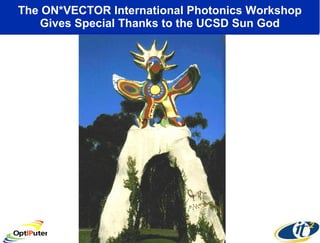
The ON*VECTOR International Photonics Workshop Gives Special Thanks to the UCSD Sun God
Four Classes of Applications are Driving the   Optical Networked Virtual Environment for  Collaborative Trans-Oceanic Research (ON*VECTOR) Browsing & Analysis of Multiple Large Remote Data Objects Telepresence, CineGrid, and Shared Virtual Reality Assimilating Data—Linking Supercomputers with Data Sets Interacting with Remote Scientific Instruments
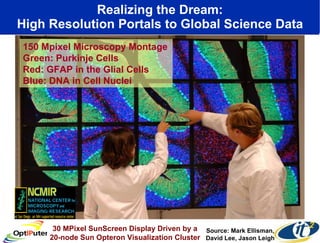
Realizing the Dream: High Resolution Portals to Global Science Data 30 MPixel SunScreen Display Driven by a 20-node Sun Opteron Visualization Cluster Source: Mark Ellisman, David Lee, Jason Leigh 150 Mpixel Microscopy Montage Green: Purkinje Cells Red: GFAP in the Glial Cells Blue: DNA in Cell Nuclei
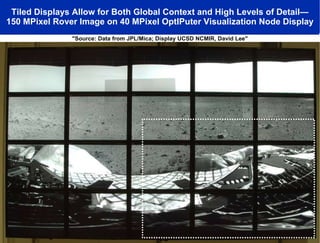
Tiled Displays Allow for Both Global Context and High Levels of Detail— 150 MPixel Rover Image on 40 MPixel OptIPuter Visualization Node Display "Source: Data from JPL/Mica; Display UCSD NCMIR, David Lee"
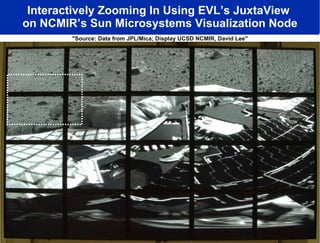
Interactively Zooming In Using EVL’s JuxtaView  on NCMIR’s Sun Microsystems Visualization Node "Source: Data from JPL/Mica; Display UCSD NCMIR, David Lee"
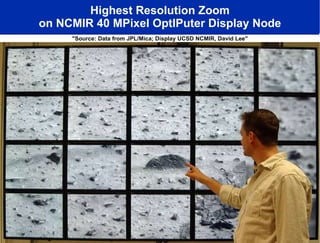
Highest Resolution Zoom on NCMIR 40 MPixel OptIPuter Display Node "Source: Data from JPL/Mica; Display UCSD NCMIR, David Lee"
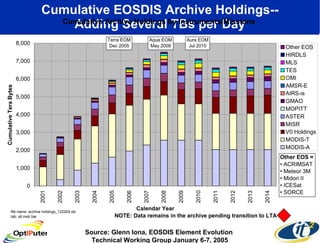
Cumulative EOSDIS Archive Holdings-- Adding Several TBs per Day Source: Glenn Iona, EOSDIS Element Evolution  Technical Working Group January 6-7, 2005
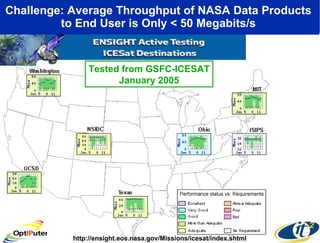
Challenge: Average Throughput of NASA Data Products  to End User is Only < 50 Megabits/s  Tested from GSFC-ICESAT January 2005 http://ensight.eos.nasa.gov/Missions/icesat/index.shtml
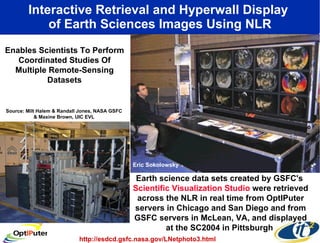
Interactive Retrieval and Hyperwall Display  of Earth Sciences Images Using NLR Earth science data sets created by GSFC's  Scientific Visualization Studio  were retrieved across the NLR in real time from OptIPuter servers in Chicago and San Diego and from GSFC servers in McLean, VA, and displayed at the SC2004 in Pittsburgh  Enables Scientists To Perform Coordinated Studies Of Multiple Remote-Sensing Datasets http://esdcd.gsfc.nasa.gov/LNetphoto3.html Source: Milt Halem & Randall Jones, NASA GSFC & Maxine Brown, UIC EVL Eric Sokolowsky
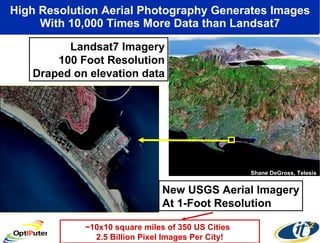
High Resolution Aerial Photography Generates Images With 10,000 Times More Data than Landsat7 Shane DeGross, Telesis USGS Landsat7 Imagery 100 Foot Resolution Draped on elevation data New USGS Aerial Imagery At 1-Foot Resolution ~10x10 square miles of 350 US Cities  2.5 Billion Pixel Images Per City!
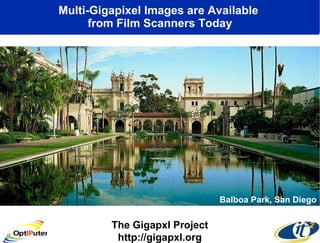
Multi-Gigapixel Images are Available  from Film Scanners Today The Gigapxl Project http://gigapxl.org Balboa Park, San Diego
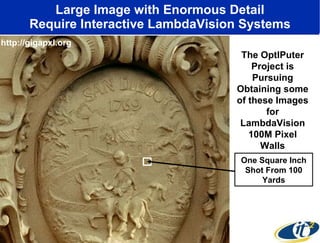
Large Image with Enormous Detail Require Interactive LambdaVision Systems One Square Inch Shot From 100 Yards The OptIPuter Project is Pursuing Obtaining some of these Images for LambdaVision 100M Pixel Walls http://gigapxl.org
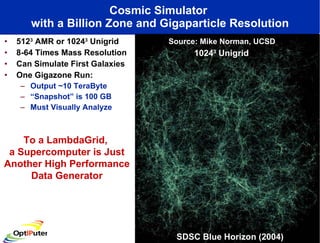
Cosmic Simulator  with a Billion Zone and Gigaparticle Resolution 512 3  AMR or 1024 3  Unigrid  8-64 Times Mass Resolution Can Simulate First Galaxies One Gigazone Run: Output ~10 TeraByte  “ Snapshot” is 100 GB Must Visually Analyze Source: Mike Norman, UCSD SDSC Blue Horizon (2004) 1024 3  Unigrid To a LambdaGrid,  a Supercomputer is Just Another High Performance Data Generator
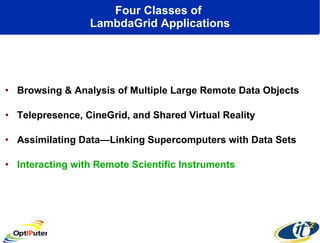
Four Classes of  LambdaGrid Applications Browsing & Analysis of Multiple Large Remote Data Objects Telepresence, CineGrid, and Shared Virtual Reality Assimilating Data—Linking Supercomputers with Data Sets Interacting with Remote Scientific Instruments
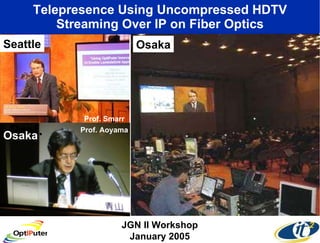
Telepresence Using Uncompressed HDTV Streaming Over IP on Fiber Optics Seattle JGN II Workshop January 2005 Osaka Prof.  Osaka Prof. Aoyama Prof. Smarr
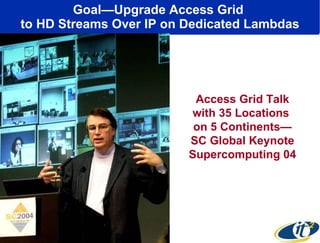
Goal—Upgrade Access Grid  to HD Streams Over IP on Dedicated Lambdas Access Grid Talk with 35 Locations  on 5 Continents— SC Global Keynote Supercomputing 04
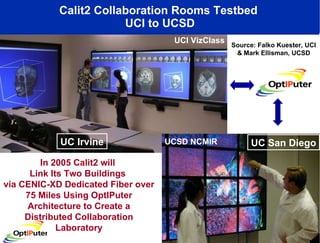
Calit2 Collaboration Rooms Testbed  UCI to UCSD In 2005 Calit2 will  Link Its Two Buildings  via CENIC-XD Dedicated Fiber over 75 Miles Using OptIPuter Architecture to Create a Distributed Collaboration Laboratory UC Irvine UC San Diego UCI VizClass  UCSD NCMIR Source: Falko Kuester, UCI & Mark Ellisman, UCSD
Applying the OptIPuter to Digital Cinema   The Calit2 CineGrid Project Connect a Global Community of Users and Researchers Engineering a Camera-to-Theatre Integrated System Create Digital CineGrid Production & Teaching Tools  Engage Artists, Producers, Scientists, Educators Educational & Research Testbed Using OptIPuter Architecture  Scaling to 4K SHD and Beyond! Distributed Computing, Storage, Visualization & Collaboration CAVEwave and Global Lambda Infrastructure Facility (GLIF) Support CineGrid Network Operations from Calit2 Develop Partnerships with Industry and Universities, e.g.: USC School of Cinema-Television DCTF in Japan National School of Cinema in Italy Source: Laurin Herr, Pacific-Interface
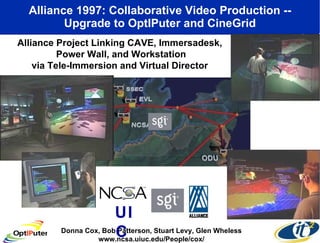
Alliance 1997: Collaborative Video Production -- Upgrade to OptIPuter and CineGrid Donna Cox, Bob Patterson, Stuart Levy, Glen Wheless www.ncsa.uiuc.edu/People/cox/ Alliance Project Linking CAVE, Immersadesk,  Power Wall, and Workstation via Tele-Immersion and Virtual Director  UIC
Four Classes of  LambdaGrid Applications Browsing & Analysis of Multiple Large Remote Data Objects Telepresence, CineGrid, and Shared Virtual Reality Assimilating Data—Linking Supercomputers with Data Sets Interacting with Remote Scientific Instruments
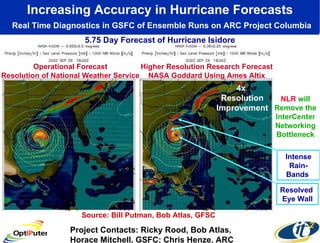
Increasing Accuracy in Hurricane Forecasts   Real Time Diagnostics in GSFC of Ensemble Runs on ARC Project Columbia Operational Forecast Resolution of National Weather Service Higher Resolution Research Forecast NASA Goddard Using Ames Altix 5.75 Day Forecast of Hurricane Isidore Intense Rain- Bands  4x  Resolution Improvement Source: Bill Putman, Bob Atlas, GFSC NLR   will Remove the InterCenter Networking Bottleneck Project Contacts: Ricky Rood, Bob Atlas, Horace Mitchell, GSFC; Chris Henze, ARC Resolved  Eye Wall
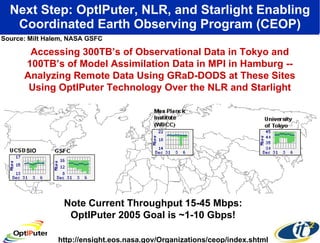
Next Step: OptIPuter, NLR, and Starlight Enabling Coordinated Earth Observing Program (CEOP) Note Current Throughput 15-45 Mbps: OptIPuter 2005 Goal is ~1-10 Gbps! http://ensight.eos.nasa.gov/Organizations/ceop/index.shtml Accessing 300TB’s of Observational Data in Tokyo and 100TB’s of Model Assimilation Data in MPI in Hamburg -- Analyzing Remote Data Using GRaD-DODS at These Sites Using OptIPuter Technology Over the NLR and Starlight Source: Milt Halem, NASA GSFC SIO
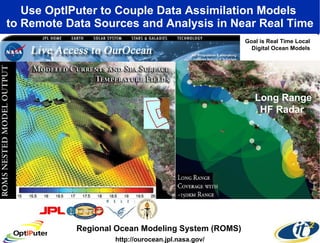
Use OptIPuter to Couple Data Assimilation Models  to Remote Data Sources and Analysis in Near Real Time Regional Ocean Modeling System (ROMS)  http://ourocean.jpl.nasa.gov/ Goal is Real Time Local Digital Ocean Models Long Range HF Radar
Four Classes of  LambdaGrid Applications Browsing & Analysis of Multiple Large Remote Data Objects Telepresence, CineGrid, and Shared Virtual Reality Assimilating Data—Linking Supercomputers with Data Sets Interacting with Remote Scientific Instruments
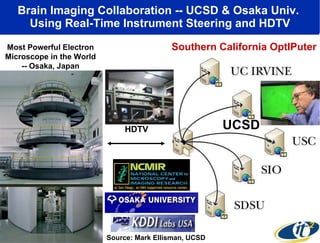
Brain Imaging Collaboration -- UCSD & Osaka Univ.  Using Real-Time Instrument Steering and HDTV Southern California OptIPuter Most Powerful Electron Microscope in the World -- Osaka, Japan Source: Mark Ellisman, UCSD UCSD HDTV
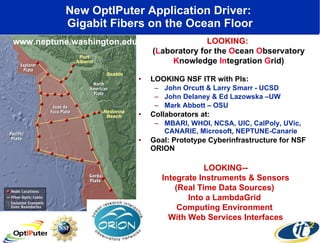
New OptIPuter Application Driver:  Gigabit Fibers on the Ocean Floor LOOKING NSF ITR with PIs: John Orcutt & Larry Smarr - UCSD John Delaney & Ed Lazowska –UW Mark Abbott – OSU Collaborators at: MBARI, WHOI, NCSA, UIC, CalPoly, UVic, CANARIE, Microsoft, NEPTUNE-Canarie Goal: Prototype Cyberinfrastructure for NSF ORION LOOKING:  ( L aboratory for the  O cean  O bservatory  K nowledge  In tegration  G rid) www.neptune.washington.edu LOOKING-- Integrate Instruments & Sensors (Real Time Data Sources)  Into a LambdaGrid  Computing Environment  With Web Services Interfaces
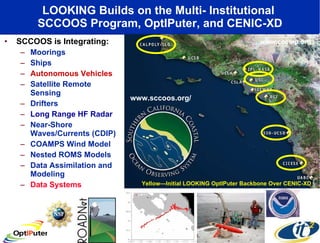
LOOKING Builds on the Multi- Institutional  SCCOOS Program, OptIPuter, and CENIC-XD SCCOOS is Integrating: Moorings Ships Autonomous Vehicles  Satellite Remote Sensing Drifters Long Range HF Radar   Near-Shore Waves/Currents (CDIP) COAMPS Wind Model Nested ROMS Models Data Assimilation and Modeling Data Systems Pilot Project Components www.sccoos.org/ www.cocmp.org Yellow—Initial LOOKING OptIPuter Backbone Over CENIC-XD
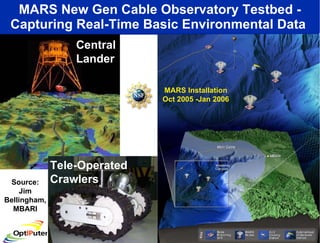
MARS New Gen Cable Observatory Testbed - Capturing Real-Time Basic Environmental Data  Tele-Operated Crawlers Central Lander MARS Installation Oct 2005 -Jan 2006 Source: Jim Bellingham, MBARI
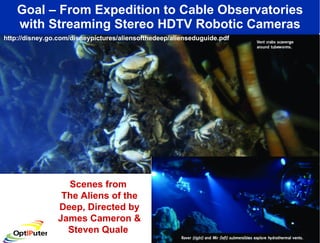
Goal – From Expedition to Cable Observatories with Streaming Stereo HDTV Robotic Cameras Scenes from  The Aliens of the Deep, Directed by James Cameron & Steven Quale  http://disney.go.com/disneypictures/aliensofthedeep/alienseduguide.pdf
September 26-30, 2005 University of California, San Diego California Institute for Telecommunications and Information Technology The Networking Double Header of the Century  Will Be Driven by LambdaGrid Applications i Grid  2 oo 5 T   H   E  G   L   O   B   A   L  L   A   M   B   D   A  I   N   T   E   G   R   A   T   E   D  F   A   C   I   L   I   T   Y   Maxine Brown, Tom DeFanti, Co-Organizers www.startap.net/igrid2005/ http://sc05.supercomp.org

Applying Photonics to User Needs: The Application Challenge

  • 1.
    “ Applying Photonicsto User Needs: The Application Challenge&quot; Invited Talk to the 4 th Annual ON*VECTOR International Photonics Workshop Sponsored by NTT Network Innovation Laboratories University of California, San Diego La Jolla, CA February 28, 2005 Dr. Larry Smarr Director, California Institute for Telecommunications and Information Technology Harry E. Gruber Professor, Dept. of Computer Science and Engineering Jacobs School of Engineering, UCSD
  • 2.
    The ON*VECTOR InternationalPhotonics Workshop Gives Special Thanks to the UCSD Sun God
  • 3.
    Four Classes ofApplications are Driving the Optical Networked Virtual Environment for Collaborative Trans-Oceanic Research (ON*VECTOR) Browsing & Analysis of Multiple Large Remote Data Objects Telepresence, CineGrid, and Shared Virtual Reality Assimilating Data—Linking Supercomputers with Data Sets Interacting with Remote Scientific Instruments
  • 4.
    Realizing the Dream:High Resolution Portals to Global Science Data 30 MPixel SunScreen Display Driven by a 20-node Sun Opteron Visualization Cluster Source: Mark Ellisman, David Lee, Jason Leigh 150 Mpixel Microscopy Montage Green: Purkinje Cells Red: GFAP in the Glial Cells Blue: DNA in Cell Nuclei
  • 5.
    Tiled Displays Allowfor Both Global Context and High Levels of Detail— 150 MPixel Rover Image on 40 MPixel OptIPuter Visualization Node Display &quot;Source: Data from JPL/Mica; Display UCSD NCMIR, David Lee&quot;
  • 6.
    Interactively Zooming InUsing EVL’s JuxtaView on NCMIR’s Sun Microsystems Visualization Node &quot;Source: Data from JPL/Mica; Display UCSD NCMIR, David Lee&quot;
  • 7.
    Highest Resolution Zoomon NCMIR 40 MPixel OptIPuter Display Node &quot;Source: Data from JPL/Mica; Display UCSD NCMIR, David Lee&quot;
  • 8.
    Cumulative EOSDIS ArchiveHoldings-- Adding Several TBs per Day Source: Glenn Iona, EOSDIS Element Evolution Technical Working Group January 6-7, 2005
  • 9.
    Challenge: Average Throughputof NASA Data Products to End User is Only < 50 Megabits/s Tested from GSFC-ICESAT January 2005 http://ensight.eos.nasa.gov/Missions/icesat/index.shtml
  • 10.
    Interactive Retrieval andHyperwall Display of Earth Sciences Images Using NLR Earth science data sets created by GSFC's Scientific Visualization Studio were retrieved across the NLR in real time from OptIPuter servers in Chicago and San Diego and from GSFC servers in McLean, VA, and displayed at the SC2004 in Pittsburgh Enables Scientists To Perform Coordinated Studies Of Multiple Remote-Sensing Datasets http://esdcd.gsfc.nasa.gov/LNetphoto3.html Source: Milt Halem & Randall Jones, NASA GSFC & Maxine Brown, UIC EVL Eric Sokolowsky
  • 11.
    High Resolution AerialPhotography Generates Images With 10,000 Times More Data than Landsat7 Shane DeGross, Telesis USGS Landsat7 Imagery 100 Foot Resolution Draped on elevation data New USGS Aerial Imagery At 1-Foot Resolution ~10x10 square miles of 350 US Cities 2.5 Billion Pixel Images Per City!
  • 12.
    Multi-Gigapixel Images areAvailable from Film Scanners Today The Gigapxl Project http://gigapxl.org Balboa Park, San Diego
  • 13.
    Large Image withEnormous Detail Require Interactive LambdaVision Systems One Square Inch Shot From 100 Yards The OptIPuter Project is Pursuing Obtaining some of these Images for LambdaVision 100M Pixel Walls http://gigapxl.org
  • 14.
    Cosmic Simulator with a Billion Zone and Gigaparticle Resolution 512 3 AMR or 1024 3 Unigrid 8-64 Times Mass Resolution Can Simulate First Galaxies One Gigazone Run: Output ~10 TeraByte “ Snapshot” is 100 GB Must Visually Analyze Source: Mike Norman, UCSD SDSC Blue Horizon (2004) 1024 3 Unigrid To a LambdaGrid, a Supercomputer is Just Another High Performance Data Generator
  • 15.
    Four Classes of LambdaGrid Applications Browsing & Analysis of Multiple Large Remote Data Objects Telepresence, CineGrid, and Shared Virtual Reality Assimilating Data—Linking Supercomputers with Data Sets Interacting with Remote Scientific Instruments
  • 16.
    Telepresence Using UncompressedHDTV Streaming Over IP on Fiber Optics Seattle JGN II Workshop January 2005 Osaka Prof. Osaka Prof. Aoyama Prof. Smarr
  • 17.
    Goal—Upgrade Access Grid to HD Streams Over IP on Dedicated Lambdas Access Grid Talk with 35 Locations on 5 Continents— SC Global Keynote Supercomputing 04
  • 18.
    Calit2 Collaboration RoomsTestbed UCI to UCSD In 2005 Calit2 will Link Its Two Buildings via CENIC-XD Dedicated Fiber over 75 Miles Using OptIPuter Architecture to Create a Distributed Collaboration Laboratory UC Irvine UC San Diego UCI VizClass UCSD NCMIR Source: Falko Kuester, UCI & Mark Ellisman, UCSD
  • 19.
    Applying the OptIPuterto Digital Cinema The Calit2 CineGrid Project Connect a Global Community of Users and Researchers Engineering a Camera-to-Theatre Integrated System Create Digital CineGrid Production & Teaching Tools Engage Artists, Producers, Scientists, Educators Educational & Research Testbed Using OptIPuter Architecture Scaling to 4K SHD and Beyond! Distributed Computing, Storage, Visualization & Collaboration CAVEwave and Global Lambda Infrastructure Facility (GLIF) Support CineGrid Network Operations from Calit2 Develop Partnerships with Industry and Universities, e.g.: USC School of Cinema-Television DCTF in Japan National School of Cinema in Italy Source: Laurin Herr, Pacific-Interface
  • 20.
    Alliance 1997: CollaborativeVideo Production -- Upgrade to OptIPuter and CineGrid Donna Cox, Bob Patterson, Stuart Levy, Glen Wheless www.ncsa.uiuc.edu/People/cox/ Alliance Project Linking CAVE, Immersadesk, Power Wall, and Workstation via Tele-Immersion and Virtual Director UIC
  • 21.
    Four Classes of LambdaGrid Applications Browsing & Analysis of Multiple Large Remote Data Objects Telepresence, CineGrid, and Shared Virtual Reality Assimilating Data—Linking Supercomputers with Data Sets Interacting with Remote Scientific Instruments
  • 22.
    Increasing Accuracy inHurricane Forecasts Real Time Diagnostics in GSFC of Ensemble Runs on ARC Project Columbia Operational Forecast Resolution of National Weather Service Higher Resolution Research Forecast NASA Goddard Using Ames Altix 5.75 Day Forecast of Hurricane Isidore Intense Rain- Bands 4x Resolution Improvement Source: Bill Putman, Bob Atlas, GFSC NLR will Remove the InterCenter Networking Bottleneck Project Contacts: Ricky Rood, Bob Atlas, Horace Mitchell, GSFC; Chris Henze, ARC Resolved Eye Wall
  • 23.
    Next Step: OptIPuter,NLR, and Starlight Enabling Coordinated Earth Observing Program (CEOP) Note Current Throughput 15-45 Mbps: OptIPuter 2005 Goal is ~1-10 Gbps! http://ensight.eos.nasa.gov/Organizations/ceop/index.shtml Accessing 300TB’s of Observational Data in Tokyo and 100TB’s of Model Assimilation Data in MPI in Hamburg -- Analyzing Remote Data Using GRaD-DODS at These Sites Using OptIPuter Technology Over the NLR and Starlight Source: Milt Halem, NASA GSFC SIO
  • 24.
    Use OptIPuter toCouple Data Assimilation Models to Remote Data Sources and Analysis in Near Real Time Regional Ocean Modeling System (ROMS) http://ourocean.jpl.nasa.gov/ Goal is Real Time Local Digital Ocean Models Long Range HF Radar
  • 25.
    Four Classes of LambdaGrid Applications Browsing & Analysis of Multiple Large Remote Data Objects Telepresence, CineGrid, and Shared Virtual Reality Assimilating Data—Linking Supercomputers with Data Sets Interacting with Remote Scientific Instruments
  • 26.
    Brain Imaging Collaboration-- UCSD & Osaka Univ. Using Real-Time Instrument Steering and HDTV Southern California OptIPuter Most Powerful Electron Microscope in the World -- Osaka, Japan Source: Mark Ellisman, UCSD UCSD HDTV
  • 27.
    New OptIPuter ApplicationDriver: Gigabit Fibers on the Ocean Floor LOOKING NSF ITR with PIs: John Orcutt & Larry Smarr - UCSD John Delaney & Ed Lazowska –UW Mark Abbott – OSU Collaborators at: MBARI, WHOI, NCSA, UIC, CalPoly, UVic, CANARIE, Microsoft, NEPTUNE-Canarie Goal: Prototype Cyberinfrastructure for NSF ORION LOOKING: ( L aboratory for the O cean O bservatory K nowledge In tegration G rid) www.neptune.washington.edu LOOKING-- Integrate Instruments & Sensors (Real Time Data Sources) Into a LambdaGrid Computing Environment With Web Services Interfaces
  • 28.
    LOOKING Builds onthe Multi- Institutional SCCOOS Program, OptIPuter, and CENIC-XD SCCOOS is Integrating: Moorings Ships Autonomous Vehicles Satellite Remote Sensing Drifters Long Range HF Radar Near-Shore Waves/Currents (CDIP) COAMPS Wind Model Nested ROMS Models Data Assimilation and Modeling Data Systems Pilot Project Components www.sccoos.org/ www.cocmp.org Yellow—Initial LOOKING OptIPuter Backbone Over CENIC-XD
  • 29.
    MARS New GenCable Observatory Testbed - Capturing Real-Time Basic Environmental Data Tele-Operated Crawlers Central Lander MARS Installation Oct 2005 -Jan 2006 Source: Jim Bellingham, MBARI
  • 30.
    Goal – FromExpedition to Cable Observatories with Streaming Stereo HDTV Robotic Cameras Scenes from The Aliens of the Deep, Directed by James Cameron & Steven Quale http://disney.go.com/disneypictures/aliensofthedeep/alienseduguide.pdf
  • 31.
    September 26-30, 2005University of California, San Diego California Institute for Telecommunications and Information Technology The Networking Double Header of the Century Will Be Driven by LambdaGrid Applications i Grid 2 oo 5 T H E G L O B A L L A M B D A I N T E G R A T E D F A C I L I T Y Maxine Brown, Tom DeFanti, Co-Organizers www.startap.net/igrid2005/ http://sc05.supercomp.org

Editor's Notes

  • #27 Accomplishment Instrument to OptIPuter resources data distribution architecture