Definition & causes of climate change, impact on development with focus on Asia PacificRichard Labellerlab@sympatico.caModule 10 Session 1(Seoul, Korea, 23 February 2011)
2Objectives of Module 10To show that ICTs can be used to address climate changeTo demonstrate why ICTs are a crucial part of the solution – i.e. in promoting efficiency, Green Growth & sustainable development
3What is climate change?Any change in climate over time, whether due to natural variability or as a result of human activity[IPCC. 2007. Climate Change 2007: Synthesis Report. Contribution of Working Groups I, II and III to the Fourth Assessment Report of the Intergovernmental Panel on Climate Change. IPCC. Core Writing Team, Pachauri, R.K. and Reisinger, A. (Eds.). IPCC, Geneva, Switzerland. pp 104. http://www.ipcc.ch/publications_and_data/publications_ipcc_fourth_assessment_report_synthesis_report.htm
4DiscussionIs climate change real?How is it affecting your country or region?Summarize the evidence of climate change in your regions (4 groups)[IPCC. 2007. Climate Change 2007: Synthesis Report. Contribution of Working Groups I, II and III to the Fourth Assessment Report of the Intergovernmental Panel on Climate Change. IPCC. Core Writing Team, Pachauri, R.K. and Reisinger, A. (Eds.). IPCC, Geneva, Switzerland. pp 104. http://www.ipcc.ch/publications_and_data/publications_ipcc_fourth_assessment_report_synthesis_report.htm
5The causes of climate change (1)The variability in the composition of the constituents of the global atmosphere that affects the energy balance of the planet earthWhen certain gases which absorb solar radiation and emit heat increase in concentration in the atmosphere, this can lead to global warming and climate change
6The causes of climate change (2)Atmospheric gases that absorb solar radiation more than others retain heat that warms the atmosphere and the surface of the planetThis leads to global warming and climate change
7What is global warming?Increase in the average temperature of Earth's near-surface air and oceans since the mid-20th century and its projected continuation. Global surface temperature increased 0.74 ± 0.18 °C (1.33 ± 0.32 °F) between the start and the end of the 20th century.Wikipedia. 2010. Global warming. Last modified March 18, 2010, 1621. http://en.wikipedia.org/wiki/Global_warming#cnote_A
8Natural greenhouse gases (GHGs)Naturally occurring GHGs:Water vapor (H2O), Carbon dioxide (CO2), Nitrous oxide (N2O), Methane (CH4), Ozone (O3).
9Human-made greenhouse gases (GHGs)Sulfur hexaflouride (SF6)Hydrofluorocarbons (HFCs)Perfluorocarbons (PFCs).
10Relative contribution of GHGs to global warming[1]
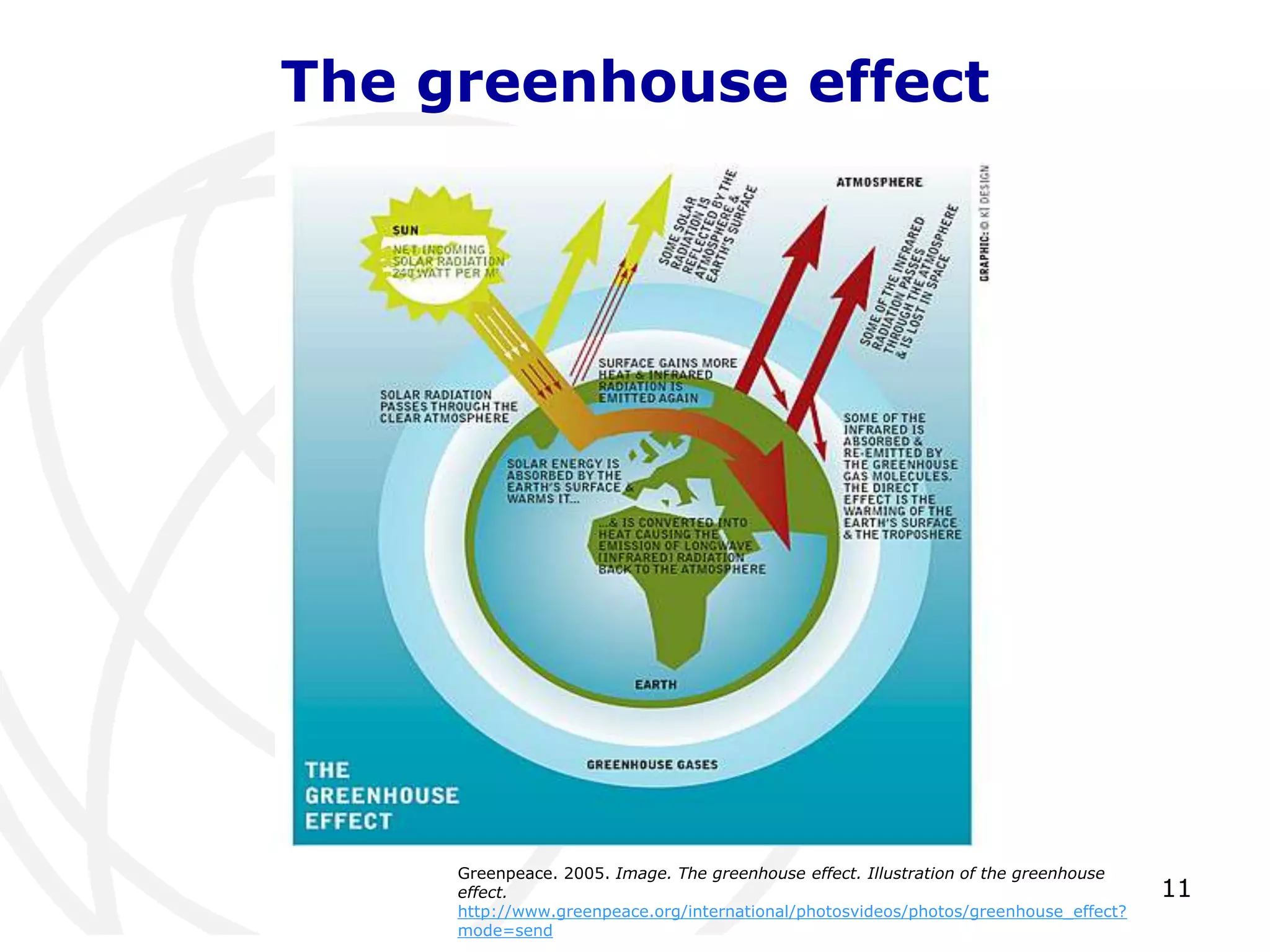
The greenhouse effect11Greenpeace. 2005. Image. The greenhouse effect. Illustration of the greenhouse effect.http://www.greenpeace.org/international/photosvideos/photos/greenhouse_effect?mode=send
12Atmospheric concentrations of carbon dioxide (CO2) - Mauna Loa or Keeling curve[1]Wikipedia. 2010. Mauna Loa Carbon Dioxide-en.svg. Own work, from Image:Mauna Loa Carbon Dioxide.png, uploaded in Commons by Nils Simon under licence GFDL & CC-NC-SA ; itself created by Robert A. Rohde from NOAA published data and is incorporated into the Global Warming Art project.http://en.wikipedia.org/wiki/File:Mauna_Loa_Carbon_Dioxide-en.svg
13Atmospheric concentrations of CO2 January 2011:  391.19 ppm[1]http://www.esrl.noaa.gov/gmd/ccgg/trends/
14Evidence of climate change comes from:Data on global average surface temperatures; Global average sea level riseThe thermal expansion of the water in the oceans plus the amount of glacier ice that has melted and that has led by extension to a rise in the level of the oceans around the worldNorthern hemisphere snow cover.
15Changes in temperature, sea level and Northern Hemisphere snow cover[1][IPCC. 2007. Climate Change 2007: Synthesis Report. Contribution of Working Groups I, II and III to the Fourth Assessment Report of the Intergovernmental Panel on Climate Change. IPCC. Core Writing Team, Pachauri, R.K. and Reisinger, A. (Eds.). IPCC, Geneva, Switzerland. pp 104. http://www.ipcc.ch/publications_and_data/publications_ipcc_fourth_assessment_report_synthesis_report.htm
16Fluctuations in T (red line) and in the atmospheric concentration of CO2 (yellow) over the past 649,000 years[1]US. EPA. 2009. Climate change science. Figure 1: Changes in Carbon Dioxide and Temperature. 8 Sept. 2009. http://www.epa.gov/climatechange/science/pastcc_fig1.html
17Changes in CO2 from ice core and modern data over a period of 10,000 years before the present[1][IPCC. 2007. Climate Change 2007: Synthesis Report. Contribution of Working Groups I, II and III to the Fourth Assessment Report of the Intergovernmental Panel on Climate Change. IPCC. Core Writing Team, Pachauri, R.K. and Reisinger, A. (Eds.). IPCC, Geneva, Switzerland. pp 104. http://www.ipcc.ch/publications_and_data/publications_ipcc_fourth_assessment_report_synthesis_report.htm
18Global and continental temperature change[1][IPCC. 2007. Climate Change 2007: Synthesis Report. Contribution of Working Groups I, II and III to the Fourth Assessment Report of the Intergovernmental Panel on Climate Change. IPCC. Core Writing Team, Pachauri, R.K. and Reisinger, A. (Eds.). IPCC, Geneva, Switzerland. pp 104. http://www.ipcc.ch/publications_and_data/publications_ipcc_fourth_assessment_report_synthesis_report.htm
19Other explanations for climate changeNatural phenomenaLong range natural cycle of climate change
20Mapping the global variation in CO2 emissions[1]UNDP. 2007. Human Development Report 2007/2008. Fighting climate change: Human solidarity in a divided world. Map. 1.1. UNDP, New York. 399 pp.
21Most important sources of GHG emissionsFossil fuel related energy emissionsEmissions from land-use changes and then agriculture where much of the releases are due to methane release and nitrous oxides escaping from the soil surface of cultivated land.
22Share of different sectors in total anthropogenic GHG emissions in 2004 in terms of CO2-eq. (Forestry includes deforestation)[1]IPCC. 2007. Climate Change 2007: Synthesis Report. Contribution of Working Groups I, II and III to the Fourth Assessment Report of the Intergovernmental Panel on Climate Change. IPCC. Core Writing Team, Pachauri, R.K. and Reisinger, A. (Eds.). IPCC, Geneva, Switzerland. pp 104. http://www.ipcc.ch/publications_and_data/publications_ipcc_fourth_assessment_report_synthesis_report.htm
23[1]World Resources Institute. 2005. Climate Analysis Indicator Tool (CAIT), Navigating the Numbers: Greenhouse Gas Data and International Climate Policy, December 2005. Intergovernmental Panel on Climate Change, 1996 (data for 2000). http://maps.grida.no/go/graphic/world-greenhouse-gas-emissions-by-sector1
24Group discussionCan ICTs have a role in reducing emissions from these sectors?How?Choose 2 sectors and discuss how ICTs can limit or help avoid GHG emissions
25Life Cycle GHG Emissions for Selected Power Generation Technologies[1]IAEA. 2010. Judge Nuclear. IAEA Bulletin51-2, April 2010. Pp. 16.19. http://www.iaea.or.at/OurWork/ST/NE/judge-nuclear.html
26Shares of Non-Fossil Sources in the Electricity Sector and CO2 Intensities for Selected Countries in 2006[1]IAEA. 2010. Judge Nuclear. IAEA Bulletin51-2, April 2010. Pp. 16.19. http://www.iaea.or.at/OurWork/ST/NE/judge-nuclear.htmll
27IPCC Projections of surface warming as a result of increasing GHG emissions[1][IPCC. 2007. Climate Change 2007: Synthesis Report. Contribution of Working Groups I, II and III to the Fourth Assessment Report of the Intergovernmental Panel on Climate Change. IPCC. Core Writing Team, Pachauri, R.K. and Reisinger, A. (Eds.). IPCC, Geneva, Switzerland. pp 104. http://www.ipcc.ch/publications_and_data/publications_ipcc_fourth_assessment_report_synthesis_report.htm
28Fossil fuel emissions: actual vs. IPCC scenarios[1]Global Carbon Project. 2009. Carbon 2008. Budget 08 Released on 17 November 2009. GCP-Global Carbon Budget Consortium. PowerPoint presentation. GCP-Global Carbon Budget Consortium. 38 slides.
29Growth in fossil fuel demandGrowth in fossil fuel demand is following the worst case scenarios predicted by a variety of different experts
30What is driving energy demand?Growing population & affluence Shift in global growth to emerging markets
31What is affecting energy prices? (1)Price, availability and security of energy supplies Environmental risks associated with hard to access oil resourcesOffshore & deep sea drillingDrilling in sensitive ecosystems: the Arctic/Antarctic, coastal areas, etc.Extracting heavy oil (Oil sands, heavy oil)Hydraulic fracturing: shale gas
32What is affecting energy prices? (2)Global security issuesPolicy uncertainty on fossil fuels & renewablesInvestment paralysis in the WestChina votes for investing in both fossil fuels & renewables!
33Growth in World primary energy demand to 2035, IEA New Policies Scenario[1]IEA. 2010. World Energy Outlook 2010. N. Tanaka, Executive Director, IEA, Beijing, 17 Nov. 2010. PowerPoint presentation. 35 slides. http://www.energy.eu/publications/weo_2010-China.pdf
34The impact of climate change (1)The efficiency of CO2 sinks is downAtmospheric CO2 is being added at the rate of 2ppm annuallyMethane up after 10 years of being stableCarbonate calcium walls of marine life are down. The oceans are getting more acidic.
35The impact of climate change (2)Oceans have warmed up fasterArctic sea ice is at a low peakGreenland ice sheets have decreased in sizeFossil fuel emissions are above worst case scenariosDeforestation emissions continue and are high
36Examples of impacts associated with global average temperature change (Impacts will vary by extent of adaptation, rate of temperature change and socio-economic pathway)[1]IPCC. 2007. Climate Change 2007: Synthesis Report. Contribution of Working Groups I, II and III to the Fourth Assessment Report of the Intergovernmental Panel on Climate Change. IPCC. Core Writing Team, Pachauri, R.K. and Reisinger, A. (Eds.). IPCC, Geneva, Switzerland. pp 104. http://www.ipcc.ch/publications_and_data/publications_ipcc_fourth_assessment_report_synthesis_report.htm
Impacts from increasing GHGs levels in the atmosphere37[1] Stern, N. 2006. Stern Review on the economics of climate change (pre-publication edition). Executive summary. HM Treasury. London. 27 pp. http://www.hm-treasury.gov.uk/sternreview_index.htm
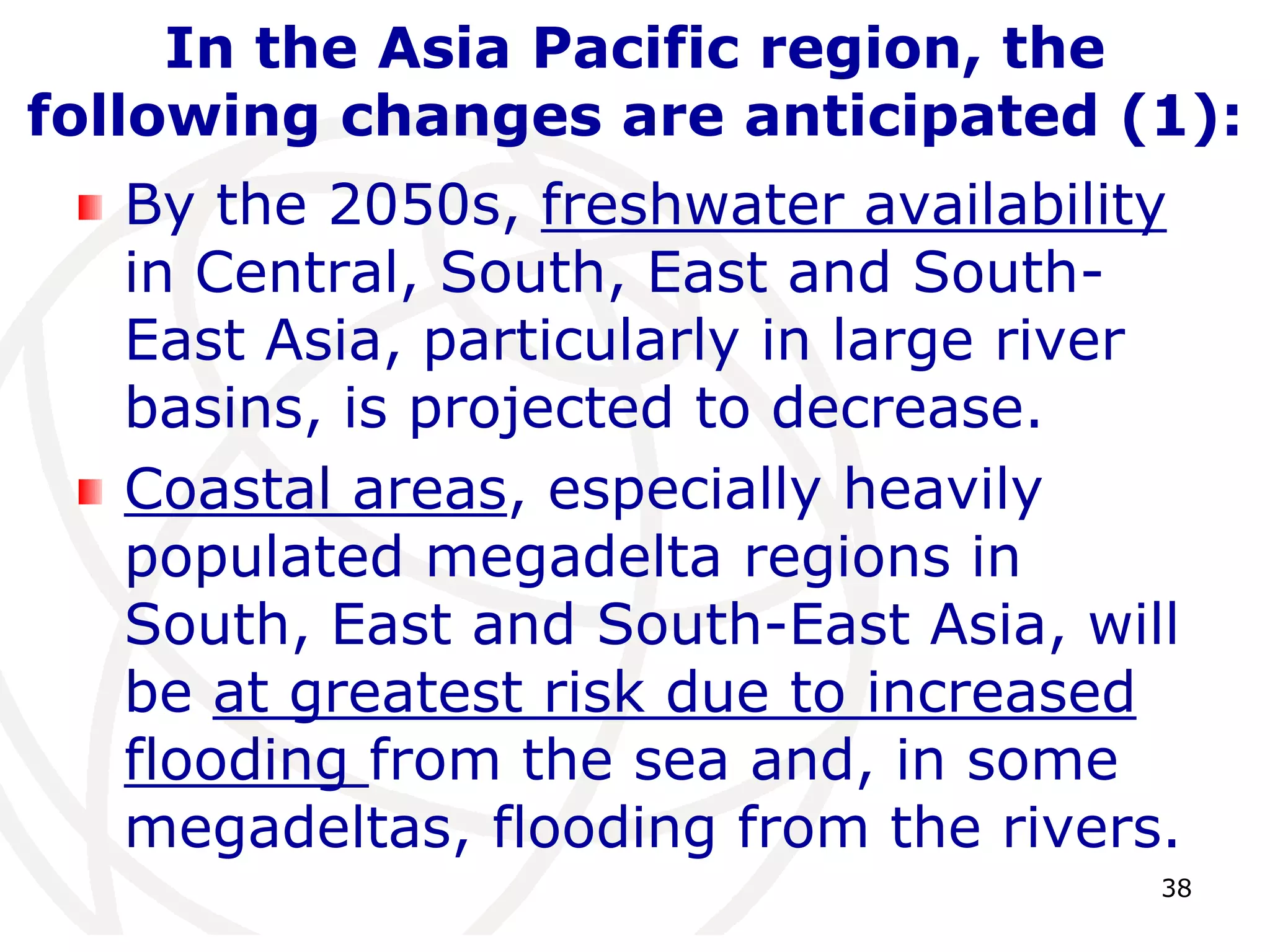
38In the Asia Pacific region, the following changes are anticipated (1):By the 2050s, freshwater availability in Central, South, East and South-East Asia, particularly in large river basins, is projected to decrease. Coastal areas, especially heavily populated megadelta regions in South, East and South-East Asia, will be at greatest risk due to increased flooding from the sea and, in some megadeltas, flooding from the rivers.
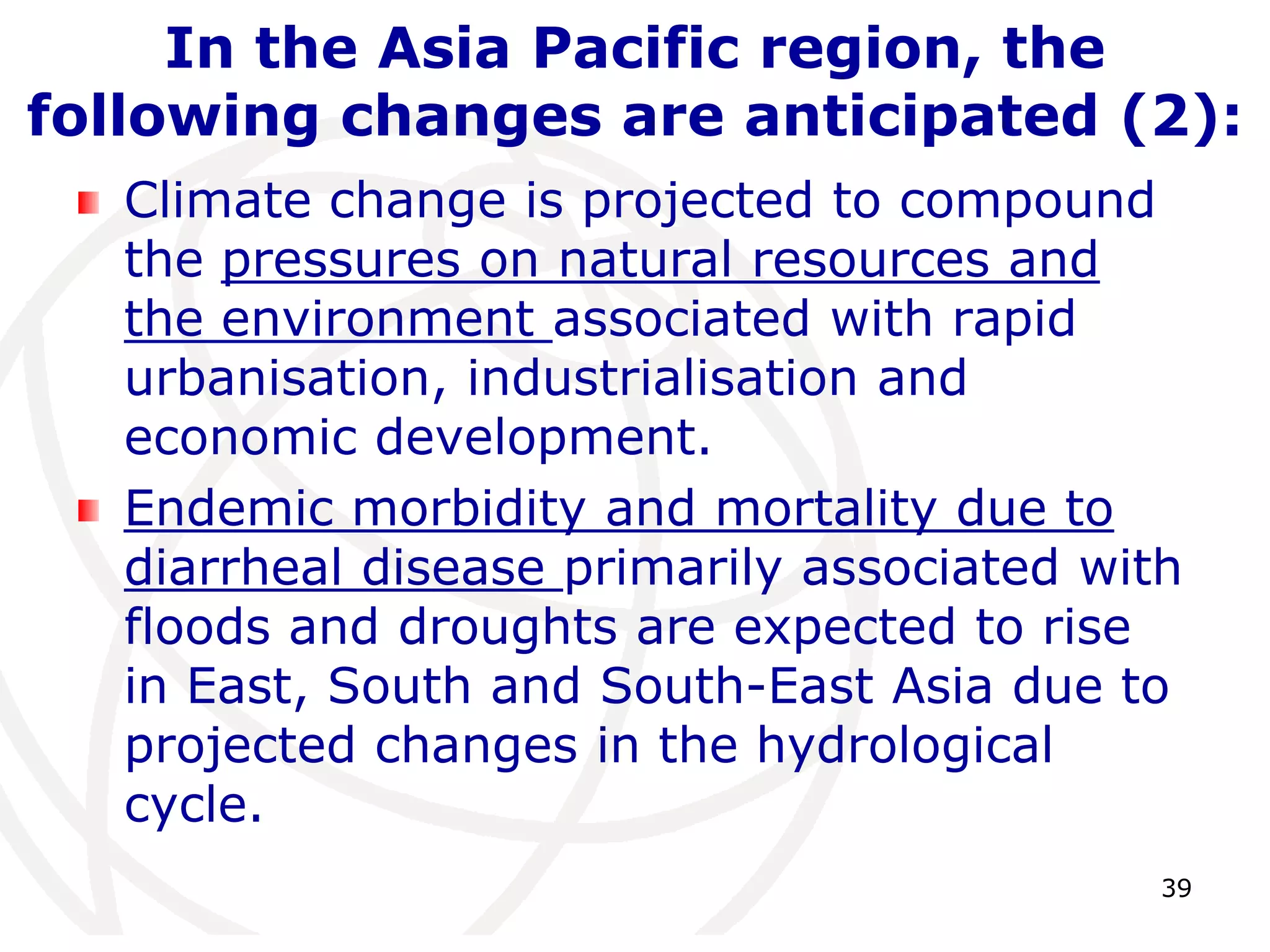
39In the Asia Pacific region, the following changes are anticipated (2):Climate change is projected to compound the pressures on natural resources and the environment associated with rapid urbanisation, industrialisation and economic development. Endemic morbidity and mortality due to diarrheal disease primarily associated with floods and droughts are expected to rise in East, South and South-East Asia due to projected changes in the hydrological cycle.
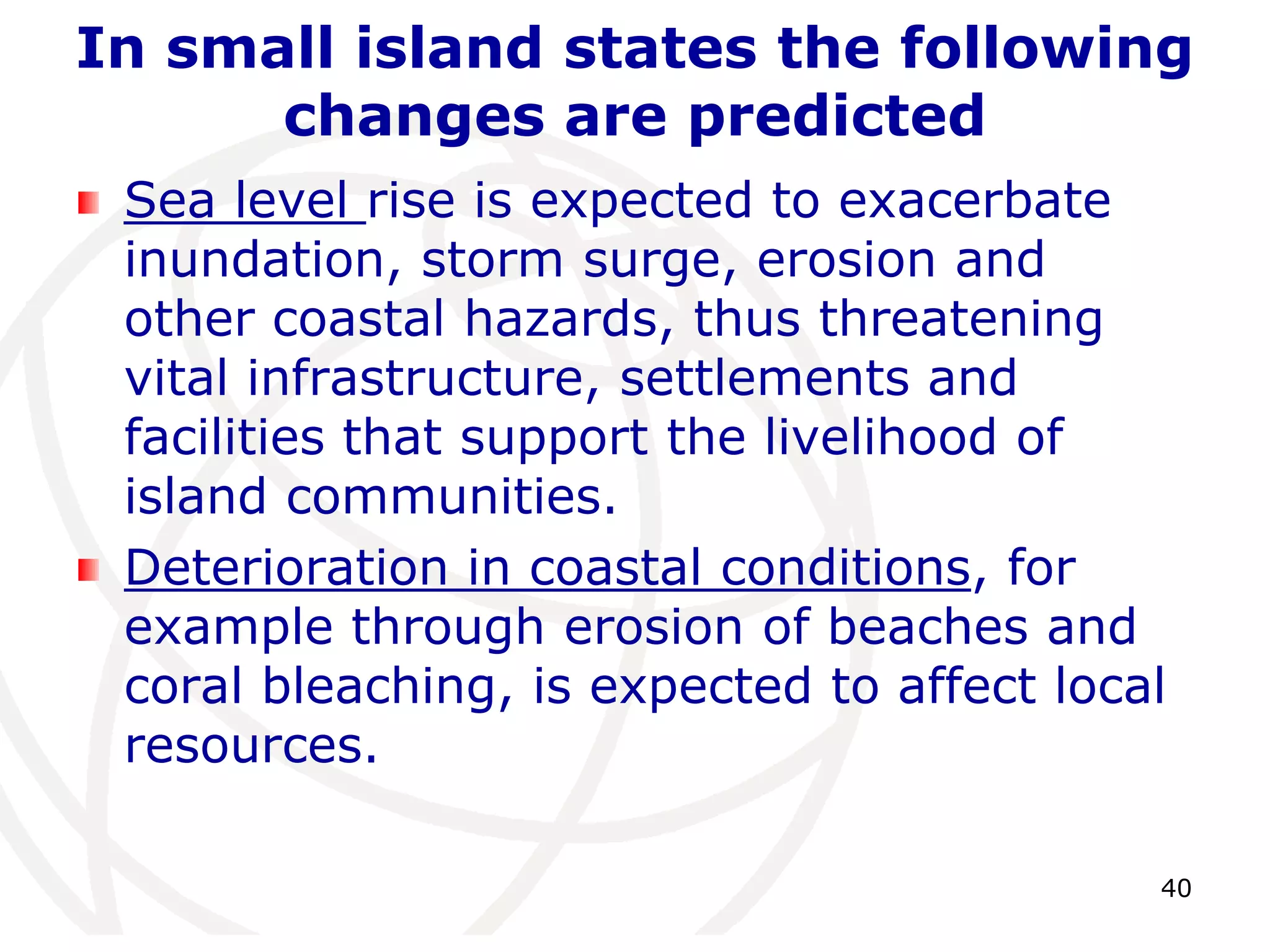
40In small island states the following changes are predictedSea level rise is expected to exacerbate inundation, storm surge, erosion and other coastal hazards, thus threatening vital infrastructure, settlements and facilities that support the livelihood of island communities.Deterioration in coastal conditions, for example through erosion of beaches and coral bleaching, is expected to affect local resources.
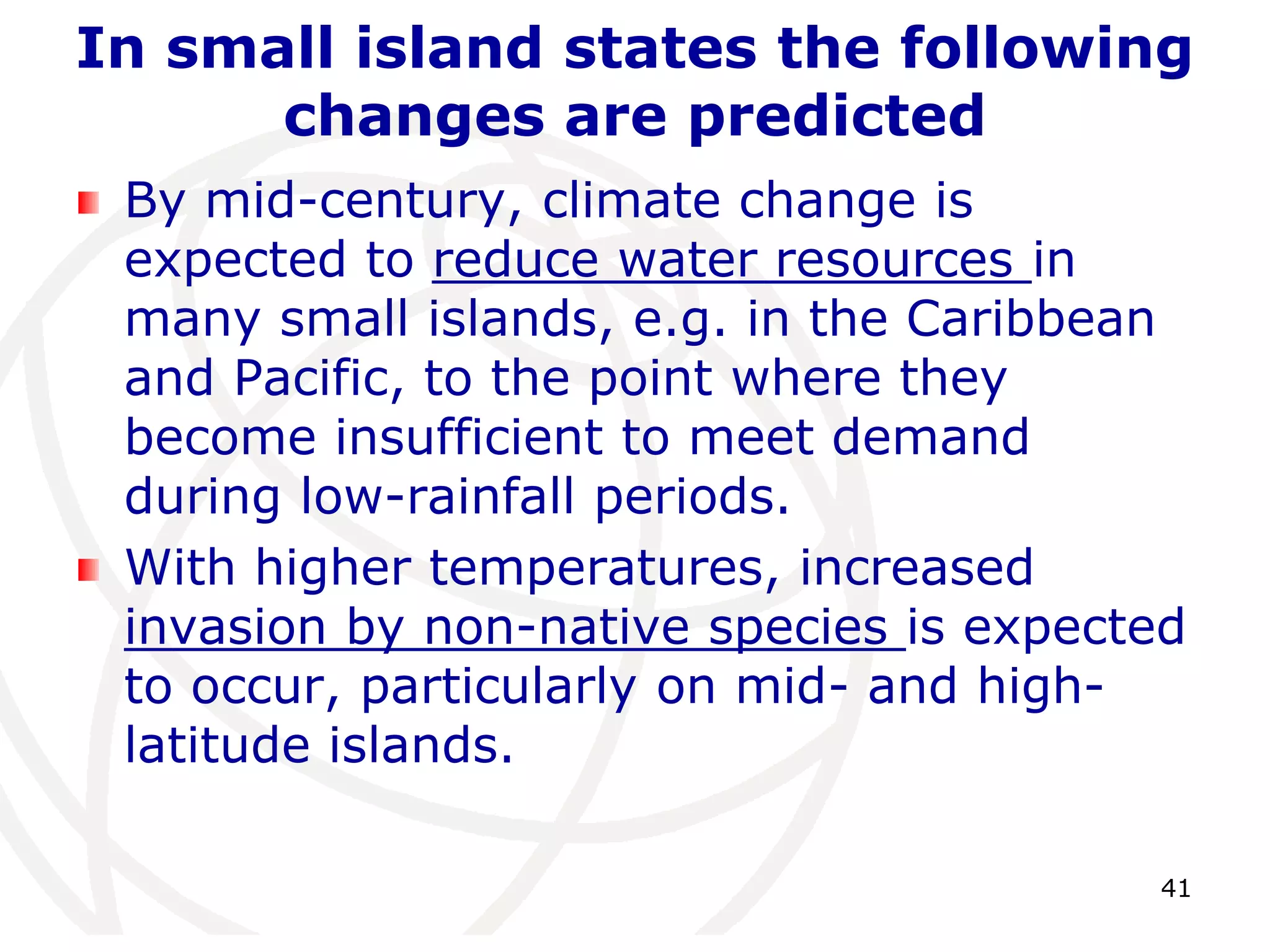
41In small island states the following changes are predictedBy mid-century, climate change is expected to reduce water resources in many small islands, e.g. in the Caribbean and Pacific, to the point where they become insufficient to meet demand during low-rainfall periods. With higher temperatures, increased invasion by non-native species is expected to occur, particularly on mid- and high-latitude islands.
42Solutions going forward: two issues & how to deal with themIncreasing demand for energyWill need both fossil fuels & new and alternate energyNeed to limit GHG emissionsNeed to replace emissions from fossil fuel emitting sources
43We have a problem!Renewables are plentiful but require massive investment to fully replace fossil fuels23,000 CMO / yr. from solar.. but…Now using about 0.2 CMO/yr fm solarFor 1 CMO solar: 70,000 x 100 MW Spain Andasol solar thermal @ $ 14 Trillion27 Andasol projects/ week for 50 yrs!At present rate of E demand – need 270 CMO by 2050!
44Predicted global energy use in CMO under 4 different scenarios[1]Crane, H.D., E. M. Kinderman & R. Malhotra. 2010. A cubic mile of oil. Realities and options for averting the looming global energy crisis. Oxford University Press, New York, 297 pp. http://www.oup.com/us/companion.websites/9780195325546/?view=usa
45Proportion of energy expressed in CMO from different primary sources (2006 data)[1]Crane, H.D., E. M. Kinderman & R. Malhotra. 2010. A cubic mile of oil. Realities and options for averting the looming global energy crisis. Oxford University Press, New York, 297 pp. http://www.oup.com/us/companion.websites/9780195325546/?view=usa
46IEA estimate of renewable and other power technology investments for lowest GHG emissions[1][IEA. 2010. Energy Technology Perspectives 2010. Lisbon, 21 October 2010. http://www.renewable.pt/pt/Noticias/Documents/2010_Nobuo_Tanaka.pdf
47Global change & global actionLack of unified commitment to UNFCCC process does not mean lack of action…
48The top ten countries leading investment in clean energy technologies [1][Pew Charitable Trusts. 2010. The clean energy economy. China Leads G-20 Members in Clean Energy Finance and Investment. http://www.pewglobalwarming.org/cleanenergyeconomy/pr_24mar2010.html
49Some elements of a solutionNo silver bullet (no single solution)Mix of approaches neededEfficiency and conservation very very importantTransition from fossil fuels with focus on renewables & efficiency, CCS, +/- nuclearWWF 2011: possible to (mostly) replace fossil fuels with renewables by 2050... without nuclear or CCS
50The past contribution of energy efficiency[1]Segar, C. 2009. International energy co-operation and global energy security. International Energy Agency (IEA). Session on “Ensuring the sustainability of energy supply chain”, Conference on Strengthening Energy Security in the OSCE area, Bratislava, 6 – 7 July 2009. PowerPoint presentation. http://www.osce.org/documents/eea/2009/07/38666_en.pdf
51Energy efficiency will have major role to play in achieving low C future (IEA)[1]IEA. 2010. World Energy Outlook 2010. N. Tanaka, Executive Director, IEA, Beijing, 17 Nov. 2010. PowerPoint presentation. 35 slides. http://www.energy.eu/publications/weo_2010-China.pdf
52ICTs are key!
53ICTs enhance efficiency & facilitate conservation by (1):Process efficiencyDoing things fasterUse less energy  emit less CConnecting everything:  The Internet of ThingsMeasuring everything: The Internet of Things More info on energy use
54ICTs enhance efficiency & facilitate conservation by (2):Controlling everythingSmart controlsConnect & control all motors & energy consumption (embedded controls)More options to reduce consumption: smart logistics /transport & cities
55Different measures and technologies will be needed to get the world onto a 2°C path[1][World Bank. 2010. World Development Report. Development and Climate Change. Figure 8. World Bank, Washington, D.C. 439 pp.
56IEA: Key technologies for reducing CO2 emissions under the BLUE Map scenario[1][IEA. 2010. Energy Technology Perspectives 2010. Scenarios & strategies to 2050. Executive Summary. OECD/IEA, Paris, 20 pp. http://www.iea.org/Textbase/npsum/etp2010sum.pdf
57Discussion
Thank YouVisit ava.unapcict.org for more infoand free online learning courses.Twitter : @unapcict (twitter.com/unapcict)United Nations Asian and Pacific Training Centre for Information and Communication Technology for Development

Module 10 definition & causes of climate change & impact on ap region

  • 1.
    Definition & causesof climate change, impact on development with focus on Asia PacificRichard Labellerlab@sympatico.caModule 10 Session 1(Seoul, Korea, 23 February 2011)
  • 2.
    2Objectives of Module10To show that ICTs can be used to address climate changeTo demonstrate why ICTs are a crucial part of the solution – i.e. in promoting efficiency, Green Growth & sustainable development
  • 3.
    3What is climatechange?Any change in climate over time, whether due to natural variability or as a result of human activity[IPCC. 2007. Climate Change 2007: Synthesis Report. Contribution of Working Groups I, II and III to the Fourth Assessment Report of the Intergovernmental Panel on Climate Change. IPCC. Core Writing Team, Pachauri, R.K. and Reisinger, A. (Eds.). IPCC, Geneva, Switzerland. pp 104. http://www.ipcc.ch/publications_and_data/publications_ipcc_fourth_assessment_report_synthesis_report.htm
  • 4.
    4DiscussionIs climate changereal?How is it affecting your country or region?Summarize the evidence of climate change in your regions (4 groups)[IPCC. 2007. Climate Change 2007: Synthesis Report. Contribution of Working Groups I, II and III to the Fourth Assessment Report of the Intergovernmental Panel on Climate Change. IPCC. Core Writing Team, Pachauri, R.K. and Reisinger, A. (Eds.). IPCC, Geneva, Switzerland. pp 104. http://www.ipcc.ch/publications_and_data/publications_ipcc_fourth_assessment_report_synthesis_report.htm
  • 5.
    5The causes ofclimate change (1)The variability in the composition of the constituents of the global atmosphere that affects the energy balance of the planet earthWhen certain gases which absorb solar radiation and emit heat increase in concentration in the atmosphere, this can lead to global warming and climate change
  • 6.
    6The causes ofclimate change (2)Atmospheric gases that absorb solar radiation more than others retain heat that warms the atmosphere and the surface of the planetThis leads to global warming and climate change
  • 7.
    7What is globalwarming?Increase in the average temperature of Earth's near-surface air and oceans since the mid-20th century and its projected continuation. Global surface temperature increased 0.74 ± 0.18 °C (1.33 ± 0.32 °F) between the start and the end of the 20th century.Wikipedia. 2010. Global warming. Last modified March 18, 2010, 1621. http://en.wikipedia.org/wiki/Global_warming#cnote_A
  • 8.
    8Natural greenhouse gases(GHGs)Naturally occurring GHGs:Water vapor (H2O), Carbon dioxide (CO2), Nitrous oxide (N2O), Methane (CH4), Ozone (O3).
  • 9.
    9Human-made greenhouse gases(GHGs)Sulfur hexaflouride (SF6)Hydrofluorocarbons (HFCs)Perfluorocarbons (PFCs).
  • 10.
    10Relative contribution ofGHGs to global warming[1]
  • 11.
    The greenhouse effect11Greenpeace.2005. Image. The greenhouse effect. Illustration of the greenhouse effect.http://www.greenpeace.org/international/photosvideos/photos/greenhouse_effect?mode=send
  • 12.
    12Atmospheric concentrations ofcarbon dioxide (CO2) - Mauna Loa or Keeling curve[1]Wikipedia. 2010. Mauna Loa Carbon Dioxide-en.svg. Own work, from Image:Mauna Loa Carbon Dioxide.png, uploaded in Commons by Nils Simon under licence GFDL & CC-NC-SA ; itself created by Robert A. Rohde from NOAA published data and is incorporated into the Global Warming Art project.http://en.wikipedia.org/wiki/File:Mauna_Loa_Carbon_Dioxide-en.svg
  • 13.
    13Atmospheric concentrations ofCO2 January 2011:  391.19 ppm[1]http://www.esrl.noaa.gov/gmd/ccgg/trends/
  • 14.
    14Evidence of climatechange comes from:Data on global average surface temperatures; Global average sea level riseThe thermal expansion of the water in the oceans plus the amount of glacier ice that has melted and that has led by extension to a rise in the level of the oceans around the worldNorthern hemisphere snow cover.
  • 15.
    15Changes in temperature,sea level and Northern Hemisphere snow cover[1][IPCC. 2007. Climate Change 2007: Synthesis Report. Contribution of Working Groups I, II and III to the Fourth Assessment Report of the Intergovernmental Panel on Climate Change. IPCC. Core Writing Team, Pachauri, R.K. and Reisinger, A. (Eds.). IPCC, Geneva, Switzerland. pp 104. http://www.ipcc.ch/publications_and_data/publications_ipcc_fourth_assessment_report_synthesis_report.htm
  • 16.
    16Fluctuations in T(red line) and in the atmospheric concentration of CO2 (yellow) over the past 649,000 years[1]US. EPA. 2009. Climate change science. Figure 1: Changes in Carbon Dioxide and Temperature. 8 Sept. 2009. http://www.epa.gov/climatechange/science/pastcc_fig1.html
  • 17.
    17Changes in CO2from ice core and modern data over a period of 10,000 years before the present[1][IPCC. 2007. Climate Change 2007: Synthesis Report. Contribution of Working Groups I, II and III to the Fourth Assessment Report of the Intergovernmental Panel on Climate Change. IPCC. Core Writing Team, Pachauri, R.K. and Reisinger, A. (Eds.). IPCC, Geneva, Switzerland. pp 104. http://www.ipcc.ch/publications_and_data/publications_ipcc_fourth_assessment_report_synthesis_report.htm
  • 18.
    18Global and continentaltemperature change[1][IPCC. 2007. Climate Change 2007: Synthesis Report. Contribution of Working Groups I, II and III to the Fourth Assessment Report of the Intergovernmental Panel on Climate Change. IPCC. Core Writing Team, Pachauri, R.K. and Reisinger, A. (Eds.). IPCC, Geneva, Switzerland. pp 104. http://www.ipcc.ch/publications_and_data/publications_ipcc_fourth_assessment_report_synthesis_report.htm
  • 19.
    19Other explanations forclimate changeNatural phenomenaLong range natural cycle of climate change
  • 20.
    20Mapping the globalvariation in CO2 emissions[1]UNDP. 2007. Human Development Report 2007/2008. Fighting climate change: Human solidarity in a divided world. Map. 1.1. UNDP, New York. 399 pp.
  • 21.
    21Most important sourcesof GHG emissionsFossil fuel related energy emissionsEmissions from land-use changes and then agriculture where much of the releases are due to methane release and nitrous oxides escaping from the soil surface of cultivated land.
  • 22.
    22Share of differentsectors in total anthropogenic GHG emissions in 2004 in terms of CO2-eq. (Forestry includes deforestation)[1]IPCC. 2007. Climate Change 2007: Synthesis Report. Contribution of Working Groups I, II and III to the Fourth Assessment Report of the Intergovernmental Panel on Climate Change. IPCC. Core Writing Team, Pachauri, R.K. and Reisinger, A. (Eds.). IPCC, Geneva, Switzerland. pp 104. http://www.ipcc.ch/publications_and_data/publications_ipcc_fourth_assessment_report_synthesis_report.htm
  • 23.
    23[1]World Resources Institute.2005. Climate Analysis Indicator Tool (CAIT), Navigating the Numbers: Greenhouse Gas Data and International Climate Policy, December 2005. Intergovernmental Panel on Climate Change, 1996 (data for 2000). http://maps.grida.no/go/graphic/world-greenhouse-gas-emissions-by-sector1
  • 24.
    24Group discussionCan ICTshave a role in reducing emissions from these sectors?How?Choose 2 sectors and discuss how ICTs can limit or help avoid GHG emissions
  • 25.
    25Life Cycle GHGEmissions for Selected Power Generation Technologies[1]IAEA. 2010. Judge Nuclear. IAEA Bulletin51-2, April 2010. Pp. 16.19. http://www.iaea.or.at/OurWork/ST/NE/judge-nuclear.html
  • 26.
    26Shares of Non-FossilSources in the Electricity Sector and CO2 Intensities for Selected Countries in 2006[1]IAEA. 2010. Judge Nuclear. IAEA Bulletin51-2, April 2010. Pp. 16.19. http://www.iaea.or.at/OurWork/ST/NE/judge-nuclear.htmll
  • 27.
    27IPCC Projections ofsurface warming as a result of increasing GHG emissions[1][IPCC. 2007. Climate Change 2007: Synthesis Report. Contribution of Working Groups I, II and III to the Fourth Assessment Report of the Intergovernmental Panel on Climate Change. IPCC. Core Writing Team, Pachauri, R.K. and Reisinger, A. (Eds.). IPCC, Geneva, Switzerland. pp 104. http://www.ipcc.ch/publications_and_data/publications_ipcc_fourth_assessment_report_synthesis_report.htm
  • 28.
    28Fossil fuel emissions:actual vs. IPCC scenarios[1]Global Carbon Project. 2009. Carbon 2008. Budget 08 Released on 17 November 2009. GCP-Global Carbon Budget Consortium. PowerPoint presentation. GCP-Global Carbon Budget Consortium. 38 slides.
  • 29.
    29Growth in fossilfuel demandGrowth in fossil fuel demand is following the worst case scenarios predicted by a variety of different experts
  • 30.
    30What is drivingenergy demand?Growing population & affluence Shift in global growth to emerging markets
  • 31.
    31What is affectingenergy prices? (1)Price, availability and security of energy supplies Environmental risks associated with hard to access oil resourcesOffshore & deep sea drillingDrilling in sensitive ecosystems: the Arctic/Antarctic, coastal areas, etc.Extracting heavy oil (Oil sands, heavy oil)Hydraulic fracturing: shale gas
  • 32.
    32What is affectingenergy prices? (2)Global security issuesPolicy uncertainty on fossil fuels & renewablesInvestment paralysis in the WestChina votes for investing in both fossil fuels & renewables!
  • 33.
    33Growth in Worldprimary energy demand to 2035, IEA New Policies Scenario[1]IEA. 2010. World Energy Outlook 2010. N. Tanaka, Executive Director, IEA, Beijing, 17 Nov. 2010. PowerPoint presentation. 35 slides. http://www.energy.eu/publications/weo_2010-China.pdf
  • 34.
    34The impact ofclimate change (1)The efficiency of CO2 sinks is downAtmospheric CO2 is being added at the rate of 2ppm annuallyMethane up after 10 years of being stableCarbonate calcium walls of marine life are down. The oceans are getting more acidic.
  • 35.
    35The impact ofclimate change (2)Oceans have warmed up fasterArctic sea ice is at a low peakGreenland ice sheets have decreased in sizeFossil fuel emissions are above worst case scenariosDeforestation emissions continue and are high
  • 36.
    36Examples of impactsassociated with global average temperature change (Impacts will vary by extent of adaptation, rate of temperature change and socio-economic pathway)[1]IPCC. 2007. Climate Change 2007: Synthesis Report. Contribution of Working Groups I, II and III to the Fourth Assessment Report of the Intergovernmental Panel on Climate Change. IPCC. Core Writing Team, Pachauri, R.K. and Reisinger, A. (Eds.). IPCC, Geneva, Switzerland. pp 104. http://www.ipcc.ch/publications_and_data/publications_ipcc_fourth_assessment_report_synthesis_report.htm
  • 37.
    Impacts from increasingGHGs levels in the atmosphere37[1] Stern, N. 2006. Stern Review on the economics of climate change (pre-publication edition). Executive summary. HM Treasury. London. 27 pp. http://www.hm-treasury.gov.uk/sternreview_index.htm
  • 38.
    38In the AsiaPacific region, the following changes are anticipated (1):By the 2050s, freshwater availability in Central, South, East and South-East Asia, particularly in large river basins, is projected to decrease. Coastal areas, especially heavily populated megadelta regions in South, East and South-East Asia, will be at greatest risk due to increased flooding from the sea and, in some megadeltas, flooding from the rivers.
  • 39.
    39In the AsiaPacific region, the following changes are anticipated (2):Climate change is projected to compound the pressures on natural resources and the environment associated with rapid urbanisation, industrialisation and economic development. Endemic morbidity and mortality due to diarrheal disease primarily associated with floods and droughts are expected to rise in East, South and South-East Asia due to projected changes in the hydrological cycle.
  • 40.
    40In small islandstates the following changes are predictedSea level rise is expected to exacerbate inundation, storm surge, erosion and other coastal hazards, thus threatening vital infrastructure, settlements and facilities that support the livelihood of island communities.Deterioration in coastal conditions, for example through erosion of beaches and coral bleaching, is expected to affect local resources.
  • 41.
    41In small islandstates the following changes are predictedBy mid-century, climate change is expected to reduce water resources in many small islands, e.g. in the Caribbean and Pacific, to the point where they become insufficient to meet demand during low-rainfall periods. With higher temperatures, increased invasion by non-native species is expected to occur, particularly on mid- and high-latitude islands.
  • 42.
    42Solutions going forward:two issues & how to deal with themIncreasing demand for energyWill need both fossil fuels & new and alternate energyNeed to limit GHG emissionsNeed to replace emissions from fossil fuel emitting sources
  • 43.
    43We have aproblem!Renewables are plentiful but require massive investment to fully replace fossil fuels23,000 CMO / yr. from solar.. but…Now using about 0.2 CMO/yr fm solarFor 1 CMO solar: 70,000 x 100 MW Spain Andasol solar thermal @ $ 14 Trillion27 Andasol projects/ week for 50 yrs!At present rate of E demand – need 270 CMO by 2050!
  • 44.
    44Predicted global energyuse in CMO under 4 different scenarios[1]Crane, H.D., E. M. Kinderman & R. Malhotra. 2010. A cubic mile of oil. Realities and options for averting the looming global energy crisis. Oxford University Press, New York, 297 pp. http://www.oup.com/us/companion.websites/9780195325546/?view=usa
  • 45.
    45Proportion of energyexpressed in CMO from different primary sources (2006 data)[1]Crane, H.D., E. M. Kinderman & R. Malhotra. 2010. A cubic mile of oil. Realities and options for averting the looming global energy crisis. Oxford University Press, New York, 297 pp. http://www.oup.com/us/companion.websites/9780195325546/?view=usa
  • 46.
    46IEA estimate ofrenewable and other power technology investments for lowest GHG emissions[1][IEA. 2010. Energy Technology Perspectives 2010. Lisbon, 21 October 2010. http://www.renewable.pt/pt/Noticias/Documents/2010_Nobuo_Tanaka.pdf
  • 47.
    47Global change &global actionLack of unified commitment to UNFCCC process does not mean lack of action…
  • 48.
    48The top tencountries leading investment in clean energy technologies [1][Pew Charitable Trusts. 2010. The clean energy economy. China Leads G-20 Members in Clean Energy Finance and Investment. http://www.pewglobalwarming.org/cleanenergyeconomy/pr_24mar2010.html
  • 49.
    49Some elements ofa solutionNo silver bullet (no single solution)Mix of approaches neededEfficiency and conservation very very importantTransition from fossil fuels with focus on renewables & efficiency, CCS, +/- nuclearWWF 2011: possible to (mostly) replace fossil fuels with renewables by 2050... without nuclear or CCS
  • 50.
    50The past contributionof energy efficiency[1]Segar, C. 2009. International energy co-operation and global energy security. International Energy Agency (IEA). Session on “Ensuring the sustainability of energy supply chain”, Conference on Strengthening Energy Security in the OSCE area, Bratislava, 6 – 7 July 2009. PowerPoint presentation. http://www.osce.org/documents/eea/2009/07/38666_en.pdf
  • 51.
    51Energy efficiency willhave major role to play in achieving low C future (IEA)[1]IEA. 2010. World Energy Outlook 2010. N. Tanaka, Executive Director, IEA, Beijing, 17 Nov. 2010. PowerPoint presentation. 35 slides. http://www.energy.eu/publications/weo_2010-China.pdf
  • 52.
  • 53.
    53ICTs enhance efficiency& facilitate conservation by (1):Process efficiencyDoing things fasterUse less energy  emit less CConnecting everything: The Internet of ThingsMeasuring everything: The Internet of Things More info on energy use
  • 54.
    54ICTs enhance efficiency& facilitate conservation by (2):Controlling everythingSmart controlsConnect & control all motors & energy consumption (embedded controls)More options to reduce consumption: smart logistics /transport & cities
  • 55.
    55Different measures andtechnologies will be needed to get the world onto a 2°C path[1][World Bank. 2010. World Development Report. Development and Climate Change. Figure 8. World Bank, Washington, D.C. 439 pp.
  • 56.
    56IEA: Key technologiesfor reducing CO2 emissions under the BLUE Map scenario[1][IEA. 2010. Energy Technology Perspectives 2010. Scenarios & strategies to 2050. Executive Summary. OECD/IEA, Paris, 20 pp. http://www.iea.org/Textbase/npsum/etp2010sum.pdf
  • 57.
  • 58.
    Thank YouVisit ava.unapcict.orgfor more infoand free online learning courses.Twitter : @unapcict (twitter.com/unapcict)United Nations Asian and Pacific Training Centre for Information and Communication Technology for Development