Can a Greener Internet Help Us
         Moderate Climate Change?

           High Definition Remote Presentation to the
Monash Undergraduate Research Projects Abroad (MURPA) Program
            Located at Monash University, Australia
                       From Calit2@UCSD
                          May 13, 2009

                                Dr. Larry Smarr
         Director, California Institute for Telecommunications and
                           Information Technology
                         Harry E. Gruber Professor,
               Dept. of Computer Science and Engineering
                   Jacobs School of Engineering, UCSD
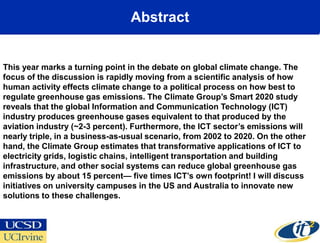
Abstract


This year marks a turning point in the debate on global climate change. The
focus of the discussion is rapidly moving from a scientific analysis of how
human activity effects climate change to a political process on how best to
regulate greenhouse gas emissions. The Climate Group’s Smart 2020 study
reveals that the global Information and Communication Technology (ICT)
industry produces greenhouse gases equivalent to that produced by the
aviation industry (~2-3 percent). Furthermore, the ICT sector’s emissions will
nearly triple, in a business-as-usual scenario, from 2002 to 2020. On the other
hand, the Climate Group estimates that transformative applications of ICT to
electricity grids, logistic chains, intelligent transportation and building
infrastructure, and other social systems can reduce global greenhouse gas
emissions by about 15 percent— five times ICT’s own footprint! I will discuss
initiatives on university campuses in the US and Australia to innovate new
solutions to these challenges.
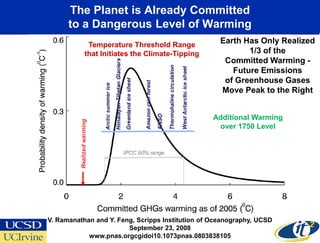
The Planet is Already Committed
      to a Dangerous Level of Warming
            Temperature Threshold Range
                                                    Earth Has Only Realized
           that Initiates the Climate-Tipping              1/3 of the
                                                     Committed Warming -
                                                       Future Emissions
                                                     of Greenhouse Gases
                                                    Move Peak to the Right


                                                  Additional Warming
                                                   over 1750 Level


V. Ramanathan and Y. Feng, Scripps Institution of Oceanography, UCSD
                        September 23, 2008
            www.pnas.orgcgidoi10.1073pnas.0803838105
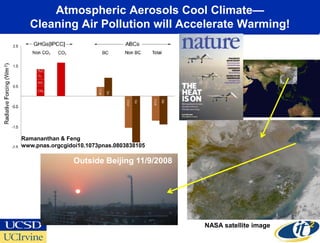
Atmospheric Aerosols Cool Climate—
  Cleaning Air Pollution will Accelerate Warming!


Ramananthan & Feng
www.pnas.orgcgidoi10.1073pnas.0803838105

                Outside Beijing 11/9/2008


                                            NASA satellite image
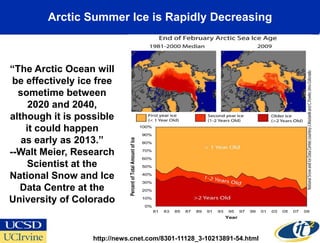
Arctic Summer Ice is Rapidly Decreasing


“The Arctic Ocean will
 be effectively ice free
  sometime between
     2020 and 2040,
although it is possible
    it could happen
   as early as 2013.”
--Walt Meier, Research
    Scientist at the
National Snow and Ice
  Data Centre at the
University of Colorado


                   http://news.cnet.com/8301-11128_3-10213891-54.html
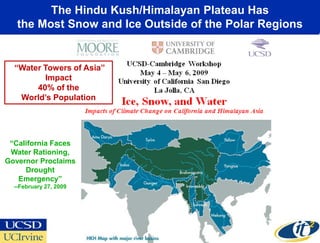
The Hindu Kush/Himalayan Plateau Has
   the Most Snow and Ice Outside of the Polar Regions


  “Water Towers of Asia”
         Impact
       40% of the
   World’s Population


 “California Faces
 Water Rationing,
Governor Proclaims
     Drought
   Emergency”
  --February 27, 2009
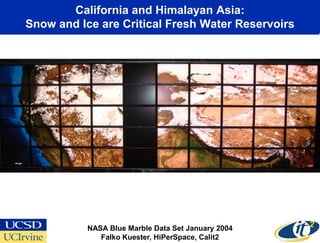
California and Himalayan Asia:
Snow and Ice are Critical Fresh Water Reservoirs


           NASA Blue Marble Data Set January 2004
              Falko Kuester, HiPerSpace, Calit2
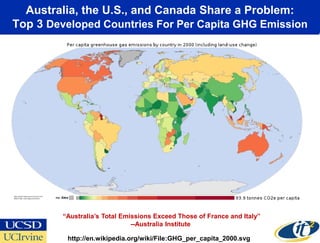
Australia, the U.S., and Canada Share a Problem:
Top 3 Developed Countries For Per Capita GHG Emission


         “Australia’s Total Emissions Exceed Those of France and Italy”
                               --Australia Institute

          http://en.wikipedia.org/wiki/File:GHG_per_capita_2000.svg
Countries and States are Setting Aggressive
    Greenhouse Gas Reduction Goals


"Australia is today the biggest carbon polluter
 in the developed world on a per capita basis,
        yet we are the developed country
  with the most to lose from climate change.
        Without action on climate change,
   Australia faces a future of parched farms,
     bleached reefs, and empty reservoirs."
     --Australian Prime Minister Kevin Rudd


  www.guardian.co.uk/environment/2008/dec/15/climate-change-australia
“It Will Be the Biggest Single Peacetime Project
     Humankind Will Have Ever Undertaken”
The IPCC Recommends
     a 25-40% Reduction Below 1990 Levels by 2020
• On September 27, 2006, Governor Schwarzenegger signed
  California the Global Warming Solutions Act of 2006
   – Assembly Bill 32 (AB32)
   – Requires Reduction of GHG by 2020 Only to 1990 Levels
      – 10% Reduction from 2008 Levels; 30% from BAU 2020 Levels
      – 4 Tons of CO2-equiv. Reduction for Every Person in California!
• The European Union Requires Reduction of GHG by 2020 to
  20% Below 1990 Levels (12/12/2008)
• Australia has Pledged to Cut by 2020 its GHG Emissions 5%
  from 2000 Levels via the World's Broadest Cap &Trade Scheme
  (12/15/08) [~5% Below 1990 Levels]
• Neither the U.S. or Canada has an Official Target Yet
   – President Obama Has Endorsed the AB32 2020 Goal
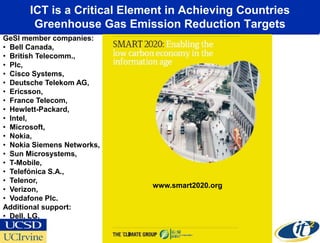
ICT is a Critical Element in Achieving Countries
       Greenhouse Gas Emission Reduction Targets
GeSI member companies:
• Bell Canada,
• British Telecomm.,
• Plc,
• Cisco Systems,
• Deutsche Telekom AG,
• Ericsson,
• France Telecom,
• Hewlett-Packard,
• Intel,
• Microsoft,
• Nokia,
• Nokia Siemens Networks,
• Sun Microsystems,
• T-Mobile,
• Telefónica S.A.,
• Telenor,
                            www.smart2020.org
• Verizon,
• Vodafone Plc.
Additional support:
• Dell, LG.
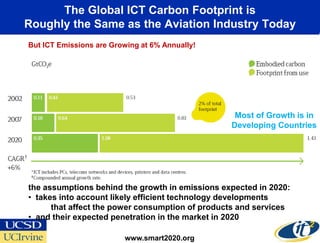
The Global ICT Carbon Footprint is
Roughly the Same as the Aviation Industry Today
But ICT Emissions are Growing at 6% Annually!


                                                  Most of Growth is in
                                                 Developing Countries


the assumptions behind the growth in emissions expected in 2020:
• takes into account likely efficient technology developments
      that affect the power consumption of products and services
• and their expected penetration in the market in 2020

                         www.smart2020.org
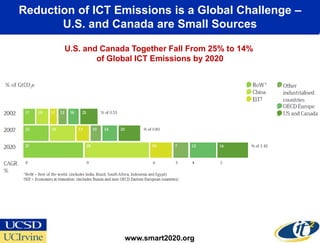
Reduction of ICT Emissions is a Global Challenge –
       U.S. and Canada are Small Sources

        U.S. and Canada Together Fall From 25% to 14%
                of Global ICT Emissions by 2020


                      www.smart2020.org
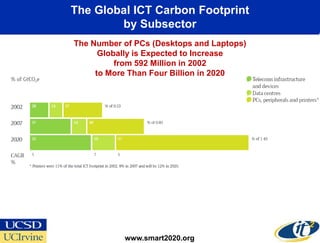
The Global ICT Carbon Footprint
        by Subsector
The Number of PCs (Desktops and Laptops)
      Globally is Expected to Increase
          from 592 Million in 2002
     to More Than Four Billion in 2020


           www.smart2020.org
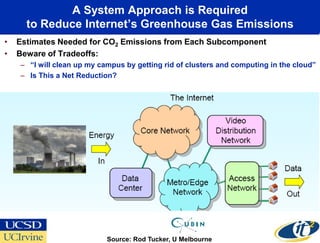
A System Approach is Required
      to Reduce Internet’s Greenhouse Gas Emissions
•   Estimates Needed for CO2 Emissions from Each Subcomponent
•   Beware of Tradeoffs:
    – “I will clean up my campus by getting rid of clusters and computing in the cloud”
    – Is This a Net Reduction?


                            Source: Rod Tucker, U Melbourne
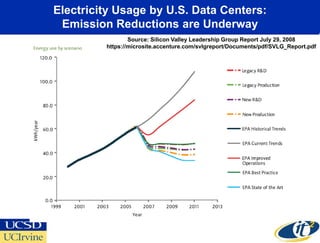
Electricity Usage by U.S. Data Centers:
 Emission Reductions are Underway
                 Source: Silicon Valley Leadership Group Report July 29, 2008
         https://microsite.accenture.com/svlgreport/Documents/pdf/SVLG_Report.pdf
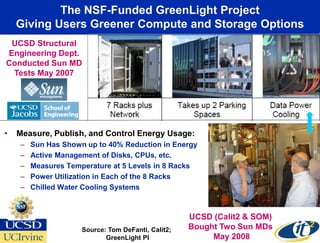
The NSF-Funded GreenLight Project
    Giving Users Greener Compute and Storage Options
 UCSD Structural
Engineering Dept.
Conducted Sun MD
 Tests May 2007


•   Measure, Publish, and Control Energy Usage:
    –   Sun Has Shown up to 40% Reduction in Energy
    –   Active Management of Disks, CPUs, etc.
    –   Measures Temperature at 5 Levels in 8 Racks
    –   Power Utilization in Each of the 8 Racks
    –   Chilled Water Cooling Systems


                                                    UCSD (Calit2 & SOM)
                     Source: Tom DeFanti, Calit2;   Bought Two Sun MDs
                            GreenLight PI                May 2008
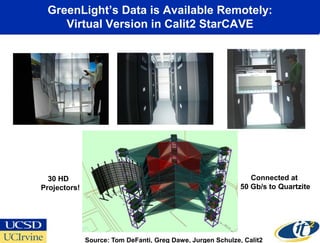
GreenLight’s Data is Available Remotely:
    Virtual Version in Calit2 StarCAVE


  30 HD                                                         Connected at
Projectors!                                                  50 Gb/s to Quartzite


              Source: Tom DeFanti, Greg Dawe, Jurgen Schulze, Calit2
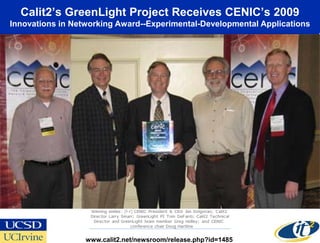
Calit2’s GreenLight Project Receives CENIC’s 2009
Innovations in Networking Award--Experimental-Developmental Applications


                  www.calit2.net/newsroom/release.php?id=1485
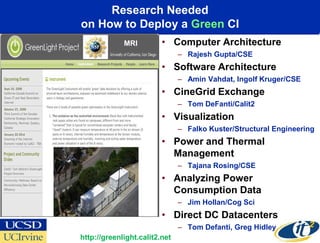
Research Needed
on How to Deploy a Green CI
             MRI         • Computer Architecture
                               – Rajesh Gupta/CSE
                         • Software Architecture
                               – Amin Vahdat, Ingolf Kruger/CSE
                         • CineGrid Exchange
                               – Tom DeFanti/Calit2
                         • Visualization
                               – Falko Kuster/Structural Engineering
                         • Power and Thermal
                           Management
                               – Tajana Rosing/CSE
                         • Analyzing Power
                           Consumption Data
                               – Jim Hollan/Cog Sci
                         • Direct DC Datacenters
                               – Tom Defanti, Greg Hidley
http://greenlight.calit2.net
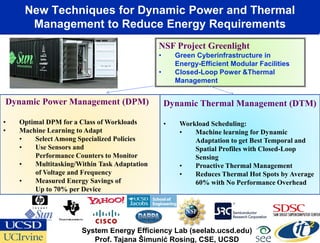
New Techniques for Dynamic Power and Thermal
      Management to Reduce Energy Requirements
                                              NSF Project Greenlight
                                              •       Green Cyberinfrastructure in
                                                      Energy-Efficient Modular Facilities
                                              •       Closed-Loop Power &Thermal
                                                      Management


Dynamic Power Management (DPM)                    Dynamic Thermal Management (DTM)
•   Optimal DPM for a Class of Workloads          •    Workload Scheduling:
•   Machine Learning to Adapt                          •   Machine learning for Dynamic
    •   Select Among Specialized Policies                  Adaptation to get Best Temporal and
    •   Use Sensors and                                    Spatial Profiles with Closed-Loop
        Performance Counters to Monitor                    Sensing
    •   Multitasking/Within Task Adaptation            •   Proactive Thermal Management
        of Voltage and Frequency                       •   Reduces Thermal Hot Spots by Average
    •   Measured Energy Savings of                         60% with No Performance Overhead
        Up to 70% per Device


                      System Energy Efficiency Lab (seelab.ucsd.edu)
                         Prof. Tajana Šimunić Rosing, CSE, UCSD
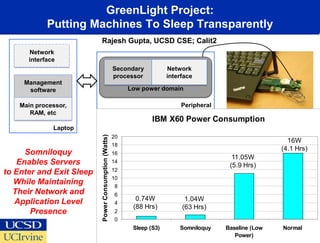
GreenLight Project:
            Putting Machines To Sleep Transparently
                          Rajesh Gupta, UCSD CSE; Calit2
      Network
      interface
                                                      Secondary          Network
                                                      processor          interface
     Management
      software                                             Low power domain

    Main processor,                                                           Peripheral
       RAM, etc
                                                                   IBM X60 Power Consumption
              Laptop
                          Power Consumption (Watts)


                                                      20
                                                                                                             16W
                                                      18
                                                                                                           (4.1 Hrs)
      Somniloquy                                      16
                                                                                             11.05W
    Enables Servers                                   14
                                                                                            (5.9 Hrs)
to Enter and Exit Sleep                               12
                                                      10
   While Maintaining                                   8
   Their Network and                                   6
   Application Level                                         0.74W             1.04W
                                                       4
                                                            (88 Hrs)          (63 Hrs)
       Presence                                        2
                                                       0
                                                            Sleep (S3)       Somniloquy    Baseline (Low
                                                                                             23            Normal
                                                                                              Power)
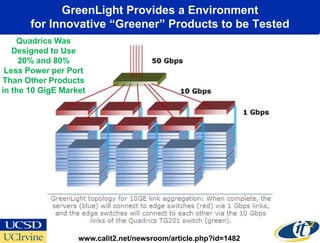
GreenLight Provides a Environment
       for Innovative “Greener” Products to be Tested
    Quadrics Was
   Designed to Use
     20% and 80%
 Less Power per Port
Than Other Products
in the 10 GigE Market


                   www.calit2.net/newsroom/article.php?id=1482
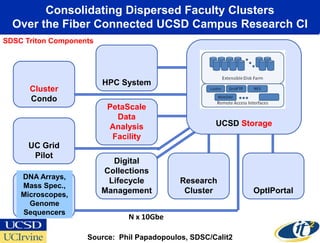
Consolidating Dispersed Faculty Clusters
  Over the Fiber Connected UCSD Campus Research CI
SDSC Triton Components


                         HPC System
      Cluster
      Condo
                          PetaScale
                            Data
                          Analysis                   UCSD Storage
                           Facility
      UC Grid
       Pilot
                           Digital
                         Collections
    DNA Arrays,
                          Lifecycle         Research
    Mass Spec.,
    Microscopes,
                         Management          Cluster         OptIPortal
     Research
      Genome
    Instrument
    Sequencers
                              N x 10Gbe

                    Source: Phil Papadopoulos, SDSC/Calit2
Power Management in the Cellular Infrastructure:
Calit2 Team Achieves 58% Power Amplifier Efficiency
   Standard Commercial Base Station Power Amp is 10% Efficient
        Calit2
                        Power Transistor Tradeoffs:
     High-Power
    Amplifier Lab         Si-LDMOS, GaN, & GaAs
                             Price & Performance


                         Power Amplifier Tradeoffs:
                            WiMAX & 3.9GPP LTE
                             Efficiency & Linearity            STMicroelectronics


                    Digital Signal Processing Tradeoffs:
                      Pre-Distortion, Memory Effects
                             & Power Control
                                MIPS & Memory
                   www.universityofcalifornia.edu/news/article/19058
            Source: Don Kimball, Calit2; Peter Asbeck and Larry Larson, ECE
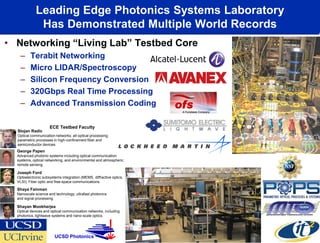
Leading Edge Photonics Systems Laboratory
              Has Demonstrated Multiple World Records
• Networking “Living Lab” Testbed Core
   –      Terabit Networking
   –      Micro LIDAR/Spectroscopy
   –      Silicon Frequency Conversion
   –      320Gbps Real Time Processing
   –      Advanced Transmission Coding

                     ECE Testbed Faculty
  Stojan Radic
  Optical communication networks; all-optical processing;
  parametric processes in high-confinement fiber and
  semiconductor devices.
  George Papen
  Advanced photonic systems including optical communication
  systems, optical networking, and environmental and atmospheric
  remote sensing.

  Joseph Ford
  Optoelectronic subsystems integration (MEMS, diffractive optics,
  VLSI); Fiber optic and free-space communications.

  Shaya Fainman
  Nanoscale science and technology; ultrafast photonics
  and signal processing

  Shayan Mookherjea
  Optical devices and optical communication networks, including
  photonics, lightwave systems and nano-scale optics.


                        UCSD Photonics
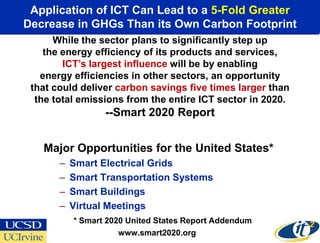
Application of ICT Can Lead to a 5-Fold Greater
Decrease in GHGs Than its Own Carbon Footprint
      While the sector plans to significantly step up
    the energy efficiency of its products and services,
        ICT’s largest influence will be by enabling
   energy efficiencies in other sectors, an opportunity
 that could deliver carbon savings five times larger than
  the total emissions from the entire ICT sector in 2020.
                  --Smart 2020 Report


   Major Opportunities for the United States*
       –   Smart Electrical Grids
       –   Smart Transportation Systems
       –   Smart Buildings
       –   Virtual Meetings
           * Smart 2020 United States Report Addendum
                      www.smart2020.org
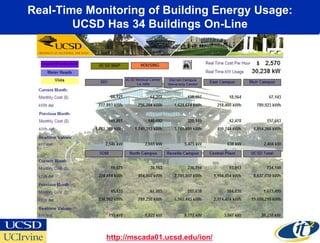
Real-Time Monitoring of Building Energy Usage:
        UCSD Has 34 Buildings On-Line


             http://mscada01.ucsd.edu/ion/
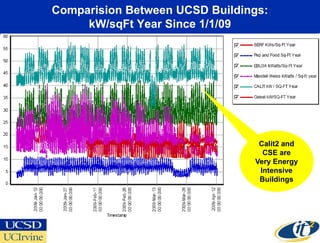
Comparision Between UCSD Buildings:
     kW/sqFt Year Since 1/1/09


                                 Calit2 and
                                  CSE are
                                Very Energy
                                 Intensive
                                 Buildings
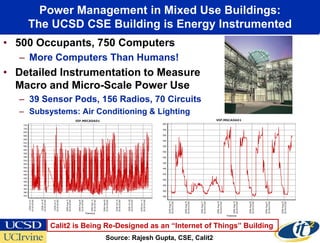
Power Management in Mixed Use Buildings:
     The UCSD CSE Building is Energy Instrumented
• 500 Occupants, 750 Computers
   – More Computers Than Humans!
• Detailed Instrumentation to Measure
  Macro and Micro-Scale Power Use
   – 39 Sensor Pods, 156 Radios, 70 Circuits
   – Subsystems: Air Conditioning & Lighting


          Calit2 is Being Re-Designed as an “Internet of Things” Building
                         Source: Rajesh Gupta, CSE, Calit2
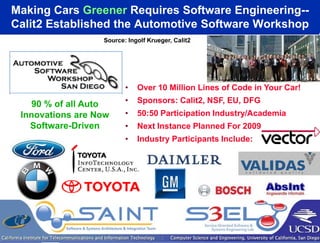
Making Cars Greener Requires Software Engineering--
Calit2 Established the Automotive Software Workshop
                  Source: Ingolf Krueger, Calit2


                         •   Over 10 Million Lines of Code in Your Car!

   90 % of all Auto      •   Sponsors: Calit2, NSF, EU, DFG
 Innovations are Now     •   50:50 Participation Industry/Academia
   Software-Driven       •   Next Instance Planned For 2009
                         •   Industry Participants Include:
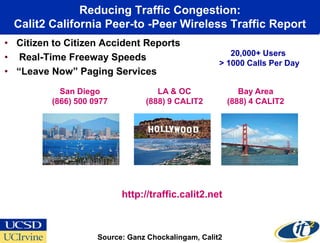
Reducing Traffic Congestion:
 Calit2 California Peer-to -Peer Wireless Traffic Report
• Citizen to Citizen Accident Reports
                                                        20,000+ Users
• Real-Time Freeway Speeds
                                                     > 1000 Calls Per Day
• “Leave Now” Paging Services
            San Diego               LA & OC                 Bay Area
          (866) 500 0977         (888) 9 CALIT2          (888) 4 CALIT2


                           http://traffic.calit2.net


                     Source: Ganz Chockalingam, Calit2
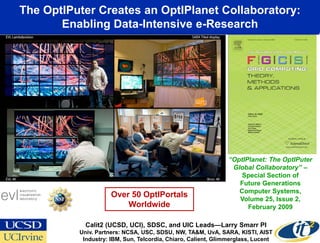
The OptIPuter Creates an OptIPlanet Collaboratory:
       Enabling Data-Intensive e-Research
       www.evl.uic.edu/cavern/sage


                                                                 “OptIPlanet: The OptIPuter
                                                                  Global Collaboratory” –
                                                                     Special Section of
                                                                    Future Generations
                                                                    Computer Systems,
                       Over 50 OptIPortals                          Volume 25, Issue 2,
                           Worldwide                                   February 2009

              Calit2 (UCSD, UCI), SDSC, and UIC Leads—Larry Smarr PI
            Univ. Partners: NCSA, USC, SDSU, NW, TA&M, UvA, SARA, KISTI, AIST
             Industry: IBM, Sun, Telcordia, Chiaro, Calient, Glimmerglass, Lucent
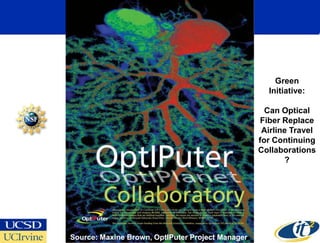
Green
                                                    Initiative:

                                                    Can Optical
                                                  Fiber Replace
                                                   Airline Travel
                                                  for Continuing
                                                  Collaborations
                                                         ?


Source: Maxine Brown, OptIPuter Project Manager
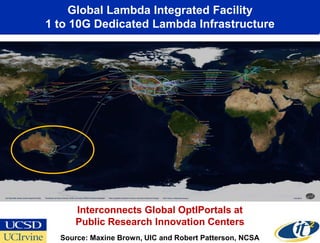
Global Lambda Integrated Facility
1 to 10G Dedicated Lambda Infrastructure


     Interconnects Global OptIPortals at
     Public Research Innovation Centers
  Source: Maxine Brown, UIC and Robert Patterson, NCSA
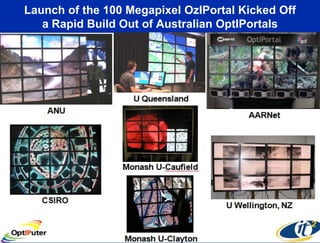
Launch of the 100 Megapixel OzIPortal Kicked Off
      a Rapid Build Out of Australian OptIPortals
  January 15, 2008                               Smarr OptIPortal Road Show


January 15, 2008
      No Calit2 Person Physically Flew to Australia to Bring This Up!
                         Covise, Phil Weber, Jurgen Schulze, Calit2
                               CGLX, Kai-Uwe Doerr , Calit2
                   http://www.calit2.net/newsroom/release.php?id=1421
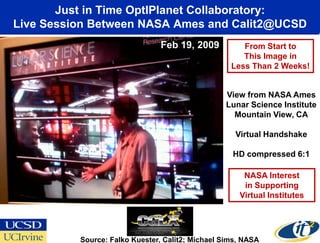
Just in Time OptIPlanet Collaboratory:
Live Session Between NASA Ames and Calit2@UCSD
                                Feb 19, 2009          From Start to
                                                      This Image in
                                                   Less Than 2 Weeks!


                                                 View from NASA Ames
                                                 Lunar Science Institute
                                                   Mountain View, CA

                                                    Virtual Handshake

                                                   HD compressed 6:1

                                                      NASA Interest
                                                      in Supporting
                                                     Virtual Institutes


          Source: Falko Kuester, Calit2; Michael Sims, NASA
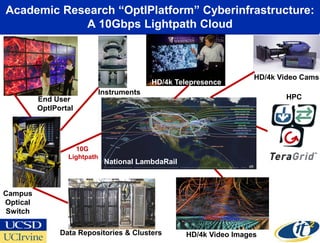
Academic Research “OptIPlatform” Cyberinfrastructure:
            A 10Gbps Lightpath Cloud


                                                                     HD/4k Video Cams
                                          HD/4k Telepresence
                          Instruments
          End User                                                          HPC
          OptIPortal


                    10G
                  Lightpath
                              National LambdaRail


Campus
Optical
Switch

                Data Repositories & Clusters        HD/4k Video Images
International Symposia on Green ICT:
Greening ICT and Applying ICT to Green Infrastructures


           Webcasts Available at:
www.calit2.net/newsroom/article.php?id=1456


                                              Calit2@UCSD

Can a Greener Internet Help Us Moderate Climate Change?

  • 1.
    Can a GreenerInternet Help Us Moderate Climate Change? High Definition Remote Presentation to the Monash Undergraduate Research Projects Abroad (MURPA) Program Located at Monash University, Australia From Calit2@UCSD May 13, 2009 Dr. Larry Smarr Director, California Institute for Telecommunications and Information Technology Harry E. Gruber Professor, Dept. of Computer Science and Engineering Jacobs School of Engineering, UCSD
  • 2.
    Abstract This year marksa turning point in the debate on global climate change. The focus of the discussion is rapidly moving from a scientific analysis of how human activity effects climate change to a political process on how best to regulate greenhouse gas emissions. The Climate Group’s Smart 2020 study reveals that the global Information and Communication Technology (ICT) industry produces greenhouse gases equivalent to that produced by the aviation industry (~2-3 percent). Furthermore, the ICT sector’s emissions will nearly triple, in a business-as-usual scenario, from 2002 to 2020. On the other hand, the Climate Group estimates that transformative applications of ICT to electricity grids, logistic chains, intelligent transportation and building infrastructure, and other social systems can reduce global greenhouse gas emissions by about 15 percent— five times ICT’s own footprint! I will discuss initiatives on university campuses in the US and Australia to innovate new solutions to these challenges.
  • 3.
    The Planet isAlready Committed to a Dangerous Level of Warming Temperature Threshold Range Earth Has Only Realized that Initiates the Climate-Tipping 1/3 of the Committed Warming - Future Emissions of Greenhouse Gases Move Peak to the Right Additional Warming over 1750 Level V. Ramanathan and Y. Feng, Scripps Institution of Oceanography, UCSD September 23, 2008 www.pnas.orgcgidoi10.1073pnas.0803838105
  • 4.
    Atmospheric Aerosols CoolClimate— Cleaning Air Pollution will Accelerate Warming! Ramananthan & Feng www.pnas.orgcgidoi10.1073pnas.0803838105 Outside Beijing 11/9/2008 NASA satellite image
  • 5.
    Arctic Summer Iceis Rapidly Decreasing “The Arctic Ocean will be effectively ice free sometime between 2020 and 2040, although it is possible it could happen as early as 2013.” --Walt Meier, Research Scientist at the National Snow and Ice Data Centre at the University of Colorado http://news.cnet.com/8301-11128_3-10213891-54.html
  • 6.
    The Hindu Kush/HimalayanPlateau Has the Most Snow and Ice Outside of the Polar Regions “Water Towers of Asia” Impact 40% of the World’s Population “California Faces Water Rationing, Governor Proclaims Drought Emergency” --February 27, 2009
  • 7.
    California and HimalayanAsia: Snow and Ice are Critical Fresh Water Reservoirs NASA Blue Marble Data Set January 2004 Falko Kuester, HiPerSpace, Calit2
  • 8.
    Australia, the U.S.,and Canada Share a Problem: Top 3 Developed Countries For Per Capita GHG Emission “Australia’s Total Emissions Exceed Those of France and Italy” --Australia Institute http://en.wikipedia.org/wiki/File:GHG_per_capita_2000.svg
  • 9.
    Countries and Statesare Setting Aggressive Greenhouse Gas Reduction Goals "Australia is today the biggest carbon polluter in the developed world on a per capita basis, yet we are the developed country with the most to lose from climate change. Without action on climate change, Australia faces a future of parched farms, bleached reefs, and empty reservoirs." --Australian Prime Minister Kevin Rudd www.guardian.co.uk/environment/2008/dec/15/climate-change-australia
  • 10.
    “It Will Bethe Biggest Single Peacetime Project Humankind Will Have Ever Undertaken”
  • 11.
    The IPCC Recommends a 25-40% Reduction Below 1990 Levels by 2020 • On September 27, 2006, Governor Schwarzenegger signed California the Global Warming Solutions Act of 2006 – Assembly Bill 32 (AB32) – Requires Reduction of GHG by 2020 Only to 1990 Levels – 10% Reduction from 2008 Levels; 30% from BAU 2020 Levels – 4 Tons of CO2-equiv. Reduction for Every Person in California! • The European Union Requires Reduction of GHG by 2020 to 20% Below 1990 Levels (12/12/2008) • Australia has Pledged to Cut by 2020 its GHG Emissions 5% from 2000 Levels via the World's Broadest Cap &Trade Scheme (12/15/08) [~5% Below 1990 Levels] • Neither the U.S. or Canada has an Official Target Yet – President Obama Has Endorsed the AB32 2020 Goal
  • 12.
    ICT is aCritical Element in Achieving Countries Greenhouse Gas Emission Reduction Targets GeSI member companies: • Bell Canada, • British Telecomm., • Plc, • Cisco Systems, • Deutsche Telekom AG, • Ericsson, • France Telecom, • Hewlett-Packard, • Intel, • Microsoft, • Nokia, • Nokia Siemens Networks, • Sun Microsystems, • T-Mobile, • Telefónica S.A., • Telenor, www.smart2020.org • Verizon, • Vodafone Plc. Additional support: • Dell, LG.
  • 13.
    The Global ICTCarbon Footprint is Roughly the Same as the Aviation Industry Today But ICT Emissions are Growing at 6% Annually! Most of Growth is in Developing Countries the assumptions behind the growth in emissions expected in 2020: • takes into account likely efficient technology developments that affect the power consumption of products and services • and their expected penetration in the market in 2020 www.smart2020.org
  • 14.
    Reduction of ICTEmissions is a Global Challenge – U.S. and Canada are Small Sources U.S. and Canada Together Fall From 25% to 14% of Global ICT Emissions by 2020 www.smart2020.org
  • 15.
    The Global ICTCarbon Footprint by Subsector The Number of PCs (Desktops and Laptops) Globally is Expected to Increase from 592 Million in 2002 to More Than Four Billion in 2020 www.smart2020.org
  • 16.
    A System Approachis Required to Reduce Internet’s Greenhouse Gas Emissions • Estimates Needed for CO2 Emissions from Each Subcomponent • Beware of Tradeoffs: – “I will clean up my campus by getting rid of clusters and computing in the cloud” – Is This a Net Reduction? Source: Rod Tucker, U Melbourne
  • 17.
    Electricity Usage byU.S. Data Centers: Emission Reductions are Underway Source: Silicon Valley Leadership Group Report July 29, 2008 https://microsite.accenture.com/svlgreport/Documents/pdf/SVLG_Report.pdf
  • 18.
    The NSF-Funded GreenLightProject Giving Users Greener Compute and Storage Options UCSD Structural Engineering Dept. Conducted Sun MD Tests May 2007 • Measure, Publish, and Control Energy Usage: – Sun Has Shown up to 40% Reduction in Energy – Active Management of Disks, CPUs, etc. – Measures Temperature at 5 Levels in 8 Racks – Power Utilization in Each of the 8 Racks – Chilled Water Cooling Systems UCSD (Calit2 & SOM) Source: Tom DeFanti, Calit2; Bought Two Sun MDs GreenLight PI May 2008
  • 19.
    GreenLight’s Data isAvailable Remotely: Virtual Version in Calit2 StarCAVE 30 HD Connected at Projectors! 50 Gb/s to Quartzite Source: Tom DeFanti, Greg Dawe, Jurgen Schulze, Calit2
  • 20.
    Calit2’s GreenLight ProjectReceives CENIC’s 2009 Innovations in Networking Award--Experimental-Developmental Applications www.calit2.net/newsroom/release.php?id=1485
  • 21.
    Research Needed on Howto Deploy a Green CI MRI • Computer Architecture – Rajesh Gupta/CSE • Software Architecture – Amin Vahdat, Ingolf Kruger/CSE • CineGrid Exchange – Tom DeFanti/Calit2 • Visualization – Falko Kuster/Structural Engineering • Power and Thermal Management – Tajana Rosing/CSE • Analyzing Power Consumption Data – Jim Hollan/Cog Sci • Direct DC Datacenters – Tom Defanti, Greg Hidley http://greenlight.calit2.net
  • 22.
    New Techniques forDynamic Power and Thermal Management to Reduce Energy Requirements NSF Project Greenlight • Green Cyberinfrastructure in Energy-Efficient Modular Facilities • Closed-Loop Power &Thermal Management Dynamic Power Management (DPM) Dynamic Thermal Management (DTM) • Optimal DPM for a Class of Workloads • Workload Scheduling: • Machine Learning to Adapt • Machine learning for Dynamic • Select Among Specialized Policies Adaptation to get Best Temporal and • Use Sensors and Spatial Profiles with Closed-Loop Performance Counters to Monitor Sensing • Multitasking/Within Task Adaptation • Proactive Thermal Management of Voltage and Frequency • Reduces Thermal Hot Spots by Average • Measured Energy Savings of 60% with No Performance Overhead Up to 70% per Device System Energy Efficiency Lab (seelab.ucsd.edu) Prof. Tajana Šimunić Rosing, CSE, UCSD
  • 23.
    GreenLight Project: Putting Machines To Sleep Transparently Rajesh Gupta, UCSD CSE; Calit2 Network interface Secondary Network processor interface Management software Low power domain Main processor, Peripheral RAM, etc IBM X60 Power Consumption Laptop Power Consumption (Watts) 20 16W 18 (4.1 Hrs) Somniloquy 16 11.05W Enables Servers 14 (5.9 Hrs) to Enter and Exit Sleep 12 10 While Maintaining 8 Their Network and 6 Application Level 0.74W 1.04W 4 (88 Hrs) (63 Hrs) Presence 2 0 Sleep (S3) Somniloquy Baseline (Low 23 Normal Power)
  • 24.
    GreenLight Provides aEnvironment for Innovative “Greener” Products to be Tested Quadrics Was Designed to Use 20% and 80% Less Power per Port Than Other Products in the 10 GigE Market www.calit2.net/newsroom/article.php?id=1482
  • 25.
    Consolidating Dispersed FacultyClusters Over the Fiber Connected UCSD Campus Research CI SDSC Triton Components HPC System Cluster Condo PetaScale Data Analysis UCSD Storage Facility UC Grid Pilot Digital Collections DNA Arrays, Lifecycle Research Mass Spec., Microscopes, Management Cluster OptIPortal Research Genome Instrument Sequencers N x 10Gbe Source: Phil Papadopoulos, SDSC/Calit2
  • 26.
    Power Management inthe Cellular Infrastructure: Calit2 Team Achieves 58% Power Amplifier Efficiency Standard Commercial Base Station Power Amp is 10% Efficient Calit2 Power Transistor Tradeoffs: High-Power Amplifier Lab Si-LDMOS, GaN, & GaAs Price & Performance Power Amplifier Tradeoffs: WiMAX & 3.9GPP LTE Efficiency & Linearity STMicroelectronics Digital Signal Processing Tradeoffs: Pre-Distortion, Memory Effects & Power Control MIPS & Memory www.universityofcalifornia.edu/news/article/19058 Source: Don Kimball, Calit2; Peter Asbeck and Larry Larson, ECE
  • 27.
    Leading Edge PhotonicsSystems Laboratory Has Demonstrated Multiple World Records • Networking “Living Lab” Testbed Core – Terabit Networking – Micro LIDAR/Spectroscopy – Silicon Frequency Conversion – 320Gbps Real Time Processing – Advanced Transmission Coding ECE Testbed Faculty Stojan Radic Optical communication networks; all-optical processing; parametric processes in high-confinement fiber and semiconductor devices. George Papen Advanced photonic systems including optical communication systems, optical networking, and environmental and atmospheric remote sensing. Joseph Ford Optoelectronic subsystems integration (MEMS, diffractive optics, VLSI); Fiber optic and free-space communications. Shaya Fainman Nanoscale science and technology; ultrafast photonics and signal processing Shayan Mookherjea Optical devices and optical communication networks, including photonics, lightwave systems and nano-scale optics. UCSD Photonics
  • 28.
    Application of ICTCan Lead to a 5-Fold Greater Decrease in GHGs Than its Own Carbon Footprint While the sector plans to significantly step up the energy efficiency of its products and services, ICT’s largest influence will be by enabling energy efficiencies in other sectors, an opportunity that could deliver carbon savings five times larger than the total emissions from the entire ICT sector in 2020. --Smart 2020 Report Major Opportunities for the United States* – Smart Electrical Grids – Smart Transportation Systems – Smart Buildings – Virtual Meetings * Smart 2020 United States Report Addendum www.smart2020.org
  • 29.
    Real-Time Monitoring ofBuilding Energy Usage: UCSD Has 34 Buildings On-Line http://mscada01.ucsd.edu/ion/
  • 30.
    Comparision Between UCSDBuildings: kW/sqFt Year Since 1/1/09 Calit2 and CSE are Very Energy Intensive Buildings
  • 31.
    Power Management inMixed Use Buildings: The UCSD CSE Building is Energy Instrumented • 500 Occupants, 750 Computers – More Computers Than Humans! • Detailed Instrumentation to Measure Macro and Micro-Scale Power Use – 39 Sensor Pods, 156 Radios, 70 Circuits – Subsystems: Air Conditioning & Lighting Calit2 is Being Re-Designed as an “Internet of Things” Building Source: Rajesh Gupta, CSE, Calit2
  • 32.
    Making Cars GreenerRequires Software Engineering-- Calit2 Established the Automotive Software Workshop Source: Ingolf Krueger, Calit2 • Over 10 Million Lines of Code in Your Car! 90 % of all Auto • Sponsors: Calit2, NSF, EU, DFG Innovations are Now • 50:50 Participation Industry/Academia Software-Driven • Next Instance Planned For 2009 • Industry Participants Include:
  • 33.
    Reducing Traffic Congestion: Calit2 California Peer-to -Peer Wireless Traffic Report • Citizen to Citizen Accident Reports 20,000+ Users • Real-Time Freeway Speeds > 1000 Calls Per Day • “Leave Now” Paging Services San Diego LA & OC Bay Area (866) 500 0977 (888) 9 CALIT2 (888) 4 CALIT2 http://traffic.calit2.net Source: Ganz Chockalingam, Calit2
  • 34.
    The OptIPuter Createsan OptIPlanet Collaboratory: Enabling Data-Intensive e-Research www.evl.uic.edu/cavern/sage “OptIPlanet: The OptIPuter Global Collaboratory” – Special Section of Future Generations Computer Systems, Over 50 OptIPortals Volume 25, Issue 2, Worldwide February 2009 Calit2 (UCSD, UCI), SDSC, and UIC Leads—Larry Smarr PI Univ. Partners: NCSA, USC, SDSU, NW, TA&M, UvA, SARA, KISTI, AIST Industry: IBM, Sun, Telcordia, Chiaro, Calient, Glimmerglass, Lucent
  • 35.
    Green Initiative: Can Optical Fiber Replace Airline Travel for Continuing Collaborations ? Source: Maxine Brown, OptIPuter Project Manager
  • 36.
    Global Lambda IntegratedFacility 1 to 10G Dedicated Lambda Infrastructure Interconnects Global OptIPortals at Public Research Innovation Centers Source: Maxine Brown, UIC and Robert Patterson, NCSA
  • 37.
    Launch of the100 Megapixel OzIPortal Kicked Off a Rapid Build Out of Australian OptIPortals January 15, 2008 Smarr OptIPortal Road Show January 15, 2008 No Calit2 Person Physically Flew to Australia to Bring This Up! Covise, Phil Weber, Jurgen Schulze, Calit2 CGLX, Kai-Uwe Doerr , Calit2 http://www.calit2.net/newsroom/release.php?id=1421
  • 38.
    Just in TimeOptIPlanet Collaboratory: Live Session Between NASA Ames and Calit2@UCSD Feb 19, 2009 From Start to This Image in Less Than 2 Weeks! View from NASA Ames Lunar Science Institute Mountain View, CA Virtual Handshake HD compressed 6:1 NASA Interest in Supporting Virtual Institutes Source: Falko Kuester, Calit2; Michael Sims, NASA
  • 39.
    Academic Research “OptIPlatform”Cyberinfrastructure: A 10Gbps Lightpath Cloud HD/4k Video Cams HD/4k Telepresence Instruments End User HPC OptIPortal 10G Lightpath National LambdaRail Campus Optical Switch Data Repositories & Clusters HD/4k Video Images
  • 40.
    International Symposia onGreen ICT: Greening ICT and Applying ICT to Green Infrastructures Webcasts Available at: www.calit2.net/newsroom/article.php?id=1456 Calit2@UCSD