TBLL focuses on the use
of authentic language
and on asking students
to do meaningful tasks
using the target
language.
Theory of learning involved

          The PPP approach
   (presentation, practice, production)

With this model individual language
items are presented by the teacher, then
practiced in the form of spoken and
written exercises and then used by the
learners in less controlled speaking or
writing activities.
Characteristics

Task-based learning is based on the use of tasks as
the core unit of planning and instruction in language
teaching.

Tasks that involve real communication are essential
for language learning.

Learners learn language by interacting
communicatively and purposefully while engaged in
the activities and tasks.

The focus is on process rather than product.
Language that is meaningful to the learner supports
the learning process.

Activities and tasks of a task-based syllabus are
sequenced according to difficulty.

The difficulty of a task depends on a range of factors
including the previous experience of the learner, the
complexity of the task, the language required to
undertake the task, and the degree of support
available (Richards and Rodgers 2001).

Errors are not necessarily the result of bad learning,
but are part of the natural process of interlanguage
forms gradually moving towards target forms (Ellis
1994).
Introduction to topic and task: Teacher explores the topic with
            the class, highlights useful words and phrases, helps
 Pre-task   students understand task instructions and prepare.


            Task: Students do the task, in pairs or small groups. Teacher
           monitors from a distance.
            Planning: Students prepare to report to the whole class(
Task Cycle orally or in writing) how they did the task, what they decided
           or discovered.
            Report: Some groups present their reports to the class, or
           exchange written reports and compare results.
           Analysis: Students examine and discuss specific features of
           the text or transcript of the recording.
Language
           Practice: Teacher conducts practice or new words, phrases
  Focus
           and patterns occurring in the data, either during or after the
           analysis (Willis 1996: 38).

Task Based Language Learning

  • 2.
    TBLL focuses onthe use of authentic language and on asking students to do meaningful tasks using the target language.
  • 3.
    Theory of learninginvolved The PPP approach (presentation, practice, production) With this model individual language items are presented by the teacher, then practiced in the form of spoken and written exercises and then used by the learners in less controlled speaking or writing activities.
  • 4.
    Characteristics Task-based learning isbased on the use of tasks as the core unit of planning and instruction in language teaching. Tasks that involve real communication are essential for language learning. Learners learn language by interacting communicatively and purposefully while engaged in the activities and tasks. The focus is on process rather than product.
  • 5.
    Language that ismeaningful to the learner supports the learning process. Activities and tasks of a task-based syllabus are sequenced according to difficulty. The difficulty of a task depends on a range of factors including the previous experience of the learner, the complexity of the task, the language required to undertake the task, and the degree of support available (Richards and Rodgers 2001). Errors are not necessarily the result of bad learning, but are part of the natural process of interlanguage forms gradually moving towards target forms (Ellis 1994).
  • 6.
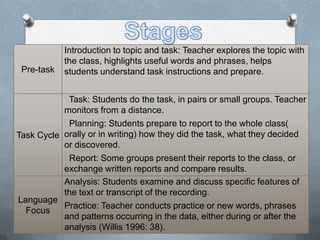
    Introduction to topicand task: Teacher explores the topic with the class, highlights useful words and phrases, helps Pre-task students understand task instructions and prepare. Task: Students do the task, in pairs or small groups. Teacher monitors from a distance. Planning: Students prepare to report to the whole class( Task Cycle orally or in writing) how they did the task, what they decided or discovered. Report: Some groups present their reports to the class, or exchange written reports and compare results. Analysis: Students examine and discuss specific features of the text or transcript of the recording. Language Practice: Teacher conducts practice or new words, phrases Focus and patterns occurring in the data, either during or after the analysis (Willis 1996: 38).