



A special lecture by
Robert J. Dickey, MPA, JD
1
“The Shakedown”
2
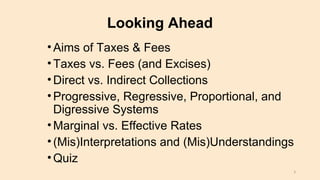
•Aims of Taxes & Fees
•Taxes vs. Fees (and Excises)
•Direct vs. Indirect Collections
•Progressive, Regressive, Proportional, and
Digressive Systems
•Marginal vs. Effective Rates
•(Mis)Interpretations and (Mis)Understandings
•Quiz
Looking Ahead
3
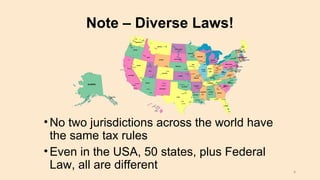
•No two jurisdictions across the world have
the same tax rules
•Even in the USA, 50 states, plus Federal
Law, all are different
Note – Diverse Laws!
4
Aims of Taxes & Fees
•What are the objectives of any tax or fee?
What is the objective of this particular
collection?
5
Aims of Taxes & Fees
1. Generate Revenue
a) General purpose revenues
b) Specific purpose revenues
2. Encourage/Discourage Specific Behavior
3. Promote Equity
6
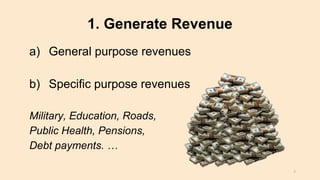
1. Generate Revenue
a) General purpose revenues
b) Specific purpose revenues
Military, Education, Roads,
Public Health, Pensions,
Debt payments. …
7
2. Discourage Specific Behavior
http://www.freemalaysiatoday.com/category/leisure/2015/05/24/smokers-more-likely-to-t
8
3. Promote Equity
What is the difference between
•“equality”
and
•“equity”
? ? ?
9
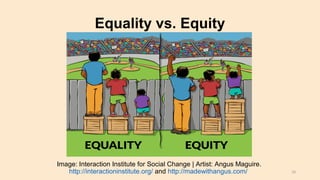
Equality vs. Equity
Image: Interaction Institute for Social Change | Artist: Angus Maguire.
http://interactioninstitute.org/ and http://madewithangus.com/ 10
How much Equity?
•Gini Co-efficient a major concern?
•Envy of the “too rich”?
•Concern about the poor?
•Incentives to work hard
•Socio-economic “Safety-net”
•Socialist perspectives
11
Taxes vs. Fees (and Excises)
•Taxes are paid for government services that
should help everyone
We all benefit, directly or indirectly
oSchools, Safety, Health…
•Fees are paid for government services that
directly serve that particular person
The fee (amount) should be directly tied to the
cost of maintaining the service
oSwimming pool entrance, Parking garage
12
Excises
•Excises are a special type of tax,
something closer to a “fee”
•Not all countries agree on the definition
•Often defined through a list created by
legislation(s)
•Fixed rate by quantity, not by price
•Usually included in the basic price at
purchase
13
14
Excises
•in the USA …
an indirect tax on listed items
by federal, state and local governments
not uniform throughout the United States
collected from the producer or retailer
not paid directly by the consumer
 “hidden" in the price
 maybe explains appeal to many politicians?
But sometimes a tax is called “an excise tax”
15
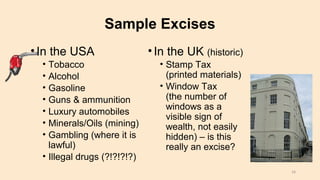
Sample Excises
•In the USA
• Tobacco
• Alcohol
• Gasoline
• Guns & ammunition
• Luxury automobiles
• Minerals/Oils (mining)
• Gambling (where it is
lawful)
• Illegal drugs (?!?!?!?)
•In the UK (historic)
• Stamp Tax
(printed materials)
• Window Tax
(the number of
windows as a
visible sign of
wealth, not easily
hidden) – is this
really an excise?
16
More details on tax types
•Ad valorum tax - % of product value
•Specific tax - per unit, e.g., petroleum, wine
•Sales tax – applies only at end of process
(final sale)
•GST – sales tax that applies to both goods
and services
•VAT – applies at every level of process
(taxed each time value is added)
17
Direct vs. Indirect Collections
•Direct – payment direct from people (tax-
payer) to government
•Indirect – payment to government made
through an intermediary
18
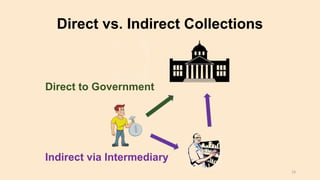
Direct vs. Indirect Collections
Direct to Government
Indirect via Intermediary
19
(Dis)Advantages of
Indirect Collections
Advantages
•Poor exempted from paying direct taxes
•Convenient to taxpayer & the state
•Can be spread over a wide range of
products/services
•Easy to collect when goods bought & sold
•Elastic in yield
•Equitable
•Curb consumption of harmful commodities
Disadvantages
•Not equitable
•Discourages industry if
raw goods are taxed
•Uneconomical
•Does not develop
civic-mindedness
•Difficulty in tracking
20
Examples of Direct Taxes
•Income tax
•Corporation tax
•Property tax
•Motor vehicle registration (re-registration)
•Inheritance tax
•Gift tax
•Wealth tax
•Municipal residency tax 21
Examples of Indirect Taxes
•Sales Tax
•Value Added Tax (VAT)
•Goods & Services Tax (GST)
•Excise (tax)
•Customs duty
•Service tax
•Securities Exchange Transaction Tax (STT)
22
photo credit: Wai Linn Kyaw/Myanmar Business Today
http://www.mmbiztoday.com/articles/ird-revenue-stamp-crackdown-imminent 23
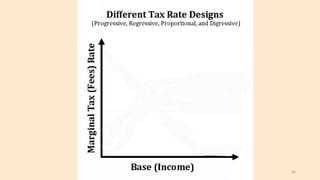
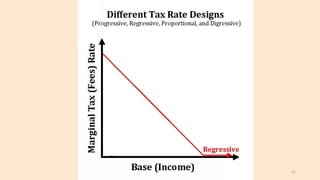
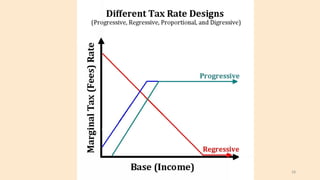
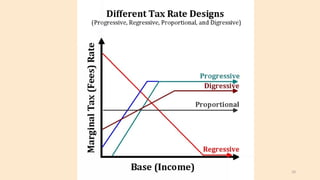
Progressive, Regressive,
Proportional and Digressive Systems
•Progressive taxes are based on a
progressive or increasing tax rate schedule
the more you earn, the higher the tax rate
•Regressive taxes have a greater impact
on low-income individuals or entities than
high-income earners
Low income earners feel like they pay more
24
Progressive, Regressive,
Proportional and Digressive Systems
•Proportional taxes (aka "flat tax") impacts
low-, middle- and high-income earners
relatively equally
•Digressive tax is just a “flatter” version of a
progressive tax – it stops “progressing”
earlier (lower) and might start at a higher
rate than a “pure” progressive system
25
26
27
28
29
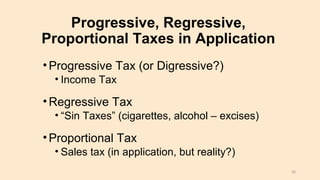
Progressive, Regressive,
Proportional Taxes in Application
•Progressive Tax (or Digressive?)
• Income Tax
•Regressive Tax
• “Sin Taxes” (cigarettes, alcohol – excises)
•Proportional Tax
• Sales tax (in application, but reality?)
30
Actual Effects
•Governments generally describe tax systems
according to marginal tax rates
•Citizens generally consider taxes to be “fair” or
unfair based on effect
31
Marginal vs. Effective Rates
•Marginal Rates indicate tax on additional
amounts
•Banded Rates describe tax for total amount
within a range
•Effective Rates are the “actual” amount after
discounts (deductions, waivers, etc.)
compared to actual income (or value)
32
Examples
•The marginal tax rate is the percentage of
tax applied to your income for each tax
bracket (band) you qualify for.
•The effective tax rate is the final calculated
amount compared to your total income (or
value)
•Let’s look at USA Federal Income Tax 2016
and a “Mr. John Smith.”
33
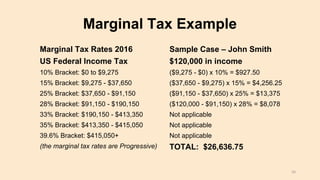
Marginal Tax Example
Marginal Tax Rates 2016
US Federal Income Tax
10% Bracket: $0 to $9,275
15% Bracket: $9,275 - $37,650
25% Bracket: $37,650 - $91,150
28% Bracket: $91,150 - $190,150
33% Bracket: $190,150 - $413,350
35% Bracket: $413,350 - $415,050
39.6% Bracket: $415,050+
(the marginal tax rates are Progressive)
Sample Case – John Smith
$120,000 in income
($9,275 - $0) x 10% = $927.50
($37,650 - $9,275) x 15% = $4,256.25
($91,150 - $37,650) x 25% = $13,375
($120,000 - $91,150) x 28% = $8,078
Not applicable
Not applicable
Not applicable
TOTAL: $26,636.75
34
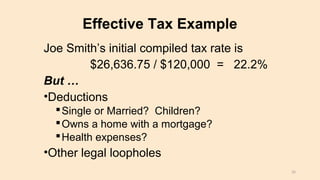
Effective Tax Example
Joe Smith’s initial compiled tax rate is
$26,636.75 / $120,000 = 22.2%
But …
•Deductions
Single or Married? Children?
Owns a home with a mortgage?
Health expenses?
•Other legal loopholes
35
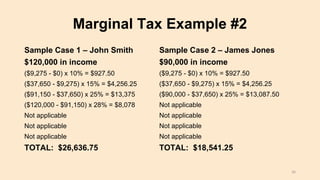
Marginal Tax Example #2
Sample Case 2 – James Jones
$90,000 in income
($9,275 - $0) x 10% = $927.50
($37,650 - $9,275) x 15% = $4,256.25
($90,000 - $37,650) x 25% = $13,087.50
Not applicable
Not applicable
Not applicable
Not applicable
TOTAL: $18,541.25
Sample Case 1 – John Smith
$120,000 in income
($9,275 - $0) x 10% = $927.50
($37,650 - $9,275) x 15% = $4,256.25
($91,150 - $37,650) x 25% = $13,375
($120,000 - $91,150) x 28% = $8,078
Not applicable
Not applicable
Not applicable
TOTAL: $26,636.75
36
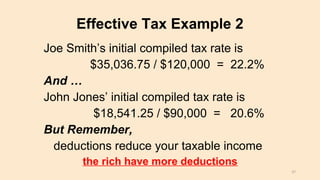
Effective Tax Example 2
Joe Smith’s initial compiled tax rate is
$35,036.75 / $120,000 = 22.2%
And …
John Jones’ initial compiled tax rate is
$18,541.25 / $90,000 = 20.6%
But Remember,
deductions reduce your taxable income
the rich have more deductions
37
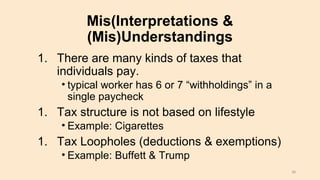
Mis(Interpretations &
(Mis)Understandings
1. There are many kinds of taxes that
individuals pay.
• typical worker has 6 or 7 “withholdings” in a
single paycheck
1. Tax structure is not based on lifestyle
• Example: Cigarettes
1. Tax Loopholes (deductions & exemptions)
• Example: Buffett & Trump
38
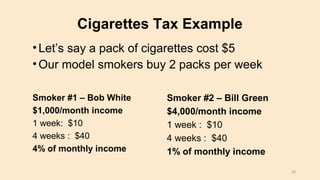
Cigarettes Tax Example
Smoker #2 – Bill Green
$4,000/month income
1 week : $10
4 weeks : $40
1% of monthly income
Smoker #1 – Bob White
$1,000/month income
1 week: $10
4 weeks : $40
4% of monthly income
39
•Let’s say a pack of cigarettes cost $5
•Our model smokers buy 2 packs per week
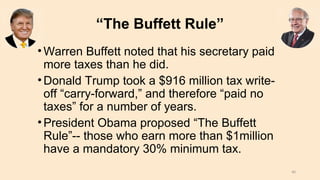
“The Buffett Rule”
•Warren Buffett noted that his secretary paid
more taxes than he did.
•Donald Trump took a $916 million tax write-
off “carry-forward,” and therefore “paid no
taxes” for a number of years.
•President Obama proposed “The Buffett
Rule”-- those who earn more than $1million
have a mandatory 30% minimum tax.
40
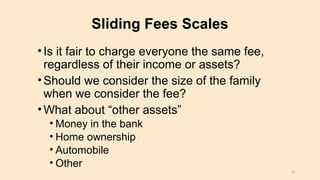
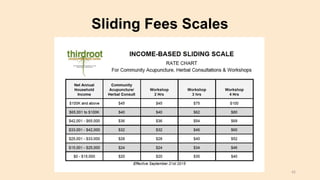
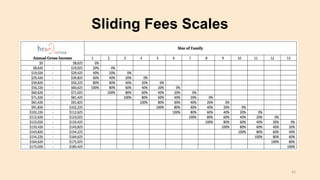
Sliding Fees Scales
•Is it fair to charge everyone the same fee,
regardless of their income or assets?
•Should we consider the size of the family
when we consider the fee?
•What about “other assets”
• Money in the bank
• Home ownership
• Automobile
• Other
41
Sliding Fees Scales
42
Sliding Fees Scales
43
Finally
44

Taxes & Fees

  • 1.
    A special lectureby Robert J. Dickey, MPA, JD 1
  • 2.
  • 3.
    •Aims of Taxes& Fees •Taxes vs. Fees (and Excises) •Direct vs. Indirect Collections •Progressive, Regressive, Proportional, and Digressive Systems •Marginal vs. Effective Rates •(Mis)Interpretations and (Mis)Understandings •Quiz Looking Ahead 3
  • 4.
    •No two jurisdictionsacross the world have the same tax rules •Even in the USA, 50 states, plus Federal Law, all are different Note – Diverse Laws! 4
  • 5.
    Aims of Taxes& Fees •What are the objectives of any tax or fee? What is the objective of this particular collection? 5
  • 6.
    Aims of Taxes& Fees 1. Generate Revenue a) General purpose revenues b) Specific purpose revenues 2. Encourage/Discourage Specific Behavior 3. Promote Equity 6
  • 7.
    1. Generate Revenue a)General purpose revenues b) Specific purpose revenues Military, Education, Roads, Public Health, Pensions, Debt payments. … 7
  • 8.
    2. Discourage SpecificBehavior http://www.freemalaysiatoday.com/category/leisure/2015/05/24/smokers-more-likely-to-t 8
  • 9.
    3. Promote Equity Whatis the difference between •“equality” and •“equity” ? ? ? 9
  • 10.
    Equality vs. Equity Image:Interaction Institute for Social Change | Artist: Angus Maguire. http://interactioninstitute.org/ and http://madewithangus.com/ 10
  • 11.
    How much Equity? •GiniCo-efficient a major concern? •Envy of the “too rich”? •Concern about the poor? •Incentives to work hard •Socio-economic “Safety-net” •Socialist perspectives 11
  • 12.
    Taxes vs. Fees(and Excises) •Taxes are paid for government services that should help everyone We all benefit, directly or indirectly oSchools, Safety, Health… •Fees are paid for government services that directly serve that particular person The fee (amount) should be directly tied to the cost of maintaining the service oSwimming pool entrance, Parking garage 12
  • 13.
    Excises •Excises are aspecial type of tax, something closer to a “fee” •Not all countries agree on the definition •Often defined through a list created by legislation(s) •Fixed rate by quantity, not by price •Usually included in the basic price at purchase 13
  • 14.
  • 15.
    Excises •in the USA… an indirect tax on listed items by federal, state and local governments not uniform throughout the United States collected from the producer or retailer not paid directly by the consumer  “hidden" in the price  maybe explains appeal to many politicians? But sometimes a tax is called “an excise tax” 15
  • 16.
    Sample Excises •In theUSA • Tobacco • Alcohol • Gasoline • Guns & ammunition • Luxury automobiles • Minerals/Oils (mining) • Gambling (where it is lawful) • Illegal drugs (?!?!?!?) •In the UK (historic) • Stamp Tax (printed materials) • Window Tax (the number of windows as a visible sign of wealth, not easily hidden) – is this really an excise? 16
  • 17.
    More details ontax types •Ad valorum tax - % of product value •Specific tax - per unit, e.g., petroleum, wine •Sales tax – applies only at end of process (final sale) •GST – sales tax that applies to both goods and services •VAT – applies at every level of process (taxed each time value is added) 17
  • 18.
    Direct vs. IndirectCollections •Direct – payment direct from people (tax- payer) to government •Indirect – payment to government made through an intermediary 18
  • 19.
    Direct vs. IndirectCollections Direct to Government Indirect via Intermediary 19
  • 20.
    (Dis)Advantages of Indirect Collections Advantages •Poorexempted from paying direct taxes •Convenient to taxpayer & the state •Can be spread over a wide range of products/services •Easy to collect when goods bought & sold •Elastic in yield •Equitable •Curb consumption of harmful commodities Disadvantages •Not equitable •Discourages industry if raw goods are taxed •Uneconomical •Does not develop civic-mindedness •Difficulty in tracking 20
  • 21.
    Examples of DirectTaxes •Income tax •Corporation tax •Property tax •Motor vehicle registration (re-registration) •Inheritance tax •Gift tax •Wealth tax •Municipal residency tax 21
  • 22.
    Examples of IndirectTaxes •Sales Tax •Value Added Tax (VAT) •Goods & Services Tax (GST) •Excise (tax) •Customs duty •Service tax •Securities Exchange Transaction Tax (STT) 22
  • 23.
    photo credit: WaiLinn Kyaw/Myanmar Business Today http://www.mmbiztoday.com/articles/ird-revenue-stamp-crackdown-imminent 23
  • 24.
    Progressive, Regressive, Proportional andDigressive Systems •Progressive taxes are based on a progressive or increasing tax rate schedule the more you earn, the higher the tax rate •Regressive taxes have a greater impact on low-income individuals or entities than high-income earners Low income earners feel like they pay more 24
  • 25.
    Progressive, Regressive, Proportional andDigressive Systems •Proportional taxes (aka "flat tax") impacts low-, middle- and high-income earners relatively equally •Digressive tax is just a “flatter” version of a progressive tax – it stops “progressing” earlier (lower) and might start at a higher rate than a “pure” progressive system 25
  • 26.
  • 27.
  • 28.
  • 29.
  • 30.
    Progressive, Regressive, Proportional Taxesin Application •Progressive Tax (or Digressive?) • Income Tax •Regressive Tax • “Sin Taxes” (cigarettes, alcohol – excises) •Proportional Tax • Sales tax (in application, but reality?) 30
  • 31.
    Actual Effects •Governments generallydescribe tax systems according to marginal tax rates •Citizens generally consider taxes to be “fair” or unfair based on effect 31
  • 32.
    Marginal vs. EffectiveRates •Marginal Rates indicate tax on additional amounts •Banded Rates describe tax for total amount within a range •Effective Rates are the “actual” amount after discounts (deductions, waivers, etc.) compared to actual income (or value) 32
  • 33.
    Examples •The marginal taxrate is the percentage of tax applied to your income for each tax bracket (band) you qualify for. •The effective tax rate is the final calculated amount compared to your total income (or value) •Let’s look at USA Federal Income Tax 2016 and a “Mr. John Smith.” 33
  • 34.
    Marginal Tax Example MarginalTax Rates 2016 US Federal Income Tax 10% Bracket: $0 to $9,275 15% Bracket: $9,275 - $37,650 25% Bracket: $37,650 - $91,150 28% Bracket: $91,150 - $190,150 33% Bracket: $190,150 - $413,350 35% Bracket: $413,350 - $415,050 39.6% Bracket: $415,050+ (the marginal tax rates are Progressive) Sample Case – John Smith $120,000 in income ($9,275 - $0) x 10% = $927.50 ($37,650 - $9,275) x 15% = $4,256.25 ($91,150 - $37,650) x 25% = $13,375 ($120,000 - $91,150) x 28% = $8,078 Not applicable Not applicable Not applicable TOTAL: $26,636.75 34
  • 35.
    Effective Tax Example JoeSmith’s initial compiled tax rate is $26,636.75 / $120,000 = 22.2% But … •Deductions Single or Married? Children? Owns a home with a mortgage? Health expenses? •Other legal loopholes 35
  • 36.
    Marginal Tax Example#2 Sample Case 2 – James Jones $90,000 in income ($9,275 - $0) x 10% = $927.50 ($37,650 - $9,275) x 15% = $4,256.25 ($90,000 - $37,650) x 25% = $13,087.50 Not applicable Not applicable Not applicable Not applicable TOTAL: $18,541.25 Sample Case 1 – John Smith $120,000 in income ($9,275 - $0) x 10% = $927.50 ($37,650 - $9,275) x 15% = $4,256.25 ($91,150 - $37,650) x 25% = $13,375 ($120,000 - $91,150) x 28% = $8,078 Not applicable Not applicable Not applicable TOTAL: $26,636.75 36
  • 37.
    Effective Tax Example2 Joe Smith’s initial compiled tax rate is $35,036.75 / $120,000 = 22.2% And … John Jones’ initial compiled tax rate is $18,541.25 / $90,000 = 20.6% But Remember, deductions reduce your taxable income the rich have more deductions 37
  • 38.
    Mis(Interpretations & (Mis)Understandings 1. Thereare many kinds of taxes that individuals pay. • typical worker has 6 or 7 “withholdings” in a single paycheck 1. Tax structure is not based on lifestyle • Example: Cigarettes 1. Tax Loopholes (deductions & exemptions) • Example: Buffett & Trump 38
  • 39.
    Cigarettes Tax Example Smoker#2 – Bill Green $4,000/month income 1 week : $10 4 weeks : $40 1% of monthly income Smoker #1 – Bob White $1,000/month income 1 week: $10 4 weeks : $40 4% of monthly income 39 •Let’s say a pack of cigarettes cost $5 •Our model smokers buy 2 packs per week
  • 40.
    “The Buffett Rule” •WarrenBuffett noted that his secretary paid more taxes than he did. •Donald Trump took a $916 million tax write- off “carry-forward,” and therefore “paid no taxes” for a number of years. •President Obama proposed “The Buffett Rule”-- those who earn more than $1million have a mandatory 30% minimum tax. 40
  • 41.
    Sliding Fees Scales •Isit fair to charge everyone the same fee, regardless of their income or assets? •Should we consider the size of the family when we consider the fee? •What about “other assets” • Money in the bank • Home ownership • Automobile • Other 41
  • 42.
  • 43.
  • 44.