Classroom Action Research - an ethical obligation
Robert J. Dickey Session # 160
Keimyung University, S. Korea
AsiaTEFL 2023 International Conference
Introduction
• Scholars are obligated to do research
in most academic settings.
• What about Teachers?
• What are the ethical implications
of research requirement for those
in a different context?
• Solutions?
Outline
1. Define the problem(s)
a) Settings
b) Defining “research”
c) Exploring “professional ethics”
2. Suggested solution
3. Framework
4. A publishing option
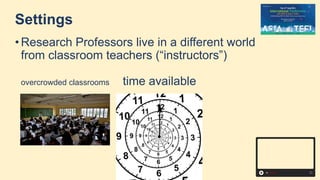
Settings
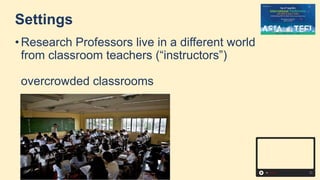
• Research Professors live in a different world
from classroom teachers (“instructors”)
Settings
• Research Professors live in a different world
from classroom teachers (“instructors”)
overcrowded classrooms
Settings
• Research Professors live in a different world
from classroom teachers (“instructors”)
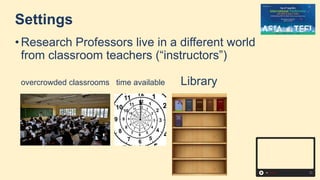
overcrowded classrooms time available
Settings
• Research Professors live in a different world
from classroom teachers (“instructors”)
overcrowded classrooms time available Library
Settings
• Research Professors live in a different world
from classroom teachers (“instructors”)
overcrowded classrooms time available Library
FINANCIAL RESOURCES
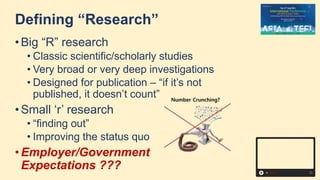
Defining “Research”
• Big “R” research
• Classic scientific/scholarly studies
• Very broad or very deep investigations
• Designed for publication – “if it’s not
published, it doesn’t count”
• Small ‘r’ research
• “finding out”
• Improving the status quo
• Employer/Government
Expectations ???
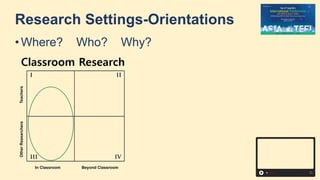
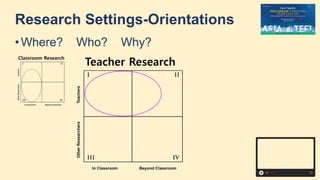
Research Settings-Orientations
• Where? Who? Why?
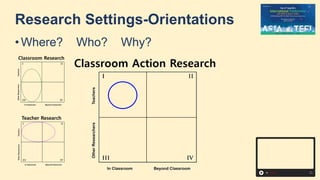
Research Settings-Orientations
• Where? Who? Why?
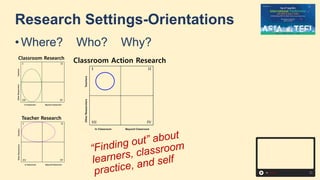
Research Settings-Orientations
• Where? Who? Why?
Research Settings-Orientations
• Where? Who? Why?
Professional Ethics
• Professional standards of conduct
• No universal Code of Ethics in TESOL
• Licensed teachers may have local legal
ethical Codes (alongside other subjects teachers)
• Duty of Continuing Professional
Development
• Minimum Standards or Aspirations?
see Dickey (2018) “Ethical guidelines for teachers.”
In J. I. Liontas (Ed.), The TESOL encyclopedia of
English language teaching (Vol.7, pp. 4242-4247),
John Wiley & Sons, Inc.
Suggested Solution
Action Research
• Orientation to Action, not “Study”
• Encouraged by various governments
• Minimal “scholarly preparation”
• Reduced “Literature” requirements
• Simplified methodological options
• Use of available (data) resources
• Varieties of “publication”
Why Action Research?
“…academia has created rules that suit
their academics. Teachers outside of the
academia have other times and
responsibilities… it is unfair to ask
teachers to adapt themselves to the
academic’s lifestyle when it comes to
doing research. Teachers are capable of
researching their own practice which
should be done in a way that fits the
nature of their work”
• Farrell, T.S.C (2019). Standing on the Shoulders of
Giants: Interpreting Reflective Practice in TESOL.
Iranian Journal of Language Teaching Research
7(3), 1-14. (emphasis added above)
Action Research
• In a nutshell –
‘research by teachers for teachers
and their learners’ (emphases added)
• Introduction. Empowering teacher-
researchers, empowering learners.
Gary Barkhuizen, Anne Burns,
Kenan Dikilitaş and Mark Wyatt. 2018.
IATEFL Research Special Interest
Group. ISBN 978-1-912588-11-4.
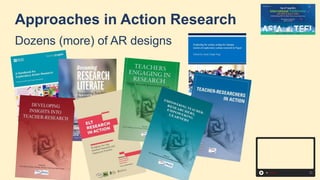
Approaches in Action Research
Dozens (more) of AR designs
Key Elements in Action Research
• Research is Systematic
• Organized Process (method)
• Based on literature (more or less?)
• Pro-active Reflection
• Seek real problems
• Seek real solutions
• Reflect on actions
• Mentoring (?)
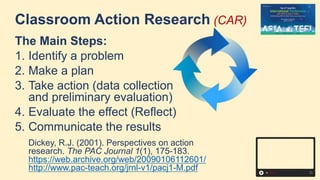
Classroom Action Research (CAR)
The Main Steps:
1. Identify a problem
2. Make a plan
3. Take action (data collection
and preliminary evaluation)
4. Evaluate the effect (Reflect)
5. Communicate the results
Dickey, R.J. (2001). Perspectives on action
research. The PAC Journal 1(1), 175-183.
https://web.archive.org/web/20090106112601/
http://www.pac-teach.org/jrnl-v1/pacj1-M.pdf
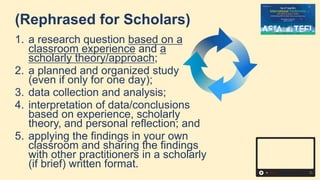
(Rephrased for Scholars)
1. a research question based on a
classroom experience and a
scholarly theory/approach;
2. a planned and organized study
(even if only for one day);
3. data collection and analysis;
4. interpretation of data/conclusions
based on experience, scholarly
theory, and personal reflection; and
5. applying the findings in your own
classroom and sharing the findings
with other practitioners in a scholarly
(if brief) written format.
1. Identify a problem
• Initially, could be (too) broad
• What does literature suggest?
• Narrow the focus
• Invite students to help analyze the problem
(anonymous survey?)
• Do-able
• Time/Resources, Measurable, Engaging
2. Make a plan
1. Again, consider your resources (research
assets)
2. Methodology, consult the literature
3. Start small (1 class, 1 hour, 1 action?)
• Later “cycle” could test across more classes /
teachers
4. Set Measureable Objectives
5. Don’t exceed your “know-how”
3. Take action
(data collection and prelim evaluation)
• Multiple cycles in with step 3,
or with steps 3+4
• Document your “before,”
your actions, and your after
• Peer teacher views, video, charts, etc
• What does your data suggest,
before deeper analysis?
4. Evaluate the effect
(Reflect)
1. Data analysis (as necessary)
2. What does this data mean?
(evaluation against my objectives,
against the literature)
3. How do I think it changes things for
my classroom (and me) [Reflect]
4. Cycle back? (change something, redo)
5. Communicate the results
• Share!
• Staff Meetings, Poster Displays,
Conference Presentations, Proceedings,
Newsletters, Journal Articles
• Peer Review
• Others’ insights, Others’ benefit,
• Psychological rewards
• Academic Rewards
• Shorter papers, less rewards?
• Scopus focus???
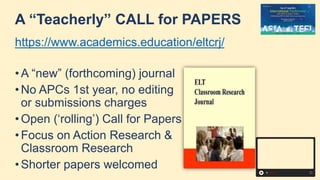
A “Teacherly” CALL for PAPERS
https://www.academics.education/eltcrj/
• A “new” (forthcoming) journal
• No APCs 1st year, no editing
or submissions charges
• Open (‘rolling’) Call for Papers
• Focus on Action Research &
Classroom Research
• Shorter papers welcomed
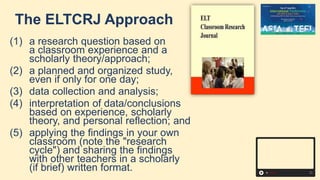
The ELTCRJ Approach
(1) a research question based on
a classroom experience and a
scholarly theory/approach;
(2) a planned and organized study,
even if only for one day;
(3) data collection and analysis;
(4) interpretation of data/conclusions
based on experience, scholarly
theory, and personal reflection; and
(5) applying the findings in your own
classroom (note the "research
cycle") and sharing the findings
with other teachers in a scholarly
(if brief) written format.
Thanks for joining!
Robert J. Dickey
Keimyung University, S. Korea
robertjdickey@yahoo.com
Find this and other slideshows at
https://www.slideshare.net/RobertDickey/

Classroom Action Research AsiaTEFL2023

  • 1.
    Classroom Action Research- an ethical obligation Robert J. Dickey Session # 160 Keimyung University, S. Korea AsiaTEFL 2023 International Conference
  • 2.
    Introduction • Scholars areobligated to do research in most academic settings. • What about Teachers? • What are the ethical implications of research requirement for those in a different context? • Solutions?
  • 3.
    Outline 1. Define theproblem(s) a) Settings b) Defining “research” c) Exploring “professional ethics” 2. Suggested solution 3. Framework 4. A publishing option
  • 4.
    Settings • Research Professorslive in a different world from classroom teachers (“instructors”)
  • 5.
    Settings • Research Professorslive in a different world from classroom teachers (“instructors”) overcrowded classrooms
  • 6.
    Settings • Research Professorslive in a different world from classroom teachers (“instructors”) overcrowded classrooms time available
  • 7.
    Settings • Research Professorslive in a different world from classroom teachers (“instructors”) overcrowded classrooms time available Library
  • 8.
    Settings • Research Professorslive in a different world from classroom teachers (“instructors”) overcrowded classrooms time available Library FINANCIAL RESOURCES
  • 9.
    Defining “Research” • Big“R” research • Classic scientific/scholarly studies • Very broad or very deep investigations • Designed for publication – “if it’s not published, it doesn’t count” • Small ‘r’ research • “finding out” • Improving the status quo • Employer/Government Expectations ???
  • 10.
  • 11.
  • 12.
  • 13.
  • 14.
    Professional Ethics • Professionalstandards of conduct • No universal Code of Ethics in TESOL • Licensed teachers may have local legal ethical Codes (alongside other subjects teachers) • Duty of Continuing Professional Development • Minimum Standards or Aspirations? see Dickey (2018) “Ethical guidelines for teachers.” In J. I. Liontas (Ed.), The TESOL encyclopedia of English language teaching (Vol.7, pp. 4242-4247), John Wiley & Sons, Inc.
  • 15.
    Suggested Solution Action Research •Orientation to Action, not “Study” • Encouraged by various governments • Minimal “scholarly preparation” • Reduced “Literature” requirements • Simplified methodological options • Use of available (data) resources • Varieties of “publication”
  • 16.
    Why Action Research? “…academiahas created rules that suit their academics. Teachers outside of the academia have other times and responsibilities… it is unfair to ask teachers to adapt themselves to the academic’s lifestyle when it comes to doing research. Teachers are capable of researching their own practice which should be done in a way that fits the nature of their work” • Farrell, T.S.C (2019). Standing on the Shoulders of Giants: Interpreting Reflective Practice in TESOL. Iranian Journal of Language Teaching Research 7(3), 1-14. (emphasis added above)
  • 17.
    Action Research • Ina nutshell – ‘research by teachers for teachers and their learners’ (emphases added) • Introduction. Empowering teacher- researchers, empowering learners. Gary Barkhuizen, Anne Burns, Kenan Dikilitaş and Mark Wyatt. 2018. IATEFL Research Special Interest Group. ISBN 978-1-912588-11-4.
  • 18.
    Approaches in ActionResearch Dozens (more) of AR designs
  • 19.
    Key Elements inAction Research • Research is Systematic • Organized Process (method) • Based on literature (more or less?) • Pro-active Reflection • Seek real problems • Seek real solutions • Reflect on actions • Mentoring (?)
  • 20.
    Classroom Action Research(CAR) The Main Steps: 1. Identify a problem 2. Make a plan 3. Take action (data collection and preliminary evaluation) 4. Evaluate the effect (Reflect) 5. Communicate the results Dickey, R.J. (2001). Perspectives on action research. The PAC Journal 1(1), 175-183. https://web.archive.org/web/20090106112601/ http://www.pac-teach.org/jrnl-v1/pacj1-M.pdf
  • 21.
    (Rephrased for Scholars) 1.a research question based on a classroom experience and a scholarly theory/approach; 2. a planned and organized study (even if only for one day); 3. data collection and analysis; 4. interpretation of data/conclusions based on experience, scholarly theory, and personal reflection; and 5. applying the findings in your own classroom and sharing the findings with other practitioners in a scholarly (if brief) written format.
  • 22.
    1. Identify aproblem • Initially, could be (too) broad • What does literature suggest? • Narrow the focus • Invite students to help analyze the problem (anonymous survey?) • Do-able • Time/Resources, Measurable, Engaging
  • 23.
    2. Make aplan 1. Again, consider your resources (research assets) 2. Methodology, consult the literature 3. Start small (1 class, 1 hour, 1 action?) • Later “cycle” could test across more classes / teachers 4. Set Measureable Objectives 5. Don’t exceed your “know-how”
  • 24.
    3. Take action (datacollection and prelim evaluation) • Multiple cycles in with step 3, or with steps 3+4 • Document your “before,” your actions, and your after • Peer teacher views, video, charts, etc • What does your data suggest, before deeper analysis?
  • 25.
    4. Evaluate theeffect (Reflect) 1. Data analysis (as necessary) 2. What does this data mean? (evaluation against my objectives, against the literature) 3. How do I think it changes things for my classroom (and me) [Reflect] 4. Cycle back? (change something, redo)
  • 26.
    5. Communicate theresults • Share! • Staff Meetings, Poster Displays, Conference Presentations, Proceedings, Newsletters, Journal Articles • Peer Review • Others’ insights, Others’ benefit, • Psychological rewards • Academic Rewards • Shorter papers, less rewards? • Scopus focus???
  • 27.
    A “Teacherly” CALLfor PAPERS https://www.academics.education/eltcrj/ • A “new” (forthcoming) journal • No APCs 1st year, no editing or submissions charges • Open (‘rolling’) Call for Papers • Focus on Action Research & Classroom Research • Shorter papers welcomed
  • 28.
    The ELTCRJ Approach (1)a research question based on a classroom experience and a scholarly theory/approach; (2) a planned and organized study, even if only for one day; (3) data collection and analysis; (4) interpretation of data/conclusions based on experience, scholarly theory, and personal reflection; and (5) applying the findings in your own classroom (note the "research cycle") and sharing the findings with other teachers in a scholarly (if brief) written format.
  • 29.
    Thanks for joining! RobertJ. Dickey Keimyung University, S. Korea robertjdickey@yahoo.com Find this and other slideshows at https://www.slideshare.net/RobertDickey/