Unit 1:
Reading Poetry
Grade 8
English
Lesson x.y
Lesson Title
Lesson 1
Poetry
English
3
At the end of this lesson, you should be able to analyze literary texts as
expressions of individual or communal values within (EN8LIT-I-1).
Learning Competencies
structural context
■ rhyme and meter
■ figures of speech and sound devices
4
Learning Targets
At the end of this lesson, you should be able to do the following:
○ Identify and explain the use of rhyme and meter in poems.
○ Analyze figures of speech and sound devices in poems to interpret how
these elements enhance meaning and emotion.
5
Essential
Question
How do rhyme, meter, figures of
speech, and sound devices work
together to enhance the meaning
and emotion in poetry?
Warm-Up
Poetry Word Cloud
Think about different poetic elements like rhyme, meter, figures of speech,
and sound devices. Using an online word cloud generator or a large piece
of paper, create a word cloud with words that you associate with poetry.
After you finish your word cloud, discuss with your classmates which words
are most prominent and why you chose them. Be ready to share your
thoughts with the class.
Warm-Up
Guide Questions
1. Which words did you include in your word cloud and why?
2. How do the words you chose reflect your understanding of poetry?
3. What patterns or themes do you notice in the word cloud, and how do
they relate to the elements of poetry?
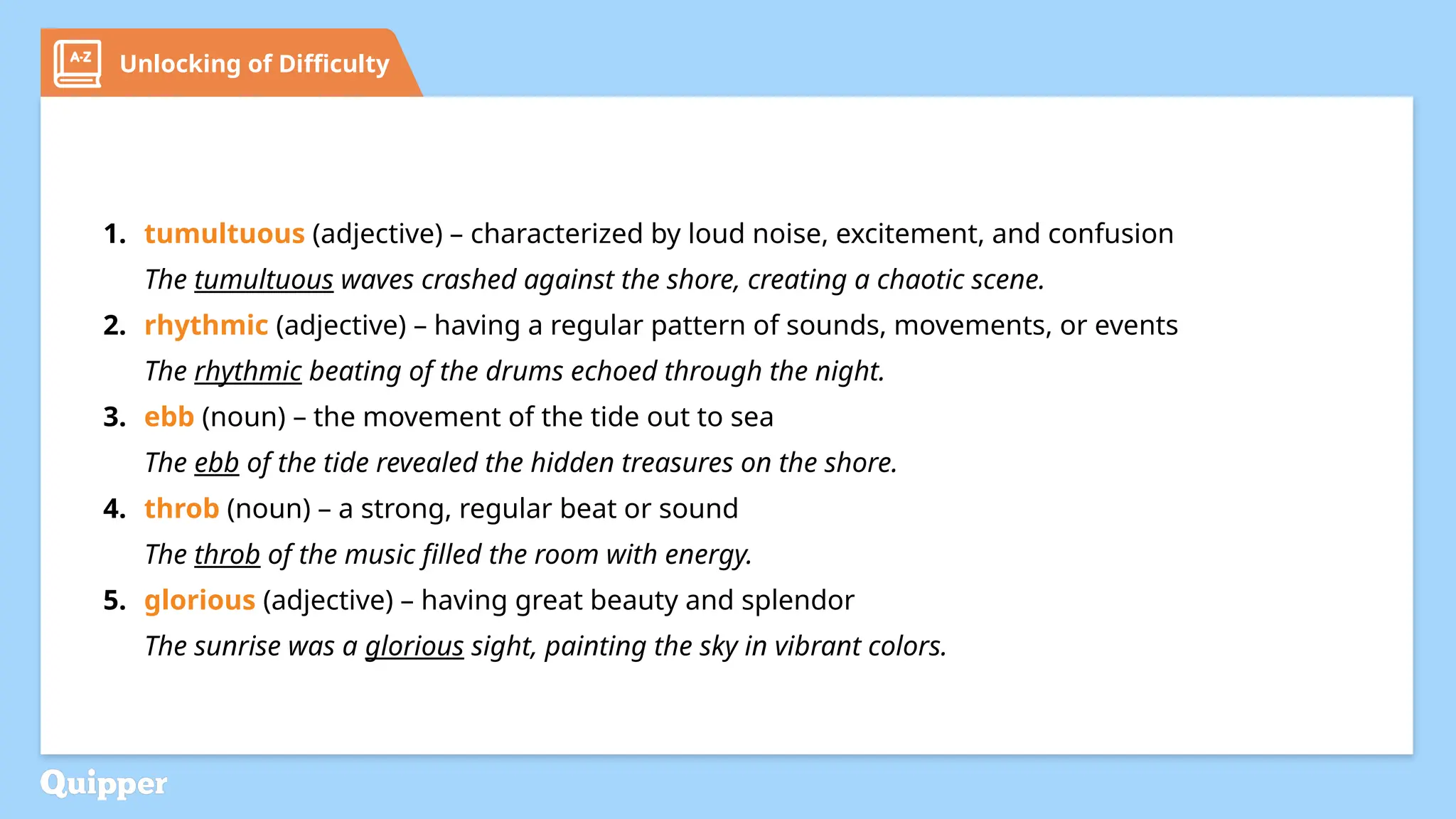
Unlocking of Difficulty
1. tumultuous (adjective) – characterized by loud noise, excitement, and confusion
The tumultuous waves crashed against the shore, creating a chaotic scene.
2. rhythmic (adjective) – having a regular pattern of sounds, movements, or events
The rhythmic beating of the drums echoed through the night.
3. ebb (noun) – the movement of the tide out to sea
The ebb of the tide revealed the hidden treasures on the shore.
4. throb (noun) – a strong, regular beat or sound
The throb of the music filled the room with energy.
5. glorious (adjective) – having great beauty and splendor
The sunrise was a glorious sight, painting the sky in vibrant colors.
Learn about It
Poetry
● uses structured language to convey emotions, ideas, and values
● characterized by its use of various elements
Learn about It
Rhyme
– repetition of similar sounds, usually at line ends
● end rhyme – rhyming words at the end of lines
● internal rhyme – rhyming within a line
● slant rhyme – approximate rhyme where the sounds are similar but not
exact
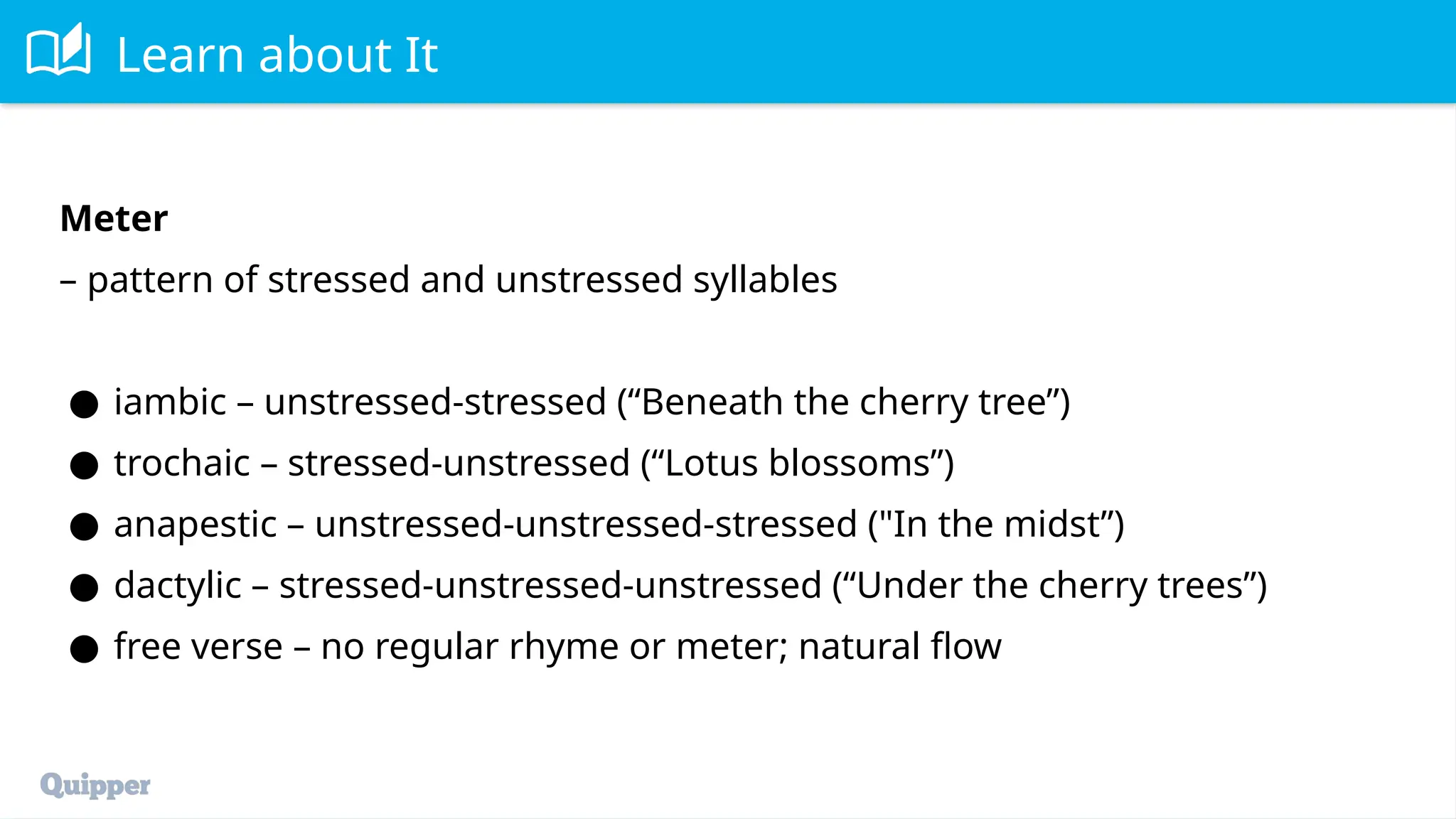
Learn about It
Meter
– pattern of stressed and unstressed syllables
● iambic – unstressed-stressed (“Beneath the cherry tree”)
● trochaic – stressed-unstressed (“Lotus blossoms”)
● anapestic – unstressed-unstressed-stressed ("In the midst”)
● dactylic – stressed-unstressed-unstressed (“Under the cherry trees”)
● free verse – no regular rhyme or meter; natural flow
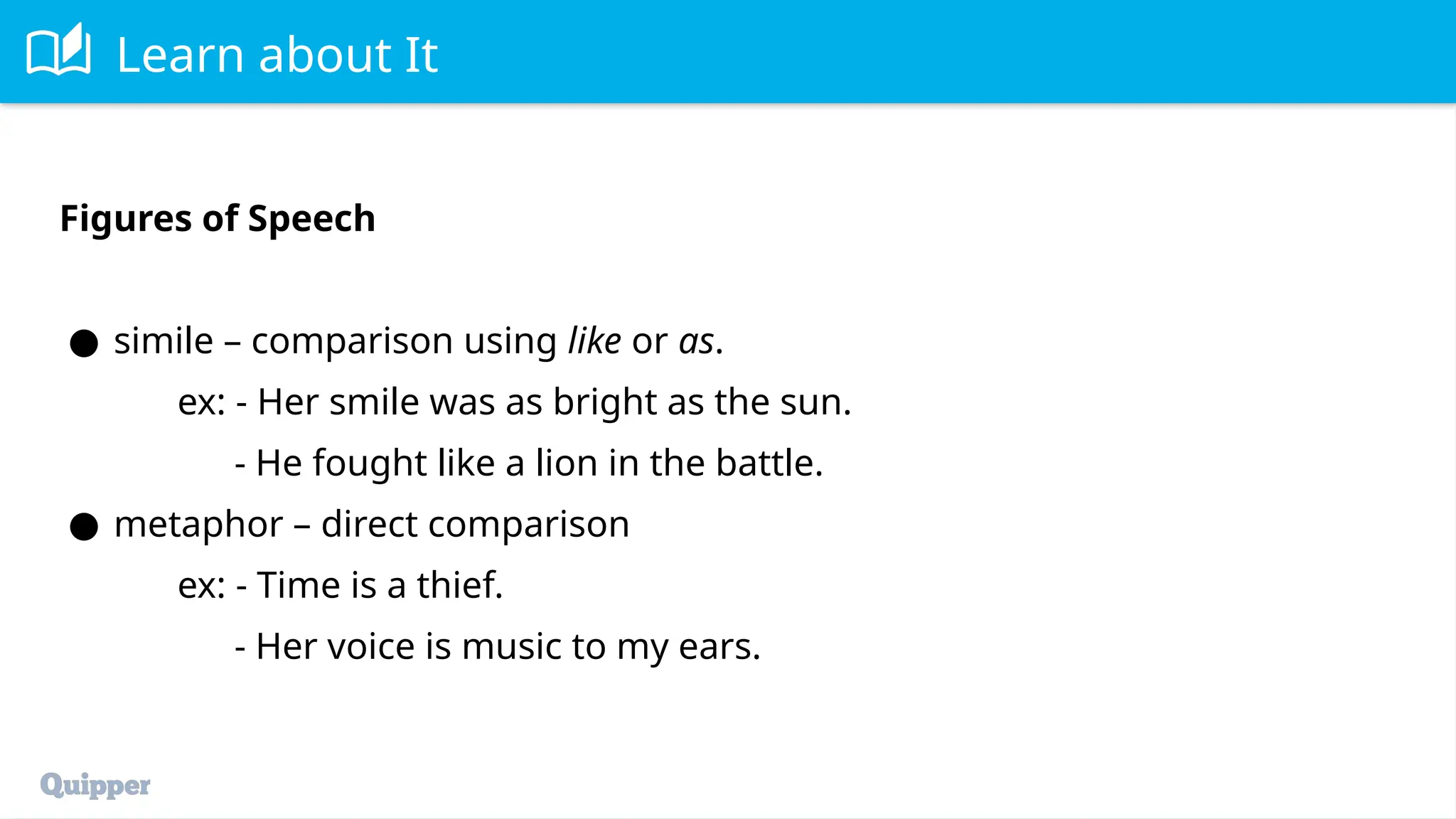
Learn about It
Figures of Speech
● simile – comparison using like or as.
ex: - Her smile was as bright as the sun.
- He fought like a lion in the battle.
● metaphor – direct comparison
ex: - Time is a thief.
- Her voice is music to my ears.
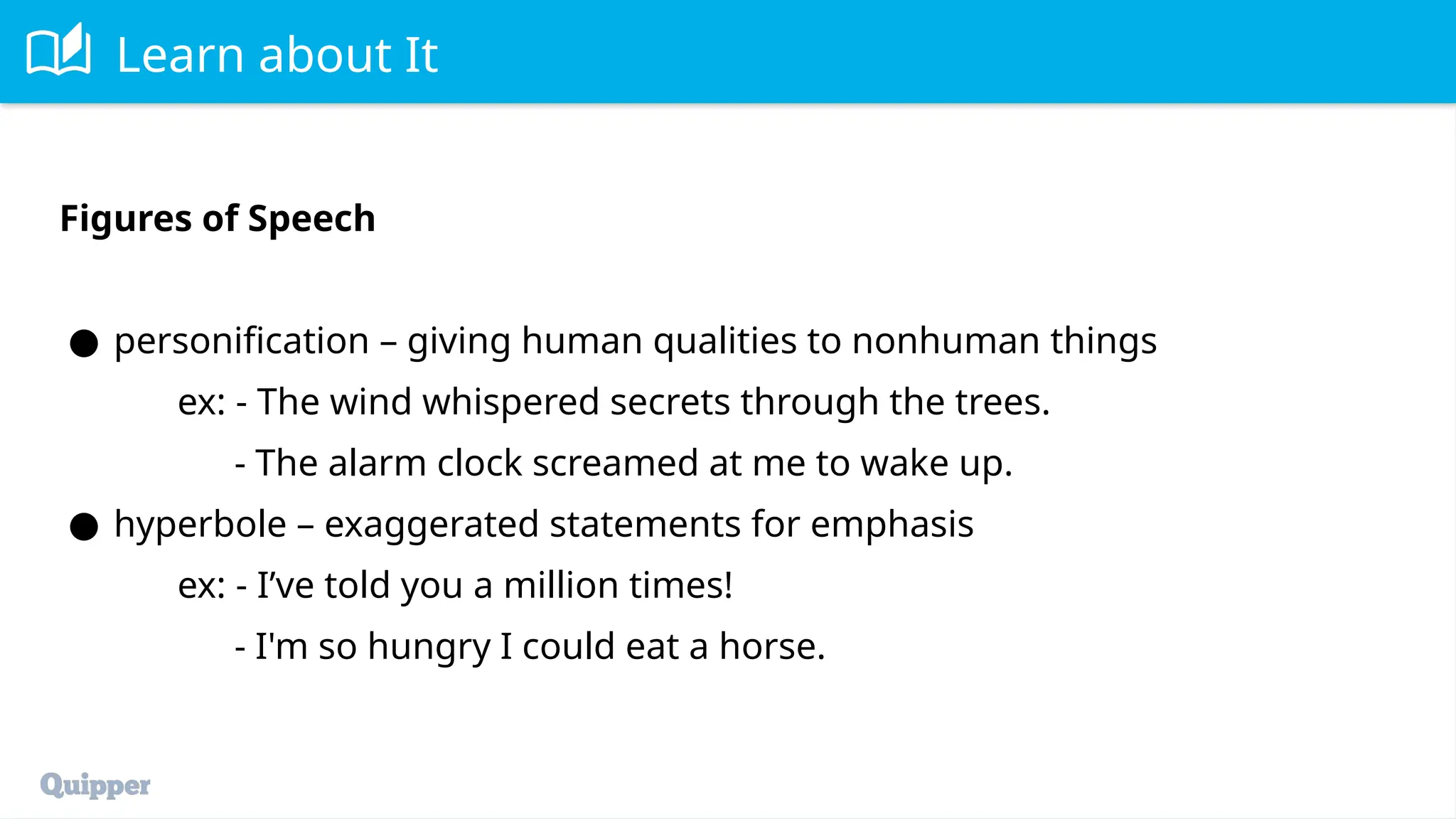
Learn about It
Figures of Speech
● personification – giving human qualities to nonhuman things
ex: - The wind whispered secrets through the trees.
- The alarm clock screamed at me to wake up.
● hyperbole – exaggerated statements for emphasis
ex: - I’ve told you a million times!
- I'm so hungry I could eat a horse.
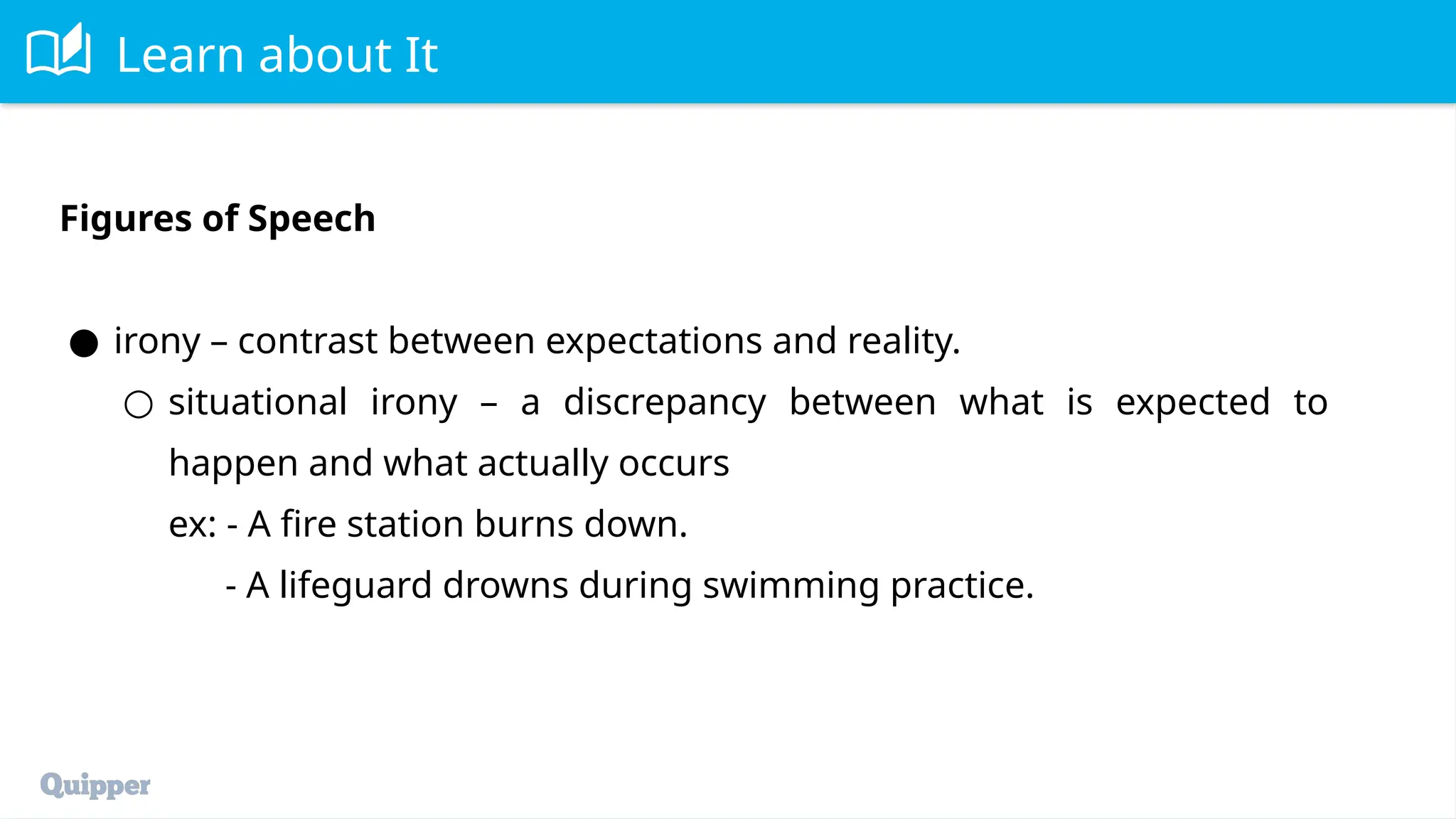
Learn about It
Figures of Speech
● irony – contrast between expectations and reality.
○ situational irony – a discrepancy between what is expected to
happen and what actually occurs
ex: - A fire station burns down.
- A lifeguard drowns during swimming practice.
Learn about It
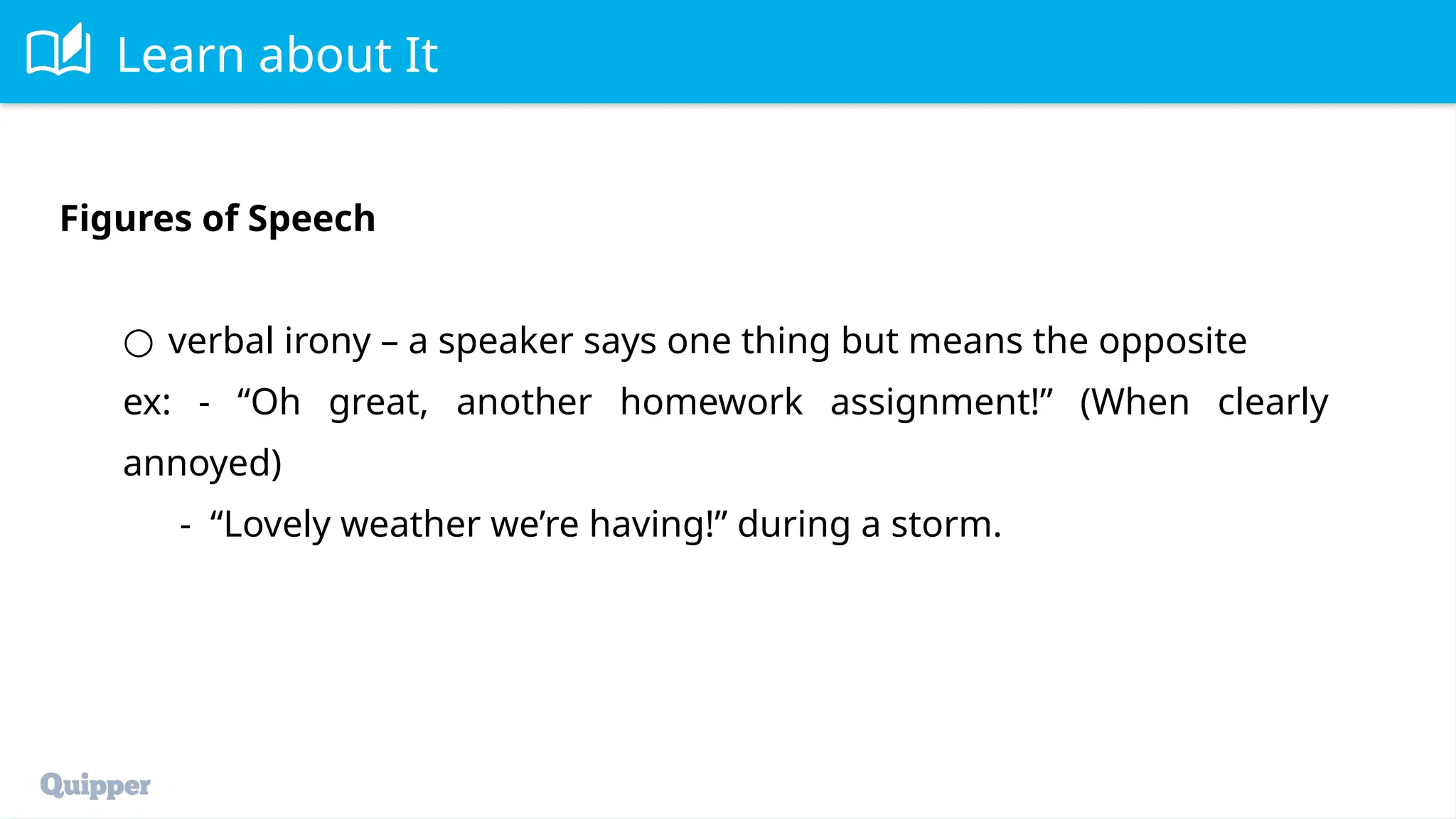
Figures of Speech
○ verbal irony – a speaker says one thing but means the opposite
ex: - “Oh great, another homework assignment!” (When clearly
annoyed)
- “Lovely weather we’re having!” during a storm.
Learn about It
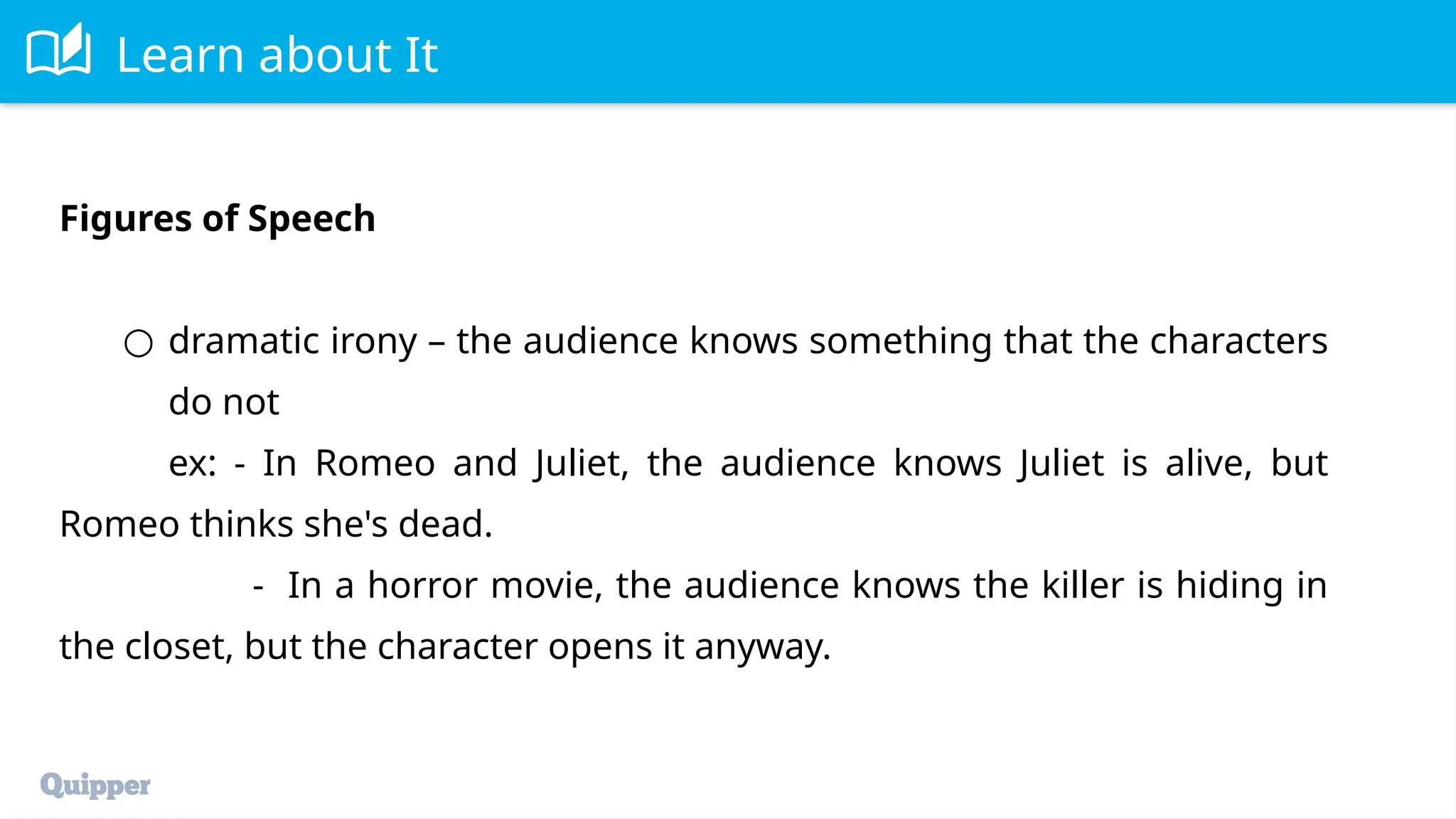
Figures of Speech
○ dramatic irony – the audience knows something that the characters
do not
ex: - In Romeo and Juliet, the audience knows Juliet is alive, but
Romeo thinks she's dead.
- In a horror movie, the audience knows the killer is hiding in
the closet, but the character opens it anyway.
Learn about It
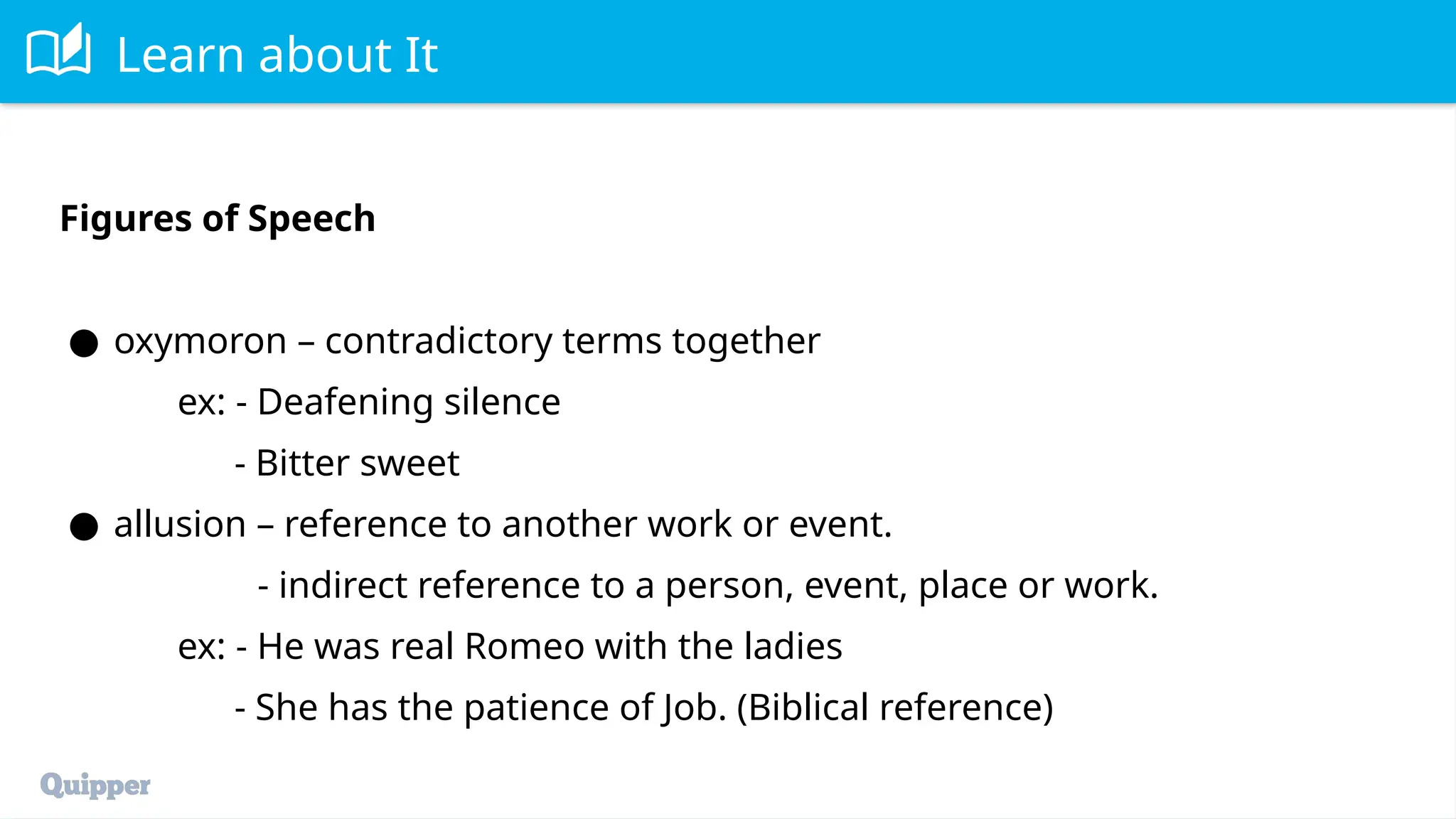
Figures of Speech
● oxymoron – contradictory terms together
ex: - Deafening silence
- Bitter sweet
● allusion – reference to another work or event.
- indirect reference to a person, event, place or work.
ex: - He was real Romeo with the ladies
- She has the patience of Job. (Biblical reference)
Learn about It
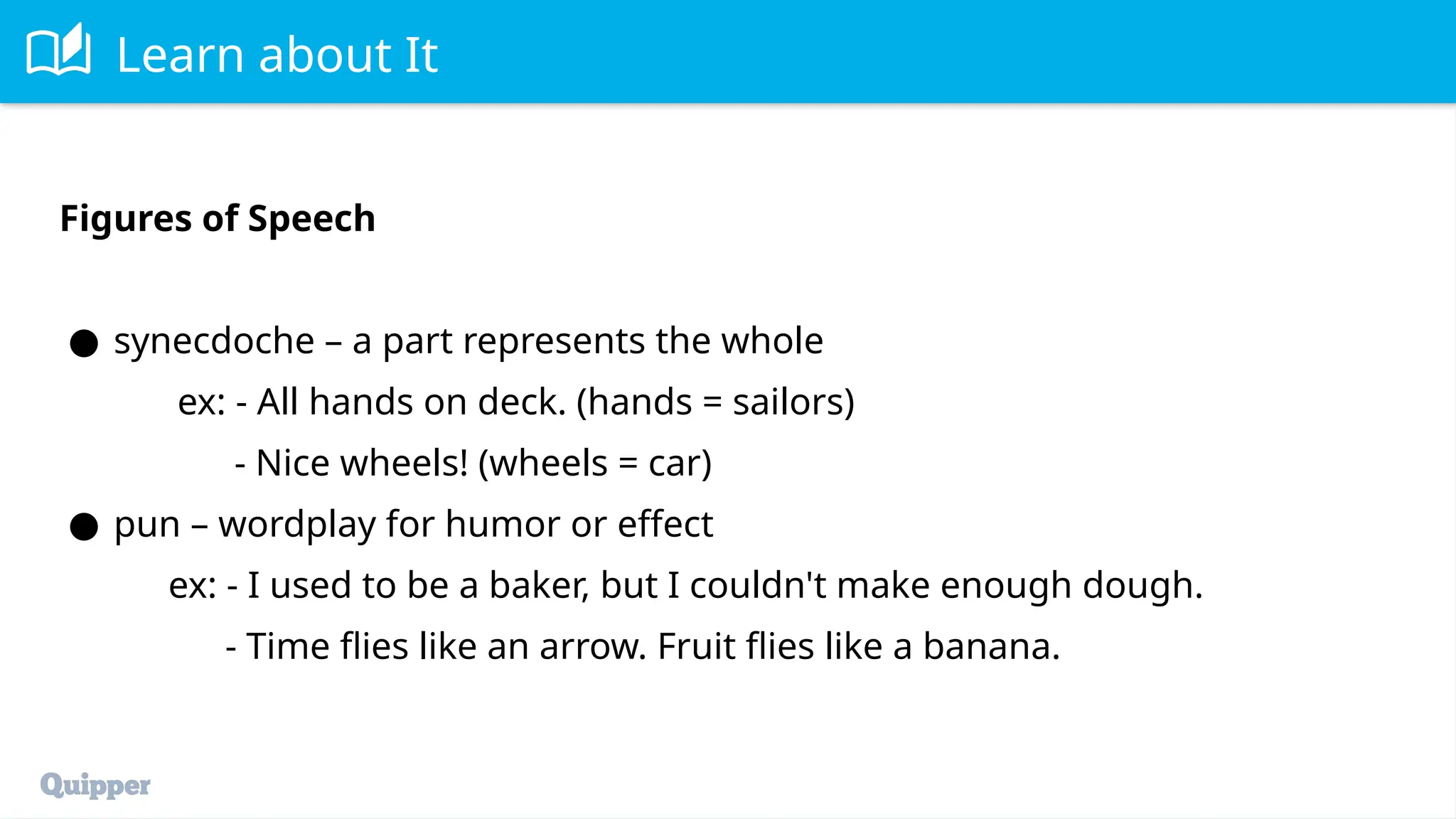
Figures of Speech
● synecdoche – a part represents the whole
ex: - All hands on deck. (hands = sailors)
- Nice wheels! (wheels = car)
● pun – wordplay for humor or effect
ex: - I used to be a baker, but I couldn't make enough dough.
- Time flies like an arrow. Fruit flies like a banana.
Learn about It
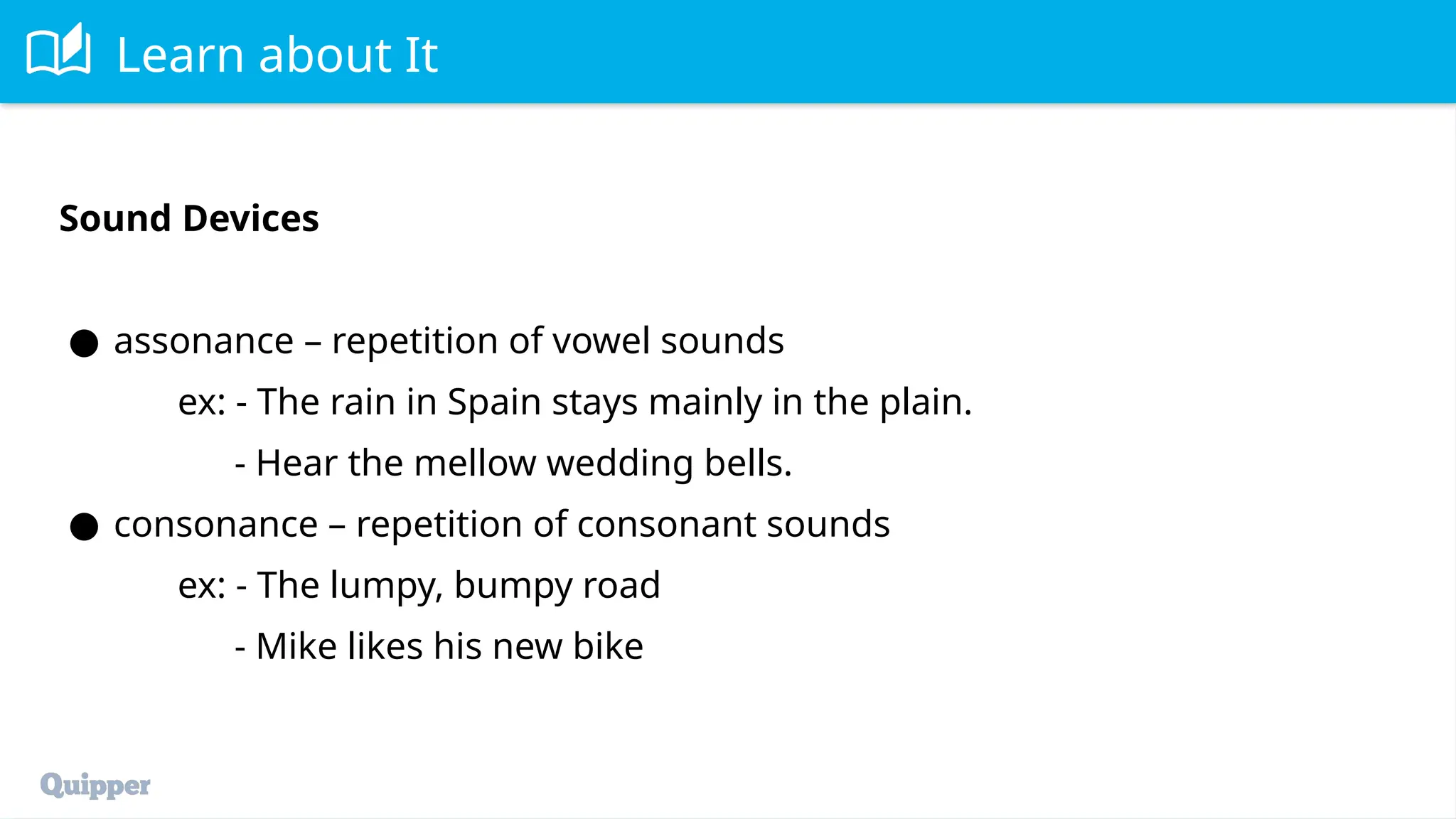
Sound Devices
● assonance – repetition of vowel sounds
ex: - The rain in Spain stays mainly in the plain.
- Hear the mellow wedding bells.
● consonance – repetition of consonant sounds
ex: - The lumpy, bumpy road
- Mike likes his new bike
Learn about It
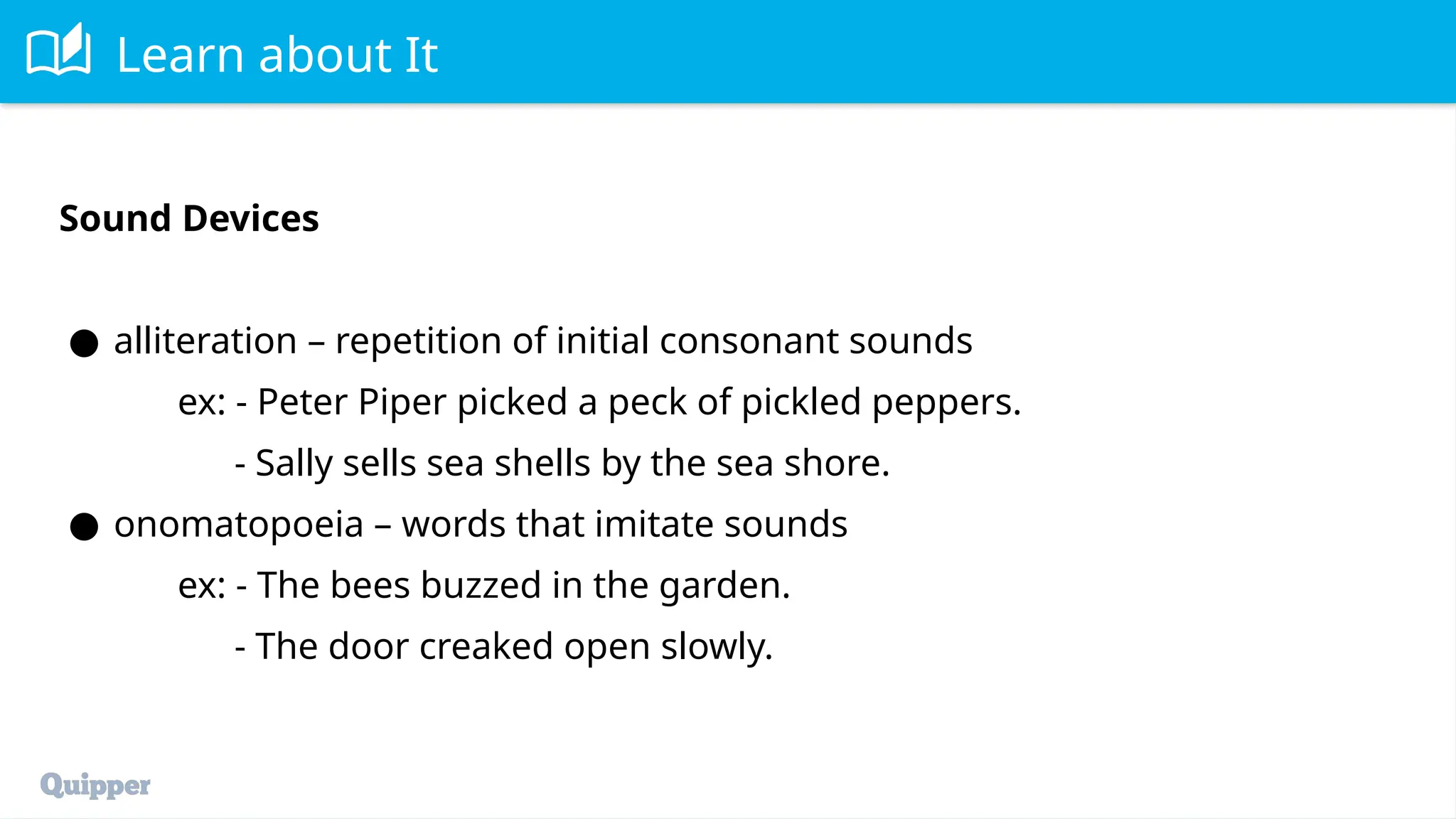
Sound Devices
● alliteration – repetition of initial consonant sounds
ex: - Peter Piper picked a peck of pickled peppers.
- Sally sells sea shells by the sea shore.
● onomatopoeia – words that imitate sounds
ex: - The bees buzzed in the garden.
- The door creaked open slowly.
Learn about It
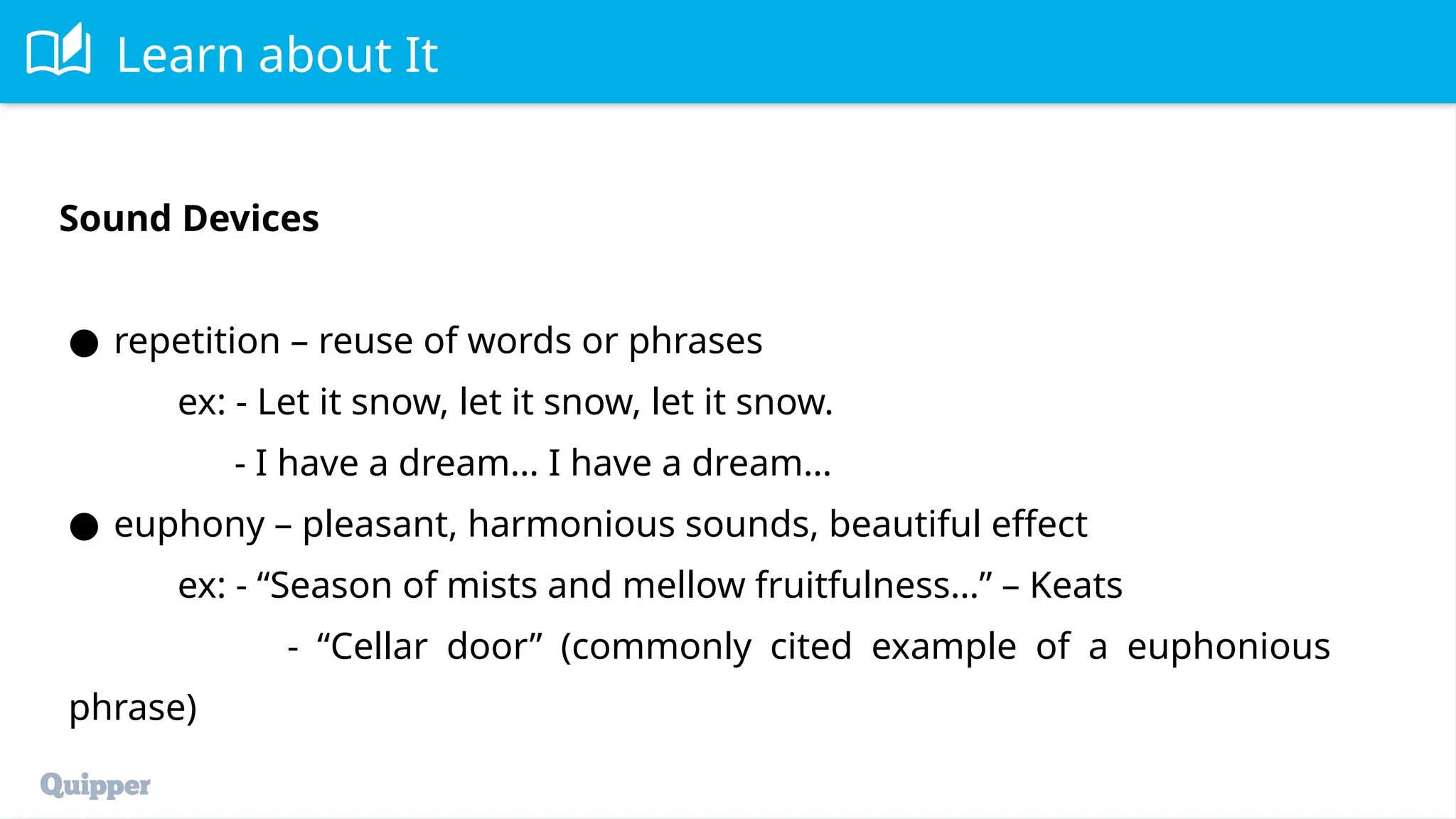
Sound Devices
● repetition – reuse of words or phrases
ex: - Let it snow, let it snow, let it snow.
- I have a dream… I have a dream…
● euphony – pleasant, harmonious sounds, beautiful effect
ex: - “Season of mists and mellow fruitfulness…” – Keats
- “Cellar door” (commonly cited example of a euphonious
phrase)
Learn about It
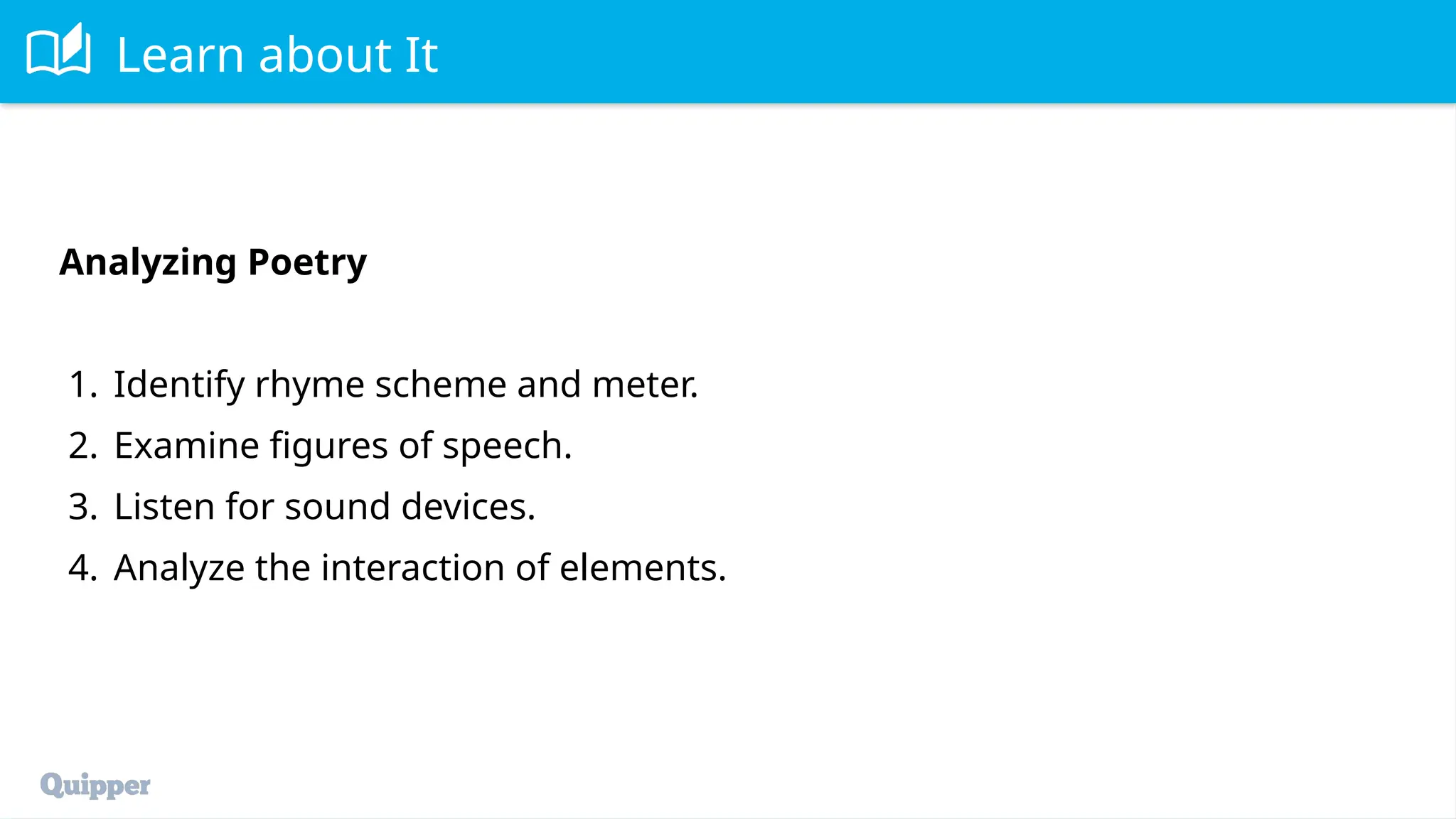
Analyzing Poetry
1. Identify rhyme scheme and meter.
2. Examine figures of speech.
3. Listen for sound devices.
4. Analyze the interaction of elements.
Learn about It
Gitanjali 69
Rabindranath Tagore
Learn about It
Guide Questions
1. What is the rhyme scheme of “Gitanjali 69”? How does it contribute to the
poem's musicality?
2. Identify and explain two metaphors used in the poem. How do they
enhance the imagery?
3. Find examples of sound devices in the poem. How do they affect the
poem's mood?
4. What themes are presented in the poem? How do they reflect individual or
communal values?
5. How do the elements of poetry in “Gitanjali 69” work together to create an
emotional impact? What emotions does the poem evoke and why?
25
Analysis
Read the poem and answer the questions that follow.
Gitanjali 68
Rabindranath Tagore
26
Analysis
Short-Response Questions
1. Identify the rhyme scheme in the poem. How does it contribute to the
overall rhythm and mood?
2. What type of meter is used in the poem? Provide an example from the text.
3. Analyze the use of personification in the poem. How does it enhance the
imagery?
4. Identify and explain a metaphor in the poem. What effect does this
metaphor have on the reader's understanding?
5. How do sound devices like alliteration or assonance contribute to the
musical quality of the poem?
Values Integration
How can understanding the elements of poetry help you
appreciate and express your own experiences as a learner or a
family member?
28
Synthesis Activity
Create a poem using the elements of rhyme, meter, figures of speech, and
sound devices that were discussed. Your poem should be at least eight
lines long and should reflect a personal experience or emotion. After
writing your poem, explain how you used each of these elements to
enhance the meaning and emotional impact of your poem.
29
Synthesis Activity
Guide Questions
1. How did you choose the rhyme scheme for your poem, and how does it
contribute to its overall mood?
2. Identify and explain a figure of speech in your poem. How does it
enhance the imagery or emotion?
3. What sound devices did you incorporate in your poem? How do they
contribute to its musicality?
30
Additional Exercise
Read the poem and answer the questions that follow.
Gitanjali 23
Rabindranath Tagore
31
Additional Exercise
Short-Response Questions
1. How does the poem's rhyme scheme contribute to the overall rhythm and
mood of the poem?
2. What type of meter is used in the poem? Provide an example from the text.
3. Analyze the use of metaphor in the poem. How does the poem's use of
metaphor enhance the imagery and emotional tone?
4. How does the use of sound devices in the poem contribute to its musical
quality?
5. How do the figures of speech in the poem contribute to the theme of the
journey of love?
References
Peregoy, Suzanne, and Owen F. Boyle. Reading, Writing, and Learning in ESL. New York: Longman, 1997.
Puzo, Mario. The Godfather. New York: Signet, 1978.
Redmon, Allen H. “How Many Lebowskis Are There? Genre, Spectatorial Authorship, and The Big Lebowski.” Journal
of Popular Film & Television 40, no. 2 (2012): 52–61. doi:10.1080/ 01956051.2011.613422
32
“Figure of Speech Definition and Examples.” n.d. Poem Analysis. Accessed May 16, 2024.
https://poemanalysis.com/figurative-language/figure-of-speech/.
Hamilton, Virginia. n.d. “Rhyme.” Poetry Foundation. Accessed May 16, 2024. https://www.poetryfoundation.org/learn/glossary-terms/rhyme.
“Poetry 101: What Is Meter? Learn the Difference Between Qualitative and Quantitative Meter in Poetry with Examples.” 2021. MasterClass.
https://www.masterclass.com/articles/poetry-101-what-is-meter-learn-the-difference-between-qualitative-and-quantitative-meter-in-poet
ry-with-examples
.
Tagore, Rabindranath. n.d. “Gitanjali 23.” Poets.org. Accessed May 16, 2024. https://poets.org/poem/gitanjali-23.
Tagore, Rabindranath. n.d. “Gitanjali 68.” Poets.org. Accessed May 16, 2024. https://poets.org/poem/gitanjali-68.
Tagore, Rabindranath. n.d. “Gitanjali 69.” Poets.org. Accessed May 16, 2024. https://poets.org/poem/gitanjali-69.
Yamasaki, Parker. 2022. “20 Types of Figures of Speech, With Definitions and Examples.” Grammarly.
https://www.grammarly.com/blog/figure-of-speech/.
E8 ssssssssssssssssssssssssssssssssssQ1 0101 PS.pptx

  • 1.
  • 2.
  • 3.
    3 At the endof this lesson, you should be able to analyze literary texts as expressions of individual or communal values within (EN8LIT-I-1). Learning Competencies structural context ■ rhyme and meter ■ figures of speech and sound devices
  • 4.
    4 Learning Targets At theend of this lesson, you should be able to do the following: ○ Identify and explain the use of rhyme and meter in poems. ○ Analyze figures of speech and sound devices in poems to interpret how these elements enhance meaning and emotion.
  • 5.
    5 Essential Question How do rhyme,meter, figures of speech, and sound devices work together to enhance the meaning and emotion in poetry?
  • 6.
    Warm-Up Poetry Word Cloud Thinkabout different poetic elements like rhyme, meter, figures of speech, and sound devices. Using an online word cloud generator or a large piece of paper, create a word cloud with words that you associate with poetry. After you finish your word cloud, discuss with your classmates which words are most prominent and why you chose them. Be ready to share your thoughts with the class.
  • 7.
    Warm-Up Guide Questions 1. Whichwords did you include in your word cloud and why? 2. How do the words you chose reflect your understanding of poetry? 3. What patterns or themes do you notice in the word cloud, and how do they relate to the elements of poetry?
  • 8.
    Unlocking of Difficulty 1.tumultuous (adjective) – characterized by loud noise, excitement, and confusion The tumultuous waves crashed against the shore, creating a chaotic scene. 2. rhythmic (adjective) – having a regular pattern of sounds, movements, or events The rhythmic beating of the drums echoed through the night. 3. ebb (noun) – the movement of the tide out to sea The ebb of the tide revealed the hidden treasures on the shore. 4. throb (noun) – a strong, regular beat or sound The throb of the music filled the room with energy. 5. glorious (adjective) – having great beauty and splendor The sunrise was a glorious sight, painting the sky in vibrant colors.
  • 9.
    Learn about It Poetry ●uses structured language to convey emotions, ideas, and values ● characterized by its use of various elements
  • 10.
    Learn about It Rhyme –repetition of similar sounds, usually at line ends ● end rhyme – rhyming words at the end of lines ● internal rhyme – rhyming within a line ● slant rhyme – approximate rhyme where the sounds are similar but not exact
  • 11.
    Learn about It Meter –pattern of stressed and unstressed syllables ● iambic – unstressed-stressed (“Beneath the cherry tree”) ● trochaic – stressed-unstressed (“Lotus blossoms”) ● anapestic – unstressed-unstressed-stressed ("In the midst”) ● dactylic – stressed-unstressed-unstressed (“Under the cherry trees”) ● free verse – no regular rhyme or meter; natural flow
  • 12.
    Learn about It Figuresof Speech ● simile – comparison using like or as. ex: - Her smile was as bright as the sun. - He fought like a lion in the battle. ● metaphor – direct comparison ex: - Time is a thief. - Her voice is music to my ears.
  • 13.
    Learn about It Figuresof Speech ● personification – giving human qualities to nonhuman things ex: - The wind whispered secrets through the trees. - The alarm clock screamed at me to wake up. ● hyperbole – exaggerated statements for emphasis ex: - I’ve told you a million times! - I'm so hungry I could eat a horse.
  • 14.
    Learn about It Figuresof Speech ● irony – contrast between expectations and reality. ○ situational irony – a discrepancy between what is expected to happen and what actually occurs ex: - A fire station burns down. - A lifeguard drowns during swimming practice.
  • 15.
    Learn about It Figuresof Speech ○ verbal irony – a speaker says one thing but means the opposite ex: - “Oh great, another homework assignment!” (When clearly annoyed) - “Lovely weather we’re having!” during a storm.
  • 16.
    Learn about It Figuresof Speech ○ dramatic irony – the audience knows something that the characters do not ex: - In Romeo and Juliet, the audience knows Juliet is alive, but Romeo thinks she's dead. - In a horror movie, the audience knows the killer is hiding in the closet, but the character opens it anyway.
  • 17.
    Learn about It Figuresof Speech ● oxymoron – contradictory terms together ex: - Deafening silence - Bitter sweet ● allusion – reference to another work or event. - indirect reference to a person, event, place or work. ex: - He was real Romeo with the ladies - She has the patience of Job. (Biblical reference)
  • 18.
    Learn about It Figuresof Speech ● synecdoche – a part represents the whole ex: - All hands on deck. (hands = sailors) - Nice wheels! (wheels = car) ● pun – wordplay for humor or effect ex: - I used to be a baker, but I couldn't make enough dough. - Time flies like an arrow. Fruit flies like a banana.
  • 19.
    Learn about It SoundDevices ● assonance – repetition of vowel sounds ex: - The rain in Spain stays mainly in the plain. - Hear the mellow wedding bells. ● consonance – repetition of consonant sounds ex: - The lumpy, bumpy road - Mike likes his new bike
  • 20.
    Learn about It SoundDevices ● alliteration – repetition of initial consonant sounds ex: - Peter Piper picked a peck of pickled peppers. - Sally sells sea shells by the sea shore. ● onomatopoeia – words that imitate sounds ex: - The bees buzzed in the garden. - The door creaked open slowly.
  • 21.
    Learn about It SoundDevices ● repetition – reuse of words or phrases ex: - Let it snow, let it snow, let it snow. - I have a dream… I have a dream… ● euphony – pleasant, harmonious sounds, beautiful effect ex: - “Season of mists and mellow fruitfulness…” – Keats - “Cellar door” (commonly cited example of a euphonious phrase)
  • 22.
    Learn about It AnalyzingPoetry 1. Identify rhyme scheme and meter. 2. Examine figures of speech. 3. Listen for sound devices. 4. Analyze the interaction of elements.
  • 23.
    Learn about It Gitanjali69 Rabindranath Tagore
  • 24.
    Learn about It GuideQuestions 1. What is the rhyme scheme of “Gitanjali 69”? How does it contribute to the poem's musicality? 2. Identify and explain two metaphors used in the poem. How do they enhance the imagery? 3. Find examples of sound devices in the poem. How do they affect the poem's mood? 4. What themes are presented in the poem? How do they reflect individual or communal values? 5. How do the elements of poetry in “Gitanjali 69” work together to create an emotional impact? What emotions does the poem evoke and why?
  • 25.
    25 Analysis Read the poemand answer the questions that follow. Gitanjali 68 Rabindranath Tagore
  • 26.
    26 Analysis Short-Response Questions 1. Identifythe rhyme scheme in the poem. How does it contribute to the overall rhythm and mood? 2. What type of meter is used in the poem? Provide an example from the text. 3. Analyze the use of personification in the poem. How does it enhance the imagery? 4. Identify and explain a metaphor in the poem. What effect does this metaphor have on the reader's understanding? 5. How do sound devices like alliteration or assonance contribute to the musical quality of the poem?
  • 27.
    Values Integration How canunderstanding the elements of poetry help you appreciate and express your own experiences as a learner or a family member?
  • 28.
    28 Synthesis Activity Create apoem using the elements of rhyme, meter, figures of speech, and sound devices that were discussed. Your poem should be at least eight lines long and should reflect a personal experience or emotion. After writing your poem, explain how you used each of these elements to enhance the meaning and emotional impact of your poem.
  • 29.
    29 Synthesis Activity Guide Questions 1.How did you choose the rhyme scheme for your poem, and how does it contribute to its overall mood? 2. Identify and explain a figure of speech in your poem. How does it enhance the imagery or emotion? 3. What sound devices did you incorporate in your poem? How do they contribute to its musicality?
  • 30.
    30 Additional Exercise Read thepoem and answer the questions that follow. Gitanjali 23 Rabindranath Tagore
  • 31.
    31 Additional Exercise Short-Response Questions 1.How does the poem's rhyme scheme contribute to the overall rhythm and mood of the poem? 2. What type of meter is used in the poem? Provide an example from the text. 3. Analyze the use of metaphor in the poem. How does the poem's use of metaphor enhance the imagery and emotional tone? 4. How does the use of sound devices in the poem contribute to its musical quality? 5. How do the figures of speech in the poem contribute to the theme of the journey of love?
  • 32.
    References Peregoy, Suzanne, andOwen F. Boyle. Reading, Writing, and Learning in ESL. New York: Longman, 1997. Puzo, Mario. The Godfather. New York: Signet, 1978. Redmon, Allen H. “How Many Lebowskis Are There? Genre, Spectatorial Authorship, and The Big Lebowski.” Journal of Popular Film & Television 40, no. 2 (2012): 52–61. doi:10.1080/ 01956051.2011.613422 32 “Figure of Speech Definition and Examples.” n.d. Poem Analysis. Accessed May 16, 2024. https://poemanalysis.com/figurative-language/figure-of-speech/. Hamilton, Virginia. n.d. “Rhyme.” Poetry Foundation. Accessed May 16, 2024. https://www.poetryfoundation.org/learn/glossary-terms/rhyme. “Poetry 101: What Is Meter? Learn the Difference Between Qualitative and Quantitative Meter in Poetry with Examples.” 2021. MasterClass. https://www.masterclass.com/articles/poetry-101-what-is-meter-learn-the-difference-between-qualitative-and-quantitative-meter-in-poet ry-with-examples . Tagore, Rabindranath. n.d. “Gitanjali 23.” Poets.org. Accessed May 16, 2024. https://poets.org/poem/gitanjali-23. Tagore, Rabindranath. n.d. “Gitanjali 68.” Poets.org. Accessed May 16, 2024. https://poets.org/poem/gitanjali-68. Tagore, Rabindranath. n.d. “Gitanjali 69.” Poets.org. Accessed May 16, 2024. https://poets.org/poem/gitanjali-69. Yamasaki, Parker. 2022. “20 Types of Figures of Speech, With Definitions and Examples.” Grammarly. https://www.grammarly.com/blog/figure-of-speech/.