MODULE 1:
INTRODUCTION TO PLANT
TAXONOMY
LEARNING OUTCOME:-
At the end of the lesson, students should be
able to:-
• define order, family, genus and species
• explain the process of plant classification
• describe different types of plant family
Introduction
• Scientists have sorted and classified living organisms
based on their similarities and differences.
• This system of classification are called taxonomy and
usually features both English and Latin names for
different divisions.
• It is important for people in the commercial plant and
nursery business to know both scientific and common
names as they become confusing.
Plant Taxonomy
• Taxonomy is the science of identifying, naming and
classifying plants.
• Carolus Linnaeus has develop the current Latin based
system called the binomial nomenclature.
• He was the first person to propose an orderly system
for classifying organisms.
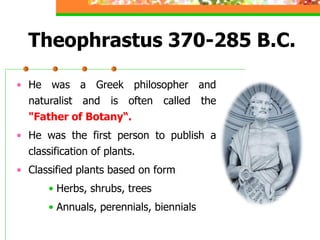
Theophrastus 370-285 B.C.
• He was a Greek philosopher and
naturalist and is often called the
"Father of Botany“.
• He was the first person to publish a
classification of plants.
• Classified plants based on form
• Herbs, shrubs, trees
• Annuals, perennials, biennials
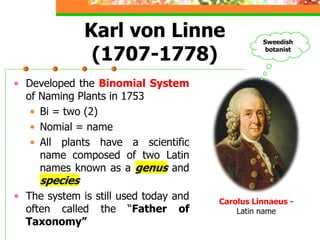
• Developed the Binomial System
of Naming Plants in 1753
• Bi = two (2)
• Nomial = name
• All plants have a scientific
name composed of two Latin
names known as a genus and
species
• The system is still used today and
often called the “Father of
Taxonomy”
Karl von Linne
(1707-1778)
Carolus Linnaeus -
Latin name
Sweedish
botanist
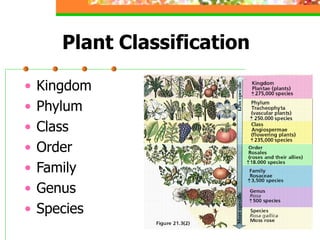
Plant Classification
• Kingdom
• Phylum
• Class
• Order
• Family
• Genus
• Species
Kingdom
• Over 275,000 species
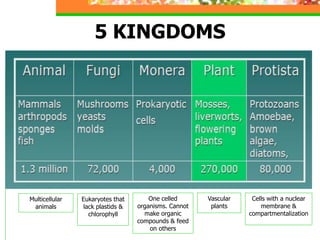
• Kingdom (Plantae) is broken down into smaller
divisions based on several characteristics:-
• Whether they can circulate fluids (like rainwater)
through their bodies @ need to absorb them from the
moisture that surrounds them
• How they reproduce (by spores @ seeds)
• Their size
Vascular
plants
5 KINGDOMS
Multicellular
animals
Eukaryotes that
lack plastids &
chlorophyll
One celled
organisms. Cannot
make organic
compounds & feed
on others
Cells with a nuclear
membrane &
compartmentalization
Phylum
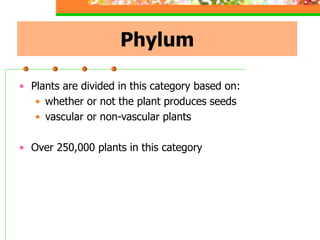
• Plants are divided in this category based on:
• whether or not the plant produces seeds
• vascular or non-vascular plants
• Over 250,000 plants in this category
Division
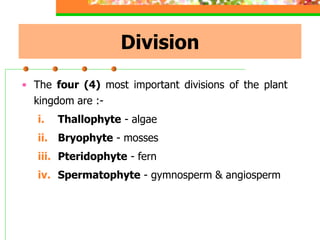
• The four (4) most important divisions of the plant
kingdom are :-
i. Thallophyte - algae
ii. Bryophyte - mosses
iii. Pteridophyte - fern
iv. Spermatophyte - gymnosperm & angiosperm
Class
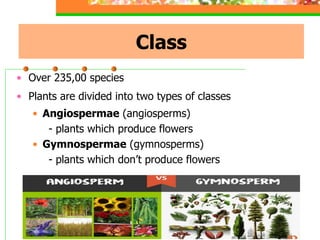
• Over 235,00 species
• Plants are divided into two types of classes
• Angiospermae (angiosperms)
- plants which produce flowers
• Gymnospermae (gymnosperms)
- plants which don’t produce flowers
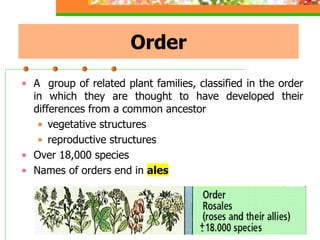
Order
• A group of related plant families, classified in the order
in which they are thought to have developed their
differences from a common ancestor
• vegetative structures
• reproductive structures
• Over 18,000 species
• Names of orders end in ales
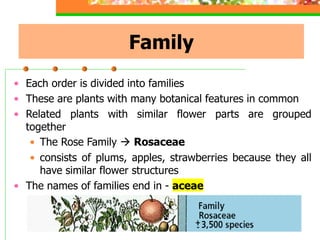
Family
• Each order is divided into families
• These are plants with many botanical features in common
• Related plants with similar flower parts are grouped
together
• The Rose Family → Rosaceae
• consists of plums, apples, strawberries because they all
have similar flower structures
• The names of families end in - aceae
Genus
• This is the part of the plant name that is most familiar
• The normal name that you give a plant
• The name of the Genus should be written with a capital
letter
• Over 500 species
Species
• This is the highest level that defines an individual
plant.
• Often, the name will describe some aspect of the plant.
• The color of the flowers, size or shape of the leaves,
or it may be named after the place where it was
found.
• Together the Genus and species name refer to only
one plant, and they are used to identify that particular
plant.
• Plants in the same species
consistently produce plants of the
same types.
• The species name is an adjective that
describes the genus.
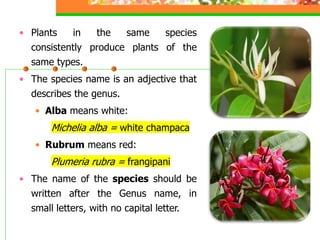
• Alba means white:
Michelia alba = white champaca
• Rubrum means red:
Plumeria rubra = frangipani
• The name of the species should be
written after the Genus name, in
small letters, with no capital letter.

M1_1 - PLANT TAXONOMY ONLINE.pdf

  • 1.
  • 2.
    LEARNING OUTCOME:- At theend of the lesson, students should be able to:- • define order, family, genus and species • explain the process of plant classification • describe different types of plant family
  • 3.
    Introduction • Scientists havesorted and classified living organisms based on their similarities and differences. • This system of classification are called taxonomy and usually features both English and Latin names for different divisions. • It is important for people in the commercial plant and nursery business to know both scientific and common names as they become confusing.
  • 4.
    Plant Taxonomy • Taxonomyis the science of identifying, naming and classifying plants. • Carolus Linnaeus has develop the current Latin based system called the binomial nomenclature. • He was the first person to propose an orderly system for classifying organisms.
  • 5.
    Theophrastus 370-285 B.C. •He was a Greek philosopher and naturalist and is often called the "Father of Botany“. • He was the first person to publish a classification of plants. • Classified plants based on form • Herbs, shrubs, trees • Annuals, perennials, biennials
  • 6.
    • Developed theBinomial System of Naming Plants in 1753 • Bi = two (2) • Nomial = name • All plants have a scientific name composed of two Latin names known as a genus and species • The system is still used today and often called the “Father of Taxonomy” Karl von Linne (1707-1778) Carolus Linnaeus - Latin name Sweedish botanist
  • 7.
    Plant Classification • Kingdom •Phylum • Class • Order • Family • Genus • Species
  • 8.
    Kingdom • Over 275,000species • Kingdom (Plantae) is broken down into smaller divisions based on several characteristics:- • Whether they can circulate fluids (like rainwater) through their bodies @ need to absorb them from the moisture that surrounds them • How they reproduce (by spores @ seeds) • Their size
  • 9.
    Vascular plants 5 KINGDOMS Multicellular animals Eukaryotes that lackplastids & chlorophyll One celled organisms. Cannot make organic compounds & feed on others Cells with a nuclear membrane & compartmentalization
  • 10.
    Phylum • Plants aredivided in this category based on: • whether or not the plant produces seeds • vascular or non-vascular plants • Over 250,000 plants in this category
  • 11.
    Division • The four(4) most important divisions of the plant kingdom are :- i. Thallophyte - algae ii. Bryophyte - mosses iii. Pteridophyte - fern iv. Spermatophyte - gymnosperm & angiosperm
  • 12.
    Class • Over 235,00species • Plants are divided into two types of classes • Angiospermae (angiosperms) - plants which produce flowers • Gymnospermae (gymnosperms) - plants which don’t produce flowers
  • 13.
    Order • A groupof related plant families, classified in the order in which they are thought to have developed their differences from a common ancestor • vegetative structures • reproductive structures • Over 18,000 species • Names of orders end in ales
  • 14.
    Family • Each orderis divided into families • These are plants with many botanical features in common • Related plants with similar flower parts are grouped together • The Rose Family → Rosaceae • consists of plums, apples, strawberries because they all have similar flower structures • The names of families end in - aceae
  • 15.
    Genus • This isthe part of the plant name that is most familiar • The normal name that you give a plant • The name of the Genus should be written with a capital letter • Over 500 species
  • 16.
    Species • This isthe highest level that defines an individual plant. • Often, the name will describe some aspect of the plant. • The color of the flowers, size or shape of the leaves, or it may be named after the place where it was found. • Together the Genus and species name refer to only one plant, and they are used to identify that particular plant.
  • 17.
    • Plants inthe same species consistently produce plants of the same types. • The species name is an adjective that describes the genus. • Alba means white: Michelia alba = white champaca • Rubrum means red: Plumeria rubra = frangipani • The name of the species should be written after the Genus name, in small letters, with no capital letter.