1.Herbarium
2.Botanical gardens
3.Museum
4.Key
5.Zoological gardens
Taxonomical aids
Taxonomical aids:
 Taxonomic studies of various species of plants,
animals and other organisms are useful in
agriculture, forestry, industry and in general in
knowing our bio-resources and their diversity.
These studies would require correct classification
and identification of organisms
 Biologists have established certain procedures
and techniques to store and preserve the
information as well as the specimens. Some of
these are explained to help you understand the
usage of these aids.
Herbarium:
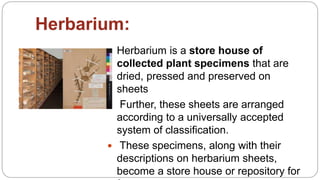
 Herbarium is a store house of
collected plant specimens that are
dried, pressed and preserved on
sheets
 Further, these sheets are arranged
according to a universally accepted
system of classification.
 These specimens, along with their
descriptions on herbarium sheets,
become a store house or repository for
Botanical
garden:
 These specialised gardens have
collections of living plants for
reference. Plant species in these
gardens are grown for identification
purposes and each plant is labelled
indicating its botanical/scientific name
and its family.
 Example:The famous botanical
gardens are at Kew (England), Indian
Botanical Garden, Howrah (India) and
Museum:
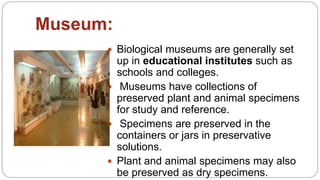
 Biological museums are generally set
up in educational institutes such as
schools and colleges.
 Museums have collections of
preserved plant and animal specimens
for study and reference.
 Specimens are preserved in the
containers or jars in preservative
solutions.
 Plant and animal specimens may also
be preserved as dry specimens.
key:
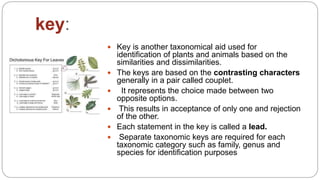
 Key is another taxonomical aid used for
identification of plants and animals based on the
similarities and dissimilarities.
 The keys are based on the contrasting characters
generally in a pair called couplet.
 It represents the choice made between two
opposite options.
 This results in acceptance of only one and rejection
of the other.
 Each statement in the key is called a lead.
 Separate taxonomic keys are required for each
taxonomic category such as family, genus and
species for identification purposes
Zoological
gardens:  These are the places where wild
animals are kept in protected
environments under human care and
which enable us to learn about their
food habits and behaviour
..........thank you.............

Taxonomical Aids

  • 1.
  • 2.
    Taxonomical aids:  Taxonomicstudies of various species of plants, animals and other organisms are useful in agriculture, forestry, industry and in general in knowing our bio-resources and their diversity. These studies would require correct classification and identification of organisms  Biologists have established certain procedures and techniques to store and preserve the information as well as the specimens. Some of these are explained to help you understand the usage of these aids.
  • 3.
    Herbarium:  Herbarium isa store house of collected plant specimens that are dried, pressed and preserved on sheets  Further, these sheets are arranged according to a universally accepted system of classification.  These specimens, along with their descriptions on herbarium sheets, become a store house or repository for
  • 4.
    Botanical garden:  These specialisedgardens have collections of living plants for reference. Plant species in these gardens are grown for identification purposes and each plant is labelled indicating its botanical/scientific name and its family.  Example:The famous botanical gardens are at Kew (England), Indian Botanical Garden, Howrah (India) and
  • 5.
    Museum:  Biological museumsare generally set up in educational institutes such as schools and colleges.  Museums have collections of preserved plant and animal specimens for study and reference.  Specimens are preserved in the containers or jars in preservative solutions.  Plant and animal specimens may also be preserved as dry specimens.
  • 6.
    key:  Key isanother taxonomical aid used for identification of plants and animals based on the similarities and dissimilarities.  The keys are based on the contrasting characters generally in a pair called couplet.  It represents the choice made between two opposite options.  This results in acceptance of only one and rejection of the other.  Each statement in the key is called a lead.  Separate taxonomic keys are required for each taxonomic category such as family, genus and species for identification purposes
  • 7.
    Zoological gardens:  Theseare the places where wild animals are kept in protected environments under human care and which enable us to learn about their food habits and behaviour
  • 8.