Created	
  by	
  John	
  Walker	
  
       11/08/2011	
  
            IT375	
  
Thomas	
  Jefferson	


  Thomas	
  was	
  born	
  on	
  April	
  13,	
  1743.	
  
  He	
  was	
  the	
  principal	
  author	
  of	
  the	
  United	
  States	
  
   Declaration	
  of	
  Independence.	
  
  At	
  the	
  beginning	
  of	
  the	
  American	
  Revolution,	
  
   Jefferson	
  served	
  in	
  the	
  Continental	
  Congress,	
  
   representing	
  Virginia.	
  
Isac	
  Newton	


  Born	
  on	
  December	
  25,	
  1962.	
  
  Considered	
  by	
  many	
  to	
  be	
  the	
  greatest	
  and	
  most	
  
   influential	
  scientist	
  who	
  ever	
  lived.	
  
  Newton	
  described	
  universal	
  gravitation	
  and	
  the	
  three	
  
   laws	
  of	
  motion,	
  which	
  dominated	
  the	
  scientific	
  view	
  
   of	
  the	
  physical	
  universe	
  for	
  the	
  next	
  three	
  centuries.	
  
   Newton	
  showed	
  that	
  the	
  motions	
  of	
  objects	
  on	
  Earth	
  
   and	
  of	
  celestial	
  bodies	
  are	
  governed	
  by	
  the	
  same	
  set	
  of	
  
   natural	
  laws.	
  
George	
  Washington	
  
  He	
  was	
  born	
  on	
  February	
  22,	
  1732	
  
  George	
  was	
  the	
  first	
  president	
  of	
  the	
  United	
  States	
  of	
  
   America.	
  	
  
  ‘’A	
  slender	
  acquaintance	
  with	
  the	
  world	
  must	
  
   convince	
  every	
  man	
  that	
  actions,	
  not	
  words,	
  are	
  the	
  
   true	
  criterion	
  of	
  the	
  attachment	
  of	
  friends.’’	
  
Christopher	
  Columbus	
  
  He	
  was	
  born	
  on	
  October	
  1451,	
  in	
  Public	
  of	
  Genoa	
  in	
  
   southwestern	
  Italy.	
  
  Columbus	
  completed	
  four	
  voyages	
  across	
  the	
  Atlantic	
  
   Ocean	
  that	
  led	
  to	
  general	
  European	
  awareness	
  of	
  the	
  
   American	
  Continents	
  in	
  the	
  Western	
  Hemisphere.	
  	
  
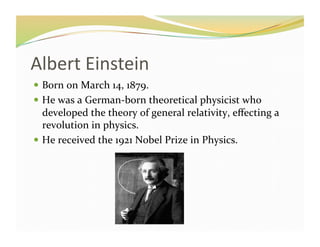
Albert	
  Einstein	
  	
  
  Born	
  on	
  March	
  14,	
  1879.	
  
  He	
  was	
  a	
  German-­‐born	
  theoretical	
  physicist	
  who	
  
   developed	
  the	
  theory	
  of	
  general	
  relativity,	
  effecting	
  a	
  
   revolution	
  in	
  physics.	
  
  He	
  received	
  the	
  1921	
  Nobel	
  Prize	
  in	
  Physics.	
  
The	
  End	
  

Historically Important People

  • 1.
    Created  by  John  Walker   11/08/2011   IT375  
  • 2.
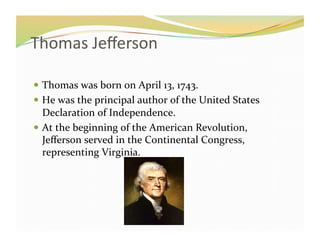
    Thomas  Jefferson       Thomas  was  born  on  April  13,  1743.     He  was  the  principal  author  of  the  United  States   Declaration  of  Independence.     At  the  beginning  of  the  American  Revolution,   Jefferson  served  in  the  Continental  Congress,   representing  Virginia.  
  • 3.
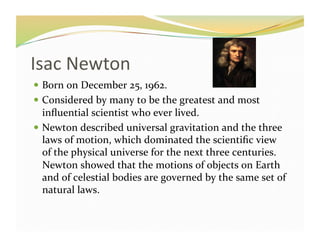
    Isac  Newton                   Born  on  December  25,  1962.     Considered  by  many  to  be  the  greatest  and  most   influential  scientist  who  ever  lived.     Newton  described  universal  gravitation  and  the  three   laws  of  motion,  which  dominated  the  scientific  view   of  the  physical  universe  for  the  next  three  centuries.   Newton  showed  that  the  motions  of  objects  on  Earth   and  of  celestial  bodies  are  governed  by  the  same  set  of   natural  laws.  
  • 4.
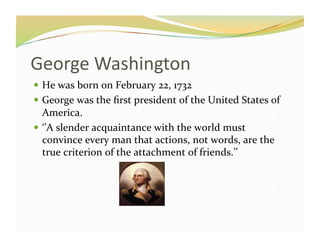
    George  Washington    He  was  born  on  February  22,  1732     George  was  the  first  president  of  the  United  States  of   America.       ‘’A  slender  acquaintance  with  the  world  must   convince  every  man  that  actions,  not  words,  are  the   true  criterion  of  the  attachment  of  friends.’’  
  • 5.
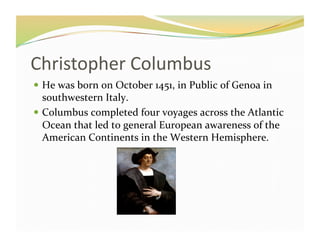
    Christopher  Columbus    He  was  born  on  October  1451,  in  Public  of  Genoa  in   southwestern  Italy.     Columbus  completed  four  voyages  across  the  Atlantic   Ocean  that  led  to  general  European  awareness  of  the   American  Continents  in  the  Western  Hemisphere.    
  • 6.
    Albert  Einstein       Born  on  March  14,  1879.     He  was  a  German-­‐born  theoretical  physicist  who   developed  the  theory  of  general  relativity,  effecting  a   revolution  in  physics.     He  received  the  1921  Nobel  Prize  in  Physics.  
  • 7.