TAKING TO TASK(S)
Exploring task design by novice teachers
in technologically mediated
and non-technological activities
Shona Whyte
17th International CALL Research Conference, Tarragona, 7 July 2015
http://wp.me/p28EmH-6N
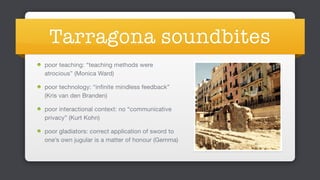
Tarragona soundbites
poor teaching: “teaching methods were
atrocious” (Monica Ward)

poor technology: “infinite mindless feedback” 

(Kris van den Branden)

poor interactional context: no “communicative
privacy” (Kurt Kohn)

poor gladiators: correct application of sword to
one’s own jugular is a matter of honour (Gemma)

academics said
Best TBLT hedge: Kris van den Branden

“create interaction which leaves memory traces and
changes in behaviour often associated with learning” 

Optimism award: Vance Stevens

“experts will emerge” 

TAKING TO TASK(S)
Exploring task design by novice teachers in technologically mediated
and non-technological activities
http://wp.me/p28EmH-6N
Shona Whyte Wordpress
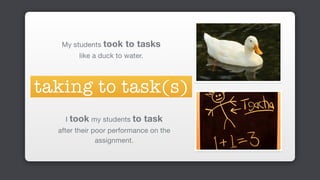
My students took to tasks 

like a duck to water.
taking to task(s)
I took my students to task 

after their poor performance on the
assignment.
background
teacher education projects (iTILT)

difficulties in getting to grips with task-
based or task-oriented teaching

technology as only one element of
teaching/learning environment
http://wp.me/p28EmH-6N
context
English Language Teaching in French state school
contexts (upper, lower secondary; primary)

pre-service teacher education: Masters in Teaching
English at ESPE/University of Nice

first year Masters students: short teaching
placements with mentor teacher
http://wp.me/p28EmH-6N
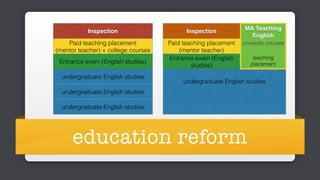
education reform
Inspection
Paid teaching placement
(mentor teacher) + college courses
Entrance exam (English studies)
undergraduate English studies
Inspection MA Teaching
English
Paid teaching placement
(mentor teacher)
university courses
Entrance exam (English
studies)
teaching
placement
teacher
undergraduate English studies
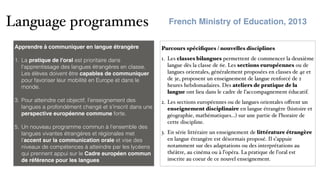
Language programmes
Parcours spécifiques / nouvelles disciplines
1. Les classes bilangues permettent de commencer la deuxième
langue dès la classe de 6e. Les sections européennes ou de
langues orientales, généralement proposées en classes de 4e et
de 3e, proposent un enseignement de langue renforcé de 2
heures hebdomadaires. Des ateliers de pratique de la
langue ont lieu dans le cadre de l’accompagnement éducatif.
2. Les sections européennes ou de langues orientales offrent un
enseignement disciplinaire en langue étrangère (histoire et
géographie, mathématiques...) sur une partie de l’horaire de
cette discipline.
3. En série littéraire un enseignement de littérature étrangère
en langue étrangère est désormais proposé. Il s’appuie
notamment sur des adaptations ou des interprétations au
théâtre, au cinéma ou à l’opéra. La pratique de l’oral est
inscrite au coeur de ce nouvel enseignement.
Apprendre à communiquer en langue étrangère

1. La pratique de l'oral est prioritaire dans
l'apprentissage des langues étrangères en classe.
Les élèves doivent être capables de communiquer
pour favoriser leur mobilité en Europe et dans le
monde.
3. Pour atteindre cet objectif, l’enseignement des
langues a profondément changé et s’inscrit dans une
perspective européenne commune forte.
5. Un nouveau programme commun à l’ensemble des
langues vivantes étrangères et régionales met
l’accent sur la communication orale et vise des
niveaux de compétences à atteindre par les lycéens
qui prennent appui sur le Cadre européen commun
de référence pour les langues
French Ministry of Education, 2013
new opportunities
university role in pre-service teacher
education beyond disciplinary knowledge

collaboration among student teachers (MA
students), experienced teachers (mentors)
and university tutors

access to classroom learners following
task-oriented teaching programmes
3 ideas
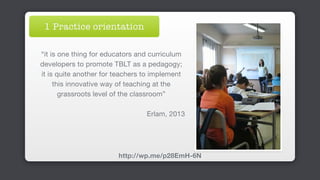
“it is one thing for educators and curriculum
developers to promote TBLT as a pedagogy;
it is quite another for teachers to implement
this innovative way of teaching at the
grassroots level of the classroom”

Erlam, 2013
http://wp.me/p28EmH-6N
1 Practice orientation
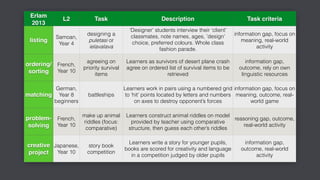
Erlam
2013
L2 Task Description Task criteria
listing
Samoan,
Year 4
designing a
puletasi or
ielavalava
‘Designer’ students interview their ‘client’
classmates, note names, ages, ’design’
choice, preferred colours. Whole class
fashion parade.
information gap, focus on
meaning, real-world
activity
ordering/
sorting
French,
Year 10
agreeing on
priority survival
items
Learners as survivors of desert plane crash
agree on ordered list of survival items to be
retrieved
information gap,
outcome, rely on own
linguistic resources
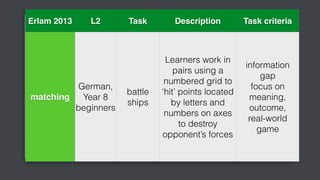
matching
German,
Year 8
beginners
battleships
Learners work in pairs using a numbered grid
to ‘hit’ points located by letters and numbers
on axes to destroy opponent’s forces
information gap, focus on
meaning, outcome, real-
world game
problem-
solving
French,
Year 10
make up animal
riddles (focus:
comparative)
Learners construct animal riddles on model
provided by teacher using comparative
structure, then guess each other’s riddles
reasoning gap, outcome,
real-world activity
creative
project
Japanese,
Year 10
story book
competition
Learners write a story for younger pupils,
books are scored for creativity and language
in a competition judged by older pupils
information gap,
outcome, real-world
activity
Erlam 2013 L2 Task Description Task criteria
matching
German,
Year 8
beginners
battle
ships
Learners work in
pairs using a
numbered grid to
‘hit’ points located
by letters and
numbers on axes
to destroy
opponent’s forces
information
gap
focus on
meaning,
outcome,
real-world
game
Implementation of innovation 

may be enhanced when

• innovations are easy to understand

• the teacher is allowed time and space to try out
the innovation 

• teachers are able to observe colleagues while
trying out the innovation

•[it] is perceived by teachers as practically doable
and compatible with practical constraints


Van den Branden, 2009
http://wp.me/p28EmH-6N
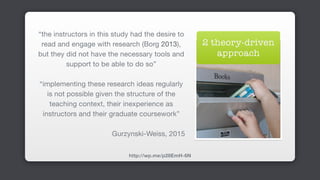
“the instructors in this study had the desire to
read and engage with research (Borg 2013),
but they did not have the necessary tools and
support to be able to do so”

“implementing these research ideas regularly
is not possible given the structure of the
teaching context, their inexperience as
instructors and their graduate coursework”

Gurzynski-Weiss, 2015
http://wp.me/p28EmH-6N
2 theory-driven
approach
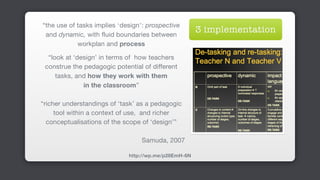
“the use of tasks implies ‘design’: prospective
and dynamic, with fluid boundaries between
workplan and process 

“look at ‘design’ in terms of how teachers
construe the pedagogic potential of different
tasks, and how they work with them
in the classroom” 

“richer understandings of ‘task’ as a pedagogic
tool within a context of use, and richer
conceptualisations of the scope of ‘design’”

Samuda, 2007

http://wp.me/p28EmH-6N
3 implementation
present study
support student teachers in
design and implementation of
teaching activities

encourage reflective practice
for professional development

understand teacher attitudes
to changing practice
present study
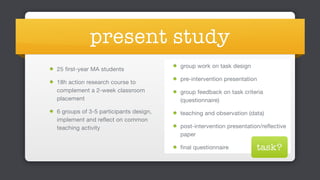
25 first-year MA students 

18h action research course to
complement a 2-week classroom
placement

6 groups of 3-5 participants design,
implement and reflect on common
teaching activity


group work on task design

pre-intervention presentation

group feedback on task criteria
(questionnaire)

teaching and observation (data)

post-intervention presentation/reflective
paper

final questionnaire task?
design brief
You now wish to give these learners a ‘communicative
activity’ to practise this area further. You want the
students to interact as much as possible and involve
as many different members of the class as possible.
Although reading and writing may be involved, you are
most concerned to provide opportunities for speaking
skills. You want the activity to last roughly between 15
and 30 minutes.
Samuda, 2005
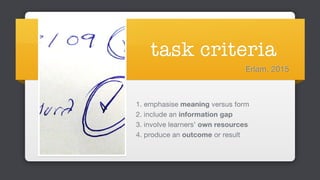
task criteria
1. emphasise meaning versus form

2. include an information gap 

3. involve learners’ own resources 

4. produce an outcome or result
Erlam, 2015
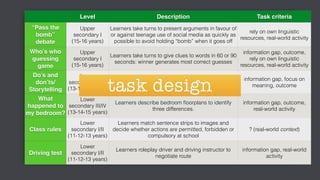
Level Description Task criteria
“Pass the
bomb”
debate
Upper
secondary I
(15-16 years)
Learners take turns to present arguments in favour of
or against teenage use of social media as quickly as
possible to avoid holding “bomb” when it goes off
rely on own linguistic
resources, real-world activity
Who’s who
guessing
game
Upper
secondary I
(15-16 years)
Learners take turns to give clues to words in 60 or 90
seconds: winner generates most correct guesses
information gap, outcome,
rely on own linguistic
resources, real-world activity
Do’s and
don’ts/
Storytelling
Lower
secondary III/IV
(13-14-15 years)
One learner tells story to allow partner to put
separate comic strip panels into correct order.
information gap, focus on
meaning, outcome
What
happened to
my bedroom?
Lower
secondary III/IV
(13-14-15 years)
Learners describe bedroom floorplans to identify
three differences.
information gap, outcome,
real-world activity
Class rules
Lower
secondary I/II
(11-12-13 years)
Learners match sentence strips to images and
decide whether actions are permitted, forbidden or
compulsory at school
? (real-world context)
Driving test
Lower
secondary I/II
(11-12-13 years)
Learners roleplay driver and driving instructor to
negotiate route
information gap, real-world
activity
task design
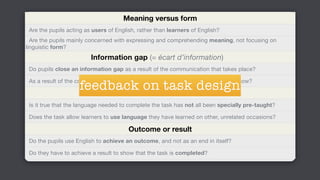
Meaning versus form
Are the pupils acting as users of English, rather than learners of English?
Are the pupils mainly concerned with expressing and comprehending meaning, not focusing on
linguistic form?
Information gap (= écart d’information)
Do pupils close an information gap as a result of the communication that takes place?
As a result of the communication do pupils find out something that they didn’t know?
Learner resources
Is it true that the language needed to complete the task has not all been specially pre-taught?
Does the task allow learners to use language they have learned on other, unrelated occasions?
Outcome or result
Do the pupils use English to achieve an outcome, and not as an end in itself?
Do they have to achieve a result to show that the task is completed?
feedback on task design
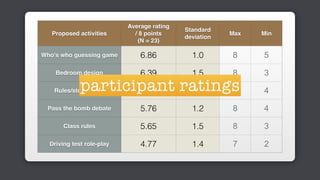
Proposed activities
Average rating
/ 8 points
(N = 23)
Standard
deviation
Max Min
Who's who guessing game 6.86 1.0 8 5
Bedroom design 6.39 1.5 8 3
Rules/storytelling 5.98 1.1 8 4
Pass the bomb debate 5.76 1.2 8 4
Class rules 5.65 1.5 8 3
Driving test role-play 4.77 1.4 7 2
participant ratings
Ivy
No
ra
An
na
Ast
rid
Izz
y
Ja
so
n
Cel
ine
Ca
rrie
Cin
dy
Sh
aro
n
Ab
by
Su
ky
Ch
ris
Do
m
Ja
ck
Lar
ry
Ali
ne
To
dd
Am
y
Me
liss
a
Se
b
Kri
ste
n
Ro
b
6.8 6.7 6.5 6.5 6.5 6.5 6.3 6.3 6.3 6.2 6.1 6.1 6.0 5.9 5.7 5.7 5.6 5.5 4.9 4.7 4.7 4.6 4.3
7.5 8 7 8 8 8 8 8 8 8 7 7 8 7 8 7 7 6.5 8 8 8 5 6
7 7 7 7 8 7 7 8 8 8 7 6.5 7.5 7 6 7 6.5 6 5.5 6 6 5 5
7 7 7 7 7 6 6 6 7 7 6.5 6.5 6.5 6.5 6 6 6 6 3 5 5 5 4
7 6 6 6.5 7 6 6 6 6 6 6.5 6 5.5 6 5 6 6 6 3 5 4 4 4
6.5 6 6 6 5 6 6 5.5 4.5 5 5.5 6 5 5 5 4 6 5.5 * 4 3 4 4
6 6 6 4.5 4 6 5 4.5 4 3 4 4.5 3.5 4 4 4 2 3 * * 2 * 3
Ivy
Nora
Anna
Astrid
Izzy
Jason
Céline
Carrie
Cindy
Sharon
Abby
Suky
Chris
Dom
Jack
Larry
Aline
Todd
Amy
Melissa
Seb
Kristen
Rob
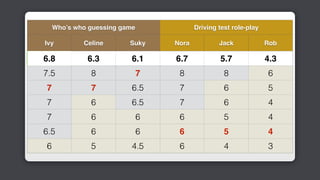
Who’s who guessing game Driving test role-play
Ivy Celine Suky Nora Jack Rob
6.8 6.3 6.1 6.7 5.7 4.3
7.5 8 7 8 8 6
7 7 6.5 7 6 5
7 6 6.5 7 6 4
7 6 6 6 5 4
6.5 6 6 6 5 4
6 5 4.5 6 4 3
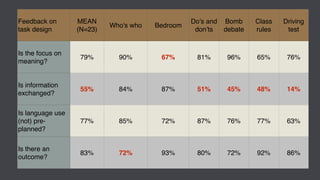
Feedback on
task design
MEAN
(N=23)
Who's who Bedroom
Do’s and
don’ts
Bomb
debate
Class
rules
Driving
test
Is the focus on
meaning?
79% 90% 67% 81% 96% 65% 76%
Is information
exchanged?
55% 84% 87% 51% 45% 48% 14%
Is language use
(not) pre-
planned?
77% 85% 72% 87% 76% 77% 63%
Is there an
outcome?
83% 72% 93% 80% 72% 92% 86%
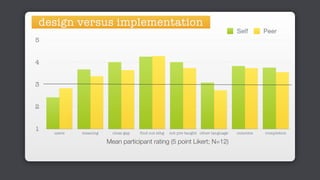
implementation
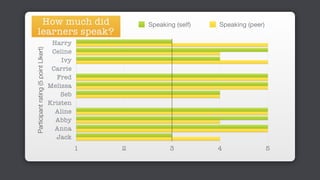
What happened in the classroom?

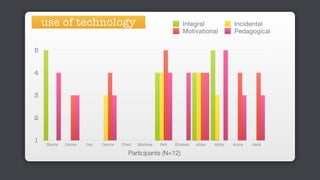
What role did technology play?
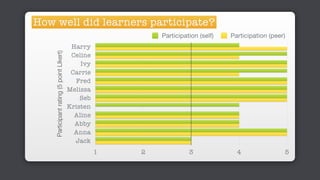
Participantrating(5pointLIkert)
Harry
Celine
Ivy
Carrie
Fred
Melissa
Seb
Kristen
Aline
Abby
Anna
Jack
1 2 3 4 5
Participation (self) Participation (peer)
How well did learners participate?
Participantrating(5pointLIkert) Harry
Celine
Ivy
Carrie
Fred
Melissa
Seb
Kristen
Aline
Abby
Anna
Jack
1 2 3 4 5
Speaking (self) Speaking (peer)How much did
learners speak?
1
2
3
4
5
Participants (N=12)
Harry Celine Ivy Carrie Fred Melissa Seb Kristen Aline Abby Anna Jack
Integral Incidental
Motivational Pedagogical
use of technology
1
2
3
4
5
Mean participant rating (5 point Likert; N=12)
users meaning close gap find out sthg not pre-taught other language outcome completion
Self Peer
design versus implementation
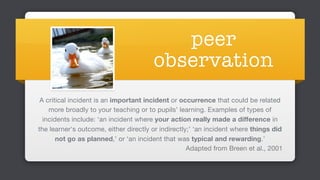
peer
observation
A critical incident is an important incident or occurrence that could be related
more broadly to your teaching or to pupils’ learning. Examples of types of
incidents include: ‘an incident where your action really made a difference in
the learner's outcome, either directly or indirectly;’ ‘an incident where things did
not go as planned,’ or ‘an incident that was typical and rewarding.’ 

Adapted from Breen et al., 2001
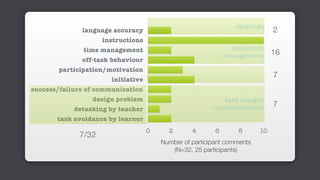
language accuracy
instructions
time management
off-task behaviour
participation/motivation
initiative
success/failure of communication
design problem
detasking by teacher
task avoidance by learner
Number of participant comments 

(N=32, 25 participants)
0 2 4 6 8 10
classroom
management
task design/
implementation
language
2
7
16
7
7/32
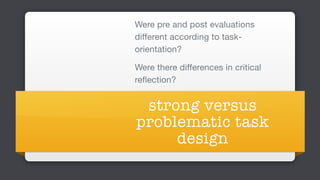
strong versus
problematic task
design
Were pre and post evaluations
different according to task-
orientation?

Were there differences in critical
reflection?
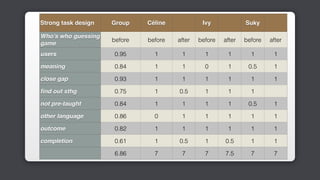
Strong task design Group Céline Ivy Suky
Who’s who guessing
game
before before after before after before after
users 0.95 1 1 1 1 1 1
meaning 0.84 1 1 0 1 0.5 1
close gap 0.93 1 1 1 1 1 1
find out sthg 0.75 1 0.5 1 1 1
not pre-taught 0.84 1 1 1 1 0.5 1
other language 0.86 0 1 1 1 1 1
outcome 0.82 1 1 1 1 1 1
completion 0.61 1 0.5 1 0.5 1 1
6.86 7 7 7 7.5 7 7
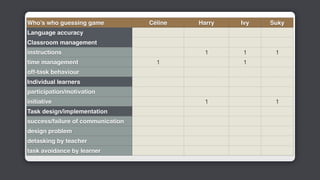
Who’s who guessing game Céline Harry Ivy Suky
Language accuracy
Classroom management
instructions 1 1 1
time management 1 1
off-task behaviour
Individual learners
participation/motivation
initiative 1 1
Task design/implementation
success/failure of communication
design problem
detasking by teacher
task avoidance by learner
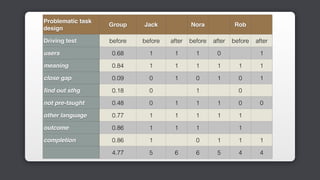
Problematic task
design
Group Jack Nora Rob
Driving test before before after before after before after
users 0.68 1 1 1 0 1
meaning 0.84 1 1 1 1 1 1
close gap 0.09 0 1 0 1 0 1
find out sthg 0.18 0 1 0
not pre-taught 0.48 0 1 1 1 0 0
other language 0.77 1 1 1 1 1
outcome 0.86 1 1 1 1
completion 0.86 1 0 1 1 1
4.77 5 6 6 5 4 4
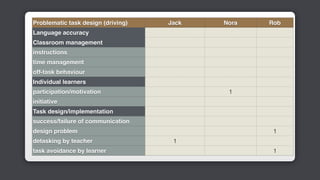
Problematic task design (driving) Jack Nora Rob
Language accuracy
Classroom management
instructions
time management
off-task behaviour
Individual learners
participation/motivation 1
initiative
Task design/implementation
success/failure of communication
design problem 1
detasking by teacher 1
task avoidance by learner 1
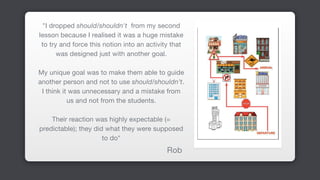
"I dropped should/shouldn't from my second
lesson because I realised it was a huge mistake
to try and force this notion into an activity that
was designed just with another goal. 

My unique goal was to make them able to guide
another person and not to use should/shouldn’t.
I think it was unnecessary and a mistake from
us and not from the students. 

Their reaction was highly expectable (=
predictable); they did what they were supposed
to do" 

Rob
What had troubled me during the lesson is that without really having
thought about it, I started writing out on the board the different
instructions that were being given by the instructor, such as “fasten
your seat-belt, turn left, turn right, go straight, etc.”
The problem after having done that is
that the following students kept looking
at the board and basically reading “the
answers.” At this point my activity was
not going so well anymore, but in the
heat of the moment I did not realize
what had caused it to dysfunction. This
transformed the activity, which had
been quite authentic so far, into a
“reading exercise.”
Now that I think about it, I
realize that this might have
been the cause, but at the same
time I understand why I did it.
I did that because I was afraid
that they would not be able to
do the activity and would be
stuck.
Jack
some conclusions
student teachers able to
design, implement and
evaluate teaching tasks to
varying degrees

role of technology not central
if not specified in design brief

“garden path” approach may
be more beneficial: learn more
from less successful tasks


interactive Teaching
in Language with
Technology
(Erasmus+)

Social Networks in
Teacher Education
(LLP)

Telecollaboration
for Intercultural
Language
Acquisition
online
collaboration with
classroom
teachers

MOOC: use of
video in the
language
classroom

pre-service teacher
collaboration on
teaching tasks
TAKING TO TASK(S)
Exploring task design by novice teachers
in technologically mediated
and non-technological activities
http://wp.me/p28EmH-6N
Shona Whyte
@whyshona
http://efl.unice.fr
whyte@unice.fr

Taking to tasks

  • 1.
    TAKING TO TASK(S) Exploringtask design by novice teachers in technologically mediated and non-technological activities Shona Whyte 17th International CALL Research Conference, Tarragona, 7 July 2015 http://wp.me/p28EmH-6N
  • 2.
    Tarragona soundbites poor teaching:“teaching methods were atrocious” (Monica Ward) poor technology: “infinite mindless feedback” 
 (Kris van den Branden) poor interactional context: no “communicative privacy” (Kurt Kohn) poor gladiators: correct application of sword to one’s own jugular is a matter of honour (Gemma)

  • 3.
    academics said Best TBLThedge: Kris van den Branden “create interaction which leaves memory traces and changes in behaviour often associated with learning” 
 Optimism award: Vance Stevens “experts will emerge” 

  • 4.
    TAKING TO TASK(S) Exploringtask design by novice teachers in technologically mediated and non-technological activities http://wp.me/p28EmH-6N Shona Whyte Wordpress
  • 5.
    My students tookto tasks like a duck to water. taking to task(s) I took my students to task after their poor performance on the assignment.
  • 6.
    background teacher education projects(iTILT) difficulties in getting to grips with task- based or task-oriented teaching technology as only one element of teaching/learning environment http://wp.me/p28EmH-6N
  • 7.
    context English Language Teachingin French state school contexts (upper, lower secondary; primary) pre-service teacher education: Masters in Teaching English at ESPE/University of Nice first year Masters students: short teaching placements with mentor teacher http://wp.me/p28EmH-6N
  • 8.
    education reform Inspection Paid teachingplacement (mentor teacher) + college courses Entrance exam (English studies) undergraduate English studies undergraduate English studies undergraduate English studies Inspection MA Teaching English Paid teaching placement (mentor teacher) university courses Entrance exam (English studies) teaching placement teacher undergraduate English studies
  • 9.
    Language programmes Parcours spécifiques/ nouvelles disciplines 1. Les classes bilangues permettent de commencer la deuxième langue dès la classe de 6e. Les sections européennes ou de langues orientales, généralement proposées en classes de 4e et de 3e, proposent un enseignement de langue renforcé de 2 heures hebdomadaires. Des ateliers de pratique de la langue ont lieu dans le cadre de l’accompagnement éducatif. 2. Les sections européennes ou de langues orientales offrent un enseignement disciplinaire en langue étrangère (histoire et géographie, mathématiques...) sur une partie de l’horaire de cette discipline. 3. En série littéraire un enseignement de littérature étrangère en langue étrangère est désormais proposé. Il s’appuie notamment sur des adaptations ou des interprétations au théâtre, au cinéma ou à l’opéra. La pratique de l’oral est inscrite au coeur de ce nouvel enseignement. Apprendre à communiquer en langue étrangère
 1. La pratique de l'oral est prioritaire dans l'apprentissage des langues étrangères en classe. Les élèves doivent être capables de communiquer pour favoriser leur mobilité en Europe et dans le monde. 3. Pour atteindre cet objectif, l’enseignement des langues a profondément changé et s’inscrit dans une perspective européenne commune forte. 5. Un nouveau programme commun à l’ensemble des langues vivantes étrangères et régionales met l’accent sur la communication orale et vise des niveaux de compétences à atteindre par les lycéens qui prennent appui sur le Cadre européen commun de référence pour les langues French Ministry of Education, 2013
  • 10.
    new opportunities university rolein pre-service teacher education beyond disciplinary knowledge collaboration among student teachers (MA students), experienced teachers (mentors) and university tutors access to classroom learners following task-oriented teaching programmes 3 ideas
  • 11.
    “it is onething for educators and curriculum developers to promote TBLT as a pedagogy; it is quite another for teachers to implement this innovative way of teaching at the grassroots level of the classroom” Erlam, 2013 http://wp.me/p28EmH-6N 1 Practice orientation
  • 12.
    Erlam 2013 L2 Task DescriptionTask criteria listing Samoan, Year 4 designing a puletasi or ielavalava ‘Designer’ students interview their ‘client’ classmates, note names, ages, ’design’ choice, preferred colours. Whole class fashion parade. information gap, focus on meaning, real-world activity ordering/ sorting French, Year 10 agreeing on priority survival items Learners as survivors of desert plane crash agree on ordered list of survival items to be retrieved information gap, outcome, rely on own linguistic resources matching German, Year 8 beginners battleships Learners work in pairs using a numbered grid to ‘hit’ points located by letters and numbers on axes to destroy opponent’s forces information gap, focus on meaning, outcome, real- world game problem- solving French, Year 10 make up animal riddles (focus: comparative) Learners construct animal riddles on model provided by teacher using comparative structure, then guess each other’s riddles reasoning gap, outcome, real-world activity creative project Japanese, Year 10 story book competition Learners write a story for younger pupils, books are scored for creativity and language in a competition judged by older pupils information gap, outcome, real-world activity
  • 13.
    Erlam 2013 L2Task Description Task criteria matching German, Year 8 beginners battle ships Learners work in pairs using a numbered grid to ‘hit’ points located by letters and numbers on axes to destroy opponent’s forces information gap focus on meaning, outcome, real-world game
  • 14.
    Implementation of innovation may be enhanced when • innovations are easy to understand • the teacher is allowed time and space to try out the innovation • teachers are able to observe colleagues while trying out the innovation •[it] is perceived by teachers as practically doable and compatible with practical constraints
 
 Van den Branden, 2009 http://wp.me/p28EmH-6N
  • 15.
    “the instructors inthis study had the desire to read and engage with research (Borg 2013), but they did not have the necessary tools and support to be able to do so” “implementing these research ideas regularly is not possible given the structure of the teaching context, their inexperience as instructors and their graduate coursework”
 Gurzynski-Weiss, 2015 http://wp.me/p28EmH-6N 2 theory-driven approach
  • 16.
    “the use oftasks implies ‘design’: prospective and dynamic, with fluid boundaries between workplan and process “look at ‘design’ in terms of how teachers construe the pedagogic potential of different tasks, and how they work with them in the classroom” “richer understandings of ‘task’ as a pedagogic tool within a context of use, and richer conceptualisations of the scope of ‘design’” Samuda, 2007 http://wp.me/p28EmH-6N 3 implementation
  • 17.
    present study support studentteachers in design and implementation of teaching activities encourage reflective practice for professional development understand teacher attitudes to changing practice
  • 18.
    present study 25 first-yearMA students 18h action research course to complement a 2-week classroom placement 6 groups of 3-5 participants design, implement and reflect on common teaching activity
 
 group work on task design pre-intervention presentation group feedback on task criteria (questionnaire) teaching and observation (data) post-intervention presentation/reflective paper final questionnaire task?
  • 19.
    design brief You nowwish to give these learners a ‘communicative activity’ to practise this area further. You want the students to interact as much as possible and involve as many different members of the class as possible. Although reading and writing may be involved, you are most concerned to provide opportunities for speaking skills. You want the activity to last roughly between 15 and 30 minutes. Samuda, 2005
  • 20.
    task criteria 1. emphasisemeaning versus form 2. include an information gap 3. involve learners’ own resources 4. produce an outcome or result Erlam, 2015
  • 21.
    Level Description Taskcriteria “Pass the bomb” debate Upper secondary I (15-16 years) Learners take turns to present arguments in favour of or against teenage use of social media as quickly as possible to avoid holding “bomb” when it goes off rely on own linguistic resources, real-world activity Who’s who guessing game Upper secondary I (15-16 years) Learners take turns to give clues to words in 60 or 90 seconds: winner generates most correct guesses information gap, outcome, rely on own linguistic resources, real-world activity Do’s and don’ts/ Storytelling Lower secondary III/IV (13-14-15 years) One learner tells story to allow partner to put separate comic strip panels into correct order. information gap, focus on meaning, outcome What happened to my bedroom? Lower secondary III/IV (13-14-15 years) Learners describe bedroom floorplans to identify three differences. information gap, outcome, real-world activity Class rules Lower secondary I/II (11-12-13 years) Learners match sentence strips to images and decide whether actions are permitted, forbidden or compulsory at school ? (real-world context) Driving test Lower secondary I/II (11-12-13 years) Learners roleplay driver and driving instructor to negotiate route information gap, real-world activity task design
  • 22.
    Meaning versus form Arethe pupils acting as users of English, rather than learners of English? Are the pupils mainly concerned with expressing and comprehending meaning, not focusing on linguistic form? Information gap (= écart d’information) Do pupils close an information gap as a result of the communication that takes place? As a result of the communication do pupils find out something that they didn’t know? Learner resources Is it true that the language needed to complete the task has not all been specially pre-taught? Does the task allow learners to use language they have learned on other, unrelated occasions? Outcome or result Do the pupils use English to achieve an outcome, and not as an end in itself? Do they have to achieve a result to show that the task is completed? feedback on task design
  • 23.
    Proposed activities Average rating /8 points (N = 23) Standard deviation Max Min Who's who guessing game 6.86 1.0 8 5 Bedroom design 6.39 1.5 8 3 Rules/storytelling 5.98 1.1 8 4 Pass the bomb debate 5.76 1.2 8 4 Class rules 5.65 1.5 8 3 Driving test role-play 4.77 1.4 7 2 participant ratings
  • 24.
    Ivy No ra An na Ast rid Izz y Ja so n Cel ine Ca rrie Cin dy Sh aro n Ab by Su ky Ch ris Do m Ja ck Lar ry Ali ne To dd Am y Me liss a Se b Kri ste n Ro b 6.8 6.7 6.56.5 6.5 6.5 6.3 6.3 6.3 6.2 6.1 6.1 6.0 5.9 5.7 5.7 5.6 5.5 4.9 4.7 4.7 4.6 4.3 7.5 8 7 8 8 8 8 8 8 8 7 7 8 7 8 7 7 6.5 8 8 8 5 6 7 7 7 7 8 7 7 8 8 8 7 6.5 7.5 7 6 7 6.5 6 5.5 6 6 5 5 7 7 7 7 7 6 6 6 7 7 6.5 6.5 6.5 6.5 6 6 6 6 3 5 5 5 4 7 6 6 6.5 7 6 6 6 6 6 6.5 6 5.5 6 5 6 6 6 3 5 4 4 4 6.5 6 6 6 5 6 6 5.5 4.5 5 5.5 6 5 5 5 4 6 5.5 * 4 3 4 4 6 6 6 4.5 4 6 5 4.5 4 3 4 4.5 3.5 4 4 4 2 3 * * 2 * 3 Ivy Nora Anna Astrid Izzy Jason Céline Carrie Cindy Sharon Abby Suky Chris Dom Jack Larry Aline Todd Amy Melissa Seb Kristen Rob
  • 25.
    Who’s who guessinggame Driving test role-play Ivy Celine Suky Nora Jack Rob 6.8 6.3 6.1 6.7 5.7 4.3 7.5 8 7 8 8 6 7 7 6.5 7 6 5 7 6 6.5 7 6 4 7 6 6 6 5 4 6.5 6 6 6 5 4 6 5 4.5 6 4 3
  • 26.
    Feedback on task design MEAN (N=23) Who'swho Bedroom Do’s and don’ts Bomb debate Class rules Driving test Is the focus on meaning? 79% 90% 67% 81% 96% 65% 76% Is information exchanged? 55% 84% 87% 51% 45% 48% 14% Is language use (not) pre- planned? 77% 85% 72% 87% 76% 77% 63% Is there an outcome? 83% 72% 93% 80% 72% 92% 86%
  • 27.
    implementation What happened inthe classroom? What role did technology play?
  • 28.
    Participantrating(5pointLIkert) Harry Celine Ivy Carrie Fred Melissa Seb Kristen Aline Abby Anna Jack 1 2 34 5 Participation (self) Participation (peer) How well did learners participate?
  • 29.
  • 30.
    1 2 3 4 5 Participants (N=12) Harry CelineIvy Carrie Fred Melissa Seb Kristen Aline Abby Anna Jack Integral Incidental Motivational Pedagogical use of technology
  • 31.
    1 2 3 4 5 Mean participant rating(5 point Likert; N=12) users meaning close gap find out sthg not pre-taught other language outcome completion Self Peer design versus implementation
  • 32.
    peer observation A critical incidentis an important incident or occurrence that could be related more broadly to your teaching or to pupils’ learning. Examples of types of incidents include: ‘an incident where your action really made a difference in the learner's outcome, either directly or indirectly;’ ‘an incident where things did not go as planned,’ or ‘an incident that was typical and rewarding.’ Adapted from Breen et al., 2001
  • 33.
    language accuracy instructions time management off-taskbehaviour participation/motivation initiative success/failure of communication design problem detasking by teacher task avoidance by learner Number of participant comments 
 (N=32, 25 participants) 0 2 4 6 8 10 classroom management task design/ implementation language 2 7 16 7 7/32
  • 34.
    strong versus problematic task design Werepre and post evaluations different according to task- orientation? Were there differences in critical reflection?
  • 35.
    Strong task designGroup Céline Ivy Suky Who’s who guessing game before before after before after before after users 0.95 1 1 1 1 1 1 meaning 0.84 1 1 0 1 0.5 1 close gap 0.93 1 1 1 1 1 1 find out sthg 0.75 1 0.5 1 1 1 not pre-taught 0.84 1 1 1 1 0.5 1 other language 0.86 0 1 1 1 1 1 outcome 0.82 1 1 1 1 1 1 completion 0.61 1 0.5 1 0.5 1 1 6.86 7 7 7 7.5 7 7
  • 36.
    Who’s who guessinggame Céline Harry Ivy Suky Language accuracy Classroom management instructions 1 1 1 time management 1 1 off-task behaviour Individual learners participation/motivation initiative 1 1 Task design/implementation success/failure of communication design problem detasking by teacher task avoidance by learner
  • 37.
    Problematic task design Group JackNora Rob Driving test before before after before after before after users 0.68 1 1 1 0 1 meaning 0.84 1 1 1 1 1 1 close gap 0.09 0 1 0 1 0 1 find out sthg 0.18 0 1 0 not pre-taught 0.48 0 1 1 1 0 0 other language 0.77 1 1 1 1 1 outcome 0.86 1 1 1 1 completion 0.86 1 0 1 1 1 4.77 5 6 6 5 4 4
  • 38.
    Problematic task design(driving) Jack Nora Rob Language accuracy Classroom management instructions time management off-task behaviour Individual learners participation/motivation 1 initiative Task design/implementation success/failure of communication design problem 1 detasking by teacher 1 task avoidance by learner 1
  • 39.
    "I dropped should/shouldn'tfrom my second lesson because I realised it was a huge mistake to try and force this notion into an activity that was designed just with another goal. My unique goal was to make them able to guide another person and not to use should/shouldn’t. I think it was unnecessary and a mistake from us and not from the students. Their reaction was highly expectable (= predictable); they did what they were supposed to do" Rob
  • 40.
    What had troubledme during the lesson is that without really having thought about it, I started writing out on the board the different instructions that were being given by the instructor, such as “fasten your seat-belt, turn left, turn right, go straight, etc.” The problem after having done that is that the following students kept looking at the board and basically reading “the answers.” At this point my activity was not going so well anymore, but in the heat of the moment I did not realize what had caused it to dysfunction. This transformed the activity, which had been quite authentic so far, into a “reading exercise.” Now that I think about it, I realize that this might have been the cause, but at the same time I understand why I did it. I did that because I was afraid that they would not be able to do the activity and would be stuck. Jack
  • 41.
    some conclusions student teachersable to design, implement and evaluate teaching tasks to varying degrees role of technology not central if not specified in design brief
 “garden path” approach may be more beneficial: learn more from less successful tasks


  • 42.
    interactive Teaching in Languagewith Technology (Erasmus+) Social Networks in Teacher Education (LLP) Telecollaboration for Intercultural Language Acquisition online collaboration with classroom teachers MOOC: use of video in the language classroom pre-service teacher collaboration on teaching tasks
  • 43.
    TAKING TO TASK(S) Exploringtask design by novice teachers in technologically mediated and non-technological activities http://wp.me/p28EmH-6N Shona Whyte @whyshona http://efl.unice.fr whyte@unice.fr