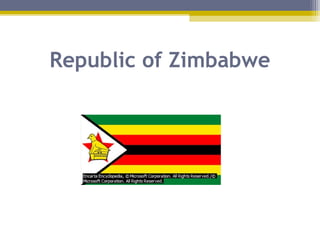
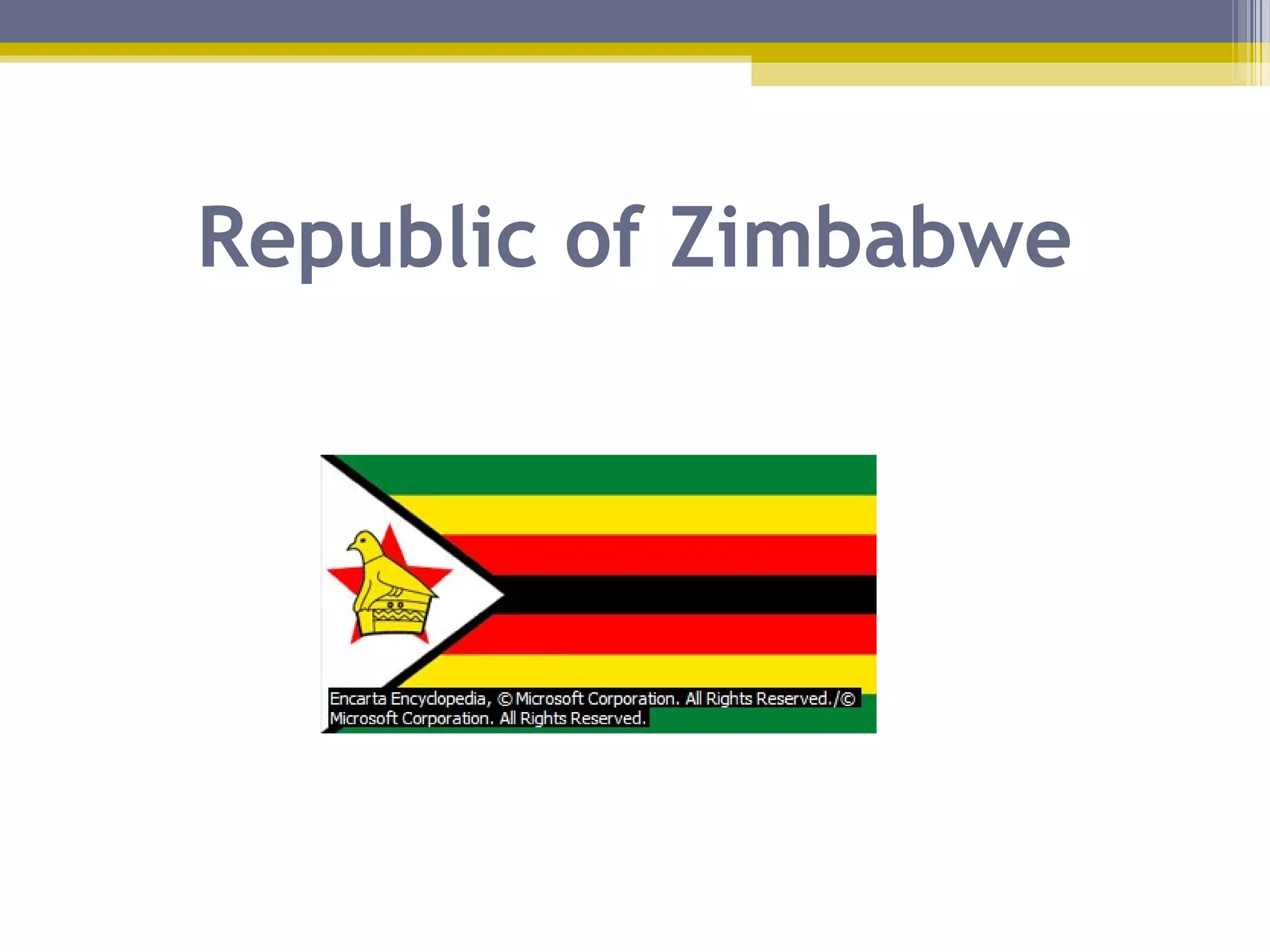
Republic of Zimbabwe
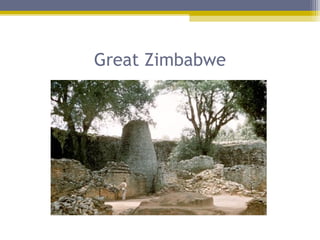
Great Zimbabwe
Background
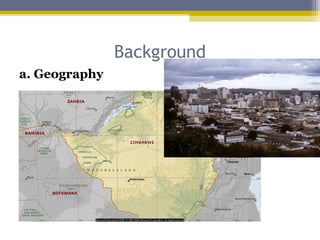
a. Geography
b. People
- Population - 12,382,920 (2008 estimate)
- Linguistic and Ethnic Groups: Shona &
Ndebele
- Official Language: English
- Life Expectancy Rate: 39.7 years
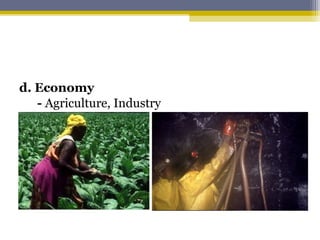
d. Economy
- Agriculture, Industry
c. Government
- Form: Presidential Republic
- Head of State: Pres. Robert Mugabe
e. Religious Affiliations
- Syncretic, Protestant, Catholic …
Educational System of
Zimbabwe
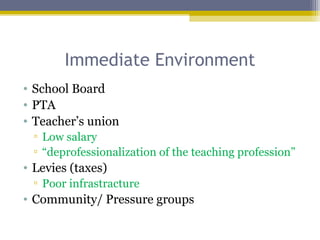
Immediate Environment
• School Board
• PTA
• Teacher’s union
▫ Low salary
▫ “deprofessionalization of the teaching profession”
• Levies (taxes)
▫ Poor infrastracture
• Community/ Pressure groups
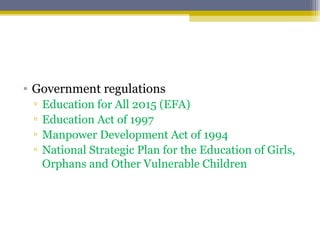
• Government regulations
▫ Education for All 2015 (EFA)
▫ Education Act of 1997
▫ Manpower Development Act of 1994
▫ National Strategic Plan for the Education of Girls,
Orphans and Other Vulnerable Children
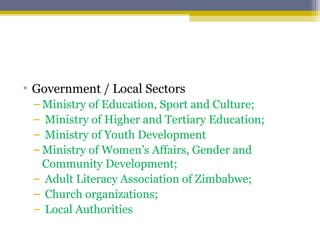
• Government / Local Sectors
– Ministry of Education, Sport and Culture;
– Ministry of Higher and Tertiary Education;
– Ministry of Youth Development
– Ministry of Women’s Affairs, Gender and
Community Development;
– Adult Literacy Association of Zimbabwe;
– Church organizations;
– Local Authorities
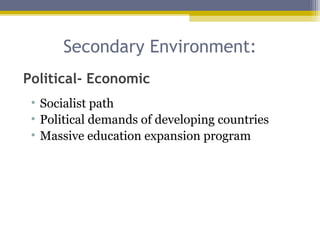
Secondary Environment:
• Socialist path
• Political demands of developing countries
• Massive education expansion program
Political- Economic
• Lack of government funding
– poor infrastructure/ lack of classrooms
– Lack of instructional materials
– Scarcity of Resources
• Political Instability
– Populist political ideology of ZANU-PF (political
repression and economic meltdown)
Social movements
• Investment on Education
• Human Capital Shortage (Brain Drain)
Technology
• Lack of State-of-the-art facilities
• Generation of scientific and technological
capabilities (Science and Technology Policy)
• Globalization
Cultural values and ideology
• Hegemonic culture
• Racial Discrimination
• Tradition of placing great value on education-
• Apartheid Legacy
• Racial Capitalism
• Ceremonial rituals
• Influence of Traditional African Education
• Colonial Legacy on Educ. System
▫ Politics of EXCLUSION
Population changes
• Growth of private schools
• Decrease of Life expectancy rate due to
HIV/AIDS
Religious
• Mission Schools
• Research and development
Industrialization
Input
• Students
▫ Demographic variables
 Gender
 Population
 Proportion
 Age
 Enrolment Rate
 Dropout Rate
 Literacy Rate
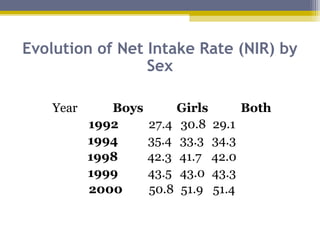
Evolution of Net Intake Rate (NIR) by
Sex
Year Boys Girls Both
1992 27.4 30.8 29.1
1994 35.4 33.3 34.3
1998 42.3 41.7 42.0
1999 43.5 43.0 43.3
2000 50.8 51.9 51.4
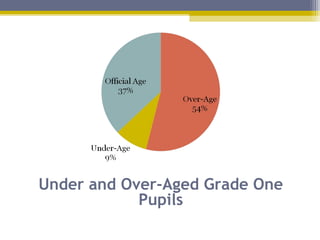
Under and Over-Aged Grade One
Pupils
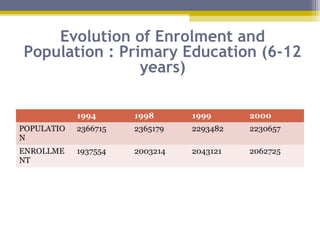
Evolution of Enrolment and
Population : Primary Education (6-12
years)
1994 1998 1999 2000
POPULATIO
N
2366715 2365179 2293482 2230657
ENROLLME
NT
1937554 2003214 2043121 2062725
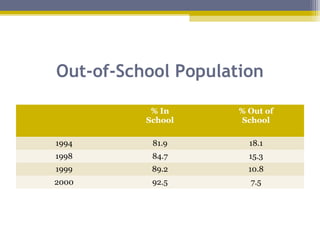
Out-of-School Population
% In
School
% Out of
School
1994 81.9 18.1
1998 84.7 15.3
1999 89.2 10.8
2000 92.5 7.5
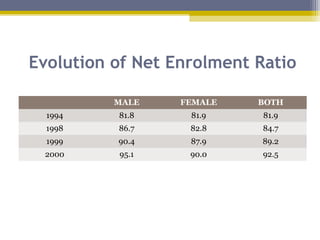
Evolution of Net Enrolment Ratio
MALE FEMALE BOTH
1994 81.8 81.9 81.9
1998 86.7 82.8 84.7
1999 90.4 87.9 89.2
2000 95.1 90.0 92.5
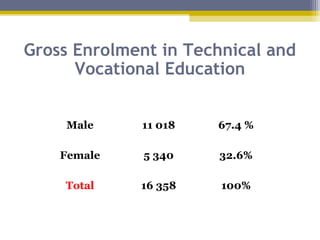
Gross Enrolment in Technical and
Vocational Education
Male 11 018 67.4 %
Female 5 340 32.6%
Total 16 358 100%
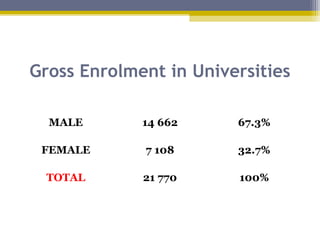
Gross Enrolment in Universities
MALE 14 662 67.3%
FEMALE 7 108 32.7%
TOTAL 21 770 100%
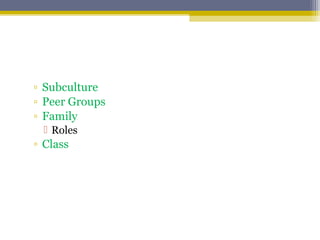
▫ Subculture
▫ Peer Groups
▫ Family
 Roles
▫ Class
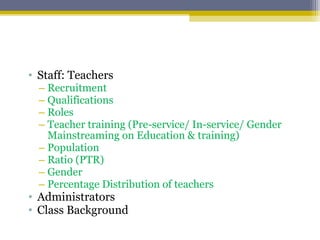
• Staff: Teachers
– Recruitment
– Qualifications
– Roles
– Teacher training (Pre-service/ In-service/ Gender
Mainstreaming on Education & training)
– Population
– Ratio (PTR)
– Gender
– Percentage Distribution of teachers
• Administrators
• Class Background
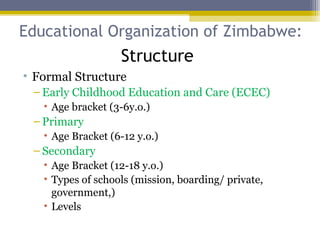
Educational Organization of Zimbabwe:
• Formal Structure
– Early Childhood Education and Care (ECEC)
• Age bracket (3-6y.o.)
– Primary
• Age Bracket (6-12 y.o.)
– Secondary
• Age Bracket (12-18 y.o.)
• Types of schools (mission, boarding/ private,
government,)
• Levels
Structure
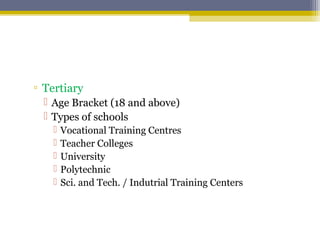
▫ Tertiary
 Age Bracket (18 and above)
 Types of schools
 Vocational Training Centres
 Teacher Colleges
 University
 Polytechnic
 Sci. and Tech. / Indutrial Training Centers
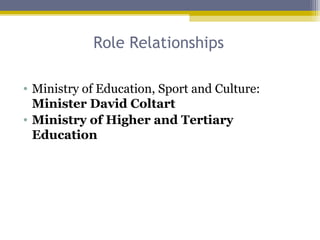
Role Relationships
• Ministry of Education, Sport and Culture:
Minister David Coltart
• Ministry of Higher and Tertiary
Education
Goals
• To promote effectiveness, efficiency, equality in
education
• To develop the whole person and cultivate life skills
• To preserve the cultural heritage of the past, acquaint
the growing generation with the culture, and contribute
towards the growth and protection of the culture
• To equip students with basic survival, technical and
vocational skills
• To establish a strong scientific and technological base
for economic development
• To promote development of skills and competencies in
language and communication, numeracy and literacy as
well as entrepreneurship
Programs
• Content:Curriculum
 Philosophy: Education With Production (EWP)
– Primary (subjects)
• Mathematics
• English
• Shona/Ndebele
• Practical subjects (i.e. Art and Craft, House
Economics, Music, Sports, Physical Education)
• Social Studies
• Environmental Science
• Religious Education (largely based on Christianity)
– Secondary (a. Zimbabwe Junior Certificate)
• English
• Shona or Ndebele
• Mathematics
• Science
• History
• Geography
• Bible Knowledge
• Practical Subject (i.e. Food and Nutrition, Fashion and
Fabrics, Woodwork, Agriculture, Metalwork, Technical
Drawing, etc.)
– Secondary (b. Ordinary-Level)
• Sciences: (Biology, Chemistry, Physics, Physics with
Chemistry, Integrated Science, Mathematics)
• Liberal Arts: (English Literature, Religious Education,
Geography, History)
• Commercial Subjects: (Accounts, Commerce, Economics,
Computer Studies)
• Languages: (English, Shona, Ndebele, French, German,
Latin)
• Arts: (Art, Music)
• Practical Subjects: (Woodwork, Metalwork, Agriculture,
Technical Drawing, Fashion & Fabrics, Food & Nutrition)
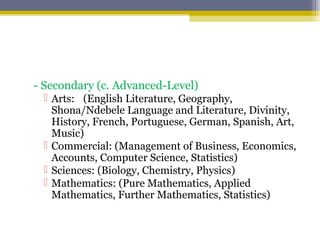
- Secondary (c. Advanced-Level)
 Arts: (English Literature, Geography,
Shona/Ndebele Language and Literature, Divinity,
History, French, Portuguese, German, Spanish, Art,
Music)
 Commercial: (Management of Business, Economics,
Accounts, Computer Science, Statistics)
 Sciences: (Biology, Chemistry, Physics)
 Mathematics: (Pure Mathematics, Applied
Mathematics, Further Mathematics, Statistics)
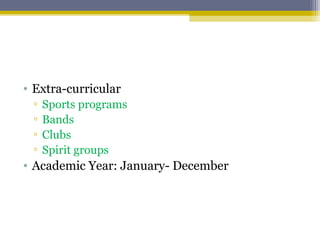
• Extra-curricular
▫ Sports programs
▫ Bands
▫ Clubs
▫ Spirit groups
• Academic Year: January- December
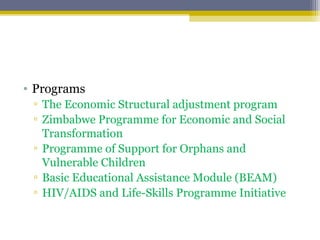
• Programs
▫ The Economic Structural adjustment program
▫ Zimbabwe Programme for Economic and Social
Transformation
▫ Programme of Support for Orphans and
Vulnerable Children
▫ Basic Educational Assistance Module (BEAM)
▫ HIV/AIDS and Life-Skills Programme Initiative
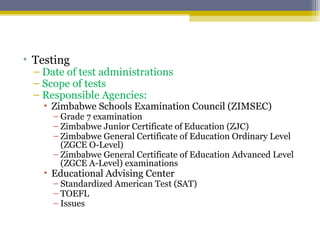
• Testing
– Date of test administrations
– Scope of tests
– Responsible Agencies:
• Zimbabwe Schools Examination Council (ZIMSEC)
– Grade 7 examination
– Zimbabwe Junior Certificate of Education (ZJC)
– Zimbabwe General Certificate of Education Ordinary Level
(ZGCE O-Level)
– Zimbabwe General Certificate of Education Advanced Level
(ZGCE A-Level) examinations
• Educational Advising Center
– Standardized American Test (SAT)
– TOEFL
– Issues
Processes within Systems
• Socialization
▫ Gender Socialization
 GEM-Girls Education Movement
▫ Family and Community Socialization Process
 To strengthen traditional values through the
utilization of discipline, positive values, strong
ethics, morals and collectivism constituting unhu/
ubuntu.
• Teaching and Learning
▫ Innovative teaching
▫ Learning by experimentation (using the available
indigenous resources)
▫ Group work
▫ Interactive learning
▫ Collaborative teaching and learning
• Decision Making
▫ Curricular Reforms: Curriculum Development
Unit
▫ Financing: Education Transition Fund
• Communication Systems
▫ Print / Electronic Media
▫ Research and information
• Discipline
• Change, adaptation
▫ Ideological Factors
▫ International Influence
▫ Search for Relevance
▫ Research
Informal Structure
• Inclusive Education
• Special Needs Education
• Adult and Non-Formal Education Programmes
(ANFE)
▫ Adult Literacy Programme(Continuous
Education)
▫ Study Group Programme
▫ Distance Education
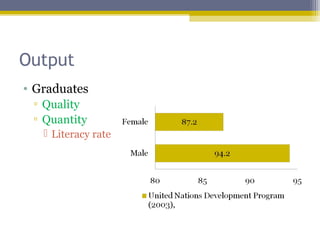
Output
• Graduates
▫ Quality
▫ Quantity
 Literacy rate
• New Knowledge
▫ Equity and efficiency in education
• Obsolete Information
▫ Provision for education mainly by missionaries
rather than government
▫ Racial biased governance and financing
▫ Gender disparity
▫ Belief that Blacks are inferior to Whites
• Emerging Culture
– More schools operate (via donations & other NGO’s)
– Decrease of students in Secondary Education (increased fees)
– Educated manpower
– “Brain Drain”
– Restoration of professional status of teachers
– Racial & Gender Equity
– Establishment plans of Academies/ Centers of Excellence
– Plans of Curriculum Revisions

Educational System of Zimbabwe

  • 1.
  • 2.
  • 3.
  • 4.
    b. People - Population- 12,382,920 (2008 estimate) - Linguistic and Ethnic Groups: Shona & Ndebele - Official Language: English - Life Expectancy Rate: 39.7 years
  • 5.
  • 6.
    c. Government - Form:Presidential Republic - Head of State: Pres. Robert Mugabe e. Religious Affiliations - Syncretic, Protestant, Catholic …
  • 7.
  • 8.
    Immediate Environment • SchoolBoard • PTA • Teacher’s union ▫ Low salary ▫ “deprofessionalization of the teaching profession” • Levies (taxes) ▫ Poor infrastracture • Community/ Pressure groups
  • 9.
    • Government regulations ▫Education for All 2015 (EFA) ▫ Education Act of 1997 ▫ Manpower Development Act of 1994 ▫ National Strategic Plan for the Education of Girls, Orphans and Other Vulnerable Children
  • 10.
    • Government /Local Sectors – Ministry of Education, Sport and Culture; – Ministry of Higher and Tertiary Education; – Ministry of Youth Development – Ministry of Women’s Affairs, Gender and Community Development; – Adult Literacy Association of Zimbabwe; – Church organizations; – Local Authorities
  • 11.
    Secondary Environment: • Socialistpath • Political demands of developing countries • Massive education expansion program Political- Economic
  • 12.
    • Lack ofgovernment funding – poor infrastructure/ lack of classrooms – Lack of instructional materials – Scarcity of Resources • Political Instability – Populist political ideology of ZANU-PF (political repression and economic meltdown)
  • 13.
    Social movements • Investmenton Education • Human Capital Shortage (Brain Drain)
  • 14.
    Technology • Lack ofState-of-the-art facilities • Generation of scientific and technological capabilities (Science and Technology Policy) • Globalization
  • 15.
    Cultural values andideology • Hegemonic culture • Racial Discrimination • Tradition of placing great value on education- • Apartheid Legacy • Racial Capitalism • Ceremonial rituals • Influence of Traditional African Education
  • 16.
    • Colonial Legacyon Educ. System ▫ Politics of EXCLUSION
  • 17.
    Population changes • Growthof private schools • Decrease of Life expectancy rate due to HIV/AIDS
  • 18.
    Religious • Mission Schools •Research and development Industrialization
  • 19.
    Input • Students ▫ Demographicvariables  Gender  Population  Proportion  Age  Enrolment Rate  Dropout Rate  Literacy Rate
  • 20.
    Evolution of NetIntake Rate (NIR) by Sex Year Boys Girls Both 1992 27.4 30.8 29.1 1994 35.4 33.3 34.3 1998 42.3 41.7 42.0 1999 43.5 43.0 43.3 2000 50.8 51.9 51.4
  • 21.
    Under and Over-AgedGrade One Pupils
  • 22.
    Evolution of Enrolmentand Population : Primary Education (6-12 years) 1994 1998 1999 2000 POPULATIO N 2366715 2365179 2293482 2230657 ENROLLME NT 1937554 2003214 2043121 2062725
  • 23.
    Out-of-School Population % In School %Out of School 1994 81.9 18.1 1998 84.7 15.3 1999 89.2 10.8 2000 92.5 7.5
  • 24.
    Evolution of NetEnrolment Ratio MALE FEMALE BOTH 1994 81.8 81.9 81.9 1998 86.7 82.8 84.7 1999 90.4 87.9 89.2 2000 95.1 90.0 92.5
  • 25.
    Gross Enrolment inTechnical and Vocational Education Male 11 018 67.4 % Female 5 340 32.6% Total 16 358 100%
  • 26.
    Gross Enrolment inUniversities MALE 14 662 67.3% FEMALE 7 108 32.7% TOTAL 21 770 100%
  • 27.
    ▫ Subculture ▫ PeerGroups ▫ Family  Roles ▫ Class
  • 28.
    • Staff: Teachers –Recruitment – Qualifications – Roles – Teacher training (Pre-service/ In-service/ Gender Mainstreaming on Education & training) – Population – Ratio (PTR) – Gender – Percentage Distribution of teachers • Administrators • Class Background
  • 29.
    Educational Organization ofZimbabwe: • Formal Structure – Early Childhood Education and Care (ECEC) • Age bracket (3-6y.o.) – Primary • Age Bracket (6-12 y.o.) – Secondary • Age Bracket (12-18 y.o.) • Types of schools (mission, boarding/ private, government,) • Levels Structure
  • 30.
    ▫ Tertiary  AgeBracket (18 and above)  Types of schools  Vocational Training Centres  Teacher Colleges  University  Polytechnic  Sci. and Tech. / Indutrial Training Centers
  • 31.
    Role Relationships • Ministryof Education, Sport and Culture: Minister David Coltart • Ministry of Higher and Tertiary Education
  • 32.
    Goals • To promoteeffectiveness, efficiency, equality in education • To develop the whole person and cultivate life skills • To preserve the cultural heritage of the past, acquaint the growing generation with the culture, and contribute towards the growth and protection of the culture • To equip students with basic survival, technical and vocational skills • To establish a strong scientific and technological base for economic development • To promote development of skills and competencies in language and communication, numeracy and literacy as well as entrepreneurship
  • 33.
    Programs • Content:Curriculum  Philosophy:Education With Production (EWP) – Primary (subjects) • Mathematics • English • Shona/Ndebele • Practical subjects (i.e. Art and Craft, House Economics, Music, Sports, Physical Education) • Social Studies • Environmental Science • Religious Education (largely based on Christianity)
  • 34.
    – Secondary (a.Zimbabwe Junior Certificate) • English • Shona or Ndebele • Mathematics • Science • History • Geography • Bible Knowledge • Practical Subject (i.e. Food and Nutrition, Fashion and Fabrics, Woodwork, Agriculture, Metalwork, Technical Drawing, etc.)
  • 35.
    – Secondary (b.Ordinary-Level) • Sciences: (Biology, Chemistry, Physics, Physics with Chemistry, Integrated Science, Mathematics) • Liberal Arts: (English Literature, Religious Education, Geography, History) • Commercial Subjects: (Accounts, Commerce, Economics, Computer Studies) • Languages: (English, Shona, Ndebele, French, German, Latin) • Arts: (Art, Music) • Practical Subjects: (Woodwork, Metalwork, Agriculture, Technical Drawing, Fashion & Fabrics, Food & Nutrition)
  • 36.
    - Secondary (c.Advanced-Level)  Arts: (English Literature, Geography, Shona/Ndebele Language and Literature, Divinity, History, French, Portuguese, German, Spanish, Art, Music)  Commercial: (Management of Business, Economics, Accounts, Computer Science, Statistics)  Sciences: (Biology, Chemistry, Physics)  Mathematics: (Pure Mathematics, Applied Mathematics, Further Mathematics, Statistics)
  • 37.
    • Extra-curricular ▫ Sportsprograms ▫ Bands ▫ Clubs ▫ Spirit groups • Academic Year: January- December
  • 38.
    • Programs ▫ TheEconomic Structural adjustment program ▫ Zimbabwe Programme for Economic and Social Transformation ▫ Programme of Support for Orphans and Vulnerable Children ▫ Basic Educational Assistance Module (BEAM) ▫ HIV/AIDS and Life-Skills Programme Initiative
  • 39.
    • Testing – Dateof test administrations – Scope of tests – Responsible Agencies: • Zimbabwe Schools Examination Council (ZIMSEC) – Grade 7 examination – Zimbabwe Junior Certificate of Education (ZJC) – Zimbabwe General Certificate of Education Ordinary Level (ZGCE O-Level) – Zimbabwe General Certificate of Education Advanced Level (ZGCE A-Level) examinations • Educational Advising Center – Standardized American Test (SAT) – TOEFL – Issues
  • 40.
    Processes within Systems •Socialization ▫ Gender Socialization  GEM-Girls Education Movement ▫ Family and Community Socialization Process  To strengthen traditional values through the utilization of discipline, positive values, strong ethics, morals and collectivism constituting unhu/ ubuntu.
  • 41.
    • Teaching andLearning ▫ Innovative teaching ▫ Learning by experimentation (using the available indigenous resources) ▫ Group work ▫ Interactive learning ▫ Collaborative teaching and learning
  • 42.
    • Decision Making ▫Curricular Reforms: Curriculum Development Unit ▫ Financing: Education Transition Fund • Communication Systems ▫ Print / Electronic Media ▫ Research and information • Discipline
  • 43.
    • Change, adaptation ▫Ideological Factors ▫ International Influence ▫ Search for Relevance ▫ Research
  • 44.
    Informal Structure • InclusiveEducation • Special Needs Education • Adult and Non-Formal Education Programmes (ANFE) ▫ Adult Literacy Programme(Continuous Education) ▫ Study Group Programme ▫ Distance Education
  • 45.
    Output • Graduates ▫ Quality ▫Quantity  Literacy rate
  • 46.
    • New Knowledge ▫Equity and efficiency in education
  • 47.
    • Obsolete Information ▫Provision for education mainly by missionaries rather than government ▫ Racial biased governance and financing ▫ Gender disparity ▫ Belief that Blacks are inferior to Whites
  • 48.
    • Emerging Culture –More schools operate (via donations & other NGO’s) – Decrease of students in Secondary Education (increased fees) – Educated manpower – “Brain Drain” – Restoration of professional status of teachers – Racial & Gender Equity – Establishment plans of Academies/ Centers of Excellence – Plans of Curriculum Revisions