







LANGUAGE TEACHING
APPROACHES
References:
Foundations of Methodology & Approaches and Methods in
Language Teaching
by Marianne Celce – Murcia by Jack C. Richards and
PRE – TWENTIETH
CENTURY LANGUAGE
TEACHING APPROACHES
THE GRAMMAR – TRANSLATION APPROACH
*KARL PLOETZ*
• instruction in the native language of the students
• little use of the target language for
communication
• focus on grammatical parsing
• early reading of difficult texts
• translate sentences from the target language into
the mother tongue (or vice versa)
THE DIRECT METHOD
*FRANCOIS GOUIN, 1880*
• use of the target language in the classroom
• no use of the mother tongue
• use of dialogues and anecdotes
• use of actions and pictures
• present grammar and culture inductively
• literary texts for pleasure
THE REFORM MOVEMENT
*HENRY SWEET, WILHELM VIËTOR, AND PAUL
PASSY, 1886*
• the spoken form of a language is primary and
should be taught first
• the findings of phonetics should be applied to
language teaching
• language teachers must have solid training in
phonetics
EARLY AND MID-
TWENTIETH-CENTURY
APPROACHES
THE READING APPROACH
• study of a foreign language by reading the target
language
• useful grammar is only taught
• translation is once more a respectable classroom
procedure
• reading comprehension
• the teacher does not need to have good oral
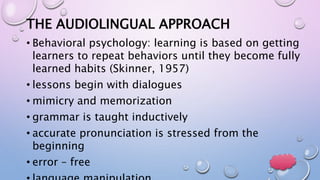
THE AUDIOLINGUAL APPROACH
• Behavioral psychology: learning is based on getting
learners to repeat behaviors until they become fully
learned habits (Skinner, 1957)
• lessons begin with dialogues
• mimicry and memorization
• grammar is taught inductively
• accurate pronunciation is stressed from the
beginning
• error – free
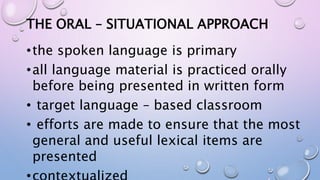
THE ORAL – SITUATIONAL APPROACH
•the spoken language is primary
•all language material is practiced orally
before being presented in written form
• target language – based classroom
• efforts are made to ensure that the most
general and useful lexical items are
presented
Lesson Pattern Vocabular
y
1 I am
hungry.
Thirsty,
poor,
alone
2 He is Prompt,
RECENT LANGUAGE
TEACHING
APPROACHES
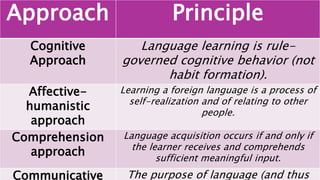
Approach Principle
Cognitive
Approach
Language learning is rule-
governed cognitive behavior (not
habit formation).
Affective-
humanistic
approach
Learning a foreign language is a process of
self-realization and of relating to other
people.
Comprehension
approach
Language acquisition occurs if and only if
the learner receives and comprehends
sufficient meaningful input.
Communicative The purpose of language (and thus
THE COGNITIVE APPROACH
•Cognitive psychology and Chomskyan
linguistics
•Language learning as rule acquisition
•grammar is taught either inductively or
deductively
•Pronunciation is deemphasized
•Reading and writing = listening and speaking
•Errors are used for improvement
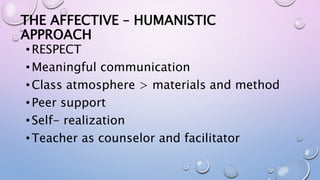
THE AFFECTIVE – HUMANISTIC
APPROACH
•RESPECT
•Meaningful communication
•Class atmosphere > materials and method
•Peer support
•Self- realization
•Teacher as counselor and facilitator
THE COMPREHENSION – BASED
APPROACH
•Listening comprehension
•Silent way
•Law of readiness
•Rule learning
•Error correction is unnecessary
•Appropriate audiovisual materials
THE COMMUNICATIVE APPROACH
•Communicating in the target language
•Semantic notions and social functions
•Academic or job – related material
•Role play/ dramatization
•Integrated skills
THANK YOU. 
PRESENTED BY:
MARIE BUENA SALAVERIA BUNSOY,
MALED

Language teaching approaches

  • 1.
    LANGUAGE TEACHING APPROACHES References: Foundations ofMethodology & Approaches and Methods in Language Teaching by Marianne Celce – Murcia by Jack C. Richards and
  • 2.
    PRE – TWENTIETH CENTURYLANGUAGE TEACHING APPROACHES
  • 3.
    THE GRAMMAR –TRANSLATION APPROACH *KARL PLOETZ* • instruction in the native language of the students • little use of the target language for communication • focus on grammatical parsing • early reading of difficult texts • translate sentences from the target language into the mother tongue (or vice versa)
  • 4.
    THE DIRECT METHOD *FRANCOISGOUIN, 1880* • use of the target language in the classroom • no use of the mother tongue • use of dialogues and anecdotes • use of actions and pictures • present grammar and culture inductively • literary texts for pleasure
  • 5.
    THE REFORM MOVEMENT *HENRYSWEET, WILHELM VIËTOR, AND PAUL PASSY, 1886* • the spoken form of a language is primary and should be taught first • the findings of phonetics should be applied to language teaching • language teachers must have solid training in phonetics
  • 6.
  • 7.
    THE READING APPROACH •study of a foreign language by reading the target language • useful grammar is only taught • translation is once more a respectable classroom procedure • reading comprehension • the teacher does not need to have good oral
  • 8.
    THE AUDIOLINGUAL APPROACH •Behavioral psychology: learning is based on getting learners to repeat behaviors until they become fully learned habits (Skinner, 1957) • lessons begin with dialogues • mimicry and memorization • grammar is taught inductively • accurate pronunciation is stressed from the beginning • error – free
  • 9.
    THE ORAL –SITUATIONAL APPROACH •the spoken language is primary •all language material is practiced orally before being presented in written form • target language – based classroom • efforts are made to ensure that the most general and useful lexical items are presented
  • 10.
    Lesson Pattern Vocabular y 1I am hungry. Thirsty, poor, alone 2 He is Prompt,
  • 11.
  • 12.
    Approach Principle Cognitive Approach Language learningis rule- governed cognitive behavior (not habit formation). Affective- humanistic approach Learning a foreign language is a process of self-realization and of relating to other people. Comprehension approach Language acquisition occurs if and only if the learner receives and comprehends sufficient meaningful input. Communicative The purpose of language (and thus
  • 13.
    THE COGNITIVE APPROACH •Cognitivepsychology and Chomskyan linguistics •Language learning as rule acquisition •grammar is taught either inductively or deductively •Pronunciation is deemphasized •Reading and writing = listening and speaking •Errors are used for improvement
  • 14.
    THE AFFECTIVE –HUMANISTIC APPROACH •RESPECT •Meaningful communication •Class atmosphere > materials and method •Peer support •Self- realization •Teacher as counselor and facilitator
  • 15.
    THE COMPREHENSION –BASED APPROACH •Listening comprehension •Silent way •Law of readiness •Rule learning •Error correction is unnecessary •Appropriate audiovisual materials
  • 16.
    THE COMMUNICATIVE APPROACH •Communicatingin the target language •Semantic notions and social functions •Academic or job – related material •Role play/ dramatization •Integrated skills
  • 17.
    THANK YOU.  PRESENTEDBY: MARIE BUENA SALAVERIA BUNSOY, MALED