Segmentation, Targeting and Positioning
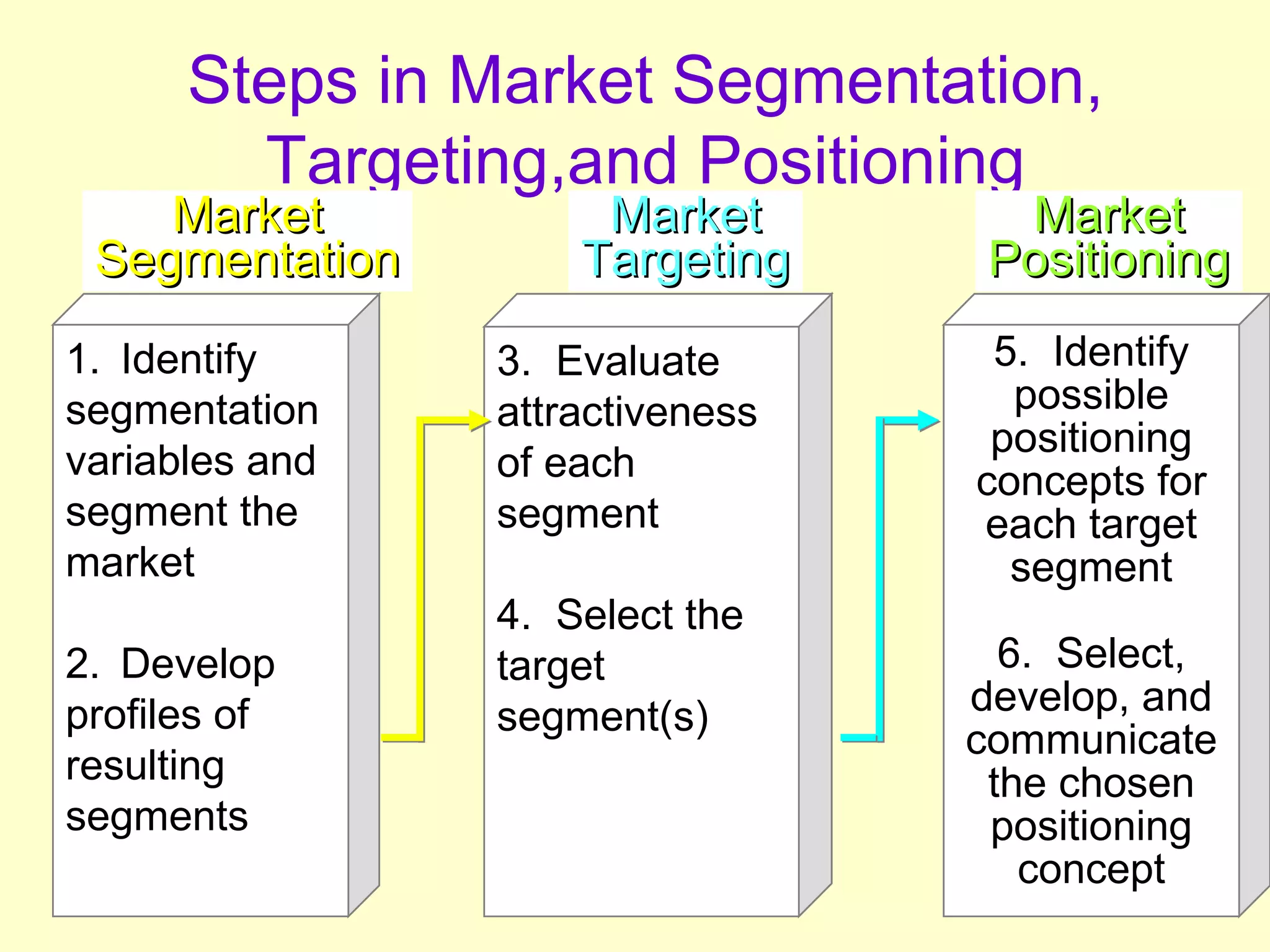
Steps in Market Segmentation, Targeting,and Positioning 1. Identify segmentation variables and segment the market 2. Develop  profiles of resulting segments Market Segmentation 3.  Evaluate attractiveness of each segment 4.  Select the target segment(s) Market Targeting 5.  Identify possible positioning concepts for each target segment 6.  Select, develop, and communicate the chosen positioning concept Market Positioning
Why Segmentation ?   Not all buyers alike Subgroups may be identified Subgroups smaller and more homogeneous Easier to satisfy smaller groups
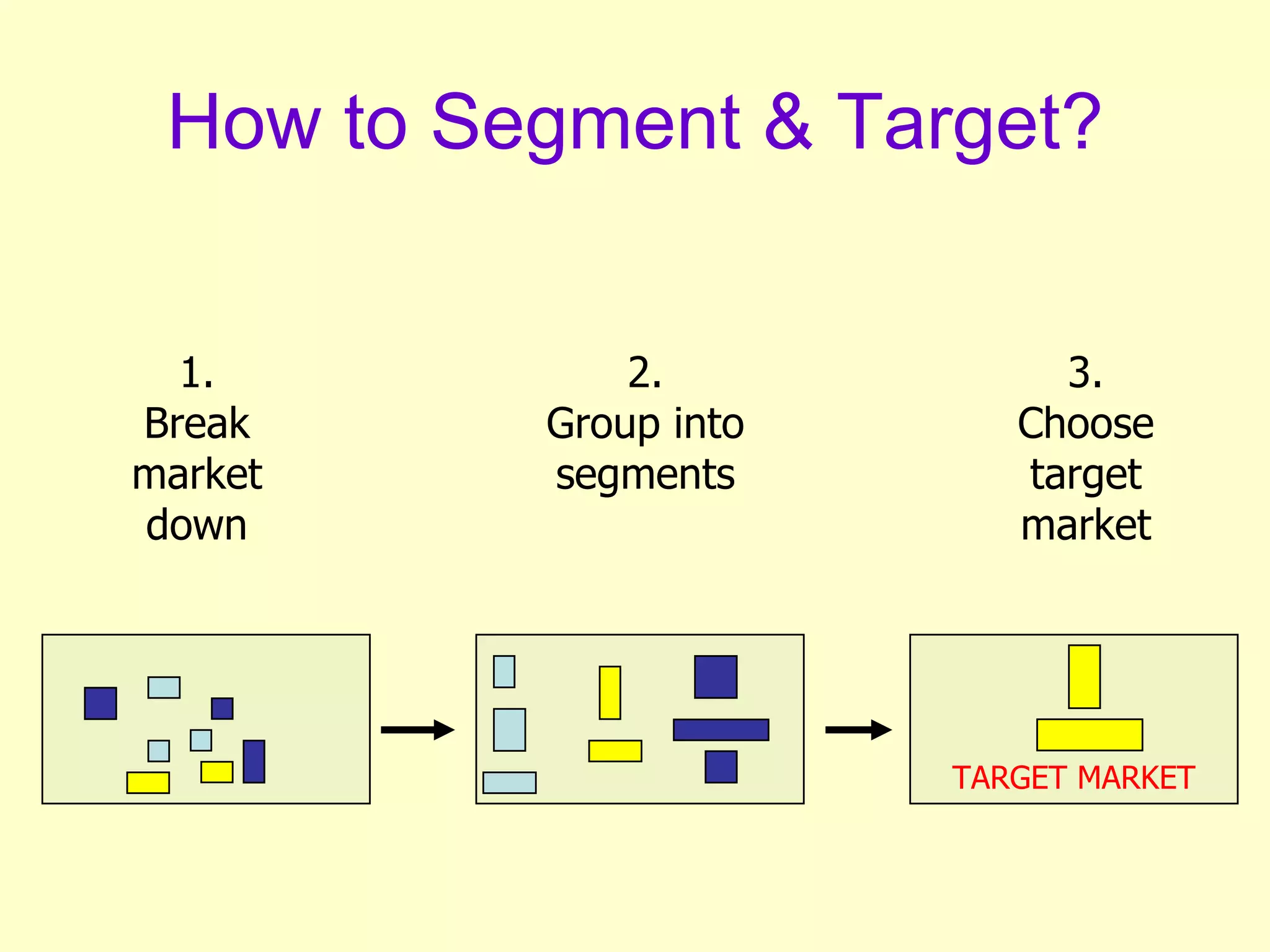
How to Segment & Target? 1. Break market down 2. Group into segments TARGET MARKET 3. Choose target market
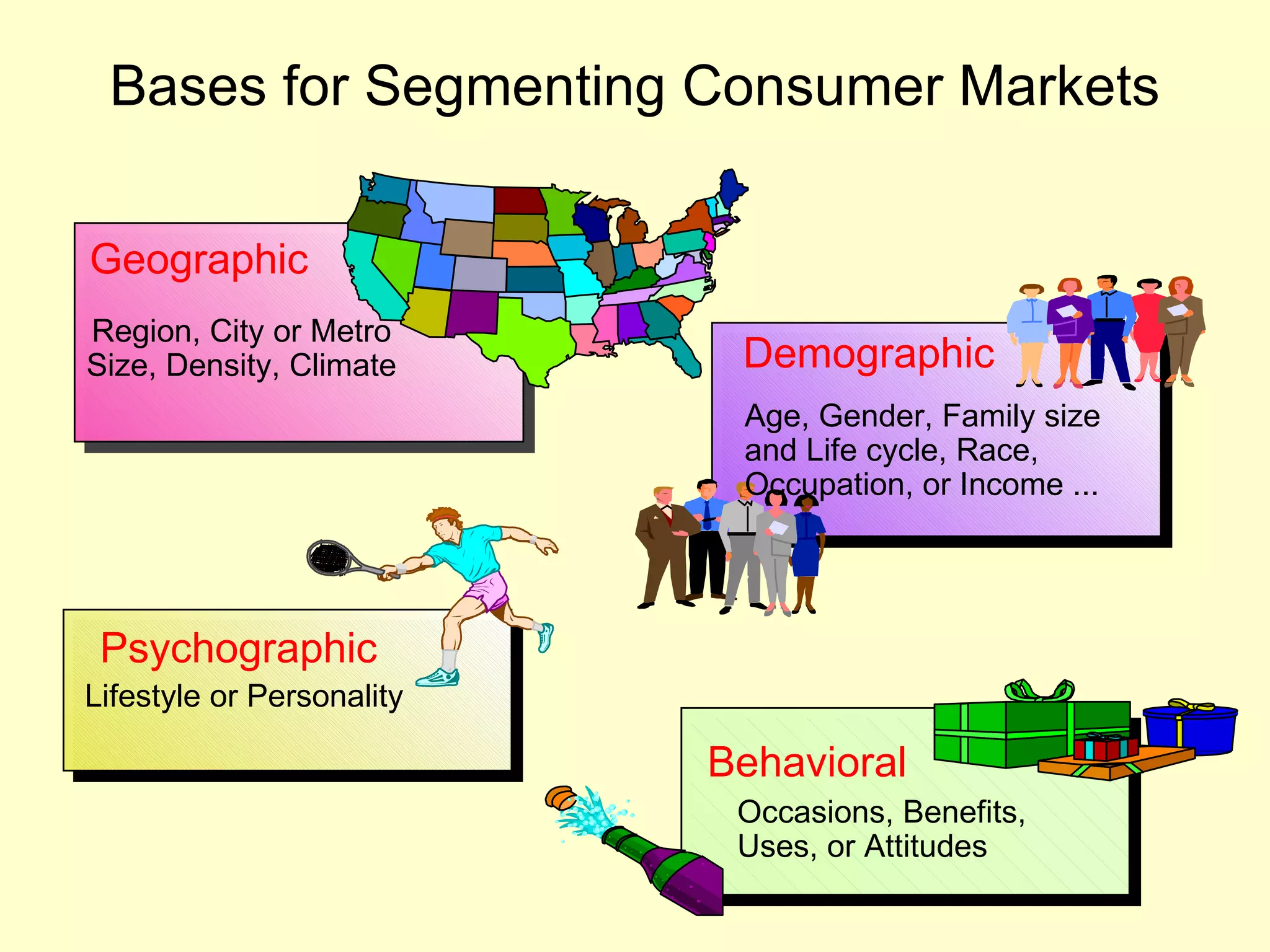
Bases for Segmenting Consumer Markets Occasions, Benefits, Uses, or Attitudes Behavioral Geographic Region, City or Metro Size, Density, Climate Demographic Age, Gender, Family size and Life cycle, Race, Occupation, or Income ... Lifestyle or Personality Psychographic
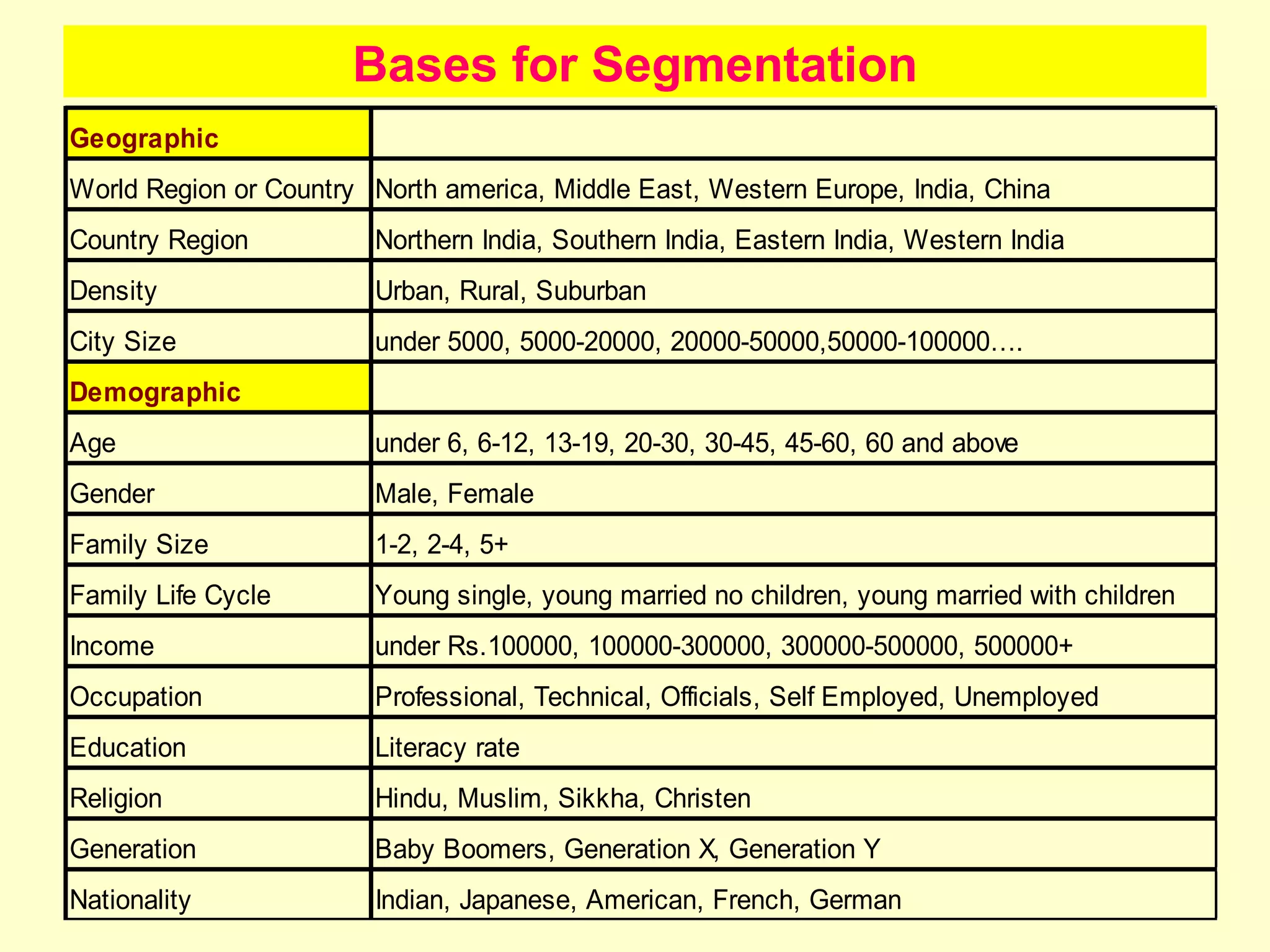
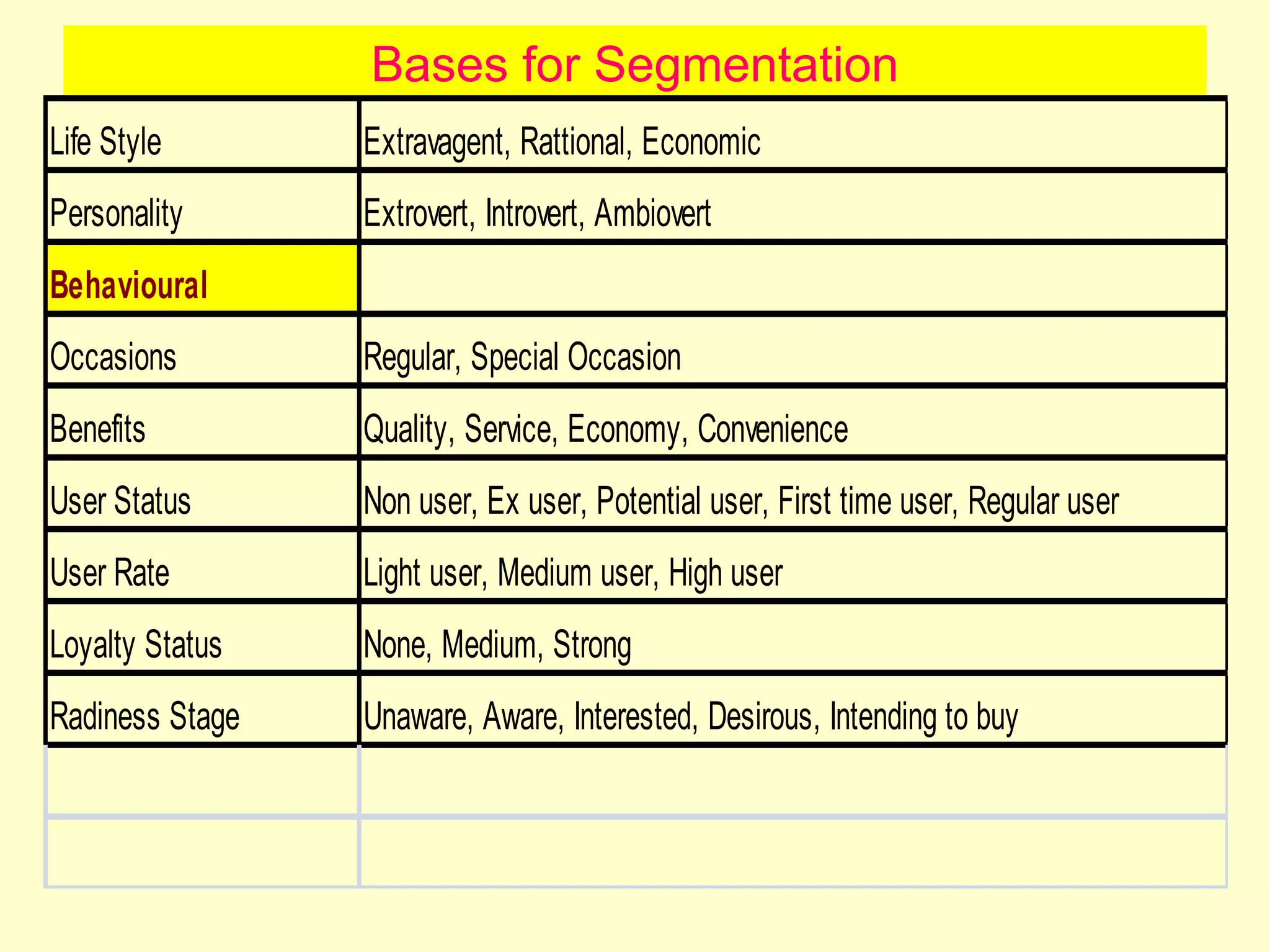
Bases for Segmentation
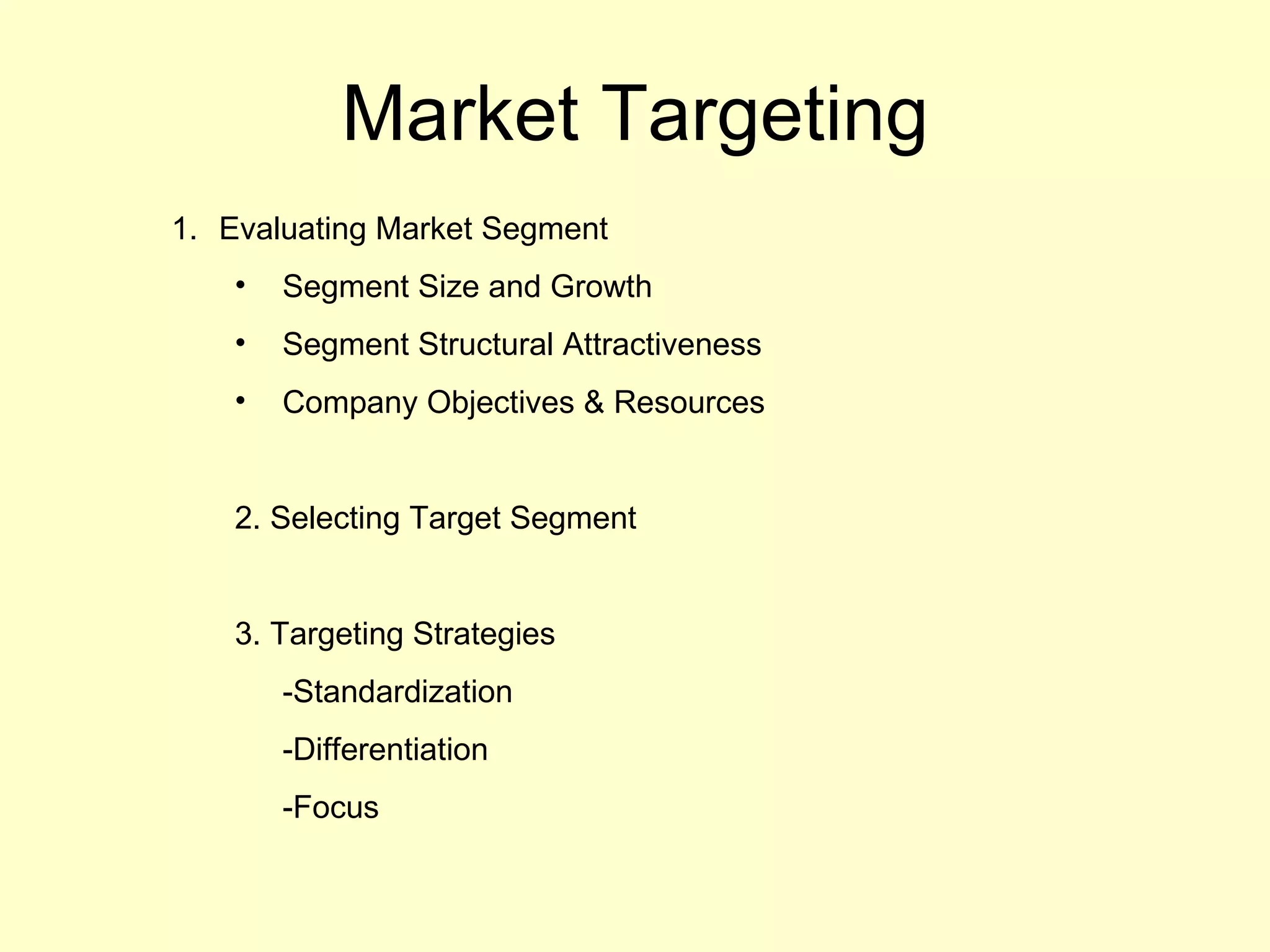
Market Targeting Evaluating Market Segment Segment Size and Growth Segment Structural Attractiveness  Company Objectives & Resources 2. Selecting Target Segment 3. Targeting Strategies -Standardization -Differentiation -Focus
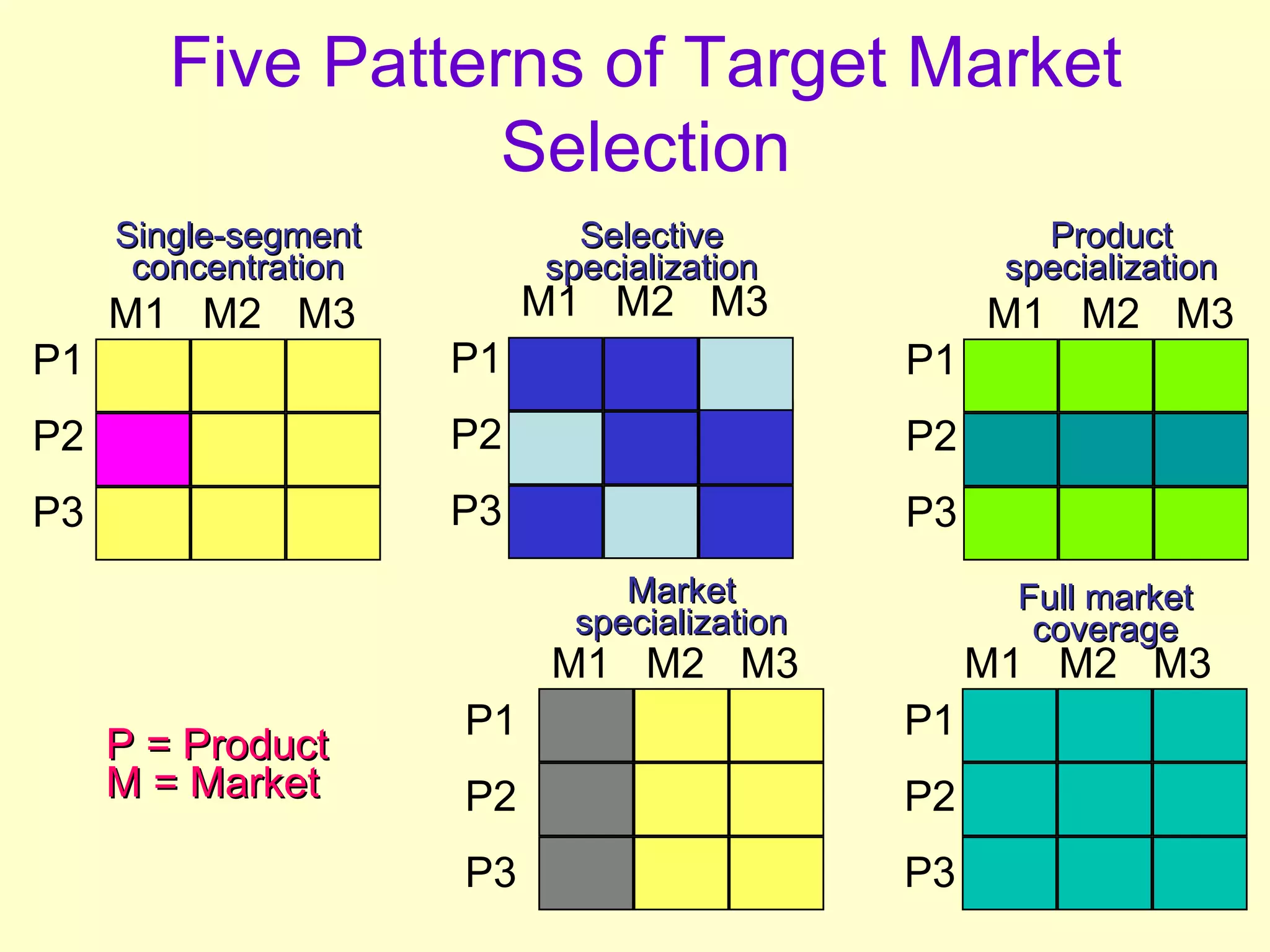
Five Patterns of Target Market Selection Single-segment concentration Product specialization M1  M2  M3   P1 P2 P3 Selective specialization M1  M2  M3   P1 P2 P3 M1  M2  M3  Full market coverage P1 P2 P3 Market specialization M1  M2  M3   P1 P2 P3 P1 P2 P3 M1  M2  M3   P = Product M = Market
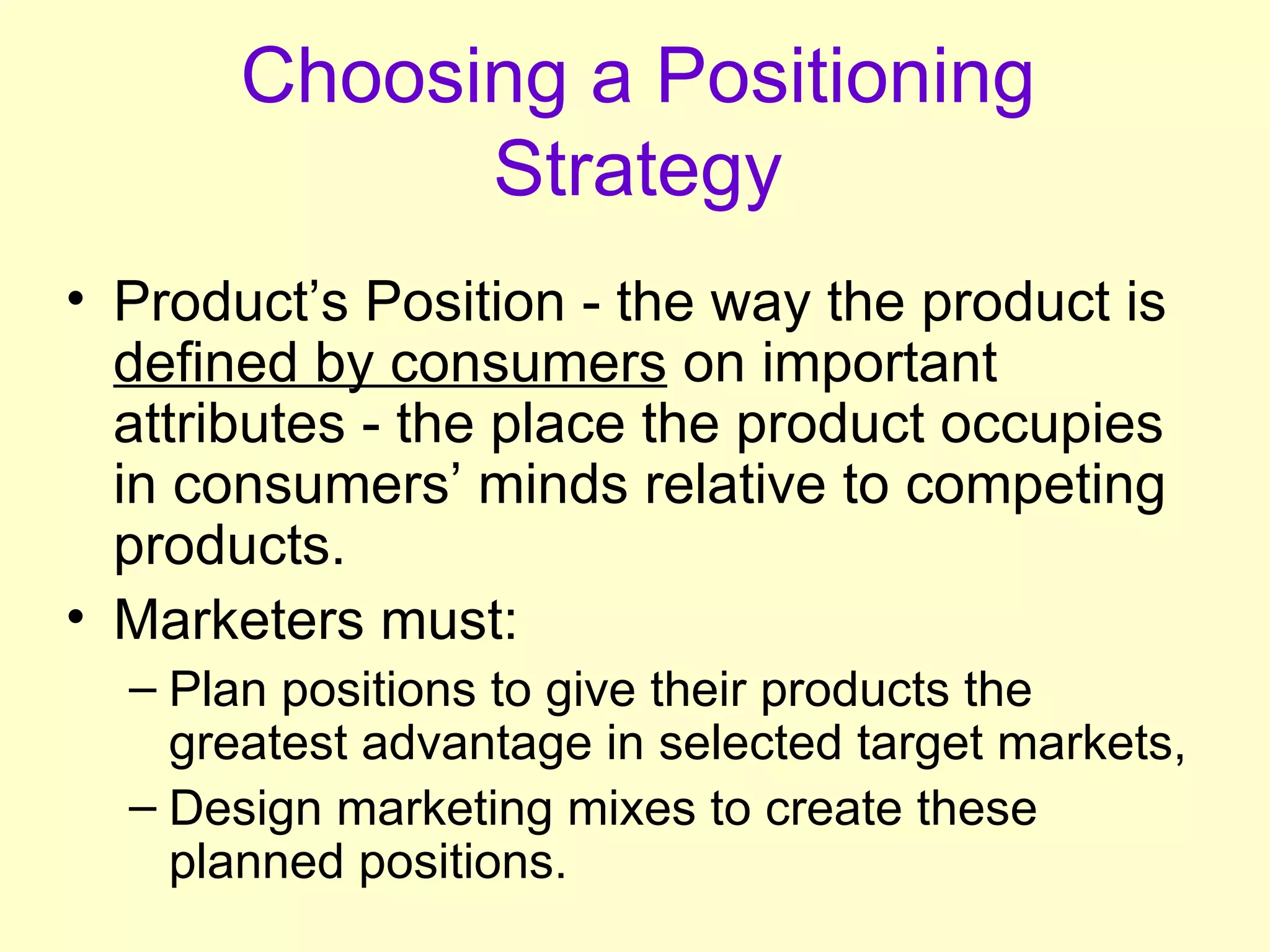
Choosing a Positioning Strategy Product’s Position - the way the product is  defined by consumers  on important attributes - the place the product occupies in consumers’ minds relative to competing products. Marketers must: Plan positions to give their products the greatest advantage in selected target markets, Design marketing mixes to create these planned positions.
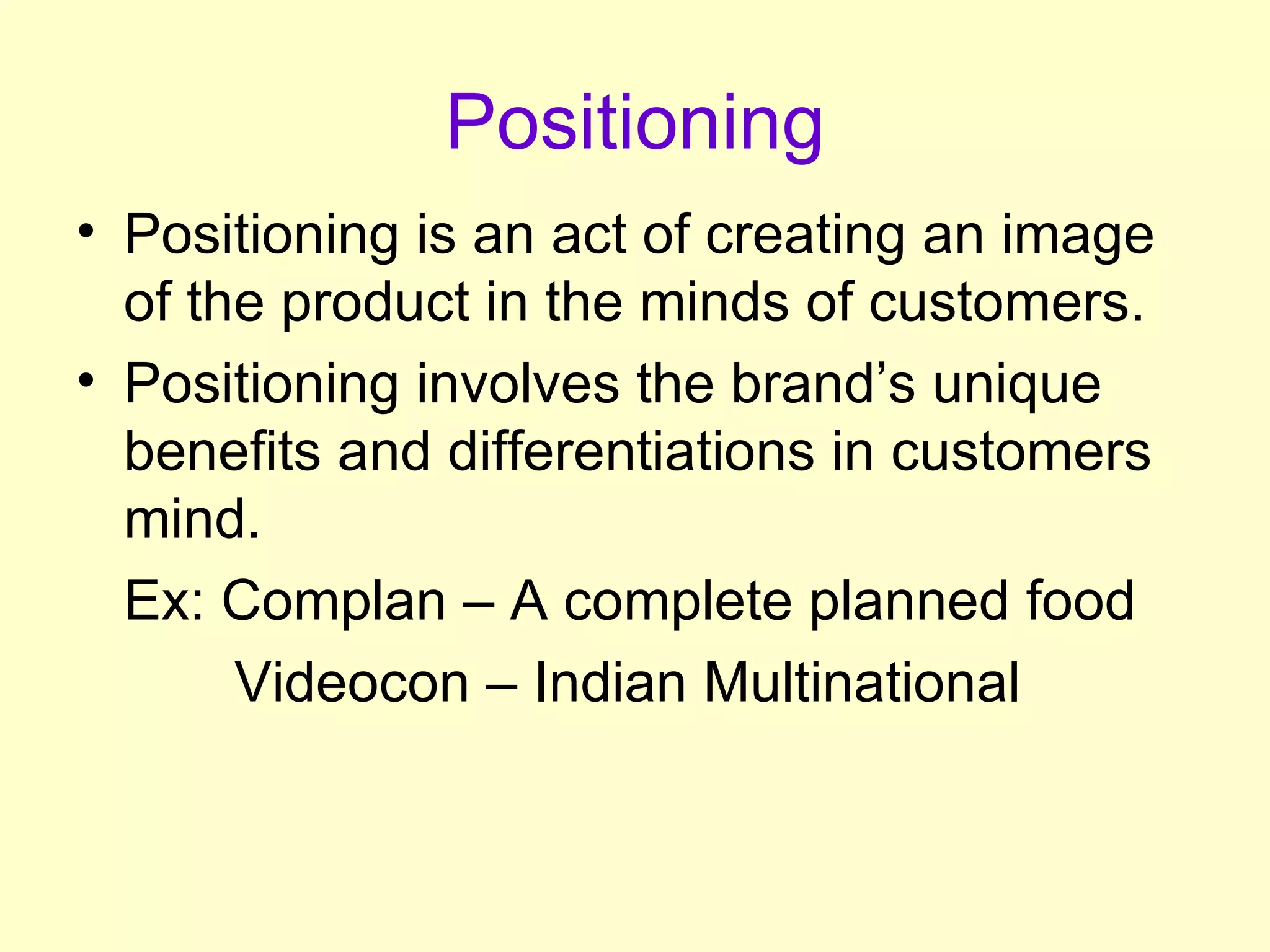
Positioning Positioning is an act of creating an image of the product in the minds of customers. Positioning involves the brand’s unique benefits and differentiations in customers mind. Ex: Complan – A complete planned food   Videocon – Indian Multinational
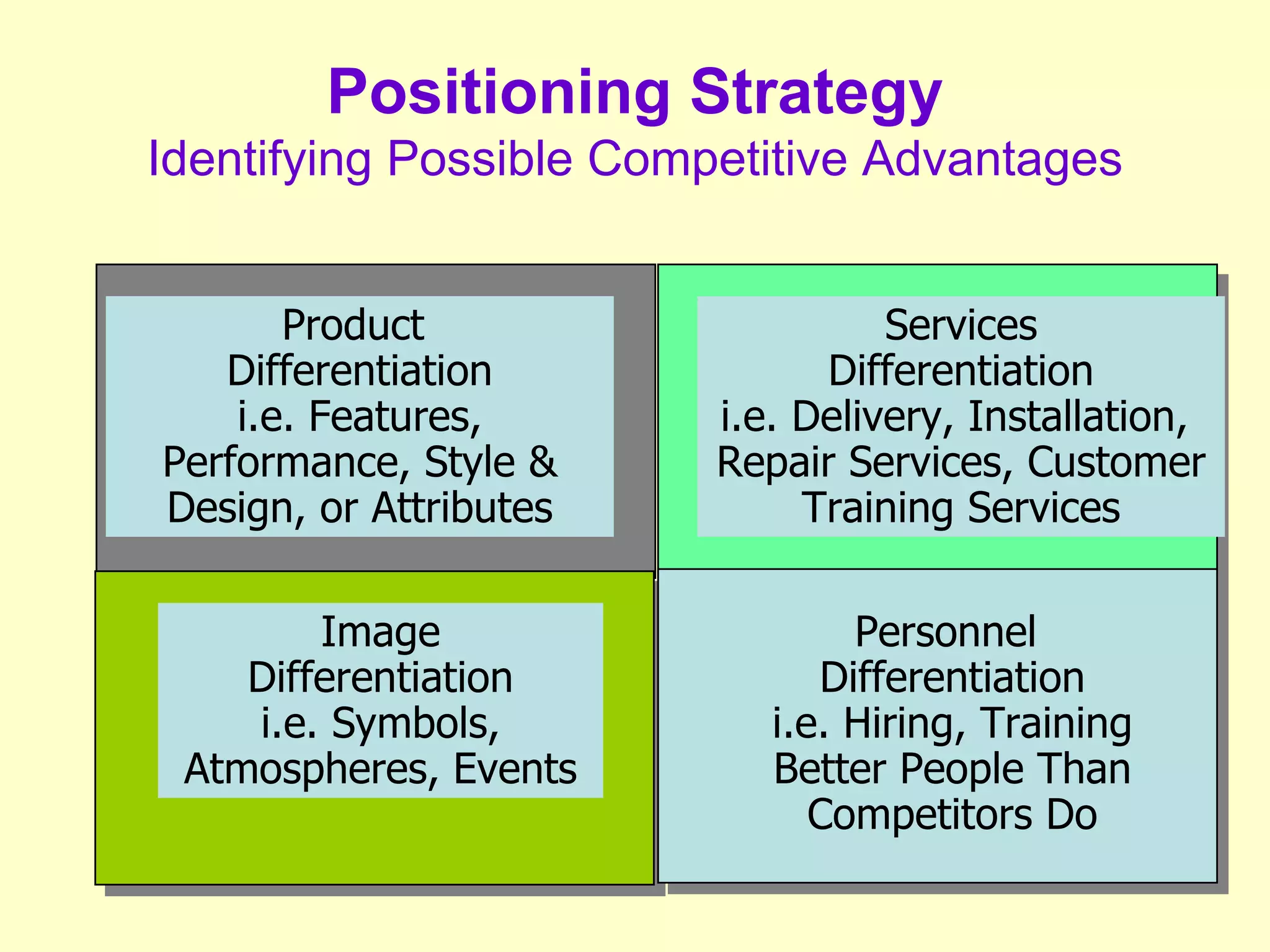
Positioning Strategy Identifying Possible Competitive Advantages Services Differentiation i.e. Delivery, Installation,  Repair Services, Customer  Training Services Product  Differentiation i.e. Features, Performance, Style & Design, or Attributes Image Differentiation i.e. Symbols, Atmospheres, Events Personnel  Differentiation i.e. Hiring, Training Better People Than Competitors Do
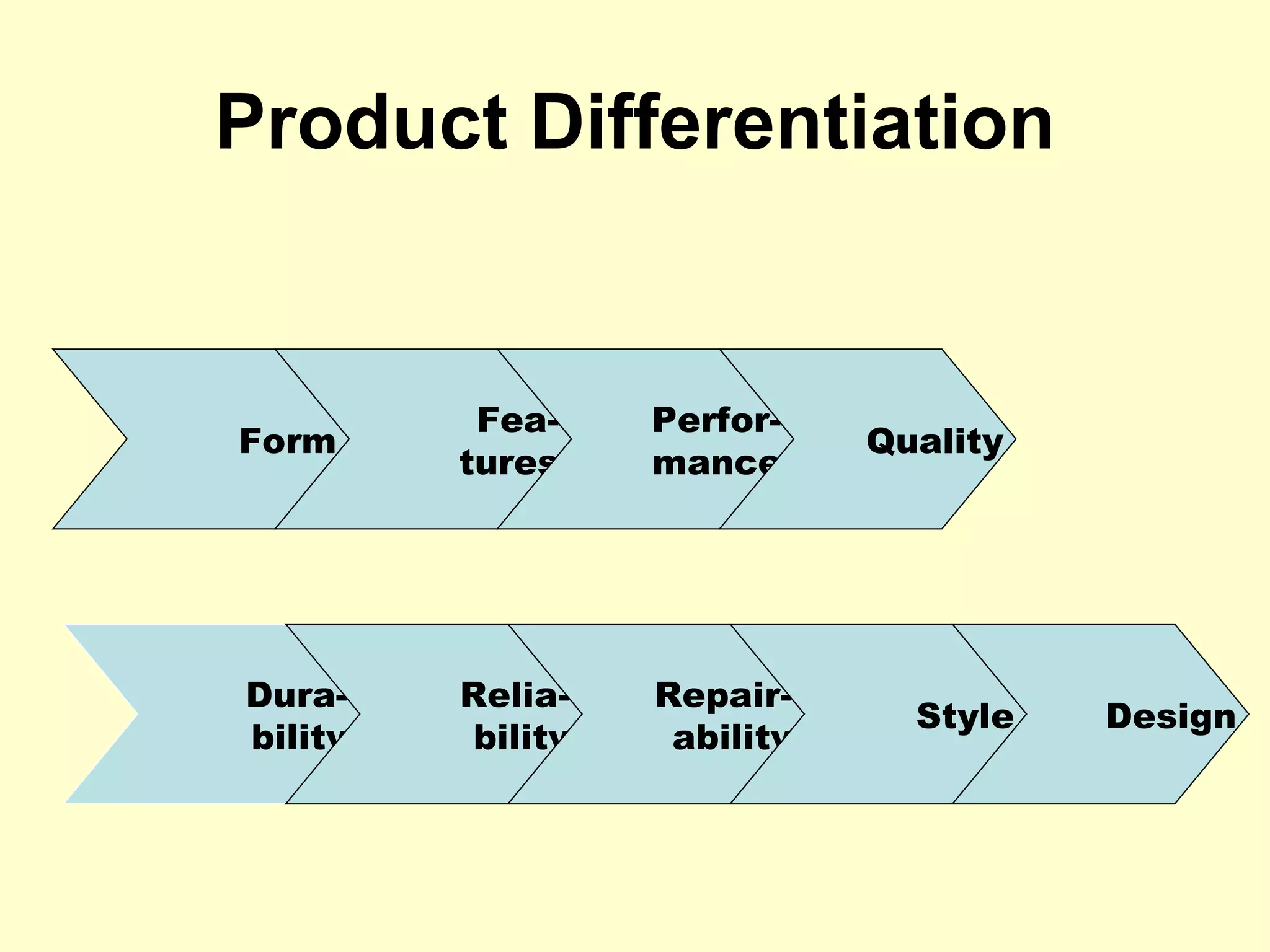
Product Differentiation Form Fea- tures Perfor- mance Quality Dura- bility Relia- bility Repair- ability Style Design
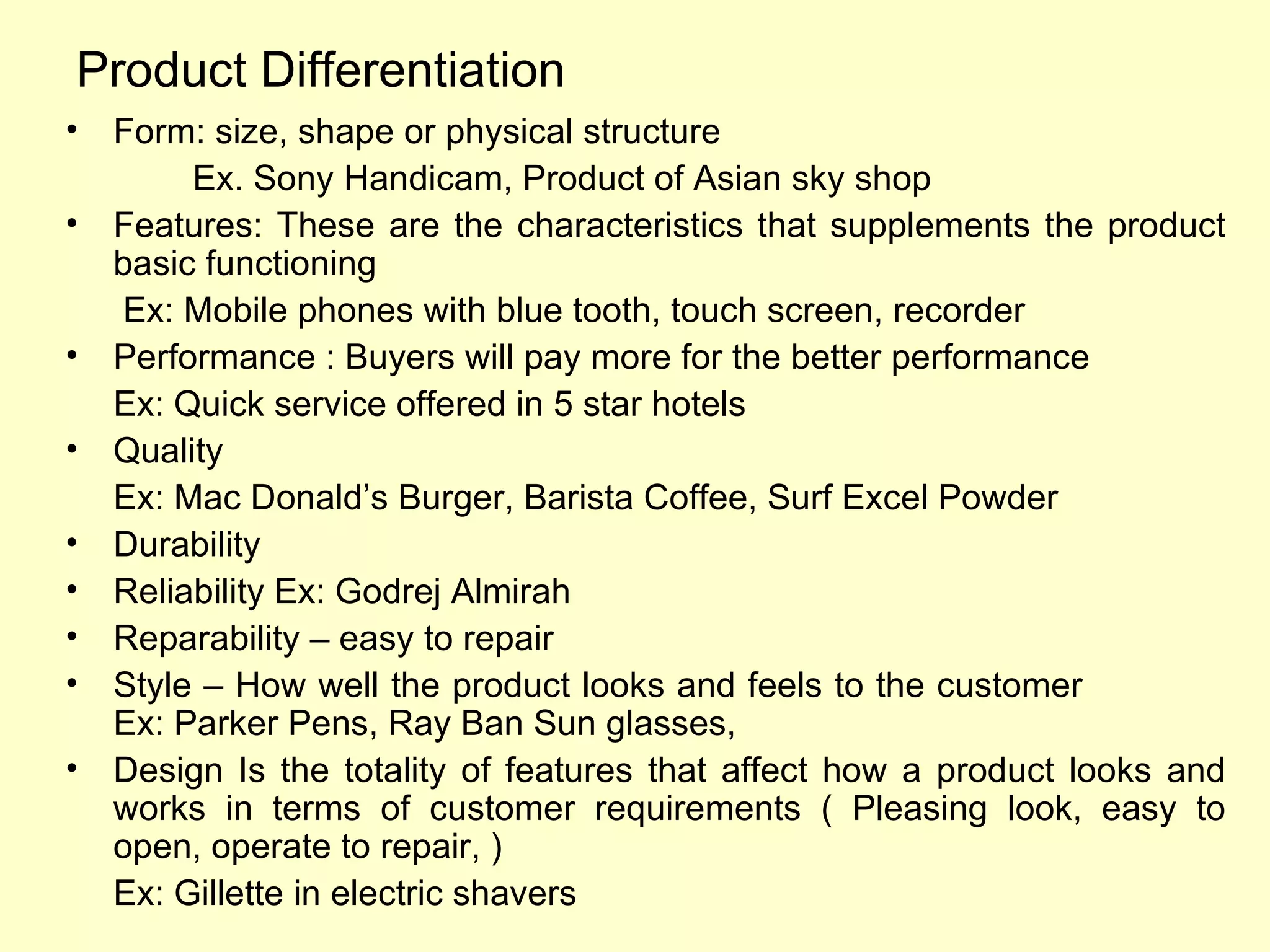
Product Differentiation Form: size, shape or physical structure Ex. Sony Handicam, Product of Asian sky shop Features: These are the characteristics that supplements the product basic functioning   Ex: Mobile phones with blue tooth, touch screen, recorder Performance : Buyers will pay more for the better performance Ex: Quick service offered in 5 star hotels Quality Ex: Mac Donald’s Burger, Barista Coffee, Surf Excel Powder Durability Reliability Ex: Godrej Almirah Reparability – easy to repair Style – How well the product looks and feels to the customer  Ex: Parker Pens, Ray Ban Sun glasses,  Design Is the totality of features that affect how a product looks and works in terms of customer requirements ( Pleasing look, easy to open, operate to repair, ) Ex: Gillette in electric shavers
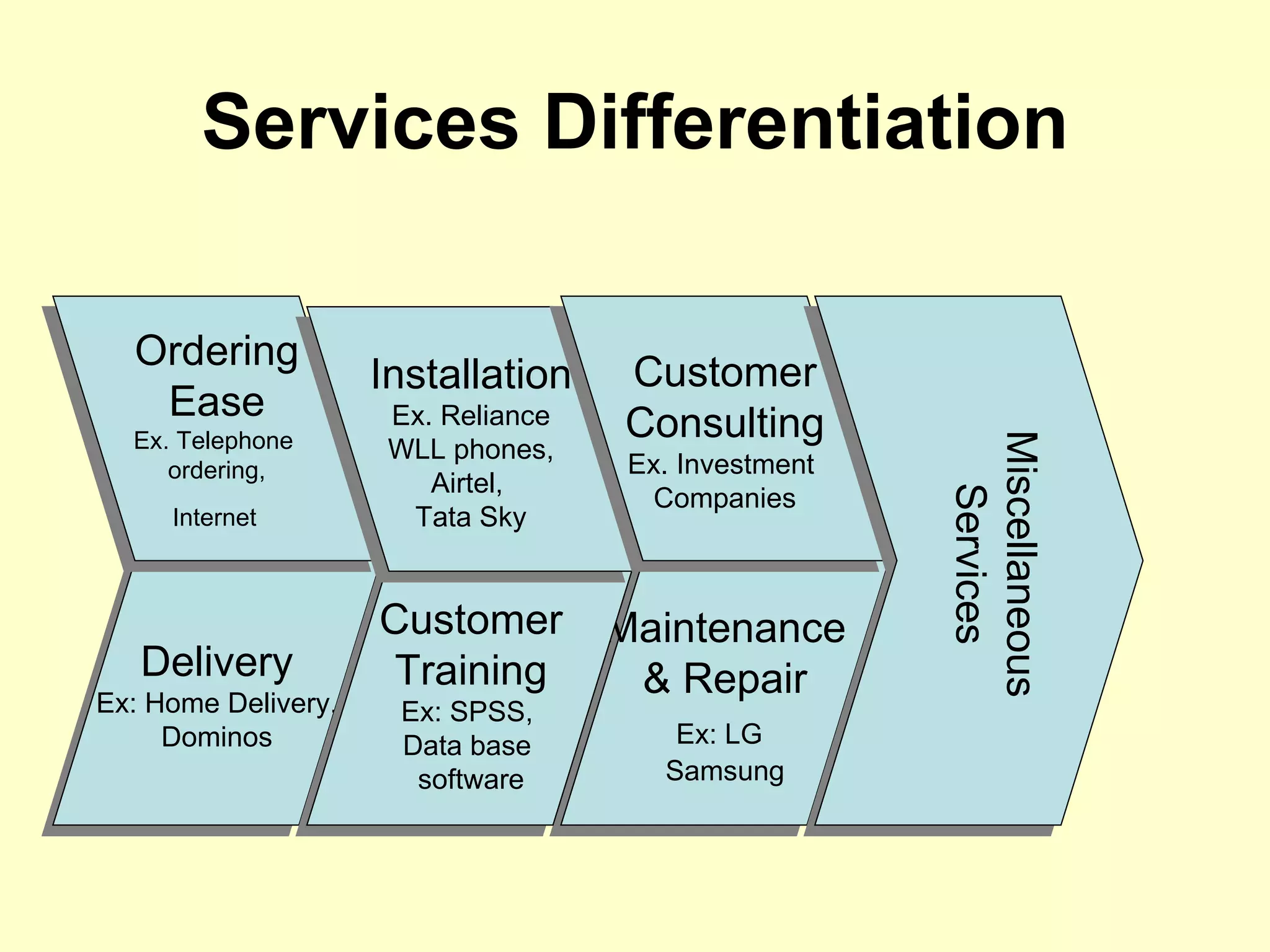
Services Differentiation Delivery Ex: Home Delivery, Dominos  Ordering Ease Ex. Telephone  ordering, Internet   Maintenance & Repair Ex: LG   Samsung Customer Training Ex: SPSS,  Data base  software Installation Ex. Reliance WLL phones,  Airtel,  Tata Sky Customer Consulting Ex. Investment  Companies Miscellaneous Services
Companies can gain a strong competitive advantage through having better trained people. Trained personnel exhibits following characteristics Competence – possess the required skills & knowledge Courtesy – Friendly, respectful Credibility – Trustworthy Reliability – perform the service consistently and accurately Responsiveness – respond quickly to the customer’s problem Communication – make an effort to understand the customer and communicate clearly PERSONNEL Differentiation
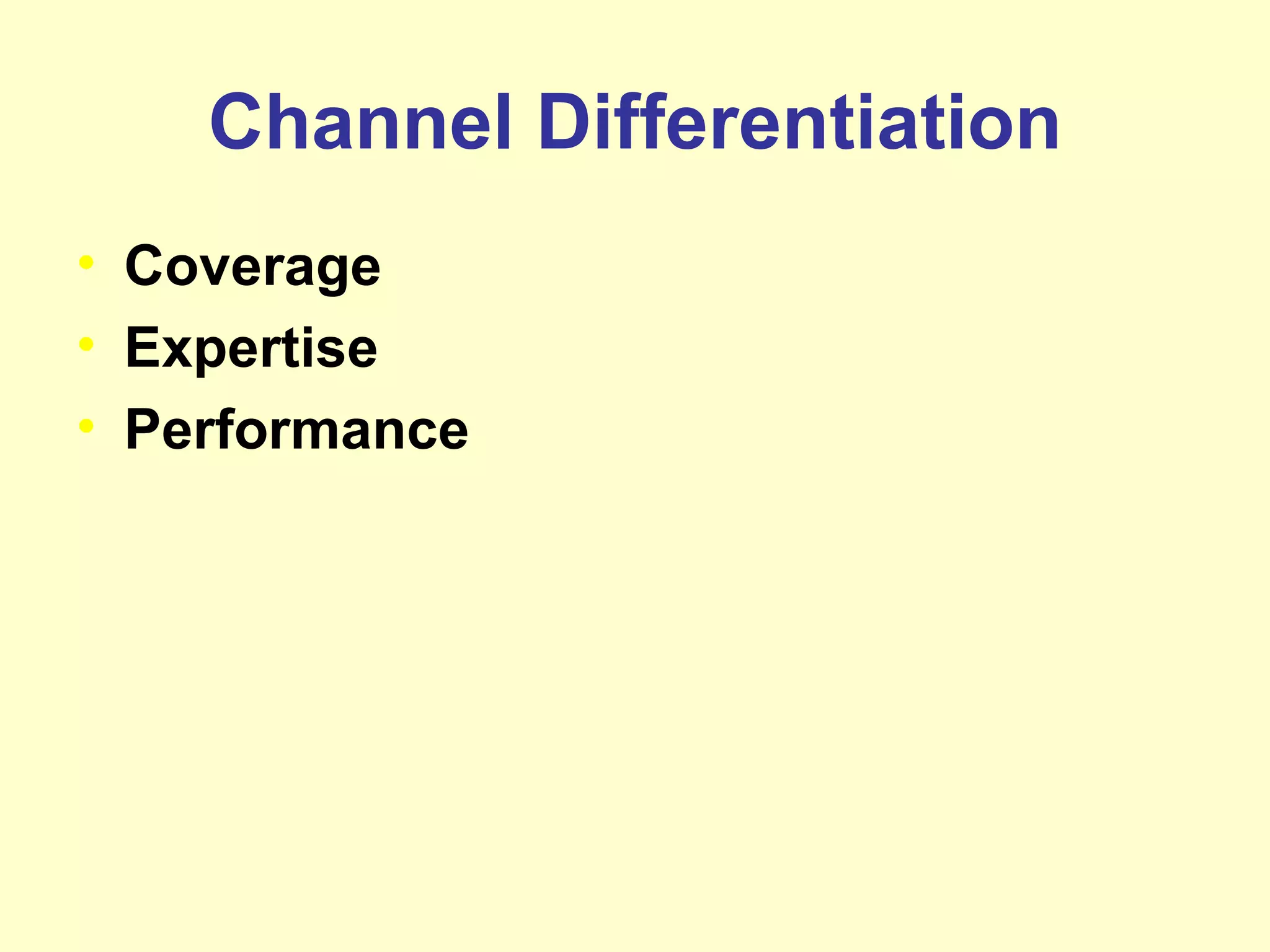
Channel Differentiation Coverage Expertise Performance
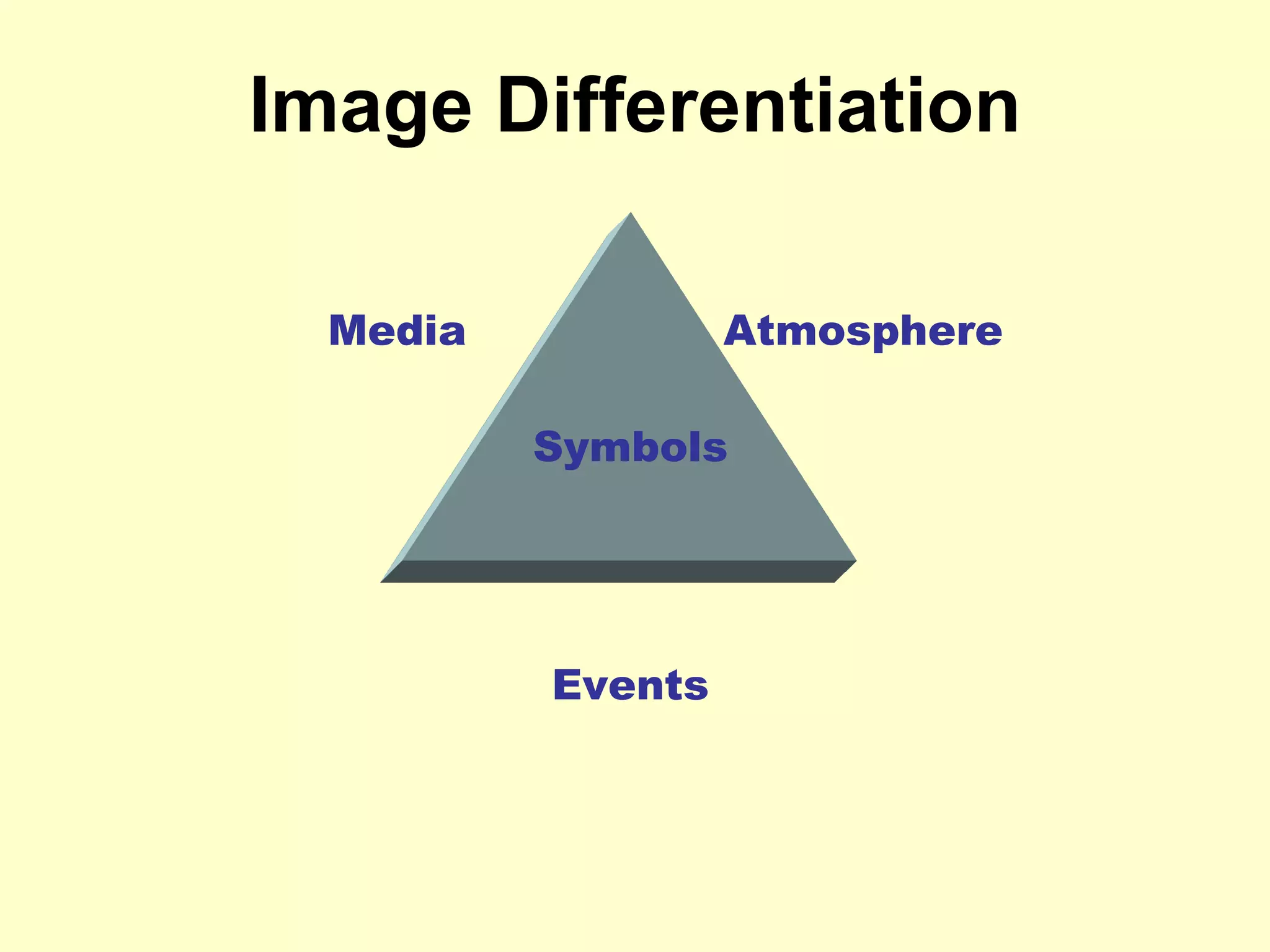
Image Differentiation Media Atmosphere Symbols Events
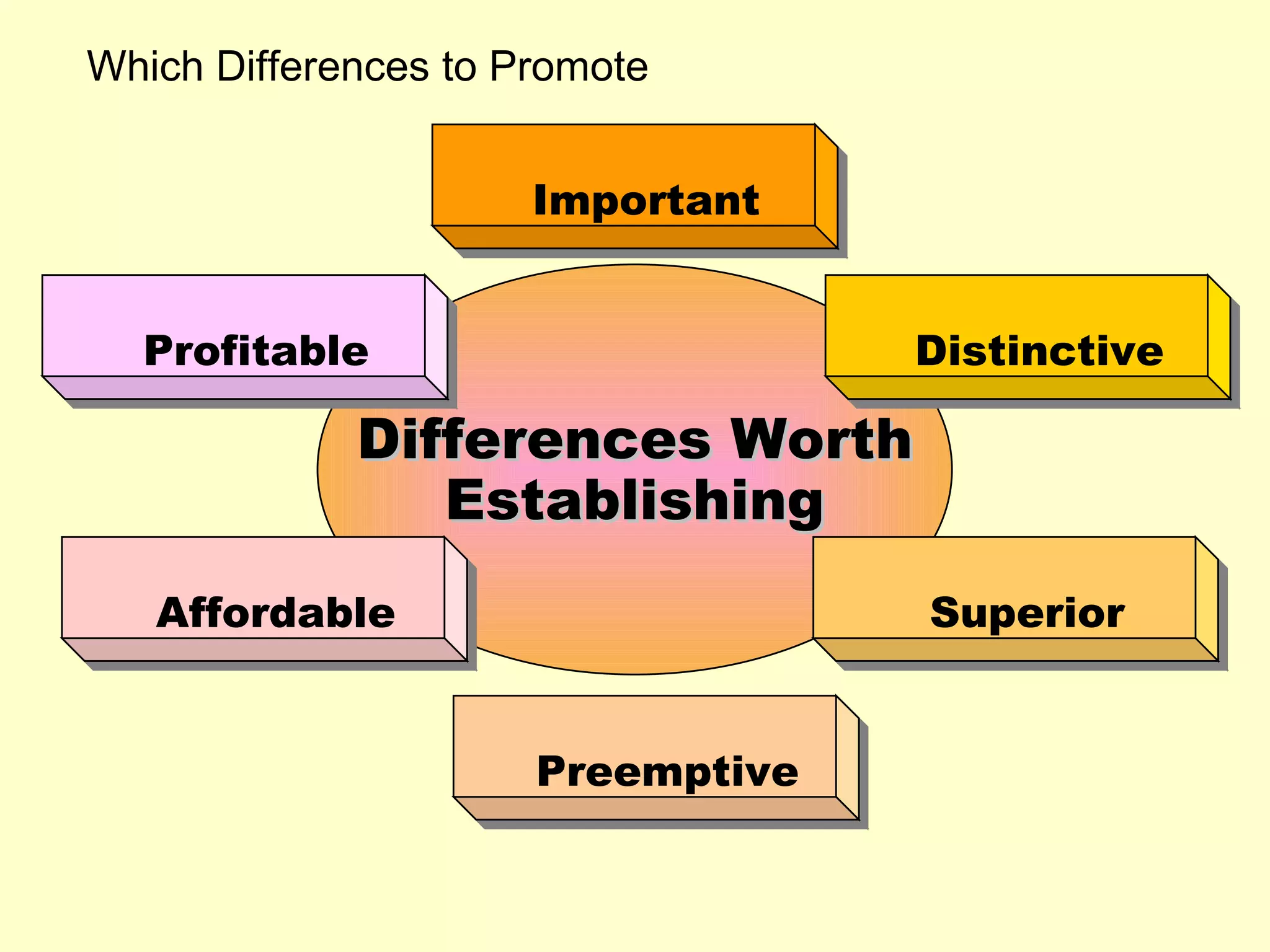
Differences Worth Establishing Affordable Superior Profitable Preemptive Distinctive Important Which Differences to Promote
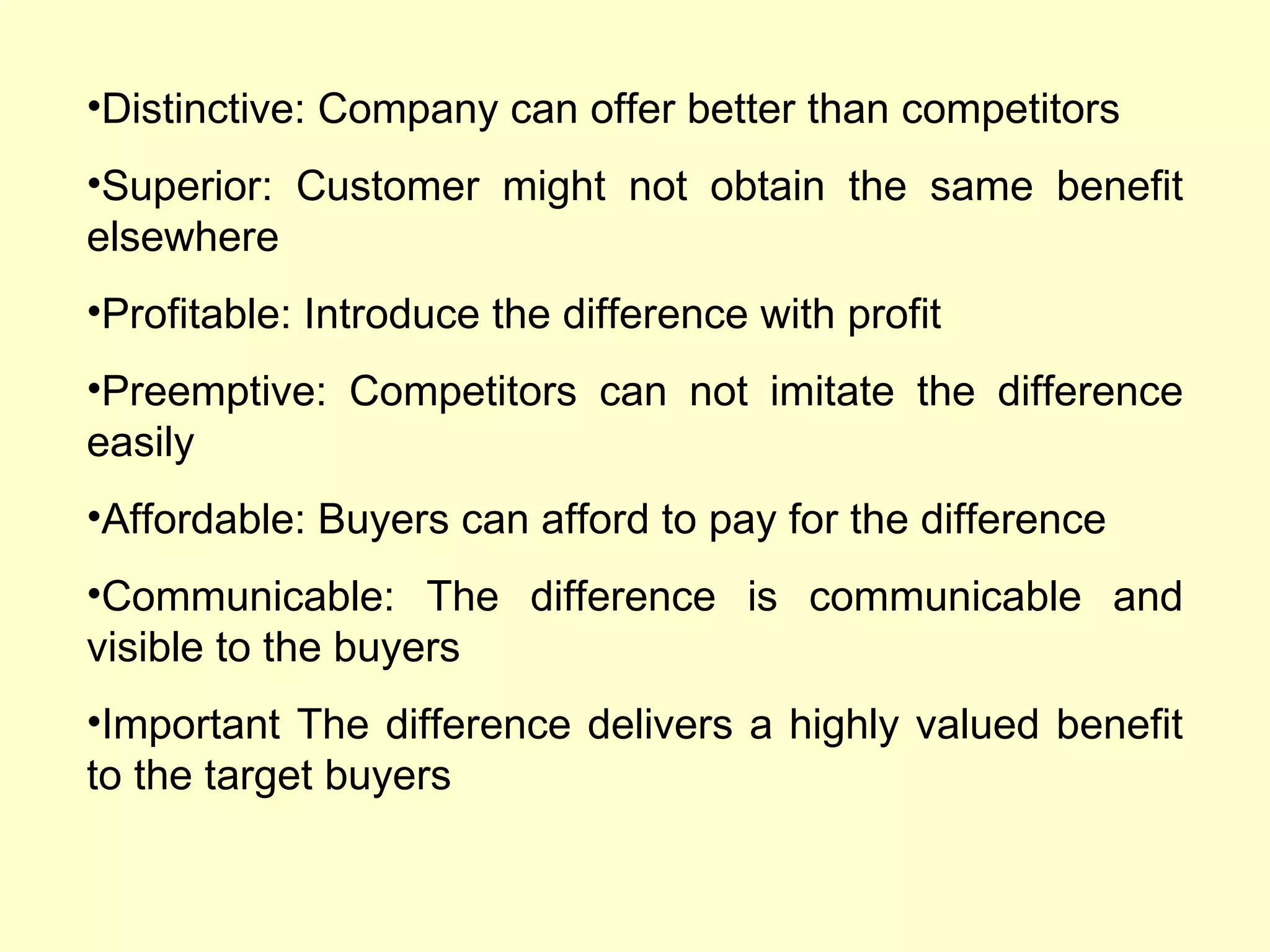
Distinctive: Company can offer better than competitors Superior: Customer might not obtain the same benefit elsewhere Profitable: Introduce the difference with profit Preemptive: Competitors can not imitate the difference easily Affordable: Buyers can afford to pay for the difference Communicable: The difference is communicable and visible to the buyers Important The difference delivers a highly valued benefit to the target buyers
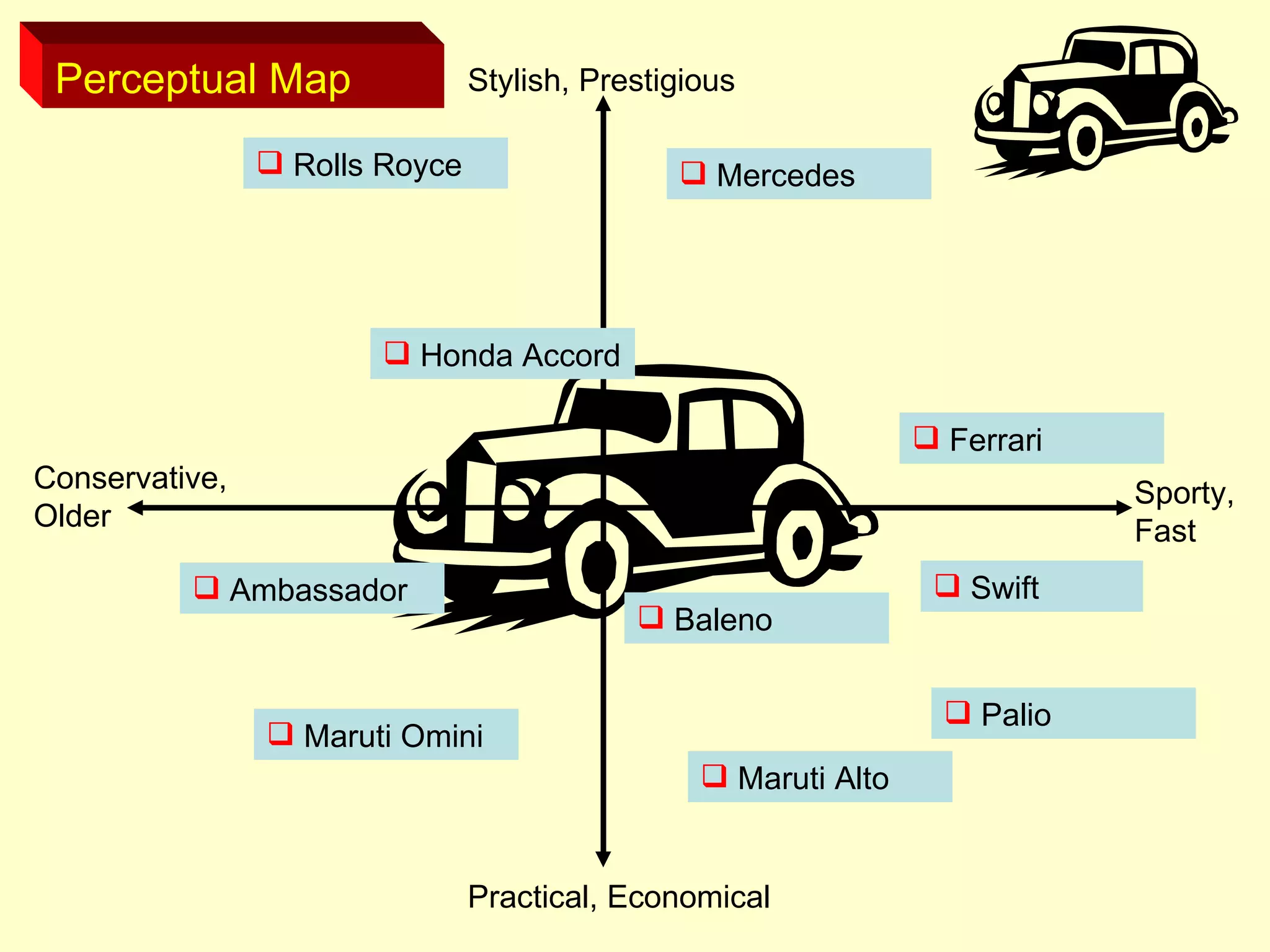
Perceptual Map Stylish, Prestigious Practical, Economical Conservative, Older Sporty, Fast Rolls Royce Maruti Alto Baleno Ambassador Mercedes Honda Accord Ferrari Maruti Omini Swift Palio

Stp new

  • 1.
  • 2.
    Steps in MarketSegmentation, Targeting,and Positioning 1. Identify segmentation variables and segment the market 2. Develop profiles of resulting segments Market Segmentation 3. Evaluate attractiveness of each segment 4. Select the target segment(s) Market Targeting 5. Identify possible positioning concepts for each target segment 6. Select, develop, and communicate the chosen positioning concept Market Positioning
  • 3.
    Why Segmentation ? Not all buyers alike Subgroups may be identified Subgroups smaller and more homogeneous Easier to satisfy smaller groups
  • 4.
    How to Segment& Target? 1. Break market down 2. Group into segments TARGET MARKET 3. Choose target market
  • 5.
    Bases for SegmentingConsumer Markets Occasions, Benefits, Uses, or Attitudes Behavioral Geographic Region, City or Metro Size, Density, Climate Demographic Age, Gender, Family size and Life cycle, Race, Occupation, or Income ... Lifestyle or Personality Psychographic
  • 6.
  • 7.
  • 8.
    Market Targeting EvaluatingMarket Segment Segment Size and Growth Segment Structural Attractiveness Company Objectives & Resources 2. Selecting Target Segment 3. Targeting Strategies -Standardization -Differentiation -Focus
  • 9.
    Five Patterns ofTarget Market Selection Single-segment concentration Product specialization M1 M2 M3 P1 P2 P3 Selective specialization M1 M2 M3 P1 P2 P3 M1 M2 M3 Full market coverage P1 P2 P3 Market specialization M1 M2 M3 P1 P2 P3 P1 P2 P3 M1 M2 M3 P = Product M = Market
  • 10.
    Choosing a PositioningStrategy Product’s Position - the way the product is defined by consumers on important attributes - the place the product occupies in consumers’ minds relative to competing products. Marketers must: Plan positions to give their products the greatest advantage in selected target markets, Design marketing mixes to create these planned positions.
  • 11.
    Positioning Positioning isan act of creating an image of the product in the minds of customers. Positioning involves the brand’s unique benefits and differentiations in customers mind. Ex: Complan – A complete planned food Videocon – Indian Multinational
  • 12.
    Positioning Strategy IdentifyingPossible Competitive Advantages Services Differentiation i.e. Delivery, Installation, Repair Services, Customer Training Services Product Differentiation i.e. Features, Performance, Style & Design, or Attributes Image Differentiation i.e. Symbols, Atmospheres, Events Personnel Differentiation i.e. Hiring, Training Better People Than Competitors Do
  • 13.
    Product Differentiation FormFea- tures Perfor- mance Quality Dura- bility Relia- bility Repair- ability Style Design
  • 14.
    Product Differentiation Form:size, shape or physical structure Ex. Sony Handicam, Product of Asian sky shop Features: These are the characteristics that supplements the product basic functioning Ex: Mobile phones with blue tooth, touch screen, recorder Performance : Buyers will pay more for the better performance Ex: Quick service offered in 5 star hotels Quality Ex: Mac Donald’s Burger, Barista Coffee, Surf Excel Powder Durability Reliability Ex: Godrej Almirah Reparability – easy to repair Style – How well the product looks and feels to the customer Ex: Parker Pens, Ray Ban Sun glasses, Design Is the totality of features that affect how a product looks and works in terms of customer requirements ( Pleasing look, easy to open, operate to repair, ) Ex: Gillette in electric shavers
  • 15.
    Services Differentiation DeliveryEx: Home Delivery, Dominos Ordering Ease Ex. Telephone ordering, Internet Maintenance & Repair Ex: LG Samsung Customer Training Ex: SPSS, Data base software Installation Ex. Reliance WLL phones, Airtel, Tata Sky Customer Consulting Ex. Investment Companies Miscellaneous Services
  • 16.
    Companies can gaina strong competitive advantage through having better trained people. Trained personnel exhibits following characteristics Competence – possess the required skills & knowledge Courtesy – Friendly, respectful Credibility – Trustworthy Reliability – perform the service consistently and accurately Responsiveness – respond quickly to the customer’s problem Communication – make an effort to understand the customer and communicate clearly PERSONNEL Differentiation
  • 17.
    Channel Differentiation CoverageExpertise Performance
  • 18.
    Image Differentiation MediaAtmosphere Symbols Events
  • 19.
    Differences Worth EstablishingAffordable Superior Profitable Preemptive Distinctive Important Which Differences to Promote
  • 20.
    Distinctive: Company canoffer better than competitors Superior: Customer might not obtain the same benefit elsewhere Profitable: Introduce the difference with profit Preemptive: Competitors can not imitate the difference easily Affordable: Buyers can afford to pay for the difference Communicable: The difference is communicable and visible to the buyers Important The difference delivers a highly valued benefit to the target buyers
  • 21.
    Perceptual Map Stylish,Prestigious Practical, Economical Conservative, Older Sporty, Fast Rolls Royce Maruti Alto Baleno Ambassador Mercedes Honda Accord Ferrari Maruti Omini Swift Palio

Editor's Notes