SEGMENTATION, TARGETING,
AND POSITIONING
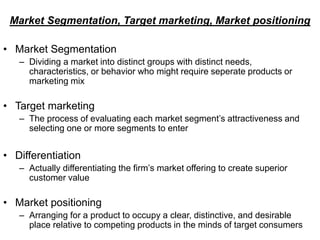
Market Segmentation, Target marketing, Market positioning
• Market Segmentation
– Dividing a market into distinct groups with distinct needs,
characteristics, or behavior who might require seperate products or
marketing mix
• Target marketing
– The process of evaluating each market segment’s attractiveness and
selecting one or more segments to enter
• Differentiation
– Actually differentiating the firm’s market offering to create superior
customer value
• Market positioning
– Arranging for a product to occupy a clear, distinctive, and desirable
place relative to competing products in the minds of target consumers
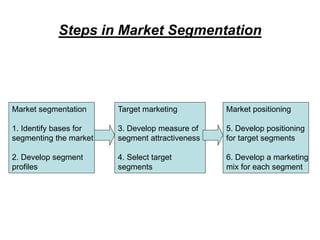
Steps in Market Segmentation
Market segmentation
1. Identify bases for
segmenting the market
2. Develop segment
profiles
Target marketing
3. Develop measure of
segment attractiveness
4. Select target
segments
Market positioning
5. Develop positioning
for target segments
6. Develop a marketing
mix for each segment
Market Segmentation
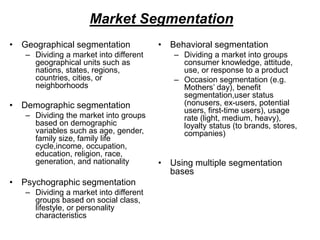
• Geographical segmentation
– Dividing a market into different
geographical units such as
nations, states, regions,
countries, cities, or
neighborhoods
• Demographic segmentation
– Dividing the market into groups
based on demographic
variables such as age, gender,
family size, family life
cycle,income, occupation,
education, religion, race,
generation, and nationality
• Psychographic segmentation
– Dividing a market into different
groups based on social class,
lifestyle, or personality
characteristics
• Behavioral segmentation
– Dividing a market into groups
consumer knowledge, attitude,
use, or response to a product
– Occasion segmentation (e.g.
Mothers’ day), benefit
segmentation,user status
(nonusers, ex-users, potential
users, first-time users), usage
rate (light, medium, heavy),
loyalty status (to brands, stores,
companies)
• Using multiple segmentation
bases
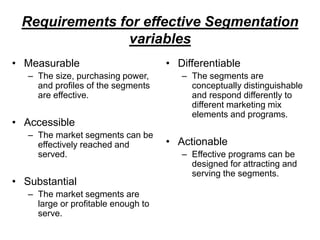
Requirements for effective Segmentation
variables
• Measurable
– The size, purchasing power,
and profiles of the segments
are effective.
• Accessible
– The market segments can be
effectively reached and
served.
• Substantial
– The market segments are
large or profitable enough to
serve.
• Differentiable
– The segments are
conceptually distinguishable
and respond differently to
different marketing mix
elements and programs.
• Actionable
– Effective programs can be
designed for attracting and
serving the segments.
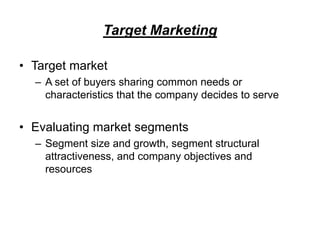
Target Marketing
• Target market
– A set of buyers sharing common needs or
characteristics that the company decides to serve
• Evaluating market segments
– Segment size and growth, segment structural
attractiveness, and company objectives and
resources
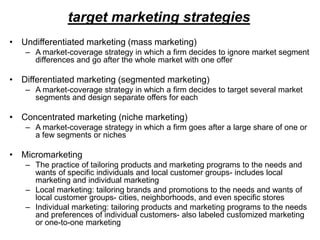
target marketing strategies
• Undifferentiated marketing (mass marketing)
– A market-coverage strategy in which a firm decides to ignore market segment
differences and go after the whole market with one offer
• Differentiated marketing (segmented marketing)
– A market-coverage strategy in which a firm decides to target several market
segments and design separate offers for each
• Concentrated marketing (niche marketing)
– A market-coverage strategy in which a firm goes after a large share of one or
a few segments or niches
• Micromarketing
– The practice of tailoring products and marketing programs to the needs and
wants of specific individuals and local customer groups- includes local
marketing and individual marketing
– Local marketing: tailoring brands and promotions to the needs and wants of
local customer groups- cities, neighborhoods, and even specific stores
– Individual marketing: tailoring products and marketing programs to the needs
and preferences of individual customers- also labeled customized marketing
or one-to-one marketing
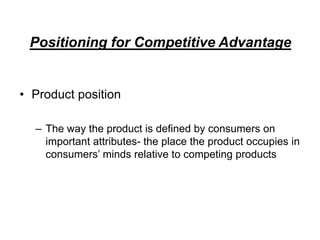
Positioning for Competitive Advantage
• Product position
– The way the product is defined by consumers on
important attributes- the place the product occupies in
consumers’ minds relative to competing products
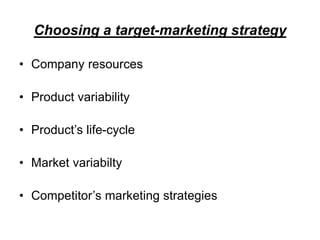
Choosing a target-marketing strategy
• Company resources
• Product variability
• Product’s life-cycle
• Market variabilty
• Competitor’s marketing strategies
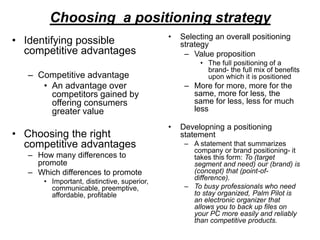
Choosing a positioning strategy
• Identifying possible
competitive advantages
– Competitive advantage
• An advantage over
competitors gained by
offering consumers
greater value
• Choosing the right
competitive advantages
– How many differences to
promote
– Which differences to promote
• Important, distinctive, superior,
communicable, preemptive,
affordable, profitable
• Selecting an overall positioning
strategy
– Value proposition
• The full positioning of a
brand- the full mix of benefits
upon which it is positioned
– More for more, more for the
same, more for less, the
same for less, less for much
less
• Developning a positioning
statement
– A statement that summarizes
company or brand positioning- it
takes this form: To (target
segment and need) our (brand) is
(concept) that (point-of-
difference).
– To busy professionals who need
to stay organized, Palm Pilot is
an electronic organizer that
allows you to back up files on
your PC more easily and reliably
than competitive products.
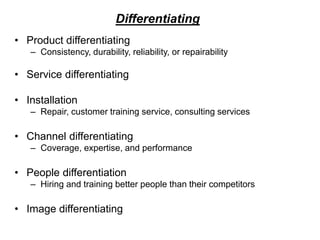
Differentiating
• Product differentiating
– Consistency, durability, reliability, or repairability
• Service differentiating
• Installation
– Repair, customer training service, consulting services
• Channel differentiating
– Coverage, expertise, and performance
• People differentiation
– Hiring and training better people than their competitors
• Image differentiating

segmentation, targeting, and positioning

  • 1.
  • 2.
    Market Segmentation, Targetmarketing, Market positioning • Market Segmentation – Dividing a market into distinct groups with distinct needs, characteristics, or behavior who might require seperate products or marketing mix • Target marketing – The process of evaluating each market segment’s attractiveness and selecting one or more segments to enter • Differentiation – Actually differentiating the firm’s market offering to create superior customer value • Market positioning – Arranging for a product to occupy a clear, distinctive, and desirable place relative to competing products in the minds of target consumers
  • 3.
    Steps in MarketSegmentation Market segmentation 1. Identify bases for segmenting the market 2. Develop segment profiles Target marketing 3. Develop measure of segment attractiveness 4. Select target segments Market positioning 5. Develop positioning for target segments 6. Develop a marketing mix for each segment
  • 4.
    Market Segmentation • Geographicalsegmentation – Dividing a market into different geographical units such as nations, states, regions, countries, cities, or neighborhoods • Demographic segmentation – Dividing the market into groups based on demographic variables such as age, gender, family size, family life cycle,income, occupation, education, religion, race, generation, and nationality • Psychographic segmentation – Dividing a market into different groups based on social class, lifestyle, or personality characteristics • Behavioral segmentation – Dividing a market into groups consumer knowledge, attitude, use, or response to a product – Occasion segmentation (e.g. Mothers’ day), benefit segmentation,user status (nonusers, ex-users, potential users, first-time users), usage rate (light, medium, heavy), loyalty status (to brands, stores, companies) • Using multiple segmentation bases
  • 5.
    Requirements for effectiveSegmentation variables • Measurable – The size, purchasing power, and profiles of the segments are effective. • Accessible – The market segments can be effectively reached and served. • Substantial – The market segments are large or profitable enough to serve. • Differentiable – The segments are conceptually distinguishable and respond differently to different marketing mix elements and programs. • Actionable – Effective programs can be designed for attracting and serving the segments.
  • 6.
    Target Marketing • Targetmarket – A set of buyers sharing common needs or characteristics that the company decides to serve • Evaluating market segments – Segment size and growth, segment structural attractiveness, and company objectives and resources
  • 7.
    target marketing strategies •Undifferentiated marketing (mass marketing) – A market-coverage strategy in which a firm decides to ignore market segment differences and go after the whole market with one offer • Differentiated marketing (segmented marketing) – A market-coverage strategy in which a firm decides to target several market segments and design separate offers for each • Concentrated marketing (niche marketing) – A market-coverage strategy in which a firm goes after a large share of one or a few segments or niches • Micromarketing – The practice of tailoring products and marketing programs to the needs and wants of specific individuals and local customer groups- includes local marketing and individual marketing – Local marketing: tailoring brands and promotions to the needs and wants of local customer groups- cities, neighborhoods, and even specific stores – Individual marketing: tailoring products and marketing programs to the needs and preferences of individual customers- also labeled customized marketing or one-to-one marketing
  • 8.
    Positioning for CompetitiveAdvantage • Product position – The way the product is defined by consumers on important attributes- the place the product occupies in consumers’ minds relative to competing products
  • 9.
    Choosing a target-marketingstrategy • Company resources • Product variability • Product’s life-cycle • Market variabilty • Competitor’s marketing strategies
  • 10.
    Choosing a positioningstrategy • Identifying possible competitive advantages – Competitive advantage • An advantage over competitors gained by offering consumers greater value • Choosing the right competitive advantages – How many differences to promote – Which differences to promote • Important, distinctive, superior, communicable, preemptive, affordable, profitable • Selecting an overall positioning strategy – Value proposition • The full positioning of a brand- the full mix of benefits upon which it is positioned – More for more, more for the same, more for less, the same for less, less for much less • Developning a positioning statement – A statement that summarizes company or brand positioning- it takes this form: To (target segment and need) our (brand) is (concept) that (point-of- difference). – To busy professionals who need to stay organized, Palm Pilot is an electronic organizer that allows you to back up files on your PC more easily and reliably than competitive products.
  • 11.
    Differentiating • Product differentiating –Consistency, durability, reliability, or repairability • Service differentiating • Installation – Repair, customer training service, consulting services • Channel differentiating – Coverage, expertise, and performance • People differentiation – Hiring and training better people than their competitors • Image differentiating