





Dr. Saravanan M. PT (PhD)
10/15/2017 3
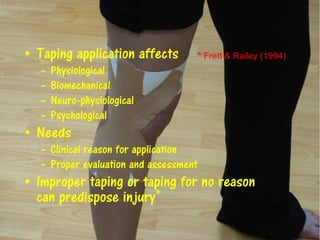
• Taping application affects
– Physiological
– Biomechanical
– Neuro-physiological
– Psychological
• Needs
– Clinical reason for application
– Proper evaluation and assessment
• Improper taping or taping for no reason
can predispose injury*
* Frett & Railey (1994)
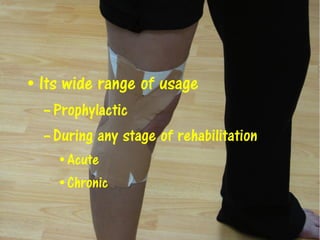
• Its wide range of usage
–Prophylactic
–During any stage of rehabilitation
•Acute
•Chronic
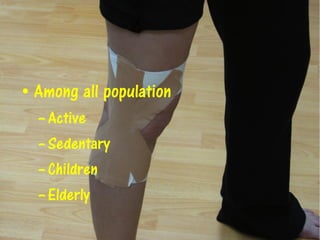
• Among all population
–Active
–Sedentary
–Children
–Elderly
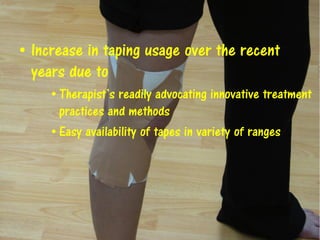
• Increase in taping usage over the recent
years due to
• Therapist’s readily advocating innovative treatment
practices and methods
• Easy availability of tapes in variety of ranges
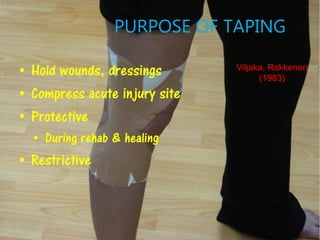
• Hold wounds, dressings
• Compress acute injury site
• Protective
• During rehab & healing
• Restrictive
Viljaka, Rokkenen
(1983)
PURPOSE OF TAPING
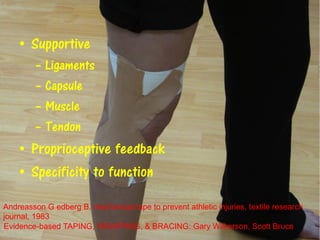
• Supportive
– Ligaments
– Capsule
– Muscle
– Tendon
• Proprioceptive feedback
• Specificity to function
Evidence-based TAPING, WRAPPING, & BRACING: Gary Wilkerson, Scott Bruce
Andreasson G edberg B, mechanical tape to prevent athletic injuries, textile research
journal, 1983
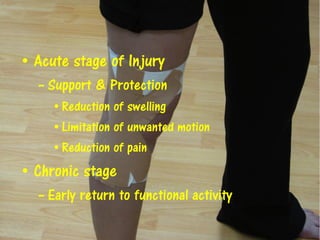
• Acute stage of Injury
– Support & Protection
• Reduction of swelling
• Limitation of unwanted motion
• Reduction of pain
• Chronic stage
– Early return to functional activity
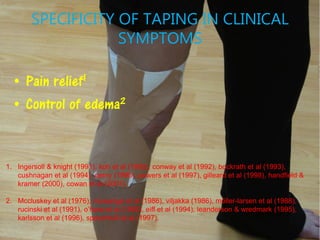
SPECIFICITY OF TAPING IN CLINICAL
SYMPTOMS
• Pain relief1
• Control of edema2
1. Ingersoll & knight (1991), koh et al (1992), conway et al (1992), bockrath et al (1993),
cushnagan et al (1994), cerny (1995), powers et al (1997), gilleard et al (1998), handfield &
kramer (2000), cowan et al (2001).
2. Mccluskey et al (1976), muwanga et al (1986), viljakka (1986), möller-larsen et al (1988),
rucinski et al (1991), o’hara et al (1992), eiff et al (1994), leanderson & wredmark (1995),
karlsson et al (1996), specchiulli et al (1997).
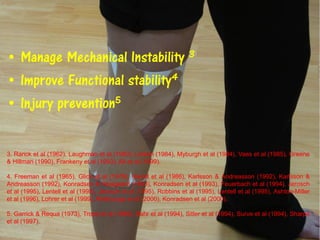
• Manage Mechanical Instability 3
• Improve Functional stability4
• Injury prevention5
3. Rarick et al (1962), Laughman et al (1980), Larsen (1984), Myburgh et al (1984), Vaes et al (1985), Greene
& Hillman (1990), Frankeny et al (1993), Alt et al (1999).
4. Freeman et al (1965), Glick et al (1976), Hamill et al (1986), Karlsson & Andreasson (1992), Karlsson &
Andreasson (1992), Konradsen & Hojsgaard (1993), Konradsen et al (1993), Feuerbach et al (1994), Jerosch
et al (1995), Lentell et al (1995), Jerosch et al (1995), Robbins et al (1995), Lentell et al (1995), Ashton-Miller
et al (1996), Lohrer et al (1999), Refshauge et al (2000), Konradsen et al (2000).
5. Garrick & Requa (1973), Tropp et al (1985), Bahr et al (1994), Sitler et al (1994), Surve et al (1994), Sharpe
et al (1997).
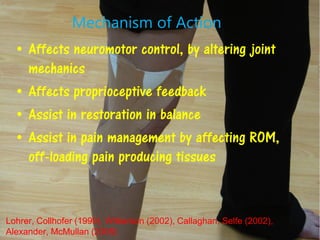
• Affects neuromotor control, by altering joint
mechanics
• Affects proprioceptive feedback
• Assist in restoration in balance
• Assist in pain management by affecting ROM,
off-loading pain producing tissues
Lohrer, Collhofer (1999), Wilkerson (2002), Callaghan, Selfe (2002),
Alexander, McMullan (2008)
Mechanism of Action
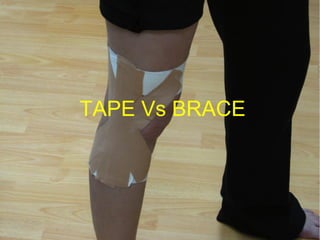
TAPE Vs BRACE
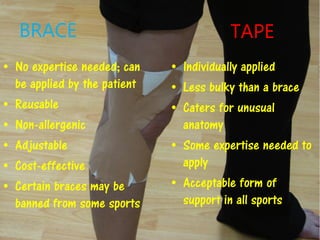
BRACE
• No expertise needed; can
be applied by the patient
• Reusable
• Non-allergenic
• Adjustable
• Cost-effective
• Certain braces may be
banned from some sports
• Individually applied
• Less bulky than a brace
• Caters for unusual
anatomy
• Some expertise needed to
apply
• Acceptable form of
support in all sports
TAPE
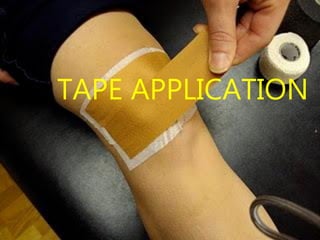
TAPE APPLICATION
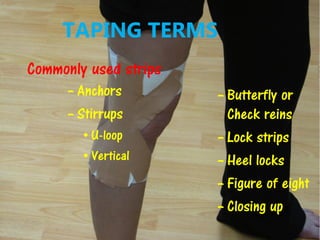
TAPING TERMS
– Anchors
– Stirrups
• U-loop
• Vertical
– Butterfly or
Check reins
– Lock strips
– Heel locks
– Figure of eight
– Closing up
Commonly used strips
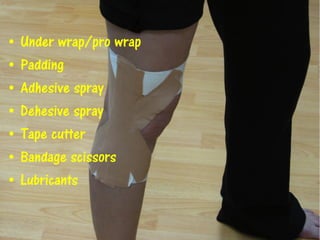
• Under wrap/pro wrap
• Padding
• Adhesive spray
• Dehesive spray
• Tape cutter
• Bandage scissors
• Lubricants
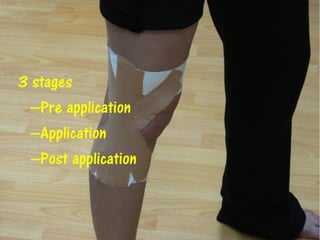
3 stages
–Pre application
–Application
–Post application
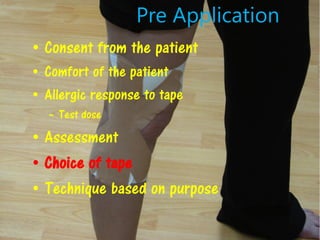
• Consent from the patient
• Comfort of the patient
• Allergic response to tape
– Test dose
• Assessment
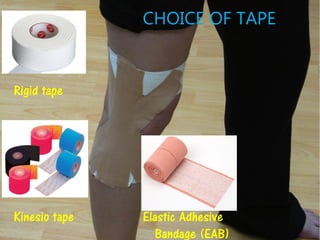
• Choice of tape
• Technique based on purpose
Pre Application
Elastic Adhesive
Bandage (EAB)
Rigid tape
Kinesio tape
CHOICE OF TAPE
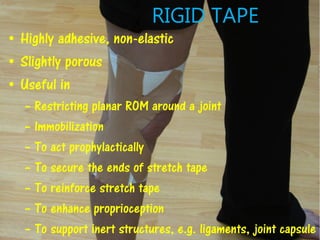
RIGID TAPE
• Highly adhesive, non-elastic
• Slightly porous
• Useful in
– Restricting planar ROM around a joint
– Immobilization
– To act prophylactically
– To secure the ends of stretch tape
– To reinforce stretch tape
– To enhance proprioception
– To support inert structures, e.g. ligaments, joint capsule
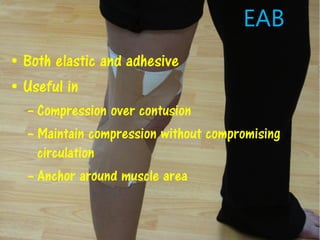
EAB
• Both elastic and adhesive
• Useful in
– Compression over contusion
– Maintain compression without compromising
circulation
– Anchor around muscle area
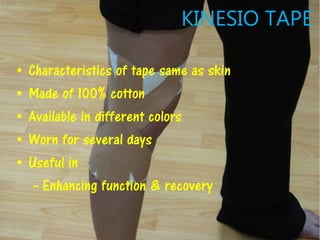
KINESIO TAPE
• Characteristics of tape same as skin
• Made of 100% cotton
• Available in different colors
• Worn for several days
• Useful in
– Enhancing function & recovery
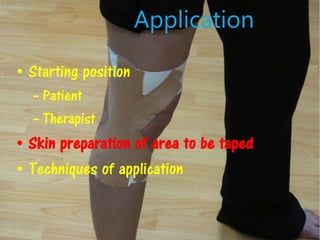
• Starting position
– Patient
– Therapist
• Skin preparation of area to be taped
• Techniques of application
Application
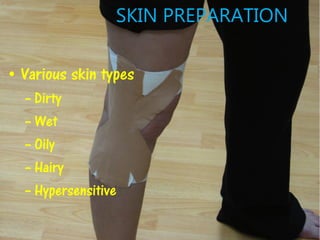
SKIN PREPARATION
• Various skin types
– Dirty
– Wet
– Oily
– Hairy
– Hypersensitive
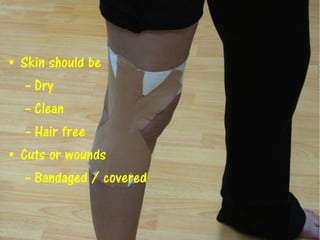
• Skin should be
– Dry
– Clean
– Hair free
• Cuts or wounds
– Bandaged / covered
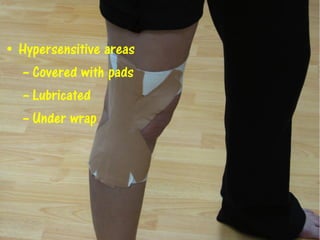
• Hypersensitive areas
– Covered with pads
– Lubricated
– Under wrap
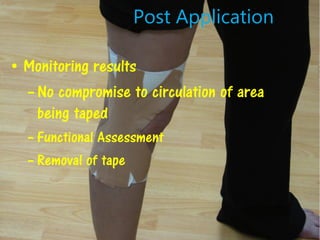
• Monitoring results
–No compromise to circulation of area
being taped
– Functional Assessment
– Removal of tape
Post Application
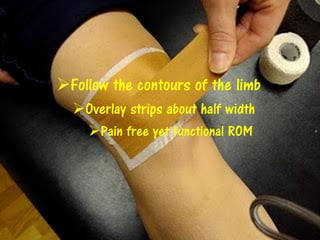
Follow the contours of the limb
Overlay strips about half width
Pain free yet functional ROM
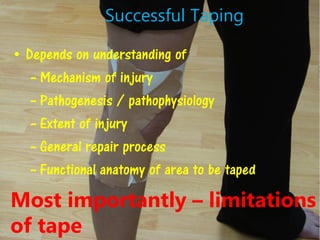
Successful Taping
• Depends on understanding of
– Mechanism of injury
– Pathogenesis / pathophysiology
– Extent of injury
– General repair process
– Functional anatomy of area to be taped
Most importantly – limitations
of tape
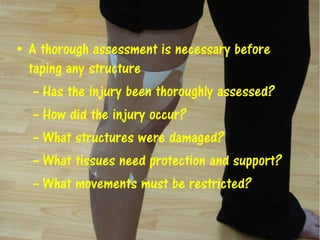
• A thorough assessment is necessary before
taping any structure
– Has the injury been thoroughly assessed?
– How did the injury occur?
– What structures were damaged?
– What tissues need protection and support?
– What movements must be restricted?
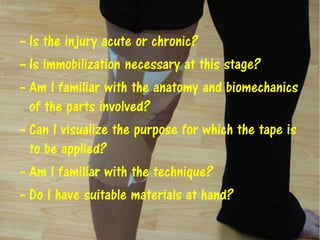
– Is the injury acute or chronic?
– Is immobilization necessary at this stage?
– Am I familiar with the anatomy and biomechanics
of the parts involved?
– Can I visualize the purpose for which the tape is
to be applied?
– Am I familiar with the technique?
– Do I have suitable materials at hand?
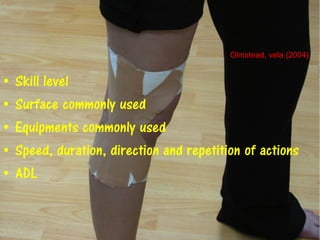
• Skill level
• Surface commonly used
• Equipments commonly used
• Speed, duration, direction and repetition of actions
• ADL
Olmstead, vela (2004)
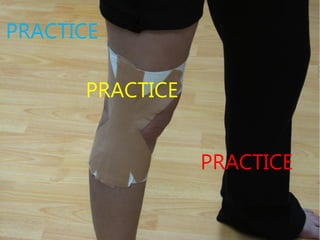
PRACTICE
PRACTICE
PRACTICE
QUESTIONS

Taping techniques-The basics

  • 1.
  • 3.
  • 4.
    • Taping applicationaffects – Physiological – Biomechanical – Neuro-physiological – Psychological • Needs – Clinical reason for application – Proper evaluation and assessment • Improper taping or taping for no reason can predispose injury* * Frett & Railey (1994)
  • 6.
    • Its widerange of usage –Prophylactic –During any stage of rehabilitation •Acute •Chronic
  • 7.
    • Among allpopulation –Active –Sedentary –Children –Elderly
  • 8.
    • Increase intaping usage over the recent years due to • Therapist’s readily advocating innovative treatment practices and methods • Easy availability of tapes in variety of ranges
  • 9.
    • Hold wounds,dressings • Compress acute injury site • Protective • During rehab & healing • Restrictive Viljaka, Rokkenen (1983) PURPOSE OF TAPING
  • 10.
    • Supportive – Ligaments –Capsule – Muscle – Tendon • Proprioceptive feedback • Specificity to function Evidence-based TAPING, WRAPPING, & BRACING: Gary Wilkerson, Scott Bruce Andreasson G edberg B, mechanical tape to prevent athletic injuries, textile research journal, 1983
  • 11.
    • Acute stageof Injury – Support & Protection • Reduction of swelling • Limitation of unwanted motion • Reduction of pain • Chronic stage – Early return to functional activity
  • 12.
    SPECIFICITY OF TAPINGIN CLINICAL SYMPTOMS • Pain relief1 • Control of edema2 1. Ingersoll & knight (1991), koh et al (1992), conway et al (1992), bockrath et al (1993), cushnagan et al (1994), cerny (1995), powers et al (1997), gilleard et al (1998), handfield & kramer (2000), cowan et al (2001). 2. Mccluskey et al (1976), muwanga et al (1986), viljakka (1986), möller-larsen et al (1988), rucinski et al (1991), o’hara et al (1992), eiff et al (1994), leanderson & wredmark (1995), karlsson et al (1996), specchiulli et al (1997).
  • 13.
    • Manage MechanicalInstability 3 • Improve Functional stability4 • Injury prevention5 3. Rarick et al (1962), Laughman et al (1980), Larsen (1984), Myburgh et al (1984), Vaes et al (1985), Greene & Hillman (1990), Frankeny et al (1993), Alt et al (1999). 4. Freeman et al (1965), Glick et al (1976), Hamill et al (1986), Karlsson & Andreasson (1992), Karlsson & Andreasson (1992), Konradsen & Hojsgaard (1993), Konradsen et al (1993), Feuerbach et al (1994), Jerosch et al (1995), Lentell et al (1995), Jerosch et al (1995), Robbins et al (1995), Lentell et al (1995), Ashton-Miller et al (1996), Lohrer et al (1999), Refshauge et al (2000), Konradsen et al (2000). 5. Garrick & Requa (1973), Tropp et al (1985), Bahr et al (1994), Sitler et al (1994), Surve et al (1994), Sharpe et al (1997).
  • 14.
    • Affects neuromotorcontrol, by altering joint mechanics • Affects proprioceptive feedback • Assist in restoration in balance • Assist in pain management by affecting ROM, off-loading pain producing tissues Lohrer, Collhofer (1999), Wilkerson (2002), Callaghan, Selfe (2002), Alexander, McMullan (2008) Mechanism of Action
  • 15.
  • 16.
    BRACE • No expertiseneeded; can be applied by the patient • Reusable • Non-allergenic • Adjustable • Cost-effective • Certain braces may be banned from some sports • Individually applied • Less bulky than a brace • Caters for unusual anatomy • Some expertise needed to apply • Acceptable form of support in all sports TAPE
  • 17.
  • 18.
    TAPING TERMS – Anchors –Stirrups • U-loop • Vertical – Butterfly or Check reins – Lock strips – Heel locks – Figure of eight – Closing up Commonly used strips
  • 19.
    • Under wrap/prowrap • Padding • Adhesive spray • Dehesive spray • Tape cutter • Bandage scissors • Lubricants
  • 20.
  • 21.
    • Consent fromthe patient • Comfort of the patient • Allergic response to tape – Test dose • Assessment • Choice of tape • Technique based on purpose Pre Application
  • 22.
    Elastic Adhesive Bandage (EAB) Rigidtape Kinesio tape CHOICE OF TAPE
  • 23.
    RIGID TAPE • Highlyadhesive, non-elastic • Slightly porous • Useful in – Restricting planar ROM around a joint – Immobilization – To act prophylactically – To secure the ends of stretch tape – To reinforce stretch tape – To enhance proprioception – To support inert structures, e.g. ligaments, joint capsule
  • 24.
    EAB • Both elasticand adhesive • Useful in – Compression over contusion – Maintain compression without compromising circulation – Anchor around muscle area
  • 25.
    KINESIO TAPE • Characteristicsof tape same as skin • Made of 100% cotton • Available in different colors • Worn for several days • Useful in – Enhancing function & recovery
  • 26.
    • Starting position –Patient – Therapist • Skin preparation of area to be taped • Techniques of application Application
  • 27.
    SKIN PREPARATION • Variousskin types – Dirty – Wet – Oily – Hairy – Hypersensitive
  • 28.
    • Skin shouldbe – Dry – Clean – Hair free • Cuts or wounds – Bandaged / covered
  • 30.
    • Hypersensitive areas –Covered with pads – Lubricated – Under wrap
  • 31.
    • Monitoring results –Nocompromise to circulation of area being taped – Functional Assessment – Removal of tape Post Application
  • 33.
    Follow the contoursof the limb Overlay strips about half width Pain free yet functional ROM
  • 34.
    Successful Taping • Dependson understanding of – Mechanism of injury – Pathogenesis / pathophysiology – Extent of injury – General repair process – Functional anatomy of area to be taped Most importantly – limitations of tape
  • 35.
    • A thoroughassessment is necessary before taping any structure – Has the injury been thoroughly assessed? – How did the injury occur? – What structures were damaged? – What tissues need protection and support? – What movements must be restricted?
  • 36.
    – Is theinjury acute or chronic? – Is immobilization necessary at this stage? – Am I familiar with the anatomy and biomechanics of the parts involved? – Can I visualize the purpose for which the tape is to be applied? – Am I familiar with the technique? – Do I have suitable materials at hand?
  • 37.
    • Skill level •Surface commonly used • Equipments commonly used • Speed, duration, direction and repetition of actions • ADL Olmstead, vela (2004)
  • 38.
  • 40.