Neurodynamics-II
The Assessment
Radhika Chintamani
CONTENTS
Neurodynamics in brief
Systems involved in neurodynamics
Assessment of Mechanical interface
Diagnostic neurodynamic
Levels of neurodynamic examination
Types of neurodynamic dysfunctions
MECHANICAL INTERFACE DYSFUNCTION
General Mechanical interface dysfunction
Aches and pains more prominent than dysaesthetic sysmptoms
Occur in the distribution of the related musculoskeletal
structures +/- neural structures
Provoked by movements of the interface that are related to the
specific dysfunction eg: opening/closing
Inflammatory or degenerative component is common
History of disease process, trauma or habitual irritating
movement in interface
Physical examination includes
Interface finding more prominent than neural findings,
includes;
a. Soft tissue palpation: for temperature, tenderness, trigger
points, spasm
b. Cuts, wounds and scars
c. Fibrosis
d. Muscle Tightness
e. Ligament injury
f. Capsule adherence or injury
g. Bursal irritation
Neurodynamic tests often reveal covert abnormal findings
includes;
a. ULTT for: radial, median and ulnar nerves
b. LLTT for: femoral, sciatic, common peroneal, obturator, tibial
and sural nerves.
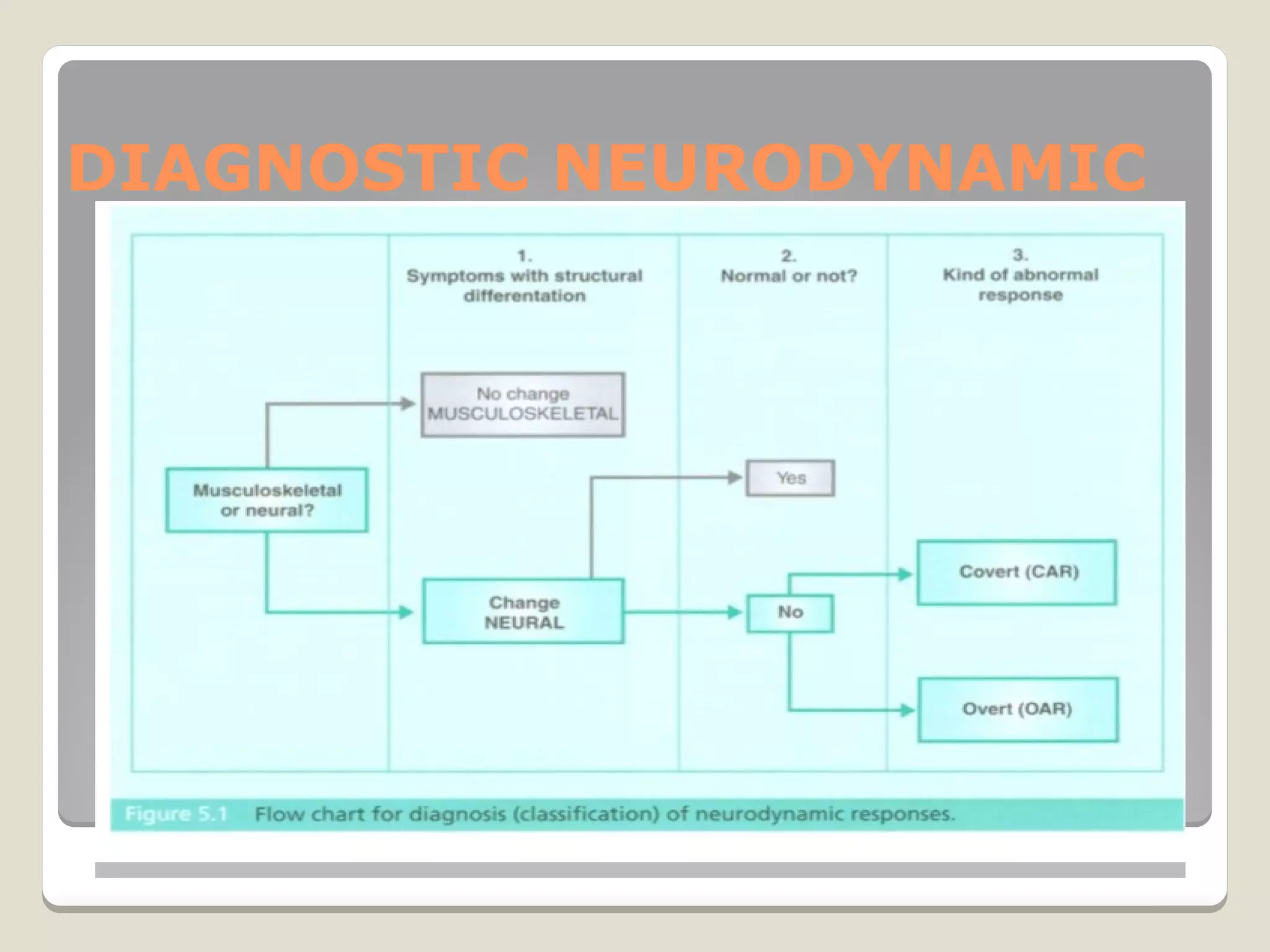
DIAGNOSTIC NEURODYNAMIC
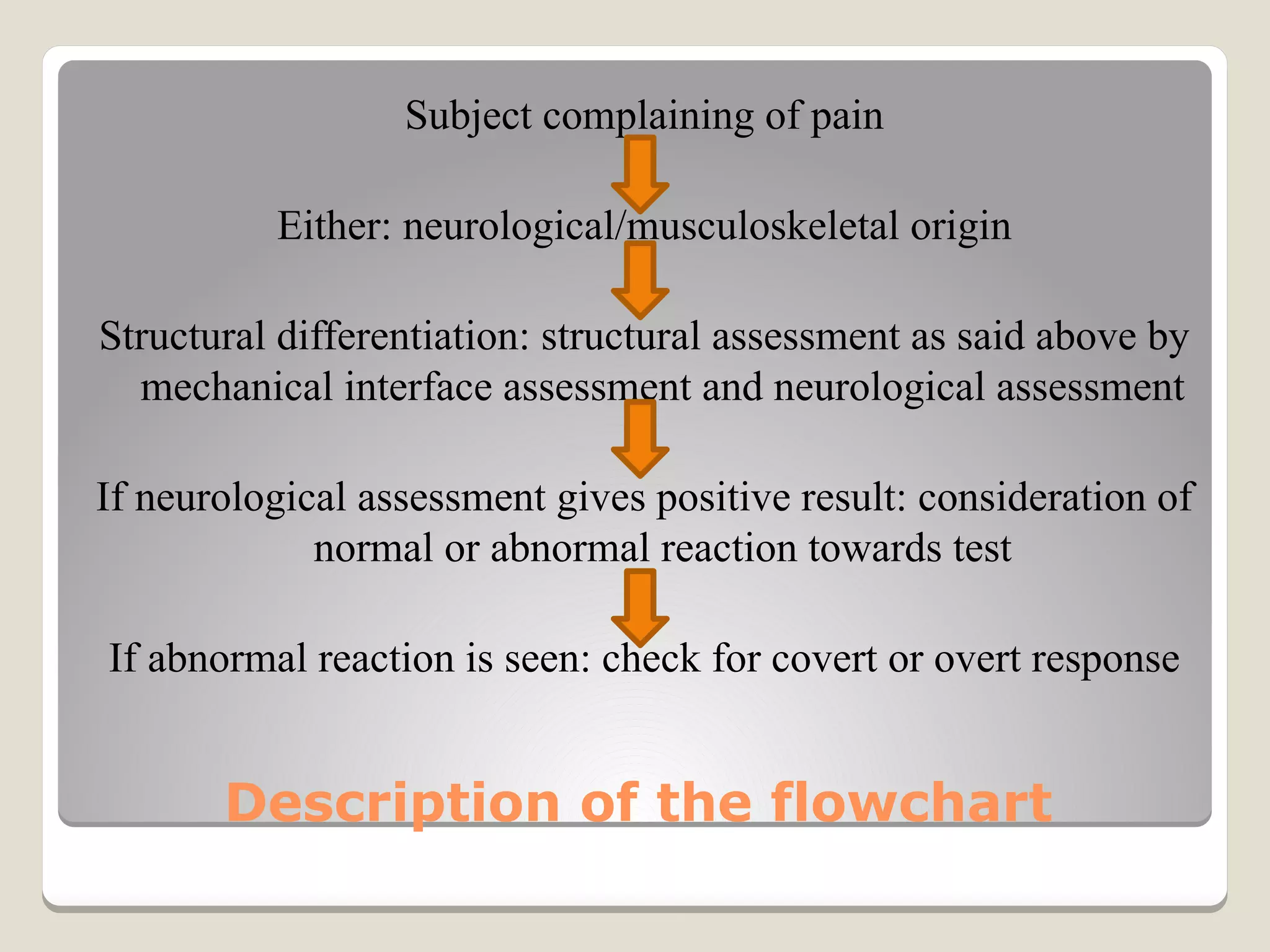
Description of the flowchart
Subject complaining of pain
Either: neurological/musculoskeletal origin
Structural differentiation: structural assessment as said above by
mechanical interface assessment and neurological assessment
If neurological assessment gives positive result: consideration of
normal or abnormal reaction towards test
If abnormal reaction is seen: check for covert or overt response
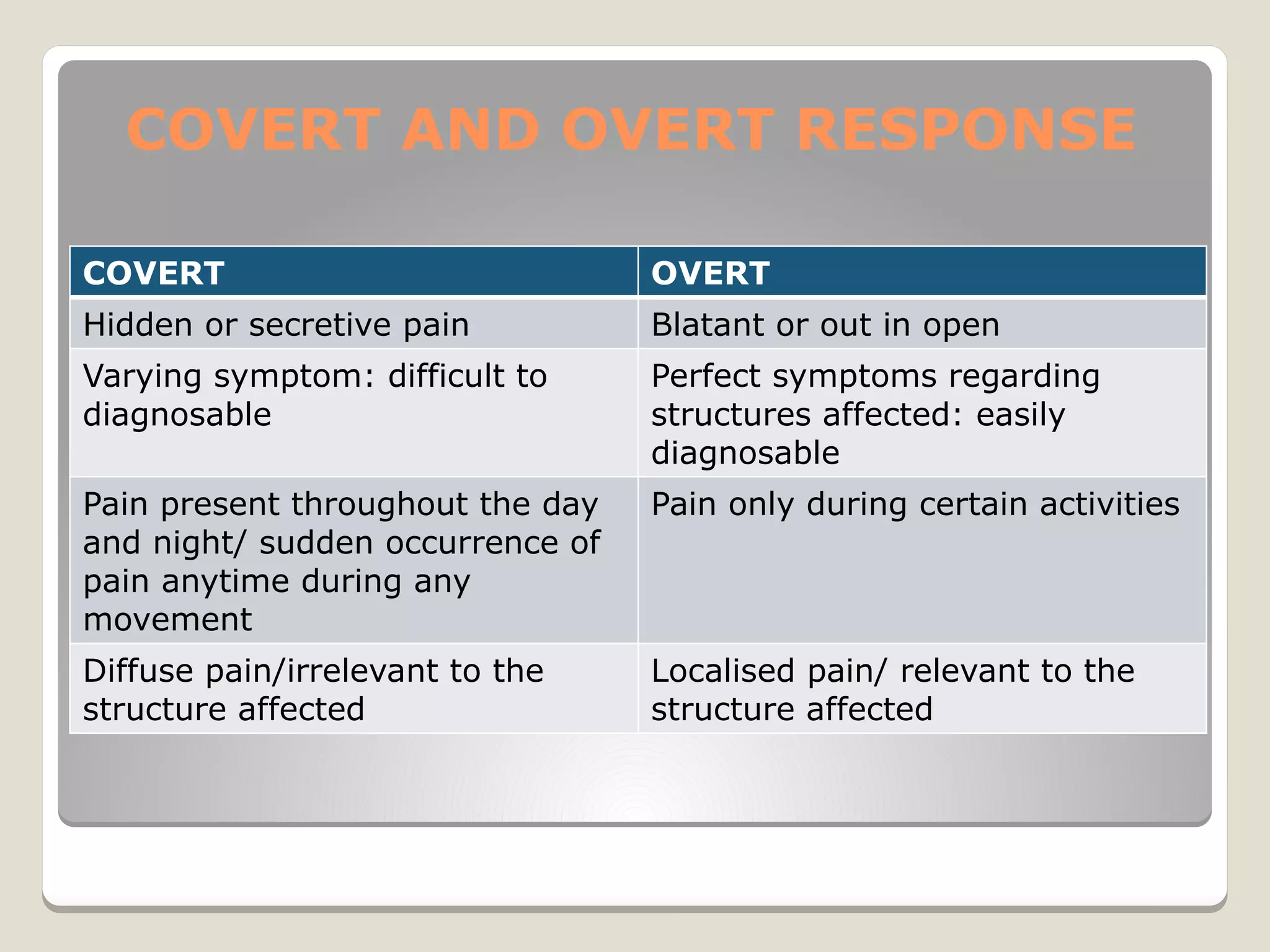
COVERT AND OVERT RESPONSE
COVERT OVERT
Hidden or secretive pain Blatant or out in open
Varying symptom: difficult to
diagnosable
Perfect symptoms regarding
structures affected: easily
diagnosable
Pain present throughout the day
and night/ sudden occurrence of
pain anytime during any
movement
Pain only during certain activities
Diffuse pain/irrelevant to the
structure affected
Localised pain/ relevant to the
structure affected
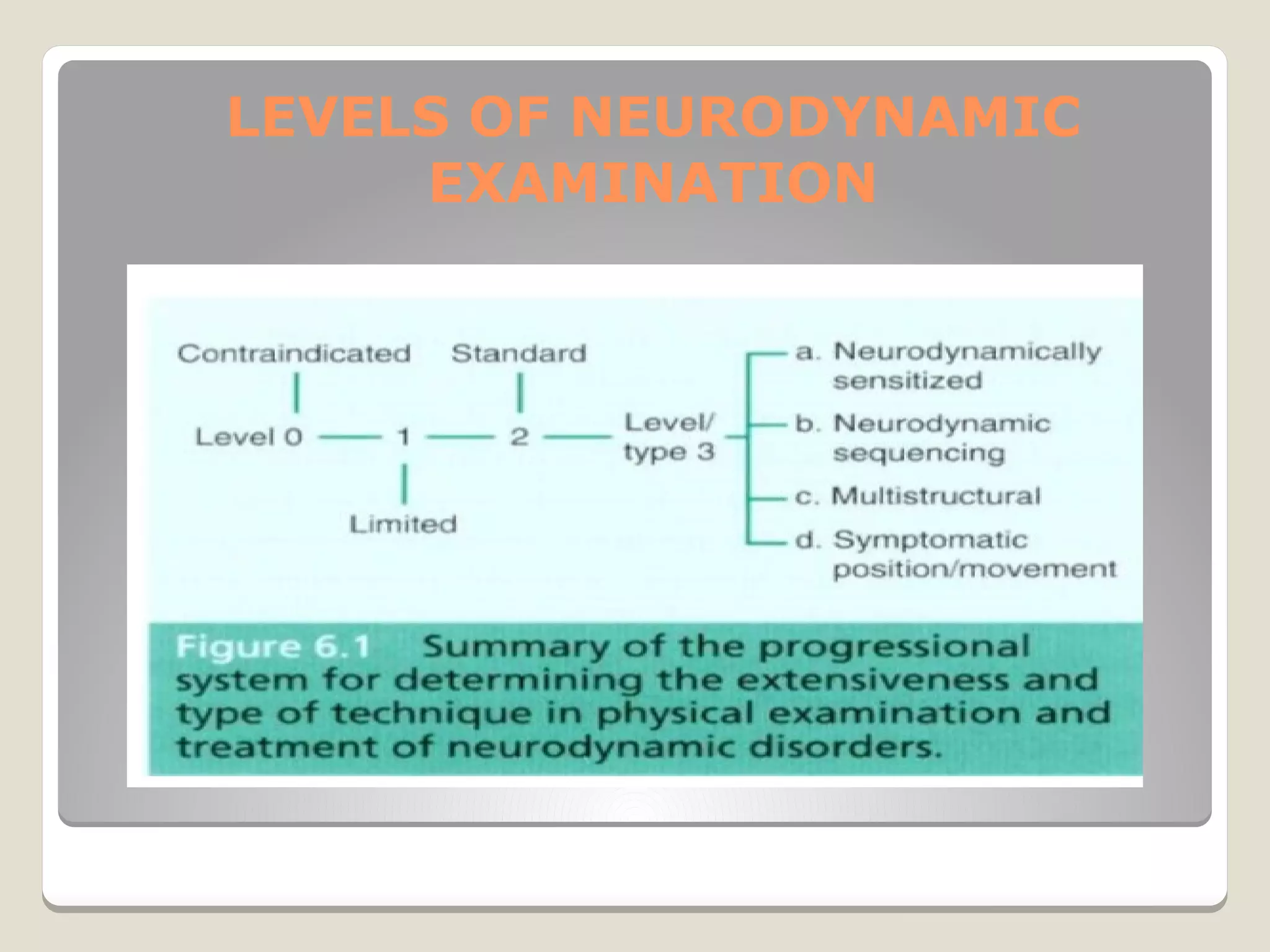
LEVELS OF NEURODYNAMIC
EXAMINATION
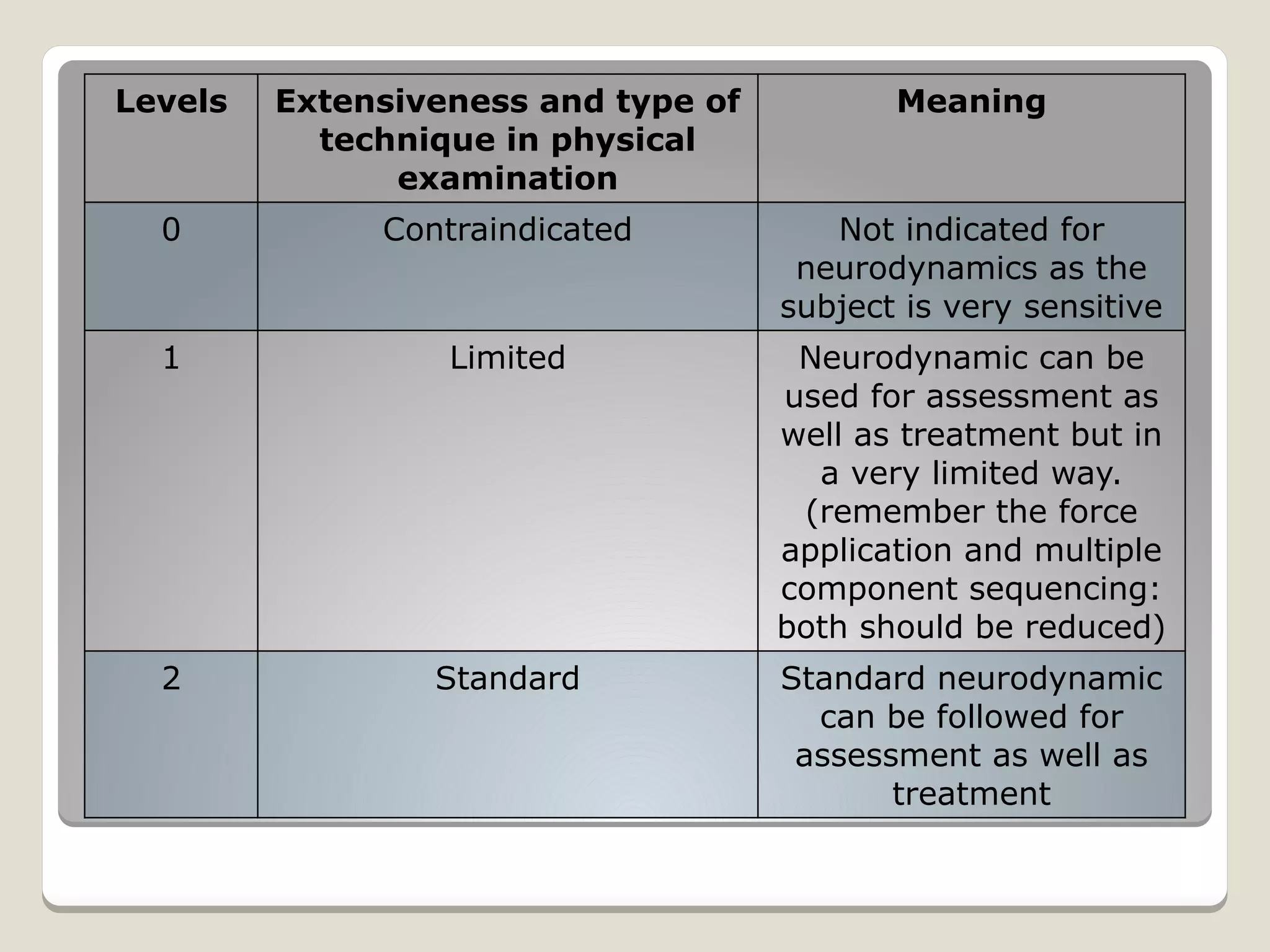
Levels Extensiveness and type of
technique in physical
examination
Meaning
0 Contraindicated Not indicated for
neurodynamics as the
subject is very sensitive
1 Limited Neurodynamic can be
used for assessment as
well as treatment but in
a very limited way.
(remember the force
application and multiple
component sequencing:
both should be reduced)
2 Standard Standard neurodynamic
can be followed for
assessment as well as
treatment
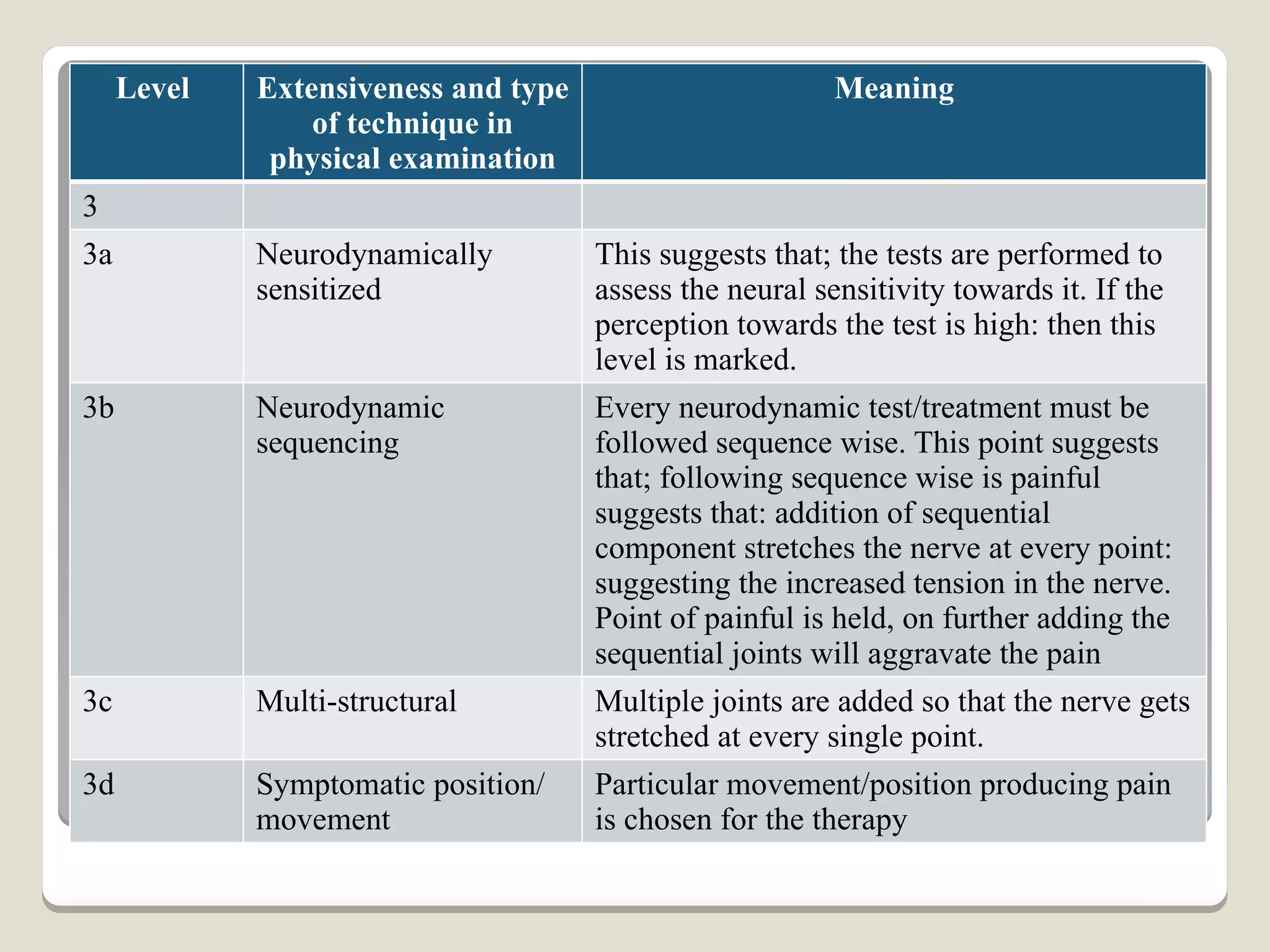
Level Extensiveness and type
of technique in
physical examination
Meaning
3
3a Neurodynamically
sensitized
This suggests that; the tests are performed to
assess the neural sensitivity towards it. If the
perception towards the test is high: then this
level is marked.
3b Neurodynamic
sequencing
Every neurodynamic test/treatment must be
followed sequence wise. This point suggests
that; following sequence wise is painful
suggests that: addition of sequential
component stretches the nerve at every point:
suggesting the increased tension in the nerve.
Point of painful is held, on further adding the
sequential joints will aggravate the pain
3c Multi-structural Multiple joints are added so that the nerve gets
stretched at every single point.
3d Symptomatic position/
movement
Particular movement/position producing pain
is chosen for the therapy
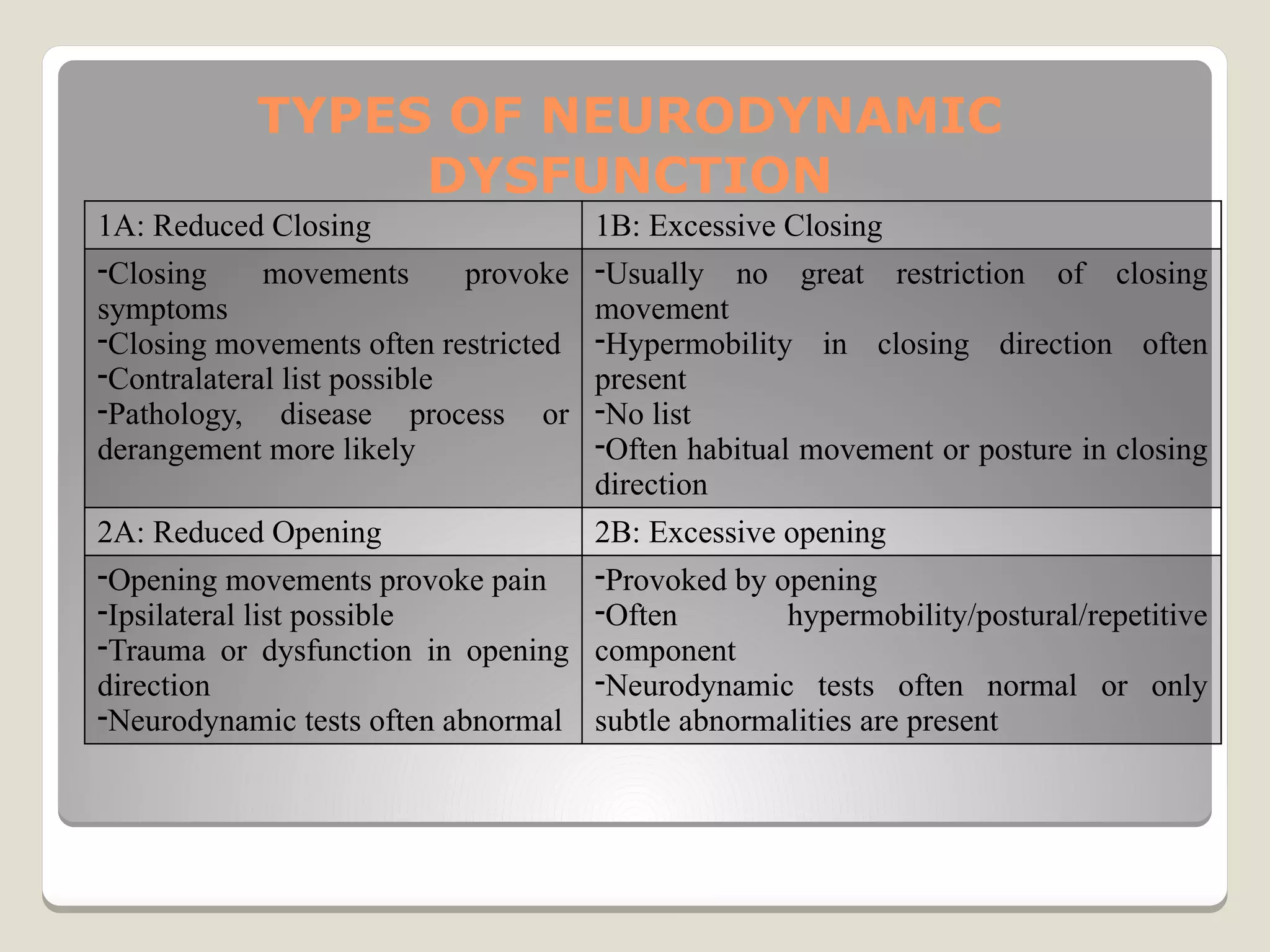
TYPES OF NEURODYNAMIC
DYSFUNCTION
1A: Reduced Closing 1B: Excessive Closing
-Closing movements provoke
symptoms
-Closing movements often restricted
-Contralateral list possible
-Pathology, disease process or
derangement more likely
-Usually no great restriction of closing
movement
-Hypermobility in closing direction often
present
-No list
-Often habitual movement or posture in closing
direction
2A: Reduced Opening 2B: Excessive opening
-Opening movements provoke pain
-Ipsilateral list possible
-Trauma or dysfunction in opening
direction
-Neurodynamic tests often abnormal
-Provoked by opening
-Often hypermobility/postural/repetitive
component
-Neurodynamic tests often normal or only
subtle abnormalities are present
THANK YOU

Neurodynamics-II

  • 1.
  • 2.
    CONTENTS Neurodynamics in brief Systemsinvolved in neurodynamics Assessment of Mechanical interface Diagnostic neurodynamic Levels of neurodynamic examination Types of neurodynamic dysfunctions
  • 3.
    MECHANICAL INTERFACE DYSFUNCTION GeneralMechanical interface dysfunction Aches and pains more prominent than dysaesthetic sysmptoms Occur in the distribution of the related musculoskeletal structures +/- neural structures Provoked by movements of the interface that are related to the specific dysfunction eg: opening/closing
  • 4.
    Inflammatory or degenerativecomponent is common History of disease process, trauma or habitual irritating movement in interface
  • 5.
    Physical examination includes Interfacefinding more prominent than neural findings, includes; a. Soft tissue palpation: for temperature, tenderness, trigger points, spasm b. Cuts, wounds and scars c. Fibrosis
  • 6.
    d. Muscle Tightness e.Ligament injury f. Capsule adherence or injury g. Bursal irritation Neurodynamic tests often reveal covert abnormal findings includes; a. ULTT for: radial, median and ulnar nerves b. LLTT for: femoral, sciatic, common peroneal, obturator, tibial and sural nerves.
  • 7.
  • 8.
    Description of theflowchart Subject complaining of pain Either: neurological/musculoskeletal origin Structural differentiation: structural assessment as said above by mechanical interface assessment and neurological assessment If neurological assessment gives positive result: consideration of normal or abnormal reaction towards test If abnormal reaction is seen: check for covert or overt response
  • 9.
    COVERT AND OVERTRESPONSE COVERT OVERT Hidden or secretive pain Blatant or out in open Varying symptom: difficult to diagnosable Perfect symptoms regarding structures affected: easily diagnosable Pain present throughout the day and night/ sudden occurrence of pain anytime during any movement Pain only during certain activities Diffuse pain/irrelevant to the structure affected Localised pain/ relevant to the structure affected
  • 10.
  • 11.
    Levels Extensiveness andtype of technique in physical examination Meaning 0 Contraindicated Not indicated for neurodynamics as the subject is very sensitive 1 Limited Neurodynamic can be used for assessment as well as treatment but in a very limited way. (remember the force application and multiple component sequencing: both should be reduced) 2 Standard Standard neurodynamic can be followed for assessment as well as treatment
  • 12.
    Level Extensiveness andtype of technique in physical examination Meaning 3 3a Neurodynamically sensitized This suggests that; the tests are performed to assess the neural sensitivity towards it. If the perception towards the test is high: then this level is marked. 3b Neurodynamic sequencing Every neurodynamic test/treatment must be followed sequence wise. This point suggests that; following sequence wise is painful suggests that: addition of sequential component stretches the nerve at every point: suggesting the increased tension in the nerve. Point of painful is held, on further adding the sequential joints will aggravate the pain 3c Multi-structural Multiple joints are added so that the nerve gets stretched at every single point. 3d Symptomatic position/ movement Particular movement/position producing pain is chosen for the therapy
  • 13.
    TYPES OF NEURODYNAMIC DYSFUNCTION 1A:Reduced Closing 1B: Excessive Closing -Closing movements provoke symptoms -Closing movements often restricted -Contralateral list possible -Pathology, disease process or derangement more likely -Usually no great restriction of closing movement -Hypermobility in closing direction often present -No list -Often habitual movement or posture in closing direction 2A: Reduced Opening 2B: Excessive opening -Opening movements provoke pain -Ipsilateral list possible -Trauma or dysfunction in opening direction -Neurodynamic tests often abnormal -Provoked by opening -Often hypermobility/postural/repetitive component -Neurodynamic tests often normal or only subtle abnormalities are present
  • 14.