Tannins
Muhammad Tanveer Khan
Introduction
The term tannin was first time coined by Seguin in 1796. This
term was used to denote substances present in plant extract
which react with protein of animal hide, prevent their
putrefaction and convert hide and skin into leather.
Definition
“Complex substances that usually occur as mixtures of
polyphenols that are very difficult to separate since they don't
crystallize, are called tannins.”
OR
“Tannins are polyhydroxy phenolic compounds.”
Physical Properties
Color:
Dark brown or reddish brown
Taste:
Puckering taste
State:
Non-crystalline
Solubility:
Soluble in water, alcohol, dilute alkalis, glycerols and acetone.
Chemical properties
(i) Precipitation
(ii) Anti-oxidizing properties
(iii) Astringent
(iv) Carcinogenicity
(v) Reaction with salts
(vi) Reaction with potassium ferricyanide and ammonia
(i) Precipitation
Tannins have ability to precipitate solutions of;
Gelatin
Alkaloids
Glycosides
Heavy metals
Proteins
(ii) Anti-oxidizing properties
Because of accumulation of OH group on small size nucleus,
these agents have anti-oxidant nature.
(iii) Astringent
Tannins have property to react with protein of mucous membrane
and cause precipitation.
(iv) Carcinogenicity
Prolong use of tannin containing plant material is hazardous
because it causes cancer. Habitual use of Areca catechu can
cause oral and esophageal cancer.
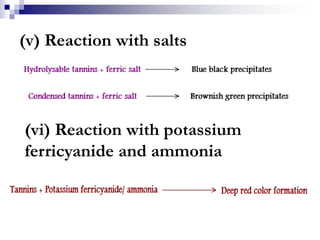
(v) Reaction with salts
(vi) Reaction with potassium
ferricyanide and ammonia
Importance of tannins
Medicinal Uses:
Antidote
Antiseptic
Algicidals
Astringents
Anti-carcinogenic
Industrial Uses:
Ink manufacture
Vegetable tanning
Preservatives
Biological Activities:
Inhibition of lipid per oxidation
Decrease in blood urea nitrogen
content
Inhibition of plasmin
Lipolysis in fat cells
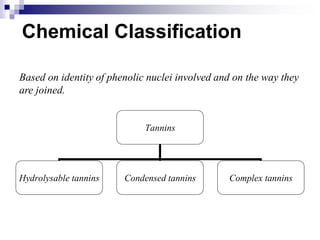
Chemical Classification
Based on identity of phenolic nuclei involved and on the way they
are joined.
Tannins
Hydrolysable tannins Condensed tannins Complex tannins
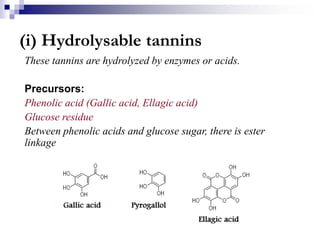
(i) Hydrolysable tannins
These tannins are hydrolyzed by enzymes or acids.
Precursors:
Phenolic acid (Gallic acid, Ellagic acid)
Glucose residue
Between phenolic acids and glucose sugar, there is ester
linkage
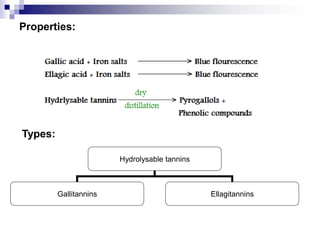
Properties:
Types:
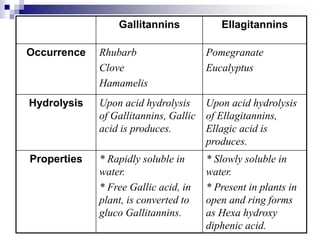
Hydrolysable tannins
Gallitannins Ellagitannins
Ellagitannins
Gallitannins
Pomegranate
Eucalyptus
Rhubarb
Clove
Hamamelis
Occurrence
Upon acid hydrolysis
of Ellagitannins,
Ellagic acid is
produces.
Upon acid hydrolysis
of Gallitannins, Gallic
acid is produces.
Hydrolysis
* Slowly soluble in
water.
* Present in plants in
open and ring forms
as Hexa hydroxy
diphenic acid.
* Rapidly soluble in
water.
* Free Gallic acid, in
plant, is converted to
gluco Gallitannins.
Properties
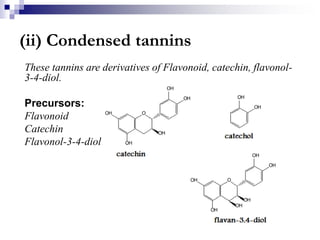
(ii) Condensed tannins
These tannins are derivatives of Flavonoid, catechin, flavonol-
3-4-diol.
Precursors:
Flavonoid
Catechin
Flavonol-3-4-diol
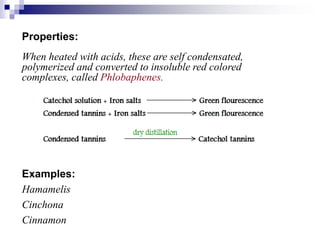
Properties:
Examples:
Hamamelis
Cinchona
Cinnamon
When heated with acids, these are self condensated,
polymerized and converted to insoluble red colored
complexes, called Phlobaphenes.
(iii) Complex tannins
These tannins are mixtures of both, hydrolysable and condensed
tannins
Examples:
Tea
Quercus
Castanea
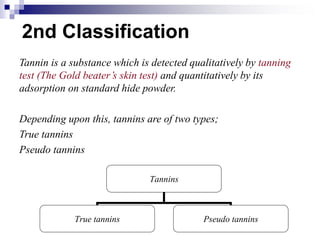
2nd Classification
Tannin is a substance which is detected qualitatively by tanning
test (The Gold beater’s skin test) and quantitatively by its
adsorption on standard hide powder.
Depending upon this, tannins are of two types;
True tannins
Pseudo tannins
Tannins
True tannins Pseudo tannins
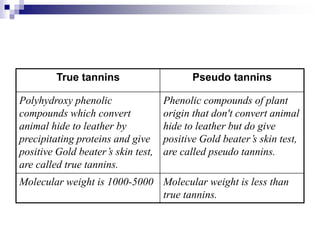
Pseudo tannins
True tannins
Phenolic compounds of plant
origin that don't convert animal
hide to leather but do give
positive Gold beater’s skin test,
are called pseudo tannins.
Polyhydroxy phenolic
compounds which convert
animal hide to leather by
precipitating proteins and give
positive Gold beater’s skin test,
are called true tannins.
Molecular weight is less than
true tannins.
Molecular weight is 1000-5000
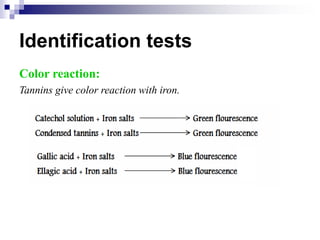
Identification tests
Color reaction:
Tannins give color reaction with iron.
Identification tests
Matchstick test:
Dip matchstick in plant extract.
Dry it.
Moisten it with hydrochloric acid. And warm near flame.
Wood will turn pink or red in color due to phloroglucinol.
Gelatin test:
Solution of tannin (0.5%-1%) precipitates 1% solution of gelatin
containing 10% sodium chloride.
Identification tests
Phenazone test:
Take 5ml of aqueous extract of drug.
Add 0.5grams of sodium acid phosphate.
Warm it and cool.
Filter solution.
To the filtrate, add 2%solution of Phenazone.
Tannins will be precipitated.
Precipitates will be bulky and colored.
Identification tests
Gold beater’s skin test:
Gold beater’s skin is a membrane prepared from intestine of Ox
and I behaves similarly to un tanned skin.
Soak a small piece of Gold beater’s skin in 2% hydrochloric acid.
Rinse it with distilled water.
Place it in solution to be tested for 5 minutes.
Wash in water and transfer to 1% solution of ferrous sulphate.
Black or brown color of skin indicates presence of tannins.
It is a quantitative test and +ive only for true tannins
Identification tests
Catechin test:
Catechin when heated with acid produce phloroglucinol.
Phloroglucinol can be detected with matchstick test.
Test for chlorogenic acid:
Treat extract containing chlorogenic acid with aqueous ammonia
and expose it to air. Green color will appear gradually.
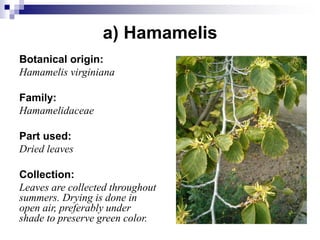
a) Hamamelis
Botanical origin:
Hamamelis virginiana
Family:
Hamamelidaceae
Part used:
Dried leaves
Collection:
Leaves are collected throughout
summers. Drying is done in
open air, preferably under
shade to preserve green color.
Constituents:
Gallitannins
Ellagitannins
Free gallic acid
Pro-anthocyanadins
Hamamelase
Uses:
Astringent
Anti-hemorrhagic
Anti-inflammatory
Anti-carcinogenic
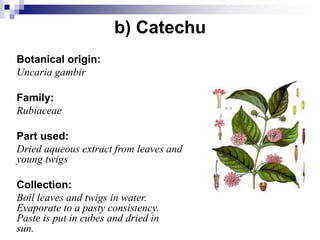
b) Catechu
Botanical origin:
Uncaria gambir
Family:
Rubiaceae
Part used:
Dried aqueous extract from leaves and
young twigs
Collection:
Boil leaves and twigs in water.
Evaporate to a pasty consistency.
Paste is put in cubes and dried in
sun.
Constituents:
Catechin
Catechutannic acid
Catechu red
Quercitin
Gambir flourescin
Uses:
Astringent
Dying
Tanning industry
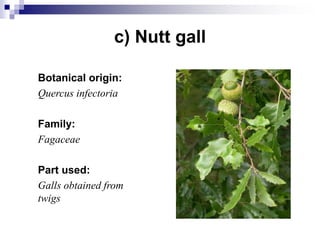
c) Nutt gall
Botanical origin:
Quercus infectoria
Family:
Fagaceae
Part used:
Galls obtained from
twigs
Formation of galls:
Galls are pathological outgrowth formed on twigs of tree. Galls
arise due to deposition of eggs by small insect Adleria
galactinctoria.
Steps are;
Early summers, insects lay eggs on twigs
Larvae come out from eggs and enter soft epidermis.
Larvae secretes enzyme that stimulates abnormal growth around
larvae.
Starch in the tissue gets converted to sugars and stimulate cell
division.
Disappearance of starch causes cell shrinkage.
Central cavity is formed in which larvae and pupae grows.
Larvae remains in gall for 5-6months.
Mature insect bores the covering of gall and escapes away.
Galls are collected before escaping of insect.
Constituents:
Tannic acid
Gallic acid
Ellagic acid
Roburic acid
Syringic acid
Calcium oxalate crystals
Uses:
Haemostatic
Antidote for alkaloidal poisoning
Astringent

tannins5-111013081409-phpapp01.ppt

  • 1.
  • 2.
    Introduction The term tanninwas first time coined by Seguin in 1796. This term was used to denote substances present in plant extract which react with protein of animal hide, prevent their putrefaction and convert hide and skin into leather.
  • 3.
    Definition “Complex substances thatusually occur as mixtures of polyphenols that are very difficult to separate since they don't crystallize, are called tannins.” OR “Tannins are polyhydroxy phenolic compounds.”
  • 4.
    Physical Properties Color: Dark brownor reddish brown Taste: Puckering taste State: Non-crystalline Solubility: Soluble in water, alcohol, dilute alkalis, glycerols and acetone.
  • 5.
    Chemical properties (i) Precipitation (ii)Anti-oxidizing properties (iii) Astringent (iv) Carcinogenicity (v) Reaction with salts (vi) Reaction with potassium ferricyanide and ammonia
  • 6.
    (i) Precipitation Tannins haveability to precipitate solutions of; Gelatin Alkaloids Glycosides Heavy metals Proteins (ii) Anti-oxidizing properties Because of accumulation of OH group on small size nucleus, these agents have anti-oxidant nature.
  • 7.
    (iii) Astringent Tannins haveproperty to react with protein of mucous membrane and cause precipitation. (iv) Carcinogenicity Prolong use of tannin containing plant material is hazardous because it causes cancer. Habitual use of Areca catechu can cause oral and esophageal cancer.
  • 8.
    (v) Reaction withsalts (vi) Reaction with potassium ferricyanide and ammonia
  • 9.
    Importance of tannins MedicinalUses: Antidote Antiseptic Algicidals Astringents Anti-carcinogenic Industrial Uses: Ink manufacture Vegetable tanning Preservatives Biological Activities: Inhibition of lipid per oxidation Decrease in blood urea nitrogen content Inhibition of plasmin Lipolysis in fat cells
  • 10.
    Chemical Classification Based onidentity of phenolic nuclei involved and on the way they are joined. Tannins Hydrolysable tannins Condensed tannins Complex tannins
  • 11.
    (i) Hydrolysable tannins Thesetannins are hydrolyzed by enzymes or acids. Precursors: Phenolic acid (Gallic acid, Ellagic acid) Glucose residue Between phenolic acids and glucose sugar, there is ester linkage
  • 12.
  • 13.
    Ellagitannins Gallitannins Pomegranate Eucalyptus Rhubarb Clove Hamamelis Occurrence Upon acid hydrolysis ofEllagitannins, Ellagic acid is produces. Upon acid hydrolysis of Gallitannins, Gallic acid is produces. Hydrolysis * Slowly soluble in water. * Present in plants in open and ring forms as Hexa hydroxy diphenic acid. * Rapidly soluble in water. * Free Gallic acid, in plant, is converted to gluco Gallitannins. Properties
  • 14.
    (ii) Condensed tannins Thesetannins are derivatives of Flavonoid, catechin, flavonol- 3-4-diol. Precursors: Flavonoid Catechin Flavonol-3-4-diol
  • 15.
    Properties: Examples: Hamamelis Cinchona Cinnamon When heated withacids, these are self condensated, polymerized and converted to insoluble red colored complexes, called Phlobaphenes.
  • 16.
    (iii) Complex tannins Thesetannins are mixtures of both, hydrolysable and condensed tannins Examples: Tea Quercus Castanea
  • 17.
    2nd Classification Tannin isa substance which is detected qualitatively by tanning test (The Gold beater’s skin test) and quantitatively by its adsorption on standard hide powder. Depending upon this, tannins are of two types; True tannins Pseudo tannins Tannins True tannins Pseudo tannins
  • 18.
    Pseudo tannins True tannins Phenoliccompounds of plant origin that don't convert animal hide to leather but do give positive Gold beater’s skin test, are called pseudo tannins. Polyhydroxy phenolic compounds which convert animal hide to leather by precipitating proteins and give positive Gold beater’s skin test, are called true tannins. Molecular weight is less than true tannins. Molecular weight is 1000-5000
  • 19.
    Identification tests Color reaction: Tanninsgive color reaction with iron.
  • 20.
    Identification tests Matchstick test: Dipmatchstick in plant extract. Dry it. Moisten it with hydrochloric acid. And warm near flame. Wood will turn pink or red in color due to phloroglucinol. Gelatin test: Solution of tannin (0.5%-1%) precipitates 1% solution of gelatin containing 10% sodium chloride.
  • 21.
    Identification tests Phenazone test: Take5ml of aqueous extract of drug. Add 0.5grams of sodium acid phosphate. Warm it and cool. Filter solution. To the filtrate, add 2%solution of Phenazone. Tannins will be precipitated. Precipitates will be bulky and colored.
  • 22.
    Identification tests Gold beater’sskin test: Gold beater’s skin is a membrane prepared from intestine of Ox and I behaves similarly to un tanned skin. Soak a small piece of Gold beater’s skin in 2% hydrochloric acid. Rinse it with distilled water. Place it in solution to be tested for 5 minutes. Wash in water and transfer to 1% solution of ferrous sulphate. Black or brown color of skin indicates presence of tannins. It is a quantitative test and +ive only for true tannins
  • 23.
    Identification tests Catechin test: Catechinwhen heated with acid produce phloroglucinol. Phloroglucinol can be detected with matchstick test. Test for chlorogenic acid: Treat extract containing chlorogenic acid with aqueous ammonia and expose it to air. Green color will appear gradually.
  • 24.
    a) Hamamelis Botanical origin: Hamamelisvirginiana Family: Hamamelidaceae Part used: Dried leaves Collection: Leaves are collected throughout summers. Drying is done in open air, preferably under shade to preserve green color.
  • 25.
  • 26.
    b) Catechu Botanical origin: Uncariagambir Family: Rubiaceae Part used: Dried aqueous extract from leaves and young twigs Collection: Boil leaves and twigs in water. Evaporate to a pasty consistency. Paste is put in cubes and dried in sun.
  • 27.
    Constituents: Catechin Catechutannic acid Catechu red Quercitin Gambirflourescin Uses: Astringent Dying Tanning industry
  • 28.
    c) Nutt gall Botanicalorigin: Quercus infectoria Family: Fagaceae Part used: Galls obtained from twigs
  • 29.
    Formation of galls: Gallsare pathological outgrowth formed on twigs of tree. Galls arise due to deposition of eggs by small insect Adleria galactinctoria. Steps are; Early summers, insects lay eggs on twigs Larvae come out from eggs and enter soft epidermis. Larvae secretes enzyme that stimulates abnormal growth around larvae. Starch in the tissue gets converted to sugars and stimulate cell division. Disappearance of starch causes cell shrinkage.
  • 30.
    Central cavity isformed in which larvae and pupae grows. Larvae remains in gall for 5-6months. Mature insect bores the covering of gall and escapes away. Galls are collected before escaping of insect.
  • 31.
    Constituents: Tannic acid Gallic acid Ellagicacid Roburic acid Syringic acid Calcium oxalate crystals Uses: Haemostatic Antidote for alkaloidal poisoning Astringent