OHM-ADVISORS.COM
Quantifying Climate Change for
Stormwater & Wastewater
Systems
Gregory P. Kacvinsky, P.E.
OHM Advisors
APWA Michigan Annual Conference
May 21, 2015
ARCHITECTS. ENGINEERS. PLANNERS.
Climate is what you expect;
weather is what you get
Edward Lorenz
Mathematician and Meteorologist
OHM-ADVISORS.COM ARCHITECTS. ENGINEERS. PLANNERS.
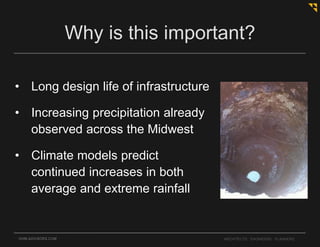
• Long design life of infrastructure
• Increasing precipitation already
observed across the Midwest
• Climate models predict
continued increases in both
average and extreme rainfall
OHM-ADVISORS.COM ARCHITECTS. ENGINEERS. PLANNERS.
Why is this important?
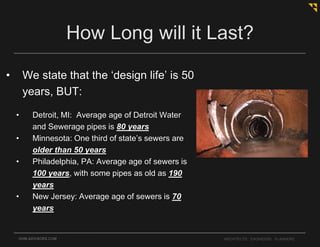
• We state that the ‘design life’ is 50
years, BUT:
• Detroit, MI: Average age of Detroit Water
and Sewerage pipes is 80 years
• Minnesota: One third of state’s sewers are
older than 50 years
• Philadelphia, PA: Average age of sewers is
100 years, with some pipes as old as 190
years
• New Jersey: Average age of sewers is 70
years
OHM-ADVISORS.COM ARCHITECTS. ENGINEERS. PLANNERS.
How Long will it Last?
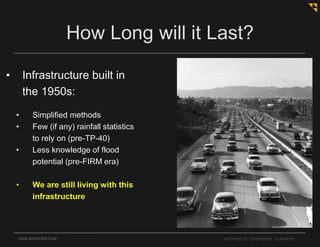
• Infrastructure built in
the 1950s:
• Simplified methods
• Few (if any) rainfall statistics
to rely on (pre-TP-40)
• Less knowledge of flood
potential (pre-FIRM era)
• We are still living with this
infrastructure
OHM-ADVISORS.COM ARCHITECTS. ENGINEERS. PLANNERS.
How Long will it Last?
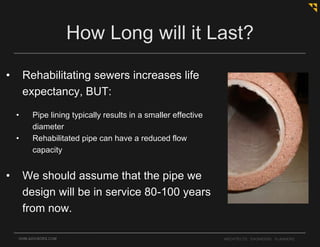
• Rehabilitating sewers increases life
expectancy, BUT:
• Pipe lining typically results in a smaller effective
diameter
• Rehabilitated pipe can have a reduced flow
capacity
• We should assume that the pipe we
design will be in service 80-100 years
from now.
OHM-ADVISORS.COM ARCHITECTS. ENGINEERS. PLANNERS.
How Long will it Last?
OHM-ADVISORS.COM ARCHITECTS. ENGINEERS. PLANNERS.
Climate models (forward-looking)
Rainfall statistics (rear-looking)
Modeling – how does all this impact utility sizing?
OHM-ADVISORS.COM ARCHITECTS. ENGINEERS. PLANNERS.
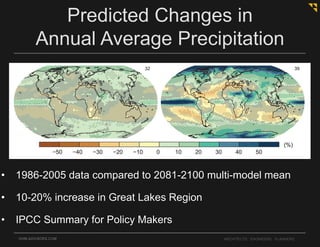
Predicted Changes in
Annual Average Precipitation
• 1986-2005 data compared to 2081-2100 multi-model mean
• 10-20% increase in Great Lakes Region
• IPCC Summary for Policy Makers
OHM-ADVISORS.COM ARCHITECTS. ENGINEERS. PLANNERS.
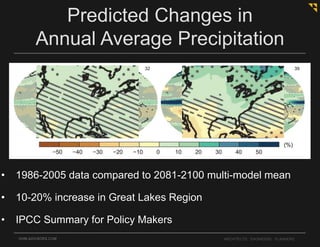
Predicted Changes in
Annual Average Precipitation
• 1986-2005 data compared to 2081-2100 multi-model mean
• 10-20% increase in Great Lakes Region
• IPCC Summary for Policy Makers
OHM-ADVISORS.COM ARCHITECTS. ENGINEERS. PLANNERS.
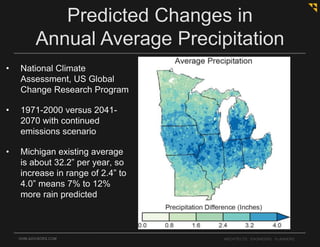
• National Climate
Assessment, US Global
Change Research Program
• 1971-2000 versus 2041-
2070 with continued
emissions scenario
• Michigan existing average
is about 32.2” per year, so
increase in range of 2.4” to
4.0” means 7% to 12%
more rain predicted
Predicted Changes in
Annual Average Precipitation
OHM-ADVISORS.COM ARCHITECTS. ENGINEERS. PLANNERS.
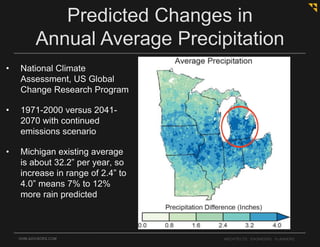
• National Climate
Assessment, US Global
Change Research Program
• 1971-2000 versus 2041-
2070 with continued
emissions scenario
• Michigan existing average
is about 32.2” per year, so
increase in range of 2.4” to
4.0” means 7% to 12%
more rain predicted
Predicted Changes in
Annual Average Precipitation
OHM-ADVISORS.COM ARCHITECTS. ENGINEERS. PLANNERS.
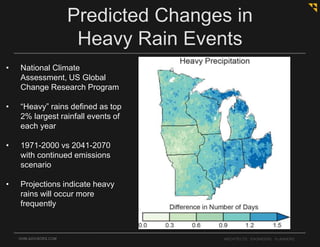
• National Climate
Assessment, US Global
Change Research Program
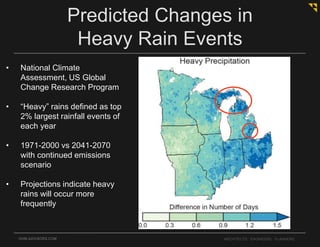
• “Heavy” rains defined as top
2% largest rainfall events of
each year
• 1971-2000 vs 2041-2070
with continued emissions
scenario
• Projections indicate heavy
rains will occur more
frequently
Predicted Changes in
Heavy Rain Events
OHM-ADVISORS.COM ARCHITECTS. ENGINEERS. PLANNERS.
• National Climate
Assessment, US Global
Change Research Program
• “Heavy” rains defined as top
2% largest rainfall events of
each year
• 1971-2000 vs 2041-2070
with continued emissions
scenario
• Projections indicate heavy
rains will occur more
frequently
Predicted Changes in
Heavy Rain Events
OHM-ADVISORS.COM ARCHITECTS. ENGINEERS. PLANNERS.
Bottom Line:
In Michigan, we should be prepared for
more rain: heavy rains should become
more frequent and rainfall intensities
should increase by 10-20%.
Predicted Changes in
Precipitation
OHM-ADVISORS.COM ARCHITECTS. ENGINEERS. PLANNERS.
Observed Changes in Very
Heavy Precipitation
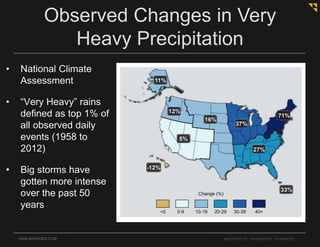
• National Climate
Assessment
• “Very Heavy” rains
defined as top 1% of
all observed daily
events (1958 to
2012)
• Big storms have
gotten more intense
over the past 50
years
OHM-ADVISORS.COM ARCHITECTS. ENGINEERS. PLANNERS.
Recent Rainfall Statistics
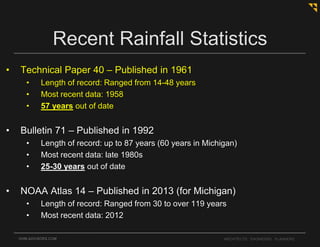
• Technical Paper 40 – Published in 1961
• Length of record: Ranged from 14-48 years
• Most recent data: 1958
• 57 years out of date
• Bulletin 71 – Published in 1992
• Length of record: up to 87 years (60 years in Michigan)
• Most recent data: late 1980s
• 25-30 years out of date
• NOAA Atlas 14 – Published in 2013 (for Michigan)
• Length of record: Ranged from 30 to over 119 years
• Most recent data: 2012
OHM-ADVISORS.COM ARCHITECTS. ENGINEERS. PLANNERS.
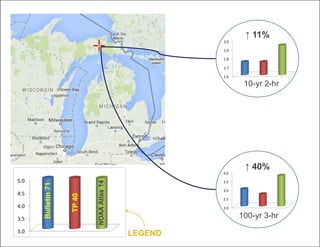
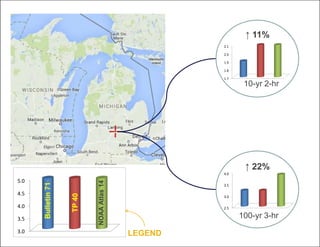
Recent Rainfall Statistics
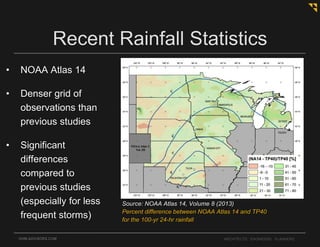
• NOAA Atlas 14
• Denser grid of
observations than
previous studies
• Significant
differences
compared to
previous studies
(especially for less
frequent storms)
Source: NOAA Atlas 14, Volume 8 (2013)
Percent difference between NOAA Atlas 14 and TP40
for the 100-yr 24-hr rainfall
OHM-ADVISORS.COM ARCHITECTS. ENGINEERS. PLANNERS.
Recent Rainfall Statistics
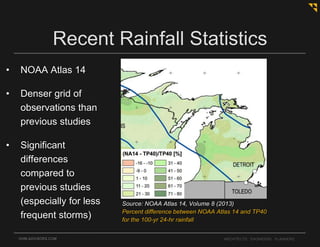
• NOAA Atlas 14
• Denser grid of
observations than
previous studies
• Significant
differences
compared to
previous studies
(especially for less
frequent storms)
Source: NOAA Atlas 14, Volume 8 (2013)
Percent difference between NOAA Atlas 14 and TP40
for the 100-yr 24-hr rainfall
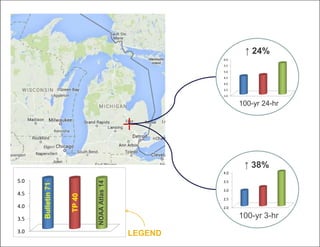
3.0
3.5
4.0
4.5
5.0
5.5
6.0
100-yr 24-hr
100-yr 3-hr
2.0
2.5
3.0
3.5
4.0
↑ 24%
↑ 38%
3.0
3.5
4.0
4.5
5.0
NOAAAtlas14
TP40
Bulletin71
LEGEND
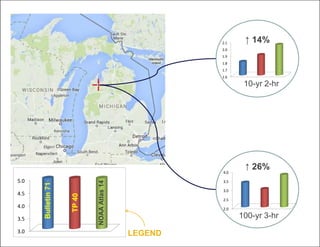
10-yr 2-hr
100-yr 3-hr
↑ 26%
2.0
2.5
3.0
3.5
4.0
1.6
1.7
1.8
1.9
2.0
2.1 ↑ 14%
3.0
3.5
4.0
4.5
5.0
NOAAAtlas14
TP40
Bulletin71
LEGEND
2.0
2.5
3.0
3.5
4.0
1.6
1.7
1.8
1.9
2.0
10-yr 2-hr
100-yr 3-hr
↑ 40%
↑ 11%
3.0
3.5
4.0
4.5
5.0
NOAAAtlas14
TP40
Bulletin71
LEGEND
2.5
3.0
3.5
4.0
1.7
1.8
1.9
2.0
2.1
10-yr 2-hr
100-yr 3-hr
↑ 22%
↑ 11%
3.0
3.5
4.0
4.5
5.0
NOAAAtlas14
TP40
Bulletin71
LEGEND
OHM-ADVISORS.COM ARCHITECTS. ENGINEERS. PLANNERS.
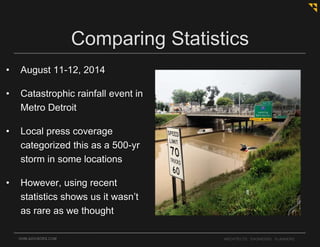
Comparing Statistics
• August 11-12, 2014
• Catastrophic rainfall event in
Metro Detroit
• Local press coverage
categorized this as a 500-yr
storm in some locations
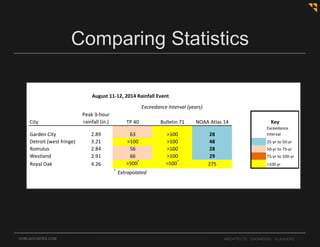
• However, using recent
statistics shows us it wasn’t
as rare as we thought
OHM-ADVISORS.COM ARCHITECTS. ENGINEERS. PLANNERS.
Comparing Statistics
City
Peak 3-hour
rainfall (in.) TP 40 Bulletin 71 NOAA Atlas 14
Garden City 2.89 63 >100 28
Exceedance
Interval
Detroit (west fringe) 3.21 >100 >100 48 25-yr to 50-yr
Romulus 2.84 56 >100 28 50-yr to 75-yr
Westland 2.91 66 >100 29 75-yr to 100-yr
Royal Oak 4.26 >500*
>500*
275 >100 yr
*
Extrapolated
August 11-12, 2014 Rainfall Event
Exceedance Interval (years)
Key
OHM-ADVISORS.COM ARCHITECTS. ENGINEERS. PLANNERS.
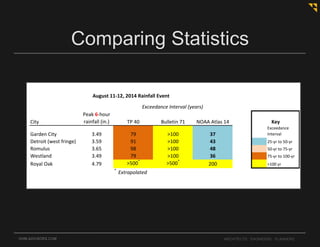
Comparing Statistics
City
Peak 6-hour
rainfall (in.) TP 40 Bulletin 71 NOAA Atlas 14
Garden City 3.49 79 >100 37
Exceedance
Interval
Detroit (west fringe) 3.59 91 >100 43 25-yr to 50-yr
Romulus 3.65 98 >100 48 50-yr to 75-yr
Westland 3.49 79 >100 36 75-yr to 100-yr
Royal Oak 4.79 >500*
>500*
200 >100 yr
*
Extrapolated
Exceedance Interval (years)
Key
August 11-12, 2014 Rainfall Event
OHM-ADVISORS.COM ARCHITECTS. ENGINEERS. PLANNERS.
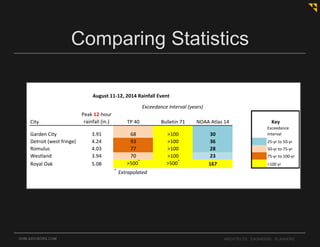
Comparing Statistics
City
Peak 12-hour
rainfall (in.) TP 40 Bulletin 71 NOAA Atlas 14
Garden City 3.91 68 >100 30
Exceedance
Interval
Detroit (west fringe) 4.24 93 >100 36 25-yr to 50-yr
Romulus 4.03 77 >100 28 50-yr to 75-yr
Westland 3.94 70 >100 23 75-yr to 100-yr
Royal Oak 5.08 >500*
>500*
167 >100 yr
*
Extrapolated
August 11-12, 2014 Rainfall Event
Exceedance Interval (years)
Key
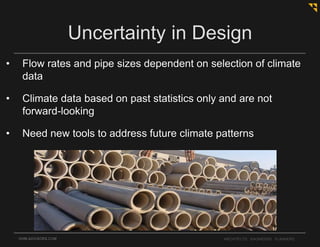
• Flow rates and pipe sizes dependent on selection of climate
data
• Climate data based on past statistics only and are not
forward-looking
• Need new tools to address future climate patterns
OHM-ADVISORS.COM ARCHITECTS. ENGINEERS. PLANNERS.
Uncertainty in Design
?
• Several Independent Methods:
 Updating Rainfall Statistics (national AND local
data, if available)
 EPA Stormwater Calculator
 Confidence Intervals
OHM-ADVISORS.COM ARCHITECTS. ENGINEERS. PLANNERS.
Tools for Addressing Climate Trends
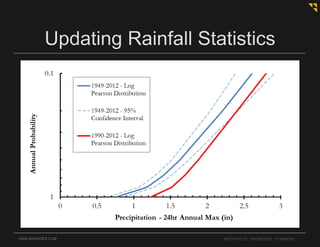
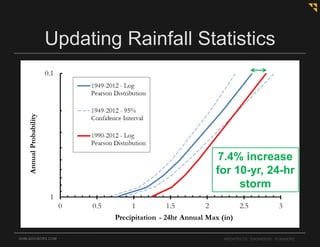
• 1949-2012 Detroit City Airport Rainfall Data
• Compared peak annual rainfall totals (1949-2012) against
more recent subset (1990-2012)
• Results showed a recent increase in peak rainfall depths,
which tends to reflect NOAA Atlas 14 findings
• 7.4% increase for 10 year, 24 hour storm
• 10.2% increase for 10 year, 1 hour storm
OHM-ADVISORS.COM ARCHITECTS. ENGINEERS. PLANNERS.
Updating Rainfall Statistics
OHM-ADVISORS.COM ARCHITECTS. ENGINEERS. PLANNERS.
Updating Rainfall Statistics
OHM-ADVISORS.COM ARCHITECTS. ENGINEERS. PLANNERS.
Updating Rainfall Statistics
7.4% increase
for 10-yr, 24-hr
storm
OHM-ADVISORS.COM ARCHITECTS. ENGINEERS. PLANNERS.
Using Models to Design for
Climate Change
OHM-ADVISORS.COM ARCHITECTS. ENGINEERS. PLANNERS.
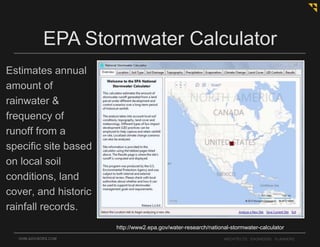
EPA Stormwater Calculator
http://www2.epa.gov/water-research/national-stormwater-calculator
Estimates annual
amount of
rainwater &
frequency of
runoff from a
specific site based
on local soil
conditions, land
cover, and historic
rainfall records.
OHM-ADVISORS.COM ARCHITECTS. ENGINEERS. PLANNERS.
EPA Stormwater Calculator:
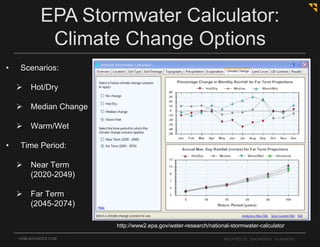
Climate Change Options
http://www2.epa.gov/water-research/national-stormwater-calculator
• Scenarios:
 Hot/Dry
 Median Change
 Warm/Wet
• Time Period:
 Near Term
(2020-2049)
 Far Term
(2045-2074)
OHM-ADVISORS.COM ARCHITECTS. ENGINEERS. PLANNERS.
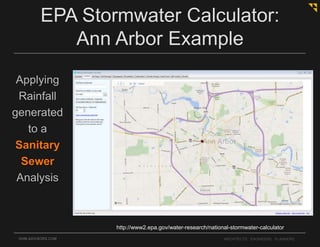
EPA Stormwater Calculator:
Ann Arbor Example
http://www2.epa.gov/water-research/national-stormwater-calculator
Applying
Rainfall
generated
to a
Sanitary
Sewer
Analysis
OHM-ADVISORS.COM ARCHITECTS. ENGINEERS. PLANNERS.
EPA Stormwater Calculator:
Ann Arbor Example
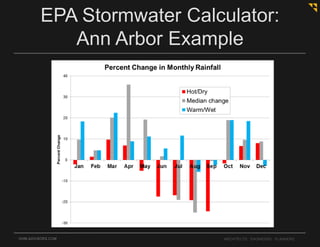
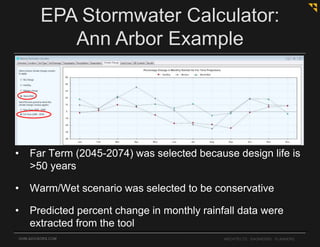
• Far Term (2045-2074) was selected because design life is
>50 years
• Warm/Wet scenario was selected to be conservative
• Predicted percent change in monthly rainfall data were
extracted from the tool
OHM-ADVISORS.COM ARCHITECTS. ENGINEERS. PLANNERS.
EPA Stormwater Calculator:
Ann Arbor Example
OHM-ADVISORS.COM ARCHITECTS. ENGINEERS. PLANNERS.
EPA Stormwater Calculator:
Ann Arbor Example
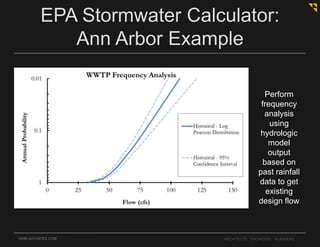
Perform
frequency
analysis
using
hydrologic
model
output
based on
past rainfall
data to get
existing
design flow
OHM-ADVISORS.COM ARCHITECTS. ENGINEERS. PLANNERS.
EPA Stormwater Calculator:
Ann Arbor Example
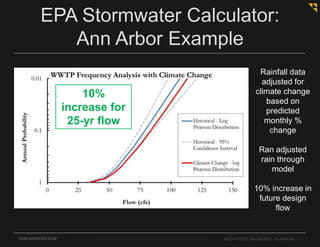
Rainfall data
adjusted for
climate change
based on
predicted
monthly %
change
Ran adjusted
rain through
model
10% increase in
future design
flow
10%
increase for
25-yr flow
OHM-ADVISORS.COM ARCHITECTS. ENGINEERS. PLANNERS.
EPA Stormwater Calculator:
Ann Arbor Example
• Consider 10% increase in peak flow at WWTP to account
for future climate change (2045-2074).
• Technical Oversight and Advisory Group (TOAG) quote:
…TOAG Members indicated that the
recommendation to increase the 25 year Design
Event flow rate by 10% is reasonable since this is
a mid-range value which falls near the center of
the climate change forecast models showing
“best case” and “worst case” future conditions…
OHM-ADVISORS.COM ARCHITECTS. ENGINEERS. PLANNERS.
Novi Study
OHM-ADVISORS.COM ARCHITECTS. ENGINEERS. PLANNERS.
Novi Study
OHM-ADVISORS.COM ARCHITECTS. ENGINEERS. PLANNERS.
Novi Study
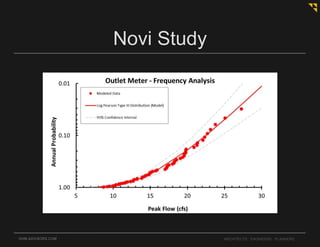
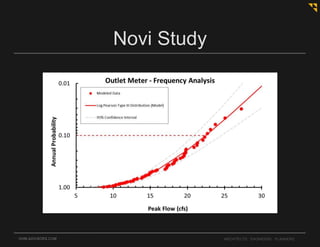
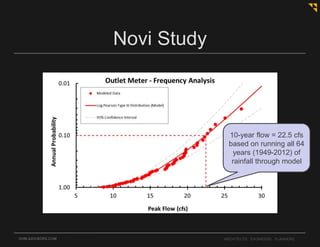
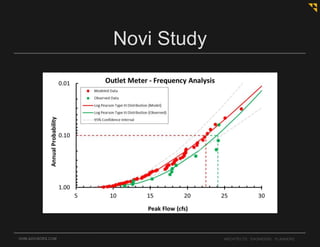
10-year flow = 22.5 cfs
based on running all 64
years (1949-2012) of
rainfall through model
OHM-ADVISORS.COM ARCHITECTS. ENGINEERS. PLANNERS.
Novi Study
OHM-ADVISORS.COM ARCHITECTS. ENGINEERS. PLANNERS.
Novi Study
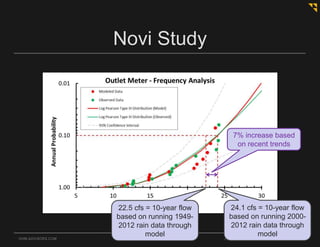
22.5 cfs = 10-year flow
based on running 1949-
2012 rain data through
model
24.1 cfs = 10-year flow
based on running 2000-
2012 rain data through
model
7% increase based
on recent trends
OHM-ADVISORS.COM ARCHITECTS. ENGINEERS. PLANNERS.
Novi Study
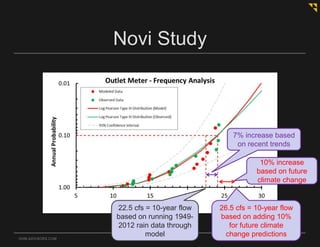
22.5 cfs = 10-year flow
based on running 1949-
2012 rain data through
model
7% increase based
on recent trends
26.5 cfs = 10-year flow
based on adding 10%
for future climate
change predictions
10% increase
based on future
climate change
OHM-ADVISORS.COM ARCHITECTS. ENGINEERS. PLANNERS.
Novi Study
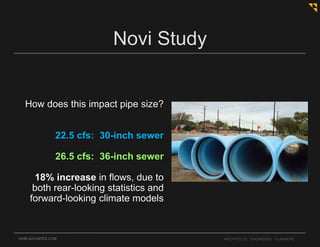
How does this impact pipe size?
22.5 cfs: 30-inch sewer
26.5 cfs: 36-inch sewer
18% increase in flows, due to
both rear-looking statistics and
forward-looking climate models
OHM-ADVISORS.COM ARCHITECTS. ENGINEERS. PLANNERS.
Novi Study
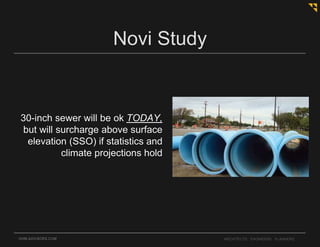
30-inch sewer will be ok TODAY,
but will surcharge above surface
elevation (SSO) if statistics and
climate projections hold
OHM-ADVISORS.COM ARCHITECTS. ENGINEERS. PLANNERS.
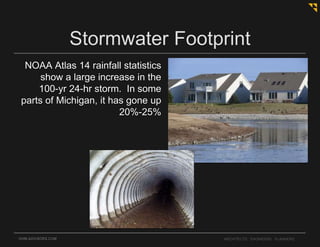
Stormwater Footprint
NOAA Atlas 14 rainfall statistics
show a large increase in the
100-yr 24-hr storm. In some
parts of Michigan, it has gone up
20%-25%
• Using confidence intervals (in NOAA Atlas 14 data)
may be a reasonable way to address future climate
variability:
• Example: (NW Oakland County)
• 100-yr 24-hr rainfall = 5.45 inches
• Climate models put the likely range closer to
6.0-6.5 inches (second half of 21st Century)
• How will this impact developability?
OHM-ADVISORS.COM ARCHITECTS. ENGINEERS. PLANNERS.
Stormwater Footprint
OHM-ADVISORS.COM ARCHITECTS. ENGINEERS. PLANNERS.
Confidence Intervals
• 90% probability of observing a value within the
range
• Climate models predict an increase in future
precipitation values so use a value towards
the upper bound of the confidence interval
OHM-ADVISORS.COM ARCHITECTS. ENGINEERS. PLANNERS.
NOAA Atlas 14
Confidence Intervals
http://www.nws.noaa.gov/oh/hdsc/index.html
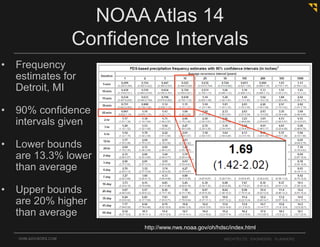
• Frequency
estimates for
Detroit, MI
• 90% confidence
intervals given
• Lower bounds
are 13.3% lower
than average
• Upper bounds
are 20% higher
than average
OHM-ADVISORS.COM ARCHITECTS. ENGINEERS. PLANNERS.
NOAA Atlas 14
Confidence Intervals
http://www.nws.noaa.gov/oh/hdsc/index.html
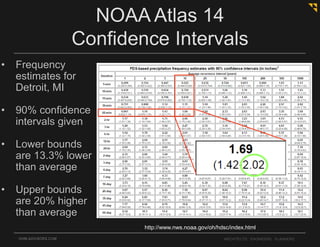
• Frequency
estimates for
Detroit, MI
• 90% confidence
intervals given
• Lower bounds
are 13.3% lower
than average
• Upper bounds
are 20% higher
than average
• Recent statistics indicate rainfall depths for design
storms have been increasing in Michigan
• Climate models project further increases in rainfall
depth for future storms
• Tools are available to estimate future rainfall increases
and develop future design flows for different parts of
the state
• Using these tools for SE Michigan communities
indicated future design flows should be increased
~10%-20% above existing
OHM-ADVISORS.COM ARCHITECTS. ENGINEERS. PLANNERS.
Conclusions
• In most cases, this translates to an increase of one pipe
size:
• 12-inch to 15-inch
• 30-inch to 36-inch
• Etc.
• When replacing storm or sanitary sewers, consider this
change
• Also consider that the pipe may be lined in the future
(design for reduced future diameter)
OHM-ADVISORS.COM ARCHITECTS. ENGINEERS. PLANNERS.
Conclusions
OHM-ADVISORS.COM ARCHITECTS. ENGINEERS. PLANNERS.

Tangible Approaches to Quantify Climate Change - APWA Conference

  • 1.
    OHM-ADVISORS.COM Quantifying Climate Changefor Stormwater & Wastewater Systems Gregory P. Kacvinsky, P.E. OHM Advisors APWA Michigan Annual Conference May 21, 2015 ARCHITECTS. ENGINEERS. PLANNERS.
  • 2.
    Climate is whatyou expect; weather is what you get Edward Lorenz Mathematician and Meteorologist OHM-ADVISORS.COM ARCHITECTS. ENGINEERS. PLANNERS.
  • 3.
    • Long designlife of infrastructure • Increasing precipitation already observed across the Midwest • Climate models predict continued increases in both average and extreme rainfall OHM-ADVISORS.COM ARCHITECTS. ENGINEERS. PLANNERS. Why is this important?
  • 4.
    • We statethat the ‘design life’ is 50 years, BUT: • Detroit, MI: Average age of Detroit Water and Sewerage pipes is 80 years • Minnesota: One third of state’s sewers are older than 50 years • Philadelphia, PA: Average age of sewers is 100 years, with some pipes as old as 190 years • New Jersey: Average age of sewers is 70 years OHM-ADVISORS.COM ARCHITECTS. ENGINEERS. PLANNERS. How Long will it Last?
  • 5.
    • Infrastructure builtin the 1950s: • Simplified methods • Few (if any) rainfall statistics to rely on (pre-TP-40) • Less knowledge of flood potential (pre-FIRM era) • We are still living with this infrastructure OHM-ADVISORS.COM ARCHITECTS. ENGINEERS. PLANNERS. How Long will it Last?
  • 6.
    • Rehabilitating sewersincreases life expectancy, BUT: • Pipe lining typically results in a smaller effective diameter • Rehabilitated pipe can have a reduced flow capacity • We should assume that the pipe we design will be in service 80-100 years from now. OHM-ADVISORS.COM ARCHITECTS. ENGINEERS. PLANNERS. How Long will it Last?
  • 7.
  • 8.
    Climate models (forward-looking) Rainfallstatistics (rear-looking) Modeling – how does all this impact utility sizing? OHM-ADVISORS.COM ARCHITECTS. ENGINEERS. PLANNERS.
  • 9.
    OHM-ADVISORS.COM ARCHITECTS. ENGINEERS.PLANNERS. Predicted Changes in Annual Average Precipitation • 1986-2005 data compared to 2081-2100 multi-model mean • 10-20% increase in Great Lakes Region • IPCC Summary for Policy Makers
  • 10.
    OHM-ADVISORS.COM ARCHITECTS. ENGINEERS.PLANNERS. Predicted Changes in Annual Average Precipitation • 1986-2005 data compared to 2081-2100 multi-model mean • 10-20% increase in Great Lakes Region • IPCC Summary for Policy Makers
  • 11.
  • 12.
    OHM-ADVISORS.COM ARCHITECTS. ENGINEERS.PLANNERS. • National Climate Assessment, US Global Change Research Program • 1971-2000 versus 2041- 2070 with continued emissions scenario • Michigan existing average is about 32.2” per year, so increase in range of 2.4” to 4.0” means 7% to 12% more rain predicted Predicted Changes in Annual Average Precipitation
  • 13.
    OHM-ADVISORS.COM ARCHITECTS. ENGINEERS.PLANNERS. • National Climate Assessment, US Global Change Research Program • 1971-2000 versus 2041- 2070 with continued emissions scenario • Michigan existing average is about 32.2” per year, so increase in range of 2.4” to 4.0” means 7% to 12% more rain predicted Predicted Changes in Annual Average Precipitation
  • 14.
    OHM-ADVISORS.COM ARCHITECTS. ENGINEERS.PLANNERS. • National Climate Assessment, US Global Change Research Program • “Heavy” rains defined as top 2% largest rainfall events of each year • 1971-2000 vs 2041-2070 with continued emissions scenario • Projections indicate heavy rains will occur more frequently Predicted Changes in Heavy Rain Events
  • 15.
    OHM-ADVISORS.COM ARCHITECTS. ENGINEERS.PLANNERS. • National Climate Assessment, US Global Change Research Program • “Heavy” rains defined as top 2% largest rainfall events of each year • 1971-2000 vs 2041-2070 with continued emissions scenario • Projections indicate heavy rains will occur more frequently Predicted Changes in Heavy Rain Events
  • 16.
    OHM-ADVISORS.COM ARCHITECTS. ENGINEERS.PLANNERS. Bottom Line: In Michigan, we should be prepared for more rain: heavy rains should become more frequent and rainfall intensities should increase by 10-20%. Predicted Changes in Precipitation
  • 17.
    OHM-ADVISORS.COM ARCHITECTS. ENGINEERS.PLANNERS. Observed Changes in Very Heavy Precipitation • National Climate Assessment • “Very Heavy” rains defined as top 1% of all observed daily events (1958 to 2012) • Big storms have gotten more intense over the past 50 years
  • 18.
    OHM-ADVISORS.COM ARCHITECTS. ENGINEERS.PLANNERS. Recent Rainfall Statistics • Technical Paper 40 – Published in 1961 • Length of record: Ranged from 14-48 years • Most recent data: 1958 • 57 years out of date • Bulletin 71 – Published in 1992 • Length of record: up to 87 years (60 years in Michigan) • Most recent data: late 1980s • 25-30 years out of date • NOAA Atlas 14 – Published in 2013 (for Michigan) • Length of record: Ranged from 30 to over 119 years • Most recent data: 2012
  • 19.
    OHM-ADVISORS.COM ARCHITECTS. ENGINEERS.PLANNERS. Recent Rainfall Statistics • NOAA Atlas 14 • Denser grid of observations than previous studies • Significant differences compared to previous studies (especially for less frequent storms) Source: NOAA Atlas 14, Volume 8 (2013) Percent difference between NOAA Atlas 14 and TP40 for the 100-yr 24-hr rainfall
  • 20.
    OHM-ADVISORS.COM ARCHITECTS. ENGINEERS.PLANNERS. Recent Rainfall Statistics • NOAA Atlas 14 • Denser grid of observations than previous studies • Significant differences compared to previous studies (especially for less frequent storms) Source: NOAA Atlas 14, Volume 8 (2013) Percent difference between NOAA Atlas 14 and TP40 for the 100-yr 24-hr rainfall
  • 21.
    3.0 3.5 4.0 4.5 5.0 5.5 6.0 100-yr 24-hr 100-yr 3-hr 2.0 2.5 3.0 3.5 4.0 ↑24% ↑ 38% 3.0 3.5 4.0 4.5 5.0 NOAAAtlas14 TP40 Bulletin71 LEGEND
  • 22.
    10-yr 2-hr 100-yr 3-hr ↑26% 2.0 2.5 3.0 3.5 4.0 1.6 1.7 1.8 1.9 2.0 2.1 ↑ 14% 3.0 3.5 4.0 4.5 5.0 NOAAAtlas14 TP40 Bulletin71 LEGEND
  • 23.
    2.0 2.5 3.0 3.5 4.0 1.6 1.7 1.8 1.9 2.0 10-yr 2-hr 100-yr 3-hr ↑40% ↑ 11% 3.0 3.5 4.0 4.5 5.0 NOAAAtlas14 TP40 Bulletin71 LEGEND
  • 24.
    2.5 3.0 3.5 4.0 1.7 1.8 1.9 2.0 2.1 10-yr 2-hr 100-yr 3-hr ↑22% ↑ 11% 3.0 3.5 4.0 4.5 5.0 NOAAAtlas14 TP40 Bulletin71 LEGEND
  • 25.
    OHM-ADVISORS.COM ARCHITECTS. ENGINEERS.PLANNERS. Comparing Statistics • August 11-12, 2014 • Catastrophic rainfall event in Metro Detroit • Local press coverage categorized this as a 500-yr storm in some locations • However, using recent statistics shows us it wasn’t as rare as we thought
  • 26.
    OHM-ADVISORS.COM ARCHITECTS. ENGINEERS.PLANNERS. Comparing Statistics City Peak 3-hour rainfall (in.) TP 40 Bulletin 71 NOAA Atlas 14 Garden City 2.89 63 >100 28 Exceedance Interval Detroit (west fringe) 3.21 >100 >100 48 25-yr to 50-yr Romulus 2.84 56 >100 28 50-yr to 75-yr Westland 2.91 66 >100 29 75-yr to 100-yr Royal Oak 4.26 >500* >500* 275 >100 yr * Extrapolated August 11-12, 2014 Rainfall Event Exceedance Interval (years) Key
  • 27.
    OHM-ADVISORS.COM ARCHITECTS. ENGINEERS.PLANNERS. Comparing Statistics City Peak 6-hour rainfall (in.) TP 40 Bulletin 71 NOAA Atlas 14 Garden City 3.49 79 >100 37 Exceedance Interval Detroit (west fringe) 3.59 91 >100 43 25-yr to 50-yr Romulus 3.65 98 >100 48 50-yr to 75-yr Westland 3.49 79 >100 36 75-yr to 100-yr Royal Oak 4.79 >500* >500* 200 >100 yr * Extrapolated Exceedance Interval (years) Key August 11-12, 2014 Rainfall Event
  • 28.
    OHM-ADVISORS.COM ARCHITECTS. ENGINEERS.PLANNERS. Comparing Statistics City Peak 12-hour rainfall (in.) TP 40 Bulletin 71 NOAA Atlas 14 Garden City 3.91 68 >100 30 Exceedance Interval Detroit (west fringe) 4.24 93 >100 36 25-yr to 50-yr Romulus 4.03 77 >100 28 50-yr to 75-yr Westland 3.94 70 >100 23 75-yr to 100-yr Royal Oak 5.08 >500* >500* 167 >100 yr * Extrapolated August 11-12, 2014 Rainfall Event Exceedance Interval (years) Key
  • 29.
    • Flow ratesand pipe sizes dependent on selection of climate data • Climate data based on past statistics only and are not forward-looking • Need new tools to address future climate patterns OHM-ADVISORS.COM ARCHITECTS. ENGINEERS. PLANNERS. Uncertainty in Design ?
  • 30.
    • Several IndependentMethods:  Updating Rainfall Statistics (national AND local data, if available)  EPA Stormwater Calculator  Confidence Intervals OHM-ADVISORS.COM ARCHITECTS. ENGINEERS. PLANNERS. Tools for Addressing Climate Trends
  • 31.
    • 1949-2012 DetroitCity Airport Rainfall Data • Compared peak annual rainfall totals (1949-2012) against more recent subset (1990-2012) • Results showed a recent increase in peak rainfall depths, which tends to reflect NOAA Atlas 14 findings • 7.4% increase for 10 year, 24 hour storm • 10.2% increase for 10 year, 1 hour storm OHM-ADVISORS.COM ARCHITECTS. ENGINEERS. PLANNERS. Updating Rainfall Statistics
  • 32.
    OHM-ADVISORS.COM ARCHITECTS. ENGINEERS.PLANNERS. Updating Rainfall Statistics
  • 33.
    OHM-ADVISORS.COM ARCHITECTS. ENGINEERS.PLANNERS. Updating Rainfall Statistics 7.4% increase for 10-yr, 24-hr storm
  • 34.
    OHM-ADVISORS.COM ARCHITECTS. ENGINEERS.PLANNERS. Using Models to Design for Climate Change
  • 35.
    OHM-ADVISORS.COM ARCHITECTS. ENGINEERS.PLANNERS. EPA Stormwater Calculator http://www2.epa.gov/water-research/national-stormwater-calculator Estimates annual amount of rainwater & frequency of runoff from a specific site based on local soil conditions, land cover, and historic rainfall records.
  • 36.
    OHM-ADVISORS.COM ARCHITECTS. ENGINEERS.PLANNERS. EPA Stormwater Calculator: Climate Change Options http://www2.epa.gov/water-research/national-stormwater-calculator • Scenarios:  Hot/Dry  Median Change  Warm/Wet • Time Period:  Near Term (2020-2049)  Far Term (2045-2074)
  • 37.
    OHM-ADVISORS.COM ARCHITECTS. ENGINEERS.PLANNERS. EPA Stormwater Calculator: Ann Arbor Example http://www2.epa.gov/water-research/national-stormwater-calculator Applying Rainfall generated to a Sanitary Sewer Analysis
  • 38.
    OHM-ADVISORS.COM ARCHITECTS. ENGINEERS.PLANNERS. EPA Stormwater Calculator: Ann Arbor Example • Far Term (2045-2074) was selected because design life is >50 years • Warm/Wet scenario was selected to be conservative • Predicted percent change in monthly rainfall data were extracted from the tool
  • 39.
    OHM-ADVISORS.COM ARCHITECTS. ENGINEERS.PLANNERS. EPA Stormwater Calculator: Ann Arbor Example
  • 40.
    OHM-ADVISORS.COM ARCHITECTS. ENGINEERS.PLANNERS. EPA Stormwater Calculator: Ann Arbor Example Perform frequency analysis using hydrologic model output based on past rainfall data to get existing design flow
  • 41.
    OHM-ADVISORS.COM ARCHITECTS. ENGINEERS.PLANNERS. EPA Stormwater Calculator: Ann Arbor Example Rainfall data adjusted for climate change based on predicted monthly % change Ran adjusted rain through model 10% increase in future design flow 10% increase for 25-yr flow
  • 42.
    OHM-ADVISORS.COM ARCHITECTS. ENGINEERS.PLANNERS. EPA Stormwater Calculator: Ann Arbor Example • Consider 10% increase in peak flow at WWTP to account for future climate change (2045-2074). • Technical Oversight and Advisory Group (TOAG) quote: …TOAG Members indicated that the recommendation to increase the 25 year Design Event flow rate by 10% is reasonable since this is a mid-range value which falls near the center of the climate change forecast models showing “best case” and “worst case” future conditions…
  • 43.
  • 44.
  • 45.
    OHM-ADVISORS.COM ARCHITECTS. ENGINEERS.PLANNERS. Novi Study 10-year flow = 22.5 cfs based on running all 64 years (1949-2012) of rainfall through model
  • 46.
  • 47.
    OHM-ADVISORS.COM ARCHITECTS. ENGINEERS.PLANNERS. Novi Study 22.5 cfs = 10-year flow based on running 1949- 2012 rain data through model 24.1 cfs = 10-year flow based on running 2000- 2012 rain data through model 7% increase based on recent trends
  • 48.
    OHM-ADVISORS.COM ARCHITECTS. ENGINEERS.PLANNERS. Novi Study 22.5 cfs = 10-year flow based on running 1949- 2012 rain data through model 7% increase based on recent trends 26.5 cfs = 10-year flow based on adding 10% for future climate change predictions 10% increase based on future climate change
  • 49.
    OHM-ADVISORS.COM ARCHITECTS. ENGINEERS.PLANNERS. Novi Study How does this impact pipe size? 22.5 cfs: 30-inch sewer 26.5 cfs: 36-inch sewer 18% increase in flows, due to both rear-looking statistics and forward-looking climate models
  • 50.
    OHM-ADVISORS.COM ARCHITECTS. ENGINEERS.PLANNERS. Novi Study 30-inch sewer will be ok TODAY, but will surcharge above surface elevation (SSO) if statistics and climate projections hold
  • 51.
    OHM-ADVISORS.COM ARCHITECTS. ENGINEERS.PLANNERS. Stormwater Footprint NOAA Atlas 14 rainfall statistics show a large increase in the 100-yr 24-hr storm. In some parts of Michigan, it has gone up 20%-25%
  • 52.
    • Using confidenceintervals (in NOAA Atlas 14 data) may be a reasonable way to address future climate variability: • Example: (NW Oakland County) • 100-yr 24-hr rainfall = 5.45 inches • Climate models put the likely range closer to 6.0-6.5 inches (second half of 21st Century) • How will this impact developability? OHM-ADVISORS.COM ARCHITECTS. ENGINEERS. PLANNERS. Stormwater Footprint
  • 53.
    OHM-ADVISORS.COM ARCHITECTS. ENGINEERS.PLANNERS. Confidence Intervals • 90% probability of observing a value within the range • Climate models predict an increase in future precipitation values so use a value towards the upper bound of the confidence interval
  • 54.
    OHM-ADVISORS.COM ARCHITECTS. ENGINEERS.PLANNERS. NOAA Atlas 14 Confidence Intervals http://www.nws.noaa.gov/oh/hdsc/index.html • Frequency estimates for Detroit, MI • 90% confidence intervals given • Lower bounds are 13.3% lower than average • Upper bounds are 20% higher than average
  • 55.
    OHM-ADVISORS.COM ARCHITECTS. ENGINEERS.PLANNERS. NOAA Atlas 14 Confidence Intervals http://www.nws.noaa.gov/oh/hdsc/index.html • Frequency estimates for Detroit, MI • 90% confidence intervals given • Lower bounds are 13.3% lower than average • Upper bounds are 20% higher than average
  • 56.
    • Recent statisticsindicate rainfall depths for design storms have been increasing in Michigan • Climate models project further increases in rainfall depth for future storms • Tools are available to estimate future rainfall increases and develop future design flows for different parts of the state • Using these tools for SE Michigan communities indicated future design flows should be increased ~10%-20% above existing OHM-ADVISORS.COM ARCHITECTS. ENGINEERS. PLANNERS. Conclusions
  • 57.
    • In mostcases, this translates to an increase of one pipe size: • 12-inch to 15-inch • 30-inch to 36-inch • Etc. • When replacing storm or sanitary sewers, consider this change • Also consider that the pipe may be lined in the future (design for reduced future diameter) OHM-ADVISORS.COM ARCHITECTS. ENGINEERS. PLANNERS. Conclusions
  • 58.

Editor's Notes

  • #3 In public works, we know this too well. We design for what we expect, but the public reacts to what we GET. We’ve traditionally based our design of infrastructure on what we’ve observed in the past, but we’re starting to look at the future…WHY? First, we’ve seen the patterns change; Second, we have more advanced computer modeling that helps predict future climate trends. What is even better is that many of the scientists generally agree on the future trends, so we have something to base this on. We’re going to look backwards AND forwards today and suggest some tangible methods to size your systems for the back half of the 21st Century.
  • #10 IPCC (Intergovernmental Panel on Climate Change) Maps of CMIP5 multi-model mean results for the scenarios RCP2.6 and RCP8.5 in 2081–2100 of hatching indicates regions where the multi-model mean is small compared to natural internal variability (i.e., less than one standard deviation of natural internal variability in 20-year means). Stippling indicates regions where the multi-model mean is large compared to natural internal variability (i.e., greater than two standard deviations of natural internal variability in 20-year means) and where at least 90% of models agree on the sign of change
  • #11 IPCC (Intergovernmental Panel on Climate Change) Maps of CMIP5 multi-model mean results for the scenarios RCP2.6 and RCP8.5 in 2081–2100 of hatching indicates regions where the multi-model mean is small compared to natural internal variability (i.e., less than one standard deviation of natural internal variability in 20-year means). Stippling indicates regions where the multi-model mean is large compared to natural internal variability (i.e., greater than two standard deviations of natural internal variability in 20-year means) and where at least 90% of models agree on the sign of change **RCP 2.6 assumes that global annual GHG emissions (measured in CO 2-equivalents) peak between 2010-2020, with emissions declining substantially thereafter. **RCP 8.5 assumes emissions continue to rise throughout the 21st century.
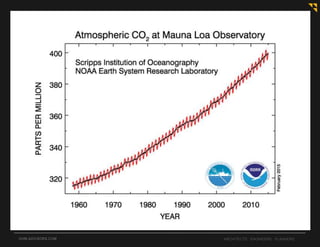
  • #12 The climate model on the left on the previous slide assumed CO2 levels would peak between 2010 and 2020. Of course, we can see that isn’t happening and there appears to be no reason to believe the levels will level off or drop based on this trend (updated in early 2015)
  • #13 **3.2” mark represents 10% increase based on existing 32.2” per year, so these projections are consistent with the previous slide that indicated a 10-20% increase **These projections indicate that the biggest increases are expected to be in mid-Michigan and SE Michigan
  • #14 **3.2” mark represents 10% increase based on existing 32.2” per year, so these projections are consistent with the previous slide that indicated a 10-20% increase **These projections indicate that the biggest increases are expected to be in mid-Michigan and SE Michigan
  • #15 **Illustrates how heavy rains are expected to become more frequent across the US, with the greatest increases expected in the UP, Northern Lower, and SE MI
  • #16 **Illustrates how heavy rains are expected to become more frequent across the US, with the greatest increases expected in the UP, Northern Lower, and SE MI
  • #17 **Illustrates how heavy rains are expected to become more frequent across the US, with the greatest increases expected in the UP, Northern Lower, and SE MI
  • #18 **Previous slides were future projections, but this is the transition to what we’ve already experienced. **Illustrates how heavy rains have become more intense across the US over the past 50 years, with the greatest increases in very heavy precipitation in the Northeast and Midwest
  • #30 How can we deal with Uncertainty? There was uncertainty in the past.
  • #35 showing how the different far term scenario projections affect monthly rainfall levels and extreme storm events. Observe that the Warm/Wet scenario results in higher average rainfall while the Hot/Dry scenario produces slightly larger extreme storms.
  • #36 showing how the different far term scenario projections affect monthly rainfall levels and extreme storm events. Observe that the Warm/Wet scenario results in higher average rainfall while the Hot/Dry scenario produces slightly larger extreme storms.
  • #37 showing how the different far term scenario projections affect monthly rainfall levels and extreme storm events. Observe that the Warm/Wet scenario results in higher average rainfall while the Hot/Dry scenario produces slightly larger extreme storms.
  • #41 Same slide – took out data points to make it easier to view
  • #42 Notice that we are generally in the Upper Bounds of the 95% confidence interval. Increase of ~6% for larger return intervals.
  • #54 Good rule of thumb
  • #55 Move box down
  • #56 Move box down