Latest climate science
Implications for Wales
Vicky Pope
Dec 2012
© Crown copyright Met Office
Latest climate science
                     Implications for Wales
  • What future extremes should we
    prepare for?


  • How can science inform future
    investments?


  • How resilient are our assets to
    future change?
© Crown copyright Met Office
What future extremes
should we prepare for?
UK cold winter December 2010
            Coldest December on record in Wales -3.8 degC
            Record minimum: -18.0 deg C at Llysdinam (Powys) 28 November 2010

• The odds of the cold December 2010 temperatures have halved as a
  result of human-induced climate change
• Unusual circulation patterns can still bring very cold winter months


                                                 Christidis and Stott, Met Office
                                                 Massey et al, University of Oxford, Met Office
                                                                                              4
Extreme weather
                                   From drought...


     2 dry winters
Oct 2010 – March 2012 Rainfall
       % of 1971-2000 average
Extreme weather
                                          ...to flood


                           Wettest June on record
                                 (180% of average)

2 dry winters               3rd wettest summer on
                                 record for Wales
   Summer 2012 Rainfall          (240% of average)
  % of 1971-2000 average
How can science inform
  future investments?
The Big Prize


• Predicting extremes in weather and climate in the near term
     • Understanding and observing the global climate system
     • Translating hazardous weather into societal impacts


• Projecting what will happen in a warmer world in the long term
     • From global to local scale, centuries to minutes – a seamless approach
     • Risk-based forecasting for society, government and business


 © Crown copyright Met Office
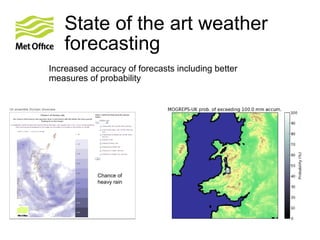
State of the art weather
   forecasting
Increased accuracy of forecasts including better
measures of probability


            Chance of
            heavy rain
Seamless prediction
                     Supporting decision making
               Now


                                                                                 Decadal


                                                                                               Climate
                                                                     Seasonal
                                                          1-month
                       Hours


                                     Days


                                                1-week
Past climate


                                                                                                             Confidence
                                                                                                             boundary
Analysis of past weather
observations to manage
climate risks                                              Monthly to decadal
Eg. Agriculture: this informs                              predictions informs
crop choice and planting Predicting routine and            probability of drought, cold,
date to optimise yields and hazardous weather              heat.                        Global and regional climate
minimise crop failure risk. conditions and                 Contingency planners,        predictions.
                             disseminating tailored and    national and international      Informs mitigation policy
                             timely warnings.              humanitarian response,          and adaptation choices.
                               Public, emergency           government and private          Impacts on water
                               response, international     infrastructure investment       resources, heat stress,
                               disaster risk reduction                                     crops, infrastructure.

                               Forecast lead-time
Moving from uncertainty to
                                         probabilities/likelihoods
                                                      UKCP09
UKCIP02
                                      Very unlikely   Central    Very unlikely
Single                                to be less      estimate   to be more
projection   Summer Rainfall 2080’s   than (10%)      (50%)      than (90%)
How resilient are our
assets to future change?
- Hotter, drier summers??
                                                                                                                                          Impacts
                                                                     - Milder wetter winters
                                                                     - Reduction in snowfall and frost
                                                                     - Increased frequency of intense rainfall events
                                                                     - Decrease groundwater levels
                                                                     - Increased flooding of low-lying coastal areas


Sea level change (central probability estimate)
Medium emission scenario: 22 cm by 2050
                                        60          High
                                                    Medium
  Sea level rise (relative 1990) [cm]


                                        50
                                                    Low
                                        40

                                        30

                                        20

                                        10
                                                                                                     Cardiff              % change in flood
                                         0
                                             2000   2010   2020   2030   2040   2050   2060   2070   2080   2090   2095   frequency of 2-year
                                                                                                                          return period flow
EP2
                    Headline
                    results


© Crown copyright
Met Office
Response to climate change:
       Multi-disciplinary and multi-
           sector partnerships
                                                     UKCP09: UK Climate
                                                         Projections 2009
                                                   Adaptation planning: CCRA
Science partnerships:     Climate Science
e.g. Joint Weather and      Climate Data
    Climate Research     Climate Projections       AVOID: Avoiding dangerous
        Partnership      Weather forecasts                climate change
 Met Office Academic                                Science advice for policy
        partnership      Interpretation for key               makers
     Extreme weather           stakeholders
      initiative Wales                              Climate Science Research
                                                             Partnership
                                                  Improved science and capacity
                                                        in sub-Saharan Africa


 © Crown copyright Met
 Office
1.5km resolution climate model
                                Resolution of Welsh terrain
                 Mountains            Mountains
                 (130km grid)          (60km grid)

Best long-                                             State-of-art
term climate                                             seasonal
models,                                                     model
UKCP09


                 Mountains            Mountains
                  (25km grid)          (1.5km grid)

Current                                                Current UK
global                                                      weather
weather                                                 forecasting
forecasting                                               + ground-
                                                           breaking
                                                      climate work
Opportunities for partnership
      Extreme Weather Initiative Wales

•   1.5km model: extreme rainfall in South Wales
    catchments
    – 20 year hourly rainfall compared with observations for 1.5km grid
      and catchment
    – Benefits of 1.5km model vs 2km driving model for Wales


•   1.5 km model: Climate change over South Wales
    – Use Welsh High Performance Computing
    – Extra model runs to complement time snapshots run at Met Office.
         •   Extract climate change signal from the noise due to climate variability
    – Projections of rainfall where model is skilful for present day
    – Implications for climate change advice and flood risk planning in
      Wales

Latest climate science implications for Wales

  • 1.
    Latest climate science Implicationsfor Wales Vicky Pope Dec 2012 © Crown copyright Met Office
  • 2.
    Latest climate science Implications for Wales • What future extremes should we prepare for? • How can science inform future investments? • How resilient are our assets to future change? © Crown copyright Met Office
  • 3.
  • 4.
    UK cold winterDecember 2010 Coldest December on record in Wales -3.8 degC Record minimum: -18.0 deg C at Llysdinam (Powys) 28 November 2010 • The odds of the cold December 2010 temperatures have halved as a result of human-induced climate change • Unusual circulation patterns can still bring very cold winter months Christidis and Stott, Met Office Massey et al, University of Oxford, Met Office 4
  • 5.
    Extreme weather From drought... 2 dry winters Oct 2010 – March 2012 Rainfall % of 1971-2000 average
  • 6.
    Extreme weather ...to flood Wettest June on record (180% of average) 2 dry winters 3rd wettest summer on record for Wales Summer 2012 Rainfall (240% of average) % of 1971-2000 average
  • 7.
    How can scienceinform future investments?
  • 8.
    The Big Prize •Predicting extremes in weather and climate in the near term • Understanding and observing the global climate system • Translating hazardous weather into societal impacts • Projecting what will happen in a warmer world in the long term • From global to local scale, centuries to minutes – a seamless approach • Risk-based forecasting for society, government and business © Crown copyright Met Office
  • 9.
    State of theart weather forecasting Increased accuracy of forecasts including better measures of probability Chance of heavy rain
  • 10.
    Seamless prediction Supporting decision making Now Decadal Climate Seasonal 1-month Hours Days 1-week Past climate Confidence boundary Analysis of past weather observations to manage climate risks Monthly to decadal Eg. Agriculture: this informs predictions informs crop choice and planting Predicting routine and probability of drought, cold, date to optimise yields and hazardous weather heat. Global and regional climate minimise crop failure risk. conditions and Contingency planners, predictions. disseminating tailored and national and international Informs mitigation policy timely warnings. humanitarian response, and adaptation choices. Public, emergency government and private Impacts on water response, international infrastructure investment resources, heat stress, disaster risk reduction crops, infrastructure. Forecast lead-time
  • 11.
    Moving from uncertaintyto probabilities/likelihoods UKCP09 UKCIP02 Very unlikely Central Very unlikely Single to be less estimate to be more projection Summer Rainfall 2080’s than (10%) (50%) than (90%)
  • 12.
    How resilient areour assets to future change?
  • 13.
    - Hotter, driersummers?? Impacts - Milder wetter winters - Reduction in snowfall and frost - Increased frequency of intense rainfall events - Decrease groundwater levels - Increased flooding of low-lying coastal areas Sea level change (central probability estimate) Medium emission scenario: 22 cm by 2050 60 High Medium Sea level rise (relative 1990) [cm] 50 Low 40 30 20 10 Cardiff % change in flood 0 2000 2010 2020 2030 2040 2050 2060 2070 2080 2090 2095 frequency of 2-year return period flow
  • 14.
    EP2 Headline results © Crown copyright Met Office
  • 15.
    Response to climatechange: Multi-disciplinary and multi- sector partnerships UKCP09: UK Climate Projections 2009 Adaptation planning: CCRA Science partnerships: Climate Science e.g. Joint Weather and Climate Data Climate Research Climate Projections AVOID: Avoiding dangerous Partnership Weather forecasts climate change Met Office Academic Science advice for policy partnership Interpretation for key makers Extreme weather stakeholders initiative Wales Climate Science Research Partnership Improved science and capacity in sub-Saharan Africa © Crown copyright Met Office
  • 16.
    1.5km resolution climatemodel Resolution of Welsh terrain Mountains Mountains (130km grid) (60km grid) Best long- State-of-art term climate seasonal models, model UKCP09 Mountains Mountains (25km grid) (1.5km grid) Current Current UK global weather weather forecasting forecasting + ground- breaking climate work
  • 17.
    Opportunities for partnership Extreme Weather Initiative Wales • 1.5km model: extreme rainfall in South Wales catchments – 20 year hourly rainfall compared with observations for 1.5km grid and catchment – Benefits of 1.5km model vs 2km driving model for Wales • 1.5 km model: Climate change over South Wales – Use Welsh High Performance Computing – Extra model runs to complement time snapshots run at Met Office. • Extract climate change signal from the noise due to climate variability – Projections of rainfall where model is skilful for present day – Implications for climate change advice and flood risk planning in Wales

Editor's Notes

  • #7 485 mm rainfall for Wales summer 2012 Average – 270.6mm Wettest June on record – 205mm (avg 86.2mm)
  • #9 Increasing model resolution Observing the current state of the global climate system A seamless approach to modelling prediction Regional-scale modelling and services
  • #11 The Vuvuzela of seamless prediction: The Met Office is able to make predictions on all timescales from now until a century ahead. Analysis of past weather data is also useful to understand weather risks today – for example what is the likelihood of a particular storm event occurring. On longer timescales the confidence boundary gets wider – however if the climate information is applied in an appropriate manner it provides extremely useful information to inform adaptation decision making.
  • #12 United Kingdom Climate Projections 2009 (UKCP09) In 2009 the Met Office Hadley Centre, in partnership with others, published the latest comprehensive climate projections for the UK. This DEFRA funded, 7 year project has concentrated on providing the UK with climate projections that will enable risk based decision-making and tailored impacts studies. The latest projections are therefore probabilistic in nature, providing PDFs of climate variables throughout many periods over this century at a horizontal resolution of 25km. The predictions were generated using Met Office Hadley Centre global and regional climate models using the different economic scenarios developed by the IPCC. Uncertainties in key climate governing processes (ocean, atmosphere, carbon cycle) and natural variability are represented along with information from different global models. Information is supplied for a range of climate variables on monthly, seasonal and annual timescales and has also been aggregated for particular regions of the UK such as administration regions and river basins. This information is the basis on which the UK government wants the country to prepare and adapt to climate change. Applications for advising e.g. wind power, water services
  • #14 UKCP09 impacts for Wales -hotter, drier summers -Increase in extremely warm days -Milder wetter winters -Reduction in snowfall and frost -Increased frequency of intense rainfall events -Decrease groundwater levels -Increased flooding of low-lying coastal areas UK Climate Change Risk Assessment (DEFRA, Welsh Assembly funding) - Uses UKCP09 projections (created by Met Office) The Met Office acts to ensure quality control of applications of UKCP09 information, and its application to sector impacts. The Met Office are involved at all levels of the science and application. Energy sector champion and analyst Regional workshop for Wales on 21 September.
  • #15 Climate Change Adaptation Planning Guide: This schematic gives the user a guide to when the energy industry should plan and adapt to climate change, based on the results of this project. The assessment is based on a judgement of the level of risk posed by climate change across the UK. In practice, adaptation plans will need to be location specific and should take in to account the resilience of the existing infrastructure. Examples of EP2 achievements: Investigated future wind resource, enabling the industry to understand the continued uncertainty of future wind power. This will assist risk management and investment decisions. Modelled future soil conditions and their impact on cables. This has helped companies understand the cost and benefits of installing cables for a more resilient future network. Built a tool to enable UK coastal and marine sites of interest to be screened to assess if sea level rise should be considered in more detail. Investigated how the urban heat island effect may change in the future, so that network companies can develop plans for their infrastructure in cities. Examples of some of the project’s findings: With a few exceptions, such as the thermal ratings of equipment and apparatus, there is currently no evidence to support adjusting network design standards. For example, existing design standards for overhead line conductors do not require change. Soil conditions will change — higher temperatures and seasonal differences in soil moisture are expected. Future conditions could be included in cable rating studies by increasing average summer soil temperatures in the models by approximately 0.5 °C per decade. The output of thermal power stations (and in particular combined cycle gas turbines) could be suppressed, with higher air temperature meaning lower air density and lower mass flow. Conditions at each location should be considered, especially during redesign or new build and, if appropriate, adaptation planned. Historical climatologies are no longer valid because climate is not stationary. The new climatologies that take account of climate change are already being adopted and will improve demand forecasting and planning out to 10 years ahead.