Inoculation Strategies for
      Victims of Viruses and
      the Sum-of-Squares
      Partition Problem
James Aspnes, Kevin Chang,
 and Aleksandr Yampolskiy
     (Yale University)
        Copyright (C) 2005 by Aleksandr
                  Yampolskiy
Outline

Ø Motivation
n Our Model
n Nash Strategies
n Optimal Strategies
n Sum-of-Squares Partition Problem
n Conclusion
               Copyright (C) 2005 by Aleksandr
                         Yampolskiy
Question: Will you install anti-virus
software?


               Norton AntiVirus 2005 = $49.95


                Value of your data = $350.00
                Infection probability = 1/10
                Expected loss = $35.00
             Copyright (C) 2005 by Aleksandr
                       Yampolskiy
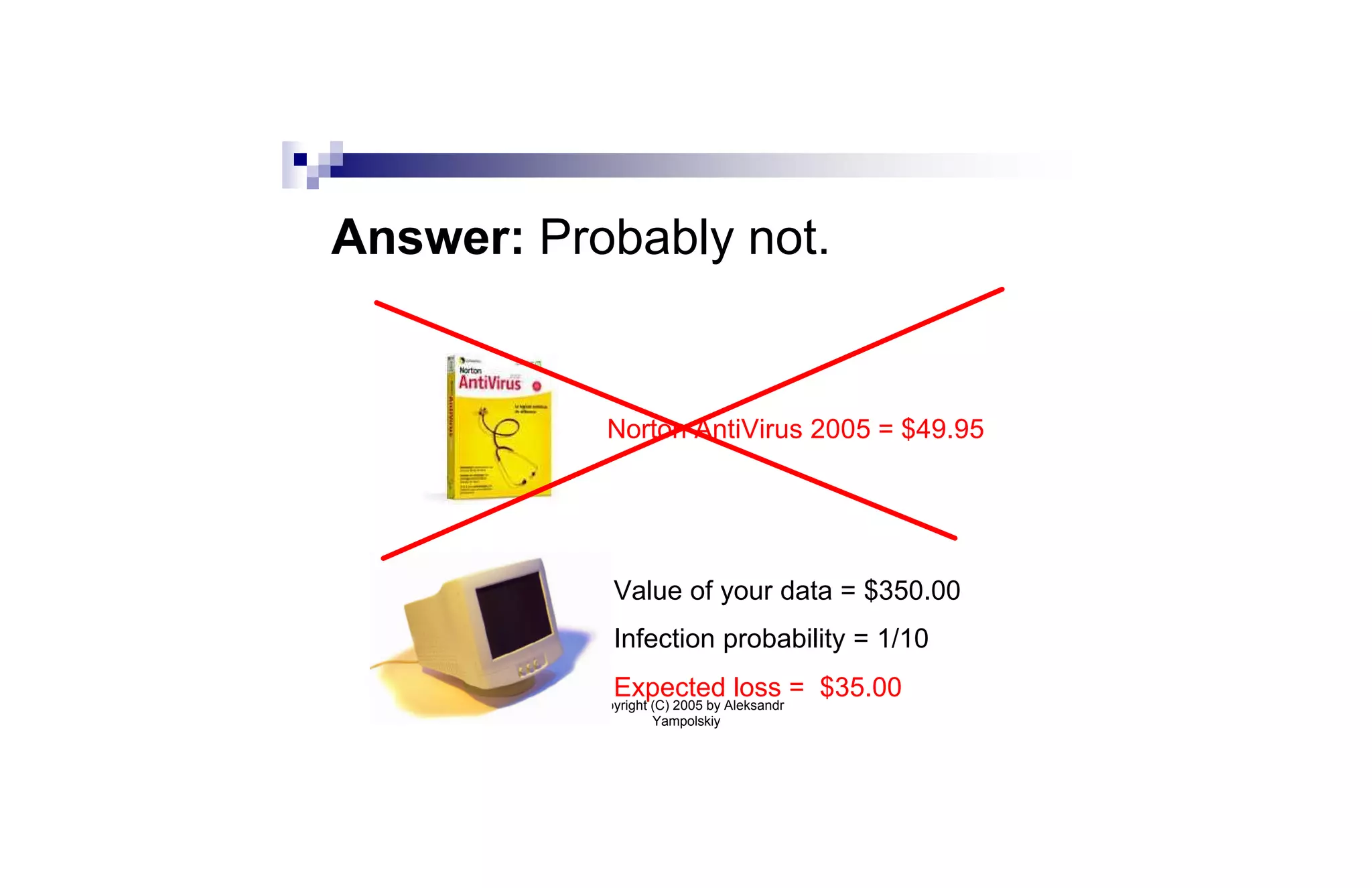
Answer: Probably not.


            Norton AntiVirus 2005 = $49.95


             Value of your data = $350.00
             Infection probability = 1/10
             Expected loss = $35.00
          Copyright (C) 2005 by Aleksandr
                    Yampolskiy
This selfish behavior…
n   …fails to achieve the social optimum.


                  Copyright (C) 2005 by Aleksandr
                            Yampolskiy
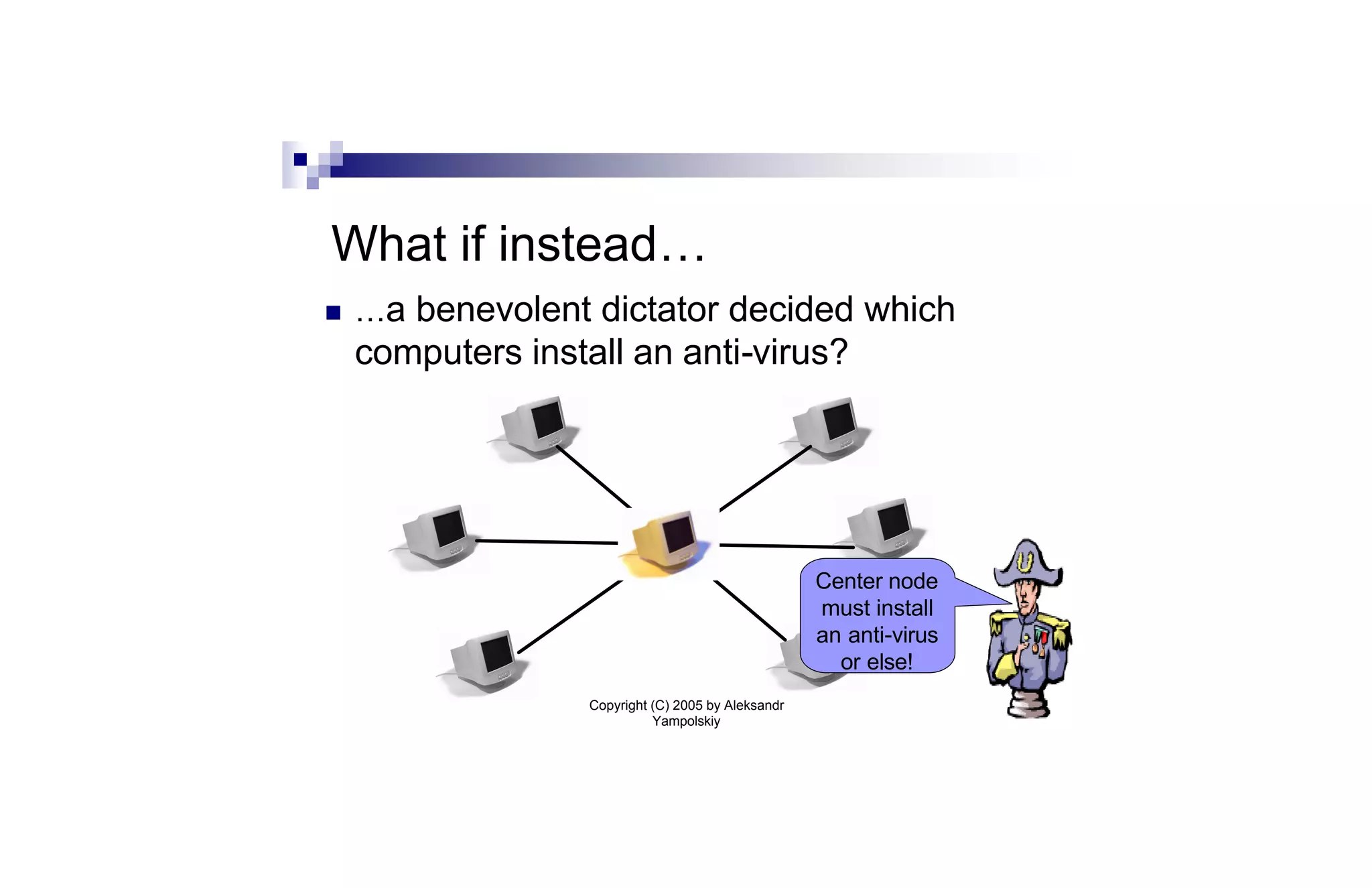
What if instead…
n   …a benevolent dictator decided which
    computers install an anti-virus?


                                                     Center node
                                                     must install
                                                     an anti-virus
                                                       or else!
                   Copyright (C) 2005 by Aleksandr
                             Yampolskiy
Outline

n Motivation
Ø Our Model
n Nash Strategies
n Optimal Strategies
n Sum-of-Squares Partition Problem
n Conclusion
               Copyright (C) 2005 by Aleksandr
                         Yampolskiy
Our Model
n The network is an undirected graph
  G = (V,E).
n Installing anti-virus software is a single
  round non-cooperative game.
n The players are the network nodes:
  V = {0,1,…,n-1}.


                  Copyright (C) 2005 by Aleksandr
                            Yampolskiy
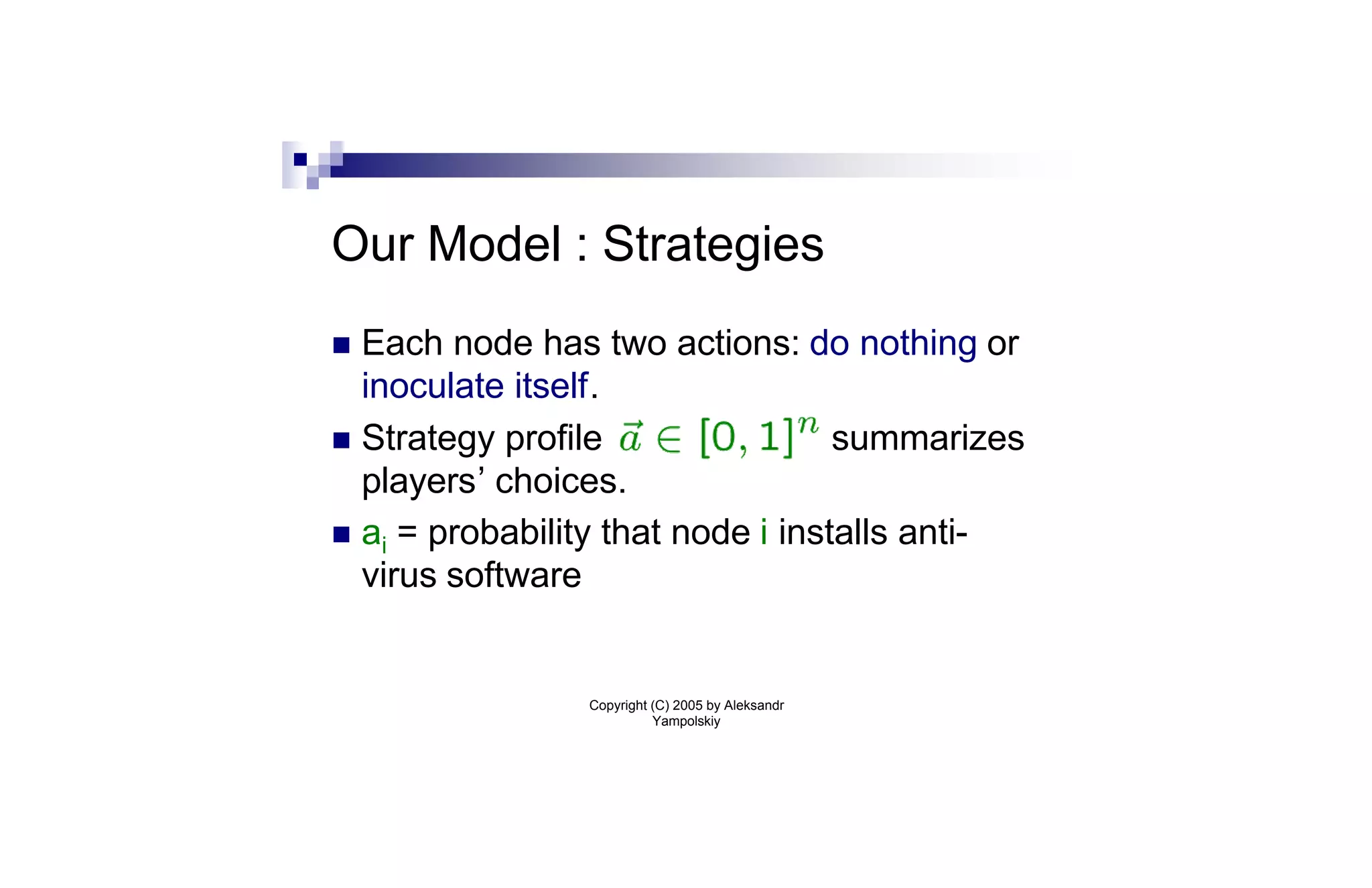
Our Model : Strategies
n Each node has two actions: do nothing or
  inoculate itself.
n Strategy profile                 summarizes
  players’ choices.
n ai = probability that node i installs anti-
  virus software


                Copyright (C) 2005 by Aleksandr
                          Yampolskiy
Our Model : Attack Model
n After the nodes choose their strategies,
  the adversary picks a starting point for
  infection uniformly at random
n Node i gets infected if it has no anti-virus
  software installed and if any of its
  neighbors become infected.


                 Copyright (C) 2005 by Aleksandr
                           Yampolskiy
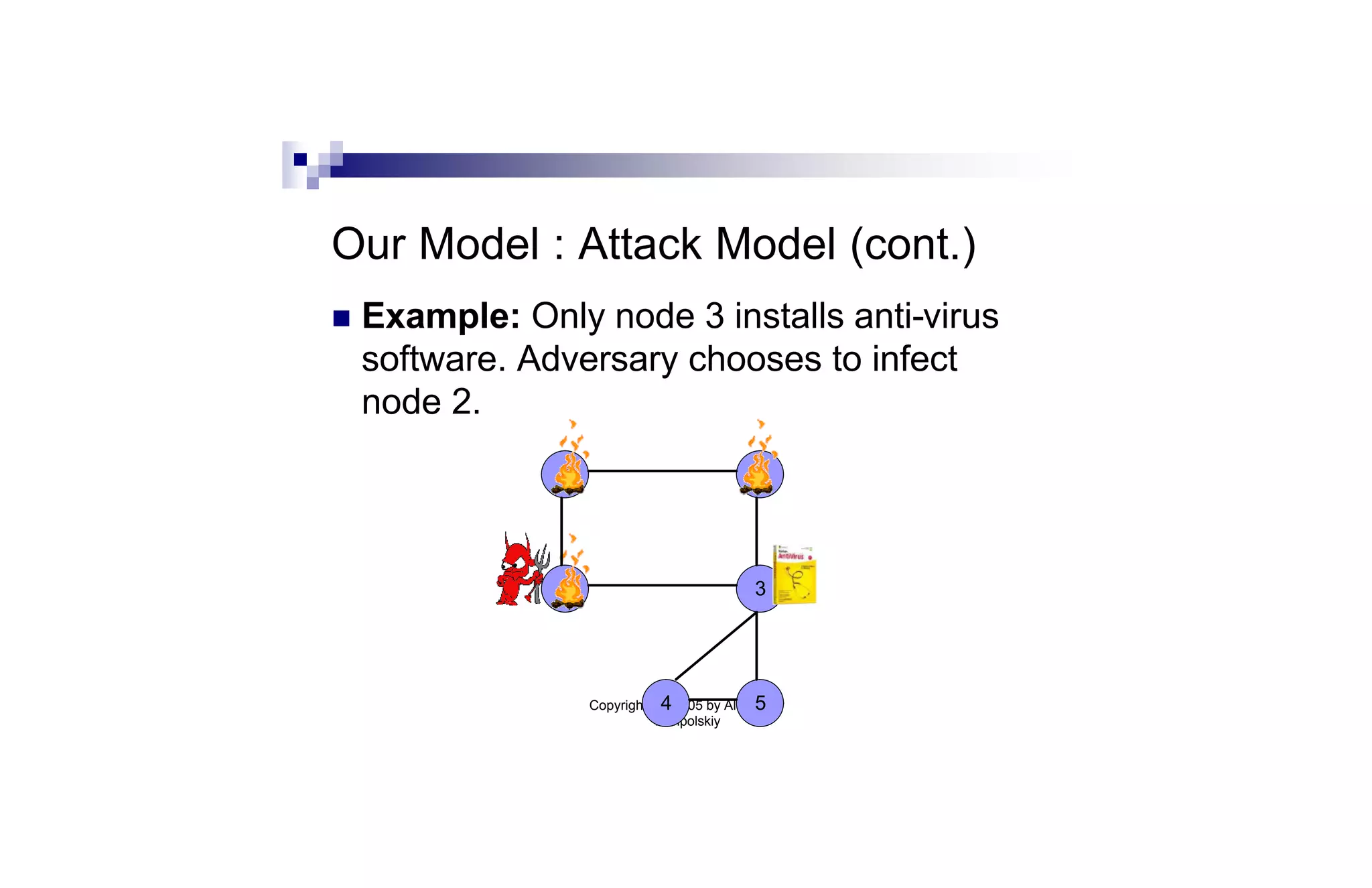
Our Model : Attack Model (cont.)
n   Example: Only node 3 installs anti-virus
    software. Adversary chooses to infect
    node 2.
                0                             1


                2                             3


                                4              5
                    Copyright (C) 2005 by Aleksandr
                              Yampolskiy
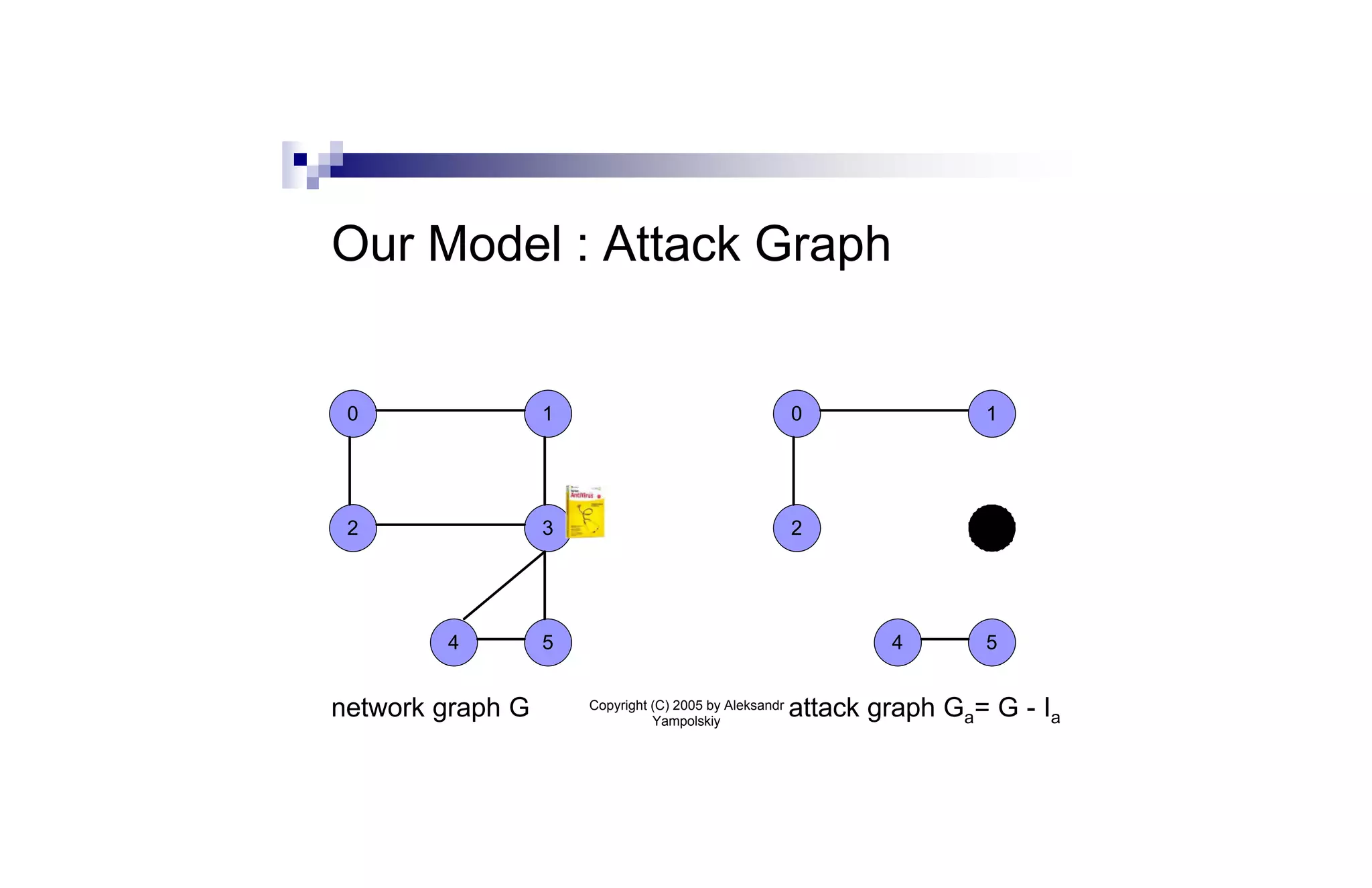
Our Model : Attack Graph


 0                1                                     0               1


 2                3                                     2               3


        4         5                                             4       5


network graph G       Copyright (C) 2005 by Aleksandr
                                Yampolskiy
                                                        attack graph Ga= G - Ia
Our Model : Individual Costs
n Anti-virus software costs C. Expected loss
  from virus is L.
n Cost of strategy    to node i:


n   Here, pi(a) = Pr[i is infected | i does not
    install an anti-virus]

                   Copyright (C) 2005 by Aleksandr
                             Yampolskiy
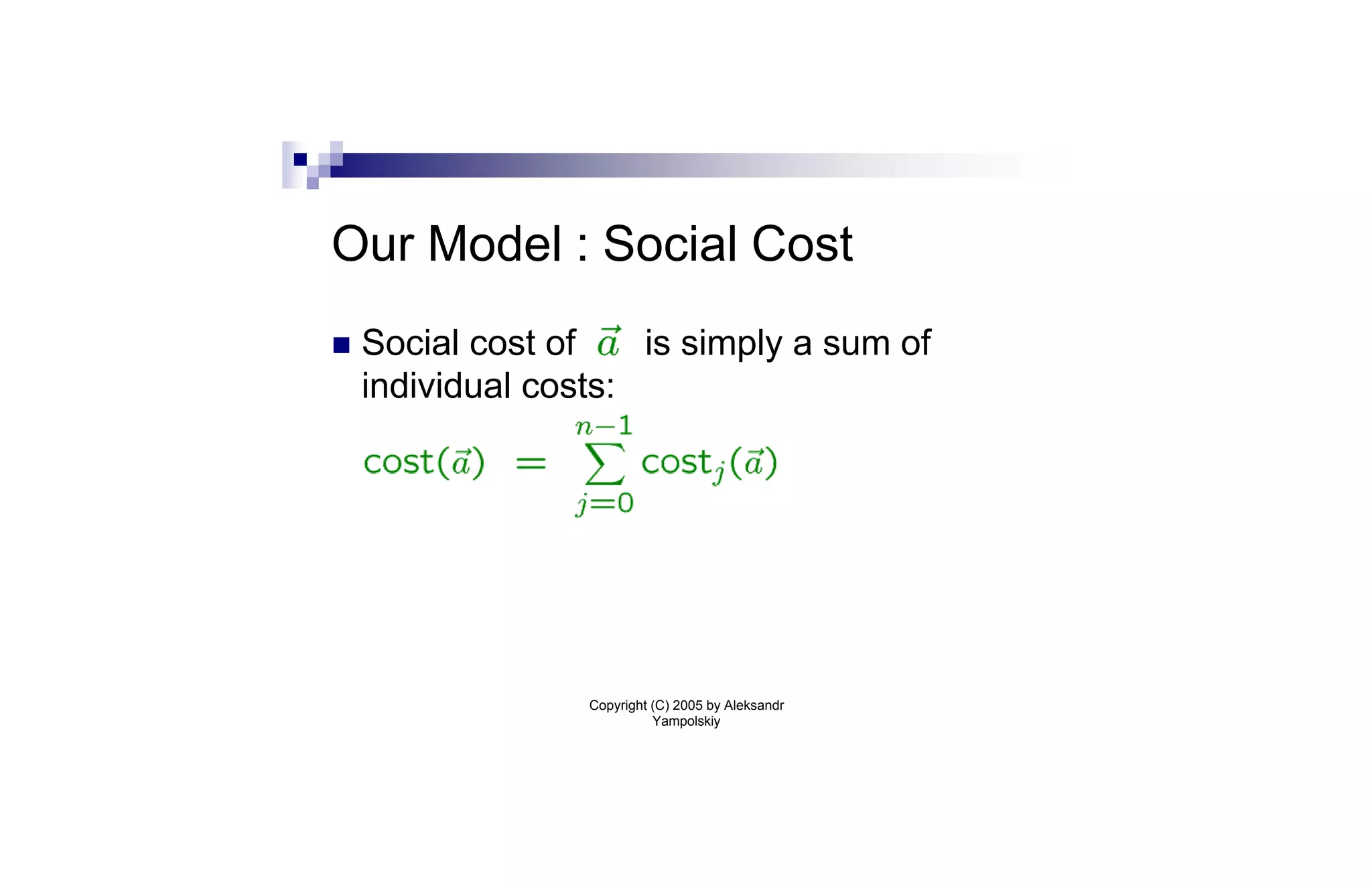
Our Model : Social Cost
n   Social cost of    is simply a sum of
    individual costs:


                  Copyright (C) 2005 by Aleksandr
                            Yampolskiy
Outline

n Motivation
n Our Model
Ø Nash Strategies
n Optimal Strategies
n Sum-of-Squares Partition Problem
n Conclusion
               Copyright (C) 2005 by Aleksandr
                         Yampolskiy
Nash Strategies
n   Def: Strategy profile      is in Nash
    equilibrium if no node can improve its
    payoff by switching to a different strategy:
      for i = 0,...,n-1 and any x 2 [0,1],


n   Fact: Nash strategies do not optimize total
    social cost (cf. Prisoner’s Dilemma)
                   Copyright (C) 2005 by Aleksandr
                             Yampolskiy
Nash Strategies (cont.)

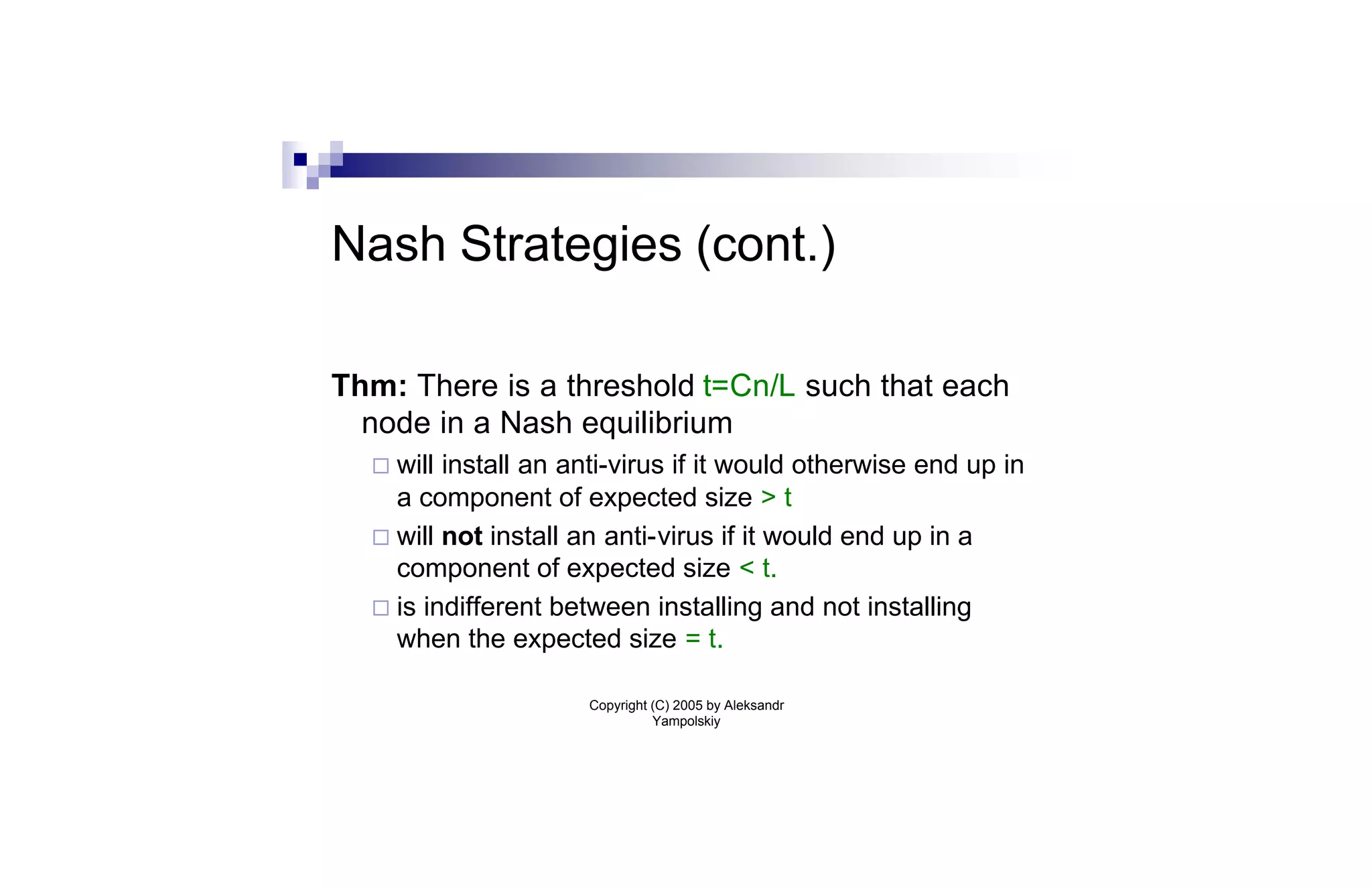
Thm: There is a threshold t=Cn/L such that each
  node in a Nash equilibrium
  ¨ will install an anti-virus if it would otherwise end up in
    a component of expected size > t
  ¨ will not install an anti-virus if it would end up in a
    component of expected size < t.
  ¨ is indifferent between installing and not installing
    when the expected size = t.

                      Copyright (C) 2005 by Aleksandr
                                Yampolskiy
Nash Strategies (cont.)
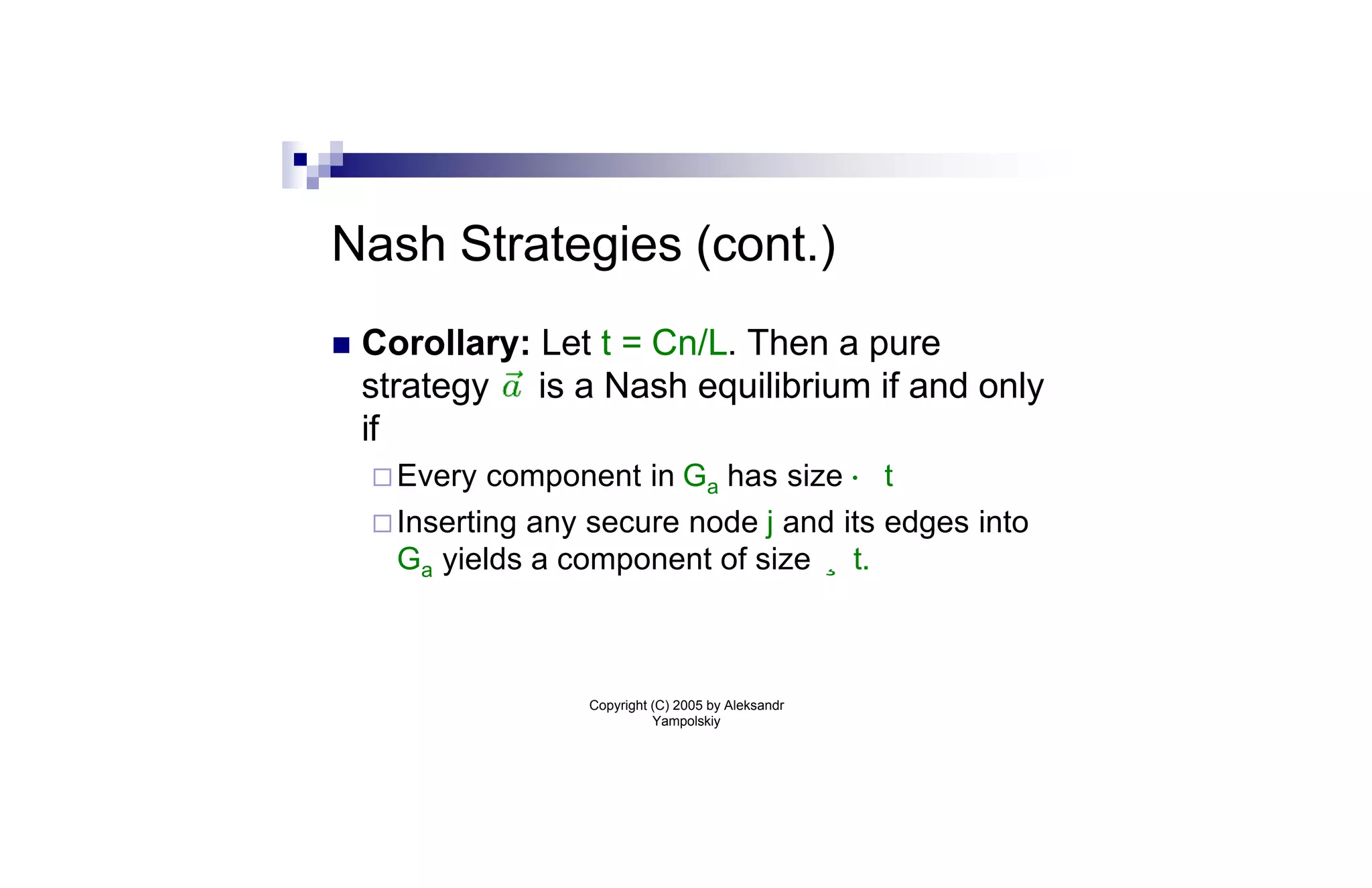
n   Corollary: Let t = Cn/L. Then a pure
    strategy is a Nash equilibrium if and only
    if
    ¨ Every  component in Ga has size · t
    ¨ Inserting any secure node j and its edges into
      Ga yields a component of size ¸ t.


                   Copyright (C) 2005 by Aleksandr
                             Yampolskiy
Nash Strategies (cont.)
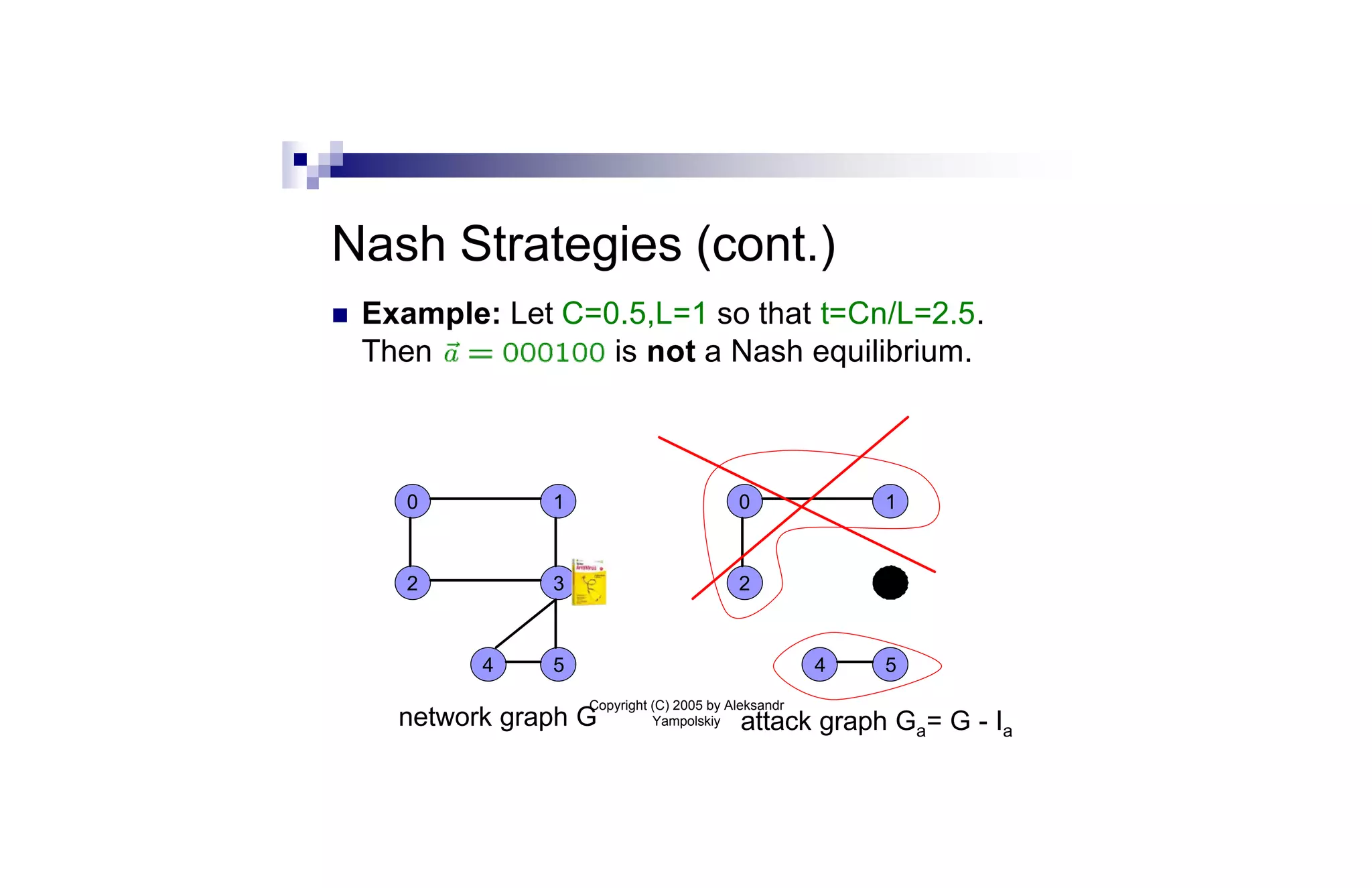
n   Example: Let C=0.5,L=1 so that t=Cn/L=2.5.
    Then            is not a Nash equilibrium.


       0         1                          0              1


       2         3                          2              3


            4    5                                     4   5
                     Copyright (C) 2005 by Aleksandr
      network graph G          Yampolskiy    attack graph Ga= G - Ia
Nash Strategies (cont.)
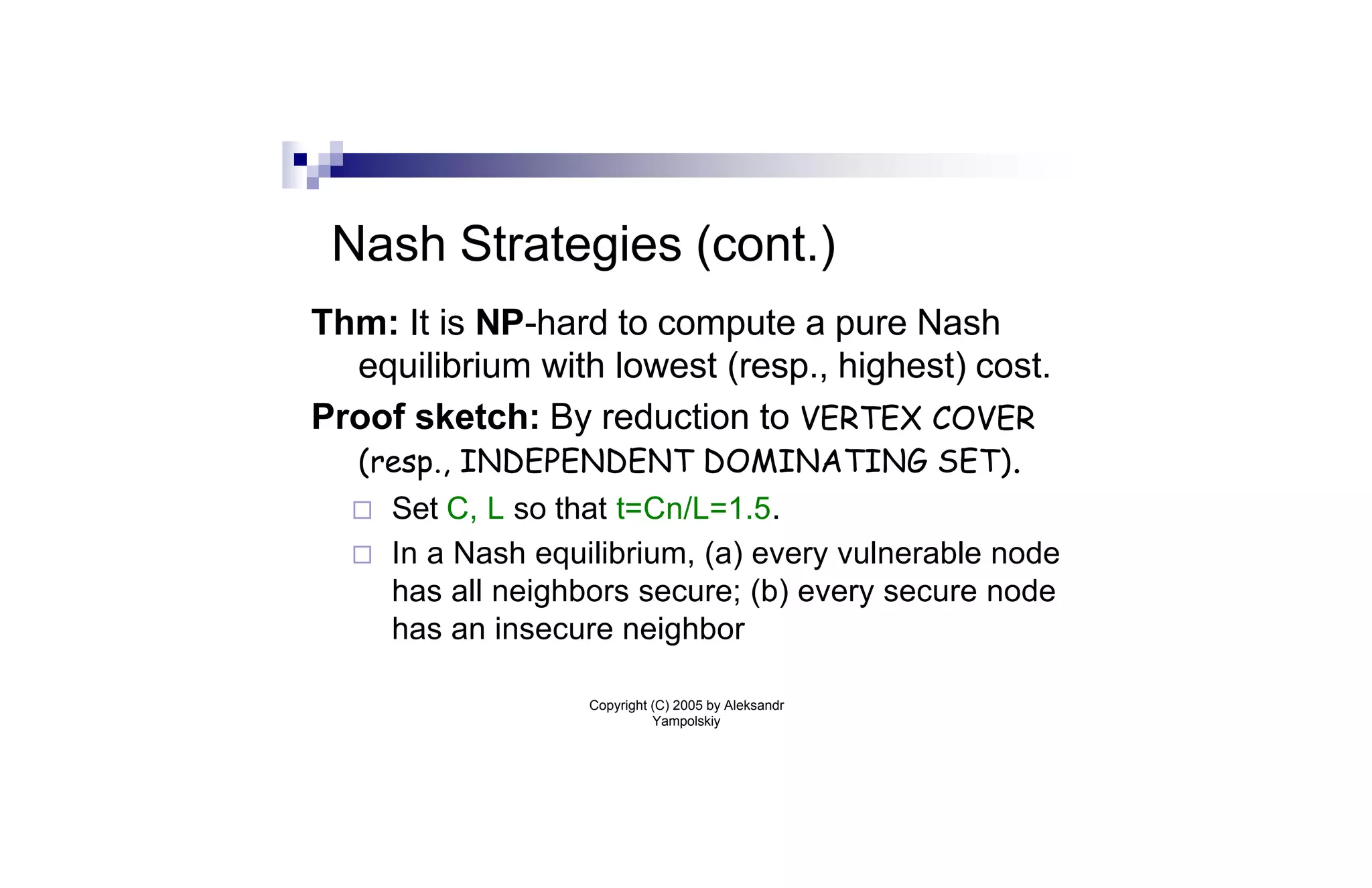
Thm: It is NP-hard to compute a pure Nash
  equilibrium with lowest (resp., highest) cost.
Proof sketch: By reduction to VERTEX COVER
  (resp., INDEPENDENT DOMINATING SET) .
  ¨   Set C, L so that t=Cn/L=1.5.
  ¨   In a Nash equilibrium, (a) every vulnerable node
      has all neighbors secure; (b) every secure node
      has an insecure neighbor

                    Copyright (C) 2005 by Aleksandr
                              Yampolskiy
Nash Strategies (cont.)
n If V’µ V is a minimal vertex cover, then
  installing software on its nodes satisfies
  (a) because V’ is a vertex cover and (b)
  because V’ is minimal.
n Conversely, if V’ are secure nodes in a
  Nash equilibrium, then V’ is a vertex cover
  by (a).

                Copyright (C) 2005 by Aleksandr
                          Yampolskiy
Nash Strategies (cont.)
n Nash Theorem guarantees our game has
  a mixed Nash equilibrium.
n But does it make sense talking about pure
  Nash equilibria?


               Copyright (C) 2005 by Aleksandr
                         Yampolskiy
Nash Strategies (cont.)
Yes, it does!

Thm: If at each step some node with
 suboptimal strategy switches its strategy,
 the system converges to a pure Nash
 equilibrium in · 2n steps.


                Copyright (C) 2005 by Aleksandr
                          Yampolskiy
Price of Anarchy [KP99]
n Price of anarchy measures how far away a
  Nash equilibrium can be from the social
  optimum
n Formally, it is the worst-case ratio between
  cost of Nash equilibrium and cost of social
  optimum
n For network G and costs C, L, we denote it:


                Copyright (C) 2005 by Aleksandr
                          Yampolskiy
Price of Anarchy (cont.)
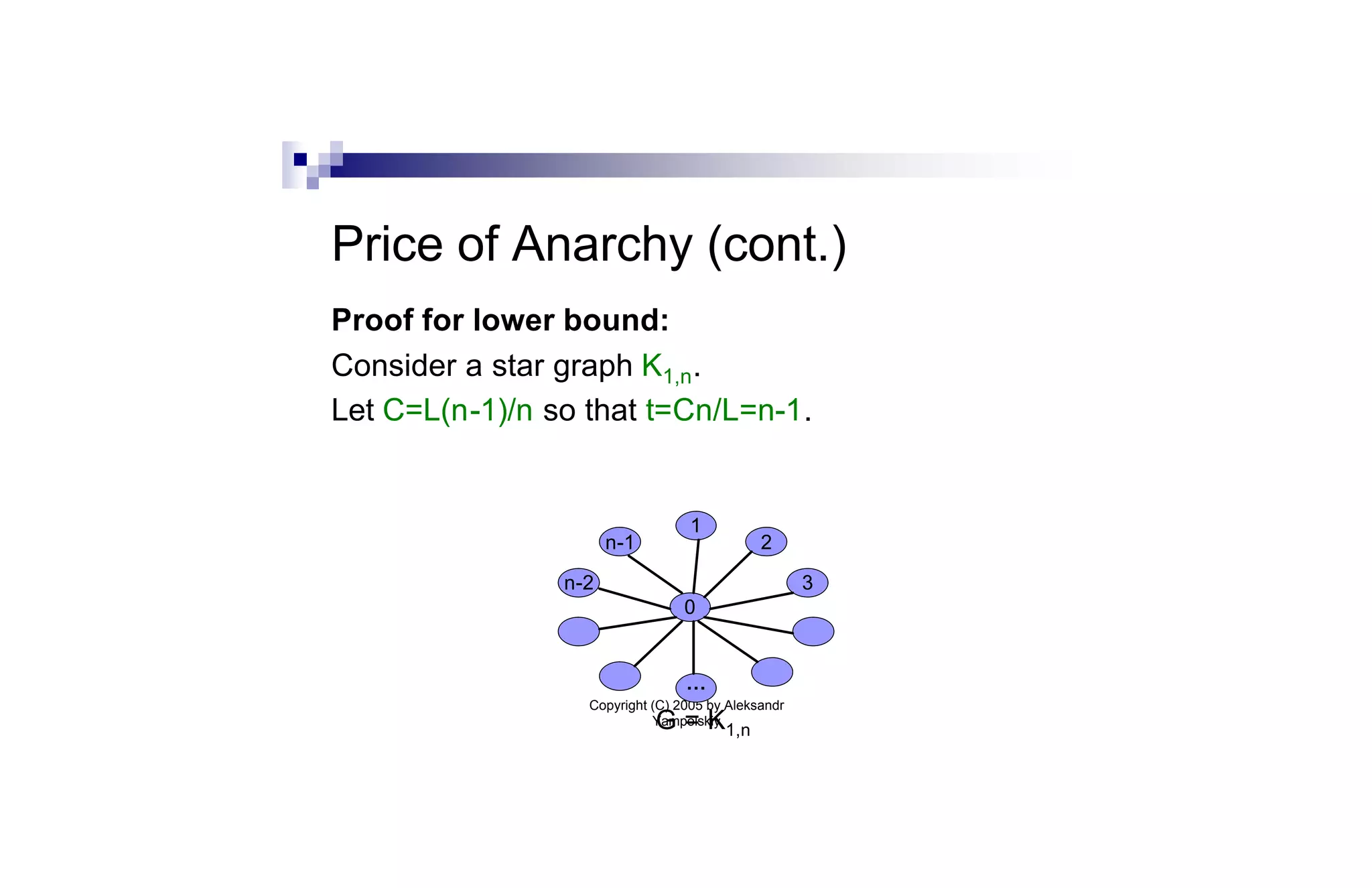
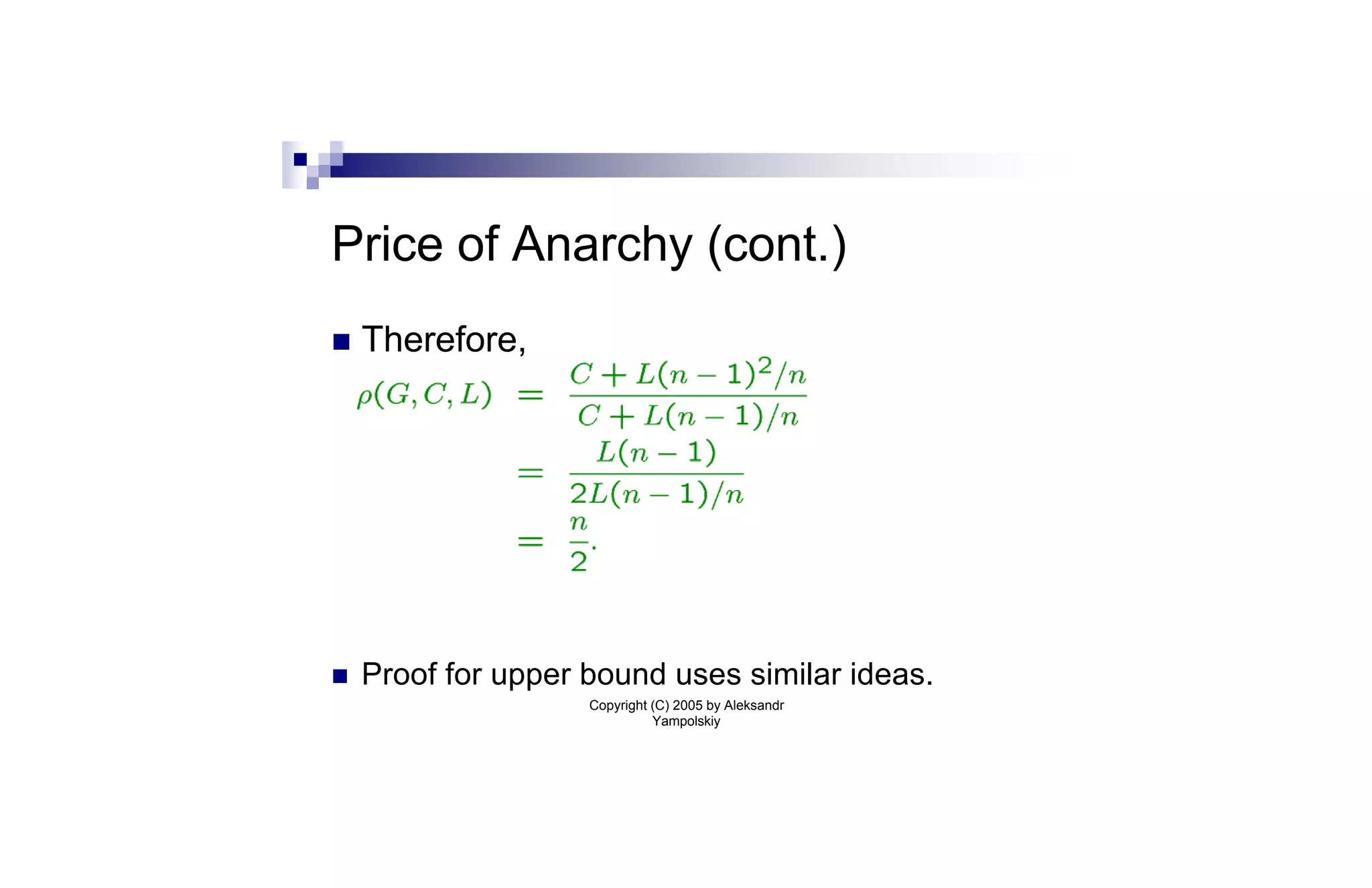
Lower Bound: For a star graph K1,n,
  ρ(G, C, L) = n/2.
Upper Bound: For any graph G and any C, L,
  ρ(G, C, L)· n.


Thm: Price of anarchy in our game is
 ρ(G, C, L) = Θ(n).


                Copyright (C) 2005 by Aleksandr
                          Yampolskiy
Price of Anarchy (cont.)
Proof for lower bound:
Consider a star graph K1,n.
Let C=L(n-1)/n so that t=Cn/L=n-1.


                                  1
                      n-1                    2

                n-2                                 3
                                 0


                                 …
                  Copyright (C) 2005 by Aleksandr
                            G = K1,n
                            Yampolskiy
Price of Anarchy (cont.)
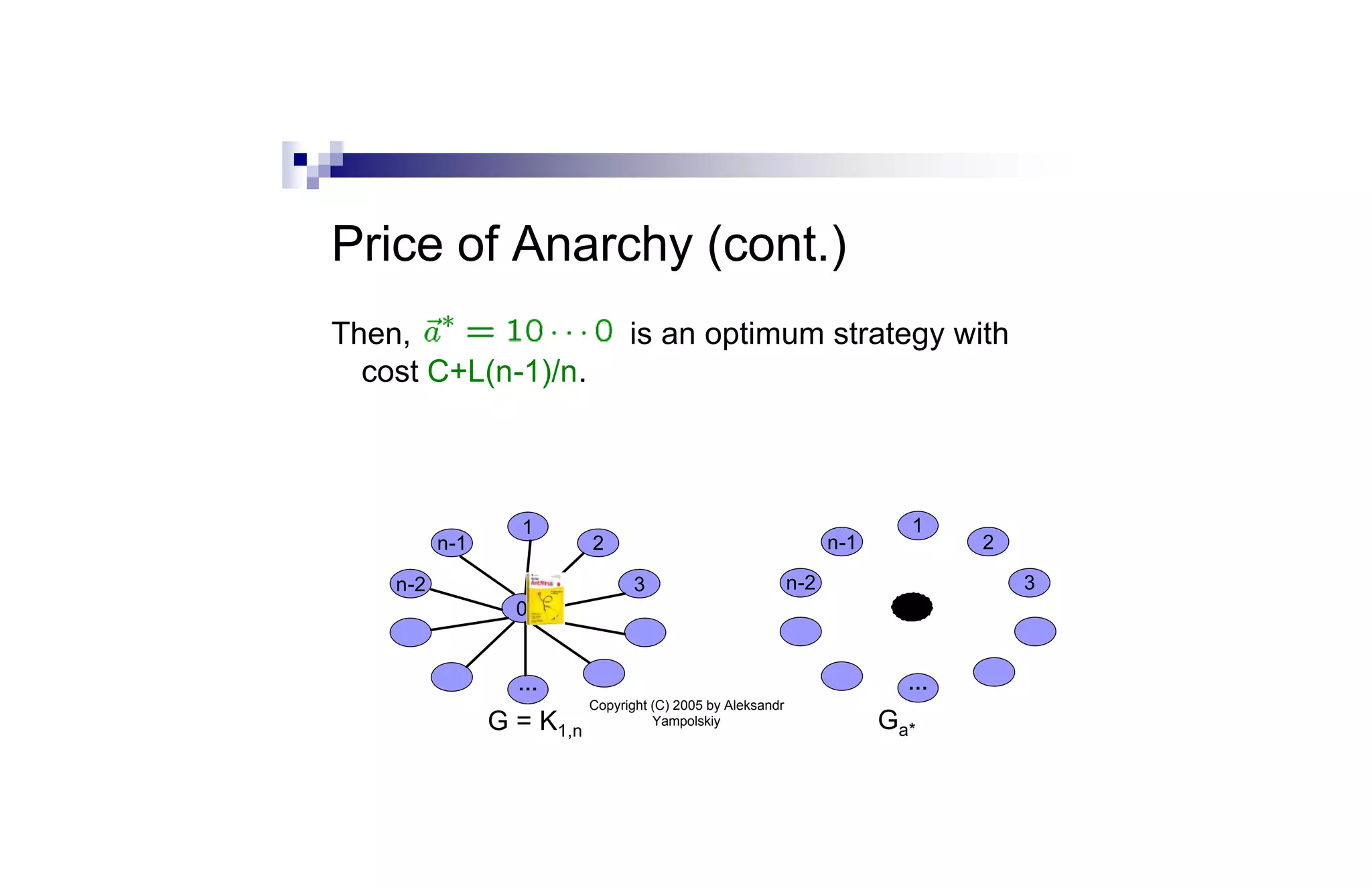
Then,                            is an optimum strategy with
  cost C+L(n-1)/n.


                  1                                                        1
          n-1              2                                       n-1         2

    n-2                           3                          n-2                   3
                  0                                                        0


                  …                                                        …
                           Copyright (C) 2005 by Aleksandr
                G = K1,n             Yampolskiy                          Ga*
Price of Anarchy (cont.)
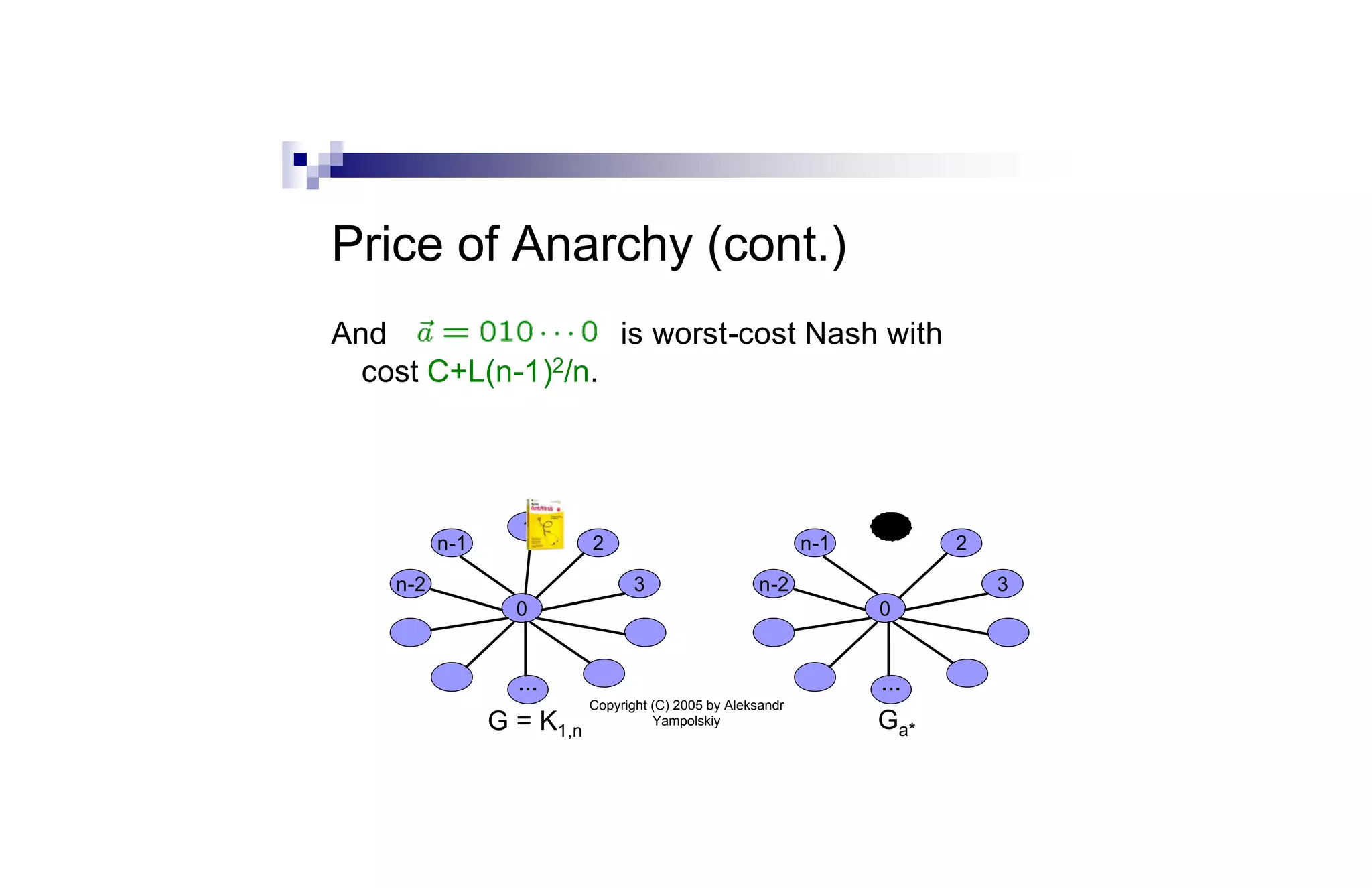
And                 is worst-cost Nash with
  cost C+L(n-1)2/n.


                  1                                                1
          n-1              2                                 n-1         2

    n-2                           3                   n-2                    3
                  0                                                0


                  …                                                …
                           Copyright (C) 2005 by Aleksandr
                G = K1,n             Yampolskiy                    Ga*
Price of Anarchy (cont.)
n   Therefore,


n   Proof for upper bound uses similar ideas.
                    Copyright (C) 2005 by Aleksandr
                              Yampolskiy
Outline

n Motivation
n Our Model
n Nash Strategies
Ø Optimal Strategies
n Sum-of-Squares Partition Problem
n Conclusion
               Copyright (C) 2005 by Aleksandr
                         Yampolskiy
Optimal Strategies
n So, allowing users to selfishly choose
  whether or not to install anti-virus software
  may be very inefficient
n Instead, let’s have a benevolent dictator
  compute and impose a solution
  maximizing overall welfare


                 Copyright (C) 2005 by Aleksandr
                           Yampolskiy
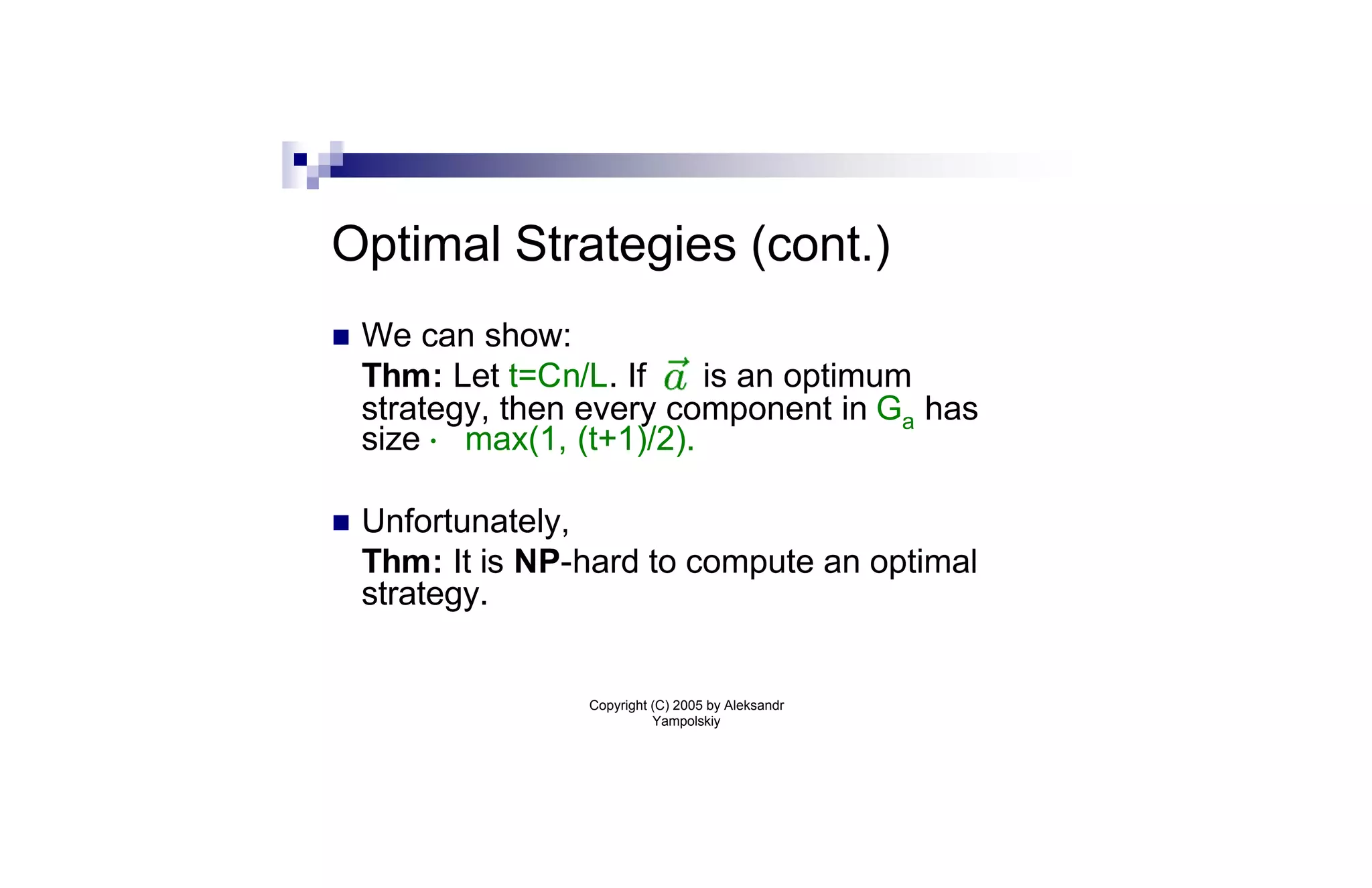
Optimal Strategies (cont.)
n   We can show:
    Thm: Let t=Cn/L. If     is an optimum
    strategy, then every component in Ga has
    size · max(1, (t+1)/2).

n   Unfortunately,
    Thm: It is NP-hard to compute an optimal
    strategy.


                  Copyright (C) 2005 by Aleksandr
                            Yampolskiy
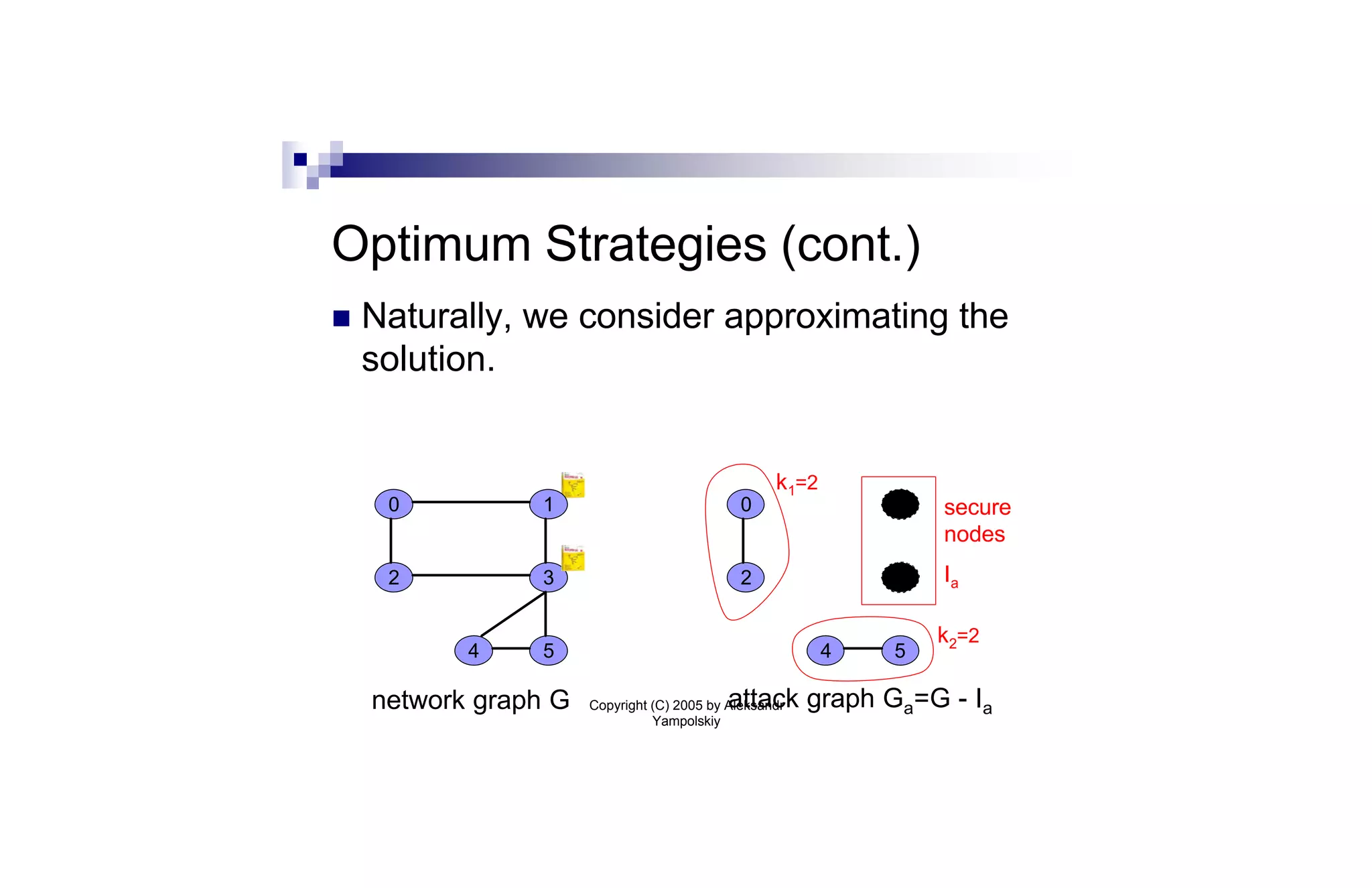
Optimum Strategies (cont.)
n   Naturally, we consider approximating the
    solution.


                                                   k1=2
     0          1                             0               1   secure
                                                                  nodes
     2          3                             2               3   Ia

                                                                  k2=2
           4    5                                         4   5

    network graph G                         attack graph Ga=G - Ia
                      Copyright (C) 2005 by Aleksandr
                                Yampolskiy
Optimum Strategies (cont.)
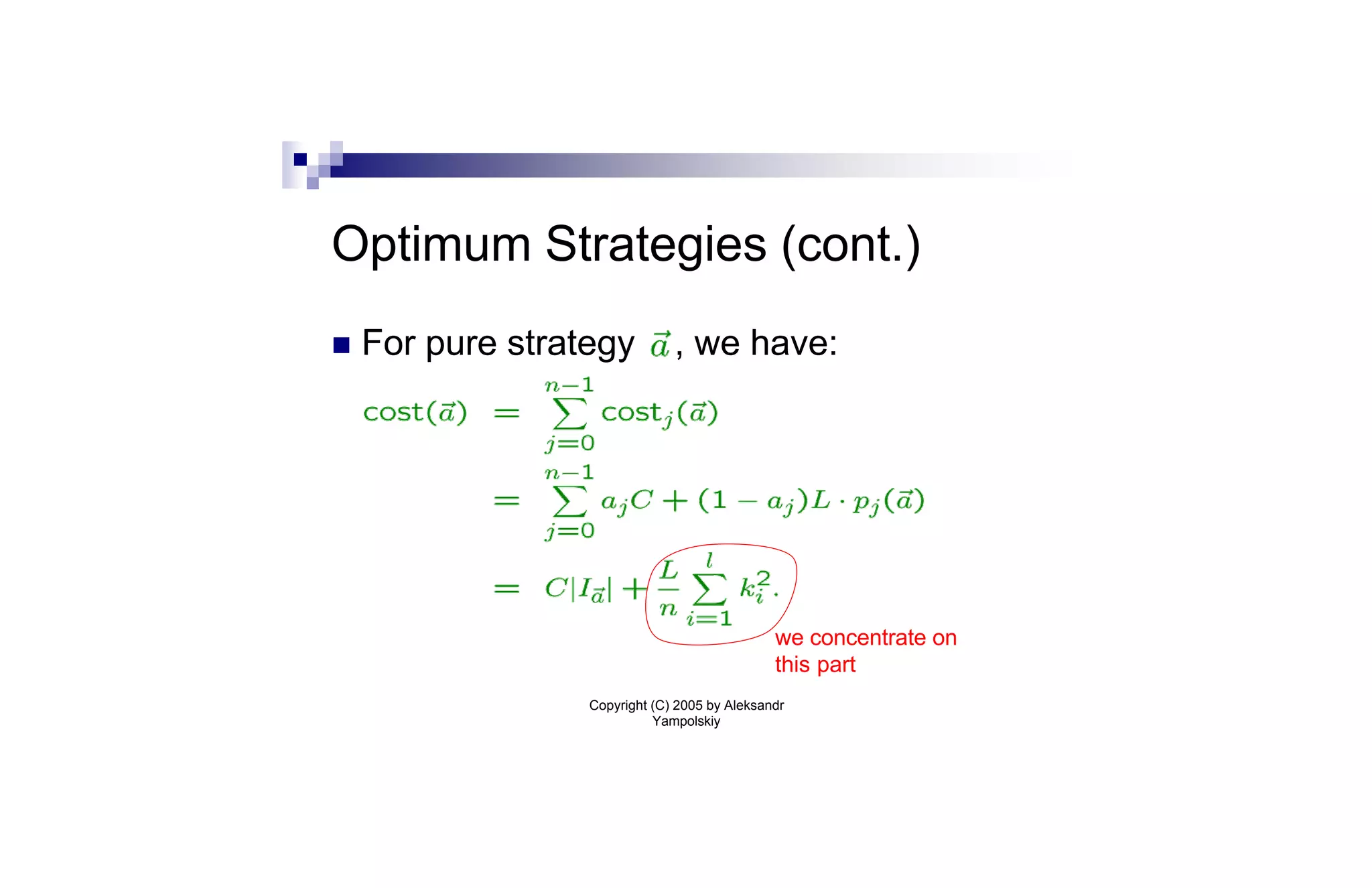
n   For pure strategy          , we have:


                                               we concentrate on
                                               this part
                  Copyright (C) 2005 by Aleksandr
                            Yampolskiy
Outline

n Motivation
n Our Model
n Nash Strategies
n Optimal Strategies
Ø Sum-of-Squares Partition Problem
n Conclusion
               Copyright (C) 2005 by Aleksandr
                         Yampolskiy
Sum-of-Squares Partition
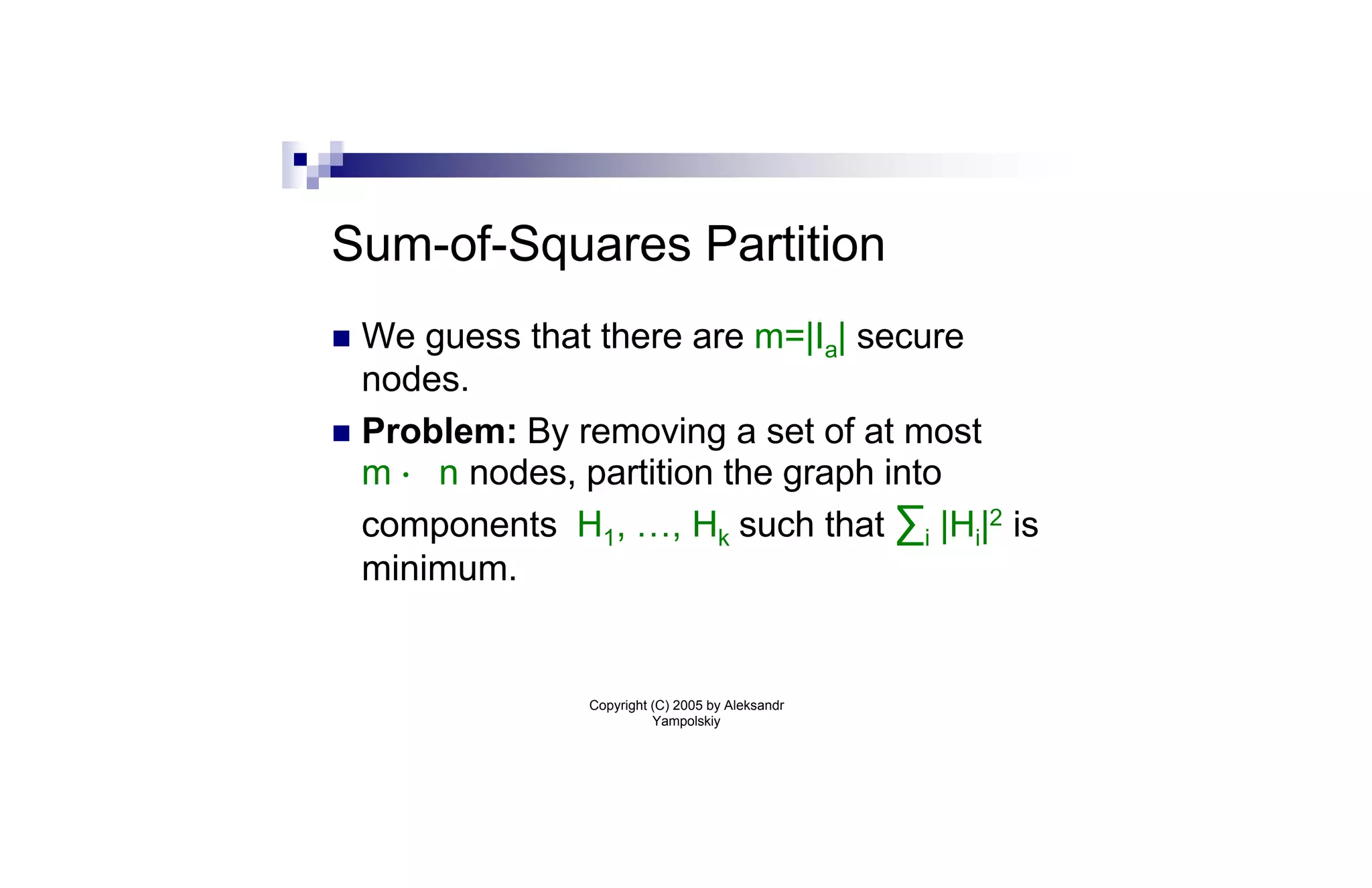
n We guess that there are m=|Ia| secure
  nodes.
n Problem: By removing a set of at most
  m · n nodes, partition the graph into
  components H1, …, Hk such that ∑i |Hi|2 is
  minimum.


                Copyright (C) 2005 by Aleksandr
                          Yampolskiy
Sum-of-Squares Partition (cont.)
Thm: We can find a set of O(log2 n)¢m nodes whose
  removal partitions the graph into components
  H1,…,Hk such that ∑i |Hi|2 · O(1)¢OPT.
Proof sketch: We use the Leighton-Rao sparse cut
  algorithm [LR99]. The approach is similar to greedy
  log n approximation algorithm for set cover. We
  repeatedly remove the node cut that gives the best
  per-node benefit.

                   Copyright (C) 2005 by Aleksandr
                             Yampolskiy
Outline

n Motivation
n Our Model
n Nash Strategies
n Optimal Strategies
n Sum-of-Squares Partition Problem
Ø Conclusion
               Copyright (C) 2005 by Aleksandr
                         Yampolskiy
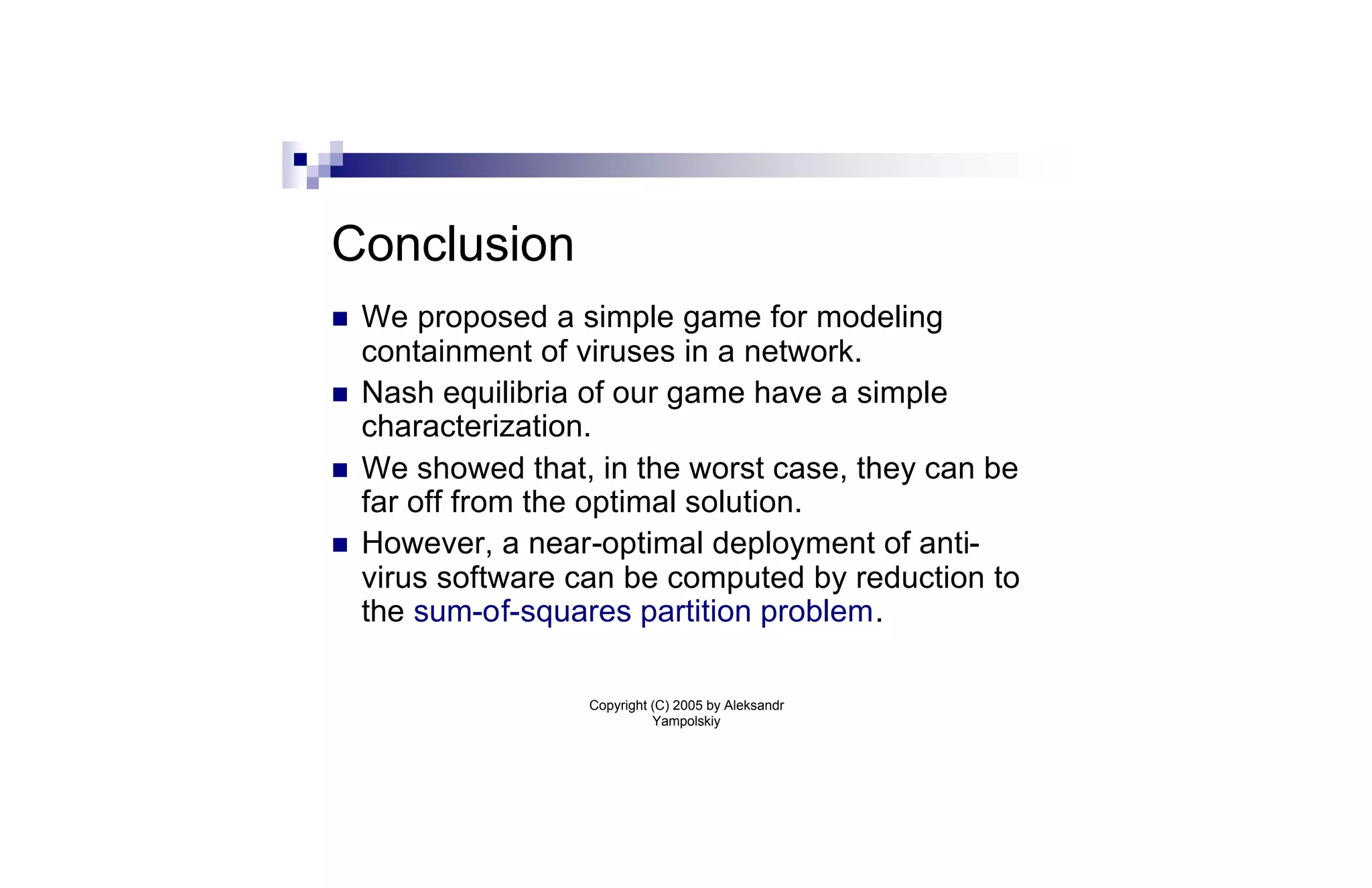
Conclusion
n   We proposed a simple game for modeling
    containment of viruses in a network.
n   Nash equilibria of our game have a simple
    characterization.
n   We showed that, in the worst case, they can be
    far off from the optimal solution.
n   However, a near-optimal deployment of anti-
    virus software can be computed by reduction to
    the sum-of-squares partition problem.

                   Copyright (C) 2005 by Aleksandr
                             Yampolskiy
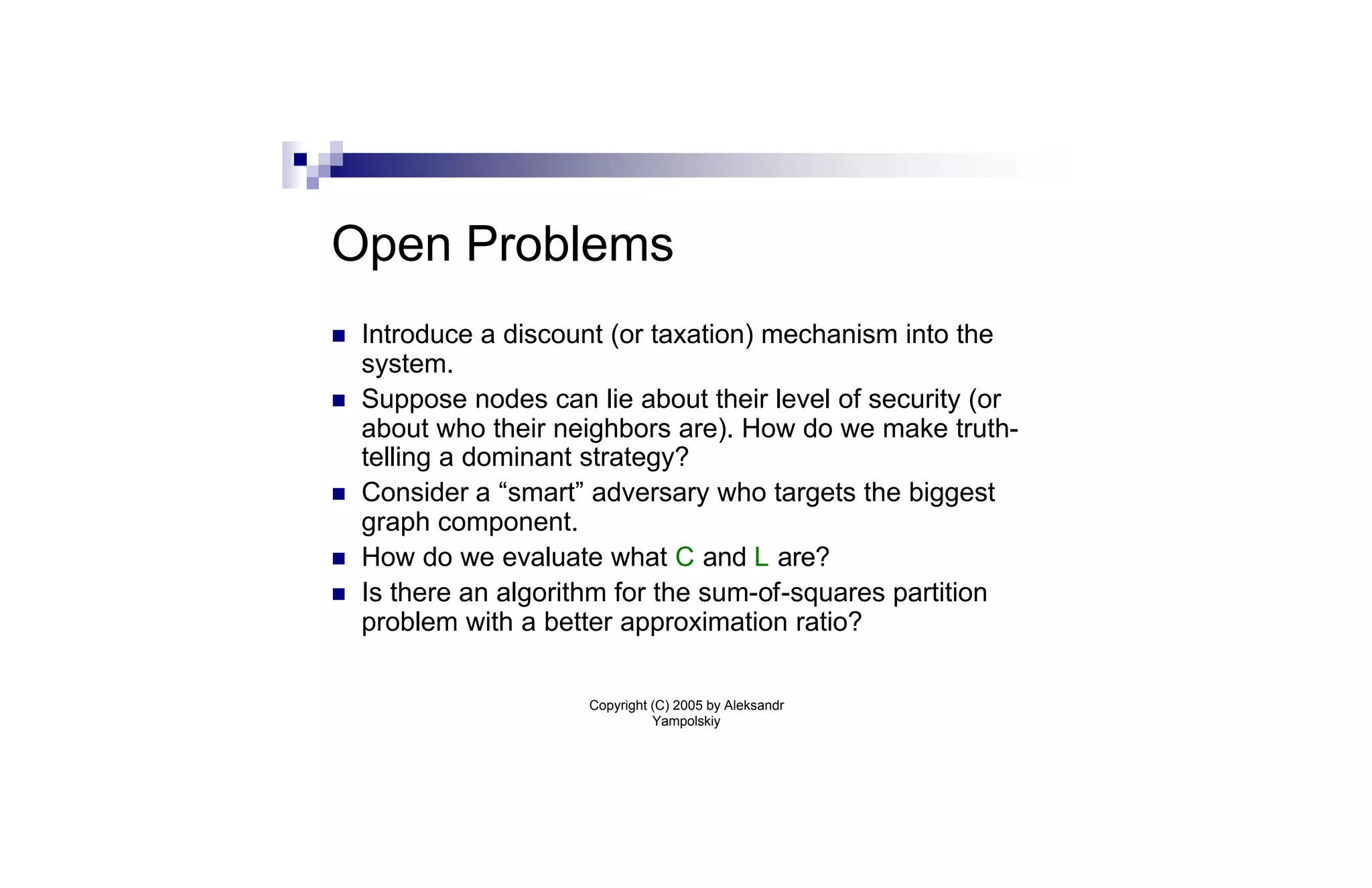
Open Problems
n   Introduce a discount (or taxation) mechanism into the
    system.
n   Suppose nodes can lie about their level of security (or
    about who their neighbors are). How do we make truth-
    telling a dominant strategy?
n   Consider a “smart” adversary who targets the biggest
    graph component.
n   How do we evaluate what C and L are?
n   Is there an algorithm for the sum-of-squares partition
    problem with a better approximation ratio?

                       Copyright (C) 2005 by Aleksandr
                                 Yampolskiy
Acknowledgments
Joan Feigenbaum, Hong Jiang, and Yang
Richard Yang


              Copyright (C) 2005 by Aleksandr
                        Yampolskiy
Thank you!


             Copyright (C) 2005 by Aleksandr
                       Yampolskiy

Inoculation strategies for victims of viruses

  • 1.
    Inoculation Strategies for Victims of Viruses and the Sum-of-Squares Partition Problem James Aspnes, Kevin Chang, and Aleksandr Yampolskiy (Yale University) Copyright (C) 2005 by Aleksandr Yampolskiy
  • 2.
    Outline Ø Motivation n OurModel n Nash Strategies n Optimal Strategies n Sum-of-Squares Partition Problem n Conclusion Copyright (C) 2005 by Aleksandr Yampolskiy
  • 3.
    Question: Will youinstall anti-virus software? Norton AntiVirus 2005 = $49.95 Value of your data = $350.00 Infection probability = 1/10 Expected loss = $35.00 Copyright (C) 2005 by Aleksandr Yampolskiy
  • 4.
    Answer: Probably not. Norton AntiVirus 2005 = $49.95 Value of your data = $350.00 Infection probability = 1/10 Expected loss = $35.00 Copyright (C) 2005 by Aleksandr Yampolskiy
  • 5.
    This selfish behavior… n …fails to achieve the social optimum. Copyright (C) 2005 by Aleksandr Yampolskiy
  • 6.
    What if instead… n …a benevolent dictator decided which computers install an anti-virus? Center node must install an anti-virus or else! Copyright (C) 2005 by Aleksandr Yampolskiy
  • 7.
    Outline n Motivation Ø OurModel n Nash Strategies n Optimal Strategies n Sum-of-Squares Partition Problem n Conclusion Copyright (C) 2005 by Aleksandr Yampolskiy
  • 8.
    Our Model n Thenetwork is an undirected graph G = (V,E). n Installing anti-virus software is a single round non-cooperative game. n The players are the network nodes: V = {0,1,…,n-1}. Copyright (C) 2005 by Aleksandr Yampolskiy
  • 9.
    Our Model :Strategies n Each node has two actions: do nothing or inoculate itself. n Strategy profile summarizes players’ choices. n ai = probability that node i installs anti- virus software Copyright (C) 2005 by Aleksandr Yampolskiy
  • 10.
    Our Model :Attack Model n After the nodes choose their strategies, the adversary picks a starting point for infection uniformly at random n Node i gets infected if it has no anti-virus software installed and if any of its neighbors become infected. Copyright (C) 2005 by Aleksandr Yampolskiy
  • 11.
    Our Model :Attack Model (cont.) n Example: Only node 3 installs anti-virus software. Adversary chooses to infect node 2. 0 1 2 3 4 5 Copyright (C) 2005 by Aleksandr Yampolskiy
  • 12.
    Our Model :Attack Graph 0 1 0 1 2 3 2 3 4 5 4 5 network graph G Copyright (C) 2005 by Aleksandr Yampolskiy attack graph Ga= G - Ia
  • 13.
    Our Model :Individual Costs n Anti-virus software costs C. Expected loss from virus is L. n Cost of strategy to node i: n Here, pi(a) = Pr[i is infected | i does not install an anti-virus] Copyright (C) 2005 by Aleksandr Yampolskiy
  • 14.
    Our Model :Social Cost n Social cost of is simply a sum of individual costs: Copyright (C) 2005 by Aleksandr Yampolskiy
  • 15.
    Outline n Motivation n OurModel Ø Nash Strategies n Optimal Strategies n Sum-of-Squares Partition Problem n Conclusion Copyright (C) 2005 by Aleksandr Yampolskiy
  • 16.
    Nash Strategies n Def: Strategy profile is in Nash equilibrium if no node can improve its payoff by switching to a different strategy: for i = 0,...,n-1 and any x 2 [0,1], n Fact: Nash strategies do not optimize total social cost (cf. Prisoner’s Dilemma) Copyright (C) 2005 by Aleksandr Yampolskiy
  • 17.
    Nash Strategies (cont.) Thm:There is a threshold t=Cn/L such that each node in a Nash equilibrium ¨ will install an anti-virus if it would otherwise end up in a component of expected size > t ¨ will not install an anti-virus if it would end up in a component of expected size < t. ¨ is indifferent between installing and not installing when the expected size = t. Copyright (C) 2005 by Aleksandr Yampolskiy
  • 18.
    Nash Strategies (cont.) n Corollary: Let t = Cn/L. Then a pure strategy is a Nash equilibrium if and only if ¨ Every component in Ga has size · t ¨ Inserting any secure node j and its edges into Ga yields a component of size ¸ t. Copyright (C) 2005 by Aleksandr Yampolskiy
  • 19.
    Nash Strategies (cont.) n Example: Let C=0.5,L=1 so that t=Cn/L=2.5. Then is not a Nash equilibrium. 0 1 0 1 2 3 2 3 4 5 4 5 Copyright (C) 2005 by Aleksandr network graph G Yampolskiy attack graph Ga= G - Ia
  • 20.
    Nash Strategies (cont.) Thm:It is NP-hard to compute a pure Nash equilibrium with lowest (resp., highest) cost. Proof sketch: By reduction to VERTEX COVER (resp., INDEPENDENT DOMINATING SET) . ¨ Set C, L so that t=Cn/L=1.5. ¨ In a Nash equilibrium, (a) every vulnerable node has all neighbors secure; (b) every secure node has an insecure neighbor Copyright (C) 2005 by Aleksandr Yampolskiy
  • 21.
    Nash Strategies (cont.) nIf V’µ V is a minimal vertex cover, then installing software on its nodes satisfies (a) because V’ is a vertex cover and (b) because V’ is minimal. n Conversely, if V’ are secure nodes in a Nash equilibrium, then V’ is a vertex cover by (a). Copyright (C) 2005 by Aleksandr Yampolskiy
  • 22.
    Nash Strategies (cont.) nNash Theorem guarantees our game has a mixed Nash equilibrium. n But does it make sense talking about pure Nash equilibria? Copyright (C) 2005 by Aleksandr Yampolskiy
  • 23.
    Nash Strategies (cont.) Yes,it does! Thm: If at each step some node with suboptimal strategy switches its strategy, the system converges to a pure Nash equilibrium in · 2n steps. Copyright (C) 2005 by Aleksandr Yampolskiy
  • 24.
    Price of Anarchy[KP99] n Price of anarchy measures how far away a Nash equilibrium can be from the social optimum n Formally, it is the worst-case ratio between cost of Nash equilibrium and cost of social optimum n For network G and costs C, L, we denote it: Copyright (C) 2005 by Aleksandr Yampolskiy
  • 25.
    Price of Anarchy(cont.) Lower Bound: For a star graph K1,n, ρ(G, C, L) = n/2. Upper Bound: For any graph G and any C, L, ρ(G, C, L)· n. Thm: Price of anarchy in our game is ρ(G, C, L) = Θ(n). Copyright (C) 2005 by Aleksandr Yampolskiy
  • 26.
    Price of Anarchy(cont.) Proof for lower bound: Consider a star graph K1,n. Let C=L(n-1)/n so that t=Cn/L=n-1. 1 n-1 2 n-2 3 0 … Copyright (C) 2005 by Aleksandr G = K1,n Yampolskiy
  • 27.
    Price of Anarchy(cont.) Then, is an optimum strategy with cost C+L(n-1)/n. 1 1 n-1 2 n-1 2 n-2 3 n-2 3 0 0 … … Copyright (C) 2005 by Aleksandr G = K1,n Yampolskiy Ga*
  • 28.
    Price of Anarchy(cont.) And is worst-cost Nash with cost C+L(n-1)2/n. 1 1 n-1 2 n-1 2 n-2 3 n-2 3 0 0 … … Copyright (C) 2005 by Aleksandr G = K1,n Yampolskiy Ga*
  • 29.
    Price of Anarchy(cont.) n Therefore, n Proof for upper bound uses similar ideas. Copyright (C) 2005 by Aleksandr Yampolskiy
  • 30.
    Outline n Motivation n OurModel n Nash Strategies Ø Optimal Strategies n Sum-of-Squares Partition Problem n Conclusion Copyright (C) 2005 by Aleksandr Yampolskiy
  • 31.
    Optimal Strategies n So,allowing users to selfishly choose whether or not to install anti-virus software may be very inefficient n Instead, let’s have a benevolent dictator compute and impose a solution maximizing overall welfare Copyright (C) 2005 by Aleksandr Yampolskiy
  • 32.
    Optimal Strategies (cont.) n We can show: Thm: Let t=Cn/L. If is an optimum strategy, then every component in Ga has size · max(1, (t+1)/2). n Unfortunately, Thm: It is NP-hard to compute an optimal strategy. Copyright (C) 2005 by Aleksandr Yampolskiy
  • 33.
    Optimum Strategies (cont.) n Naturally, we consider approximating the solution. k1=2 0 1 0 1 secure nodes 2 3 2 3 Ia k2=2 4 5 4 5 network graph G attack graph Ga=G - Ia Copyright (C) 2005 by Aleksandr Yampolskiy
  • 34.
    Optimum Strategies (cont.) n For pure strategy , we have: we concentrate on this part Copyright (C) 2005 by Aleksandr Yampolskiy
  • 35.
    Outline n Motivation n OurModel n Nash Strategies n Optimal Strategies Ø Sum-of-Squares Partition Problem n Conclusion Copyright (C) 2005 by Aleksandr Yampolskiy
  • 36.
    Sum-of-Squares Partition n Weguess that there are m=|Ia| secure nodes. n Problem: By removing a set of at most m · n nodes, partition the graph into components H1, …, Hk such that ∑i |Hi|2 is minimum. Copyright (C) 2005 by Aleksandr Yampolskiy
  • 37.
    Sum-of-Squares Partition (cont.) Thm:We can find a set of O(log2 n)¢m nodes whose removal partitions the graph into components H1,…,Hk such that ∑i |Hi|2 · O(1)¢OPT. Proof sketch: We use the Leighton-Rao sparse cut algorithm [LR99]. The approach is similar to greedy log n approximation algorithm for set cover. We repeatedly remove the node cut that gives the best per-node benefit. Copyright (C) 2005 by Aleksandr Yampolskiy
  • 38.
    Outline n Motivation n OurModel n Nash Strategies n Optimal Strategies n Sum-of-Squares Partition Problem Ø Conclusion Copyright (C) 2005 by Aleksandr Yampolskiy
  • 39.
    Conclusion n We proposed a simple game for modeling containment of viruses in a network. n Nash equilibria of our game have a simple characterization. n We showed that, in the worst case, they can be far off from the optimal solution. n However, a near-optimal deployment of anti- virus software can be computed by reduction to the sum-of-squares partition problem. Copyright (C) 2005 by Aleksandr Yampolskiy
  • 40.
    Open Problems n Introduce a discount (or taxation) mechanism into the system. n Suppose nodes can lie about their level of security (or about who their neighbors are). How do we make truth- telling a dominant strategy? n Consider a “smart” adversary who targets the biggest graph component. n How do we evaluate what C and L are? n Is there an algorithm for the sum-of-squares partition problem with a better approximation ratio? Copyright (C) 2005 by Aleksandr Yampolskiy
  • 41.
    Acknowledgments Joan Feigenbaum, HongJiang, and Yang Richard Yang Copyright (C) 2005 by Aleksandr Yampolskiy
  • 42.
    Thank you! Copyright (C) 2005 by Aleksandr Yampolskiy