CLASSIFICATION
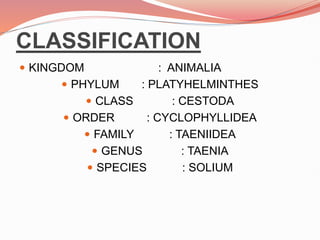
 KINGDOM : ANIMALIA
 PHYLUM : PLATYHELMINTHES
 CLASS : CESTODA
 ORDER : CYCLOPHYLLIDEA
 FAMILY : TAENIIDEA
 GENUS : TAENIA
 SPECIES : SOLIUM
HISTORY
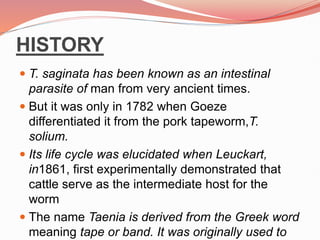
 T. saginata has been known as an intestinal
parasite of man from very ancient times.
 But it was only in 1782 when Goeze
differentiated it from the pork tapeworm,T.
solium.
 Its life cycle was elucidated when Leuckart,
in1861, first experimentally demonstrated that
cattle serve as the intermediate host for the
worm
 The name Taenia is derived from the Greek word
meaning tape or band. It was originally used to
DISTRIBUTION
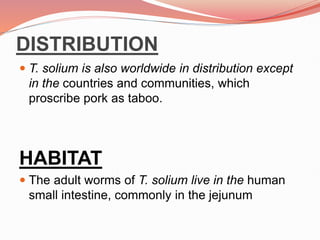
 T. solium is also worldwide in distribution except
in the countries and communities, which
proscribe pork as taboo.
HABITAT
 The adult worms of T. solium live in the human
small intestine, commonly in the jejunum
MORPHOLOGY
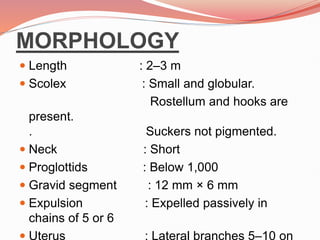
 Length : 2–3 m
 Scolex : Small and globular.
Rostellum and hooks are
present.
. Suckers not pigmented.
 Neck : Short
 Proglottids : Below 1,000
 Gravid segment : 12 mm × 6 mm
 Expulsion : Expelled passively in
chains of 5 or 6
 Uterus : Lateral branches 5–10 on
 Vagina : Absent
 Accessary lobe of ovary : Present
 Testes : 150–200 follicles
 Genital pore : present, alternating
between the . . right
and left sides of adjacent .
segments.
EGGS
 Spherical, measuring 30–40 μm in diameter.
 It has a thin hyaline embryonic membrane
around it which soon disappears after release.
 The inner embryophore is radially striated and is
yellow-brown due to bile staining.
 In the center is a fully-developed embryo
(oncosphere) with 3 pairs of hooklets
(hexacanth embryo).
 Do not float in saturated salt solution.
 The eggs of T. solium are infective to pigs and
humans.
LARVA : Cysticercus
cellulosae
 The larval stage of Taenia is called as
cysticercus
 Cysticercus cellulosae is the larva of T. solium.
 The infective form of the parasite.
 It can develop in various organs of pig as well as
in man.
 The cysticercus cellulosae or ‘bladder worm’ is
ovoid opalescent milky-white, measuring 8–10
mm in breadth and 5 mm in length.
 The scolex of the larva, with its suckers, lies
invaginated within the bladder and can be seen
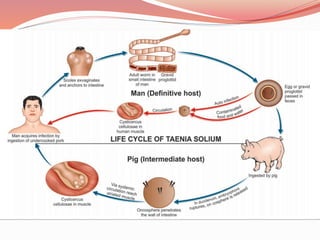
LIFE CYCLE
 When T. solium causes intestinal taeniasis :
Definitive host : Man
Intermediate host : Pig
Infective stage : Cysticercus cellulosae
(larva)
• When Taenia leads to cysticercosis :
Definitive host and Intermediate host: Both man
Infective stage : Eggs of T. solium (not larva)
Pathogenicity and Clinical
Features
Intestinal Taeniasis
 Caused by both T. saginata and T. solium.
 When the infection is symptomatic, vague
abdominal discomfort, indigestion, nausea,
diarrhea, and weightloss may be present.
 Occasional cases of acute intestinal
obstruction, acute appendicitis, and
pancreatitis have also been reported.
Cysticercosis
• It is caused by larval stage (cysticecus
cellulosae) of T. solium.
 Cysticercus cellulosae may be solitary or more
often multiple.
 Any organ or tissue may be involved, the most
common being subcutaneous tissues and
muscles. It may also affect the eyes, brain, and
less often other organs.
 The cysticercus is surrounded by a fibrous
capsule except in the eye and ventricles of the
brain.
 The larvae evoke a cellular reaction starting with
 The clinical features depend on the site affected
 Subcutaneous nodules are mostly
asymptomatic
 €
Muscular cysticerosis may cause acute
myositis
 Neurocysticerosis (cysticercosis of brain) is
the most common and most serious form of
cysticercosis.
Clinical features of neurocysticercosis are
epilepsy, increased intracranial
tension,hydrocephalus, psychiatric disturbances,
meningoencephalitis, behavioral disorders and
visual disturbances.
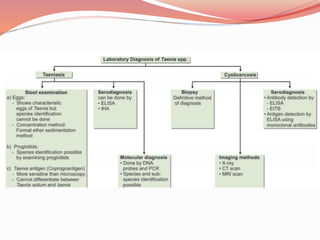
Laboratory Diagnosis
Stool Examination
Eggs
• Microscopic examination of feces
 Formol ether sedimentation method of stool
concentration is useful.
 cellophane swab method (NIH Swab)
 Species identification cannot be made from the
eggs.
Proglottids
• Species identification can be done
 When the gravid proglotlid pressed between 2
slides, branching can be made out (under 13
Scolex
 Definitive diagnosis can also be established by
demonstration of armed scolex in case of T.
solium.
Detection of Taenia Antigen in feces
 Antigen capture ELISA using polyclonal antisera
against Taenia is employed to detect
coproantigen in feces and is more sensitive than
microscopy.
 The drawback of the test is that it cannot
differentiate between T. saginata and T. solium
Serodiagnosis
 Specific antibodies in serum can be
demonstrated by ELISA, indirect
immunofluroscence test and indirect
hemagglutination (IHA) test.
Molecular Diagnosis
 Both DNA probes and polymerase chain reaction
(PCR) technique are used to detect and
differentiate between eggs and proglottids of T.
saginata and T. solium. It can also differentiate
between their subspecies.
Biopsy
 Definitive diagnosis of cysticercosis is by biopsy
of the lesion and its microscopic examination to
show the invaginated scolex with suckers and
hooks.
Imaging Methods
X ray : Calcified cysts in muscles &
subcutaneous tisses
CT scan : Detecting dead calcified cysts
MRI scan : Non calcified cysts and ventricular
cysts.
Serodiagnosis
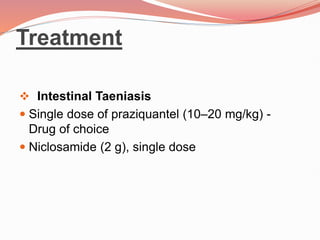
Treatment
 Intestinal Taeniasis
 Single dose of praziquantel (10–20 mg/kg) -
Drug of choice
 Niclosamide (2 g), single dose
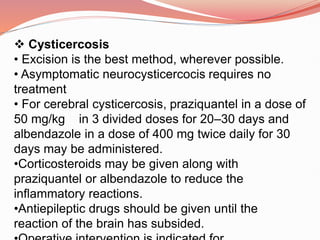
 Cysticercosis
• Excision is the best method, wherever possible.
• Asymptomatic neurocysticercocis requires no
treatment
• For cerebral cysticercosis, praziquantel in a dose of
50 mg/kg in 3 divided doses for 20–30 days and
albendazole in a dose of 400 mg twice daily for 30
days may be administered.
•Corticosteroids may be given along with
praziquantel or albendazole to reduce the
inflammatory reactions.
•Antiepileptic drugs should be given until the
reaction of the brain has subsided.
Prophylaxis
 Pork to be eaten by man should be subjected to
effective inspection for cysticerci in slaughter
house.
 Avoidance of eating raw or undercooked pork.
The critical thermal point of cysticercus is 56°C
for 5 minutes.
 Maintainence of clean personal habits and
general sanitary measures.
TAENIA SOLIUM.pptx

TAENIA SOLIUM.pptx

  • 2.
    CLASSIFICATION  KINGDOM :ANIMALIA  PHYLUM : PLATYHELMINTHES  CLASS : CESTODA  ORDER : CYCLOPHYLLIDEA  FAMILY : TAENIIDEA  GENUS : TAENIA  SPECIES : SOLIUM
  • 3.
    HISTORY  T. saginatahas been known as an intestinal parasite of man from very ancient times.  But it was only in 1782 when Goeze differentiated it from the pork tapeworm,T. solium.  Its life cycle was elucidated when Leuckart, in1861, first experimentally demonstrated that cattle serve as the intermediate host for the worm  The name Taenia is derived from the Greek word meaning tape or band. It was originally used to
  • 4.
    DISTRIBUTION  T. soliumis also worldwide in distribution except in the countries and communities, which proscribe pork as taboo. HABITAT  The adult worms of T. solium live in the human small intestine, commonly in the jejunum
  • 5.
    MORPHOLOGY  Length :2–3 m  Scolex : Small and globular. Rostellum and hooks are present. . Suckers not pigmented.  Neck : Short  Proglottids : Below 1,000  Gravid segment : 12 mm × 6 mm  Expulsion : Expelled passively in chains of 5 or 6  Uterus : Lateral branches 5–10 on
  • 6.
     Vagina :Absent  Accessary lobe of ovary : Present  Testes : 150–200 follicles  Genital pore : present, alternating between the . . right and left sides of adjacent . segments.
  • 7.
    EGGS  Spherical, measuring30–40 μm in diameter.  It has a thin hyaline embryonic membrane around it which soon disappears after release.  The inner embryophore is radially striated and is yellow-brown due to bile staining.  In the center is a fully-developed embryo (oncosphere) with 3 pairs of hooklets (hexacanth embryo).  Do not float in saturated salt solution.  The eggs of T. solium are infective to pigs and humans.
  • 8.
    LARVA : Cysticercus cellulosae The larval stage of Taenia is called as cysticercus  Cysticercus cellulosae is the larva of T. solium.  The infective form of the parasite.  It can develop in various organs of pig as well as in man.  The cysticercus cellulosae or ‘bladder worm’ is ovoid opalescent milky-white, measuring 8–10 mm in breadth and 5 mm in length.  The scolex of the larva, with its suckers, lies invaginated within the bladder and can be seen
  • 9.
    LIFE CYCLE  WhenT. solium causes intestinal taeniasis : Definitive host : Man Intermediate host : Pig Infective stage : Cysticercus cellulosae (larva) • When Taenia leads to cysticercosis : Definitive host and Intermediate host: Both man Infective stage : Eggs of T. solium (not larva)
  • 11.
    Pathogenicity and Clinical Features IntestinalTaeniasis  Caused by both T. saginata and T. solium.  When the infection is symptomatic, vague abdominal discomfort, indigestion, nausea, diarrhea, and weightloss may be present.  Occasional cases of acute intestinal obstruction, acute appendicitis, and pancreatitis have also been reported.
  • 12.
    Cysticercosis • It iscaused by larval stage (cysticecus cellulosae) of T. solium.  Cysticercus cellulosae may be solitary or more often multiple.  Any organ or tissue may be involved, the most common being subcutaneous tissues and muscles. It may also affect the eyes, brain, and less often other organs.  The cysticercus is surrounded by a fibrous capsule except in the eye and ventricles of the brain.  The larvae evoke a cellular reaction starting with
  • 13.
     The clinicalfeatures depend on the site affected  Subcutaneous nodules are mostly asymptomatic  € Muscular cysticerosis may cause acute myositis  Neurocysticerosis (cysticercosis of brain) is the most common and most serious form of cysticercosis. Clinical features of neurocysticercosis are epilepsy, increased intracranial tension,hydrocephalus, psychiatric disturbances, meningoencephalitis, behavioral disorders and visual disturbances.
  • 14.
    Laboratory Diagnosis Stool Examination Eggs •Microscopic examination of feces  Formol ether sedimentation method of stool concentration is useful.  cellophane swab method (NIH Swab)  Species identification cannot be made from the eggs. Proglottids • Species identification can be done  When the gravid proglotlid pressed between 2 slides, branching can be made out (under 13
  • 15.
    Scolex  Definitive diagnosiscan also be established by demonstration of armed scolex in case of T. solium. Detection of Taenia Antigen in feces  Antigen capture ELISA using polyclonal antisera against Taenia is employed to detect coproantigen in feces and is more sensitive than microscopy.  The drawback of the test is that it cannot differentiate between T. saginata and T. solium
  • 16.
    Serodiagnosis  Specific antibodiesin serum can be demonstrated by ELISA, indirect immunofluroscence test and indirect hemagglutination (IHA) test. Molecular Diagnosis  Both DNA probes and polymerase chain reaction (PCR) technique are used to detect and differentiate between eggs and proglottids of T. saginata and T. solium. It can also differentiate between their subspecies.
  • 17.
    Biopsy  Definitive diagnosisof cysticercosis is by biopsy of the lesion and its microscopic examination to show the invaginated scolex with suckers and hooks. Imaging Methods X ray : Calcified cysts in muscles & subcutaneous tisses CT scan : Detecting dead calcified cysts MRI scan : Non calcified cysts and ventricular cysts. Serodiagnosis
  • 19.
    Treatment  Intestinal Taeniasis Single dose of praziquantel (10–20 mg/kg) - Drug of choice  Niclosamide (2 g), single dose
  • 20.
     Cysticercosis • Excisionis the best method, wherever possible. • Asymptomatic neurocysticercocis requires no treatment • For cerebral cysticercosis, praziquantel in a dose of 50 mg/kg in 3 divided doses for 20–30 days and albendazole in a dose of 400 mg twice daily for 30 days may be administered. •Corticosteroids may be given along with praziquantel or albendazole to reduce the inflammatory reactions. •Antiepileptic drugs should be given until the reaction of the brain has subsided.
  • 21.
    Prophylaxis  Pork tobe eaten by man should be subjected to effective inspection for cysticerci in slaughter house.  Avoidance of eating raw or undercooked pork. The critical thermal point of cysticercus is 56°C for 5 minutes.  Maintainence of clean personal habits and general sanitary measures.