Cyclophyllidea- Taenia
Presenter; Mary Joseph
Moderator; Prof. Tarimo
outlines
• Introduction
• Classification
• Morphology
• Life cycle
• Pathogenesis and clinical features
• Diagnosis
• Treatment
• Epidemiology
• Prevention and control
Introduction
In the order cyclophllidea there are three families
Familiy Taeniidae;
genus Taenia, Enchinococus, and Multiceps
Family Hymenolepidiidae;
Genus Hymenolepis
Family Dilepidiidae:
Genus Dipylidium
Introduction to Taenia spp
Three species of medical importance in human;
Taenia saginata: Beef tapeworm
Taenia solium: pork tapeworm
Taenia asiatica: Asian tapeworm
Adult worm found only in the small intestine of Human (definitive host)
Infection to human is by ingestion of undercooked or raw infected meat
(pig meat for T. solium and T.asiatica and beef meat for T. saginata)
Infection by T. solium can also be through ingestion of eggs which
develop to larval form causing cysticercosis
Introduction cont..
There are two form of diseases;
• Infection of human with adult tapeworm of Taenia spp- Taeniosis
• Infection with larval form of T. solium- Cysticercosis
Larval stage is found in the striated muscles of the intermediate host.
Larva of T.solium is called cysticercus cellulosae and of T. saginata is
called cysticercus bovis
• IH for T. solium and T. asiatica; pig
• IH for T. saginata: cattle
Classification
Kingdom: Animalia
Phylum: Platyhelminthes
Class: cestoda
Order: cyclophllidea
Family: Taeniidae
Genus: Taenia
Species: Taenia solium, Taenia saginata and Taenia asiatica
Morphology
three forms; adult, larvae and eggs
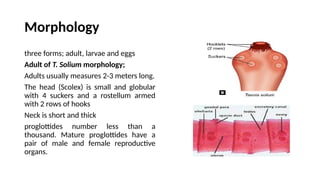
Adult of T. Solium morphology;
Adults usually measures 2-3 meters long.
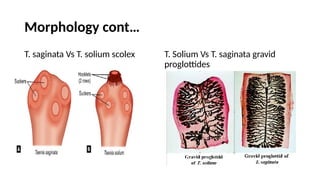
The head (Scolex) is small and globular
with 4 suckers and a rostellum armed
with 2 rows of hooks
Neck is short and thick
proglottides number less than a
thousand. Mature proglottides have a
pair of male and female reproductive
organs.
Morphology cont..
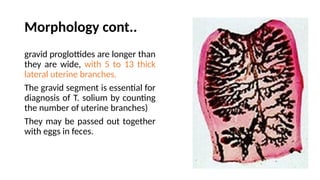
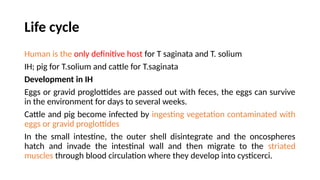
gravid proglottides are longer than
they are wide, with 5 to 13 thick
lateral uterine branches.
The gravid segment is essential for
diagnosis of T. solium by counting
the number of uterine branches)
They may be passed out together
with eggs in feces.
Morphology cont..
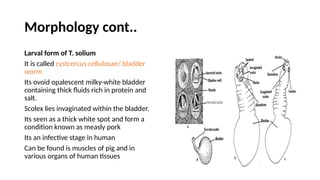
Larval form of T. solium
It is called cystcercus cellulosae/ bladder
worm
Its ovoid opalescent milky-white bladder
containing thick fluids rich in protein and
salt.
Scolex lies invaginated within the bladder.
Its seen as a thick white spot and form a
condition known as measly pork
Its an infective stage in human
Can be found is muscles of pig and in
various organs of human tissues
Morphology cont…
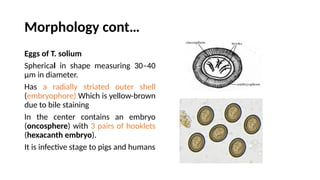
Eggs of T. solium
Spherical in shape measuring 30–40
μm in diameter.
Has a radially striated outer shell
(embryophore) Which is yellow-brown
due to bile staining
In the center contains an embryo
(oncosphere) with 3 pairs of hooklets
(hexacanth embryo).
It is infective stage to pigs and humans
Morphology cont…
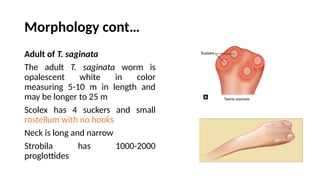
Adult of T. saginata
The adult T. saginata worm is
opalescent white in color
measuring 5-10 m in length and
may be longer to 25 m
Scolex has 4 suckers and small
rostellum with no hooks
Neck is long and narrow
Strobila has 1000-2000
proglottides
Morphology cont…
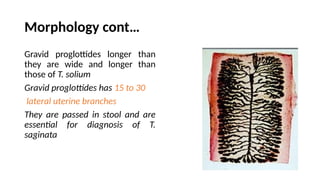
Gravid proglottides longer than
they are wide and longer than
those of T. solium
Gravid proglottides has 15 to 30
lateral uterine branches
They are passed in stool and are
essential for diagnosis of T.
saginata
Morphology cont….
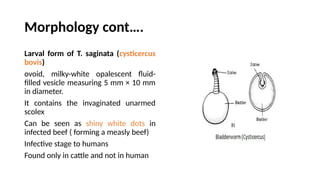
Larval form of T. saginata (cysticercus
bovis)
ovoid, milky-white opalescent fluid-
filled vesicle measuring 5 mm × 10 mm
in diameter.
It contains the invaginated unarmed
scolex
Can be seen as shiny white dots in
infected beef ( forming a measly beef)
Infective stage to humans
Found only in cattle and not in human
Morphology cont…
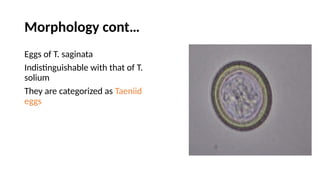
Eggs of T. saginata
Indistinguishable with that of T.
solium
They are categorized as Taeniid
eggs
Morphology cont…
T. saginata Vs T. solium scolex T. Solium Vs T. saginata gravid
proglottides
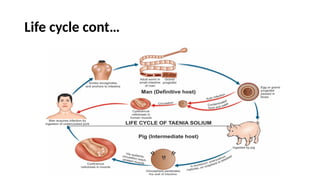
Life cycle
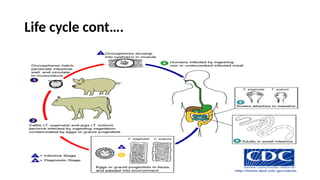
Human is the only definitive host for T saginata and T. solium
IH; pig for T.solium and cattle for T.saginata
Development in IH
Eggs or gravid proglottides are passed out with feces, the eggs can survive
in the environment for days to several weeks.
Cattle and pig become infected by ingesting vegetation contaminated with
eggs or gravid proglottides
In the small intestine, the outer shell disintegrate and the oncospheres
hatch and invade the intestinal wall and then migrate to the striated
muscles through blood circulation where they develop into cysticerci.
Life cycle cont…
Development in DH(Man)
Human become infected by ingestion of undercooked or raw infected
meat with the cysticerci.
In two or more months, the cysticercus develop into an adult tapeworm
in the human small intestine. The adult tapeworm can survive for years
The adult tapeworm attaches to the small intestine by scolex and
remain residing in the SI
The adult tapeworm produce proglottides which mature and become
gravid proglottides.
Life cycle cont….
The gravid proglottides detach from the tapeworm, migrate to anus or
passed in feces
The eggs in the gravid proglottides are released after they are passed in
feces
T. solium produces up to 50000 eggs per proglottide and T. saginata up
to 100,000 eggs per proglottide
The eggs are then ingested by the IH in fecal contaminated vegetation
Life cycle cont….
Life cycle cont…
For T. solium human can acquire infection also by ingestion of eggs in
contaminated food or water.(The infective stage is the egg)
man harboring adult worm may autoinfect oneself, either by unhygenic
personal habits or by reverse peristalsis of the intestine.
Here man is both a DH and IH( accidental IH).
The development of egg is similar to both man and pig
The oncosphere will hatch in the intestine, invade the intestinal wall and then
enters the blood vessels and disseminated to different organs and tissues.
Can be carried to any part of the body but preferably in subcutaneous tissues
and muscles, where it develop into cysticercus cellulosae
Life cycle cont…
Pathogenesis
Taeniosis
Caused by both T.solium and T. saginata
adult tapeworm causes no distinct clinical symptoms or signs.
The parasite usually causes slight traumatic damage to the mucosa at the site
of attachment of the scolex.
it has been also known to perforate the wall of the intestine, very rarely causing
death.
Csyticercosis;
It is caused by larval stage (cysticecus cellulosae) of T. solium
Cysticercus cellulosae may be solitary or more often multiple
Pathogenesis
Several organ or tissue may be involved, the most common is in
subcutaneous tissues and muscles. eyes, brain, and less often the heart,
liver, lungs, abdominal cavity, and spinal cord may also be involved.
The cysticerci have high affinity to CNS, eyes and striated muscles due
to high glucoce or glycogen in these organs
The cysticercus is surrounded by a fibrous capsule except in the eye and
ventricles of the brain.
Pathogenesis cont…
The larvae evoke a cellular reaction starting with infiltration of
neutrophils, eosinophils, lymphocytes, plasma cells, and at times, giant
cells.
This is followed by fibrosis and death of the larva with subsequent
calcification
Neurocysticercosis; cysticercosis of the CNS
It is the most common and most serous form of cysticercosis. It is
associated with about 70% of epilepsy cases in high risk communities.
Pathogenesis cont…
Cellular immune responses during NCC are diverse and distinct
depending on the localization and stages of parasite in the brain.
After months to years the cysticercus will start to disintegration and
lose their ability to regulate the host response.
an inflammatory immune response characterized by an increase in
interleukin 1 beta, tumor necrosis factor alpha, and interferon gamma
production is initiated.
Pathogenesis cont….
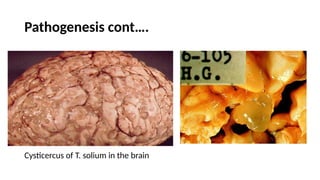
Cysticercus of T. solium in the brain
Pathogenesis cont….
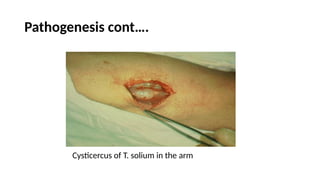
Cysticercus of T. solium in the arm
Clinical features
Intestinal Taeniosis;
Most of infection are asymptomatic
• When symptomatic patient may present with; vague abdominal
discomformt, indigestion, nausea, diarrhea, and weight loss
• Occasionally, patient may present with acute intestinal obstruction,
acute appendicitis, and pancreatitis.
Cysticercosis;
Subcutaneous nodules are mostly asymptomatic
Clinical features cont…
Muscular cysticerosis- may cause acute myositis
Neurocysticerosis (cysticercosis of brain)- most common and most
serious form of cysticercosis.
oSymptoms include; chronic headaches, blindness, epilepsy, and
hydrocephalus and meningitis.
Ocular cysticercosis- cause blurring of vision, uveitis, iritis and
ultimately blindness.
Diagnosis
1. Stool examination
Macroscopic examination; proglottides may be visible in the stool sample
Microscopic examination:
• Recovery of eggs by wet mount preparation or by formal ether
concentration technique
note: the eggs of Taenia spp are indistinguishable, therefore the test does
not offer specie identification.
• Examination of gravid proglottides recovered from clothing or passed in
faeces., this offers species identification
Diagnosis cont…
2. Serodiagnosis: Specific antibodies detection in serum by ELISA,
indirect immunofluroscence test and indirect hemagglutination (IHA)
test
3. Molecular diagnosis: DNA probes and polymerase chain reaction
(PCR) technique.
Are used to detect and differentiate between eggs and proglottids of T.
saginata and T. solium.
Diagnosis cont…
Diagnosis of cysticercosis
1. Biopsy; biopsy of the lesion and its microscopic examination to show
the invaginated scolex. It’s a definitive method of diagnosing cysticercosis.
2. Imaging methods
• Computed tomography (CT) scan- helpful in detection of the dead
calcified cysts in the brain. The cysticercal lesions appear as small
hypodensities (ring or disc-like) with a bright central spot.
• Magnetic resonance imaging(MRI) scan of the brain- helpful in
detection of non calcified cysts and ventricular cysts. Can also
demonstrate spinal cysticerci
Diagnosis cont…
• X-ray; Calcified cysticerci can be detected by radiography of
subcutaneous tissue and muscles particularly in the buttocks and
thigh. X-ray of the skull many demonstrate cerebral calcified cyst.
4. Serodiagnosis
• Antibody detection; detection of Anticysticercus antibodies in serum
or cerebrospinal fluid (CSF). Can be done by ELISA and enzyme-linked
Immunoelectrotrasfer blot (EITB) tests.
• Antigen detection; Antigen can be detected in serum and CSF by
ELISA, using monoclonal antibodies and indicate recent infection.
Diagnosis cont…
5. Opthalmoscopy; detection of Ocular cysticercosis
6. Eosinophilia: Usually occurs in early stage of cysticercosis, but is not
constant
Treatment
Taeniasis treatment
Praziquantel; single dose of 10 mg/kg
Niclosamide; single dose, adults and children over 6 yrs 2g, 2-6 yrs aged
children 1g
Albendazole; 400 mg for 3 days
Neurocysticercosis treatment
High dose of praziquantel and/ albendazole
Supporting drugs; corticosteroids, anti-epileptic drug
Surgery is recommended whenever possible
Taenia asiatica
T. asiatica is closely related to T. saginata.
Its mainly found in Asia.
It is morphologically similar to T. saginata except It is smaller than T.
Saginata.
Intermediate host is pig, but can also infect a range of IH including
cattle, goats, monkeys, and wild boar
Its cysticerci are located primarily in liver of the pig, not muscle
The parasite does not cause human cysticercosis
Clinical features, diagnosis and treatment is similar to that of T. saginata
Epidemiology
Taenia saginata, T. solium are worldwide distributed except for Taenia
asiatica which is limited to Asia.
It is estimated that 50 million people infected with T. saginata and 5
million with T. solium.
The distribution of T. solium is limited to areas where pork is consumed.
Prevalence is low in Muslim countries.
Higher rates of illness by T. solium have been seen in people in Latin
America, Eastern Europe, sub-Saharan Africa, India, and Asia
Epidemiology cont….
High prevalence of T. saginata occurs in East Africa, Bali, and Tibetan
populations in China and its rare in the united states.
Prevalence of Taeniosis are highest where cattle and swine have access
to contaminated human feaces(poor satination) and where raw or
undercooked beef or pork is consumed.
Persons who don’t eat raw or undercooked beef or pork are not likely
to get taeniasis.
Taenia asiatica is limited to Asia and is seen mostly in the Republic of
Korea, China, Taiwan, Indonesia, and Thailand.
Epidemiology cont…
cysticercosis can occur when T. solium tapeworm eggs are ingested in
contaminated food and drinks.
Individuals who neither consume nor raise pork can be at risk for
cysticercosis if they ingest T. solium eggs in contaminated food or water.
Risk factors include poor sanitation, unsafe water, poor pig/cattle
husbandry practices, inadequate meat inspection and lack of
knowledge about the parasite.
Epidemiology cont…
T. Solium is the cause of up to 30% of epilepsy cases in endemic areas
where humans and pigs live in close proximity.
In 2010, Taeniasis/cysticercosis was added in the list of a neglected
tropical disease that call for attention on research, control, and
elimination.
T. Solium was ranked first in global scale of important food borne
disease with regard to it is impact on public health and trade.
In Tanzania the prevalence of taeniosis was estimated to range from
2.3-5.2% and human cysticercosis >16% by 2018
Prevention and control
Thorough cooking of meat and freezing of meat at −20° for 12hr kills
cysticerci
Improving sanitation and husbandry practices.
Strict inspection of pork or beef prior to sale or consumption and
condemning any meat that has been found to contain cysticerci.
Sanitary disposal of human feces so as to increase the containment of
segments and destruction of eggs.
Treatment of infected people to reduce transmission from human to
cattle or pigs.
Prevention and control cont..
Provision of health education to the community so as to encourage
communities participation in control measures including use of
latrines to end open defecation, and safe handling of food
 intervention on cattle and pigs including anthelmintic treatment and
Vaccination of pigs using a TSOL18 porcine vaccine
Avoid using untreated human faeces for fertilize pastureland.
References
1. Textbook of Medical Parasitology, 6th
edition by Panker CK, (2007);
Chpt 3.; Pg 144-150
2. Medical parasitology, ninth edition by DAVID T. JOHN, MSPH, PhD
and WILLIAM A. PETRI, Jr., MD, PhD chap 5; pg 211-223.
3. District Laboratory Practice in Tropical Countries, Second Edition by
Monica Cheesbrough pg 227- 231
4. H.A. Ngowi 1, A.S. Winkler 2, U.C. Braae 3, R.H. Mdegela 1, E.M.
Mkupasi 1, M.L. Kabululu 1, F.P. Lekule1 and MVJ 4. Taenia solium.
2018;
Reference
5. Alroy KA, Gilman RH, Alroy KA, Gilman RH. 130 Tapeworm Infections
[Internet]. Tenth Edition. Hunter’s Tropical Medicine and Emerging
Infectious Disease. Elsevier Inc.; 932–940 p. Available from: https://
doi.org/10.1016/B978-0-323-55512-8.00130-7
6. Wittner M, White AC, Tanowitz JHB. CHAPTER 121 Taenia and Other
Tapeworm Infections [Internet]. Thrid Edition. Tropical Infectious
Diseases: Principles, Pathogens and Practice. Elsevier Inc.; 839–847 p.
Available from: http://dx.doi.org/10.1016/B978-0-7020-3935-5.00121-
X
Thank you

A presentation on Cyclophyllidea - Taenia

  • 1.
    Cyclophyllidea- Taenia Presenter; MaryJoseph Moderator; Prof. Tarimo
  • 2.
    outlines • Introduction • Classification •Morphology • Life cycle • Pathogenesis and clinical features • Diagnosis • Treatment • Epidemiology • Prevention and control
  • 3.
    Introduction In the ordercyclophllidea there are three families Familiy Taeniidae; genus Taenia, Enchinococus, and Multiceps Family Hymenolepidiidae; Genus Hymenolepis Family Dilepidiidae: Genus Dipylidium
  • 4.
    Introduction to Taeniaspp Three species of medical importance in human; Taenia saginata: Beef tapeworm Taenia solium: pork tapeworm Taenia asiatica: Asian tapeworm Adult worm found only in the small intestine of Human (definitive host) Infection to human is by ingestion of undercooked or raw infected meat (pig meat for T. solium and T.asiatica and beef meat for T. saginata) Infection by T. solium can also be through ingestion of eggs which develop to larval form causing cysticercosis
  • 5.
    Introduction cont.. There aretwo form of diseases; • Infection of human with adult tapeworm of Taenia spp- Taeniosis • Infection with larval form of T. solium- Cysticercosis Larval stage is found in the striated muscles of the intermediate host. Larva of T.solium is called cysticercus cellulosae and of T. saginata is called cysticercus bovis • IH for T. solium and T. asiatica; pig • IH for T. saginata: cattle
  • 6.
    Classification Kingdom: Animalia Phylum: Platyhelminthes Class:cestoda Order: cyclophllidea Family: Taeniidae Genus: Taenia Species: Taenia solium, Taenia saginata and Taenia asiatica
  • 7.
    Morphology three forms; adult,larvae and eggs Adult of T. Solium morphology; Adults usually measures 2-3 meters long. The head (Scolex) is small and globular with 4 suckers and a rostellum armed with 2 rows of hooks Neck is short and thick proglottides number less than a thousand. Mature proglottides have a pair of male and female reproductive organs.
  • 8.
    Morphology cont.. gravid proglottidesare longer than they are wide, with 5 to 13 thick lateral uterine branches. The gravid segment is essential for diagnosis of T. solium by counting the number of uterine branches) They may be passed out together with eggs in feces.
  • 9.
    Morphology cont.. Larval formof T. solium It is called cystcercus cellulosae/ bladder worm Its ovoid opalescent milky-white bladder containing thick fluids rich in protein and salt. Scolex lies invaginated within the bladder. Its seen as a thick white spot and form a condition known as measly pork Its an infective stage in human Can be found is muscles of pig and in various organs of human tissues
  • 10.
    Morphology cont… Eggs ofT. solium Spherical in shape measuring 30–40 μm in diameter. Has a radially striated outer shell (embryophore) Which is yellow-brown due to bile staining In the center contains an embryo (oncosphere) with 3 pairs of hooklets (hexacanth embryo). It is infective stage to pigs and humans
  • 11.
    Morphology cont… Adult ofT. saginata The adult T. saginata worm is opalescent white in color measuring 5-10 m in length and may be longer to 25 m Scolex has 4 suckers and small rostellum with no hooks Neck is long and narrow Strobila has 1000-2000 proglottides
  • 12.
    Morphology cont… Gravid proglottideslonger than they are wide and longer than those of T. solium Gravid proglottides has 15 to 30 lateral uterine branches They are passed in stool and are essential for diagnosis of T. saginata
  • 13.
    Morphology cont…. Larval formof T. saginata (cysticercus bovis) ovoid, milky-white opalescent fluid- filled vesicle measuring 5 mm × 10 mm in diameter. It contains the invaginated unarmed scolex Can be seen as shiny white dots in infected beef ( forming a measly beef) Infective stage to humans Found only in cattle and not in human
  • 14.
    Morphology cont… Eggs ofT. saginata Indistinguishable with that of T. solium They are categorized as Taeniid eggs
  • 15.
    Morphology cont… T. saginataVs T. solium scolex T. Solium Vs T. saginata gravid proglottides
  • 16.
    Life cycle Human isthe only definitive host for T saginata and T. solium IH; pig for T.solium and cattle for T.saginata Development in IH Eggs or gravid proglottides are passed out with feces, the eggs can survive in the environment for days to several weeks. Cattle and pig become infected by ingesting vegetation contaminated with eggs or gravid proglottides In the small intestine, the outer shell disintegrate and the oncospheres hatch and invade the intestinal wall and then migrate to the striated muscles through blood circulation where they develop into cysticerci.
  • 17.
    Life cycle cont… Developmentin DH(Man) Human become infected by ingestion of undercooked or raw infected meat with the cysticerci. In two or more months, the cysticercus develop into an adult tapeworm in the human small intestine. The adult tapeworm can survive for years The adult tapeworm attaches to the small intestine by scolex and remain residing in the SI The adult tapeworm produce proglottides which mature and become gravid proglottides.
  • 18.
    Life cycle cont…. Thegravid proglottides detach from the tapeworm, migrate to anus or passed in feces The eggs in the gravid proglottides are released after they are passed in feces T. solium produces up to 50000 eggs per proglottide and T. saginata up to 100,000 eggs per proglottide The eggs are then ingested by the IH in fecal contaminated vegetation
  • 19.
  • 20.
    Life cycle cont… ForT. solium human can acquire infection also by ingestion of eggs in contaminated food or water.(The infective stage is the egg) man harboring adult worm may autoinfect oneself, either by unhygenic personal habits or by reverse peristalsis of the intestine. Here man is both a DH and IH( accidental IH). The development of egg is similar to both man and pig The oncosphere will hatch in the intestine, invade the intestinal wall and then enters the blood vessels and disseminated to different organs and tissues. Can be carried to any part of the body but preferably in subcutaneous tissues and muscles, where it develop into cysticercus cellulosae
  • 21.
  • 22.
    Pathogenesis Taeniosis Caused by bothT.solium and T. saginata adult tapeworm causes no distinct clinical symptoms or signs. The parasite usually causes slight traumatic damage to the mucosa at the site of attachment of the scolex. it has been also known to perforate the wall of the intestine, very rarely causing death. Csyticercosis; It is caused by larval stage (cysticecus cellulosae) of T. solium Cysticercus cellulosae may be solitary or more often multiple
  • 23.
    Pathogenesis Several organ ortissue may be involved, the most common is in subcutaneous tissues and muscles. eyes, brain, and less often the heart, liver, lungs, abdominal cavity, and spinal cord may also be involved. The cysticerci have high affinity to CNS, eyes and striated muscles due to high glucoce or glycogen in these organs The cysticercus is surrounded by a fibrous capsule except in the eye and ventricles of the brain.
  • 24.
    Pathogenesis cont… The larvaeevoke a cellular reaction starting with infiltration of neutrophils, eosinophils, lymphocytes, plasma cells, and at times, giant cells. This is followed by fibrosis and death of the larva with subsequent calcification Neurocysticercosis; cysticercosis of the CNS It is the most common and most serous form of cysticercosis. It is associated with about 70% of epilepsy cases in high risk communities.
  • 25.
    Pathogenesis cont… Cellular immuneresponses during NCC are diverse and distinct depending on the localization and stages of parasite in the brain. After months to years the cysticercus will start to disintegration and lose their ability to regulate the host response. an inflammatory immune response characterized by an increase in interleukin 1 beta, tumor necrosis factor alpha, and interferon gamma production is initiated.
  • 26.
  • 27.
  • 28.
    Clinical features Intestinal Taeniosis; Mostof infection are asymptomatic • When symptomatic patient may present with; vague abdominal discomformt, indigestion, nausea, diarrhea, and weight loss • Occasionally, patient may present with acute intestinal obstruction, acute appendicitis, and pancreatitis. Cysticercosis; Subcutaneous nodules are mostly asymptomatic
  • 29.
    Clinical features cont… Muscularcysticerosis- may cause acute myositis Neurocysticerosis (cysticercosis of brain)- most common and most serious form of cysticercosis. oSymptoms include; chronic headaches, blindness, epilepsy, and hydrocephalus and meningitis. Ocular cysticercosis- cause blurring of vision, uveitis, iritis and ultimately blindness.
  • 30.
    Diagnosis 1. Stool examination Macroscopicexamination; proglottides may be visible in the stool sample Microscopic examination: • Recovery of eggs by wet mount preparation or by formal ether concentration technique note: the eggs of Taenia spp are indistinguishable, therefore the test does not offer specie identification. • Examination of gravid proglottides recovered from clothing or passed in faeces., this offers species identification
  • 31.
    Diagnosis cont… 2. Serodiagnosis:Specific antibodies detection in serum by ELISA, indirect immunofluroscence test and indirect hemagglutination (IHA) test 3. Molecular diagnosis: DNA probes and polymerase chain reaction (PCR) technique. Are used to detect and differentiate between eggs and proglottids of T. saginata and T. solium.
  • 32.
    Diagnosis cont… Diagnosis ofcysticercosis 1. Biopsy; biopsy of the lesion and its microscopic examination to show the invaginated scolex. It’s a definitive method of diagnosing cysticercosis. 2. Imaging methods • Computed tomography (CT) scan- helpful in detection of the dead calcified cysts in the brain. The cysticercal lesions appear as small hypodensities (ring or disc-like) with a bright central spot. • Magnetic resonance imaging(MRI) scan of the brain- helpful in detection of non calcified cysts and ventricular cysts. Can also demonstrate spinal cysticerci
  • 33.
    Diagnosis cont… • X-ray;Calcified cysticerci can be detected by radiography of subcutaneous tissue and muscles particularly in the buttocks and thigh. X-ray of the skull many demonstrate cerebral calcified cyst. 4. Serodiagnosis • Antibody detection; detection of Anticysticercus antibodies in serum or cerebrospinal fluid (CSF). Can be done by ELISA and enzyme-linked Immunoelectrotrasfer blot (EITB) tests. • Antigen detection; Antigen can be detected in serum and CSF by ELISA, using monoclonal antibodies and indicate recent infection.
  • 34.
    Diagnosis cont… 5. Opthalmoscopy;detection of Ocular cysticercosis 6. Eosinophilia: Usually occurs in early stage of cysticercosis, but is not constant
  • 35.
    Treatment Taeniasis treatment Praziquantel; singledose of 10 mg/kg Niclosamide; single dose, adults and children over 6 yrs 2g, 2-6 yrs aged children 1g Albendazole; 400 mg for 3 days Neurocysticercosis treatment High dose of praziquantel and/ albendazole Supporting drugs; corticosteroids, anti-epileptic drug Surgery is recommended whenever possible
  • 36.
    Taenia asiatica T. asiaticais closely related to T. saginata. Its mainly found in Asia. It is morphologically similar to T. saginata except It is smaller than T. Saginata. Intermediate host is pig, but can also infect a range of IH including cattle, goats, monkeys, and wild boar Its cysticerci are located primarily in liver of the pig, not muscle The parasite does not cause human cysticercosis Clinical features, diagnosis and treatment is similar to that of T. saginata
  • 37.
    Epidemiology Taenia saginata, T.solium are worldwide distributed except for Taenia asiatica which is limited to Asia. It is estimated that 50 million people infected with T. saginata and 5 million with T. solium. The distribution of T. solium is limited to areas where pork is consumed. Prevalence is low in Muslim countries. Higher rates of illness by T. solium have been seen in people in Latin America, Eastern Europe, sub-Saharan Africa, India, and Asia
  • 38.
    Epidemiology cont…. High prevalenceof T. saginata occurs in East Africa, Bali, and Tibetan populations in China and its rare in the united states. Prevalence of Taeniosis are highest where cattle and swine have access to contaminated human feaces(poor satination) and where raw or undercooked beef or pork is consumed. Persons who don’t eat raw or undercooked beef or pork are not likely to get taeniasis. Taenia asiatica is limited to Asia and is seen mostly in the Republic of Korea, China, Taiwan, Indonesia, and Thailand.
  • 39.
    Epidemiology cont… cysticercosis canoccur when T. solium tapeworm eggs are ingested in contaminated food and drinks. Individuals who neither consume nor raise pork can be at risk for cysticercosis if they ingest T. solium eggs in contaminated food or water. Risk factors include poor sanitation, unsafe water, poor pig/cattle husbandry practices, inadequate meat inspection and lack of knowledge about the parasite.
  • 40.
    Epidemiology cont… T. Soliumis the cause of up to 30% of epilepsy cases in endemic areas where humans and pigs live in close proximity. In 2010, Taeniasis/cysticercosis was added in the list of a neglected tropical disease that call for attention on research, control, and elimination. T. Solium was ranked first in global scale of important food borne disease with regard to it is impact on public health and trade. In Tanzania the prevalence of taeniosis was estimated to range from 2.3-5.2% and human cysticercosis >16% by 2018
  • 41.
    Prevention and control Thoroughcooking of meat and freezing of meat at −20° for 12hr kills cysticerci Improving sanitation and husbandry practices. Strict inspection of pork or beef prior to sale or consumption and condemning any meat that has been found to contain cysticerci. Sanitary disposal of human feces so as to increase the containment of segments and destruction of eggs. Treatment of infected people to reduce transmission from human to cattle or pigs.
  • 42.
    Prevention and controlcont.. Provision of health education to the community so as to encourage communities participation in control measures including use of latrines to end open defecation, and safe handling of food  intervention on cattle and pigs including anthelmintic treatment and Vaccination of pigs using a TSOL18 porcine vaccine Avoid using untreated human faeces for fertilize pastureland.
  • 43.
    References 1. Textbook ofMedical Parasitology, 6th edition by Panker CK, (2007); Chpt 3.; Pg 144-150 2. Medical parasitology, ninth edition by DAVID T. JOHN, MSPH, PhD and WILLIAM A. PETRI, Jr., MD, PhD chap 5; pg 211-223. 3. District Laboratory Practice in Tropical Countries, Second Edition by Monica Cheesbrough pg 227- 231 4. H.A. Ngowi 1, A.S. Winkler 2, U.C. Braae 3, R.H. Mdegela 1, E.M. Mkupasi 1, M.L. Kabululu 1, F.P. Lekule1 and MVJ 4. Taenia solium. 2018;
  • 44.
    Reference 5. Alroy KA,Gilman RH, Alroy KA, Gilman RH. 130 Tapeworm Infections [Internet]. Tenth Edition. Hunter’s Tropical Medicine and Emerging Infectious Disease. Elsevier Inc.; 932–940 p. Available from: https:// doi.org/10.1016/B978-0-323-55512-8.00130-7 6. Wittner M, White AC, Tanowitz JHB. CHAPTER 121 Taenia and Other Tapeworm Infections [Internet]. Thrid Edition. Tropical Infectious Diseases: Principles, Pathogens and Practice. Elsevier Inc.; 839–847 p. Available from: http://dx.doi.org/10.1016/B978-0-7020-3935-5.00121- X
  • 45.