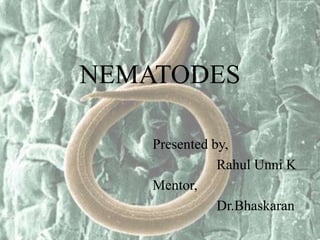
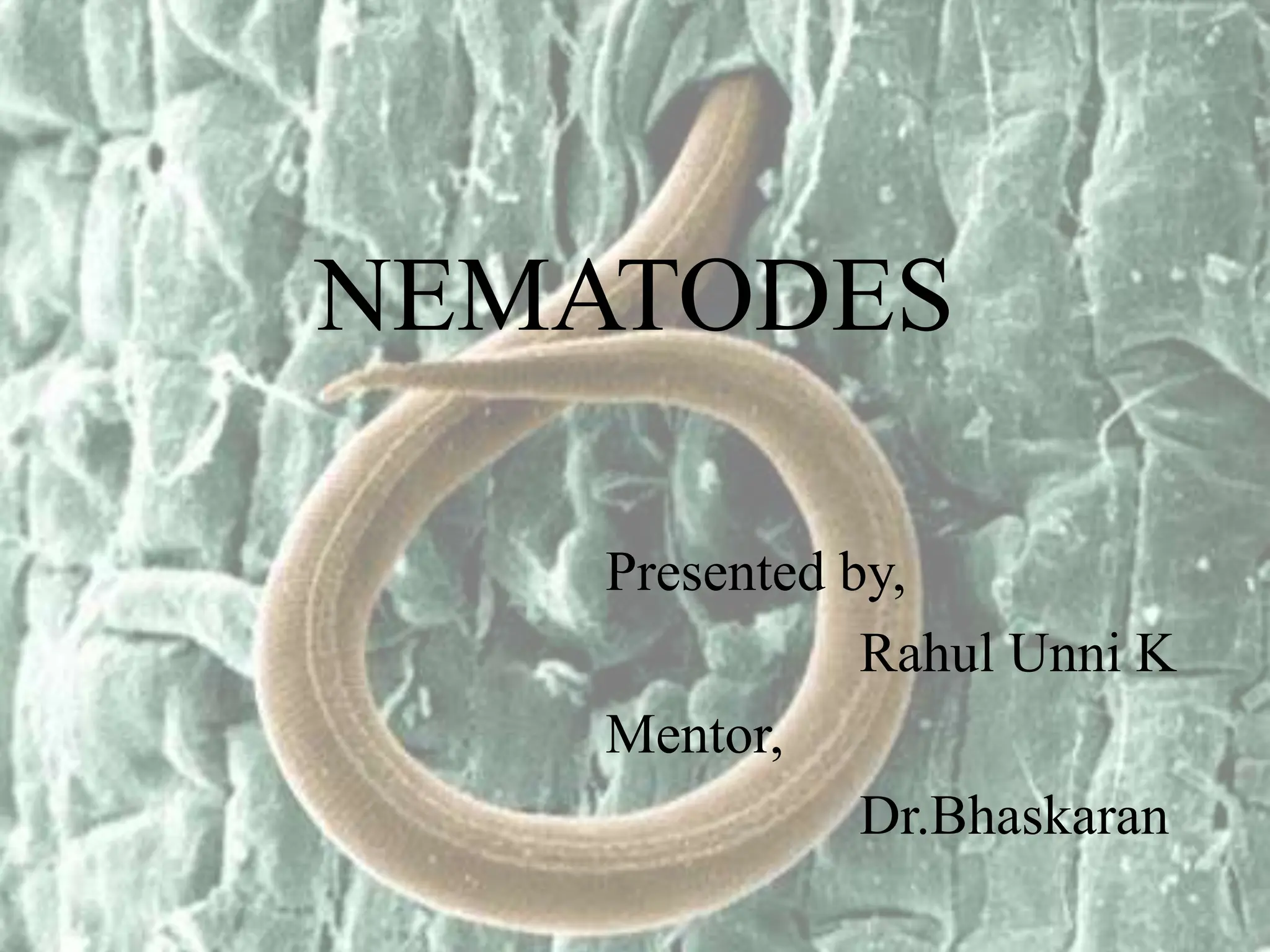
NEMATODES
Presented by,
Rahul Unni K
Mentor,
Dr.Bhaskaran
Parasites
Protozoa
Sarcodina
(Amoebas)
Sporozoa
(Sporozoans)
Mastigophora
(Flagellates)
Ciliata
(Ciliates)
Metazoa
(Helminths)
Platyhelminthes
(Flatworms)
Nemathelminthes
(Round worms)
Adenophorea Secernentea
CLASSIFICATION OF PARASITES
Classification of NEMATODES
• SYSTEMIC CLASSIFICATION
KINGDOM :ANIMALIA
PHYLUM:NEMATHELMINTHES
CLASS : NEMATODA
SUB CLASS : ADENOPHOREA
SECERNENTEA
Nematodes
• General characteristics –
• Size – 1mm to 1 m
• Shape - Elongated, Cylindrical, Unsegmented
• Head end – Hooks and sucker absent, Well developed buccal capsule with
teeth or cutting plates seen in some species.
• Alimentary canal – Complete with anus.
• Body cavity – Present and known as psuedocoele. viscera remains
suspended in the pseudocoele.
• Sex – Separate (Dioecious)
Life Cycle
• Consists of 4 larval stages and 1 adult form
• Requires one host (except filarial worms, Dracunculus – need
two hosts).
• Optimum host – Man
• Nematodes localise in intestinal tract and eggs pass out with
the faeces of the host.
Modes of infection
• By Ingestion of eggs
• Eggs : Ascaris, Enterobius
• Larvae within intermediate host : Dracunculus.
• Encysted larvae in muscle : Trichinella
• By penetration of skin: Ancylostoma, Strongyloides
• By blood sucking insects : Filariae
• By inhalation of dust containing eggs : Ascaris, Enterobius
Classification
• On the basis of habitat of adult worms
• Intestinal Human Nematodes
» Small intestine : Ascaris lumbricoides, Ancylostoma duodenale,
Strongyloides stercoralis, Trichenella spiralis
» Large intestine : Trichuris trichiura, Enterobius vermicularis
• Somatic Human Nematodes
» Lymphatics : Wuchereria bancrofti, Brugia malayi, Brugia timori
» Skin/subcutaneous : Loa loa, Dracunculus medinensis
» Mesentry : Mansonella ozzardi, Mansonella perstans
» Conjuctiva : Loa loa
• Zoological Classification

presentation nematodes.pptx

  • 1.
    NEMATODES Presented by, Rahul UnniK Mentor, Dr.Bhaskaran
  • 2.
  • 3.
    Classification of NEMATODES •SYSTEMIC CLASSIFICATION KINGDOM :ANIMALIA PHYLUM:NEMATHELMINTHES CLASS : NEMATODA SUB CLASS : ADENOPHOREA SECERNENTEA
  • 4.
    Nematodes • General characteristics– • Size – 1mm to 1 m • Shape - Elongated, Cylindrical, Unsegmented • Head end – Hooks and sucker absent, Well developed buccal capsule with teeth or cutting plates seen in some species. • Alimentary canal – Complete with anus. • Body cavity – Present and known as psuedocoele. viscera remains suspended in the pseudocoele. • Sex – Separate (Dioecious)
  • 5.
    Life Cycle • Consistsof 4 larval stages and 1 adult form • Requires one host (except filarial worms, Dracunculus – need two hosts). • Optimum host – Man • Nematodes localise in intestinal tract and eggs pass out with the faeces of the host.
  • 6.
    Modes of infection •By Ingestion of eggs • Eggs : Ascaris, Enterobius • Larvae within intermediate host : Dracunculus. • Encysted larvae in muscle : Trichinella • By penetration of skin: Ancylostoma, Strongyloides • By blood sucking insects : Filariae • By inhalation of dust containing eggs : Ascaris, Enterobius
  • 7.
    Classification • On thebasis of habitat of adult worms • Intestinal Human Nematodes » Small intestine : Ascaris lumbricoides, Ancylostoma duodenale, Strongyloides stercoralis, Trichenella spiralis » Large intestine : Trichuris trichiura, Enterobius vermicularis • Somatic Human Nematodes » Lymphatics : Wuchereria bancrofti, Brugia malayi, Brugia timori » Skin/subcutaneous : Loa loa, Dracunculus medinensis » Mesentry : Mansonella ozzardi, Mansonella perstans » Conjuctiva : Loa loa • Zoological Classification

Editor's Notes

  • #5 Free living Nematode means thread like Strongyloides – milli metre size Dracunculus – metre size Male is generally shorter than female and its posterior end is curved or coiled ventrally.
  • #6 Two hosts are man (optimum) and inesct vector or cyclops