CARDIAC ARRYTHMIAS
Presented by:
Dr.kiran mulani.
2nd year resident
Department of
Anaesthesiology.
Government Medical
College, Bhavnagar.
UNDER GUIDANCE OF:
Dr.Ronak Ramanuj
Tutor
Department of
Anaesthesiology.
Government Medical College,
Bhavnagar.
Definition
Arrhythmia is defined as “Abnormality of cardiac rate,
regularity or site of origin of cardiac impulse or disorder
of conduction of impulses.”
Pathogenesis
1. Injury or damage (pathology) to the cardiac conduction systems.
2. Re-entry :
• It is a mechanism that can precipitate wide variety of ventricular and
supraventricular arrhythmias.
• There are 2 pathways over which impulses are conducted at different
velocities. One pathway conducts the impulse in forward direction i.e
antegrade and other pathway conducts reentering cardiac impulse backwards
i.e retrograde
3. Automaticity :
Abnormal depolarization of atrial or ventricular muscle cell during the
periods of action potential can lead to arrhythmias.
4. AV dissociation:
• The atria and ventricles contract independently of each other.
Contributing factors and causes
• Hypovolemia
• Hypoxia
• Hypo/Hyperkalemia
• Hypomagnesaemia/
Hypocalcemia
• Hypoglycemia
• Hypothermia
• Acidosis
• Mechanical irritation
(e.g. central venous lines,
pulmonary artery catheter,
Chest tube)
• Cardiac ischaemia
• Light plane of anaesthesia
• Cardiac tamponade
• Tension pneumothorax
• Surgical cause(Traction to
intestine, oculocardiac
reflex, neurosurgical
causes)
• Tracheal intubation
• Preexisting cardiac disease
• Spinal anaesthesia when
blockade extends to high
thoracic levels.
Classification of arrhythmia
Sinus bradycardia
SA node discharges at a rate slower than normal.
Rate : <60bpm
Rhythm : Regular
Causes
• Physiological causes: Athletes, Labourers, During sleep
• Drug effects:Beta-blockers, digitalis, calcium channel blockers.
• Vagal stimulation
• Acute myocardial ischaemia
• Hypothermia
• Hypothyrodism
• Raised ICP.
• Chronic degenerative changes such as fibrosis of the atrium and sinus node.
Treatment
• If asymptomatic - no treatment required.
• If symptomatic – immediate treatment required.
• In patients with haemodynamic compromise such as hypotension atropine is the first line of
treatment(0.5 to 1 mg iv bolus repeated every 3 to 5 minutes, if required.)
• If bradycardia still persists despite treatment, isoprenaline can be administered (iv bolus of
5 to 10 microgm f/b infusion of 2 to 10 microgm/min.)
• Other alternative is dopamine infusion 5 to 20 microgm/min.
Various forms of heart block
First degree AV block :
• Only prolonged PR interval (>0.2 seconds)
• Every atrial depolarization is followed by
conduction to the ventricle but with delay.
• Each P wave is conducted and followed by
normal QRS complex.
 Causes : Old age
Inferior wall MI
Ischemia
Drugs affecting AV node conduction digitalis & amioderone
 Treatment : Usually not necessary
Monitor and observe for progression to higher degree block.
Second degree AV block
 Mobitz type I (Wenckebach block):
• Progressive prolongation of PR interval until
a beat is entirely blocked(absent QRS complex).
• Here each successive depolarization produces
prolongation of the refractory period of AV node.
• Treatment : Not requiered unless signs of poor
perfusion , Symptomatic patients
may be treated with Inj. Atropine.
 Mobitz type II :
• Sudden & complete interupption in
the conduction of cardiac impulse.
• Sudden dropped beat due to a block
in or below the bundle of His
Treatment :Transcutaneous or tansvenous pacing.
Third degree AV block
• Complete interupption of the AV conduction
• No conduction of cardiac impulses from
• the atria to ventricles.
• There is complete AV dissociation..
• No correlation between P waves and QRS.
• Most common cause in adults is fibrotic degeneration in distal conduction systems
associated with aging.
• Symptoms include vertigo, syncope, dyspnoea, weakness.
 Treatment :
• Transcutaneous or trans venous pacing
• If the block persists placement of permanent cardiac pacemaker
Sinus tachycardia
HR > 100bpm
 Causes
• Anaemia because of blood loss
• Pain
• Fever
• Hypercarbia
• Thyrotoxicosis/ thyroid crisis
• Cardiac failure with compensatory sinus tachycardia
• Catecholamines excess
 Treatment
• First of all precipitating factor must be identified and corrected.
• Drug therapy is required in patients with IHD who develop ST segment
changes to prevent further myocardial ischemia.
• Beta blockers such as esmolol is preferred drug for it.
• If continuous use is required , it may be replaced by longer lasting drugs
such as metoprolol.
Atrial premature beat
• Arises from ectopic foci in atria..
• An abnormal P wave is usually
• followed by normal QRS complexes.
• Treatment –
• Not normally required because haemodynamically insignificant unless the
ectopic beats provoke more significant arrhythmias, where beta blockadge may be
effective.
Atrial tachycardia
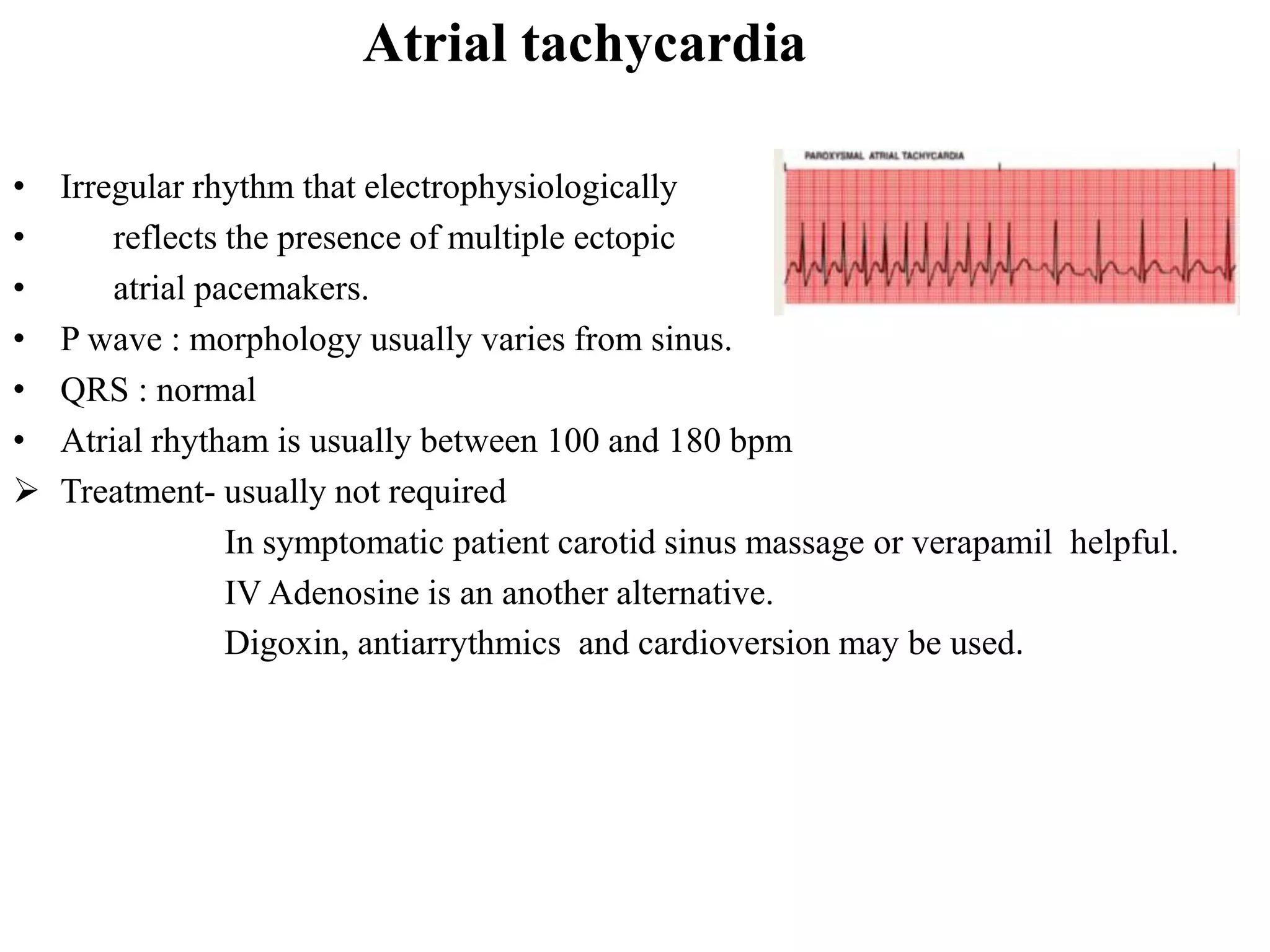
• Irregular rhythm that electrophysiologically
• reflects the presence of multiple ectopic
• atrial pacemakers.
• P wave : morphology usually varies from sinus.
• QRS : normal
• Atrial rhytham is usually between 100 and 180 bpm
 Treatment- usually not required
In symptomatic patient carotid sinus massage or verapamil helpful.
IV Adenosine is an another alternative.
Digoxin, antiarrythmics and cardioversion may be used.
Atrial flutter
• It is usually associated with organic ischamic heart disease.
• The atrial rate varies between 280 and 350 bpm.
• ECG shows saw tooth like atrial flutter waves between QRST
complexes
• Ventricular rate may be regular or irregular depending on the rate of
conduction.
• Most commonly 2:1 AV conduction for example if atrial rate 300 bpm
results in ventricular rate of 150 bpm
• Treatment :
• Pharmacological treatment with diltiazem, amioderone, or verapamil
is useful if patient is vitally stable.
• If haemodynamically significant treatment requires cardioversion.
Synchronized cardioversion starting at 50J(monophasic) is indicated.
Atrial fibrillation
• It accounts for 90% of SVT in the perioperative setting.
• It occurs when multiple areas of atria continuously depolarize and contract in
disorganized manner.
• No coordinated contractions only quivering of the atrial walls.
• It is caused by raised atrial pressure, incresed atrial muscle mass, atrial fibrosis or
inflamation and infiltration of the atrium
• Systemic disese include hyperthyrodism, pulmonary embolism and electrolyte
imbalance.
• Clinically the patient has very irregular pulse
• ECG shows fine oscillations of the baseline(so called fibrillation) and no clear P
waves. QRS rhytham is usually 160-180/min.
• In the recent onset AF, IV beta-blockers or CCB produce rapid control of rate.
• In haemodynamically compromised patients,DC cardioversion is the most effective
method of converting AF to sinus rhytham.
Ventricular premature beat
• It arises from the single or multiple foci
• located below the AV node.
• More common in patients anaesthetized
• with preexisting cardiac disease.
• New onset of VPB may occur in presence
• of coronary artery insufficiency, myocardial infarction, digitalis toxicity with
hypokalemia and hypoxemia.
• ECG shows premature & wide QRS complex, no preceding P wave and a
compensatory pause before the next sinus beat.
• Symptoms include palpitations, syncope or near syncope.
• Treatment-
• In asymptomatic and healthy patients usually no treatment required.
• VPC should be treated when they are frequent , polymorphic or associated with
haemodynamic instability.
• Primary steps include elimination of risk factors.
• Beta blockers are the most succesfull drugs in supressing.
• Amioderone, Lidocaine and other antiarrhythmic drugs are indicated only if VPC
progress to VT.
•
•
Ventricular tachycardia
• It is defined as 3 or more ventricular beats
• occuring at a rate of 120 bpm or more.
• It may be potentially life threatning.
• Pulse rate of 120-220 bpm
• ECG shows rapid ventricular rhythm with wide & bizzare QRS complexes.
• Treatment
• It may be urgent depending upon haemodynamic situation.
• Patient is if vitally unstable should undergo cardioversion immediately.
• It can begin at an output of 100 J & increse in increments of 50 to 100 J as
necessary.
• If vital signs are stable Inj. Amioderone 150 mg over 10 minute is
recommended.
• Lidocaine, Procainamide, Bretylium are other alternatives.
• Pulseless VT require inititation of CPR and immediate defibrillation using
360 J.
Ventricular fibrillations(VF)
• It is rapid and irregular ventricular activation
• with no mechanical effect.
• It is usually initiated from an ischameic
• myocardium or aberrant foci. or
• ventricular tachycardia.
• There is rapid grossly irregular ventricular rhythm with variability in QRS cycle
length, morphology and amplitude(shapeless rapid oscillations).
• There is acute fall in spo2 because of no associated stroke volume or cardiac
output.
• Causes include myocardial ischaemia, hypoxemia, electrolyte imbalance and drug
effects.
• Treatment-
• CPR must be performed as soon as possible.
• Asynchronous exeternal defibrillation should be performed using 200-360 J.
• When it is refractory to electric treatment, administration of epinephrine 1mg iv
improves response to electric cardioversion.
Torsades de points
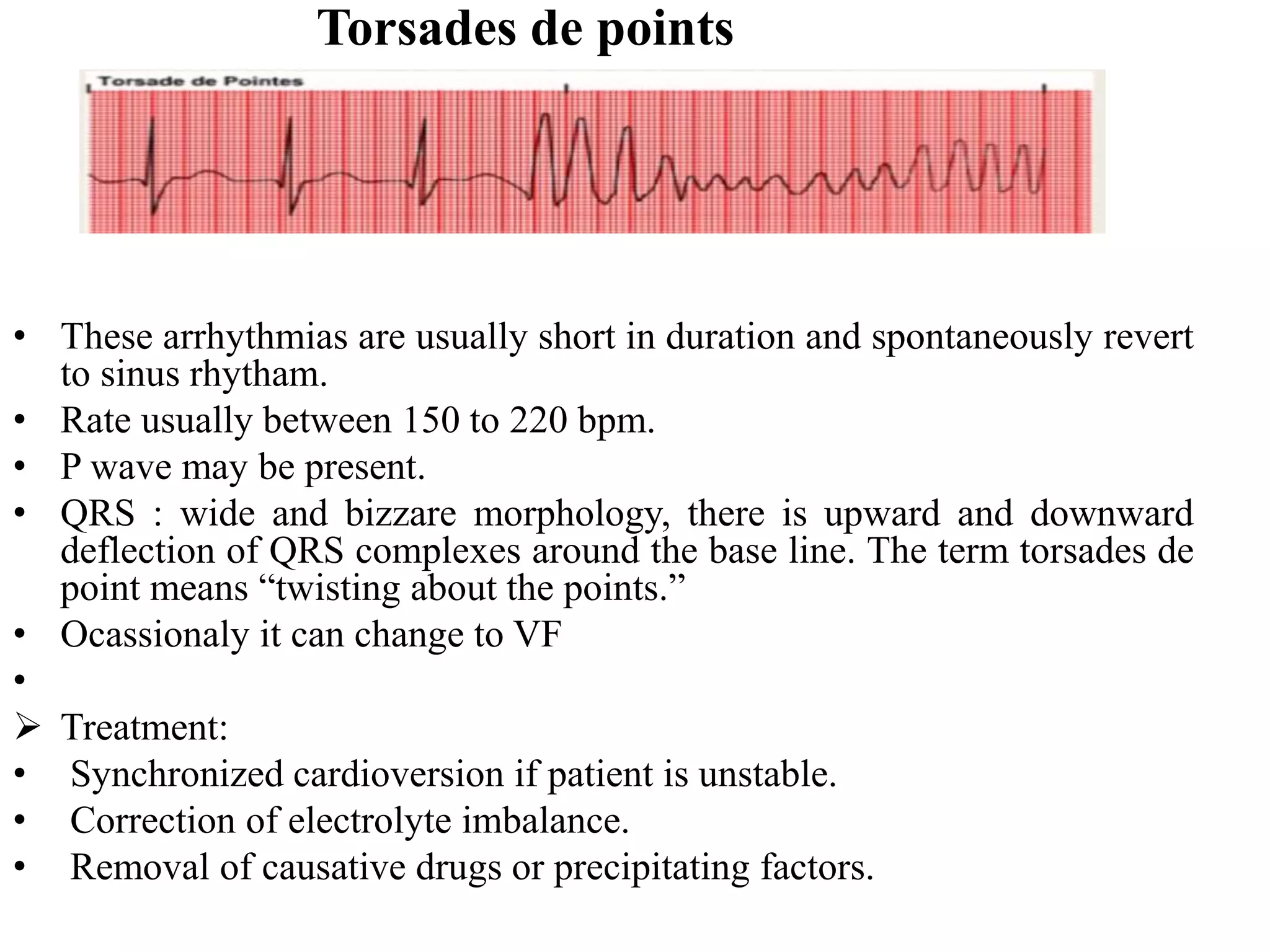
• These arrhythmias are usually short in duration and spontaneously revert
to sinus rhytham.
• Rate usually between 150 to 220 bpm.
• P wave may be present.
• QRS : wide and bizzare morphology, there is upward and downward
deflection of QRS complexes around the base line. The term torsades de
point means “twisting about the points.”
• Ocassionaly it can change to VF
•
 Treatment:
• Synchronized cardioversion if patient is unstable.
• Correction of electrolyte imbalance.
• Removal of causative drugs or precipitating factors.
Anti arrhythmic agents
THANK YOU

CARDIAC ARRHYTHMIA (1).pptx

  • 1.
    CARDIAC ARRYTHMIAS Presented by: Dr.kiranmulani. 2nd year resident Department of Anaesthesiology. Government Medical College, Bhavnagar. UNDER GUIDANCE OF: Dr.Ronak Ramanuj Tutor Department of Anaesthesiology. Government Medical College, Bhavnagar.
  • 2.
    Definition Arrhythmia is definedas “Abnormality of cardiac rate, regularity or site of origin of cardiac impulse or disorder of conduction of impulses.”
  • 3.
    Pathogenesis 1. Injury ordamage (pathology) to the cardiac conduction systems. 2. Re-entry : • It is a mechanism that can precipitate wide variety of ventricular and supraventricular arrhythmias. • There are 2 pathways over which impulses are conducted at different velocities. One pathway conducts the impulse in forward direction i.e antegrade and other pathway conducts reentering cardiac impulse backwards i.e retrograde 3. Automaticity : Abnormal depolarization of atrial or ventricular muscle cell during the periods of action potential can lead to arrhythmias. 4. AV dissociation: • The atria and ventricles contract independently of each other.
  • 4.
    Contributing factors andcauses • Hypovolemia • Hypoxia • Hypo/Hyperkalemia • Hypomagnesaemia/ Hypocalcemia • Hypoglycemia • Hypothermia • Acidosis • Mechanical irritation (e.g. central venous lines, pulmonary artery catheter, Chest tube) • Cardiac ischaemia • Light plane of anaesthesia • Cardiac tamponade • Tension pneumothorax • Surgical cause(Traction to intestine, oculocardiac reflex, neurosurgical causes) • Tracheal intubation • Preexisting cardiac disease • Spinal anaesthesia when blockade extends to high thoracic levels.
  • 5.
  • 6.
    Sinus bradycardia SA nodedischarges at a rate slower than normal. Rate : <60bpm Rhythm : Regular Causes • Physiological causes: Athletes, Labourers, During sleep • Drug effects:Beta-blockers, digitalis, calcium channel blockers. • Vagal stimulation • Acute myocardial ischaemia • Hypothermia • Hypothyrodism • Raised ICP. • Chronic degenerative changes such as fibrosis of the atrium and sinus node. Treatment • If asymptomatic - no treatment required. • If symptomatic – immediate treatment required. • In patients with haemodynamic compromise such as hypotension atropine is the first line of treatment(0.5 to 1 mg iv bolus repeated every 3 to 5 minutes, if required.) • If bradycardia still persists despite treatment, isoprenaline can be administered (iv bolus of 5 to 10 microgm f/b infusion of 2 to 10 microgm/min.) • Other alternative is dopamine infusion 5 to 20 microgm/min.
  • 7.
    Various forms ofheart block First degree AV block : • Only prolonged PR interval (>0.2 seconds) • Every atrial depolarization is followed by conduction to the ventricle but with delay. • Each P wave is conducted and followed by normal QRS complex.  Causes : Old age Inferior wall MI Ischemia Drugs affecting AV node conduction digitalis & amioderone  Treatment : Usually not necessary Monitor and observe for progression to higher degree block.
  • 8.
    Second degree AVblock  Mobitz type I (Wenckebach block): • Progressive prolongation of PR interval until a beat is entirely blocked(absent QRS complex). • Here each successive depolarization produces prolongation of the refractory period of AV node. • Treatment : Not requiered unless signs of poor perfusion , Symptomatic patients may be treated with Inj. Atropine.  Mobitz type II : • Sudden & complete interupption in the conduction of cardiac impulse. • Sudden dropped beat due to a block in or below the bundle of His Treatment :Transcutaneous or tansvenous pacing.
  • 9.
    Third degree AVblock • Complete interupption of the AV conduction • No conduction of cardiac impulses from • the atria to ventricles. • There is complete AV dissociation.. • No correlation between P waves and QRS. • Most common cause in adults is fibrotic degeneration in distal conduction systems associated with aging. • Symptoms include vertigo, syncope, dyspnoea, weakness.  Treatment : • Transcutaneous or trans venous pacing • If the block persists placement of permanent cardiac pacemaker
  • 11.
    Sinus tachycardia HR >100bpm  Causes • Anaemia because of blood loss • Pain • Fever • Hypercarbia • Thyrotoxicosis/ thyroid crisis • Cardiac failure with compensatory sinus tachycardia • Catecholamines excess  Treatment • First of all precipitating factor must be identified and corrected. • Drug therapy is required in patients with IHD who develop ST segment changes to prevent further myocardial ischemia. • Beta blockers such as esmolol is preferred drug for it. • If continuous use is required , it may be replaced by longer lasting drugs such as metoprolol.
  • 12.
    Atrial premature beat •Arises from ectopic foci in atria.. • An abnormal P wave is usually • followed by normal QRS complexes. • Treatment – • Not normally required because haemodynamically insignificant unless the ectopic beats provoke more significant arrhythmias, where beta blockadge may be effective.
  • 13.
    Atrial tachycardia • Irregularrhythm that electrophysiologically • reflects the presence of multiple ectopic • atrial pacemakers. • P wave : morphology usually varies from sinus. • QRS : normal • Atrial rhytham is usually between 100 and 180 bpm  Treatment- usually not required In symptomatic patient carotid sinus massage or verapamil helpful. IV Adenosine is an another alternative. Digoxin, antiarrythmics and cardioversion may be used.
  • 14.
    Atrial flutter • Itis usually associated with organic ischamic heart disease. • The atrial rate varies between 280 and 350 bpm. • ECG shows saw tooth like atrial flutter waves between QRST complexes • Ventricular rate may be regular or irregular depending on the rate of conduction. • Most commonly 2:1 AV conduction for example if atrial rate 300 bpm results in ventricular rate of 150 bpm • Treatment : • Pharmacological treatment with diltiazem, amioderone, or verapamil is useful if patient is vitally stable. • If haemodynamically significant treatment requires cardioversion. Synchronized cardioversion starting at 50J(monophasic) is indicated.
  • 15.
    Atrial fibrillation • Itaccounts for 90% of SVT in the perioperative setting. • It occurs when multiple areas of atria continuously depolarize and contract in disorganized manner. • No coordinated contractions only quivering of the atrial walls. • It is caused by raised atrial pressure, incresed atrial muscle mass, atrial fibrosis or inflamation and infiltration of the atrium • Systemic disese include hyperthyrodism, pulmonary embolism and electrolyte imbalance. • Clinically the patient has very irregular pulse • ECG shows fine oscillations of the baseline(so called fibrillation) and no clear P waves. QRS rhytham is usually 160-180/min. • In the recent onset AF, IV beta-blockers or CCB produce rapid control of rate. • In haemodynamically compromised patients,DC cardioversion is the most effective method of converting AF to sinus rhytham.
  • 16.
    Ventricular premature beat •It arises from the single or multiple foci • located below the AV node. • More common in patients anaesthetized • with preexisting cardiac disease. • New onset of VPB may occur in presence • of coronary artery insufficiency, myocardial infarction, digitalis toxicity with hypokalemia and hypoxemia. • ECG shows premature & wide QRS complex, no preceding P wave and a compensatory pause before the next sinus beat. • Symptoms include palpitations, syncope or near syncope. • Treatment- • In asymptomatic and healthy patients usually no treatment required. • VPC should be treated when they are frequent , polymorphic or associated with haemodynamic instability. • Primary steps include elimination of risk factors. • Beta blockers are the most succesfull drugs in supressing. • Amioderone, Lidocaine and other antiarrhythmic drugs are indicated only if VPC progress to VT. • •
  • 17.
    Ventricular tachycardia • Itis defined as 3 or more ventricular beats • occuring at a rate of 120 bpm or more. • It may be potentially life threatning. • Pulse rate of 120-220 bpm • ECG shows rapid ventricular rhythm with wide & bizzare QRS complexes. • Treatment • It may be urgent depending upon haemodynamic situation. • Patient is if vitally unstable should undergo cardioversion immediately. • It can begin at an output of 100 J & increse in increments of 50 to 100 J as necessary. • If vital signs are stable Inj. Amioderone 150 mg over 10 minute is recommended. • Lidocaine, Procainamide, Bretylium are other alternatives. • Pulseless VT require inititation of CPR and immediate defibrillation using 360 J.
  • 18.
    Ventricular fibrillations(VF) • Itis rapid and irregular ventricular activation • with no mechanical effect. • It is usually initiated from an ischameic • myocardium or aberrant foci. or • ventricular tachycardia. • There is rapid grossly irregular ventricular rhythm with variability in QRS cycle length, morphology and amplitude(shapeless rapid oscillations). • There is acute fall in spo2 because of no associated stroke volume or cardiac output. • Causes include myocardial ischaemia, hypoxemia, electrolyte imbalance and drug effects. • Treatment- • CPR must be performed as soon as possible. • Asynchronous exeternal defibrillation should be performed using 200-360 J. • When it is refractory to electric treatment, administration of epinephrine 1mg iv improves response to electric cardioversion.
  • 19.
    Torsades de points •These arrhythmias are usually short in duration and spontaneously revert to sinus rhytham. • Rate usually between 150 to 220 bpm. • P wave may be present. • QRS : wide and bizzare morphology, there is upward and downward deflection of QRS complexes around the base line. The term torsades de point means “twisting about the points.” • Ocassionaly it can change to VF •  Treatment: • Synchronized cardioversion if patient is unstable. • Correction of electrolyte imbalance. • Removal of causative drugs or precipitating factors.
  • 21.
  • 23.