Presentation on
Tabulation
Content:
 Tabulation
Characteristics of a Good Table
Types of Tables
Rules of Tabulation
 Significance of Tabulation
Tabulation:
Tabulation is a method of presenting the data in the
form of tables so that the results can be interpreted
easily.
The purpose of tabulation is to present maximum
possible information in minimum possible space.
Tabulation is the final stage of data processing which
provides the data for further analysis.
 In Tabulation, the data are represented in a compact
form in such a way, that the quality and utility of
information is not lost.
Clarity
Manageable Size
Attractive Get-Up
Logical Arrangement of Items
Characteristics of a Good
Table
05 Scientifically Prepared
06
Columns and Rows
should be Numbered
Averages and Totals
07
The Table should be prepared in
a systematic and logically
organized manner, simple and
compact so that it is readily
comprehensible.
1) Scientifically
Prepared
2) Manageable
Size:
A table should be so designed
that it is neither very long and
narrow nor very short and
broad.
3) Logical
Arrangement of Items:
There should be logical
and systematic
classification of item in
the table.
4).Columns and Rows
should be Numbered:
When there are a number of
rows and columns in a table,
they must be numbered for
reference.
5). Units:
The unit designations should be given
at the top of the table below the title
such as ‘price in rupees’ and ‘weight
in tonnes'.
6).Proper
letters:
It is not advisable to use too many
styles of letters in a table. Large capital
letters may be used for headings,
captions and small letters may be used
for footnotes and source notes.
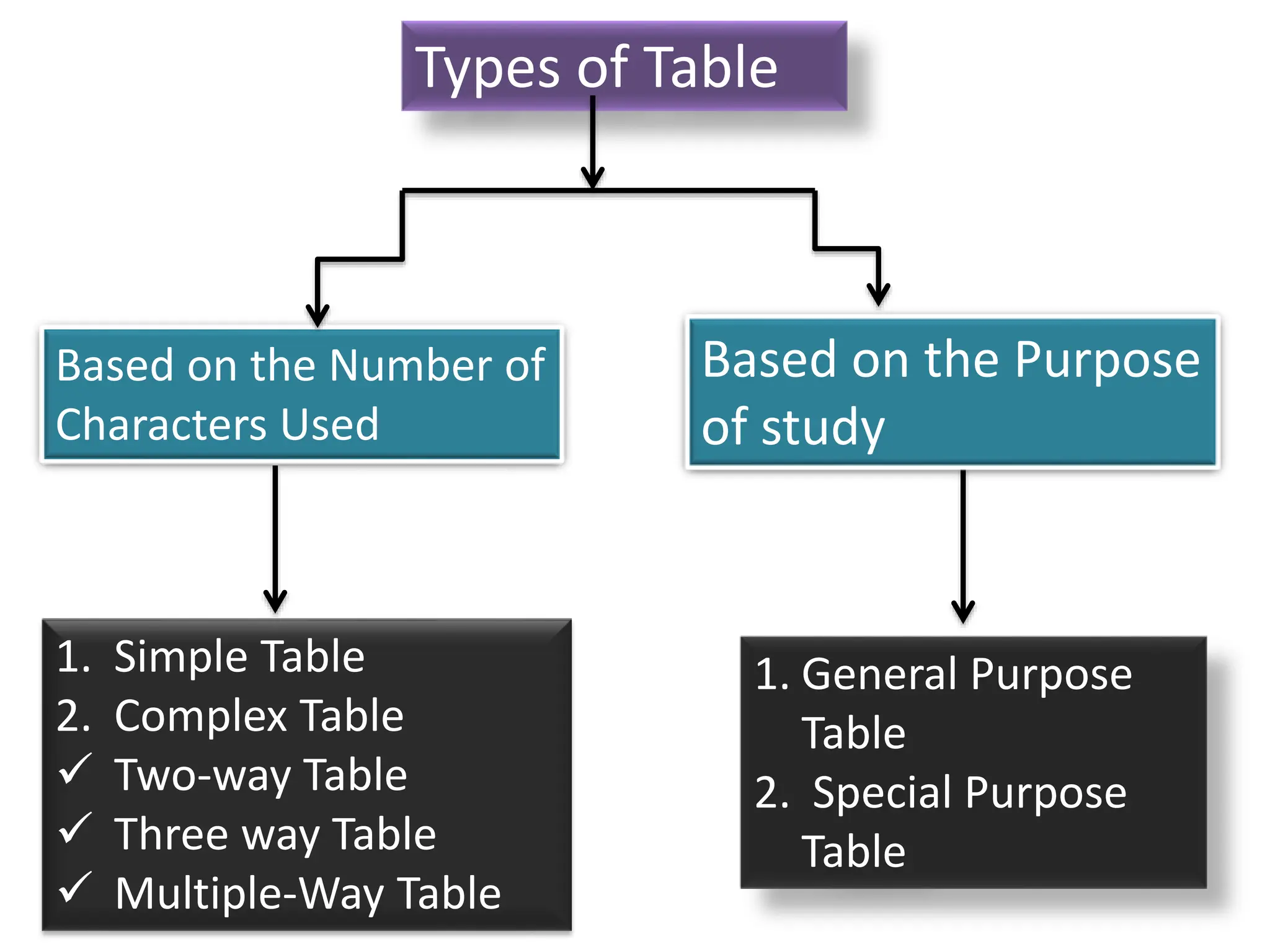
Types of Table
Based on the Number of
Characters Used
1. Simple Table
2. Complex Table
 Two-way Table
 Three way Table
 Multiple-Way Table
1. General Purpose
Table
2. Special Purpose
Table
Based on the Purpose
of study
Based on the Number of Characters Used:
1). Simple Tables
 Also known as one-way table,
 data are presented based on only
one characteristic.
Following table shows number of students in a
particular course in a university:
For example:
2). Complex
Tables:
 when a table is prepared on the basis of
more than one characteristic.
In Such tables, more than one
classification is represented.
 Here, the column represents the
category of the item and row represents
value of the item.
a) Two-Way
Table:
 In a two-way table, the classification is
made on the basis of only two character.
 It is also called “double tabulation”
Two- way tables are constructed with
the help of one-way table.
It is much easier to analyse a two-way
table compared to one-way table.
For
example:
Following table shows the number of
students in a college as per the year in
the different courses:
b) Three-way
Table:
 When a table is constructed with the
help of three inter-related
characteristics, it is known as “Three-
way Table” or “treble tabulation”.
For example:
Following table shows the number of
students in a college according to North
and South region, the course, and the
year of the course:
C) Multiple -
way Table:
 A multiple-way table is constructed in the same
way as one-way, two-way, and three-way tables
are constructed.
But the difference here is that there are multiple
characteristics which are used to tabulate the
data.
Usually these types of tables are constructed
while collecting census data.
These are also known as “ manifold tables”.
For example:
Following table categorises four
characteristics which are courses,
graduation stream of the students,
north and south region, and year.
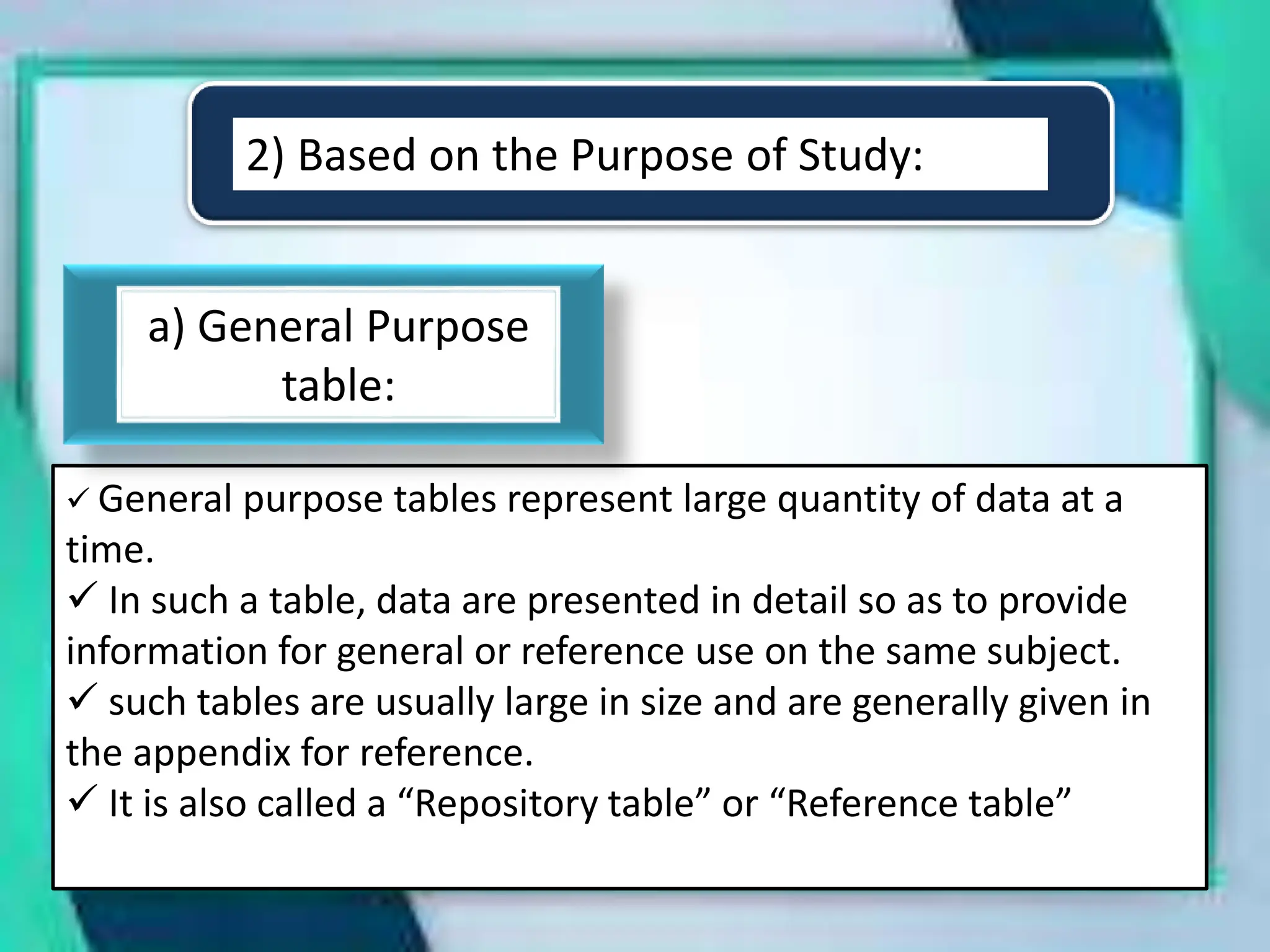
2) Based on the Purpose of Study:
 General purpose tables represent large quantity of data at a
time.
 In such a table, data are presented in detail so as to provide
information for general or reference use on the same subject.
 such tables are usually large in size and are generally given in
the appendix for reference.
 It is also called a “Repository table” or “Reference table”
a) General Purpose
table:
 These tables are comparatively small as less
amount of information is represented which are
specifically related to the research objective.
 These tables are called “summary table” or “text
table”.
 These tables help in comparative data analysis
related to a specific research problem.
b). Special Purpose
Table:
Rules of Tabulation
 Rules
Regarding the
Table Structure
 General
Rules
 Title
 Size of
Columns
 Number of
Rows and
Columns
 Table
Number
 Source
Rules Regarding the Table Structure
Table
Number
1).
When a number of tables
are constructed, serial
number should be given to
each table.
The title of the table
should be clear and
precise indicating “what,
where and when” of the
data in that order.
2). Title
3). Source The source of information must
be mentioned just below the
table.
Size of
Columns
The size of the columns
should be according to the
information to be written in the
those columns.
Number of Rows
and Columns
The number of rows
and columns depends on
the nature of the data.
4).
5).
Attractive
Shape
Free from
Irrelevant Data
Use of Circle
or Box
Non-availability
of Data
General Rules
 Attractive
Shape
Simplicity
The table should be neat
and attractive. The size of
the table should be neither
too big nor too small.
A table should be simple
and self-explanatory and
according to the object of
statistical investigation.
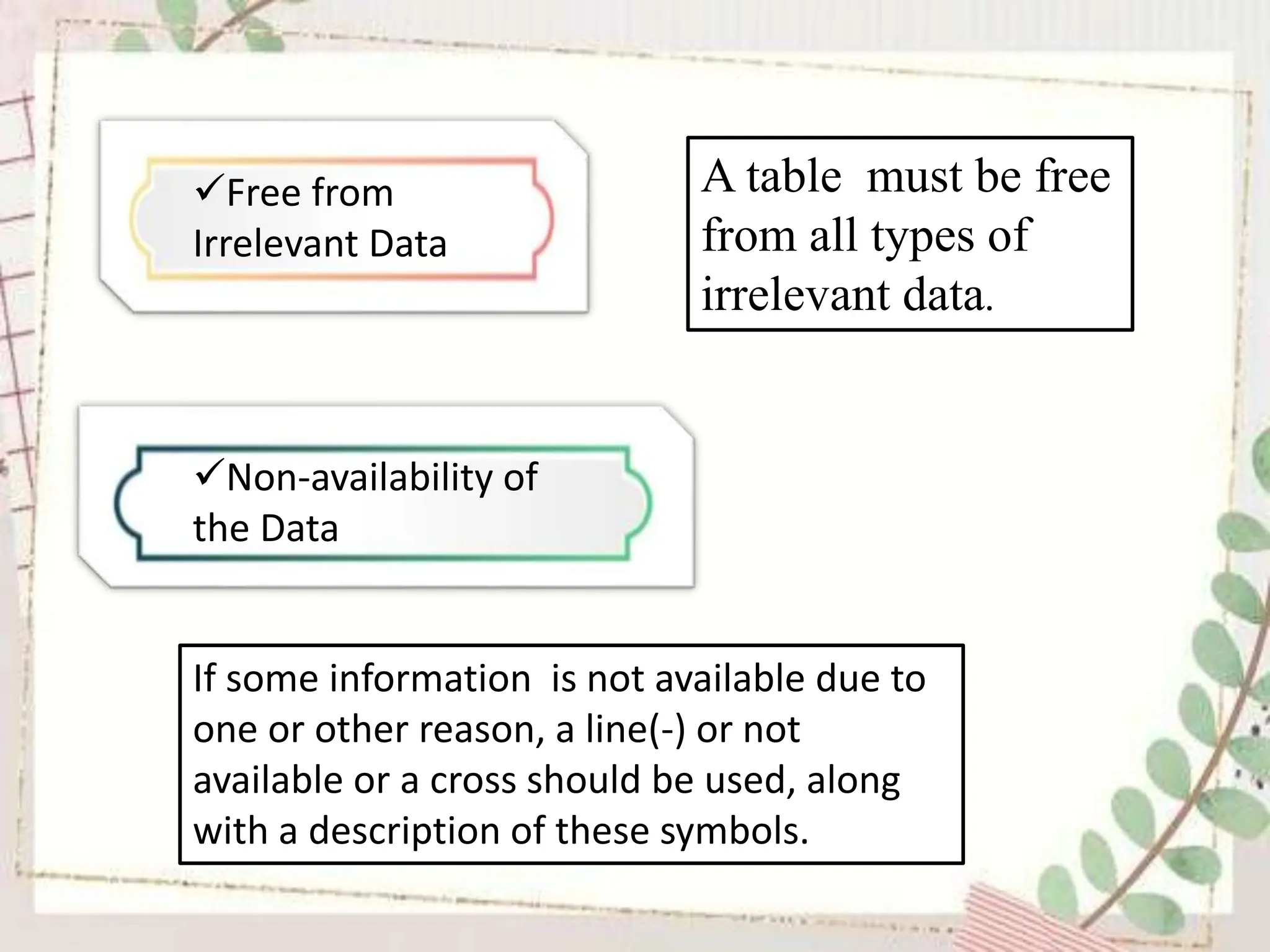
A table must be free
from all types of
irrelevant data.
If some information is not available due to
one or other reason, a line(-) or not
available or a cross should be used, along
with a description of these symbols.
Non-availability of
the Data
Free from
Irrelevant Data
Significance
of
Tabulation
Since the data is presented in a very systematic
manner in tables, therefore researchers can
easily compare data. It makes the data analysis
comparatively easy to carry-out.
1). Helps in Comparing Data
2). Important for Data Analysis
Tabulation is the intermediate step between data collection and
analysis. Analysis cannot be performed on raw data, which makes
it necessary for the data to be tabulated in a systematic and
comprehensive manner. Once the data is tabulated, it is possible
to proceed for furthers analysis.
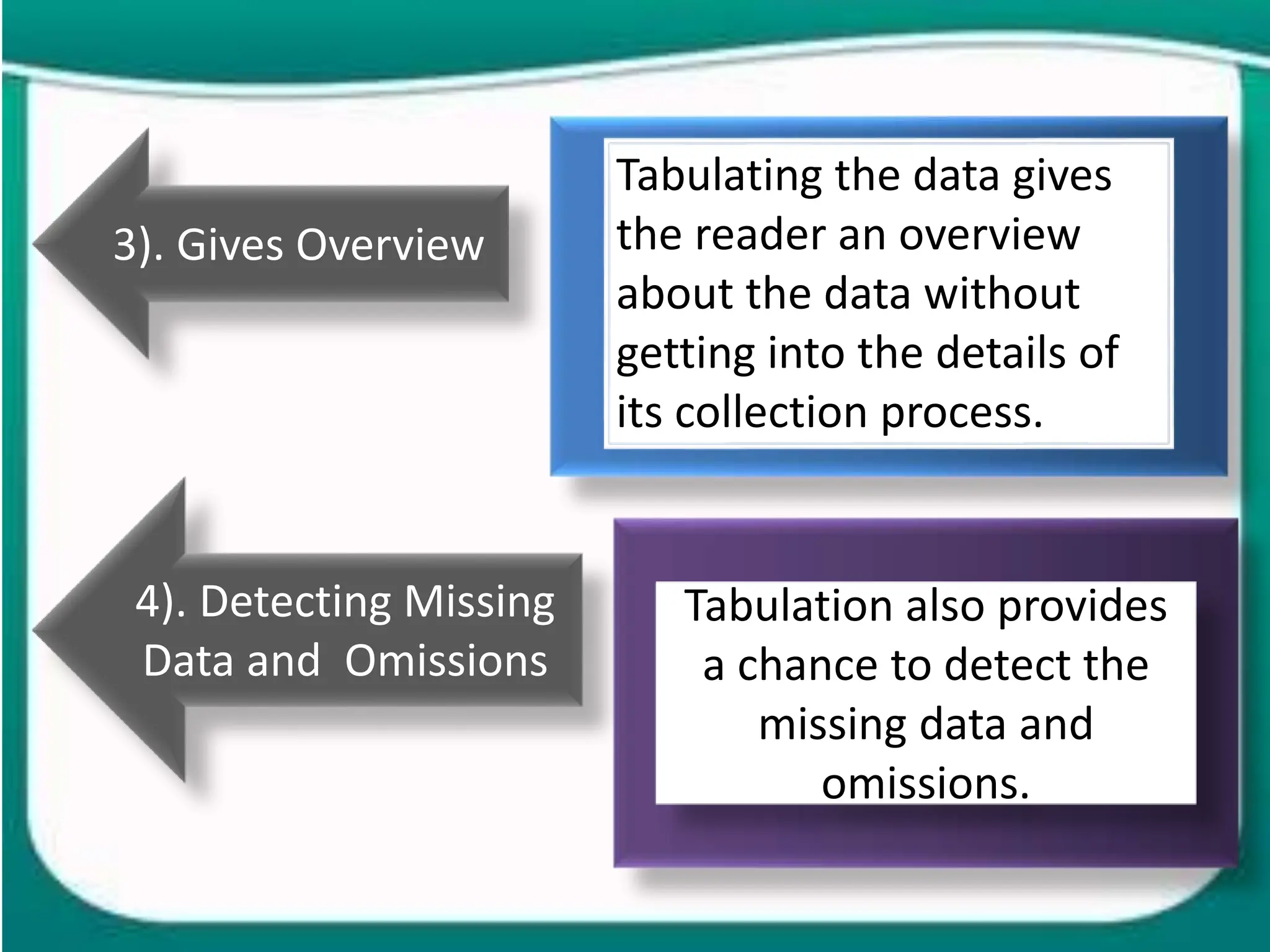
3). Gives Overview
4). Detecting Missing
Data and Omissions
Tabulation also provides
a chance to detect the
missing data and
omissions.
Tabulating the data gives
the reader an overview
about the data without
getting into the details of
its collection process.
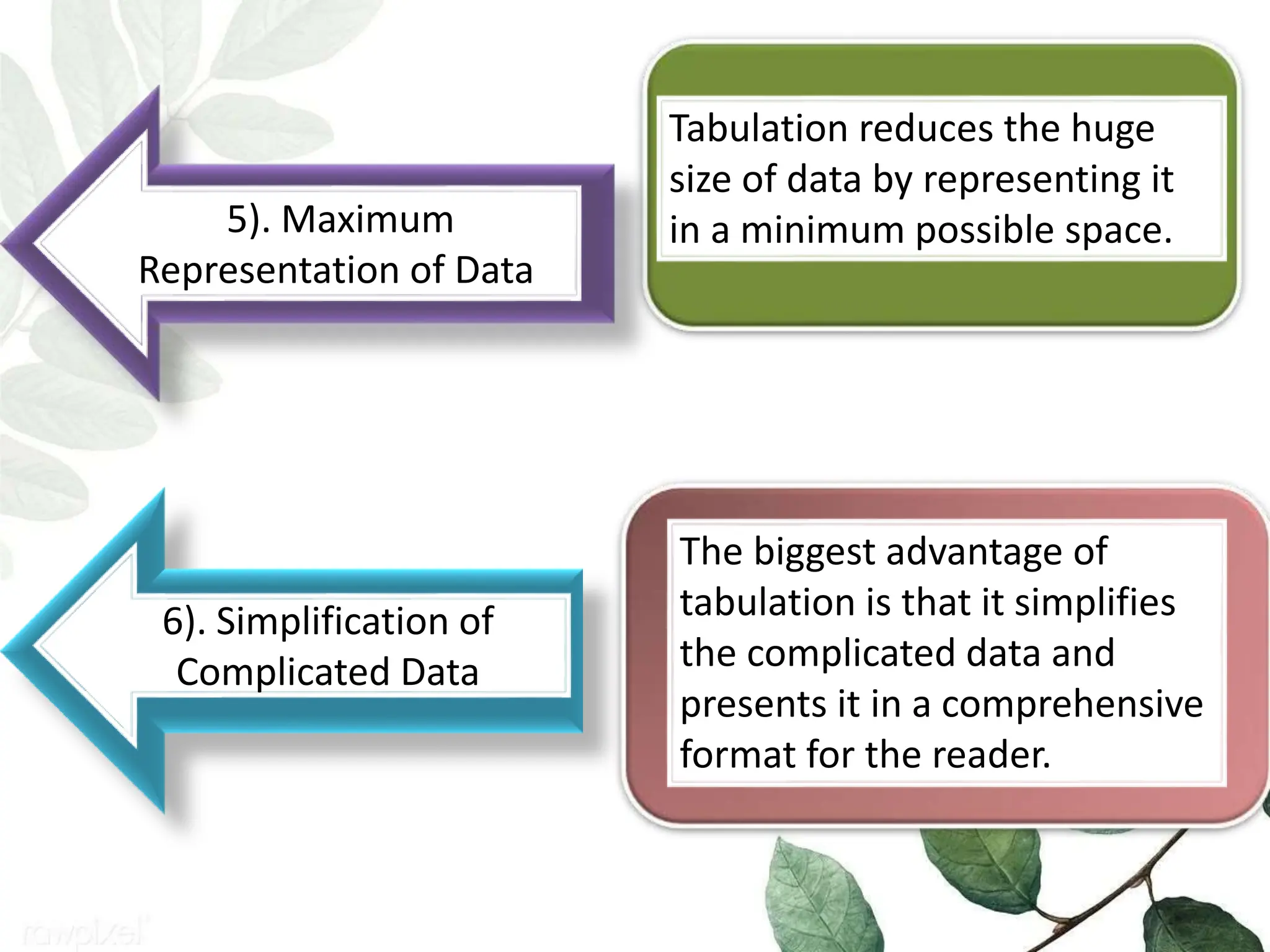
Tabulation reduces the huge
size of data by representing it
in a minimum possible space.
5). Maximum
Representation of Data
6). Simplification of
Complicated Data
The biggest advantage of
tabulation is that it simplifies
the complicated data and
presents it in a comprehensive
format for the reader.
research methodology presentation-6.pptx

research methodology presentation-6.pptx

  • 1.
  • 2.
    Content:  Tabulation Characteristics ofa Good Table Types of Tables Rules of Tabulation  Significance of Tabulation
  • 3.
    Tabulation: Tabulation is amethod of presenting the data in the form of tables so that the results can be interpreted easily. The purpose of tabulation is to present maximum possible information in minimum possible space. Tabulation is the final stage of data processing which provides the data for further analysis.  In Tabulation, the data are represented in a compact form in such a way, that the quality and utility of information is not lost.
  • 4.
    Clarity Manageable Size Attractive Get-Up LogicalArrangement of Items Characteristics of a Good Table
  • 5.
    05 Scientifically Prepared 06 Columnsand Rows should be Numbered Averages and Totals 07
  • 6.
    The Table shouldbe prepared in a systematic and logically organized manner, simple and compact so that it is readily comprehensible. 1) Scientifically Prepared 2) Manageable Size: A table should be so designed that it is neither very long and narrow nor very short and broad. 3) Logical Arrangement of Items: There should be logical and systematic classification of item in the table.
  • 7.
    4).Columns and Rows shouldbe Numbered: When there are a number of rows and columns in a table, they must be numbered for reference. 5). Units: The unit designations should be given at the top of the table below the title such as ‘price in rupees’ and ‘weight in tonnes'. 6).Proper letters: It is not advisable to use too many styles of letters in a table. Large capital letters may be used for headings, captions and small letters may be used for footnotes and source notes.
  • 8.
    Types of Table Basedon the Number of Characters Used 1. Simple Table 2. Complex Table  Two-way Table  Three way Table  Multiple-Way Table 1. General Purpose Table 2. Special Purpose Table Based on the Purpose of study
  • 9.
    Based on theNumber of Characters Used: 1). Simple Tables  Also known as one-way table,  data are presented based on only one characteristic. Following table shows number of students in a particular course in a university: For example:
  • 10.
    2). Complex Tables:  whena table is prepared on the basis of more than one characteristic. In Such tables, more than one classification is represented.  Here, the column represents the category of the item and row represents value of the item. a) Two-Way Table:  In a two-way table, the classification is made on the basis of only two character.  It is also called “double tabulation” Two- way tables are constructed with the help of one-way table. It is much easier to analyse a two-way table compared to one-way table.
  • 11.
    For example: Following table showsthe number of students in a college as per the year in the different courses:
  • 12.
    b) Three-way Table:  Whena table is constructed with the help of three inter-related characteristics, it is known as “Three- way Table” or “treble tabulation”. For example: Following table shows the number of students in a college according to North and South region, the course, and the year of the course:
  • 13.
    C) Multiple - wayTable:  A multiple-way table is constructed in the same way as one-way, two-way, and three-way tables are constructed. But the difference here is that there are multiple characteristics which are used to tabulate the data. Usually these types of tables are constructed while collecting census data. These are also known as “ manifold tables”.
  • 14.
    For example: Following tablecategorises four characteristics which are courses, graduation stream of the students, north and south region, and year.
  • 15.
    2) Based onthe Purpose of Study:  General purpose tables represent large quantity of data at a time.  In such a table, data are presented in detail so as to provide information for general or reference use on the same subject.  such tables are usually large in size and are generally given in the appendix for reference.  It is also called a “Repository table” or “Reference table” a) General Purpose table:
  • 16.
     These tablesare comparatively small as less amount of information is represented which are specifically related to the research objective.  These tables are called “summary table” or “text table”.  These tables help in comparative data analysis related to a specific research problem. b). Special Purpose Table:
  • 17.
    Rules of Tabulation Rules Regarding the Table Structure  General Rules
  • 18.
     Title  Sizeof Columns  Number of Rows and Columns  Table Number  Source Rules Regarding the Table Structure
  • 19.
    Table Number 1). When a numberof tables are constructed, serial number should be given to each table. The title of the table should be clear and precise indicating “what, where and when” of the data in that order. 2). Title
  • 20.
    3). Source Thesource of information must be mentioned just below the table. Size of Columns The size of the columns should be according to the information to be written in the those columns. Number of Rows and Columns The number of rows and columns depends on the nature of the data. 4). 5).
  • 21.
    Attractive Shape Free from Irrelevant Data Useof Circle or Box Non-availability of Data General Rules
  • 22.
     Attractive Shape Simplicity The tableshould be neat and attractive. The size of the table should be neither too big nor too small. A table should be simple and self-explanatory and according to the object of statistical investigation.
  • 23.
    A table mustbe free from all types of irrelevant data. If some information is not available due to one or other reason, a line(-) or not available or a cross should be used, along with a description of these symbols. Non-availability of the Data Free from Irrelevant Data
  • 24.
  • 25.
    Since the datais presented in a very systematic manner in tables, therefore researchers can easily compare data. It makes the data analysis comparatively easy to carry-out. 1). Helps in Comparing Data 2). Important for Data Analysis Tabulation is the intermediate step between data collection and analysis. Analysis cannot be performed on raw data, which makes it necessary for the data to be tabulated in a systematic and comprehensive manner. Once the data is tabulated, it is possible to proceed for furthers analysis.
  • 26.
    3). Gives Overview 4).Detecting Missing Data and Omissions Tabulation also provides a chance to detect the missing data and omissions. Tabulating the data gives the reader an overview about the data without getting into the details of its collection process.
  • 27.
    Tabulation reduces thehuge size of data by representing it in a minimum possible space. 5). Maximum Representation of Data 6). Simplification of Complicated Data The biggest advantage of tabulation is that it simplifies the complicated data and presents it in a comprehensive format for the reader.