DEMOGRAPHIC PERSPECTIVES
• Perspective – a way of relating basic information to
theories about how the world operates
demographically
• Demographic perspective – guide you through the
relationship that exists between population factors
and the rest of what is going on in a society
• This will help in drawing you attention or
awareness about your community, national and
world political, economic and social issues
• Positioned to ask about the influences that
demographic changes have had (may have had)
• Two questions have to be asked before developing
your own perspective
1. What are the causes of population growth
(population change)
2. What are the consequences of population growth or
change
• Following the major lines of demographic theory will
help you develop your own demographic perspective
• Doctrine – belief by early thinkers that they were
certain that they had answers and certain of their
proclamations to be representing the truth about
population growth and its consequences for society
• Theory – This is the essence of modern scientific
thought to assume that they do not have answers
and to acknowledge to be willing to consider
evidence regardless the conclusion to which it
points
• It is in the process of trying to sort out evidence
that we develop tentative statements (theories)
that at least help give us a guide to think and
search for understanding WHY THINGS ARE THE
WAY THEY ARE
• Theories replaced doctrines
THOMAS ROBERT MALTHUS
• Glergyman and Economist
• He had a degree in Maths
• He was appointed as Professor in Political Economy
• Wrote an essay on ‘The principle of population,
1978’.
• Important concepts inherent in his approach:
The principle of population
Geometric and arithmetic growth
Positive checks
Preventive checks
Moral restraint
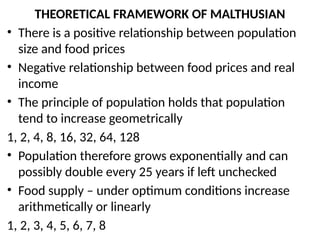
THEORETICAL FRAMEWORK OF MALTHUSIAN
• There is a positive relationship between population
size and food prices
• Negative relationship between food prices and real
income
• The principle of population holds that population
tend to increase geometrically
1, 2, 4, 8, 16, 32, 64, 128
• Population therefore grows exponentially and can
possibly double every 25 years if left unchecked
• Food supply – under optimum conditions increase
arithmetically or linearly
1, 2, 3, 4, 5, 6, 7, 8
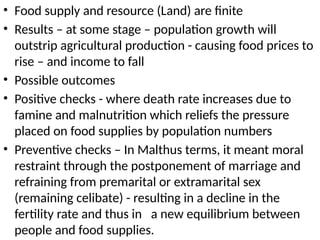
• Food supply and resource (Land) are finite
• Results – at some stage – population growth will
outstrip agricultural production - causing food prices to
rise – and income to fall
• Possible outcomes
• Positive checks - where death rate increases due to
famine and malnutrition which reliefs the pressure
placed on food supplies by population numbers
• Preventive checks – In Malthus terms, it meant moral
restraint through the postponement of marriage and
refraining from premarital or extramarital sex
(remaining celibate) - resulting in a decline in the
fertility rate and thus in a new equilibrium between
people and food supplies.
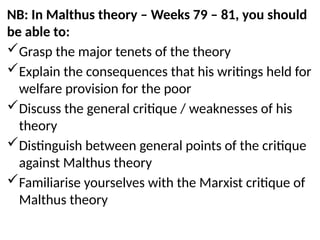
NB: In Malthus theory – Weeks 79 – 81, you should
be able to:
Grasp the major tenets of the theory
Explain the consequences that his writings held for
welfare provision for the poor
Discuss the general critique / weaknesses of his
theory
Distinguish between general points of the critique
against Malthus theory
Familiarise yourselves with the Marxist critique of
Malthus theory
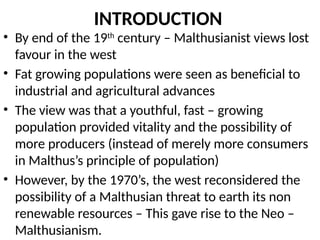
INTRODUCTION
• By end of the 19th
century – Malthusianist views lost
favour in the west
• Fat growing populations were seen as beneficial to
industrial and agricultural advances
• The view was that a youthful, fast – growing
population provided vitality and the possibility of
more producers (instead of merely more consumers
in Malthus’s principle of population)
• However, by the 1970’s, the west reconsidered the
possibility of a Malthusian threat to earth its non
renewable resources – This gave rise to the Neo –
Malthusianism.
NEO - MALTHUSIANISM
• In the 1970’s, the Neo Malthusianists reinterpreted
Malthus work and changed his preventive checks of
moral restraint into an explicit population policy
guideline – namely, that of birth control to keep the
population in check.
• Share Malthus pessimistic view of population but
use new concepts and variables than merely PEOPLE
and FOOD SUPPLIES
• Neo-Malthusianism generally refers to people with
the same basic concerns as Malthus who advocate
for population control programs to ensure enough
resources for current and future populations
• They differ from Malthus' theories mainly in their
enthusiasm for contraceptive techniques.
• Remember, Malthus, as a devout Christian believed that
"self-control" or abstinence were preferable to artificial
means of birth control.
• However, in some editions of his essay, Malthus did allow
that self restraint was unlikely to be effective on a wide
scale, and therefore could countenance the use of artificial
means of birth control as a solution to population
pressure.
• Neo-Malthusians are generally more concerned with
environmental degradation and depletion of non
renewable resources than with poverty as Malthus was,
although it is hard to completely separate all of the
different factors
• They put across the idea that rapid growth is
connected to issues of environmental degradation
and the depletion non renewable resources
• A non-renewable resource is a natural resource
which cannot be produced, grown, generated, or
used on a scale which can sustain its consumption
rate
• Once used there is no more remaining. These
resources often exist in a fixed amount and are
consumed much faster than nature can create
them.
• E.g. Fossil fuels (such as coal, petroleum and natural
gas) and nuclear power (uranium) are examples.
• When natural habitats are destroyed or natural
resources are depleted, environment is degraded
• Environmental degradation is:
the deterioration of the environment through depletion
of resources such as air, water and soil
the reduction of the capacity of the environment to
meet social and ecological objectives, and needs
Any change or disturbance to the environment perceived
to be deleterious (having harmful effects) or undesirable.
E.g.
Damaging the lithosphere - upper part of the earth’s
crust containing soil, minerals and fuels that plants and
animals require for life
Damaging the atmosphere - surface of the earth
and;
Damaging the hydrosphere - most surface water
and ground water
• Neo Malthusians argued that the rate of energy
consumption will outstrip the ability to find and
produce new energy sources, and so lead to a
crisis.
• Concerned that overpopulation may increase
resource depletion or environmental degradation
to a degree that is not sustainable, with the
potential of ecological collapse or other hazards
MARXIST PERSPECTIVE
• Karl Marx (born nearly 15 years after Malthus) and Frederick
Engels (who was seven years younger than Marx) severely
criticised Malthus perspective on population
• Marxist perspective arose mainly out of a reaction against
Malthus views
• There are 62 references in Marx’s capital to the principle of
population
• For Marx and Engels, there could not possibly be an
independed, general theory of population
• They pointed out that Malthus bases his principle on looking
at the consequences of inequality, namely poverty and
hunger, and then categorising them as outcomes of some
natural law instead of looking at the social relations that gave
rise to them in the first place
• Neither Marx nor Engels ever directly addressed
the issue of why and how population grew
• They were both in favour for equal rights for men
and women and saw no harm in preventing birth
• They were sceptical of the natural laws of nature as
Malthus stated : Population tends to outstrip
population
• They preferred to see human activity as a product
of social and economic environment
• The basic Marxian perspective is that each society
at each point in history has its own law of
population that determines the consequences of
population growth
• For capitalism, the consequences are
overpopulation and poverty, whereas for
socialism, population growth is readily absorbed
by the economy with no side effects
• Resources could not grow as rapidly as population
• They saw no reason to suspect that science and
technology could not increase the availability of
food and other goods at least as quickly as the
population grew
• Engels argued that whatever population pressures
existed in society was really pressure against the
means of subsistence
• Thus, they rejected the notion that poverty can be
blamed on the poor
• Poverty is the result of a poorly organized society,
especially capitalist society
• Consequence of population growth should be a
significant increase in production
• Obviously each worker was producing more than he /
she required
• In a well ordered society, if there were more people,
they ought to be more wealth, not more poverty
• Capitalist are skimming on the labourers wages as
profits for themselves
• The more the capitalists keeps, the lower your wages
and the poorer you will be
• Marx argued that capitalism worked by using the
labor of the working classes to earn profits to buy
machinery that would replace the labourers,
which in turn will lead to unemployment and
poverty
• The poor were not poor because they overran the
food supply, but because capitalist have taken
away their part of wages, taken away their jobs
and replaced them with machines
• Thus the consequences of pop growth discussed
by Malthus, were the consequences of a capitalist
society, not population growth per se
• Over population in a capitalist society was thought to
be a result of the capitalists’ desire for an industrial
reserve army that would keep wages low through
competition for jobs, and force workers to be
productive in order to keep their jobs
• To Marx, the growing population would bear the seeds
of destruction for capitalism, because unemployment
would lead to disaffection and revolution
• If societies could be reorganised in a more equitable
manner (socialism), pop problems would disappear
• Like Malthus, Marx practiced what he preached
(opposed to moral restraint) hence he married at a
young age (25) compared to Malthus, and fathered 8
children and one illegitimate son
• Malthus and Marx had similarities though,
• They both agreed that poverty was a severe problem
to be addressed (though solutions were quiet
different) – for Malthus the solution was moral
restraint, while for Marx the solution lay in socialism)
• Both gave the economic base of society a central
place in their analyses
NB: Read the critique of Marx!
The prelude to the Demographic Transition Theory
• The pop growth controversy initiated by Malthus
fuelled by Marx, emerged into a series of 19th
& 20th
century reformulations that have led to prevailing
theories in demography. Mill, Dumont and Durkheim
JOHN STUART MILL
• He was an English philosopher and Economist
• Influential writer in the nineteenth century
• Was not quarrelsome about Malthus as Marx and
Engels did
• His scientific insights were greater than that of
Malthus and less political / radical than Marx
• Accepted the Malthusian calculations about the
potential for population growth to outstrip food
production being a self truth
• But more optimistic about human nature than
Malthus was
• Believed that although your character is formed by
circumstances, ones own desires can do much to
shape circumstances and modify future habits
• His basic thesis was that the standard of living is a
major determinant of fertility levels
• “In proportion as mankind rises above the
condition of the beast, population is restrained by
the fear of want, rather than want itself”
• Even when there is no starvation, many are
similarly acted upon by the apprehension of losing
what have come to be regarded as the decencies
of their situation in life
• Rejected the notion that poverty is inevitable or creation of a
capitalist society as people could be and should be free to
pursue their own goals in life
• The niggardliness of nature, not the injustice of society, is the
cause of penalty attached to overpopulation
• Denies the Malthusians inevitability of a population growing
beyond its available resources
• Believed that people do not propagate like swine
• But are capable, though in unequal degrees, of being
withheld by prudence, or social affections, from giving
existence to beings born only to misery and premature death
• In the event were population would be overran by food
supply,
• He believed that it would be a temporary situation with two
possible solutions; import food or export people
• The ideal state from Mill’s perspective is that in
which all members of a society are economically
comfortable
• He felt that at that point the population would
stabilize and people would try to progress culturally,
morally, and socially instead of attempting
continually to get ahead economically – but how do
we get to that point?
• Believed that before reaching the point at which
both population and production are stable, there is
essentially a race between the two
• What is required to settle the issue is to dramatically
improve the living conditions of the poor
• If social and economic development is to occur, there
must be a sudden increase in income, which could give
rise to standard of living for a whole generation, thus
allowing productivity to outdistance population growth
• Mill was convinced that an important ingredient in the
transformation to a non – growing population is that
women do not want as many children as men do
• And if they are allowed to raise their opinions, the birth
rate will decline
• Mill like Marx was a champion of equal rights for both
sexes
• A system of national education for poor children would
provide them “common sense’’ to refrain from having
too many children
ARSENE DUMONT
• Was a late 19th
century French demographer who
felt he had found a new principle of population
that he called “social capillarity”
• Social capillarity refers to the desire of people to
rise on the social scale, to increase their
individuality as well as their personal wealth
• The concept is drawn from an analogy to a liquid
rising into the narrow neck of a laboratory flask
• The flask is like a hierarchical structure of most
societies, broad at the bottom and narrows as you
new the top
• To ascend the social hierarchy often requires that
sacrifices be made
• Argued that having few or no children was the price that
many paid to get ahead
• Recognised that such ambitions were not possible in
every society
• In a highly stratified aristocracy, few people outside of the
aristocracy could aspire to a career beyond subsistence
• However in a democracy, opportunities to succeed
existed at all social levels
• The bulk of the population, not only strove to ascend
politically, economically, socially and intellectually, but
experienced an imperative urge to climb and a palsying
fear of descent
• Since children impeded an individual and familial ascension,
their number was limited
• Dumont added an important ingredient to Mill’s recipe for
fertility control
• Mill argued that it was fear of social slippage that motivated
people to limit fertility below the level that Malthus had
expected
• Social aspiration was the root cause of slowdown in
population growth
• Dumont was not happy with this situation by the way
• He was upset by the low level of French fertility and used the
concept social capillarity to propose policies to undermine it
• He believed that socialism would undercut the desire for
upward social mobility and would thus stimulate the birth rate
EMILE DURKHEIM
• While Dumont was concerned with the causes of
population growth, another 19th
century French
sociologist, Durkheim, based his entire theory on the
consequences of population growth
• Population growth leads to greater societal
specialisation
• This was related to the increasing number of modern
societies and industries
• Leading to an increase in division of labour hence an
increase in social development
• Primitive societies are not specialised as compared to
the modern one
• In industrialised societies, there is a lot of
differentiation – increase in list of occupations and
social classes due to the volume and density of the
population
• Growth increases competition for society’s
resources, and in order to improve their advantage
in the struggle, people specialise
Demographic Transition Theory
• Began as a description of the demographic
changes that had taken place in the advanced
nations over time
• Described the transitions from high birth and
death rates to low death and birth rates
• The idea emerged in 1929 – Warren Thompson
gathered data from ‘certain countries’ for the
period of 1908 – 27 and showed that the countries
fell into three main groups, according to their
pattern of population growth
• Group A, B, and C

THEORETICAL APPROACHES TO POPULATION(1).pptx

  • 1.
  • 2.
    • Perspective –a way of relating basic information to theories about how the world operates demographically • Demographic perspective – guide you through the relationship that exists between population factors and the rest of what is going on in a society • This will help in drawing you attention or awareness about your community, national and world political, economic and social issues • Positioned to ask about the influences that demographic changes have had (may have had)
  • 3.
    • Two questionshave to be asked before developing your own perspective 1. What are the causes of population growth (population change) 2. What are the consequences of population growth or change • Following the major lines of demographic theory will help you develop your own demographic perspective • Doctrine – belief by early thinkers that they were certain that they had answers and certain of their proclamations to be representing the truth about population growth and its consequences for society
  • 4.
    • Theory –This is the essence of modern scientific thought to assume that they do not have answers and to acknowledge to be willing to consider evidence regardless the conclusion to which it points • It is in the process of trying to sort out evidence that we develop tentative statements (theories) that at least help give us a guide to think and search for understanding WHY THINGS ARE THE WAY THEY ARE • Theories replaced doctrines
  • 5.
    THOMAS ROBERT MALTHUS •Glergyman and Economist • He had a degree in Maths • He was appointed as Professor in Political Economy • Wrote an essay on ‘The principle of population, 1978’. • Important concepts inherent in his approach: The principle of population Geometric and arithmetic growth Positive checks Preventive checks Moral restraint
  • 6.
    THEORETICAL FRAMEWORK OFMALTHUSIAN • There is a positive relationship between population size and food prices • Negative relationship between food prices and real income • The principle of population holds that population tend to increase geometrically 1, 2, 4, 8, 16, 32, 64, 128 • Population therefore grows exponentially and can possibly double every 25 years if left unchecked • Food supply – under optimum conditions increase arithmetically or linearly 1, 2, 3, 4, 5, 6, 7, 8
  • 7.
    • Food supplyand resource (Land) are finite • Results – at some stage – population growth will outstrip agricultural production - causing food prices to rise – and income to fall • Possible outcomes • Positive checks - where death rate increases due to famine and malnutrition which reliefs the pressure placed on food supplies by population numbers • Preventive checks – In Malthus terms, it meant moral restraint through the postponement of marriage and refraining from premarital or extramarital sex (remaining celibate) - resulting in a decline in the fertility rate and thus in a new equilibrium between people and food supplies.
  • 8.
    NB: In Malthustheory – Weeks 79 – 81, you should be able to: Grasp the major tenets of the theory Explain the consequences that his writings held for welfare provision for the poor Discuss the general critique / weaknesses of his theory Distinguish between general points of the critique against Malthus theory Familiarise yourselves with the Marxist critique of Malthus theory
  • 9.
    INTRODUCTION • By endof the 19th century – Malthusianist views lost favour in the west • Fat growing populations were seen as beneficial to industrial and agricultural advances • The view was that a youthful, fast – growing population provided vitality and the possibility of more producers (instead of merely more consumers in Malthus’s principle of population) • However, by the 1970’s, the west reconsidered the possibility of a Malthusian threat to earth its non renewable resources – This gave rise to the Neo – Malthusianism.
  • 10.
    NEO - MALTHUSIANISM •In the 1970’s, the Neo Malthusianists reinterpreted Malthus work and changed his preventive checks of moral restraint into an explicit population policy guideline – namely, that of birth control to keep the population in check. • Share Malthus pessimistic view of population but use new concepts and variables than merely PEOPLE and FOOD SUPPLIES • Neo-Malthusianism generally refers to people with the same basic concerns as Malthus who advocate for population control programs to ensure enough resources for current and future populations
  • 11.
    • They differfrom Malthus' theories mainly in their enthusiasm for contraceptive techniques. • Remember, Malthus, as a devout Christian believed that "self-control" or abstinence were preferable to artificial means of birth control. • However, in some editions of his essay, Malthus did allow that self restraint was unlikely to be effective on a wide scale, and therefore could countenance the use of artificial means of birth control as a solution to population pressure. • Neo-Malthusians are generally more concerned with environmental degradation and depletion of non renewable resources than with poverty as Malthus was, although it is hard to completely separate all of the different factors
  • 12.
    • They putacross the idea that rapid growth is connected to issues of environmental degradation and the depletion non renewable resources • A non-renewable resource is a natural resource which cannot be produced, grown, generated, or used on a scale which can sustain its consumption rate • Once used there is no more remaining. These resources often exist in a fixed amount and are consumed much faster than nature can create them. • E.g. Fossil fuels (such as coal, petroleum and natural gas) and nuclear power (uranium) are examples.
  • 13.
    • When naturalhabitats are destroyed or natural resources are depleted, environment is degraded • Environmental degradation is: the deterioration of the environment through depletion of resources such as air, water and soil the reduction of the capacity of the environment to meet social and ecological objectives, and needs Any change or disturbance to the environment perceived to be deleterious (having harmful effects) or undesirable. E.g. Damaging the lithosphere - upper part of the earth’s crust containing soil, minerals and fuels that plants and animals require for life
  • 14.
    Damaging the atmosphere- surface of the earth and; Damaging the hydrosphere - most surface water and ground water • Neo Malthusians argued that the rate of energy consumption will outstrip the ability to find and produce new energy sources, and so lead to a crisis. • Concerned that overpopulation may increase resource depletion or environmental degradation to a degree that is not sustainable, with the potential of ecological collapse or other hazards
  • 15.
    MARXIST PERSPECTIVE • KarlMarx (born nearly 15 years after Malthus) and Frederick Engels (who was seven years younger than Marx) severely criticised Malthus perspective on population • Marxist perspective arose mainly out of a reaction against Malthus views • There are 62 references in Marx’s capital to the principle of population • For Marx and Engels, there could not possibly be an independed, general theory of population • They pointed out that Malthus bases his principle on looking at the consequences of inequality, namely poverty and hunger, and then categorising them as outcomes of some natural law instead of looking at the social relations that gave rise to them in the first place
  • 16.
    • Neither Marxnor Engels ever directly addressed the issue of why and how population grew • They were both in favour for equal rights for men and women and saw no harm in preventing birth • They were sceptical of the natural laws of nature as Malthus stated : Population tends to outstrip population • They preferred to see human activity as a product of social and economic environment • The basic Marxian perspective is that each society at each point in history has its own law of population that determines the consequences of population growth
  • 17.
    • For capitalism,the consequences are overpopulation and poverty, whereas for socialism, population growth is readily absorbed by the economy with no side effects • Resources could not grow as rapidly as population • They saw no reason to suspect that science and technology could not increase the availability of food and other goods at least as quickly as the population grew • Engels argued that whatever population pressures existed in society was really pressure against the means of subsistence
  • 18.
    • Thus, theyrejected the notion that poverty can be blamed on the poor • Poverty is the result of a poorly organized society, especially capitalist society • Consequence of population growth should be a significant increase in production • Obviously each worker was producing more than he / she required • In a well ordered society, if there were more people, they ought to be more wealth, not more poverty • Capitalist are skimming on the labourers wages as profits for themselves • The more the capitalists keeps, the lower your wages and the poorer you will be
  • 19.
    • Marx arguedthat capitalism worked by using the labor of the working classes to earn profits to buy machinery that would replace the labourers, which in turn will lead to unemployment and poverty • The poor were not poor because they overran the food supply, but because capitalist have taken away their part of wages, taken away their jobs and replaced them with machines • Thus the consequences of pop growth discussed by Malthus, were the consequences of a capitalist society, not population growth per se
  • 20.
    • Over populationin a capitalist society was thought to be a result of the capitalists’ desire for an industrial reserve army that would keep wages low through competition for jobs, and force workers to be productive in order to keep their jobs • To Marx, the growing population would bear the seeds of destruction for capitalism, because unemployment would lead to disaffection and revolution • If societies could be reorganised in a more equitable manner (socialism), pop problems would disappear • Like Malthus, Marx practiced what he preached (opposed to moral restraint) hence he married at a young age (25) compared to Malthus, and fathered 8 children and one illegitimate son
  • 21.
    • Malthus andMarx had similarities though, • They both agreed that poverty was a severe problem to be addressed (though solutions were quiet different) – for Malthus the solution was moral restraint, while for Marx the solution lay in socialism) • Both gave the economic base of society a central place in their analyses NB: Read the critique of Marx! The prelude to the Demographic Transition Theory • The pop growth controversy initiated by Malthus fuelled by Marx, emerged into a series of 19th & 20th century reformulations that have led to prevailing theories in demography. Mill, Dumont and Durkheim
  • 22.
    JOHN STUART MILL •He was an English philosopher and Economist • Influential writer in the nineteenth century • Was not quarrelsome about Malthus as Marx and Engels did • His scientific insights were greater than that of Malthus and less political / radical than Marx • Accepted the Malthusian calculations about the potential for population growth to outstrip food production being a self truth • But more optimistic about human nature than Malthus was
  • 23.
    • Believed thatalthough your character is formed by circumstances, ones own desires can do much to shape circumstances and modify future habits • His basic thesis was that the standard of living is a major determinant of fertility levels • “In proportion as mankind rises above the condition of the beast, population is restrained by the fear of want, rather than want itself” • Even when there is no starvation, many are similarly acted upon by the apprehension of losing what have come to be regarded as the decencies of their situation in life
  • 24.
    • Rejected thenotion that poverty is inevitable or creation of a capitalist society as people could be and should be free to pursue their own goals in life • The niggardliness of nature, not the injustice of society, is the cause of penalty attached to overpopulation • Denies the Malthusians inevitability of a population growing beyond its available resources • Believed that people do not propagate like swine • But are capable, though in unequal degrees, of being withheld by prudence, or social affections, from giving existence to beings born only to misery and premature death • In the event were population would be overran by food supply, • He believed that it would be a temporary situation with two possible solutions; import food or export people
  • 25.
    • The idealstate from Mill’s perspective is that in which all members of a society are economically comfortable • He felt that at that point the population would stabilize and people would try to progress culturally, morally, and socially instead of attempting continually to get ahead economically – but how do we get to that point? • Believed that before reaching the point at which both population and production are stable, there is essentially a race between the two • What is required to settle the issue is to dramatically improve the living conditions of the poor
  • 26.
    • If socialand economic development is to occur, there must be a sudden increase in income, which could give rise to standard of living for a whole generation, thus allowing productivity to outdistance population growth • Mill was convinced that an important ingredient in the transformation to a non – growing population is that women do not want as many children as men do • And if they are allowed to raise their opinions, the birth rate will decline • Mill like Marx was a champion of equal rights for both sexes • A system of national education for poor children would provide them “common sense’’ to refrain from having too many children
  • 27.
    ARSENE DUMONT • Wasa late 19th century French demographer who felt he had found a new principle of population that he called “social capillarity” • Social capillarity refers to the desire of people to rise on the social scale, to increase their individuality as well as their personal wealth • The concept is drawn from an analogy to a liquid rising into the narrow neck of a laboratory flask • The flask is like a hierarchical structure of most societies, broad at the bottom and narrows as you new the top
  • 28.
    • To ascendthe social hierarchy often requires that sacrifices be made • Argued that having few or no children was the price that many paid to get ahead • Recognised that such ambitions were not possible in every society • In a highly stratified aristocracy, few people outside of the aristocracy could aspire to a career beyond subsistence • However in a democracy, opportunities to succeed existed at all social levels • The bulk of the population, not only strove to ascend politically, economically, socially and intellectually, but experienced an imperative urge to climb and a palsying fear of descent
  • 29.
    • Since childrenimpeded an individual and familial ascension, their number was limited • Dumont added an important ingredient to Mill’s recipe for fertility control • Mill argued that it was fear of social slippage that motivated people to limit fertility below the level that Malthus had expected • Social aspiration was the root cause of slowdown in population growth • Dumont was not happy with this situation by the way • He was upset by the low level of French fertility and used the concept social capillarity to propose policies to undermine it • He believed that socialism would undercut the desire for upward social mobility and would thus stimulate the birth rate
  • 30.
    EMILE DURKHEIM • WhileDumont was concerned with the causes of population growth, another 19th century French sociologist, Durkheim, based his entire theory on the consequences of population growth • Population growth leads to greater societal specialisation • This was related to the increasing number of modern societies and industries • Leading to an increase in division of labour hence an increase in social development • Primitive societies are not specialised as compared to the modern one
  • 31.
    • In industrialisedsocieties, there is a lot of differentiation – increase in list of occupations and social classes due to the volume and density of the population • Growth increases competition for society’s resources, and in order to improve their advantage in the struggle, people specialise
  • 32.
    Demographic Transition Theory •Began as a description of the demographic changes that had taken place in the advanced nations over time • Described the transitions from high birth and death rates to low death and birth rates • The idea emerged in 1929 – Warren Thompson gathered data from ‘certain countries’ for the period of 1908 – 27 and showed that the countries fell into three main groups, according to their pattern of population growth • Group A, B, and C