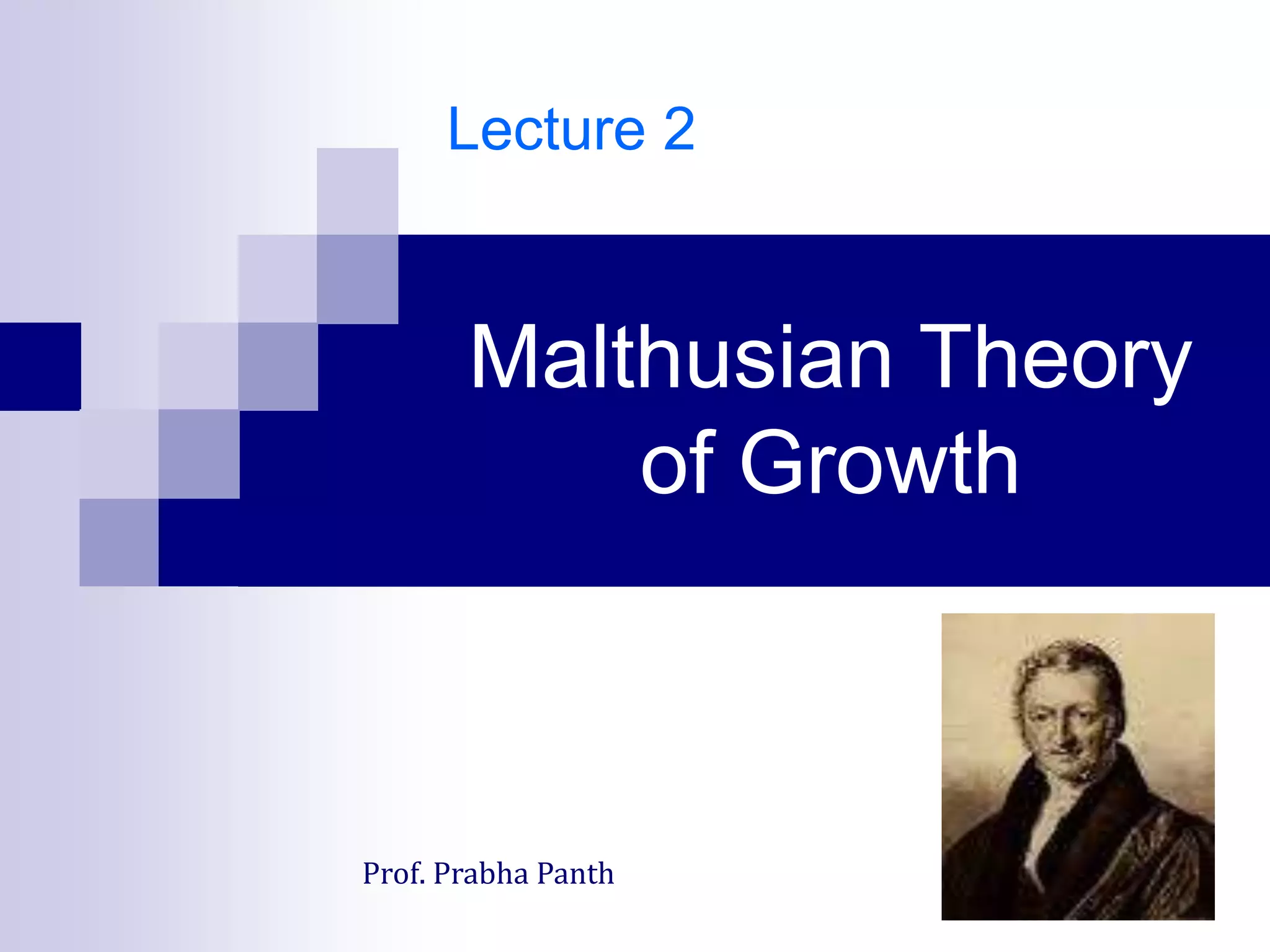
Malthusian Theory
of Growth
Lecture 2
Prof. Prabha Panth
223-Sep-13
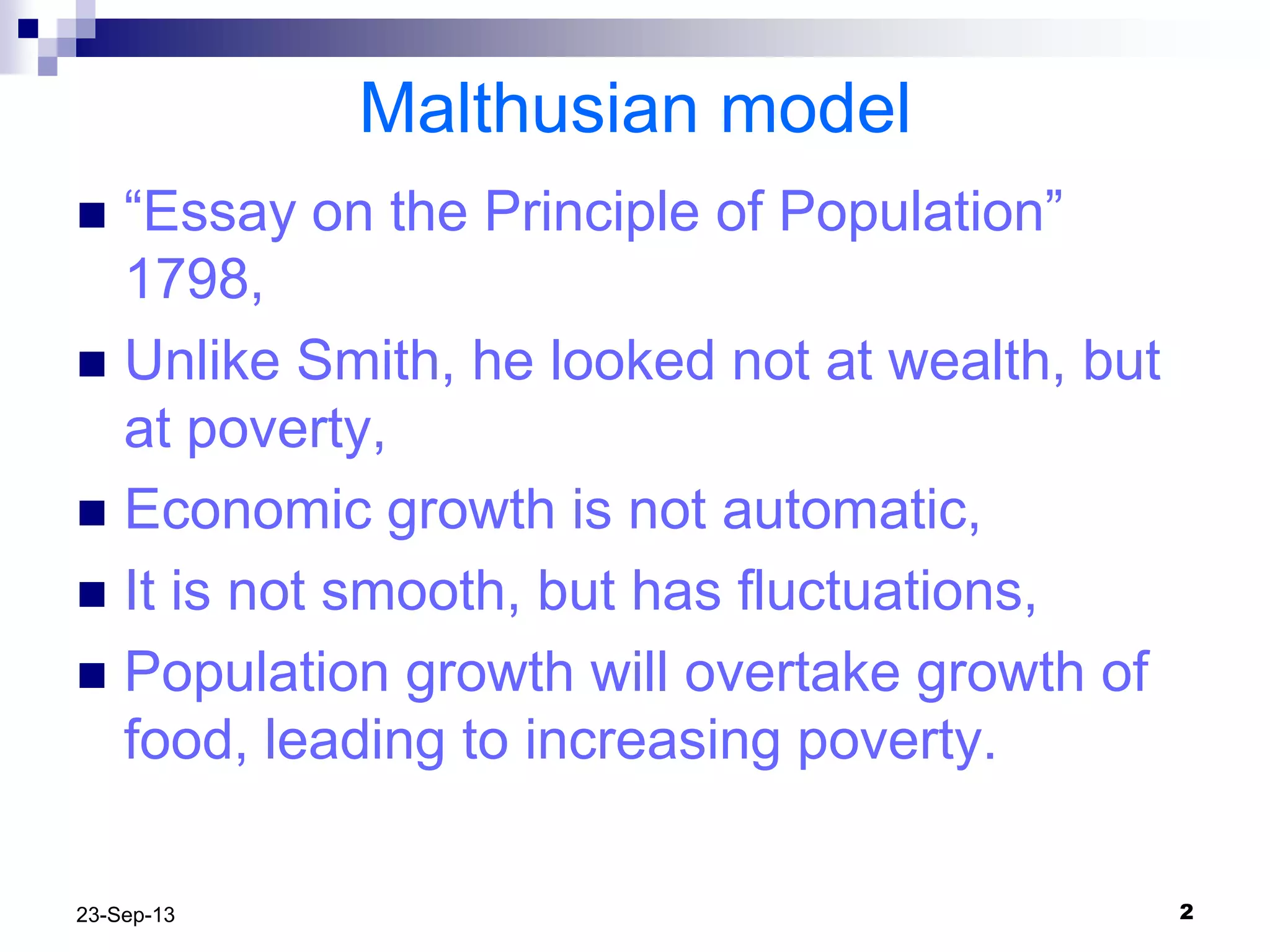
Malthusian model
 “Essay on the Principle of Population”
1798,
 Unlike Smith, he looked not at wealth, but
at poverty,
 Economic growth is not automatic,
 It is not smooth, but has fluctuations,
 Population growth will overtake growth of
food, leading to increasing poverty.
323-Sep-13
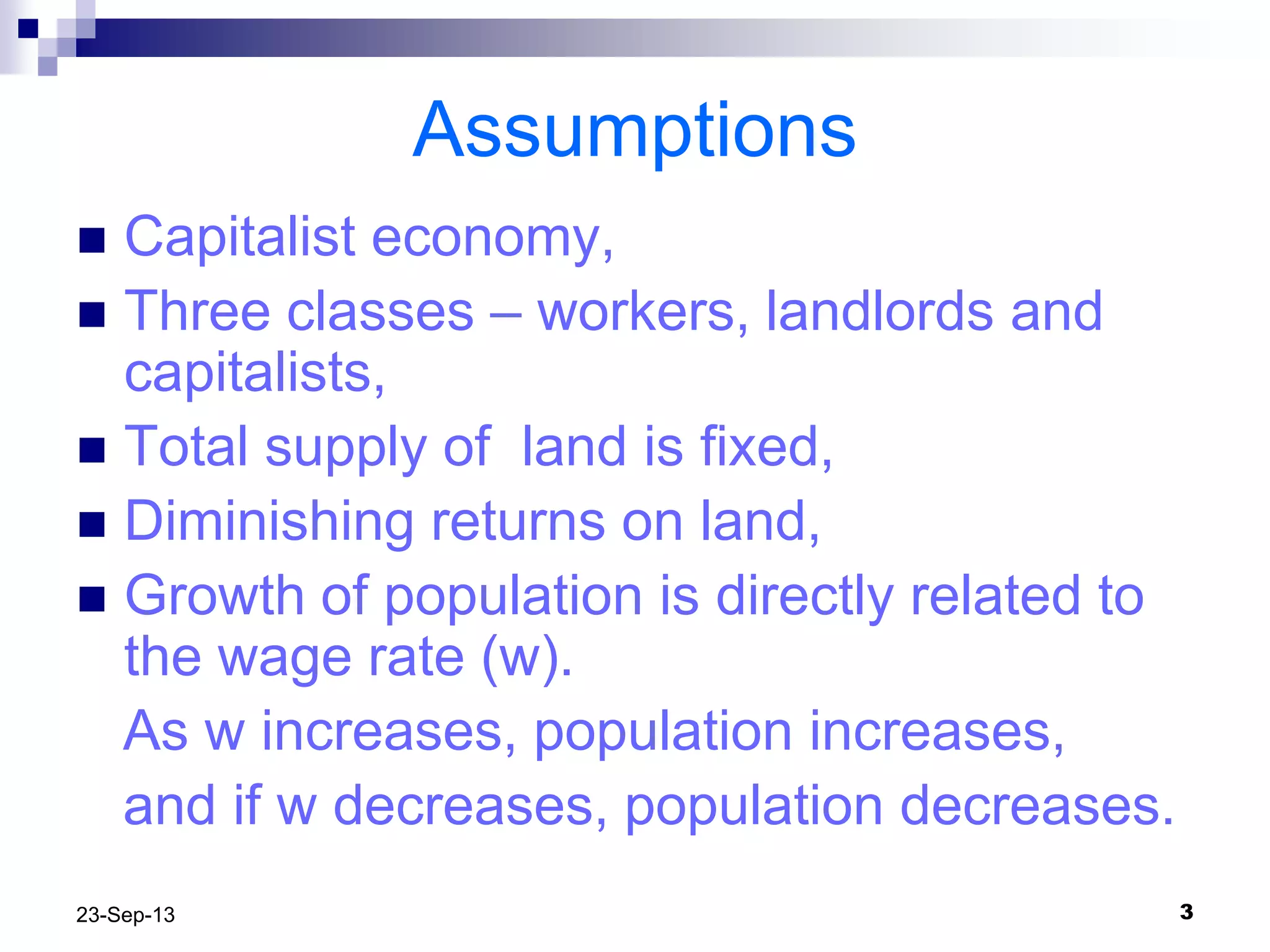
Assumptions
 Capitalist economy,
 Three classes – workers, landlords and
capitalists,
 Total supply of land is fixed,
 Diminishing returns on land,
 Growth of population is directly related to
the wage rate (w).
As w increases, population increases,
and if w decreases, population decreases.
423-Sep-13
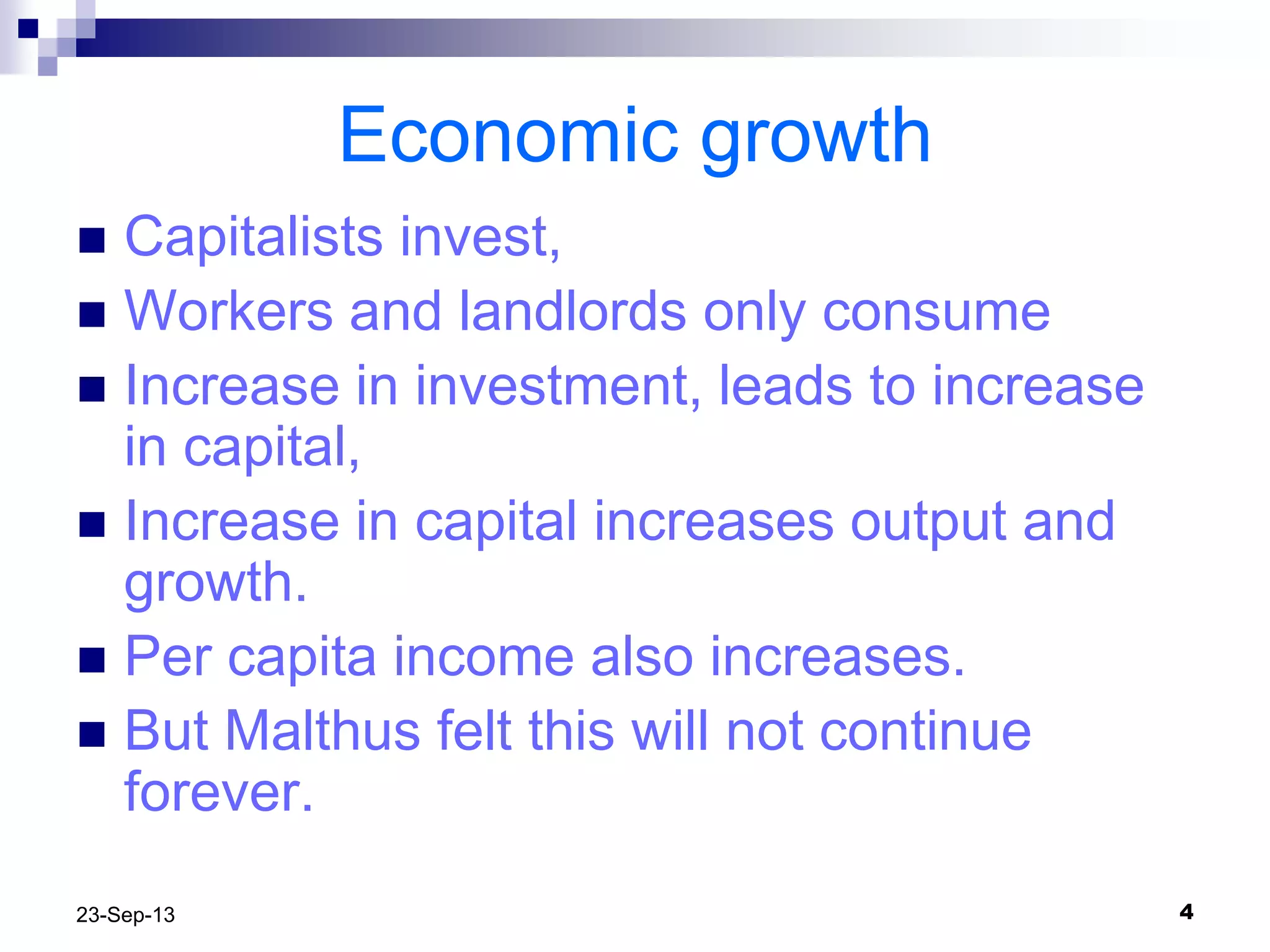
Economic growth
 Capitalists invest,
 Workers and landlords only consume
 Increase in investment, leads to increase
in capital,
 Increase in capital increases output and
growth.
 Per capita income also increases.
 But Malthus felt this will not continue
forever.
523-Sep-13
Population Growth
 Population growth is a function of wage
rate.
 When wage rate increases, birth rate also
increases, population increases
 When wage rate decreases, death rate
increases, population decreases.
 So with more growth, more output, and
wages increase,
 This cannot be sustained, due to
population growth.
Prof. Prabha Panth
623-Sep-13
Rate of population growth
 Population grows geometrically
(exponentially),
 But food production grows arithmetically
(linearly).
 So as economic growth continues, the gap
between food and population will widen,
 This will eventually lead to fall in standards
of living, and increasing poverty.
 This is known as the “Iron Law of Wages.”
723-Sep-13
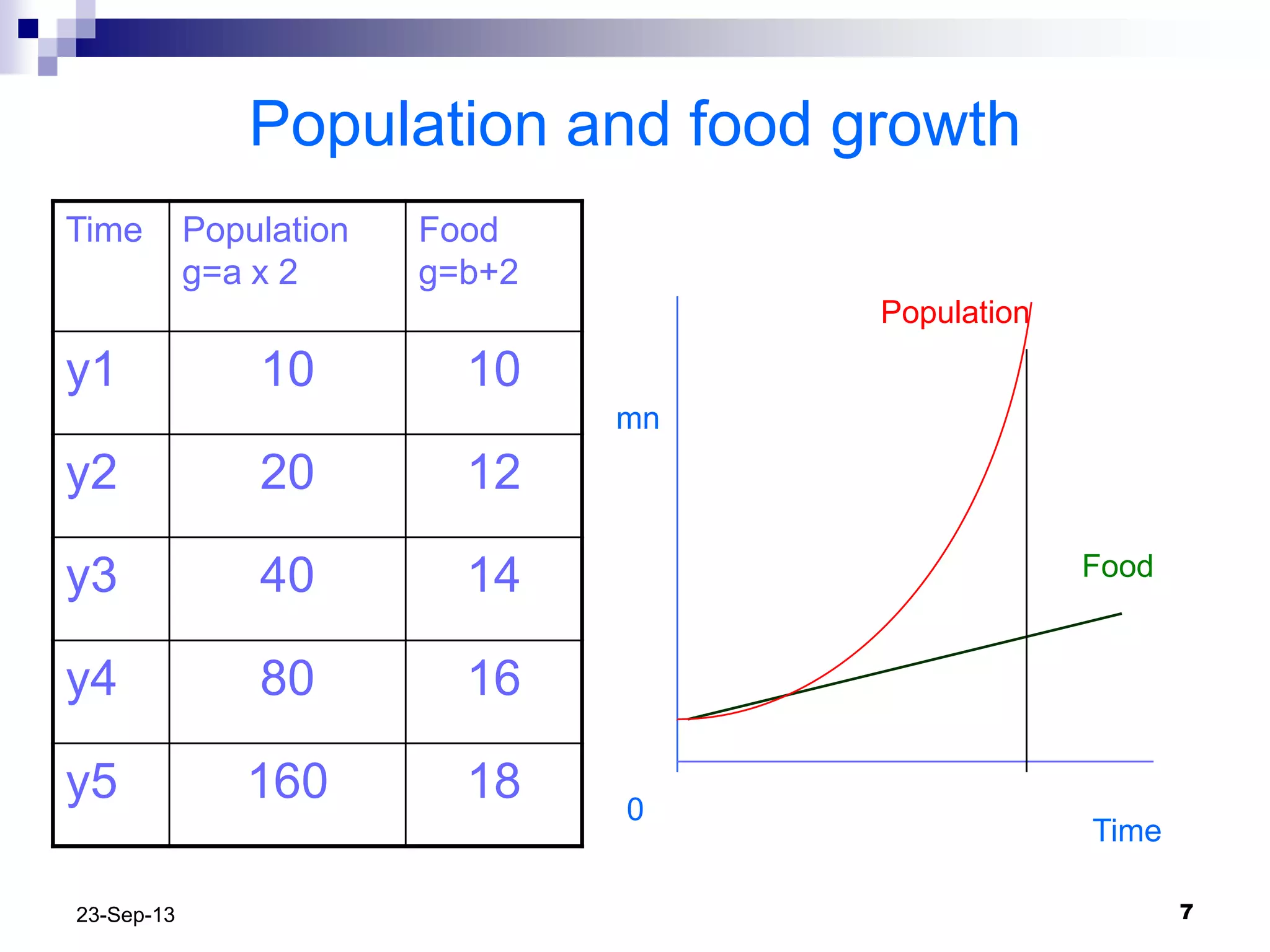
Population and food growth
Time Population
g=a x 2
Food
g=b+2
y1 10 10
y2 20 12
y3 40 14
y4 80 16
y5 160 18
mn
Time
0
Food
Population
823-Sep-13
 This is known as the “Malthusian Trap”
 When economic growth takes place, it will
not improve the conditions of workers,
 Higher growth, leads to increase in wage
rates,
 Higher wage rates leads to increase in
population. Demand for food rises,
 But food does not grow at the same rate
as population.
 The increasing gap, leads to
poverty, hunger, death, more misery.
923-Sep-13
Solution
 Malthus suggests that population growth should
be controlled.
 This can be done by „Voluntary‟ or „Positive‟
checks,
 Such as birth control, late marriages, family
planning.
 Otherwise, there will be „Negative‟ checks to
population growth –
 Famines, floods, wars, diseases will increase
death rate, and bring population down to
manageable levels.
1023-Sep-13
Criticism
 Pessimistic view of the economy
 Data of developed countries shows that as
PCY increased, birth rates automatically
decreased.
 Called “demographic transition”
 Output of food has also increased, due to
improved technology
 Imports and free trade of food can take
place, Malthus was for Protection.
1123-Sep-13
 But:
 Malthusian theory is still applicable to less
developed countries.
 Increasing population is consuming all the
surplus, nothing available for investment.
 Inferior land is used, and output falls,
 Technology is inferior,
 In recent times, the depletion of natural
resources, has shown the importance of
Malthusian theory of exponential growth in a
finite world.

2 malthusian theory of growth

  • 1.
  • 2.
    223-Sep-13 Malthusian model  “Essayon the Principle of Population” 1798,  Unlike Smith, he looked not at wealth, but at poverty,  Economic growth is not automatic,  It is not smooth, but has fluctuations,  Population growth will overtake growth of food, leading to increasing poverty.
  • 3.
    323-Sep-13 Assumptions  Capitalist economy, Three classes – workers, landlords and capitalists,  Total supply of land is fixed,  Diminishing returns on land,  Growth of population is directly related to the wage rate (w). As w increases, population increases, and if w decreases, population decreases.
  • 4.
    423-Sep-13 Economic growth  Capitalistsinvest,  Workers and landlords only consume  Increase in investment, leads to increase in capital,  Increase in capital increases output and growth.  Per capita income also increases.  But Malthus felt this will not continue forever.
  • 5.
    523-Sep-13 Population Growth  Populationgrowth is a function of wage rate.  When wage rate increases, birth rate also increases, population increases  When wage rate decreases, death rate increases, population decreases.  So with more growth, more output, and wages increase,  This cannot be sustained, due to population growth. Prof. Prabha Panth
  • 6.
    623-Sep-13 Rate of populationgrowth  Population grows geometrically (exponentially),  But food production grows arithmetically (linearly).  So as economic growth continues, the gap between food and population will widen,  This will eventually lead to fall in standards of living, and increasing poverty.  This is known as the “Iron Law of Wages.”
  • 7.
    723-Sep-13 Population and foodgrowth Time Population g=a x 2 Food g=b+2 y1 10 10 y2 20 12 y3 40 14 y4 80 16 y5 160 18 mn Time 0 Food Population
  • 8.
    823-Sep-13  This isknown as the “Malthusian Trap”  When economic growth takes place, it will not improve the conditions of workers,  Higher growth, leads to increase in wage rates,  Higher wage rates leads to increase in population. Demand for food rises,  But food does not grow at the same rate as population.  The increasing gap, leads to poverty, hunger, death, more misery.
  • 9.
    923-Sep-13 Solution  Malthus suggeststhat population growth should be controlled.  This can be done by „Voluntary‟ or „Positive‟ checks,  Such as birth control, late marriages, family planning.  Otherwise, there will be „Negative‟ checks to population growth –  Famines, floods, wars, diseases will increase death rate, and bring population down to manageable levels.
  • 10.
    1023-Sep-13 Criticism  Pessimistic viewof the economy  Data of developed countries shows that as PCY increased, birth rates automatically decreased.  Called “demographic transition”  Output of food has also increased, due to improved technology  Imports and free trade of food can take place, Malthus was for Protection.
  • 11.
    1123-Sep-13  But:  Malthusiantheory is still applicable to less developed countries.  Increasing population is consuming all the surplus, nothing available for investment.  Inferior land is used, and output falls,  Technology is inferior,  In recent times, the depletion of natural resources, has shown the importance of Malthusian theory of exponential growth in a finite world.