MALTHUS THEORY OF
POPULATION AND GROWTH
Thomas Malthus
o Born: February 14, 1766, Surrey, United Kingdom.
o Died: December 29, 1834, Bath, United Kingdom.
o Wrote ‘An essay in the First Principle of
population’ first published in 1798
o Debatable whether the principles of Malthus two
hundred years ago ( that were very revolutionary
and controversial ) have any relevance to the
modern world.
o The world population in 1798 was at nine million
people. We have now passed the seven billion
mark.
The Core Principles of Malthus
• Food is necessary for human existence.
• Human population tends to grow faster than the power in the
earth to produce subsistence.
• The effects of these two unequal powers must be kept equal.
• Since humans tend not to limit their population size voluntarily -
“preventive checks” in Malthus’ terminology.
Theory of Population
• Malthus very concerned by the condition of the poor and
particularly by rural poverty.
• Because of this he was skeptical of notions of the perfectibility of
society.
• 1st Edition of the Essay is an a priori polemic—the 2nd Edition
included much empirical observation.
• Inspired Darwin’s idea of “the struggle for survival” .
Malthus Theory
• In 1798 Thomas Malthus published his views on the effect of
population on food supply. His theory has two basic principles:
• Population grows at a geometric rate i.e. 1, 2, 4, 16, 32, etc.
• Food production increases at an arithmetic rate i.e. 1, 2, 3, 4, etc.
Geometric And Arithmetic Ratios
• Population, when unchecked, grows in a geometric ratio.
• Population, if unchecked, will double every 25 years [ a geometric
progression is 1, 2, 4, 8, 16, 32, 64, etc.].
• Evidence from the US where land is abundant.
• Subsistence grows at an arithmetic ratio [1, 2, 3, 4, 5, 6 etc.].
• Subsistence still grows, but due to the different growth ratios
population must eventually press against the means of subsistence.
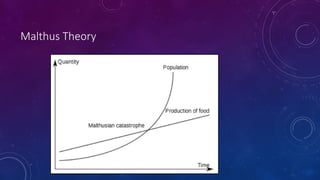
Malthus Theory
Malthus (cont.)
Proposed Solutions of Malthus
• Malthus suggested that once this ceiling (catastrophe)
had been reached, further growth in population would
be prevented by negative and positive checks. He saw
the checks as a natural method of population.
Negative Checks (Decreased Birth Rate)
• Negative Checks were used to limit the population growth. It
included abstinence/ postponement of marriage which lowered
the fertility rate.
• Malthus favored moral restraint (including late marriage and
sexual abstinence) as a check on population growth. However, it is
worth noting that Malthus proposed this only for the working and
poor classes!
Positive Checks (Increased Death Rate)
• Positive Checks were ways to reduce population size by
events such as famine, disease, war - increasing the
mortality rate and reducing life expectancy.
Malthusian Catastrophe
• A Malthusian catastrophe (also phrased Malthusian check, Malthusian crisis,
Malthusian disaster, or Malthusian nightmare) was originally foreseen to be a
forced return to subsistence-level conditions once population growth had
outpaced agricultural production. Later formulations consider economic
growth limits as well.
• Malthusian catastrophe are very similar to the Iron Law of Wages.
• The main difference is that the Malthusian theories predict what will happen
over several generations or centuries, whereas the Iron Law of Wages predicts
what will happen in a matter of years and decades.
Criticism
• As a general rule the following points were raised as criticism against
Malthusian Theory
• The ratio of arithmetical progression of means of subsistence and the geometrical progression of
population growth was never proved.
• In so many cases the theory of the growth of the means of subsistence in arithmetical ratio was
not proved.
• Malthus did not succeed in connecting positive and preventive checks with his theory.
• Friedrich Engels also criticizes the Malthusian catastrophe because Malthus failed to see that
surplus population is connected to surplus wealth, surplus capital, and surplus landed property.
• Ester Boserup wrote that population levels determine agricultural methods, rather than
agricultural methods determining population (via food supply).
14
18 Sep 2024
MALTHUSIAN MODEL
• “Essay on the Principle of Population” 1798,
• Unlike Smith, he looked not at wealth, but at
poverty,
• Economic growth is not automatic,
• It is not smooth, but has fluctuations,
• Population growth will overtake growth of
food, leading to increasing poverty.
15
18 Sep 2024
ASSUMPTIONS
• Capitalist economy,
• Three classes – workers, landlords and capitalists,
• Total supply of land is fixed,
• Diminishing returns on land,
• Growth of population is directly related to the wage
rate (w).
As w increases, population increases,
and if w decreases, population decreases.
16
18 Sep 2024
ECONOMIC GROWTH
• Capitalists invest,
• Workers and landlords only consume
• Increase in investment, leads to increase in capital,
• Increase in capital increases output and growth.
• Per capita income also increases.
• But Malthus felt this will not continue forever.
17
18 Sep 2024
POPULATION GROWTH
• Population growth is a function of wage rate.
• When wage rate increases, birth rate also increases,
population increases
• When wage rate decreases, death rate increases,
population decreases.
• So with more growth, more output, and wages
increase,
• This cannot be sustained, due to population growth.
18
18 Sep 2024
RATE OF POPULATION GROWTH
• Population grows geometrically (exponentially),
• But food production grows arithmetically (linearly).
• So as economic growth continues, the gap between food and population will
widen,
• This will eventually lead to fall in standards of living, and increasing poverty.
• This is known as the “Iron Law of Wages.”
19
18 Sep 2024
POPULATION AND FOOD GROWTH
Time Population
g=a x 2
Food
g=b+2
y1 10 10
y2 20 12
y3 40 14
y4 80 16
y5 160 18
mn
Time
0
Food
Population
20
18 Sep 2024
• This is known as the “Malthusian Trap”
• When economic growth takes place, it will not improve the conditions of workers,
• Higher growth, leads to increase in wage rates,
• Higher wage rates leads to increase in population. Demand for food rises,
• But food does not grow at the same rate as population.
• The increasing gap, leads to poverty, hunger, death, more misery.
21
18 Sep 2024
SOLUTION
• Malthus suggests that population growth should be
controlled.
• This can be done by ‘Voluntary’ or ‘Positive’ checks,
• Such as birth control, late marriages, family planning.
• Otherwise, there will be ‘Negative’ checks to
population growth –
• Famines, floods, wars, diseases will increase death
rate, and bring population down to manageable
levels.
22
18 Sep 2024
CRITICISM
• Pessimistic view of the economy
• Data of developed countries shows that as PCY increased, birth rates automatically
decreased.
• Called “demographic transition”
• Output of food has also increased, due to improved technology
• Imports and free trade of food can take place, Malthus was for Protection.
23
18 Sep 2024
• But:
• Malthusian theory is still applicable to less developed countries.
• Increasing population is consuming all the surplus, nothing available for investment.
• Inferior land is used, and output falls,
• Technology is inferior,
• In recent times, the depletion of natural resources, has shown the importance of
Malthusian theory of exponential growth in a finite world.
THANK YOU ALL

malthus-150118134503-conversion-gate01.pptx

  • 1.
  • 2.
    Thomas Malthus o Born:February 14, 1766, Surrey, United Kingdom. o Died: December 29, 1834, Bath, United Kingdom. o Wrote ‘An essay in the First Principle of population’ first published in 1798 o Debatable whether the principles of Malthus two hundred years ago ( that were very revolutionary and controversial ) have any relevance to the modern world. o The world population in 1798 was at nine million people. We have now passed the seven billion mark.
  • 3.
    The Core Principlesof Malthus • Food is necessary for human existence. • Human population tends to grow faster than the power in the earth to produce subsistence. • The effects of these two unequal powers must be kept equal. • Since humans tend not to limit their population size voluntarily - “preventive checks” in Malthus’ terminology.
  • 4.
    Theory of Population •Malthus very concerned by the condition of the poor and particularly by rural poverty. • Because of this he was skeptical of notions of the perfectibility of society. • 1st Edition of the Essay is an a priori polemic—the 2nd Edition included much empirical observation. • Inspired Darwin’s idea of “the struggle for survival” .
  • 5.
    Malthus Theory • In1798 Thomas Malthus published his views on the effect of population on food supply. His theory has two basic principles: • Population grows at a geometric rate i.e. 1, 2, 4, 16, 32, etc. • Food production increases at an arithmetic rate i.e. 1, 2, 3, 4, etc.
  • 6.
    Geometric And ArithmeticRatios • Population, when unchecked, grows in a geometric ratio. • Population, if unchecked, will double every 25 years [ a geometric progression is 1, 2, 4, 8, 16, 32, 64, etc.]. • Evidence from the US where land is abundant. • Subsistence grows at an arithmetic ratio [1, 2, 3, 4, 5, 6 etc.]. • Subsistence still grows, but due to the different growth ratios population must eventually press against the means of subsistence.
  • 7.
  • 8.
  • 9.
    Proposed Solutions ofMalthus • Malthus suggested that once this ceiling (catastrophe) had been reached, further growth in population would be prevented by negative and positive checks. He saw the checks as a natural method of population.
  • 10.
    Negative Checks (DecreasedBirth Rate) • Negative Checks were used to limit the population growth. It included abstinence/ postponement of marriage which lowered the fertility rate. • Malthus favored moral restraint (including late marriage and sexual abstinence) as a check on population growth. However, it is worth noting that Malthus proposed this only for the working and poor classes!
  • 11.
    Positive Checks (IncreasedDeath Rate) • Positive Checks were ways to reduce population size by events such as famine, disease, war - increasing the mortality rate and reducing life expectancy.
  • 12.
    Malthusian Catastrophe • AMalthusian catastrophe (also phrased Malthusian check, Malthusian crisis, Malthusian disaster, or Malthusian nightmare) was originally foreseen to be a forced return to subsistence-level conditions once population growth had outpaced agricultural production. Later formulations consider economic growth limits as well. • Malthusian catastrophe are very similar to the Iron Law of Wages. • The main difference is that the Malthusian theories predict what will happen over several generations or centuries, whereas the Iron Law of Wages predicts what will happen in a matter of years and decades.
  • 13.
    Criticism • As ageneral rule the following points were raised as criticism against Malthusian Theory • The ratio of arithmetical progression of means of subsistence and the geometrical progression of population growth was never proved. • In so many cases the theory of the growth of the means of subsistence in arithmetical ratio was not proved. • Malthus did not succeed in connecting positive and preventive checks with his theory. • Friedrich Engels also criticizes the Malthusian catastrophe because Malthus failed to see that surplus population is connected to surplus wealth, surplus capital, and surplus landed property. • Ester Boserup wrote that population levels determine agricultural methods, rather than agricultural methods determining population (via food supply).
  • 14.
    14 18 Sep 2024 MALTHUSIANMODEL • “Essay on the Principle of Population” 1798, • Unlike Smith, he looked not at wealth, but at poverty, • Economic growth is not automatic, • It is not smooth, but has fluctuations, • Population growth will overtake growth of food, leading to increasing poverty.
  • 15.
    15 18 Sep 2024 ASSUMPTIONS •Capitalist economy, • Three classes – workers, landlords and capitalists, • Total supply of land is fixed, • Diminishing returns on land, • Growth of population is directly related to the wage rate (w). As w increases, population increases, and if w decreases, population decreases.
  • 16.
    16 18 Sep 2024 ECONOMICGROWTH • Capitalists invest, • Workers and landlords only consume • Increase in investment, leads to increase in capital, • Increase in capital increases output and growth. • Per capita income also increases. • But Malthus felt this will not continue forever.
  • 17.
    17 18 Sep 2024 POPULATIONGROWTH • Population growth is a function of wage rate. • When wage rate increases, birth rate also increases, population increases • When wage rate decreases, death rate increases, population decreases. • So with more growth, more output, and wages increase, • This cannot be sustained, due to population growth.
  • 18.
    18 18 Sep 2024 RATEOF POPULATION GROWTH • Population grows geometrically (exponentially), • But food production grows arithmetically (linearly). • So as economic growth continues, the gap between food and population will widen, • This will eventually lead to fall in standards of living, and increasing poverty. • This is known as the “Iron Law of Wages.”
  • 19.
    19 18 Sep 2024 POPULATIONAND FOOD GROWTH Time Population g=a x 2 Food g=b+2 y1 10 10 y2 20 12 y3 40 14 y4 80 16 y5 160 18 mn Time 0 Food Population
  • 20.
    20 18 Sep 2024 •This is known as the “Malthusian Trap” • When economic growth takes place, it will not improve the conditions of workers, • Higher growth, leads to increase in wage rates, • Higher wage rates leads to increase in population. Demand for food rises, • But food does not grow at the same rate as population. • The increasing gap, leads to poverty, hunger, death, more misery.
  • 21.
    21 18 Sep 2024 SOLUTION •Malthus suggests that population growth should be controlled. • This can be done by ‘Voluntary’ or ‘Positive’ checks, • Such as birth control, late marriages, family planning. • Otherwise, there will be ‘Negative’ checks to population growth – • Famines, floods, wars, diseases will increase death rate, and bring population down to manageable levels.
  • 22.
    22 18 Sep 2024 CRITICISM •Pessimistic view of the economy • Data of developed countries shows that as PCY increased, birth rates automatically decreased. • Called “demographic transition” • Output of food has also increased, due to improved technology • Imports and free trade of food can take place, Malthus was for Protection.
  • 23.
    23 18 Sep 2024 •But: • Malthusian theory is still applicable to less developed countries. • Increasing population is consuming all the surplus, nothing available for investment. • Inferior land is used, and output falls, • Technology is inferior, • In recent times, the depletion of natural resources, has shown the importance of Malthusian theory of exponential growth in a finite world.
  • 24.