Dr. Francisco M. Gonzalez-Longatt, fglongatt@ieee.org .Copyright © 2009 1/21
Allrightsreserved.Nopartofthispublicationmaybereproducedordistributedinanyformwithoutpermissionoftheauthor.
Copyright©2009.http:www.fglongatt.org.ve
Francisco M. Gonzalez-Longatt, Dr.Sc
Manchester, UK, September, 2009
Tutorial:
Introduction to Transient
Analysis with PowerFactory
Dr. Francisco M. Gonzalez-Longatt, fglongatt@ieee.org .Copyright © 2009 2/21
Allrightsreserved.Nopartofthispublicationmaybereproducedordistributedinanyformwithoutpermissionoftheauthor.
Copyright©2009.http:www.fglongatt.org.ve
This tutorial is a simple introduction to transient simulation
with PowerFactory
Tutorial:
Introduction to Transient
Analysis in PowerFactory
Francisco M. Gonzalez-Longatt, Dr.Sc
fglogatt@fglongatt.org.ve
Manchester, September 2009
Dr. Francisco M. Gonzalez-Longatt, fglongatt@ieee.org .Copyright © 2009 3/21
Allrightsreserved.Nopartofthispublicationmaybereproducedordistributedinanyformwithoutpermissionoftheauthor.
Copyright©2009.http:www.fglongatt.org.ve
1. Introduction
Introduction to Transient Phenomenon and
Modeling
Dr. Francisco M. Gonzalez-Longatt, fglongatt@ieee.org .Copyright © 2009 4/21
Allrightsreserved.Nopartofthispublicationmaybereproducedordistributedinanyformwithoutpermissionoftheauthor.
Copyright©2009.http:www.fglongatt.org.ve
1. Introduction
• Power system stability may be broadly defined as that
property of a power system that enables it to remain in a
state of operating equilibrium under normal operating
conditions ad to regain an acceptable state of equilibrium
after being subjected to a disturbance [1].
• The robustness of a system is defined by the ability of
the system to maintain stable operation under normal
and perturbed conditions [2].
[1] P. Kundur, Power System Stability and Control. New York:
McGraw- Hill, 1994.
[2] PowerFactory User’s Manual DIgSILENT PowerFactory Version
14.0. DIgSILENT GmbH, Gomaringen, Germany 2008
Dr. Francisco M. Gonzalez-Longatt, fglongatt@ieee.org .Copyright © 2009 5/21
Allrightsreserved.Nopartofthispublicationmaybereproducedordistributedinanyformwithoutpermissionoftheauthor.
Copyright©2009.http:www.fglongatt.org.ve
1. Introduction
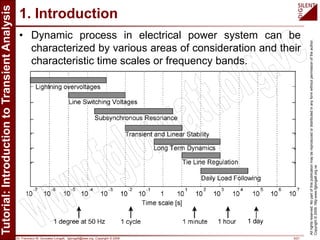
• Dynamic process in electrical power system can be
characterized by various areas of consideration and their
characteristic time scales or frequency bands.
Dr. Francisco M. Gonzalez-Longatt, fglongatt@ieee.org .Copyright © 2009 6/21
Allrightsreserved.Nopartofthispublicationmaybereproducedordistributedinanyformwithoutpermissionoftheauthor.
Copyright©2009.http:www.fglongatt.org.ve
1. Introduction
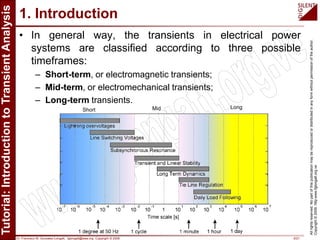
• In general way, the transients in electrical power
systems are classified according to three possible
timeframes:
– Short-term, or electromagnetic transients;
– Mid-term, or electromechanical transients;
– Long-term transients.
Short Mid Long
Dr. Francisco M. Gonzalez-Longatt, fglongatt@ieee.org .Copyright © 2009 7/21
Allrightsreserved.Nopartofthispublicationmaybereproducedordistributedinanyformwithoutpermissionoftheauthor.
Copyright©2009.http:www.fglongatt.org.ve
1. Introduction
Classification of Power System Stability [1]
Power System Stability
Angle Stability Voltage Stability
Transient
Stability
Mid-term
Stability
Long-term
Stability
Large
Disturbance
Voltage
Stability
Small-Signal
Stability
Non-
oscillatory
Instability
Oscillatory
Instability
Small-
Disturbance
Voltage Stability
• Ability to remain in operating equilibrium
• Equilibrium between opposing forces
• Ability to maintain synchronism
• Torque balance of synchronous
machines
• Ability to maintain steady
acceptable voltage
• Reactive power balance
[1] P. Kundur, Power System Stability and Control. New York:
McGraw- Hill, 1994.
RECOMMENDED READ: P. Kundur, J. Paserba, V. Ajjarapu, G. Andersson, A. Bose, C. Canizares, N. Hatziargyriou, D. Hill, A.M.
Stanković, C. Taylor, T. Van Cutsem, V. Vittal, "Definition and classification of power system stability IEEE/CIGRE joint task force on
stability terms and definitions", IEEE Transactions on Power Systems, Vol. 19 , No. 3 , pp.1387 - 1401, Aug. 2004
Dr. Francisco M. Gonzalez-Longatt, fglongatt@ieee.org .Copyright © 2009 8/21
Allrightsreserved.Nopartofthispublicationmaybereproducedordistributedinanyformwithoutpermissionoftheauthor.
Copyright©2009.http:www.fglongatt.org.ve
1. Introduction
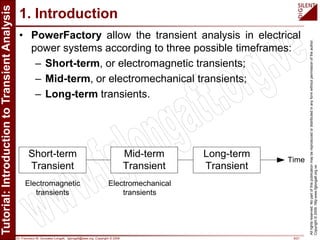
• PowerFactory allow the transient analysis in electrical
power systems according to three possible timeframes:
– Short-term, or electromagnetic transients;
– Mid-term, or electromechanical transients;
– Long-term transients.
Long-term
Transient
Short-term
Transient
Mid-term
Transient
Time
Electromagnetic
transients
Electromechanical
transients
Dr. Francisco M. Gonzalez-Longatt, fglongatt@ieee.org .Copyright © 2009 9/21
Allrightsreserved.Nopartofthispublicationmaybereproducedordistributedinanyformwithoutpermissionoftheauthor.
Copyright©2009.http:www.fglongatt.org.ve
1. Introduction
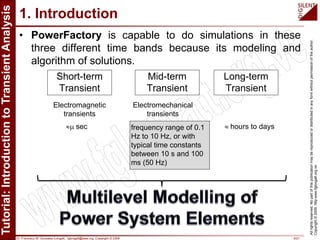
• PowerFactory is capable to do simulations in these
three different time bands because its modeling and
algorithm of solutions.
Long-term
Transient
Short-term
Transient
Mid-term
Transient
Electromagnetic
transients
Electromechanical
transients
≈µ sec frequency range of 0.1
Hz to 10 Hz, or with
typical time constants
between 10 s and 100
ms (50 Hz)
≈ hours to days
Dr. Francisco M. Gonzalez-Longatt, fglongatt@ieee.org .Copyright © 2009 10/21
Allrightsreserved.Nopartofthispublicationmaybereproducedordistributedinanyformwithoutpermissionoftheauthor.
Copyright©2009.http:www.fglongatt.org.ve
1. Introduction
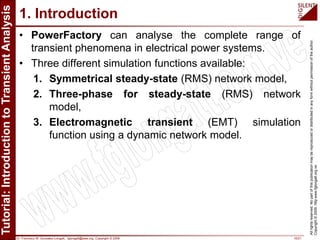
• PowerFactory can analyse the complete range of
transient phenomena in electrical power systems.
• Three different simulation functions available:
1. Symmetrical steady-state (RMS) network model,
2. Three-phase for steady-state (RMS) network
model,
3. Electromagnetic transient (EMT) simulation
function using a dynamic network model.
Dr. Francisco M. Gonzalez-Longatt, fglongatt@ieee.org .Copyright © 2009 11/21
Allrightsreserved.Nopartofthispublicationmaybereproducedordistributedinanyformwithoutpermissionoftheauthor.
Copyright©2009.http:www.fglongatt.org.ve
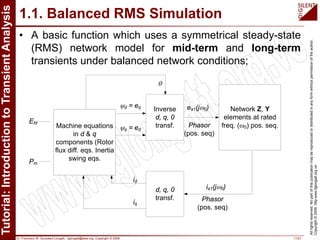
1.1. Balanced RMS Simulation
• A basic function which uses a symmetrical steady-state
(RMS) network model for mid-term and long-term
transients under balanced network conditions;
Machine equations
in d & q
components (Rotor
flux diff. eqs. Inertia
swing eqs.
Efd
Pm
Inverse
d, q, 0
transf.
d, q, 0
transf.
id
iq
Network Z, Y
elements at rated
freq. (ω0) pos. seq.
ea1(jω0)
Phasor
(pos. seq)
ψd = eq
ψq = ed
θ
ia1(jω0)
Phasor
(pos. seq)
Dr. Francisco M. Gonzalez-Longatt, fglongatt@ieee.org .Copyright © 2009 12/21
Allrightsreserved.Nopartofthispublicationmaybereproducedordistributedinanyformwithoutpermissionoftheauthor.
Copyright©2009.http:www.fglongatt.org.ve
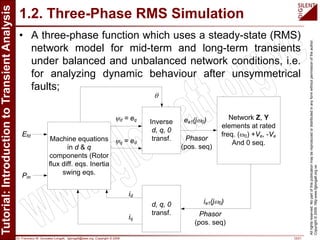
1.2. Three-Phase RMS Simulation
• A three-phase function which uses a steady-state (RMS)
network model for mid-term and long-term transients
under balanced and unbalanced network conditions, i.e.
for analyzing dynamic behaviour after unsymmetrical
faults;
Machine equations
in d & q
components (Rotor
flux diff. eqs. Inertia
swing eqs.
Efd
Pm
Inverse
d, q, 0
transf.
d, q, 0
transf.
id
iq
Network Z, Y
elements at rated
freq. (ω0) +Ve, -Ve
And 0 seq.
ea1(jω0)
Phasor
(pos. seq)
ψd = eq
ψq = ed
θ
ia1(jω0)
Phasor
(pos. seq)
Dr. Francisco M. Gonzalez-Longatt, fglongatt@ieee.org .Copyright © 2009 13/21
Allrightsreserved.Nopartofthispublicationmaybereproducedordistributedinanyformwithoutpermissionoftheauthor.
Copyright©2009.http:www.fglongatt.org.ve
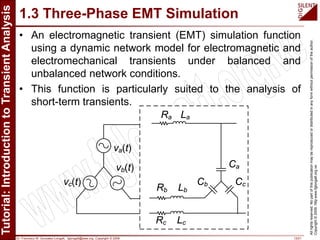
1.3 Three-Phase EMT Simulation
• An electromagnetic transient (EMT) simulation function
using a dynamic network model for electromagnetic and
electromechanical transients under balanced and
unbalanced network conditions.
• This function is particularly suited to the analysis of
short-term transients.
va(t)
vc(t)
vb(t)
Ra La
Rb Lb
Rc Lc
Ca
Cb Cc
Dr. Francisco M. Gonzalez-Longatt, fglongatt@ieee.org .Copyright © 2009 14/21
Allrightsreserved.Nopartofthispublicationmaybereproducedordistributedinanyformwithoutpermissionoftheauthor.
Copyright©2009.http:www.fglongatt.org.ve
2. Transient Simulation
Dr. Francisco M. Gonzalez-Longatt, fglongatt@ieee.org .Copyright © 2009 15/21
Allrightsreserved.Nopartofthispublicationmaybereproducedordistributedinanyformwithoutpermissionoftheauthor.
Copyright©2009.http:www.fglongatt.org.ve
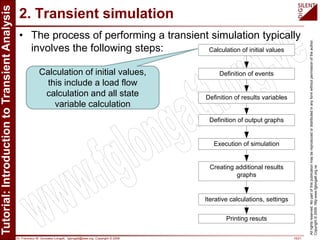
2. Transient simulation
• The process of performing a transient simulation typically
involves the following steps: Calculation of initial values
Definition of results variables
Definition of events
Definition of output graphs
Execution of simulation
Creating additional results
graphs
Iterative calculations, settings
Printing resuts
Calculation of initial values,
this include a load flow
calculation and all state
variable calculation
Dr. Francisco M. Gonzalez-Longatt, fglongatt@ieee.org .Copyright © 2009 16/21
Allrightsreserved.Nopartofthispublicationmaybereproducedordistributedinanyformwithoutpermissionoftheauthor.
Copyright©2009.http:www.fglongatt.org.ve
3. Balanced RMS
Simulation
Dr. Francisco M. Gonzalez-Longatt, fglongatt@ieee.org .Copyright © 2009 17/21
Allrightsreserved.Nopartofthispublicationmaybereproducedordistributedinanyformwithoutpermissionoftheauthor.
Copyright©2009.http:www.fglongatt.org.ve
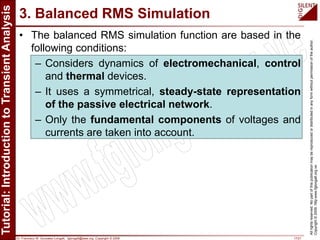
3. Balanced RMS Simulation
• The balanced RMS simulation function are based in the
following conditions:
– Considers dynamics of electromechanical, control
and thermal devices.
– It uses a symmetrical, steady-state representation
of the passive electrical network.
– Only the fundamental components of voltages and
currents are taken into account.
Dr. Francisco M. Gonzalez-Longatt, fglongatt@ieee.org .Copyright © 2009 18/21
Allrightsreserved.Nopartofthispublicationmaybereproducedordistributedinanyformwithoutpermissionoftheauthor.
Copyright©2009.http:www.fglongatt.org.ve
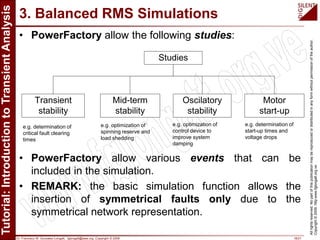
3. Balanced RMS Simulations
• PowerFactory allow the following studies:
• PowerFactory allow various events that can be
included in the simulation.
• REMARK: the basic simulation function allows the
insertion of symmetrical faults only due to the
symmetrical network representation.
Transient
stability
Mid-term
stability
Oscilatory
stability
Motor
start-up
Studies
e.g. determination of
critical fault clearing
times
e.g. optimization of
spinning reserve and
load shedding
e.g. optimization of
control device to
improve system
damping
e.g. determination of
start-up times and
voltage drops
Dr. Francisco M. Gonzalez-Longatt, fglongatt@ieee.org .Copyright © 2009 19/21
Allrightsreserved.Nopartofthispublicationmaybereproducedordistributedinanyformwithoutpermissionoftheauthor.
Copyright©2009.http:www.fglongatt.org.ve
4. Recommended
Readings
Dr. Francisco M. Gonzalez-Longatt, fglongatt@ieee.org .Copyright © 2009 20/21
Allrightsreserved.Nopartofthispublicationmaybereproducedordistributedinanyformwithoutpermissionoftheauthor.
Copyright©2009.http:www.fglongatt.org.ve
4. Recommended readings
• P. Kundur, J. Paserba, V. Ajjarapu, G. Andersson, A.
Bose, C. Canizares, N. Hatziargyriou, D. Hill, A.M.
Stanković, C. Taylor, T. Van Cutsem, V. Vittal, "Definition
and classification of power system stability IEEE/CIGRE
joint task force on stability terms and definitions", IEEE
Transactions on Power Systems, Vol. 19 , No. 3,
pp.1387 – 1401.
• F.P. deMello, “Power System Dynamic Overview”
Proceedings of the Symposium on Adequacy and
Philosophy of Modeling Dynamic System Performance,
1975 IEEE Publication 75CH0970-4-PWR (808 kB)
Dr. Francisco M. Gonzalez-Longatt, fglongatt@ieee.org .Copyright © 2009 21/21
Allrightsreserved.Nopartofthispublicationmaybereproducedordistributedinanyformwithoutpermissionoftheauthor.
Copyright©2009.http:www.fglongatt.org.ve
4. Recommended readings
• F.P. deMello. “Process Dynamics in Electric Utility
Systems”. ISA Paper 505-70, International Conference
Exhibit of ISA, October 26-29, 1970, Philadelphia, Pa.
Dr. Francisco M. Gonzalez-Longatt, fglongatt@ieee.org .Copyright © 2009 22/21
Allrightsreserved.Nopartofthispublicationmaybereproducedordistributedinanyformwithoutpermissionoftheauthor.
Copyright©2009.http:www.fglongatt.org.ve
Please visit:
http://www.fglongatt.org.ve
Comments and suggestion are welcome:
fglongatt@fglongatt.org.ve

Tutorial: Introduction to Transient Analysis using DIgSILENT PowerFactory.

  • 1.
    Dr. Francisco M.Gonzalez-Longatt, fglongatt@ieee.org .Copyright © 2009 1/21 Allrightsreserved.Nopartofthispublicationmaybereproducedordistributedinanyformwithoutpermissionoftheauthor. Copyright©2009.http:www.fglongatt.org.ve Francisco M. Gonzalez-Longatt, Dr.Sc Manchester, UK, September, 2009 Tutorial: Introduction to Transient Analysis with PowerFactory
  • 2.
    Dr. Francisco M.Gonzalez-Longatt, fglongatt@ieee.org .Copyright © 2009 2/21 Allrightsreserved.Nopartofthispublicationmaybereproducedordistributedinanyformwithoutpermissionoftheauthor. Copyright©2009.http:www.fglongatt.org.ve This tutorial is a simple introduction to transient simulation with PowerFactory Tutorial: Introduction to Transient Analysis in PowerFactory Francisco M. Gonzalez-Longatt, Dr.Sc fglogatt@fglongatt.org.ve Manchester, September 2009
  • 3.
    Dr. Francisco M.Gonzalez-Longatt, fglongatt@ieee.org .Copyright © 2009 3/21 Allrightsreserved.Nopartofthispublicationmaybereproducedordistributedinanyformwithoutpermissionoftheauthor. Copyright©2009.http:www.fglongatt.org.ve 1. Introduction Introduction to Transient Phenomenon and Modeling
  • 4.
    Dr. Francisco M.Gonzalez-Longatt, fglongatt@ieee.org .Copyright © 2009 4/21 Allrightsreserved.Nopartofthispublicationmaybereproducedordistributedinanyformwithoutpermissionoftheauthor. Copyright©2009.http:www.fglongatt.org.ve 1. Introduction • Power system stability may be broadly defined as that property of a power system that enables it to remain in a state of operating equilibrium under normal operating conditions ad to regain an acceptable state of equilibrium after being subjected to a disturbance [1]. • The robustness of a system is defined by the ability of the system to maintain stable operation under normal and perturbed conditions [2]. [1] P. Kundur, Power System Stability and Control. New York: McGraw- Hill, 1994. [2] PowerFactory User’s Manual DIgSILENT PowerFactory Version 14.0. DIgSILENT GmbH, Gomaringen, Germany 2008
  • 5.
    Dr. Francisco M.Gonzalez-Longatt, fglongatt@ieee.org .Copyright © 2009 5/21 Allrightsreserved.Nopartofthispublicationmaybereproducedordistributedinanyformwithoutpermissionoftheauthor. Copyright©2009.http:www.fglongatt.org.ve 1. Introduction • Dynamic process in electrical power system can be characterized by various areas of consideration and their characteristic time scales or frequency bands.
  • 6.
    Dr. Francisco M.Gonzalez-Longatt, fglongatt@ieee.org .Copyright © 2009 6/21 Allrightsreserved.Nopartofthispublicationmaybereproducedordistributedinanyformwithoutpermissionoftheauthor. Copyright©2009.http:www.fglongatt.org.ve 1. Introduction • In general way, the transients in electrical power systems are classified according to three possible timeframes: – Short-term, or electromagnetic transients; – Mid-term, or electromechanical transients; – Long-term transients. Short Mid Long
  • 7.
    Dr. Francisco M.Gonzalez-Longatt, fglongatt@ieee.org .Copyright © 2009 7/21 Allrightsreserved.Nopartofthispublicationmaybereproducedordistributedinanyformwithoutpermissionoftheauthor. Copyright©2009.http:www.fglongatt.org.ve 1. Introduction Classification of Power System Stability [1] Power System Stability Angle Stability Voltage Stability Transient Stability Mid-term Stability Long-term Stability Large Disturbance Voltage Stability Small-Signal Stability Non- oscillatory Instability Oscillatory Instability Small- Disturbance Voltage Stability • Ability to remain in operating equilibrium • Equilibrium between opposing forces • Ability to maintain synchronism • Torque balance of synchronous machines • Ability to maintain steady acceptable voltage • Reactive power balance [1] P. Kundur, Power System Stability and Control. New York: McGraw- Hill, 1994. RECOMMENDED READ: P. Kundur, J. Paserba, V. Ajjarapu, G. Andersson, A. Bose, C. Canizares, N. Hatziargyriou, D. Hill, A.M. Stanković, C. Taylor, T. Van Cutsem, V. Vittal, "Definition and classification of power system stability IEEE/CIGRE joint task force on stability terms and definitions", IEEE Transactions on Power Systems, Vol. 19 , No. 3 , pp.1387 - 1401, Aug. 2004
  • 8.
    Dr. Francisco M.Gonzalez-Longatt, fglongatt@ieee.org .Copyright © 2009 8/21 Allrightsreserved.Nopartofthispublicationmaybereproducedordistributedinanyformwithoutpermissionoftheauthor. Copyright©2009.http:www.fglongatt.org.ve 1. Introduction • PowerFactory allow the transient analysis in electrical power systems according to three possible timeframes: – Short-term, or electromagnetic transients; – Mid-term, or electromechanical transients; – Long-term transients. Long-term Transient Short-term Transient Mid-term Transient Time Electromagnetic transients Electromechanical transients
  • 9.
    Dr. Francisco M.Gonzalez-Longatt, fglongatt@ieee.org .Copyright © 2009 9/21 Allrightsreserved.Nopartofthispublicationmaybereproducedordistributedinanyformwithoutpermissionoftheauthor. Copyright©2009.http:www.fglongatt.org.ve 1. Introduction • PowerFactory is capable to do simulations in these three different time bands because its modeling and algorithm of solutions. Long-term Transient Short-term Transient Mid-term Transient Electromagnetic transients Electromechanical transients ≈µ sec frequency range of 0.1 Hz to 10 Hz, or with typical time constants between 10 s and 100 ms (50 Hz) ≈ hours to days
  • 10.
    Dr. Francisco M.Gonzalez-Longatt, fglongatt@ieee.org .Copyright © 2009 10/21 Allrightsreserved.Nopartofthispublicationmaybereproducedordistributedinanyformwithoutpermissionoftheauthor. Copyright©2009.http:www.fglongatt.org.ve 1. Introduction • PowerFactory can analyse the complete range of transient phenomena in electrical power systems. • Three different simulation functions available: 1. Symmetrical steady-state (RMS) network model, 2. Three-phase for steady-state (RMS) network model, 3. Electromagnetic transient (EMT) simulation function using a dynamic network model.
  • 11.
    Dr. Francisco M.Gonzalez-Longatt, fglongatt@ieee.org .Copyright © 2009 11/21 Allrightsreserved.Nopartofthispublicationmaybereproducedordistributedinanyformwithoutpermissionoftheauthor. Copyright©2009.http:www.fglongatt.org.ve 1.1. Balanced RMS Simulation • A basic function which uses a symmetrical steady-state (RMS) network model for mid-term and long-term transients under balanced network conditions; Machine equations in d & q components (Rotor flux diff. eqs. Inertia swing eqs. Efd Pm Inverse d, q, 0 transf. d, q, 0 transf. id iq Network Z, Y elements at rated freq. (ω0) pos. seq. ea1(jω0) Phasor (pos. seq) ψd = eq ψq = ed θ ia1(jω0) Phasor (pos. seq)
  • 12.
    Dr. Francisco M.Gonzalez-Longatt, fglongatt@ieee.org .Copyright © 2009 12/21 Allrightsreserved.Nopartofthispublicationmaybereproducedordistributedinanyformwithoutpermissionoftheauthor. Copyright©2009.http:www.fglongatt.org.ve 1.2. Three-Phase RMS Simulation • A three-phase function which uses a steady-state (RMS) network model for mid-term and long-term transients under balanced and unbalanced network conditions, i.e. for analyzing dynamic behaviour after unsymmetrical faults; Machine equations in d & q components (Rotor flux diff. eqs. Inertia swing eqs. Efd Pm Inverse d, q, 0 transf. d, q, 0 transf. id iq Network Z, Y elements at rated freq. (ω0) +Ve, -Ve And 0 seq. ea1(jω0) Phasor (pos. seq) ψd = eq ψq = ed θ ia1(jω0) Phasor (pos. seq)
  • 13.
    Dr. Francisco M.Gonzalez-Longatt, fglongatt@ieee.org .Copyright © 2009 13/21 Allrightsreserved.Nopartofthispublicationmaybereproducedordistributedinanyformwithoutpermissionoftheauthor. Copyright©2009.http:www.fglongatt.org.ve 1.3 Three-Phase EMT Simulation • An electromagnetic transient (EMT) simulation function using a dynamic network model for electromagnetic and electromechanical transients under balanced and unbalanced network conditions. • This function is particularly suited to the analysis of short-term transients. va(t) vc(t) vb(t) Ra La Rb Lb Rc Lc Ca Cb Cc
  • 14.
    Dr. Francisco M.Gonzalez-Longatt, fglongatt@ieee.org .Copyright © 2009 14/21 Allrightsreserved.Nopartofthispublicationmaybereproducedordistributedinanyformwithoutpermissionoftheauthor. Copyright©2009.http:www.fglongatt.org.ve 2. Transient Simulation
  • 15.
    Dr. Francisco M.Gonzalez-Longatt, fglongatt@ieee.org .Copyright © 2009 15/21 Allrightsreserved.Nopartofthispublicationmaybereproducedordistributedinanyformwithoutpermissionoftheauthor. Copyright©2009.http:www.fglongatt.org.ve 2. Transient simulation • The process of performing a transient simulation typically involves the following steps: Calculation of initial values Definition of results variables Definition of events Definition of output graphs Execution of simulation Creating additional results graphs Iterative calculations, settings Printing resuts Calculation of initial values, this include a load flow calculation and all state variable calculation
  • 16.
    Dr. Francisco M.Gonzalez-Longatt, fglongatt@ieee.org .Copyright © 2009 16/21 Allrightsreserved.Nopartofthispublicationmaybereproducedordistributedinanyformwithoutpermissionoftheauthor. Copyright©2009.http:www.fglongatt.org.ve 3. Balanced RMS Simulation
  • 17.
    Dr. Francisco M.Gonzalez-Longatt, fglongatt@ieee.org .Copyright © 2009 17/21 Allrightsreserved.Nopartofthispublicationmaybereproducedordistributedinanyformwithoutpermissionoftheauthor. Copyright©2009.http:www.fglongatt.org.ve 3. Balanced RMS Simulation • The balanced RMS simulation function are based in the following conditions: – Considers dynamics of electromechanical, control and thermal devices. – It uses a symmetrical, steady-state representation of the passive electrical network. – Only the fundamental components of voltages and currents are taken into account.
  • 18.
    Dr. Francisco M.Gonzalez-Longatt, fglongatt@ieee.org .Copyright © 2009 18/21 Allrightsreserved.Nopartofthispublicationmaybereproducedordistributedinanyformwithoutpermissionoftheauthor. Copyright©2009.http:www.fglongatt.org.ve 3. Balanced RMS Simulations • PowerFactory allow the following studies: • PowerFactory allow various events that can be included in the simulation. • REMARK: the basic simulation function allows the insertion of symmetrical faults only due to the symmetrical network representation. Transient stability Mid-term stability Oscilatory stability Motor start-up Studies e.g. determination of critical fault clearing times e.g. optimization of spinning reserve and load shedding e.g. optimization of control device to improve system damping e.g. determination of start-up times and voltage drops
  • 19.
    Dr. Francisco M.Gonzalez-Longatt, fglongatt@ieee.org .Copyright © 2009 19/21 Allrightsreserved.Nopartofthispublicationmaybereproducedordistributedinanyformwithoutpermissionoftheauthor. Copyright©2009.http:www.fglongatt.org.ve 4. Recommended Readings
  • 20.
    Dr. Francisco M.Gonzalez-Longatt, fglongatt@ieee.org .Copyright © 2009 20/21 Allrightsreserved.Nopartofthispublicationmaybereproducedordistributedinanyformwithoutpermissionoftheauthor. Copyright©2009.http:www.fglongatt.org.ve 4. Recommended readings • P. Kundur, J. Paserba, V. Ajjarapu, G. Andersson, A. Bose, C. Canizares, N. Hatziargyriou, D. Hill, A.M. Stanković, C. Taylor, T. Van Cutsem, V. Vittal, "Definition and classification of power system stability IEEE/CIGRE joint task force on stability terms and definitions", IEEE Transactions on Power Systems, Vol. 19 , No. 3, pp.1387 – 1401. • F.P. deMello, “Power System Dynamic Overview” Proceedings of the Symposium on Adequacy and Philosophy of Modeling Dynamic System Performance, 1975 IEEE Publication 75CH0970-4-PWR (808 kB)
  • 21.
    Dr. Francisco M.Gonzalez-Longatt, fglongatt@ieee.org .Copyright © 2009 21/21 Allrightsreserved.Nopartofthispublicationmaybereproducedordistributedinanyformwithoutpermissionoftheauthor. Copyright©2009.http:www.fglongatt.org.ve 4. Recommended readings • F.P. deMello. “Process Dynamics in Electric Utility Systems”. ISA Paper 505-70, International Conference Exhibit of ISA, October 26-29, 1970, Philadelphia, Pa.
  • 22.
    Dr. Francisco M.Gonzalez-Longatt, fglongatt@ieee.org .Copyright © 2009 22/21 Allrightsreserved.Nopartofthispublicationmaybereproducedordistributedinanyformwithoutpermissionoftheauthor. Copyright©2009.http:www.fglongatt.org.ve Please visit: http://www.fglongatt.org.ve Comments and suggestion are welcome: fglongatt@fglongatt.org.ve