THE POWER OF GENERATIVE-
TRANSFORMATIONAL GRAMMAR
 This grammar will generate well-formed syntactic structures
(e.g. sentences) of the language.
 This grammar will have a finite (i.e. limited) number of rules
but will be capable of generating an infinite number of well-
formed structures.
 The rules of this grammar give ‘recursiveness’, that is the
capacity to be applied more than once in generating a
structure.
 This grammar is also capable of revealing the basis two
other phenomena:
 How some superficially distinct sentences are closely related.
 How some superficially similar sentences are in fact distinct.
CRITISIZM OF GENERATIVE-
TRANSFORMATIONAL GRAMMAR
It is far from clear what
contribution Generative-
Transformational Grammar is
likely to make to language
teaching methodology."
Silalahi (1993), "
Many teachers of English as a
second language assume that
Generative-Transformational
Grammar is pedagogically
unadaptable to the needs of a
secondary curriculum.
It means that it is not applicable to
language teaching.
There are two important reasons:
The first reason is that the explication
of the theory is directed more towards
linguists, psychologists and
mathematicians than toward teachers
of English.
 The second reason is that the
criticism of this theory by other
linguists made the concept more
complicated.
THE IMPLICATION OF GENERATIVE-
TRANSFORMATIONAL GRAMMAR IN ELT
 Actually, there might be still many other
linguists who accept that Generative-
Transfromational Grammar can be
contributed in teaching and learning
process.
 Silalahi (1993) in her paper concentrates
more on the opinions which can see the
contribution of Generative-Transformational
Grammar to the teaching of grammar.
Dealing with the process of learning and
acquisition
 These two terms are different in case they are
used to separated between the first language
acquisition and the second language
acquisition learning.
 In learning second language, it is a conscious
activity, while the first language acquisition
deals with unconsious one.
 In language acquisition the focus is
communication or reception of a message as
opposed to syntax and grammar as in language
learning.
Saporta (in Silalahi,1993) claims
that the main contribution of
Generative-Transformational
Grammar is to provide relevant
data which enables textbook
writers to base their material on
the most adequate description.
If someone wants to apply
this Generative-
Transformational Grammar,
there should be a clear
differences between
scientific grammar and
pedagogical grammar.
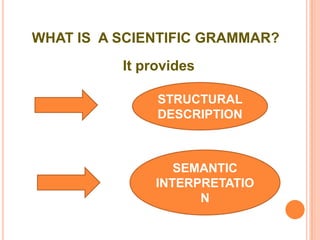
WHAT IS A SCIENTIFIC GRAMMAR?
It provides
STRUCTURAL
DESCRIPTION
SEMANTIC
INTERPRETATIO
N
WHAT IS A PEDAGOGICAL
GRAMMAR?
A COLLECTION OF
MATERIAL
GENERATIVE-
TRANSFORMATIONAL
GRAMMAR CAN BE
APPLIED IN THE FORM OF
PEDAGOGICAL GRAMMAR
(IN TEACHING ENGLISH
GRAMMAR)
Thomas (in Silalahi,1993) who is
convinced with his contribution of
Generative-Transformational Grammar,
suggests that in the beginning of
teaching, the teachers should teach the
kernel sentence first.
Kernel sentences consist of:
 Simple;
 Declarative;
 Active with no complex verb or noun
phrase.
Later on the students are taught to
construct passive, negative sentences in
the form of Transformational Grammar.
Why should the teacher
know the theory of
language structure?
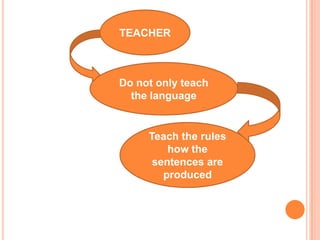
Do not only teach
the language
TEACHER
Teach the rules
how the
sentences are
produced
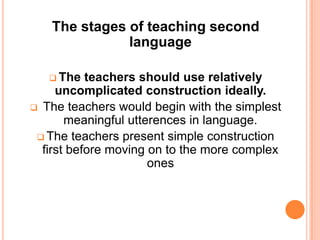
The stages of teaching second
language
 The teachers should use relatively
uncomplicated construction ideally.
 The teachers would begin with the simplest
meaningful utterences in language.
 The teachers present simple construction
first before moving on to the more complex
ones
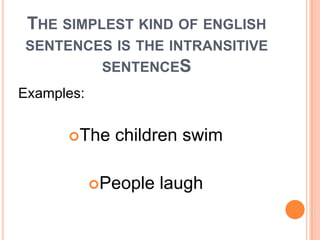
THE SIMPLEST KIND OF ENGLISH
SENTENCES IS THE INTRANSITIVE
SENTENCES
Examples:
The children swim
People laugh
OTHER MATTERS MUST SURELY BE
CONSIDERED
Meaningfulness to the learners;
Utility of the structure being learned;
 Appropriateness for age group.
But the concept of progressing from the
simple to the more complex should not
be ignored
So, Generative-Transformational
Grammar can serve as a guide to
help us to determine whether it is
a simple or more complicated
sentence form.
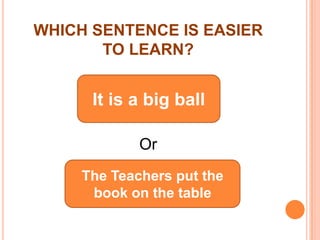
WHICH SENTENCE IS EASIER
TO LEARN?
Or
It is a big ball
The Teachers put the
book on the table
The best ways for the students
to generate sentences are:
Preparing some examples and
Excercise are used to have the
students supply sentence elements.
THERE ARE SOME RULES FOR
STUDENTS TO CREATE (GENERATE)
UTTERENCES
One of the phrase structural
rules in Transformational
Grammar is the following
example:
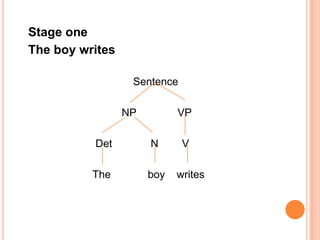
Stage one
The boy writes
Sentence
NP VP
Det N V
The boy writes
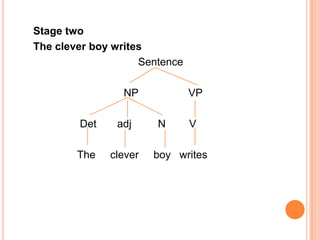
Stage two
The clever boy writes
Sentence
NP VP
Det adj N V
The clever boy writes
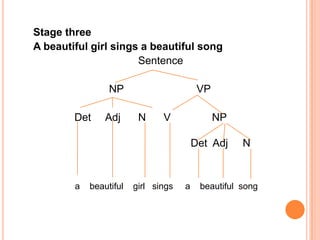
Stage three
A beautiful girl sings a beautiful song
Sentence
NP VP
Det Adj N V NP
Det Adj N
a beautiful girl sings a beautiful song
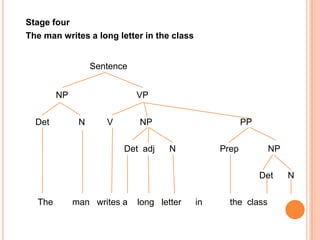
Stage four
The man writes a long letter in the class
Sentence
NP VP
Det N V NP PP
Det adj N Prep NP
Det N
The man writes a long letter in the class
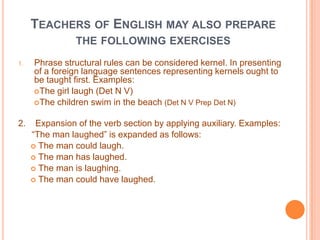
TEACHERS OF ENGLISH MAY ALSO PREPARE
THE FOLLOWING EXERCISES
1. Phrase structural rules can be considered kernel. In presenting
of a foreign language sentences representing kernels ought to
be taught first. Examples:
The girl laugh (Det N V)
The children swim in the beach (Det N V Prep Det N)
2. Expansion of the verb section by applying auxiliary. Examples:
“The man laughed” is expanded as follows:
 The man could laugh.
 The man has laughed.
 The man is laughing.
 The man could have laughed.
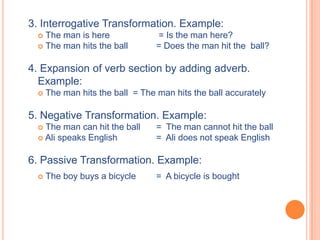
3. Interrogative Transformation. Example:
 The man is here = Is the man here?
 The man hits the ball = Does the man hit the ball?
4. Expansion of verb section by adding adverb.
Example:
 The man hits the ball = The man hits the ball accurately
5. Negative Transformation. Example:
 The man can hit the ball = The man cannot hit the ball
 Ali speaks English = Ali does not speak English
6. Passive Transformation. Example:
 The boy buys a bicycle = A bicycle is bought
So, in language teaching and
learning process, Generative
Transformational Grammar is also
the most important one for the
students to know the rules how
they produce sentences
grammatically.
THANK YOU

Generative grammar power point presentation,, ulfa

  • 1.
    THE POWER OFGENERATIVE- TRANSFORMATIONAL GRAMMAR  This grammar will generate well-formed syntactic structures (e.g. sentences) of the language.  This grammar will have a finite (i.e. limited) number of rules but will be capable of generating an infinite number of well- formed structures.  The rules of this grammar give ‘recursiveness’, that is the capacity to be applied more than once in generating a structure.  This grammar is also capable of revealing the basis two other phenomena:  How some superficially distinct sentences are closely related.  How some superficially similar sentences are in fact distinct.
  • 2.
    CRITISIZM OF GENERATIVE- TRANSFORMATIONALGRAMMAR It is far from clear what contribution Generative- Transformational Grammar is likely to make to language teaching methodology." Silalahi (1993), "
  • 3.
    Many teachers ofEnglish as a second language assume that Generative-Transformational Grammar is pedagogically unadaptable to the needs of a secondary curriculum. It means that it is not applicable to language teaching.
  • 4.
    There are twoimportant reasons: The first reason is that the explication of the theory is directed more towards linguists, psychologists and mathematicians than toward teachers of English.  The second reason is that the criticism of this theory by other linguists made the concept more complicated.
  • 5.
    THE IMPLICATION OFGENERATIVE- TRANSFORMATIONAL GRAMMAR IN ELT  Actually, there might be still many other linguists who accept that Generative- Transfromational Grammar can be contributed in teaching and learning process.  Silalahi (1993) in her paper concentrates more on the opinions which can see the contribution of Generative-Transformational Grammar to the teaching of grammar.
  • 6.
    Dealing with theprocess of learning and acquisition  These two terms are different in case they are used to separated between the first language acquisition and the second language acquisition learning.  In learning second language, it is a conscious activity, while the first language acquisition deals with unconsious one.  In language acquisition the focus is communication or reception of a message as opposed to syntax and grammar as in language learning.
  • 7.
    Saporta (in Silalahi,1993)claims that the main contribution of Generative-Transformational Grammar is to provide relevant data which enables textbook writers to base their material on the most adequate description.
  • 8.
    If someone wantsto apply this Generative- Transformational Grammar, there should be a clear differences between scientific grammar and pedagogical grammar.
  • 9.
    WHAT IS ASCIENTIFIC GRAMMAR? It provides STRUCTURAL DESCRIPTION SEMANTIC INTERPRETATIO N
  • 10.
    WHAT IS APEDAGOGICAL GRAMMAR? A COLLECTION OF MATERIAL
  • 11.
    GENERATIVE- TRANSFORMATIONAL GRAMMAR CAN BE APPLIEDIN THE FORM OF PEDAGOGICAL GRAMMAR (IN TEACHING ENGLISH GRAMMAR)
  • 12.
    Thomas (in Silalahi,1993)who is convinced with his contribution of Generative-Transformational Grammar, suggests that in the beginning of teaching, the teachers should teach the kernel sentence first. Kernel sentences consist of:  Simple;  Declarative;  Active with no complex verb or noun phrase. Later on the students are taught to construct passive, negative sentences in the form of Transformational Grammar.
  • 13.
    Why should theteacher know the theory of language structure?
  • 14.
    Do not onlyteach the language TEACHER Teach the rules how the sentences are produced
  • 15.
    The stages ofteaching second language  The teachers should use relatively uncomplicated construction ideally.  The teachers would begin with the simplest meaningful utterences in language.  The teachers present simple construction first before moving on to the more complex ones
  • 16.
    THE SIMPLEST KINDOF ENGLISH SENTENCES IS THE INTRANSITIVE SENTENCES Examples: The children swim People laugh
  • 17.
    OTHER MATTERS MUSTSURELY BE CONSIDERED Meaningfulness to the learners; Utility of the structure being learned;  Appropriateness for age group. But the concept of progressing from the simple to the more complex should not be ignored
  • 18.
    So, Generative-Transformational Grammar canserve as a guide to help us to determine whether it is a simple or more complicated sentence form.
  • 19.
    WHICH SENTENCE ISEASIER TO LEARN? Or It is a big ball The Teachers put the book on the table
  • 20.
    The best waysfor the students to generate sentences are: Preparing some examples and Excercise are used to have the students supply sentence elements.
  • 21.
    THERE ARE SOMERULES FOR STUDENTS TO CREATE (GENERATE) UTTERENCES One of the phrase structural rules in Transformational Grammar is the following example:
  • 22.
    Stage one The boywrites Sentence NP VP Det N V The boy writes
  • 23.
    Stage two The cleverboy writes Sentence NP VP Det adj N V The clever boy writes
  • 24.
    Stage three A beautifulgirl sings a beautiful song Sentence NP VP Det Adj N V NP Det Adj N a beautiful girl sings a beautiful song
  • 25.
    Stage four The manwrites a long letter in the class Sentence NP VP Det N V NP PP Det adj N Prep NP Det N The man writes a long letter in the class
  • 26.
    TEACHERS OF ENGLISHMAY ALSO PREPARE THE FOLLOWING EXERCISES 1. Phrase structural rules can be considered kernel. In presenting of a foreign language sentences representing kernels ought to be taught first. Examples: The girl laugh (Det N V) The children swim in the beach (Det N V Prep Det N) 2. Expansion of the verb section by applying auxiliary. Examples: “The man laughed” is expanded as follows:  The man could laugh.  The man has laughed.  The man is laughing.  The man could have laughed.
  • 27.
    3. Interrogative Transformation.Example:  The man is here = Is the man here?  The man hits the ball = Does the man hit the ball? 4. Expansion of verb section by adding adverb. Example:  The man hits the ball = The man hits the ball accurately 5. Negative Transformation. Example:  The man can hit the ball = The man cannot hit the ball  Ali speaks English = Ali does not speak English 6. Passive Transformation. Example:  The boy buys a bicycle = A bicycle is bought
  • 28.
    So, in languageteaching and learning process, Generative Transformational Grammar is also the most important one for the students to know the rules how they produce sentences grammatically.
  • 29.