

September 2011
Transformer Insulation Oil
Sensing System
0
Unique Sensing Solution
www.snsrevolution.co.kr
Sensor & System Technology
Doc T-1
1
Core Technology
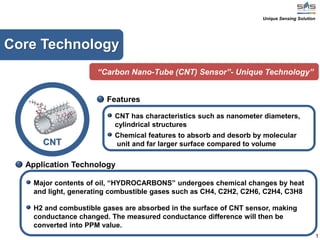
“Carbon Nano-Tube (CNT) Sensor”- Unique Technology”
CNT
Features
CNT has characteristics such as nanometer diameters,
cylindrical structures
Chemical features to absorb and desorb by molecular
unit and far larger surface compared to volume
Application Technology
Major contents of oil, “HYDROCARBONS” undergoes chemical changes by heat
and light, generating combustible gases such as CH4, C2H2, C2H6, C2H4, C3H8
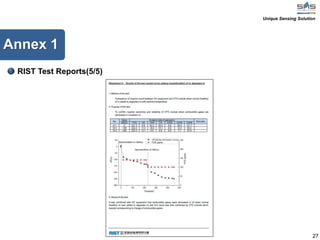
H2 and combustible gases are absorbed in the surface of CNT sensor, making
conductance changed. The measured conductance difference will then be
converted into PPM value.
Unique Sensing Solution
2
Core Technology
Measuring Gas
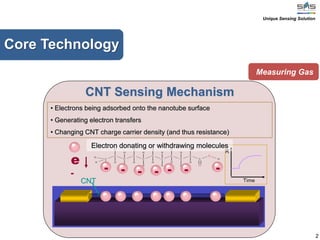
CNT Sensing Mechanism
• Electrons being adsorbed onto the nanotube surface
• Generating electron transfers
• Changing CNT charge carrier density (and thus resistance)
Electron donating or withdrawing molecules
Unique Sensing Solution
3
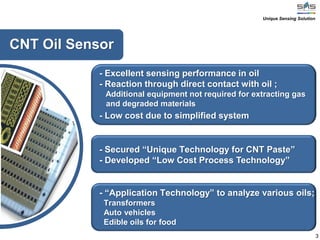
CNT Oil Sensor
- Excellent sensing performance in oil
- Reaction through direct contact with oil ;
Additional equipment not required for extracting gas
and degraded materials
- Low cost due to simplified system
- Secured “Unique Technology for CNT Paste”
- Developed “Low Cost Process Technology”
- “Application Technology” to analyze various oils;
Transformers
Auto vehicles
Edible oils for food
Unique Sensing Solution
4
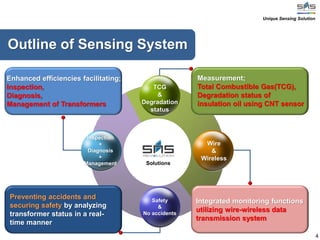
Outline of Sensing System
TCG
&
Degradation
status
Wire
&
Wireless
Inspection
+
Diagnosis
+
Management
Safety
&
No accidents
Measurement;
Total Combustible Gas(TCG),
Degradation status of
insulation oil using CNT sensor
Integrated monitoring functions
utilizing wire-wireless data
transmission system
Preventing accidents and
securing safety by analyzing
transformer status in a real-
time manner
Enhanced efficiencies facilitating;
Inspection,
Diagnosis,
Management of Transformers
Solutions
Unique Sensing Solution
5
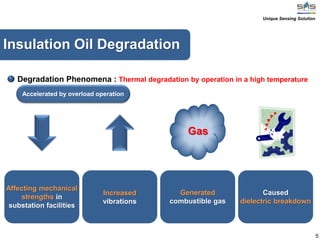
Insulation Oil Degradation
Degradation Phenomena : Thermal degradation by operation in a high temperature
Gas
Unique Sensing Solution
Affecting mechanical
strengths in
substation facilities
Increased
vibrations
Generated
combustible gas
Caused
dielectric breakdown
Accelerated by overload operation
6
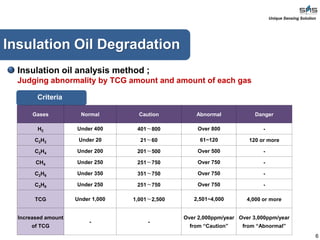
Criteria
Unique Sensing Solution
Gases Normal Caution Abnormal Danger
H2 Under 400 401∼800 Over 800 -
C2H2 Under 20 21∼60 61~120 120 or more
C2H4 Under 200 201∼500 Over 500 -
CH4 Under 250 251∼750 Over 750 -
C2H6 Under 350 351∼750 Over 750 -
C3H8 Under 250 251∼750 Over 750 -
TCG Under 1,000 1,001∼2,500 2,501~4,000 4,000 or more
Increased amount
of TCG
- -
Over 2,000ppm/year
from “Caution”
Over 3,000ppm/year
from “Abnormal”
Insulation Oil Degradation
Insulation oil analysis method ;
Judging abnormality by TCG amount and amount of each gas
7
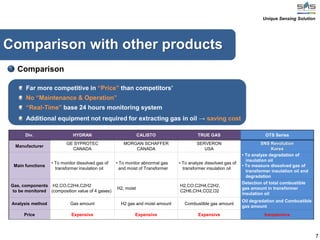
Comparison with other products
Comparison
Div. HYDRAN CALISTO TRUE GAS OTS Series
Manufacturer
GE SYPROTEC
CANADA
MORGAN SCHAFFER
CANADA
SERVERON
USA
SNS Revolution
Korea
Main functions
• To monitor dissolved gas of
transformer insulation oil
• To monitor abnormal gas
and moist of Transformer
• To analyze dissolved gas of
transformer insulation oil
• To analyze degradation of
insulation oil
• To measure dissolved gas of
transformer insulation oil and
degradation
Gas, components
to be monitored
H2,CO,C2H4,C2H2
(composition value of 4 gases)
H2, moist
H2,CO,C2H4,C2H2,
C2H6,CH4,CO2,O2
Detection of total combustible
gas amount in transformer
insulation oil
Analysis method Gas amount H2 gas and moist amount Combustible gas amount
Oil degradation and Combustible
gas amount
Price Expensive Expensive Expensive Inexpensive
Far more competitive in “Price” than competitors’
No “Maintenance & Operation”
“Real-Time” base 24 hours monitoring system
Unique Sensing Solution
Additional equipment not required for extracting gas in oil → saving cost
8
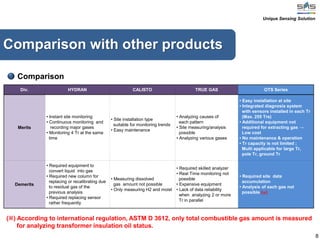
Comparison
Div. HYDRAN CALISTO TRUE GAS OTS Series
Merits
• Instant site monitoring
• Continuous monitoring and
recording major gases
• Monitoring 4 Tr at the same
time
• Site installation type
suitable for monitoring trends
• Easy maintenance
• Analyzing causes of
each pattern
• Site measuring/analysis
possible
• Analyzing various gases
• Easy installation at site
• Integrated diagnosis system
with sensors installed in each Tr
(Max. 255 Trs)
• Additional equipment not
required for extracting gas →
Low cost
• No maintenance & operation
• Tr capacity is not limited ;
Multi applicable for large Tr,
pole Tr, ground Tr
Demerits
• Required equipment to
convert liquid into gas
• Required new column for
replacing or recalibrating due
to residual gas of the
previous analysis
• Required replacing sensor
rather frequently
• Measuring dissolved
gas amount not possible
• Only measuring H2 and moist
• Required skilled analyzer
• Real Time monitoring not
possible
• Expensive equipment
• Lack of data reliability
when analyzing 2 or more
Tr in parallel
• Required site data
accumulation
• Analysis of each gas not
possible (※)
Comparison with other products
(※) According to international regulation, ASTM D 3612, only total combustible gas amount is measured
for analyzing transformer insulation oil status.
Unique Sensing Solution
9
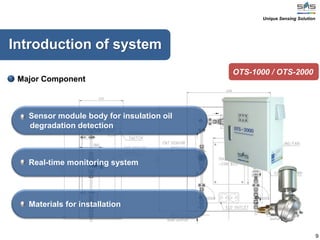
Introduction of system
OTS-1000 / OTS-2000
Major Component
Sensor module body for insulation oil
degradation detection
Materials for installation
Real-time monitoring system
Unique Sensing Solution
10
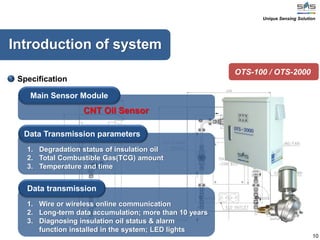
Introduction of system
Specification
Main Sensor Module
CNT Oil Sensor
Data Transmission parameters
1. Degradation status of insulation oil
2. Total Combustible Gas(TCG) amount
3. Temperature and time
Data transmission
1. Wire or wireless online communication
2. Long-term data accumulation; more than 10 years
3. Diagnosing insulation oil status & alarm
function installed in the system; LED lights
OTS-100 / OTS-2000
Unique Sensing Solution
11
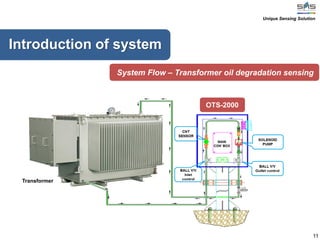
Transformer
System Flow – Transformer oil degradation sensing
Introduction of system
OTS-2000
Unique Sensing Solution
12
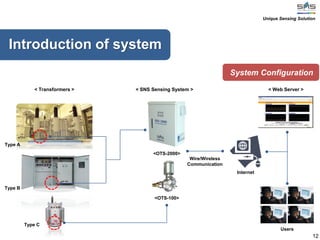
Wire/Wireless
Communication
< Web Server >
Users
Internet
< Transformers > < SNS Sensing System >
<OTS-2000>
Type A
Type B
Type C
System Configuration
Introduction of system
<OTS-100>
Unique Sensing Solution
13
Unique Sensing Solution
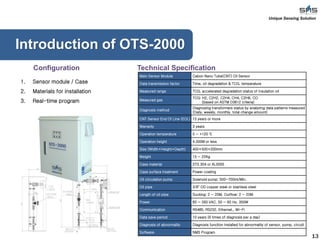
1. Sensor module / Case
2. Materials for installation
3. Real-time program
Introduction of OTS-2000
Main Sensor Module Cabon Nano Tube(CNT) Oil Sensor
Data transmission factor Time, oil degradation & TCG, temperature
Measured range TCG, accelerated degradation status of insulation oil
Measured gas
TCG: H2, C2H2, C2H4, CH4, C2H6, CO
(based on ASTM D3612 criteria)
Diagnosis method
Diagnosing transformers status by analyzing data patterns measured
(Daily, weekly, monthly, total change amount)
CNT Sensor End Of Line (EOL) 15 years or more
Warranty 3 years
Operation temperature 0 ~ +120 ℃
Operation height 4,000M or less
Size (Width×Height×Depth) 400×500×200mm
Weight 15 ~ 22Kg
Case material STS 304 or AL5005
Case surface treatment Power coating
Oil circulation pump Solenoid pump: 500~700ml/Min.
Oil pipe 3/8" OD copper steel or stainless steel
Length of oil pipe Sucking: 2 ~ 20M, Outflow: 2 ~ 20M
Power 85 ~ 260 VAC, 50 ~ 60 Hz, 350W
Communication RS485, RS232, Ethernet,, Wi-Fi
Data save period 10 years (6 times of diagnosis per a day)
Diagnosis of abnormality Diagnosis function installed for abnormality of sensor, pump, circuit
Software NMS Program
Technical SpecificationConfiguration
14
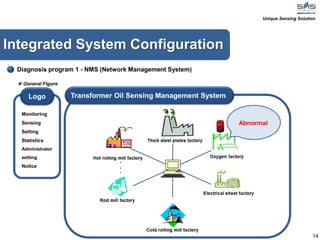
Integrated System Configuration
Diagnosis program 1 - NMS (Network Management System)
※ General Figure
Transformer Oil Sensing Management SystemLogo
Monitoring
Sensing
Setting
Statistics
Administrator
setting
Notice
Unique Sensing Solution
Abnormal
15
Integrated System Configuration
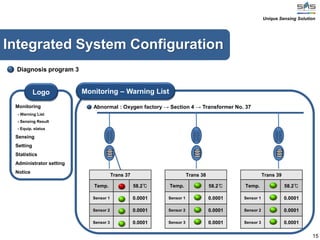
Diagnosis program 3
Monitoring – Warning ListLogo
Monitoring
- Warning List
- Sensing Result
- Equip. status
Sensing
Setting
Statistics
Administrator setting
Notice
Trans 37
Temp. 58.2℃
Sensor 1 0.0001
Sensor 2 0.0001
Sensor 3 0.0001
Trans 38
Temp. 58.2℃
Sensor 1 0.0001
Sensor 2 0.0001
Sensor 3 0.0001
Trans 39
Temp. 58.2℃
Sensor 1 0.0001
Sensor 2 0.0001
Sensor 3 0.0001
Abnormal : Oxygen factory → Section 4 → Transformer No. 37
Unique Sensing Solution
16
Integrated System Configuration
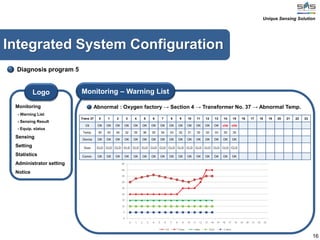
Diagnosis program 5
Logo
Monitoring
- Warning List
- Sensing Result
- Equip. status
Sensing
Setting
Statistics
Administrator setting
Notice
Abnormal : Oxygen factory → Section 4 → Transformer No. 37 → Abnormal Temp.
Monitoring – Warning List
Trans 37 0 1 2 3 4 5 6 7 8 9 10 11 12 13 14 15 16 17 18 19 20 21 22 23
Oil OK OK OK OK OK OK OK OK OK OK OK OK OK OK chk chk
Temp. 30 33 34 32 35 36 35 34 33 32 31 30 32 33 35 35
Device OK OK OK OK OK OK OK OK OK OK OK OK OK OK OK OK
Door CLD CLD CLD CLD CLD CLD CLD CLD CLD CLD CLD CLD CLD CLD CLD CLD
Comm. OK OK OK OK OK OK OK OK OK OK OK OK OK OK OK OK
Unique Sensing Solution
17
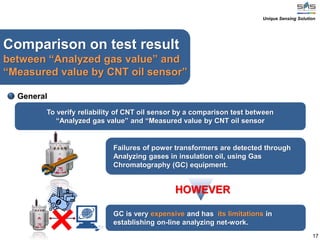
Comparison on test result
between “Analyzed gas value” and
“Measured value by CNT oil sensor”
General
Failures of power transformers are detected through
Analyzing gases in insulation oil, using Gas
Chromatography (GC) equipment.
GC is very expensive and has its limitations in
establishing on-line analyzing net-work.
HOWEVER
To verify reliability of CNT oil sensor by a comparison test between
“Analyzed gas value” and “Measured value by CNT oil sensor
Unique Sensing Solution
18
Test outline
Place
Insulation Gas analysis laboratory of EIC
technology Dept, POSCO Gwangyang Steel Mill
Performed by
EIC technology Dept, POSCO
Smart Grid Team, RIST
SNS R&D
Comparison on test result
between “Analyzed gas value” and
“Measured value by CNT oil sensor”
Unique Sensing Solution
19
Comparison on test result
between “Analyzed gas value” and
“Measured value by CNT oil sensor”
Test result
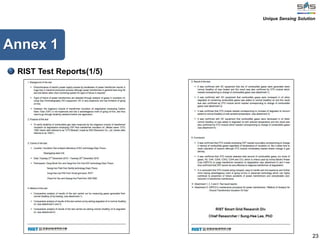
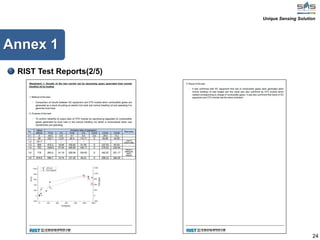
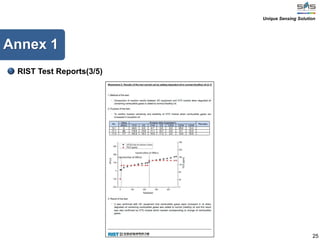
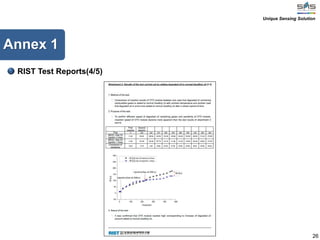
Reliability of CNT oil sensor module was verified
and confirmed which has reacted accurately
corresponding to change of combustible gases.
※ Refer to Annex 1 Research Institute of Industrial Science & Technology(RIST) test report
Unique Sensing Solution
20
Comparison on test result
between “Analyzed gas value” and
“Measured value by CNT oil sensor”
Conclusion
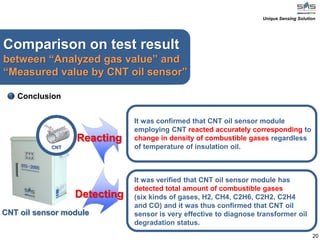
CNT oil sensor module
Reacting
Detecting
It was confirmed that CNT oil sensor module
employing CNT reacted accurately corresponding to
change in density of combustible gases regardless
of temperature of insulation oil.
It was verified that CNT oil sensor module has
detected total amount of combustible gases
(six kinds of gases, H2, CH4, C2H6, C2H2, C2H4
and CO) and it was thus confirmed that CNT oil
sensor is very effective to diagnose transformer oil
degradation status.
Unique Sensing Solution
21
Comparison on test result
between “Analyzed gas value” and
“Measured value by CNT oil sensor”
Conclusion
Compact system
Easy to monitor and handle
Not expensive
Having advantageous merits in constructing on-line monitoring net work
which can prevent failure accidents of power transformers
Minimizing transformer maintenance costs
It is verified that CNT oil sensor is ;
Unique Sensing Solution
Thank You
- End of Document -
22
Unique Sensing Solution
23
Annex 1
RIST Test Reports(1/5)
Unique Sensing Solution
24
Annex 1
RIST Test Reports(2/5)
Unique Sensing Solution
25
Annex 1
RIST Test Reports(3/5)
Unique Sensing Solution
26
Annex 1
RIST Test Reports(4/5)
Unique Sensing Solution
27
Annex 1
RIST Test Reports(5/5)
Unique Sensing Solution
28
Annex 2
Analysis data - Transformer insulation oil
Assessment of CNT oil sensor analysis test
Sensing Rate of CNT Sensor
OxidationStability
[mgKOH/g]
DielectricStrength
[KV]
※ MICHANG OIL IND.CO.,LTD Analysis Data 2008.01
Unique Sensing Solution
29
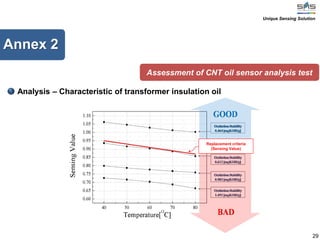
Annex 2
Analysis – Characteristic of transformer insulation oil
Assessment of CNT oil sensor analysis test
Replacement criteria
(Sensing Value)
Unique Sensing Solution
30
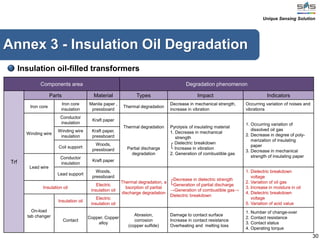
Annex 3 - Insulation Oil Degradation
Components area Degradation phenomenon
Trf
Parts Material Types Impact Indicators
Iron core
Iron core
insulation
Manila paper ,
pressboard
Thermal degradation
Decrease in mechanical strength,
increase in vibration
Occurring variation of noises and
vibrations
Winding wire
Conductor
insulation
Kraft paper
Thermal degradation
Partial discharge
degradation
Pyrolysis of insulating material
1. Decrease in mechanical
strength
┌ Dielectric breakdown
└ Increase in vibration
2. Generation of combustible gas
1. Occurring variation of
dissolved oil gas
2. Decrease in degree of poly-
merization of insulating
paper
3. Decrease in mechanical
strength of insulating paper
Winding wire
insulation
Kraft paper,
pressboard
Coil support
Woods,
pressboard
Lead wire
Conductor
insulation
Kraft paper
Lead support
Woods,
pressboard
Thermal degradation, a
bsorption of partial
discharge degradation
┌Decrease in dielectric strength
└Generation of partial discharge
→Generation of combustible gas→
Dielectric breakdown
1. Dielectric breakdown
voltage
2. Variation of oil gas
3. Increase in moisture in oil
4. Dielectric breakdown
voltage
5. Variation of acid value
Insulation oil
Electric
insulation oil
On-load
tab changer
Insulation oil
Electric
insulation oil
Contact
Copper, Copper
alloy
Abrasion,
corrosion
(copper sulfide)
Damage to contact surface
Increase in contact resistance
Overheating and melting loss
1. Number of change-over
2. Contact resistance
3. Contact status
4. Operating torque
Insulation oil-filled transformers
Unique Sensing Solution
31
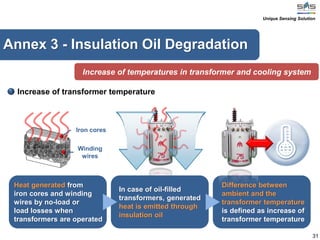
Increase of transformer temperature
Increase of temperatures in transformer and cooling system
Winding
wires
Iron cores
Heat generated from
iron cores and winding
wires by no-load or
load losses when
transformers are operated
Difference between
ambient and the
transformer temperature
is defined as increase of
transformer temperature
In case of oil-filled
transformers, generated
heat is emitted through
insulation oil
Unique Sensing Solution
Annex 3 - Insulation Oil Degradation
32
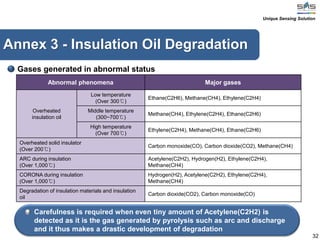
Gases generated in abnormal status
Abnormal phenomena Major gases
Overheated
insulation oil
Low temperature
(Over 300℃)
Ethane(C2H6), Methane(CH4), Ethylene(C2H4)
Middle temperature
(300~700℃)
Methane(CH4), Ethylene(C2H4), Ethane(C2H6)
High temperature
(Over 700℃)
Ethylene(C2H4), Methane(CH4), Ethane(C2H6)
Overheated solid insulator
(Over 200℃)
Carbon monoxide(CO), Carbon dioxide(CO2), Methane(CH4)
ARC during insulation
(Over 1,000℃)
Acetylene(C2H2), Hydrogen(H2), Ethylene(C2H4),
Methane(CH4)
CORONA during insulation
(Over 1,000℃)
Hydrogen(H2), Acetylene(C2H2), Ethylene(C2H4),
Methane(CH4)
Degradation of insulation materials and insulation
oil
Carbon dioxide(CO2), Carbon monoxide(CO)
Carefulness is required when even tiny amount of Acetylene(C2H2) is
detected as it is the gas generated by pyrolysis such as arc and discharge
and it thus makes a drastic development of degradation
Unique Sensing Solution
Annex 3 - Insulation Oil Degradation
33
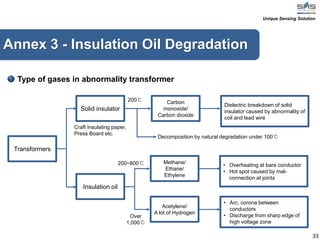
Type of gases in abnormality transformer
Transformers
Solid insulator
Insulation oil
Carbon
monoxide/
Carbon dioxide
Acetylene/
A lot of Hydrogen
Methane/
Ethane/
Ethylene
Dielectric breakdown of solid
insulator caused by abnormality of
coil and lead wire
• Arc, corona between
conductors
• Discharge from sharp edge of
high voltage zone
• Overheating at bare conductor
• Hot spot caused by mal-
connection at joints
Craft insulating paper,
Press Board etc.
200℃
200~800℃
Over
1,000℃
Decomposition by natural degradation under 100℃
Unique Sensing Solution
Annex 3 - Insulation Oil Degradation
34
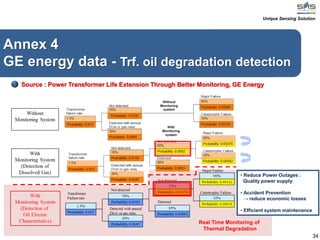
Annex 4
GE energy data - Trf. oil degradation detection
Source : Power Transformer Life Extension Through Better Monitoring, GE Energy
Real Time Monitoring of
Thermal Degradation
• Reduce Power Outages :
Quality power supply
• Accident Prevention
→ reduce economic losses
• Efficient system maintenance
Unique Sensing Solution
35
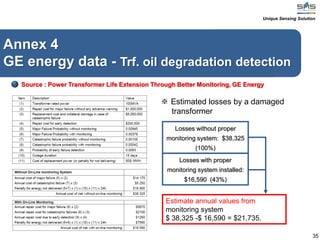
Estimate annual values from
monitoring system
$ 38,325 -$ 16,590 = $21,735.
※ Estimated losses by a damaged
transformer
Losses without proper
monitoring system: $38,325
(100%)
Losses with proper
monitoring system installed:
$16,590 (43%)
Source : Power Transformer Life Extension Through Better Monitoring, GE Energy
Unique Sensing Solution
Annex 4
GE energy data - Trf. oil degradation detection

T 1 transformer insulation oil sensing system

  • 1.
    September 2011 Transformer InsulationOil Sensing System 0 Unique Sensing Solution www.snsrevolution.co.kr Sensor & System Technology Doc T-1
  • 2.
    1 Core Technology “Carbon Nano-Tube(CNT) Sensor”- Unique Technology” CNT Features CNT has characteristics such as nanometer diameters, cylindrical structures Chemical features to absorb and desorb by molecular unit and far larger surface compared to volume Application Technology Major contents of oil, “HYDROCARBONS” undergoes chemical changes by heat and light, generating combustible gases such as CH4, C2H2, C2H6, C2H4, C3H8 H2 and combustible gases are absorbed in the surface of CNT sensor, making conductance changed. The measured conductance difference will then be converted into PPM value. Unique Sensing Solution
  • 3.
    2 Core Technology Measuring Gas CNTSensing Mechanism • Electrons being adsorbed onto the nanotube surface • Generating electron transfers • Changing CNT charge carrier density (and thus resistance) Electron donating or withdrawing molecules Unique Sensing Solution
  • 4.
    3 CNT Oil Sensor -Excellent sensing performance in oil - Reaction through direct contact with oil ; Additional equipment not required for extracting gas and degraded materials - Low cost due to simplified system - Secured “Unique Technology for CNT Paste” - Developed “Low Cost Process Technology” - “Application Technology” to analyze various oils; Transformers Auto vehicles Edible oils for food Unique Sensing Solution
  • 5.
    4 Outline of SensingSystem TCG & Degradation status Wire & Wireless Inspection + Diagnosis + Management Safety & No accidents Measurement; Total Combustible Gas(TCG), Degradation status of insulation oil using CNT sensor Integrated monitoring functions utilizing wire-wireless data transmission system Preventing accidents and securing safety by analyzing transformer status in a real- time manner Enhanced efficiencies facilitating; Inspection, Diagnosis, Management of Transformers Solutions Unique Sensing Solution
  • 6.
    5 Insulation Oil Degradation DegradationPhenomena : Thermal degradation by operation in a high temperature Gas Unique Sensing Solution Affecting mechanical strengths in substation facilities Increased vibrations Generated combustible gas Caused dielectric breakdown Accelerated by overload operation
  • 7.
    6 Criteria Unique Sensing Solution GasesNormal Caution Abnormal Danger H2 Under 400 401∼800 Over 800 - C2H2 Under 20 21∼60 61~120 120 or more C2H4 Under 200 201∼500 Over 500 - CH4 Under 250 251∼750 Over 750 - C2H6 Under 350 351∼750 Over 750 - C3H8 Under 250 251∼750 Over 750 - TCG Under 1,000 1,001∼2,500 2,501~4,000 4,000 or more Increased amount of TCG - - Over 2,000ppm/year from “Caution” Over 3,000ppm/year from “Abnormal” Insulation Oil Degradation Insulation oil analysis method ; Judging abnormality by TCG amount and amount of each gas
  • 8.
    7 Comparison with otherproducts Comparison Div. HYDRAN CALISTO TRUE GAS OTS Series Manufacturer GE SYPROTEC CANADA MORGAN SCHAFFER CANADA SERVERON USA SNS Revolution Korea Main functions • To monitor dissolved gas of transformer insulation oil • To monitor abnormal gas and moist of Transformer • To analyze dissolved gas of transformer insulation oil • To analyze degradation of insulation oil • To measure dissolved gas of transformer insulation oil and degradation Gas, components to be monitored H2,CO,C2H4,C2H2 (composition value of 4 gases) H2, moist H2,CO,C2H4,C2H2, C2H6,CH4,CO2,O2 Detection of total combustible gas amount in transformer insulation oil Analysis method Gas amount H2 gas and moist amount Combustible gas amount Oil degradation and Combustible gas amount Price Expensive Expensive Expensive Inexpensive Far more competitive in “Price” than competitors’ No “Maintenance & Operation” “Real-Time” base 24 hours monitoring system Unique Sensing Solution Additional equipment not required for extracting gas in oil → saving cost
  • 9.
    8 Comparison Div. HYDRAN CALISTOTRUE GAS OTS Series Merits • Instant site monitoring • Continuous monitoring and recording major gases • Monitoring 4 Tr at the same time • Site installation type suitable for monitoring trends • Easy maintenance • Analyzing causes of each pattern • Site measuring/analysis possible • Analyzing various gases • Easy installation at site • Integrated diagnosis system with sensors installed in each Tr (Max. 255 Trs) • Additional equipment not required for extracting gas → Low cost • No maintenance & operation • Tr capacity is not limited ; Multi applicable for large Tr, pole Tr, ground Tr Demerits • Required equipment to convert liquid into gas • Required new column for replacing or recalibrating due to residual gas of the previous analysis • Required replacing sensor rather frequently • Measuring dissolved gas amount not possible • Only measuring H2 and moist • Required skilled analyzer • Real Time monitoring not possible • Expensive equipment • Lack of data reliability when analyzing 2 or more Tr in parallel • Required site data accumulation • Analysis of each gas not possible (※) Comparison with other products (※) According to international regulation, ASTM D 3612, only total combustible gas amount is measured for analyzing transformer insulation oil status. Unique Sensing Solution
  • 10.
    9 Introduction of system OTS-1000/ OTS-2000 Major Component Sensor module body for insulation oil degradation detection Materials for installation Real-time monitoring system Unique Sensing Solution
  • 11.
    10 Introduction of system Specification MainSensor Module CNT Oil Sensor Data Transmission parameters 1. Degradation status of insulation oil 2. Total Combustible Gas(TCG) amount 3. Temperature and time Data transmission 1. Wire or wireless online communication 2. Long-term data accumulation; more than 10 years 3. Diagnosing insulation oil status & alarm function installed in the system; LED lights OTS-100 / OTS-2000 Unique Sensing Solution
  • 12.
    11 Transformer System Flow –Transformer oil degradation sensing Introduction of system OTS-2000 Unique Sensing Solution
  • 13.
    12 Wire/Wireless Communication < Web Server> Users Internet < Transformers > < SNS Sensing System > <OTS-2000> Type A Type B Type C System Configuration Introduction of system <OTS-100> Unique Sensing Solution
  • 14.
    13 Unique Sensing Solution 1.Sensor module / Case 2. Materials for installation 3. Real-time program Introduction of OTS-2000 Main Sensor Module Cabon Nano Tube(CNT) Oil Sensor Data transmission factor Time, oil degradation & TCG, temperature Measured range TCG, accelerated degradation status of insulation oil Measured gas TCG: H2, C2H2, C2H4, CH4, C2H6, CO (based on ASTM D3612 criteria) Diagnosis method Diagnosing transformers status by analyzing data patterns measured (Daily, weekly, monthly, total change amount) CNT Sensor End Of Line (EOL) 15 years or more Warranty 3 years Operation temperature 0 ~ +120 ℃ Operation height 4,000M or less Size (Width×Height×Depth) 400×500×200mm Weight 15 ~ 22Kg Case material STS 304 or AL5005 Case surface treatment Power coating Oil circulation pump Solenoid pump: 500~700ml/Min. Oil pipe 3/8" OD copper steel or stainless steel Length of oil pipe Sucking: 2 ~ 20M, Outflow: 2 ~ 20M Power 85 ~ 260 VAC, 50 ~ 60 Hz, 350W Communication RS485, RS232, Ethernet,, Wi-Fi Data save period 10 years (6 times of diagnosis per a day) Diagnosis of abnormality Diagnosis function installed for abnormality of sensor, pump, circuit Software NMS Program Technical SpecificationConfiguration
  • 15.
    14 Integrated System Configuration Diagnosisprogram 1 - NMS (Network Management System) ※ General Figure Transformer Oil Sensing Management SystemLogo Monitoring Sensing Setting Statistics Administrator setting Notice Unique Sensing Solution Abnormal
  • 16.
    15 Integrated System Configuration Diagnosisprogram 3 Monitoring – Warning ListLogo Monitoring - Warning List - Sensing Result - Equip. status Sensing Setting Statistics Administrator setting Notice Trans 37 Temp. 58.2℃ Sensor 1 0.0001 Sensor 2 0.0001 Sensor 3 0.0001 Trans 38 Temp. 58.2℃ Sensor 1 0.0001 Sensor 2 0.0001 Sensor 3 0.0001 Trans 39 Temp. 58.2℃ Sensor 1 0.0001 Sensor 2 0.0001 Sensor 3 0.0001 Abnormal : Oxygen factory → Section 4 → Transformer No. 37 Unique Sensing Solution
  • 17.
    16 Integrated System Configuration Diagnosisprogram 5 Logo Monitoring - Warning List - Sensing Result - Equip. status Sensing Setting Statistics Administrator setting Notice Abnormal : Oxygen factory → Section 4 → Transformer No. 37 → Abnormal Temp. Monitoring – Warning List Trans 37 0 1 2 3 4 5 6 7 8 9 10 11 12 13 14 15 16 17 18 19 20 21 22 23 Oil OK OK OK OK OK OK OK OK OK OK OK OK OK OK chk chk Temp. 30 33 34 32 35 36 35 34 33 32 31 30 32 33 35 35 Device OK OK OK OK OK OK OK OK OK OK OK OK OK OK OK OK Door CLD CLD CLD CLD CLD CLD CLD CLD CLD CLD CLD CLD CLD CLD CLD CLD Comm. OK OK OK OK OK OK OK OK OK OK OK OK OK OK OK OK Unique Sensing Solution
  • 18.
    17 Comparison on testresult between “Analyzed gas value” and “Measured value by CNT oil sensor” General Failures of power transformers are detected through Analyzing gases in insulation oil, using Gas Chromatography (GC) equipment. GC is very expensive and has its limitations in establishing on-line analyzing net-work. HOWEVER To verify reliability of CNT oil sensor by a comparison test between “Analyzed gas value” and “Measured value by CNT oil sensor Unique Sensing Solution
  • 19.
    18 Test outline Place Insulation Gasanalysis laboratory of EIC technology Dept, POSCO Gwangyang Steel Mill Performed by EIC technology Dept, POSCO Smart Grid Team, RIST SNS R&D Comparison on test result between “Analyzed gas value” and “Measured value by CNT oil sensor” Unique Sensing Solution
  • 20.
    19 Comparison on testresult between “Analyzed gas value” and “Measured value by CNT oil sensor” Test result Reliability of CNT oil sensor module was verified and confirmed which has reacted accurately corresponding to change of combustible gases. ※ Refer to Annex 1 Research Institute of Industrial Science & Technology(RIST) test report Unique Sensing Solution
  • 21.
    20 Comparison on testresult between “Analyzed gas value” and “Measured value by CNT oil sensor” Conclusion CNT oil sensor module Reacting Detecting It was confirmed that CNT oil sensor module employing CNT reacted accurately corresponding to change in density of combustible gases regardless of temperature of insulation oil. It was verified that CNT oil sensor module has detected total amount of combustible gases (six kinds of gases, H2, CH4, C2H6, C2H2, C2H4 and CO) and it was thus confirmed that CNT oil sensor is very effective to diagnose transformer oil degradation status. Unique Sensing Solution
  • 22.
    21 Comparison on testresult between “Analyzed gas value” and “Measured value by CNT oil sensor” Conclusion Compact system Easy to monitor and handle Not expensive Having advantageous merits in constructing on-line monitoring net work which can prevent failure accidents of power transformers Minimizing transformer maintenance costs It is verified that CNT oil sensor is ; Unique Sensing Solution
  • 23.
    Thank You - Endof Document - 22 Unique Sensing Solution
  • 24.
    23 Annex 1 RIST TestReports(1/5) Unique Sensing Solution
  • 25.
    24 Annex 1 RIST TestReports(2/5) Unique Sensing Solution
  • 26.
    25 Annex 1 RIST TestReports(3/5) Unique Sensing Solution
  • 27.
    26 Annex 1 RIST TestReports(4/5) Unique Sensing Solution
  • 28.
    27 Annex 1 RIST TestReports(5/5) Unique Sensing Solution
  • 29.
    28 Annex 2 Analysis data- Transformer insulation oil Assessment of CNT oil sensor analysis test Sensing Rate of CNT Sensor OxidationStability [mgKOH/g] DielectricStrength [KV] ※ MICHANG OIL IND.CO.,LTD Analysis Data 2008.01 Unique Sensing Solution
  • 30.
    29 Annex 2 Analysis –Characteristic of transformer insulation oil Assessment of CNT oil sensor analysis test Replacement criteria (Sensing Value) Unique Sensing Solution
  • 31.
    30 Annex 3 -Insulation Oil Degradation Components area Degradation phenomenon Trf Parts Material Types Impact Indicators Iron core Iron core insulation Manila paper , pressboard Thermal degradation Decrease in mechanical strength, increase in vibration Occurring variation of noises and vibrations Winding wire Conductor insulation Kraft paper Thermal degradation Partial discharge degradation Pyrolysis of insulating material 1. Decrease in mechanical strength ┌ Dielectric breakdown └ Increase in vibration 2. Generation of combustible gas 1. Occurring variation of dissolved oil gas 2. Decrease in degree of poly- merization of insulating paper 3. Decrease in mechanical strength of insulating paper Winding wire insulation Kraft paper, pressboard Coil support Woods, pressboard Lead wire Conductor insulation Kraft paper Lead support Woods, pressboard Thermal degradation, a bsorption of partial discharge degradation ┌Decrease in dielectric strength └Generation of partial discharge →Generation of combustible gas→ Dielectric breakdown 1. Dielectric breakdown voltage 2. Variation of oil gas 3. Increase in moisture in oil 4. Dielectric breakdown voltage 5. Variation of acid value Insulation oil Electric insulation oil On-load tab changer Insulation oil Electric insulation oil Contact Copper, Copper alloy Abrasion, corrosion (copper sulfide) Damage to contact surface Increase in contact resistance Overheating and melting loss 1. Number of change-over 2. Contact resistance 3. Contact status 4. Operating torque Insulation oil-filled transformers Unique Sensing Solution
  • 32.
    31 Increase of transformertemperature Increase of temperatures in transformer and cooling system Winding wires Iron cores Heat generated from iron cores and winding wires by no-load or load losses when transformers are operated Difference between ambient and the transformer temperature is defined as increase of transformer temperature In case of oil-filled transformers, generated heat is emitted through insulation oil Unique Sensing Solution Annex 3 - Insulation Oil Degradation
  • 33.
    32 Gases generated inabnormal status Abnormal phenomena Major gases Overheated insulation oil Low temperature (Over 300℃) Ethane(C2H6), Methane(CH4), Ethylene(C2H4) Middle temperature (300~700℃) Methane(CH4), Ethylene(C2H4), Ethane(C2H6) High temperature (Over 700℃) Ethylene(C2H4), Methane(CH4), Ethane(C2H6) Overheated solid insulator (Over 200℃) Carbon monoxide(CO), Carbon dioxide(CO2), Methane(CH4) ARC during insulation (Over 1,000℃) Acetylene(C2H2), Hydrogen(H2), Ethylene(C2H4), Methane(CH4) CORONA during insulation (Over 1,000℃) Hydrogen(H2), Acetylene(C2H2), Ethylene(C2H4), Methane(CH4) Degradation of insulation materials and insulation oil Carbon dioxide(CO2), Carbon monoxide(CO) Carefulness is required when even tiny amount of Acetylene(C2H2) is detected as it is the gas generated by pyrolysis such as arc and discharge and it thus makes a drastic development of degradation Unique Sensing Solution Annex 3 - Insulation Oil Degradation
  • 34.
    33 Type of gasesin abnormality transformer Transformers Solid insulator Insulation oil Carbon monoxide/ Carbon dioxide Acetylene/ A lot of Hydrogen Methane/ Ethane/ Ethylene Dielectric breakdown of solid insulator caused by abnormality of coil and lead wire • Arc, corona between conductors • Discharge from sharp edge of high voltage zone • Overheating at bare conductor • Hot spot caused by mal- connection at joints Craft insulating paper, Press Board etc. 200℃ 200~800℃ Over 1,000℃ Decomposition by natural degradation under 100℃ Unique Sensing Solution Annex 3 - Insulation Oil Degradation
  • 35.
    34 Annex 4 GE energydata - Trf. oil degradation detection Source : Power Transformer Life Extension Through Better Monitoring, GE Energy Real Time Monitoring of Thermal Degradation • Reduce Power Outages : Quality power supply • Accident Prevention → reduce economic losses • Efficient system maintenance Unique Sensing Solution
  • 36.
    35 Estimate annual valuesfrom monitoring system $ 38,325 -$ 16,590 = $21,735. ※ Estimated losses by a damaged transformer Losses without proper monitoring system: $38,325 (100%) Losses with proper monitoring system installed: $16,590 (43%) Source : Power Transformer Life Extension Through Better Monitoring, GE Energy Unique Sensing Solution Annex 4 GE energy data - Trf. oil degradation detection