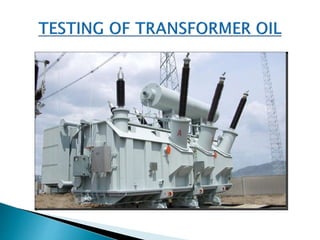
 In substation, Transformer is the most
efficient and costly equipment. So in order
to protect from faults, Transformer oil
testing is required.
 The transformer’s fluid not only serves as a
heat transfer medium, it also a part of
transformer’s insulation system.
 It is therefore prudent to periodically
perform tests on the oil to determine
whether it is capable of fulfilling its role as
an insulant.
 Dissolved Gas In Oil Analysis (Most famous
and Required Test)
 Screen tests
 Water Content
 Metals - In – Oil
 Polychlorinated Biphenyl (PCB) Content
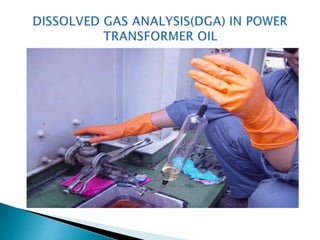
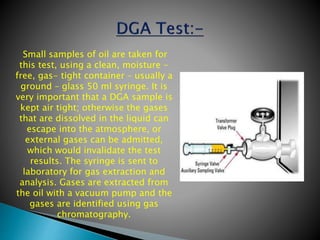
Small samples of oil are taken for
this test, using a clean, moisture -
free, gas- tight container – usually a
ground – glass 50 ml syringe. It is
very important that a DGA sample is
kept air tight; otherwise the gases
that are dissolved in the liquid can
escape into the atmosphere, or
external gases can be admitted,
which would invalidate the test
results. The syringe is sent to
laboratory for gas extraction and
analysis. Gases are extracted from
the oil with a vacuum pump and the
gases are identified using gas
chromatography.
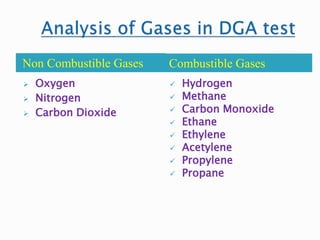
Non Combustible Gases Combustible Gases
 Oxygen
 Nitrogen
 Carbon Dioxide
 Hydrogen
 Methane
 Carbon Monoxide
 Ethane
 Ethylene
 Acetylene
 Propylene
 Propane
 Assesses the Internal condition of
transformer
 Helps to calculate the probability of failure
and end of life.
 Identifies degradation of insulation before
failure of the life.
 Low cost test process
 As the name implies, this test analyzes the
type and the quantity of gases that are
dissolved in the transformer oil.
i. Insulation overheating/overloading
ii. Insulation liquid overheating
iii. Partial discharge (Corona)
iv. Arcing in the transformer
 The paper insulation which is normally used to insulate
the windings of a transformer is a cellulose product.
 If a transformer becomes overloaded for any reason, the
windings will generate more heat and deteriorate the
cellulose insulation.
 The DGA test can identify an overloaded transformer by
a test result showing high carbon monoxide, high
carbon dioxide, and in extreme cases, even elevated
methane and ethylene is found.
 If a transformer is overloaded for a long period of time,
the deteriorating condition of the cellulose will shorten
the life of the transformer.
 Overheating of the liquid insulation is slightly different
problem in transformers.
 DGA test will indicate high thermal gases (methane,
ethane and ethylene) as a result of overheating of the
liquid.
 These gases are formed from a breakdown of the liquid
caused by the heat.
 Heating may be caused due to the following effects:-
1. Poor contacts on a tap changer.
2. Loose connections on a busing or a grounding strap.
3. Circulating currents in the core due to an
unintended core ground.
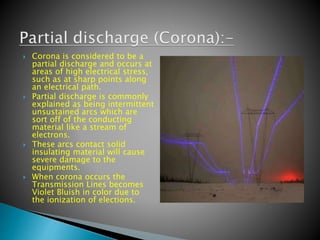
 Corona is considered to be a
partial discharge and occurs at
areas of high electrical stress,
such as at sharp points along
an electrical path.
 Partial discharge is commonly
explained as being intermittent
unsustained arcs which are
sort off of the conducting
material like a stream of
electrons.
 These arcs contact solid
insulating material will cause
severe damage to the
equipments.
 When corona occurs the
Transmission Lines becomes
Violet Bluish in color due to
the ionization of elections.
 Corona is indicated in a DGA by indications
of Elevated Hydrogen.
 If corona is detected by a DGA test, other
methods of pin-pointing the exact location
of the problem can be used – a partial
discharge detector can be used to detect
the exact place where corona is making the
hissing noise.
 Arcing is the most severe condition in a
transformer because it indicates a breakdown of
the insulation.
 The presence of Acetylene is an indicator of
arcing; and even low levels of this gas should
cause concern.
 Normally, arcing occurs only after other
problems which are detected by the DGA testing.
However, the high energy required to produce an
arc will cause all combustibles to be elevated.
 If the arc occurs in the area of cellulose
insulation, carbon dioxide and carbon monoxide
also will be elevated.
 Arcing can be generated in many areas of a
transformer.
 Insulation breakdown in the windings from coil
to coil or coil to ground, will result in arcing. A
portion of the insulation may deteriorate until it
can no longer contain the stress of the electrical
conductor.
 If a winding shorts from turn to turn, or phase to
phase, or phase to ground, arcing will occur and
the transformer will fail.
 When arcing occur in the area of the windings,
the usual result is de-tanking of the transformer,
and a rewind conducted.
 A loose connection also may cause arcing, but of
greater significance would be arcing due to
insulation breakdown.
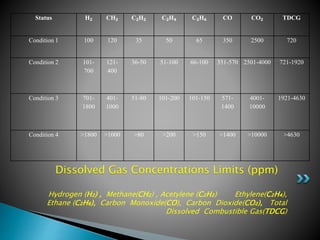
Hydrogen (H₂) , Methane(CH₂) , Acetylene (C₂H₂) Ethylene(C₂H₄),
Ethane (C₂H₆), Carbon Monoxide(CO), Carbon Dioxide(CO₂), Total
Dissolved Combustible Gas(TDCG)
Status H₂ CH₂ C₂H₂ C₂H₄ C₂H₆ CO CO₂ TDCG
Condition 1 100 120 35 50 65 350 2500 720
Condition 2 101-
700
121-
400
36-50 51-100 66-100 351-570 2501-4000 721-1920
Condition 3 701-
1800
401-
1000
51-80 101-200 101-150 571-
1400
4001-
10000
1921-4630
Condition 4 >1800 >1000 >80 >200 >150 >1400 >10000 >4630
Dissolved Gas Concentrations Limits (ppm)
 Condition 1 - TDCG below this level indicates
the transformer is operating satisfactorily
 Condition 2 - TDCG within this range indicates
greater than normal combustible levels &
should prompt additional investigation. (any
gas exceeding specified levels)
 Condition 3 - TDCG within this range indicates
high level of decomposition (additional
investigation required)
 Condition 4 - TDCG within this range indicates
excessive decomposition. Continued operation
could result in failure of the transformer.
 The Dissolved Gas Analysis (DGA) is a
chemical test rather than an electrical test.
It does not suffer from electrical
interference and can be done without de -
energization of the transformer. The cost of
each DGA is relatively inexpensive.
 All these factors make DGA a powerful tool
in the preventive maintenance of
transformer.
Dissolved Gas Analysis in Transformer Oil

Dissolved Gas Analysis in Transformer Oil

  • 2.
     In substation,Transformer is the most efficient and costly equipment. So in order to protect from faults, Transformer oil testing is required.  The transformer’s fluid not only serves as a heat transfer medium, it also a part of transformer’s insulation system.  It is therefore prudent to periodically perform tests on the oil to determine whether it is capable of fulfilling its role as an insulant.
  • 3.
     Dissolved GasIn Oil Analysis (Most famous and Required Test)  Screen tests  Water Content  Metals - In – Oil  Polychlorinated Biphenyl (PCB) Content
  • 5.
    Small samples ofoil are taken for this test, using a clean, moisture - free, gas- tight container – usually a ground – glass 50 ml syringe. It is very important that a DGA sample is kept air tight; otherwise the gases that are dissolved in the liquid can escape into the atmosphere, or external gases can be admitted, which would invalidate the test results. The syringe is sent to laboratory for gas extraction and analysis. Gases are extracted from the oil with a vacuum pump and the gases are identified using gas chromatography.
  • 6.
    Non Combustible GasesCombustible Gases  Oxygen  Nitrogen  Carbon Dioxide  Hydrogen  Methane  Carbon Monoxide  Ethane  Ethylene  Acetylene  Propylene  Propane
  • 7.
     Assesses theInternal condition of transformer  Helps to calculate the probability of failure and end of life.  Identifies degradation of insulation before failure of the life.  Low cost test process  As the name implies, this test analyzes the type and the quantity of gases that are dissolved in the transformer oil.
  • 8.
    i. Insulation overheating/overloading ii.Insulation liquid overheating iii. Partial discharge (Corona) iv. Arcing in the transformer
  • 9.
     The paperinsulation which is normally used to insulate the windings of a transformer is a cellulose product.  If a transformer becomes overloaded for any reason, the windings will generate more heat and deteriorate the cellulose insulation.  The DGA test can identify an overloaded transformer by a test result showing high carbon monoxide, high carbon dioxide, and in extreme cases, even elevated methane and ethylene is found.  If a transformer is overloaded for a long period of time, the deteriorating condition of the cellulose will shorten the life of the transformer.
  • 10.
     Overheating ofthe liquid insulation is slightly different problem in transformers.  DGA test will indicate high thermal gases (methane, ethane and ethylene) as a result of overheating of the liquid.  These gases are formed from a breakdown of the liquid caused by the heat.  Heating may be caused due to the following effects:- 1. Poor contacts on a tap changer. 2. Loose connections on a busing or a grounding strap. 3. Circulating currents in the core due to an unintended core ground.
  • 11.
     Corona isconsidered to be a partial discharge and occurs at areas of high electrical stress, such as at sharp points along an electrical path.  Partial discharge is commonly explained as being intermittent unsustained arcs which are sort off of the conducting material like a stream of electrons.  These arcs contact solid insulating material will cause severe damage to the equipments.  When corona occurs the Transmission Lines becomes Violet Bluish in color due to the ionization of elections.
  • 12.
     Corona isindicated in a DGA by indications of Elevated Hydrogen.  If corona is detected by a DGA test, other methods of pin-pointing the exact location of the problem can be used – a partial discharge detector can be used to detect the exact place where corona is making the hissing noise.
  • 13.
     Arcing isthe most severe condition in a transformer because it indicates a breakdown of the insulation.  The presence of Acetylene is an indicator of arcing; and even low levels of this gas should cause concern.  Normally, arcing occurs only after other problems which are detected by the DGA testing. However, the high energy required to produce an arc will cause all combustibles to be elevated.  If the arc occurs in the area of cellulose insulation, carbon dioxide and carbon monoxide also will be elevated.
  • 14.
     Arcing canbe generated in many areas of a transformer.  Insulation breakdown in the windings from coil to coil or coil to ground, will result in arcing. A portion of the insulation may deteriorate until it can no longer contain the stress of the electrical conductor.  If a winding shorts from turn to turn, or phase to phase, or phase to ground, arcing will occur and the transformer will fail.  When arcing occur in the area of the windings, the usual result is de-tanking of the transformer, and a rewind conducted.  A loose connection also may cause arcing, but of greater significance would be arcing due to insulation breakdown.
  • 15.
    Hydrogen (H₂) ,Methane(CH₂) , Acetylene (C₂H₂) Ethylene(C₂H₄), Ethane (C₂H₆), Carbon Monoxide(CO), Carbon Dioxide(CO₂), Total Dissolved Combustible Gas(TDCG) Status H₂ CH₂ C₂H₂ C₂H₄ C₂H₆ CO CO₂ TDCG Condition 1 100 120 35 50 65 350 2500 720 Condition 2 101- 700 121- 400 36-50 51-100 66-100 351-570 2501-4000 721-1920 Condition 3 701- 1800 401- 1000 51-80 101-200 101-150 571- 1400 4001- 10000 1921-4630 Condition 4 >1800 >1000 >80 >200 >150 >1400 >10000 >4630 Dissolved Gas Concentrations Limits (ppm)
  • 16.
     Condition 1- TDCG below this level indicates the transformer is operating satisfactorily  Condition 2 - TDCG within this range indicates greater than normal combustible levels & should prompt additional investigation. (any gas exceeding specified levels)  Condition 3 - TDCG within this range indicates high level of decomposition (additional investigation required)  Condition 4 - TDCG within this range indicates excessive decomposition. Continued operation could result in failure of the transformer.
  • 17.
     The DissolvedGas Analysis (DGA) is a chemical test rather than an electrical test. It does not suffer from electrical interference and can be done without de - energization of the transformer. The cost of each DGA is relatively inexpensive.  All these factors make DGA a powerful tool in the preventive maintenance of transformer.