Welcome
HVDC Transmission
Seminar On
Submitted To:-
Prof. Anshul Bhati
Prof. Vikram Singh Rajpurohit
Submitted By:-
Nadeem Khilji
11EVEEX032
8th Sem. EX
Evolution HVDC Technology
Agenda
 HVDC-Introduction
 Challenges with AC Power Lines
 Solution HVDC Technology
 Advantages
 Working
 Components
 HVDC Configurations
 Ground Return
 Earth Electrode
 HVDC Plus
HVDC-
Introduction
 A High Voltage Direct Current (HVDC) electric power
transmission system uses direct current for the bulk
transmission of electrical power, in contrast with the
more common alternating current (AC) systems.
 HVDC allows power transmission between
unsynchronized AC transmission systems.
 HVDC also allows transfer of power between grid
systems running at different frequencies, such as 50 Hz
and 60 Hz.
 Compared to alternating current, the direct current
system is less expensive and loses less energy.
Challenges
with AC
Power Lines
 Reduced Power quality causes the risk of declining network
stability.
 Corona Loss & Radio Interference.
 High Short Circuit Currents
 Line Support
 More Insulation Requirement
 Erection Difficulties
Solution:
HVDC
Technology
 It provides improved Power quality and Power flow
control as well.
 More Power can be Transmitted per Conductor
 Introducing extruded DC-cables which have no
technical limit to distance which can be installed.
 It can provide an alternative to overhead lines
particularly when the total capital and environmental
costs are considered.
Advantages
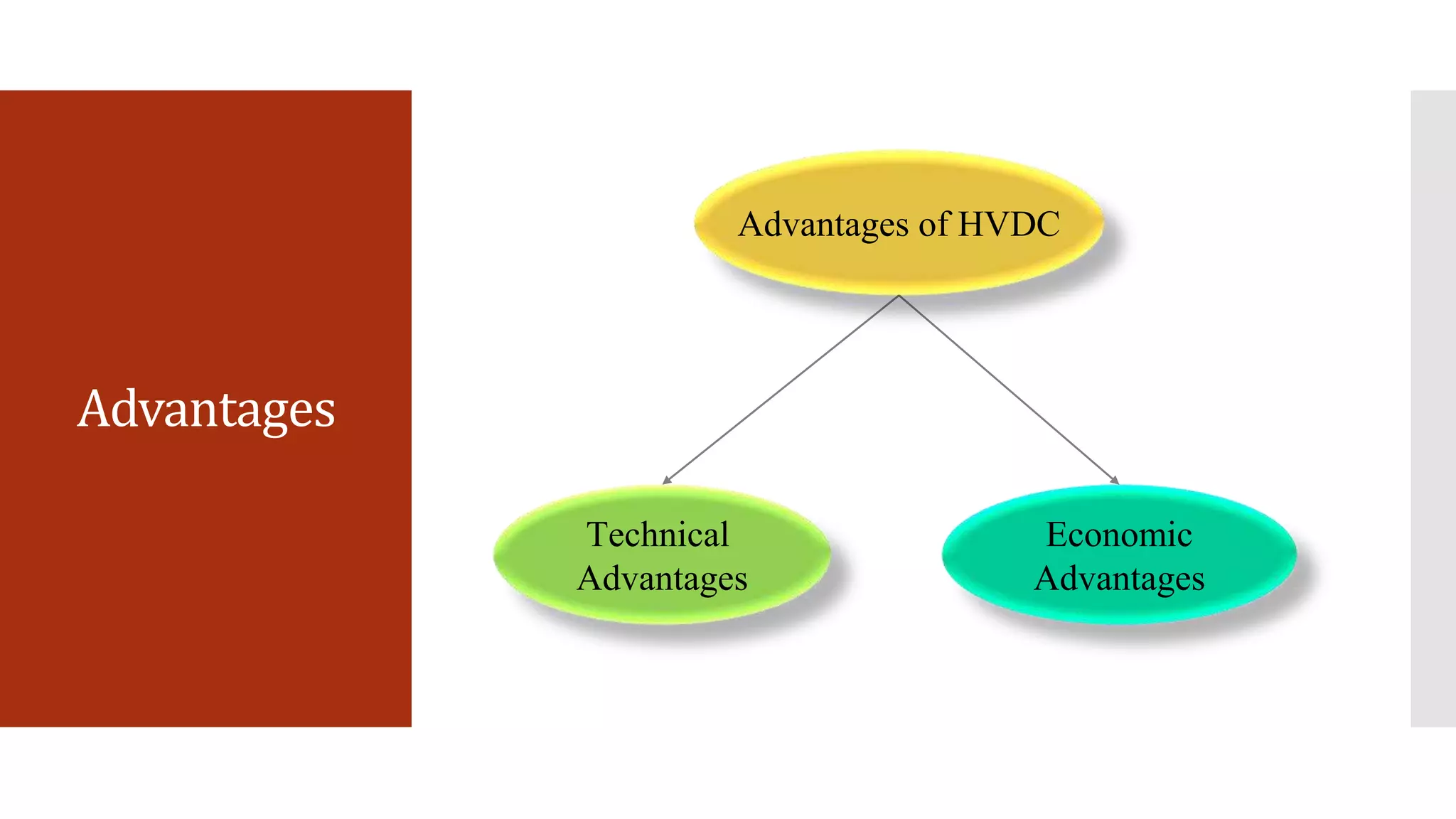
Advantages of HVDC
Technical
Advantages
Economic
Advantages
Technical
Advantages
 Smaller Tower Size
 Use of Ground Return Possible
 No Skin Effect
 Stable System
 Less Corona & Radio Interference
 Asynchronous Interconnection Possible
 Lower Short Circuit fault levels
 Power can be easily controlled
Economic
Advantages
 DC lines and cables are cheaper than AC lines or cables.
 The towers of the DC lines are narrower, simpler and
cheaper compared to the towers of the AC lines.
 Line losses in a DC line are lower than the losses in an
AC lines.
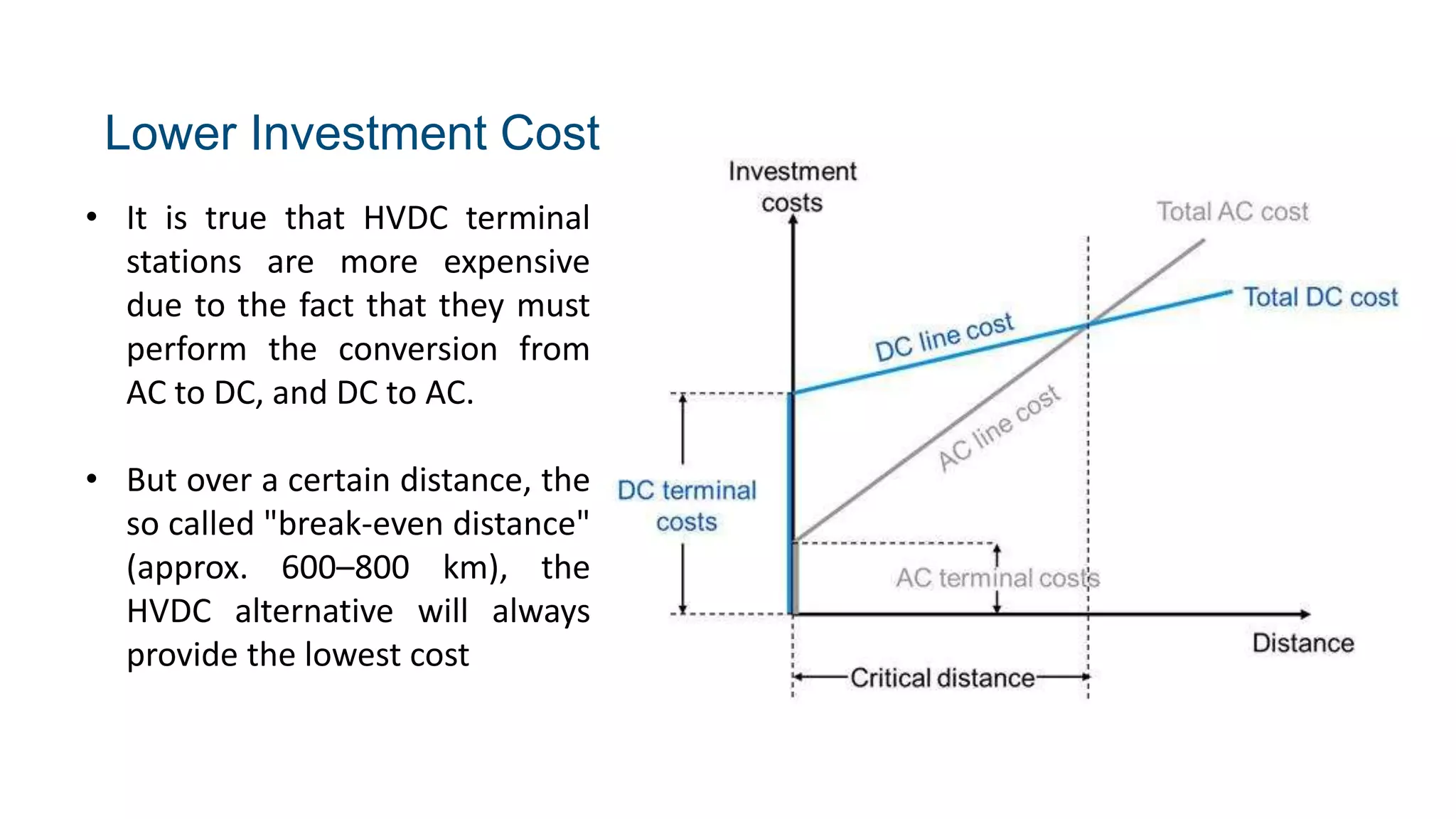
Lower Investment Cost
• It is true that HVDC terminal
stations are more expensive
due to the fact that they must
perform the conversion from
AC to DC, and DC to AC.
• But over a certain distance, the
so called "break-even distance"
(approx. 600–800 km), the
HVDC alternative will always
provide the lowest cost
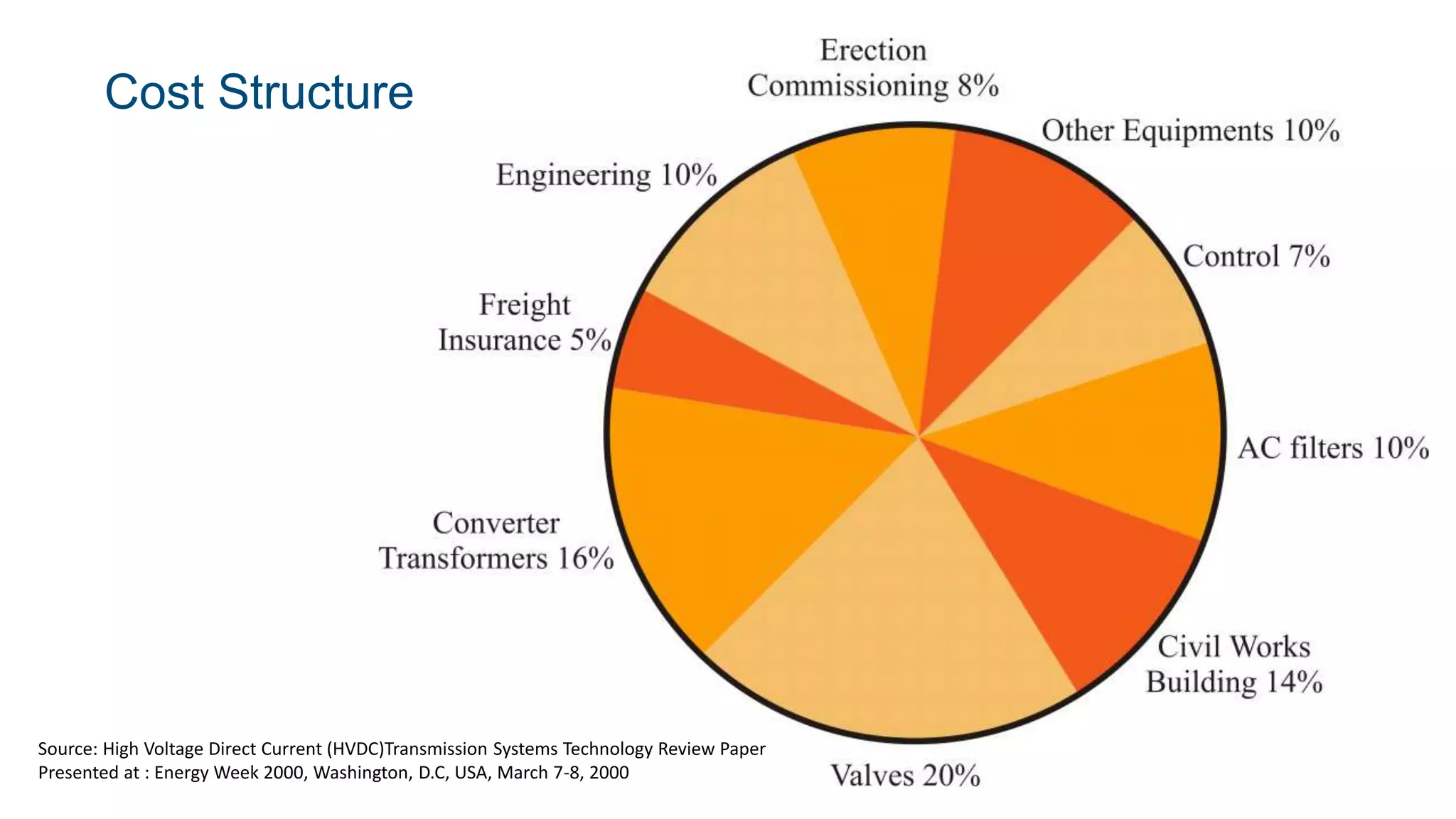
Cost Structure
Source: High Voltage Direct Current (HVDC)Transmission Systems Technology Review Paper
Presented at : Energy Week 2000, Washington, D.C, USA, March 7-8, 2000
How does it
work ?
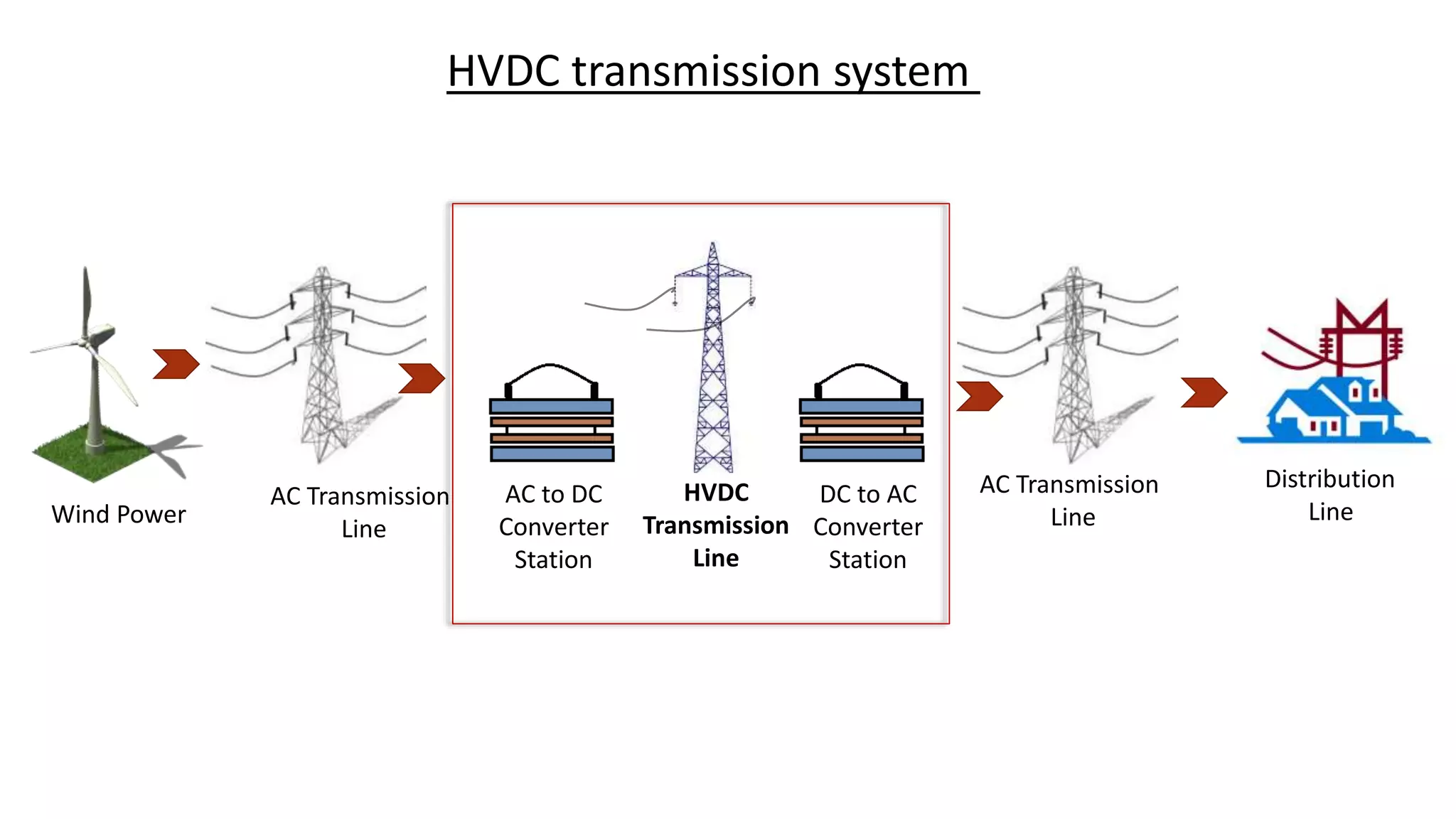
 HVDC transmission utilizes a converter station at either
end of the system.
 A mercury arc valve or solid state valve (Thyristor) is
used for the conversion of AC and DC current.
 The valve at the beginning of the system converts
alternating current to HVDC, the HVDC travels to the
next location through a cable.
 The valve at the end of the system converts the HVDC
back to alternating current.
Wind Power
AC Transmission
Line
AC to DC
Converter
Station
HVDC
Transmission
Line
DC to AC
Converter
Station
AC Transmission
Line
Distribution
Line
HVDC transmission system
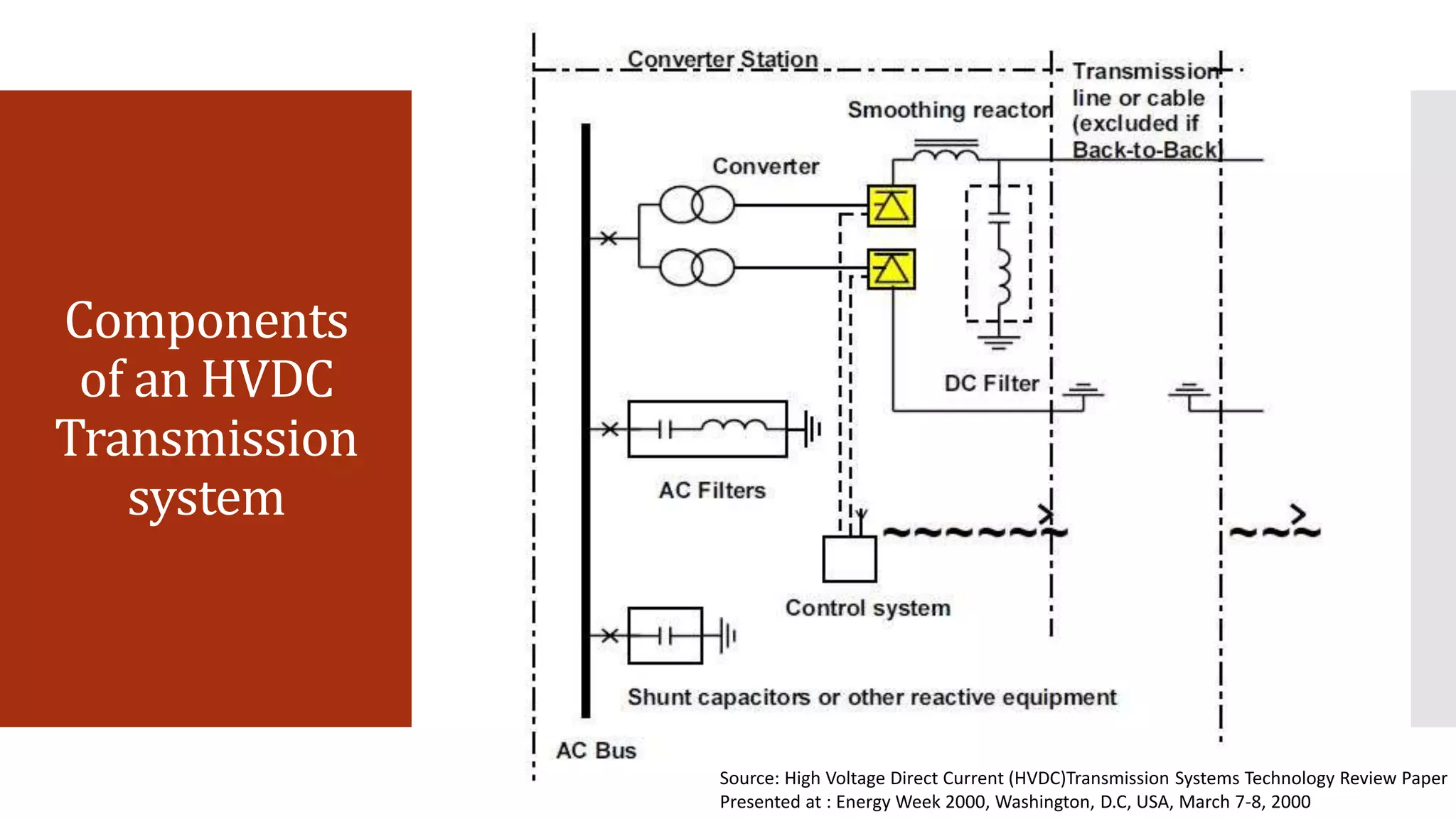
Components
of an HVDC
Transmission
system
Source: High Voltage Direct Current (HVDC)Transmission Systems Technology Review Paper
Presented at : Energy Week 2000, Washington, D.C, USA, March 7-8, 2000
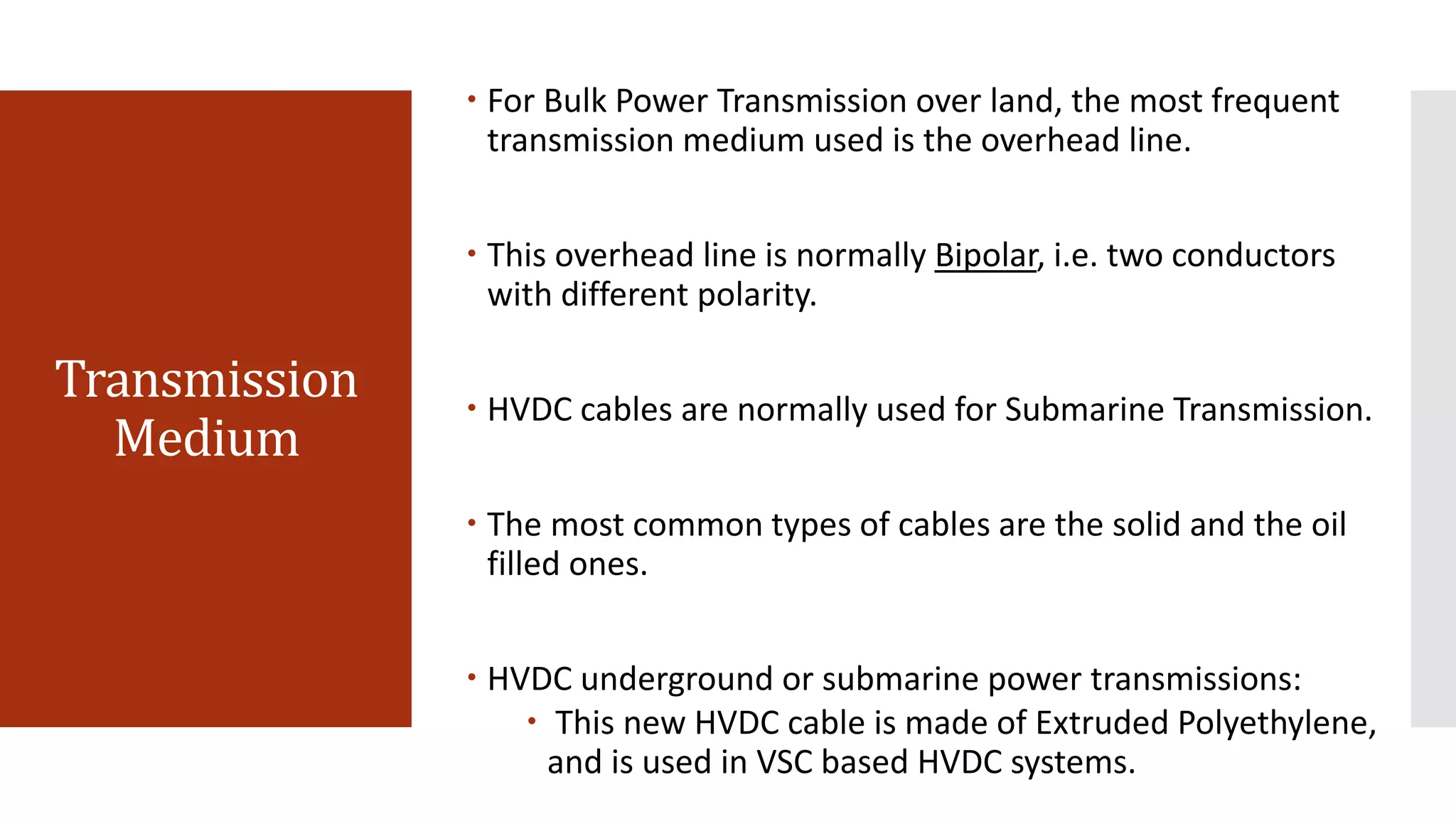
Transmission
Medium
 For Bulk Power Transmission over land, the most frequent
transmission medium used is the overhead line.
 This overhead line is normally Bipolar, i.e. two conductors
with different polarity.
 HVDC cables are normally used for Submarine Transmission.
 The most common types of cables are the solid and the oil
filled ones.
 HVDC underground or submarine power transmissions:
 This new HVDC cable is made of Extruded Polyethylene,
and is used in VSC based HVDC systems.
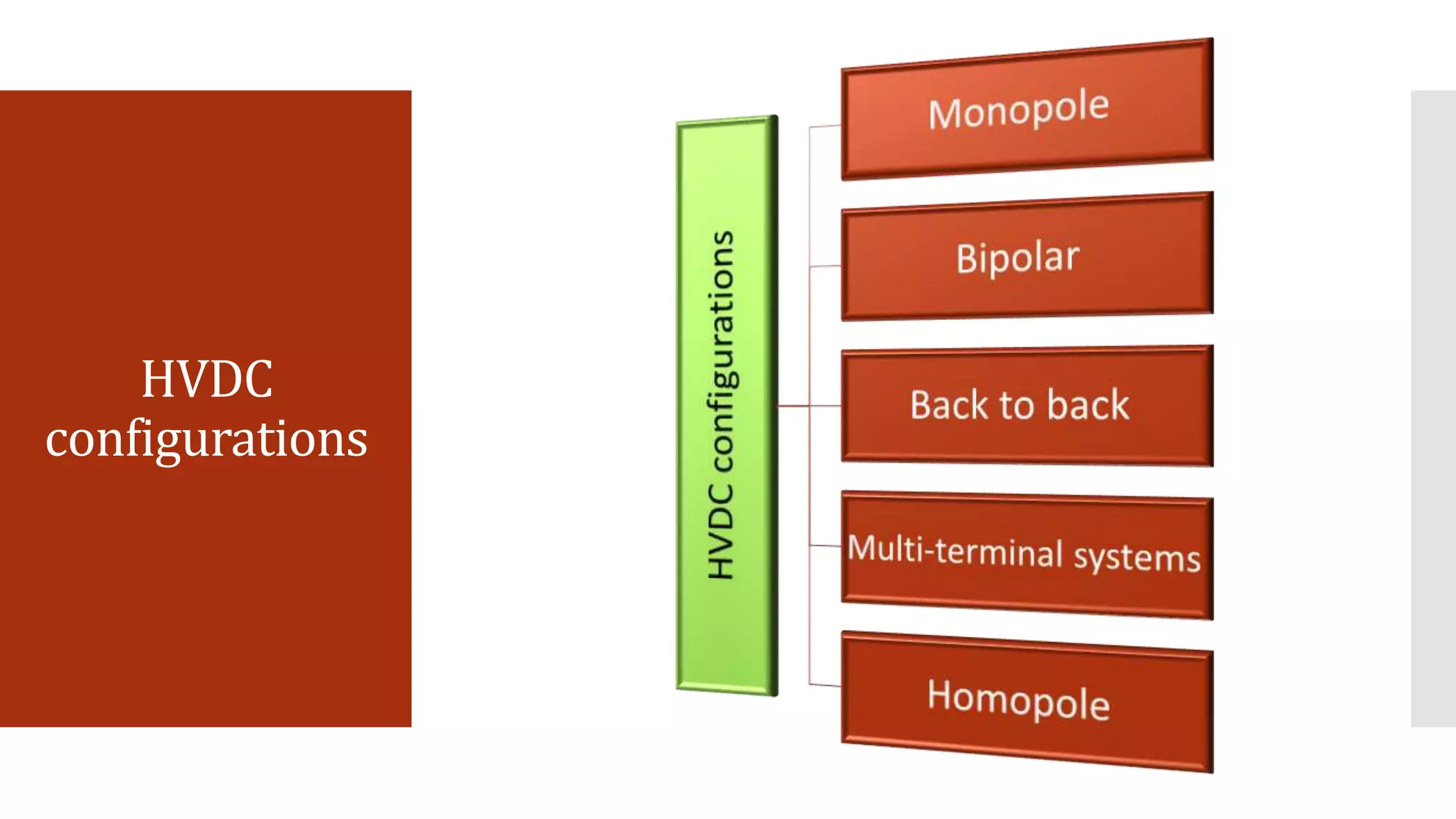
HVDC
configurations
Monopolar
Link
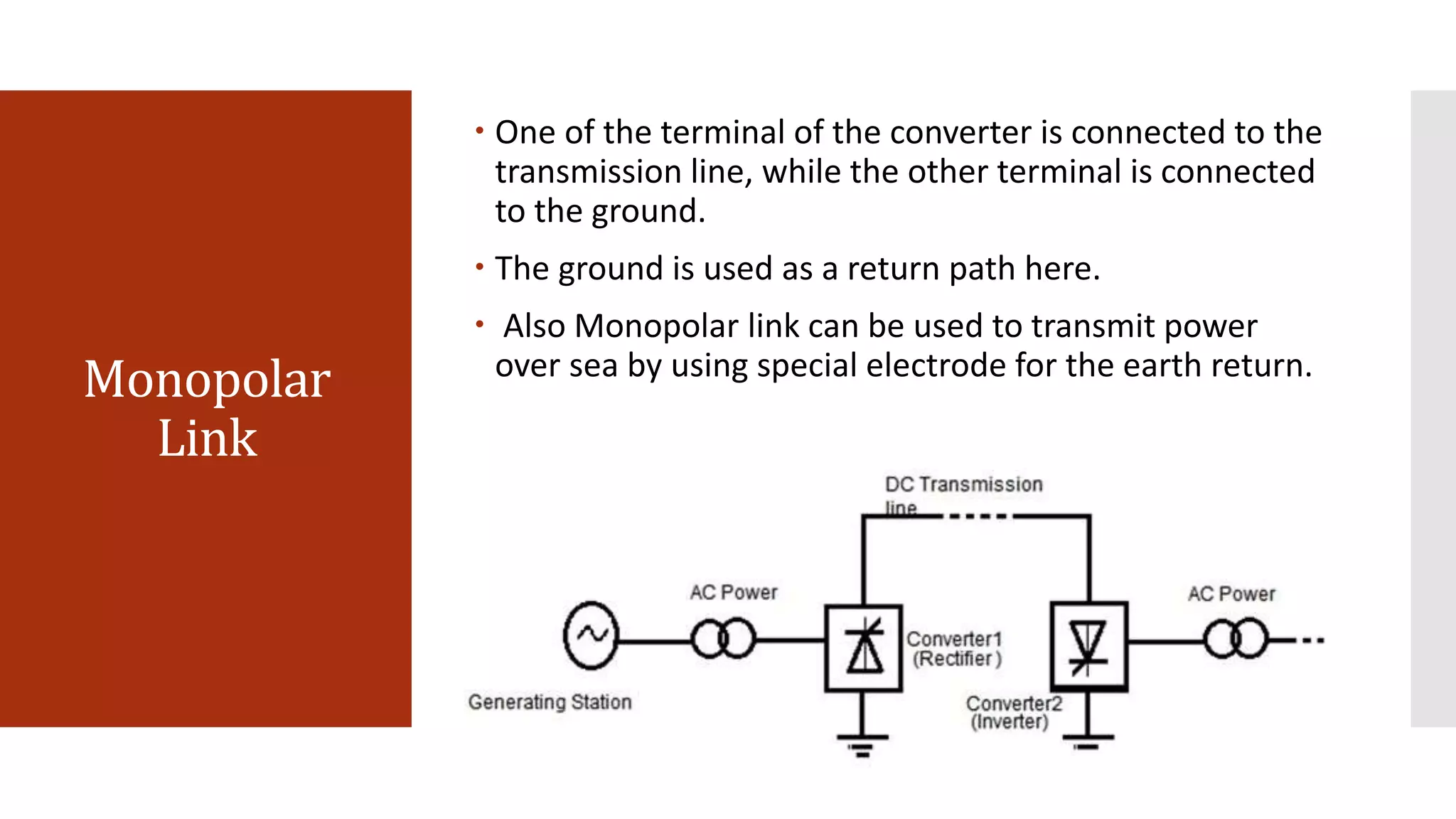
 One of the terminal of the converter is connected to the
transmission line, while the other terminal is connected
to the ground.
 The ground is used as a return path here.
 Also Monopolar link can be used to transmit power
over sea by using special electrode for the earth return.
Bipolar Link
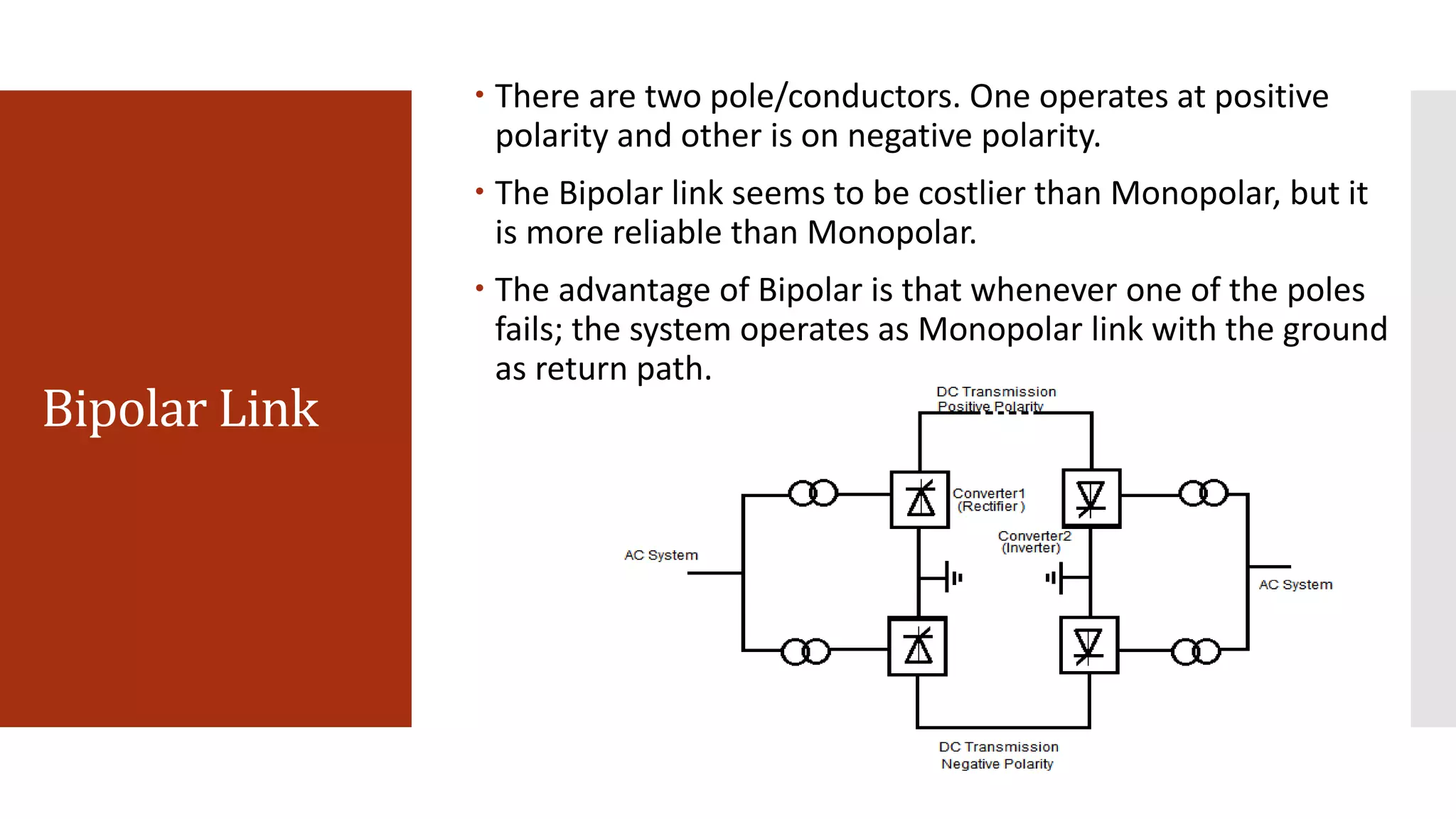
 There are two pole/conductors. One operates at positive
polarity and other is on negative polarity.
 The Bipolar link seems to be costlier than Monopolar, but it
is more reliable than Monopolar.
 The advantage of Bipolar is that whenever one of the poles
fails; the system operates as Monopolar link with the ground
as return path.
Multi terminal
Link
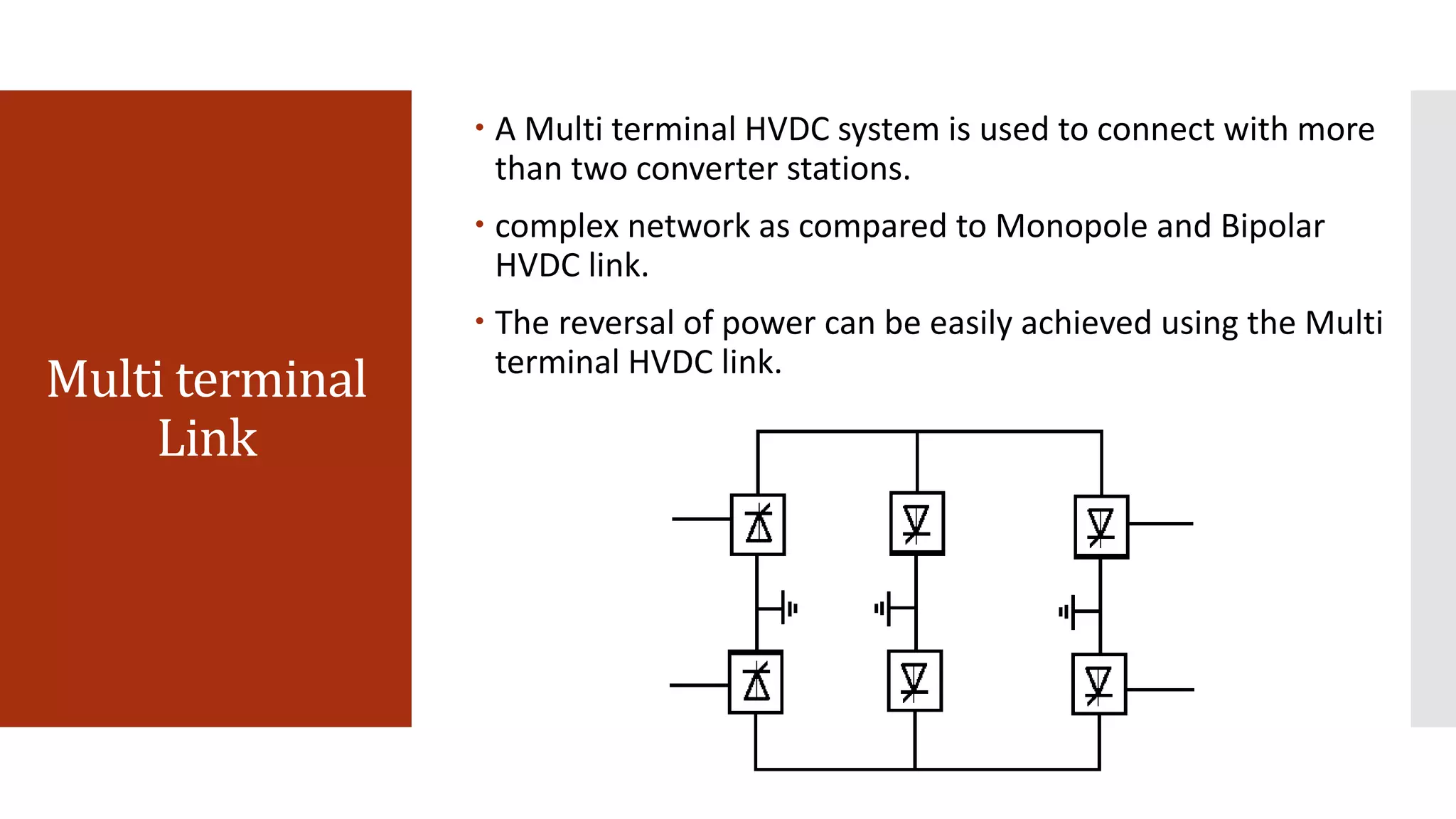
 A Multi terminal HVDC system is used to connect with more
than two converter stations.
 complex network as compared to Monopole and Bipolar
HVDC link.
 The reversal of power can be easily achieved using the Multi
terminal HVDC link.
Back to Back
(B2B)
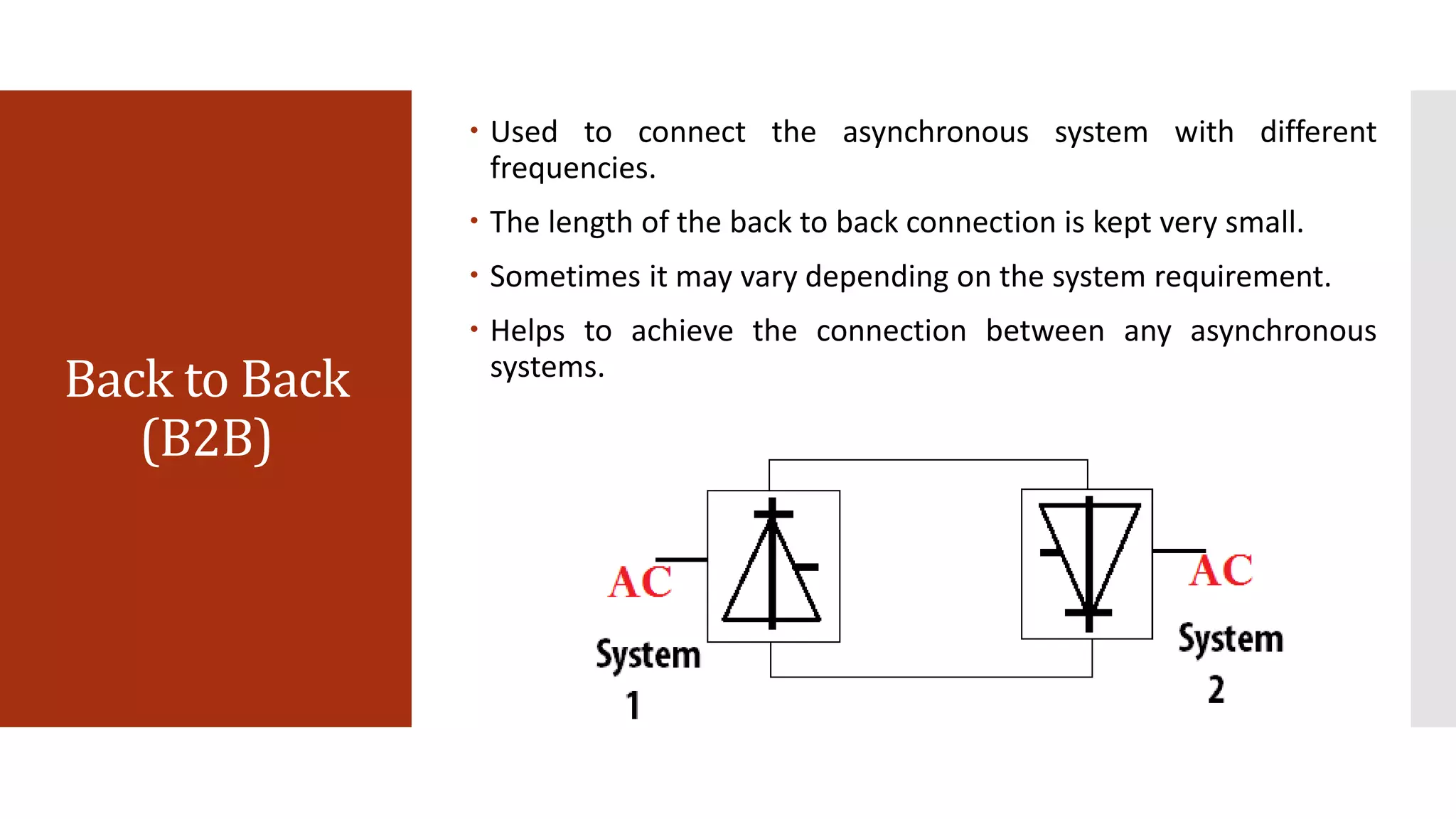
 Used to connect the asynchronous system with different
frequencies.
 The length of the back to back connection is kept very small.
 Sometimes it may vary depending on the system requirement.
 Helps to achieve the connection between any asynchronous
systems.
Converter
Station
Equipment
 Thyristor valves
 Converter Transformer
 DC Reactor
 Harmonics Filtering Equipment
 Control Equipment
 Reactive power compensation
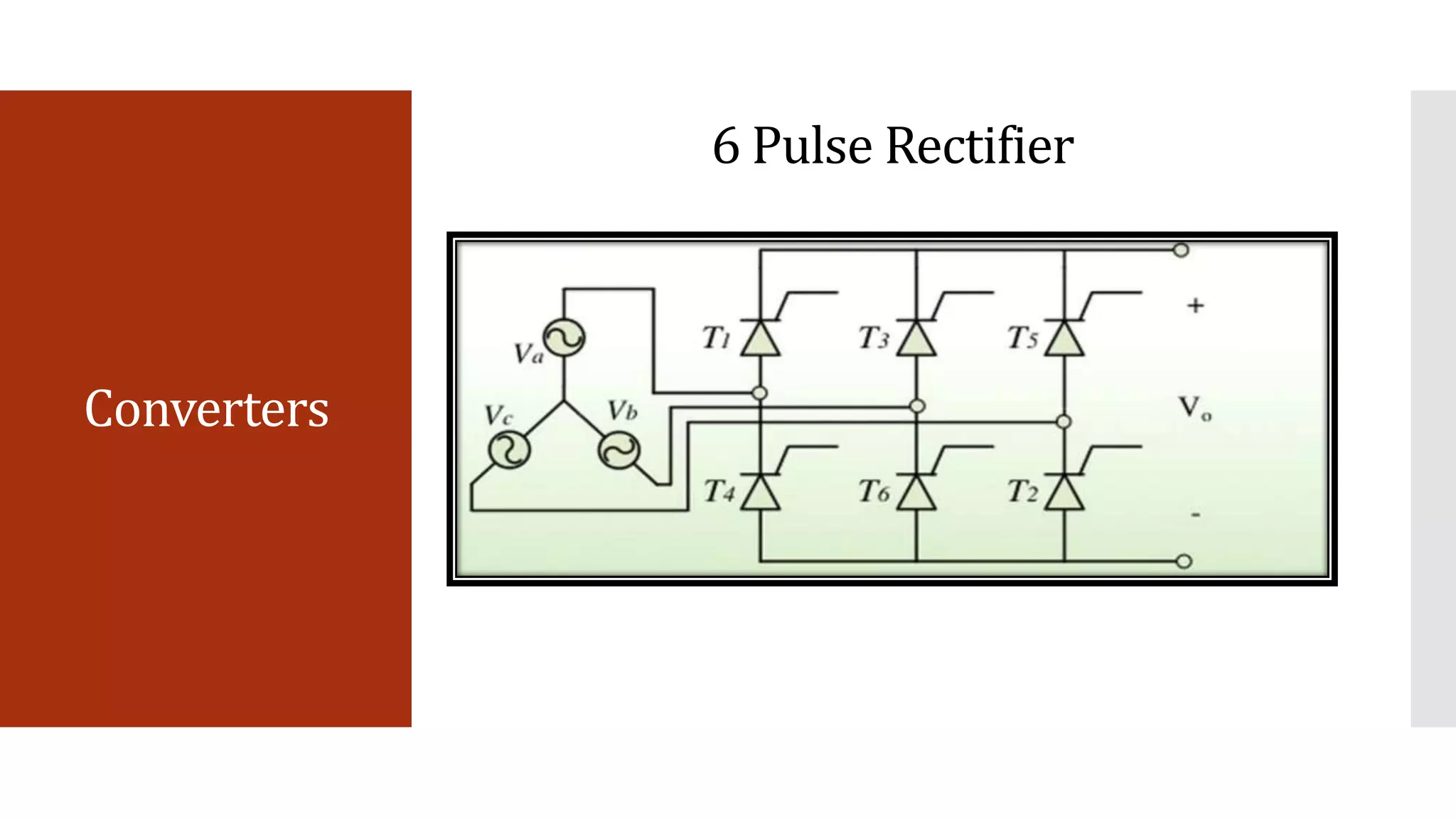
Converters
6 Pulse Rectifier
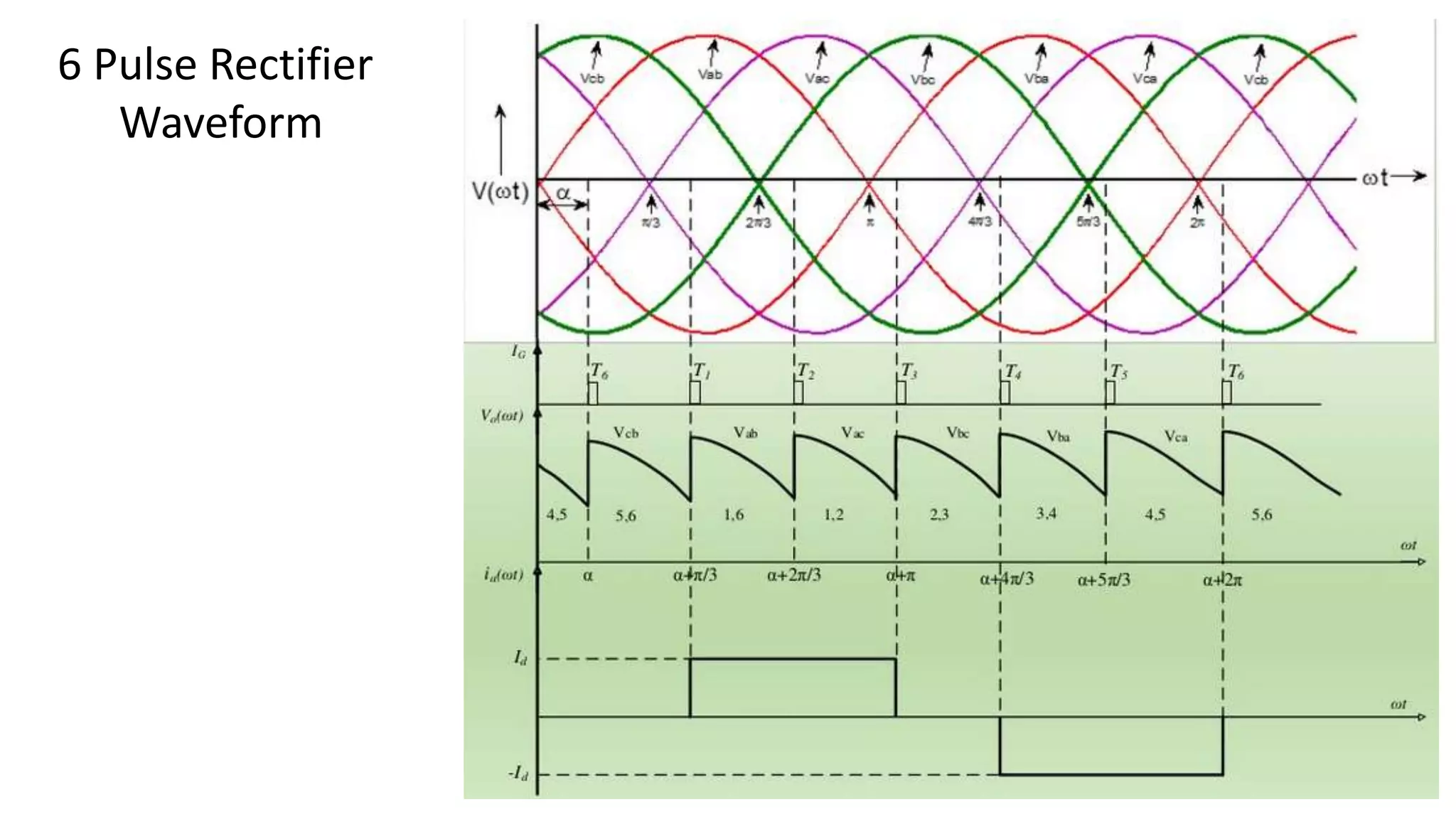
6 Pulse Rectifier
Waveform
6 Pulse Rectifier Working
6 Pulse Inverter Operation
Ground
Return
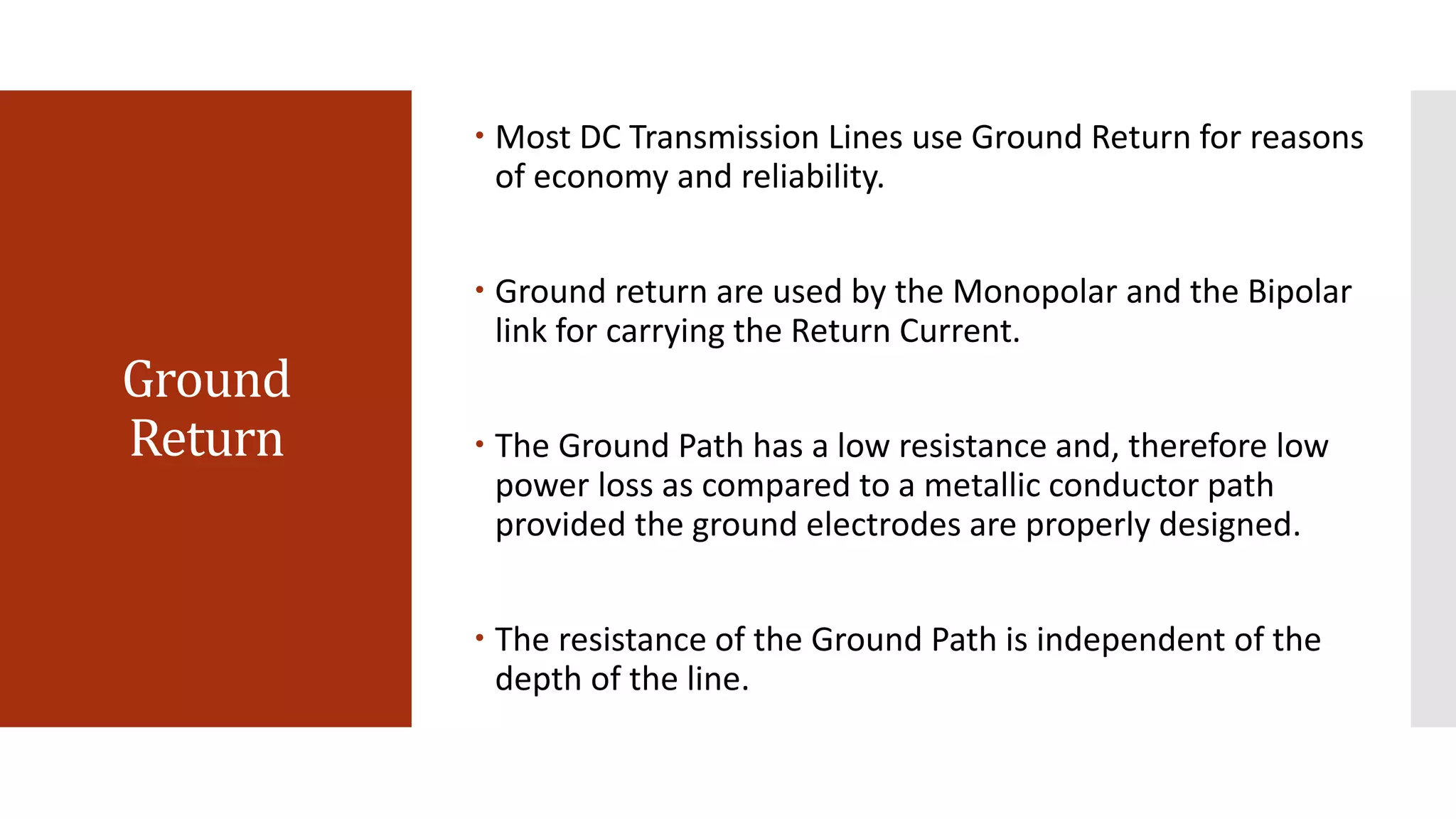
 Most DC Transmission Lines use Ground Return for reasons
of economy and reliability.
 Ground return are used by the Monopolar and the Bipolar
link for carrying the Return Current.
 The Ground Path has a low resistance and, therefore low
power loss as compared to a metallic conductor path
provided the ground electrodes are properly designed.
 The resistance of the Ground Path is independent of the
depth of the line.
Earth
Electrode
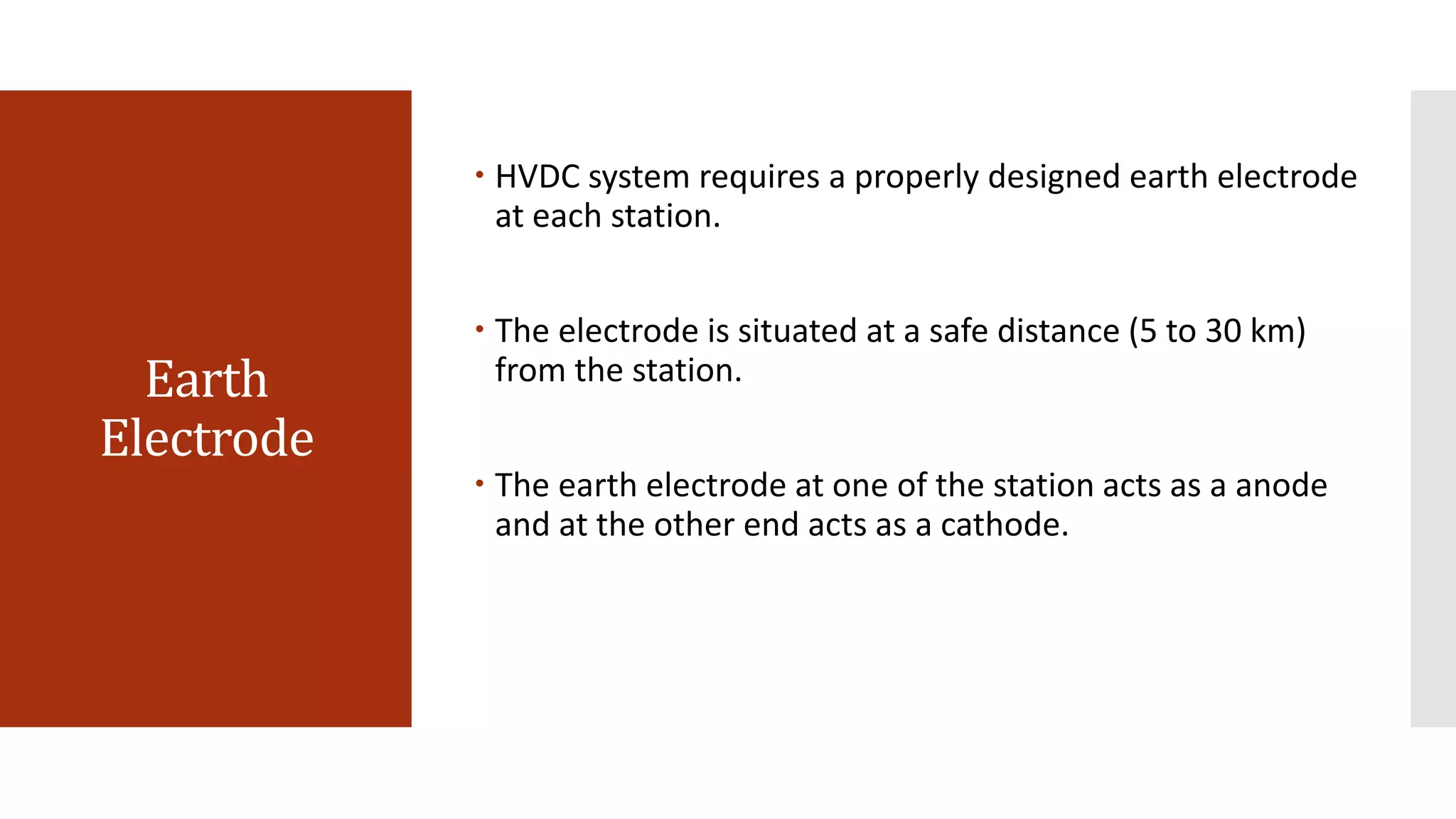
 HVDC system requires a properly designed earth electrode
at each station.
 The electrode is situated at a safe distance (5 to 30 km)
from the station.
 The earth electrode at one of the station acts as a anode
and at the other end acts as a cathode.
HVDC Links
HVDC Links are installed world wide some of the examples are as follows:
In World
S.No. Name Location Total Length (Km) Volt (KV) Power (MW) Type
1 Rio Madeira Rio Madeira
Transmission Link,
Brazil
2385 ±600 7100 Thyristor
2 Jinping-Sunan Jinping-Sunan
Transmission Link,
China
2090 800 (UHVDC) 7200 Thyristor
3. Inga-Kolwezi Inga-Kolwezi
Transmission Link,
Congo
1700 500 560 Thyristor
4. Talcher-Kolar Talcher-Kolar
Transmission Link,
India
1450 500 2500 Thyristor
5. Nor Ned Feda (Norway)-
Eemshaven(Netherl
ands) Submarine
Power Cable
580(Submarine) ±450 700 Thyristor
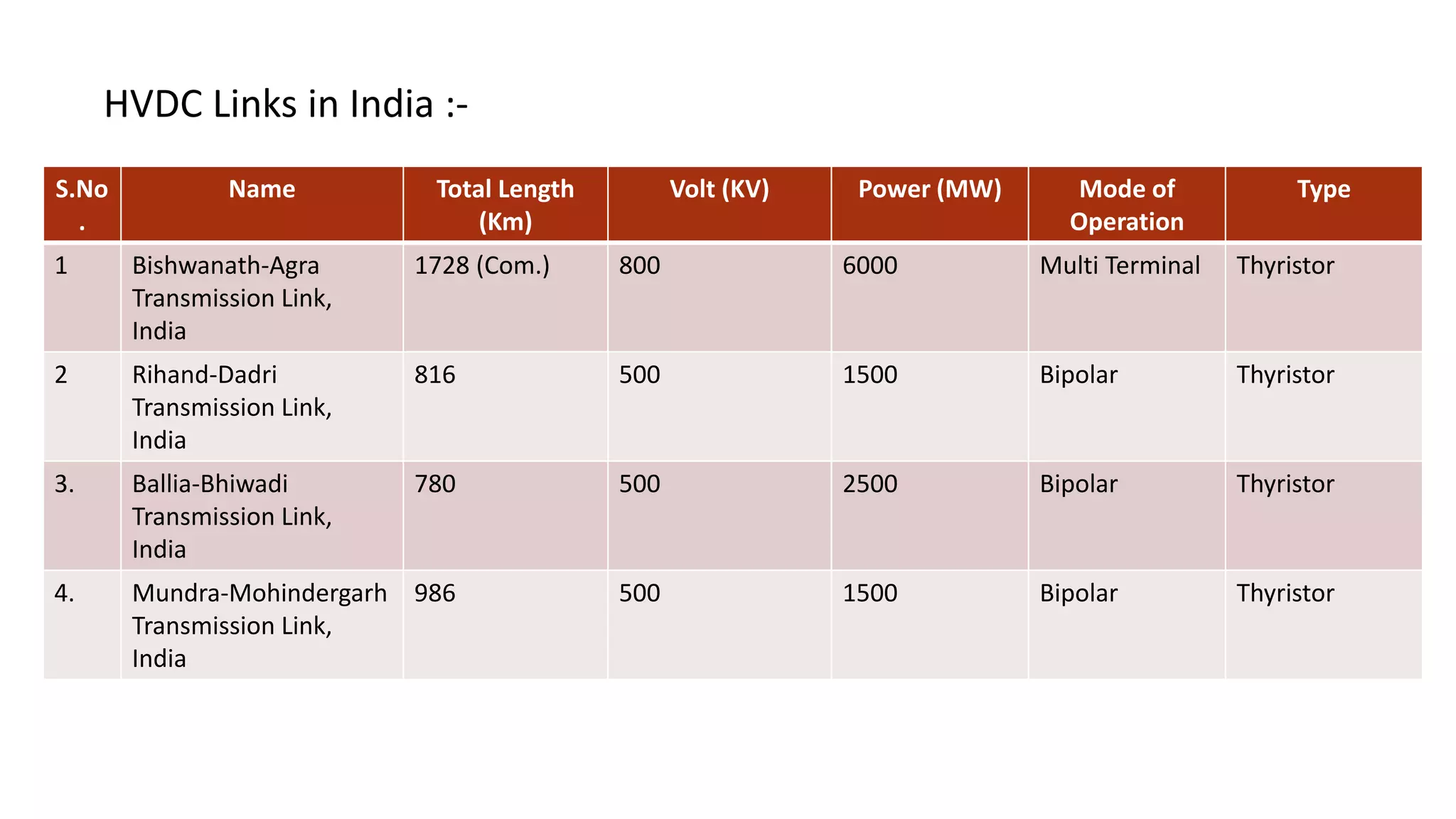
HVDC Links in India :-
S.No
.
Name Total Length
(Km)
Volt (KV) Power (MW) Mode of
Operation
Type
1 Bishwanath-Agra
Transmission Link,
India
1728 (Com.) 800 6000 Multi Terminal Thyristor
2 Rihand-Dadri
Transmission Link,
India
816 500 1500 Bipolar Thyristor
3. Ballia-Bhiwadi
Transmission Link,
India
780 500 2500 Bipolar Thyristor
4. Mundra-Mohindergarh
Transmission Link,
India
986 500 1500 Bipolar Thyristor
Disadvantages
 The disadvantages of HVDC are in conversion, switching, control,
availability and maintenance.
 HVDC is less reliable and has lower availability than alternating current
(AC) systems, mainly due to the extra conversion equipment.
 The required converter stations are expensive and have limited overload
capacity.
 At smaller transmission distances, the losses in the converter stations may
be bigger than in an AC transmission line for the same distance.
 Operating a HVDC scheme requires many spare parts to be kept, often
exclusively for one system, as HVDC systems are less standardized than AC
systems and technology changes faster.
HVDC Plus
Technology
 Also known as IGBT Technology
 It’s Self Commutated Technology
 No Harmonic Filters
 Conventional AC Transformers
 Compact Footprint
 Independent Active/Reactive Power Control
 Output Waveform is Very Close to Sine wave due to
Multi Level Switching
HVDC Plus Technology
Conclusion
HVDC offers Powerful Alternative to increase
stability of a power system as well as to improve
system operating flexibility and loss reduction.
Removes the Synchronization Problem.
High Voltage Direct Current Transmission System

High Voltage Direct Current Transmission System

  • 1.
  • 2.
    HVDC Transmission Seminar On SubmittedTo:- Prof. Anshul Bhati Prof. Vikram Singh Rajpurohit Submitted By:- Nadeem Khilji 11EVEEX032 8th Sem. EX
  • 3.
  • 4.
    Agenda  HVDC-Introduction  Challengeswith AC Power Lines  Solution HVDC Technology  Advantages  Working  Components  HVDC Configurations  Ground Return  Earth Electrode  HVDC Plus
  • 5.
    HVDC- Introduction  A HighVoltage Direct Current (HVDC) electric power transmission system uses direct current for the bulk transmission of electrical power, in contrast with the more common alternating current (AC) systems.  HVDC allows power transmission between unsynchronized AC transmission systems.  HVDC also allows transfer of power between grid systems running at different frequencies, such as 50 Hz and 60 Hz.  Compared to alternating current, the direct current system is less expensive and loses less energy.
  • 6.
    Challenges with AC Power Lines Reduced Power quality causes the risk of declining network stability.  Corona Loss & Radio Interference.  High Short Circuit Currents  Line Support  More Insulation Requirement  Erection Difficulties
  • 7.
    Solution: HVDC Technology  It providesimproved Power quality and Power flow control as well.  More Power can be Transmitted per Conductor  Introducing extruded DC-cables which have no technical limit to distance which can be installed.  It can provide an alternative to overhead lines particularly when the total capital and environmental costs are considered.
  • 8.
  • 9.
    Technical Advantages  Smaller TowerSize  Use of Ground Return Possible  No Skin Effect  Stable System  Less Corona & Radio Interference  Asynchronous Interconnection Possible  Lower Short Circuit fault levels  Power can be easily controlled
  • 10.
    Economic Advantages  DC linesand cables are cheaper than AC lines or cables.  The towers of the DC lines are narrower, simpler and cheaper compared to the towers of the AC lines.  Line losses in a DC line are lower than the losses in an AC lines.
  • 11.
    Lower Investment Cost •It is true that HVDC terminal stations are more expensive due to the fact that they must perform the conversion from AC to DC, and DC to AC. • But over a certain distance, the so called "break-even distance" (approx. 600–800 km), the HVDC alternative will always provide the lowest cost
  • 12.
    Cost Structure Source: HighVoltage Direct Current (HVDC)Transmission Systems Technology Review Paper Presented at : Energy Week 2000, Washington, D.C, USA, March 7-8, 2000
  • 13.
    How does it work?  HVDC transmission utilizes a converter station at either end of the system.  A mercury arc valve or solid state valve (Thyristor) is used for the conversion of AC and DC current.  The valve at the beginning of the system converts alternating current to HVDC, the HVDC travels to the next location through a cable.  The valve at the end of the system converts the HVDC back to alternating current.
  • 14.
    Wind Power AC Transmission Line ACto DC Converter Station HVDC Transmission Line DC to AC Converter Station AC Transmission Line Distribution Line HVDC transmission system
  • 15.
    Components of an HVDC Transmission system Source:High Voltage Direct Current (HVDC)Transmission Systems Technology Review Paper Presented at : Energy Week 2000, Washington, D.C, USA, March 7-8, 2000
  • 16.
    Transmission Medium  For BulkPower Transmission over land, the most frequent transmission medium used is the overhead line.  This overhead line is normally Bipolar, i.e. two conductors with different polarity.  HVDC cables are normally used for Submarine Transmission.  The most common types of cables are the solid and the oil filled ones.  HVDC underground or submarine power transmissions:  This new HVDC cable is made of Extruded Polyethylene, and is used in VSC based HVDC systems.
  • 17.
  • 18.
    Monopolar Link  One ofthe terminal of the converter is connected to the transmission line, while the other terminal is connected to the ground.  The ground is used as a return path here.  Also Monopolar link can be used to transmit power over sea by using special electrode for the earth return.
  • 19.
    Bipolar Link  Thereare two pole/conductors. One operates at positive polarity and other is on negative polarity.  The Bipolar link seems to be costlier than Monopolar, but it is more reliable than Monopolar.  The advantage of Bipolar is that whenever one of the poles fails; the system operates as Monopolar link with the ground as return path.
  • 20.
    Multi terminal Link  AMulti terminal HVDC system is used to connect with more than two converter stations.  complex network as compared to Monopole and Bipolar HVDC link.  The reversal of power can be easily achieved using the Multi terminal HVDC link.
  • 21.
    Back to Back (B2B) Used to connect the asynchronous system with different frequencies.  The length of the back to back connection is kept very small.  Sometimes it may vary depending on the system requirement.  Helps to achieve the connection between any asynchronous systems.

  • 22.
    Converter Station Equipment  Thyristor valves Converter Transformer  DC Reactor  Harmonics Filtering Equipment  Control Equipment  Reactive power compensation
  • 23.
  • 24.
  • 25.
  • 26.
  • 27.
    Ground Return  Most DCTransmission Lines use Ground Return for reasons of economy and reliability.  Ground return are used by the Monopolar and the Bipolar link for carrying the Return Current.  The Ground Path has a low resistance and, therefore low power loss as compared to a metallic conductor path provided the ground electrodes are properly designed.  The resistance of the Ground Path is independent of the depth of the line.
  • 28.
    Earth Electrode  HVDC systemrequires a properly designed earth electrode at each station.  The electrode is situated at a safe distance (5 to 30 km) from the station.  The earth electrode at one of the station acts as a anode and at the other end acts as a cathode.
  • 29.
    HVDC Links HVDC Linksare installed world wide some of the examples are as follows: In World S.No. Name Location Total Length (Km) Volt (KV) Power (MW) Type 1 Rio Madeira Rio Madeira Transmission Link, Brazil 2385 ±600 7100 Thyristor 2 Jinping-Sunan Jinping-Sunan Transmission Link, China 2090 800 (UHVDC) 7200 Thyristor 3. Inga-Kolwezi Inga-Kolwezi Transmission Link, Congo 1700 500 560 Thyristor 4. Talcher-Kolar Talcher-Kolar Transmission Link, India 1450 500 2500 Thyristor 5. Nor Ned Feda (Norway)- Eemshaven(Netherl ands) Submarine Power Cable 580(Submarine) ±450 700 Thyristor
  • 30.
    HVDC Links inIndia :- S.No . Name Total Length (Km) Volt (KV) Power (MW) Mode of Operation Type 1 Bishwanath-Agra Transmission Link, India 1728 (Com.) 800 6000 Multi Terminal Thyristor 2 Rihand-Dadri Transmission Link, India 816 500 1500 Bipolar Thyristor 3. Ballia-Bhiwadi Transmission Link, India 780 500 2500 Bipolar Thyristor 4. Mundra-Mohindergarh Transmission Link, India 986 500 1500 Bipolar Thyristor
  • 31.
    Disadvantages  The disadvantagesof HVDC are in conversion, switching, control, availability and maintenance.  HVDC is less reliable and has lower availability than alternating current (AC) systems, mainly due to the extra conversion equipment.  The required converter stations are expensive and have limited overload capacity.  At smaller transmission distances, the losses in the converter stations may be bigger than in an AC transmission line for the same distance.  Operating a HVDC scheme requires many spare parts to be kept, often exclusively for one system, as HVDC systems are less standardized than AC systems and technology changes faster.
  • 32.
    HVDC Plus Technology  Alsoknown as IGBT Technology  It’s Self Commutated Technology  No Harmonic Filters  Conventional AC Transformers  Compact Footprint  Independent Active/Reactive Power Control  Output Waveform is Very Close to Sine wave due to Multi Level Switching
  • 33.
  • 34.
    Conclusion HVDC offers PowerfulAlternative to increase stability of a power system as well as to improve system operating flexibility and loss reduction. Removes the Synchronization Problem.