Involve to Solve
Slide No. 1 Copyrights © 2005 TNB Research
UNDERSTANDING IEC 60599 : GUIDE
TO INTERPRETATION OF DISSOLVED
AND FREE GASES ANALYSIS
GOMATHY SETHURAMAN
TRANFORMER OIL
TESTING LABORATORY
29TH NOVEMBER 2007
Involve to Solve
Slide No. 2 Copyrights © 2005 TNB Research
IEC 60599 : INTERPRETATION OF DGA
PRESENTATION OUTLINE
 SCOPE OF IEC 60599
 TRANFORMER OIL
 CELLULOSE / PRESSBOARD SOLID INSULATION
 MECHANISM OF GAS FORMATION
 TYPE OF FAULTS vs TYPE OF GASES
 DGA INTERPRETATION TABLE
 CELLULOSE INSULATION DEGRADATION
 IEEE DGA CONCENTRATION LIMIT
 CASE STUDY
Gomathy Sethuraman TNBR
Involve to Solve
Slide No. 3 Copyrights © 2005 TNB Research
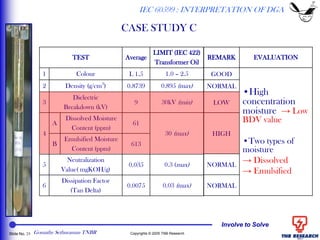
SCOPE OF IEC 50699
• Dissolved and free gas analysis (DGA) is one of the most widely used
diagnostic tools for detecting and evaluating faults in electrical equipment.
• This guide is applicable to electrical equipment filled with mineral
insulating oil and insulated with cellulose or pressboard-base solid
insulation.
• This guide facilitates the DGA interpretation describing how the
concentration of DGA or free gases may be interpreted to diagnose the
condition of the oil-filled electrical equipment in service and suggest future
action.
* Terms and conditions apply - In any case, the indication should be viewed only as a
guidance and any resulting action should be undertaken only with proper
engineering judgment.
IEC 60599 : INTERPRETATION OF DGA
Gomathy Sethuraman TNBR
Involve to Solve
Slide No. 4 Copyrights © 2005 TNB Research
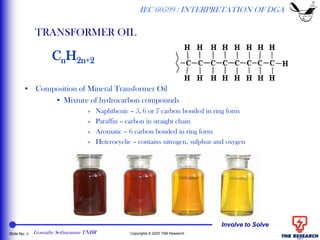
TRANSFORMER OIL
CnH2n+2
• Composition of Mineral Transformer Oil
• Mixture of hydrocarbon compounds
» Naphthenic – 5, 6 or 7 carbon bonded in ring form
» Paraffin – carbon in straight chain
» Aromatic – 6 carbon bonded in ring form
» Heterocyclic – contains nitrogen, sulphur and oxygen
IEC 60599 : INTERPRETATION OF DGA
Gomathy Sethuraman TNBR
Involve to Solve
Slide No. 5 Copyrights © 2005 TNB Research
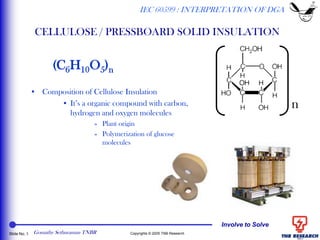
CELLULOSE / PRESSBOARD SOLID INSULATION
(C6H10O5)n
IEC 60599 : INTERPRETATION OF DGA
n
• Composition of Cellulose Insulation
• It’s a organic compound with carbon,
hydrogen and oxygen molecules
» Plant origin
» Polymerization of glucose
molecules
Gomathy Sethuraman TNBR
Involve to Solve
Slide No. 6 Copyrights © 2005 TNB Research
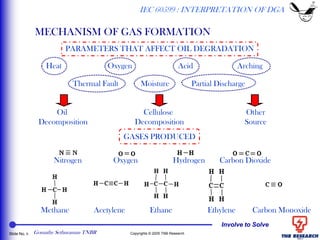
MECHANISM OF GAS FORMATION
IEC 60599 : INTERPRETATION OF DGA
Oil
Decomposition
Cellulose
Decomposition
Other
Source
Heat Oxygen
Partial DischargeThermal Fault
ArchingAcid
Moisture
PARAMETERS THAT AFFECT OIL DEGRADATION
GASES PRODUCED
Nitrogen Oxygen Hydrogen Carbon Dioxide
Methane Acetylene Ethane Ethylene Carbon Monoxide
Gomathy Sethuraman TNBR
Involve to Solve
Slide No. 7 Copyrights © 2005 TNB Research
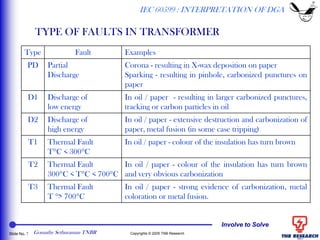
TYPE OF FAULTS IN TRANSFORMER
IEC 60599 : INTERPRETATION OF DGA
Type Fault Examples
PD Partial
Discharge
Corona - resulting in X-wax deposition on paper
Sparking - resulting in pinhole, carbonized punctures on
paper
D1 Discharge of
low energy
In oil / paper - resulting in larger carbonized punctures,
tracking or carbon particles in oil
D2 Discharge of
high energy
In oil / paper - extensive destruction and carbonization of
paper, metal fusion (in some case tripping)
T1 Thermal Fault
TC < 300C
In oil / paper - colour of the insulation has turn brown
T2 Thermal Fault
300C < TC < 700C
In oil / paper - colour of the insulation has turn brown
and very obvious carbonization
T3 Thermal Fault
T > 700C
In oil / paper - strong evidence of carbonization, metal
coloration or metal fusion.
Gomathy Sethuraman TNBR
Involve to Solve
Slide No. 8 Copyrights © 2005 TNB Research
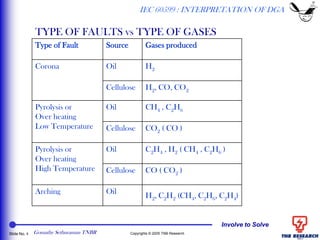
TYPE OF FAULTS vs TYPE OF GASES
IEC 60599 : INTERPRETATION OF DGA
Type of Fault Source Gases produced
Corona Oil H2
Cellulose H2, CO, CO2
Pyrolysis or
Over heating
Low Temperature
Oil CH4 , C2H6
Cellulose CO2 ( CO )
Pyrolysis or
Over heating
High Temperature
Oil C2H4 , H2 ( CH4 , C2H6 )
Cellulose CO ( CO2 )
Arching Oil
H2, C2H2 (CH4, C2H6, C2H4)
Gomathy Sethuraman TNBR
Involve to Solve
Slide No. 9 Copyrights © 2005 TNB Research
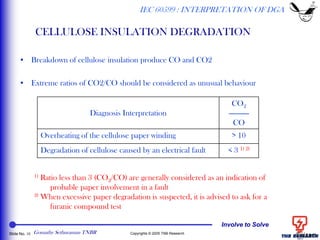
DGA INTERPRETATION TABLE
IEC 60599 : INTERPRETATION OF DGA
CASE Characteristic Fault
C2H2
----------
C2H4
CH4
----------
H2
C2H4
----------
C2H6
PD Partial Discharge NS 1) < 0.1 < 0.2
D1 Discharge of low energy > 1 0.1 - 0.5 > 1
D2 Discharge of high energy 0.6 – 2.5 0.1 - 1 > 2
T1 Thermal fault TC < 300 C NS > 1 but NS < 1
T2
Thermal fault 300C < TC <
700C
< 0.1 > 1 1 - 4
T3 Thermal fault T > 700C < 0.2 2) > 1 > 4
1) NS = Non – significant whatever the value
2) An increase value of the amount of C2H2 may indicate that the hot spot
temperature is higher than 1000 C
Gomathy Sethuraman TNBR
Involve to Solve
Slide No. 10 Copyrights © 2005 TNB Research
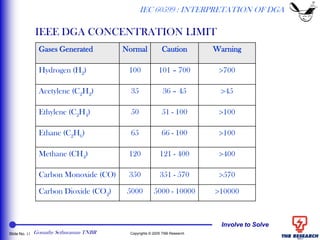
• Breakdown of cellulose insulation produce CO and CO2
• Extreme ratios of CO2/CO should be considered as unusual behaviour
©aizam
Diagnosis Interpretation
CO2
----------
CO
Overheating of the cellulose paper winding > 10
Degradation of cellulose caused by an electrical fault < 3 1) 2)
CELLULOSE INSULATION DEGRADATION
IEC 60599 : INTERPRETATION OF DGA
1) Ratio less than 3 (CO2/CO) are generally considered as an indication of
probable paper involvement in a fault
2) When excessive paper degradation is suspected, it is advised to ask for a
furanic compound test
Gomathy Sethuraman TNBR
Involve to Solve
Slide No. 11 Copyrights © 2005 TNB Research
IEEE DGA CONCENTRATION LIMIT
IEC 60599 : INTERPRETATION OF DGA
Gases Generated Normal Caution Warning
Hydrogen (H2) 100 101 – 700 700
Acetylene (C2H2) 35 36 – 45 45
Ethylene (C2H4) 50 51 - 100 100
Ethane (C2H6) 65 66 - 100 100
Methane (CH4) 120 121 - 400 400
Carbon Monoxide (CO) 350 351 - 570 570
Carbon Dioxide (CO2) 5000 5000 - 10000 10000
Gomathy Sethuraman TNBR
Involve to Solve
Slide No. 12 Copyrights © 2005 TNB Research
CSI OF TRANSFORMER OIL ?
Failure Investigation Project
1. TRANSFORMER OIL : CASE STUDY A
2. TRANSFORMER OIL : CASE STUDY B
3. TRANSFORMER OIL : CASE STUDY C
Executive Summary :
A number of failed instruments were brought to TNB Research
to be analyzed for the cause of failure.
The failed instruments were subjected to
• Electrical tests at the High Voltage Laboratory
• Oil test at the Transformer Oil Testing Laboratory
• Material and Visual test at the Advance Material Laboratory
IEC 60599 : INTERPRETATION OF DGA
Gomathy Sethuraman TNBR
Involve to Solve
Slide No. 13 Copyrights © 2005 TNB Research
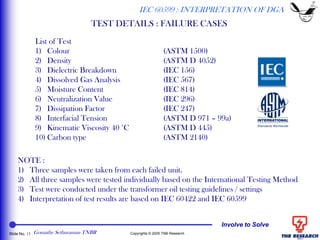
TEST DETAILS : FAILURE CASES
List of Test
1) Colour (ASTM 1500)
2) Density (ASTM D 4052)
3) Dielectric Breakdown (IEC 156)
4) Dissolved Gas Analysis (IEC 567)
5) Moisture Content (IEC 814)
6) Neutralization Value (IEC 296)
7) Dissipation Factor (IEC 247)
8) Interfacial Tension (ASTM D 971 – 99a)
9) Kinematic Viscosity 40 °C (ASTM D 445)
10) Carbon type (ASTM 2140)
NOTE :
1) Three samples were taken from each failed unit.
2) All three samples were tested individually based on the International Testing Method
3) Test were conducted under the transformer oil testing guidelines / settings
4) Interpretation of test results are based on IEC 60422 and IEC 60599
IEC 60599 : INTERPRETATION OF DGA
Gomathy Sethuraman TNBR
Involve to Solve
Slide No. 14 Copyrights © 2005 TNB Research
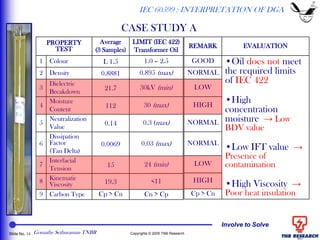
PROPERTY
TEST
Average
(3 Samples)
LIMIT (IEC 422)
Transformer Oil
1 Colour L 1.5 1.0 – 2.5
2 Density 0.8881 0.895 (max)
3
Dielectric
Breakdown
21.7 30kV (min)
4
Moisture
Content
112 30 (max)
5
Neutralization
Value
0.14 0.3 (max)
6
Dissipation
Factor
(Tan Delta)
0.0069 0.03 (max)
7
Interfacial
Tension
15 24 (min)
8 Kinematic
Viscosity 19.3 <11
9 Carbon Type Cp > Cn Cn > Cp
REMARK EVALUATION
GOOD •Oil does not meet
the required limits
of IEC 422
•High
concentration
moisture → Low
BDV value
•Low IFT value →
Presence of
contamination
•High Viscosity →
Poor heat insulation
NORMAL
LOW
HIGH
NORMAL
NORMAL
LOW
HIGH
Cp > Cn
CASE STUDY A
IEC 60599 : INTERPRETATION OF DGA
Gomathy Sethuraman TNBR
Involve to Solve
Slide No. 15 Copyrights © 2005 TNB Research
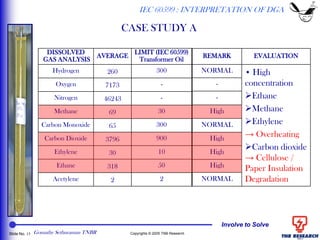
DISSOLVED
GAS ANALYSIS
AVERAGE
LIMIT (IEC 60599)
Transformer Oil
Hydrogen 260 300
Oxygen 7173 -
Nitrogen 46243 -
Methane 69 30
Carbon Monoxide 65 300
Carbon Dioxide 3796 900
Ethylene 30 10
Ethane 318 50
Acetylene 2 2
REMARK EVALUATION
NORMAL • High
concentration
Ethane
Methane
Ethylene
→ Overheating
Carbon dioxide
→ Cellulose /
Paper Insulation
Degradation
-
-
High
NORMAL
High
High
High
NORMAL
IEC 60599 : INTERPRETATION OF DGA
CASE STUDY A
Gomathy Sethuraman TNBR
Involve to Solve
Slide No. 16 Copyrights © 2005 TNB Research
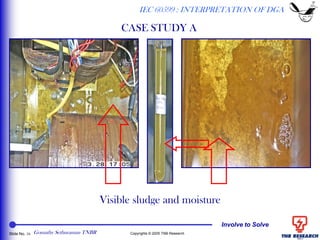
Visible sludge and moisture
IEC 60599 : INTERPRETATION OF DGA
CASE STUDY A
Gomathy Sethuraman TNBR
Involve to Solve
Slide No. 17 Copyrights © 2005 TNB Research
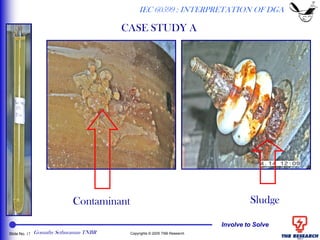
SludgeContaminant
IEC 60599 : INTERPRETATION OF DGA
CASE STUDY A
Gomathy Sethuraman TNBR
Involve to Solve
Slide No. 18 Copyrights © 2005 TNB Research
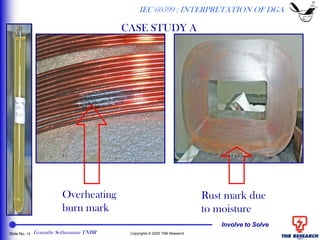
Overheating
burn mark
Rust mark due
to moisture
IEC 60599 : INTERPRETATION OF DGA
CASE STUDY A
Gomathy Sethuraman TNBR
Involve to Solve
Slide No. 19 Copyrights © 2005 TNB Research
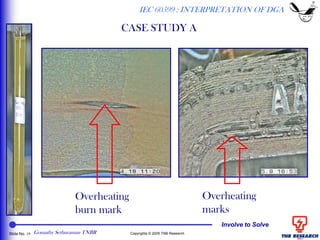
Overheating
burn mark
Overheating
marks
IEC 60599 : INTERPRETATION OF DGA
CASE STUDY A
Gomathy Sethuraman TNBR
Involve to Solve
Slide No. 20 Copyrights © 2005 TNB Research
TEST Average
LIMIT (IEC 422)
Transformer Oil
1 Colour L 1.5 1.0 – 2.5
2 Density (g/cm3
) 0.8722 0.895 (max)
3
Dielectric
Breakdown (kV)
9 30kV (min)
4
A
Dissolved Moisture
Content (ppm)
54
30 (max)
B
Emulsified Moisture
Content (ppm)
393
5
Neutralization
Value( mgKOH/g)
0.03 0.3 (max)
6
Dissipation Factor
(Tan Delta)
0.0081 0.03 (max)
REMARK EVALUATION
GOOD
•High
concentration of
moisture →
Low BDV value
NORMAL
LOW
HIGH
NORMAL
NORMAL
IEC 60599 : INTERPRETATION OF DGA
CASE STUDY B
Gomathy Sethuraman TNBR
Involve to Solve
Slide No. 21 Copyrights © 2005 TNB Research
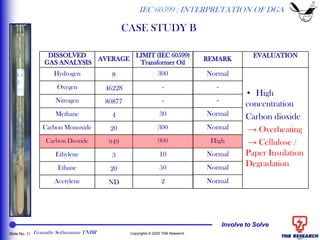
DISSOLVED
GAS ANALYSIS
AVERAGE
LIMIT (IEC 60599)
Transformer Oil
Hydrogen 8 300
Oxygen 46228 -
Nitrogen 80877 -
Methane 4 30
Carbon Monoxide 20 300
Carbon Dioxide 949 900
Ethylene 3 10
Ethane 20 50
Acetylene ND 2
REMARK
EVALUATION
Normal
• High
concentration
Carbon dioxide
→ Overheating
→ Cellulose /
Paper Insulation
Degradation
-
-
Normal
Normal
High
Normal
Normal
Normal
IEC 60599 : INTERPRETATION OF DGA
CASE STUDY B
Gomathy Sethuraman TNBR
Involve to Solve
Slide No. 22 Copyrights © 2005 TNB Research
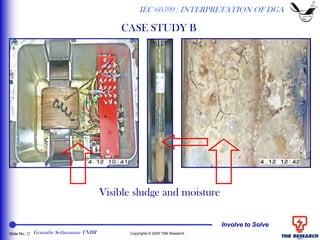
Visible sludge and moisture
IEC 60599 : INTERPRETATION OF DGA
CASE STUDY B
Gomathy Sethuraman TNBR
Involve to Solve
Slide No. 23 Copyrights © 2005 TNB Research
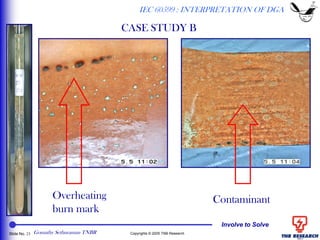
ContaminantOverheating
burn mark
IEC 60599 : INTERPRETATION OF DGA
CASE STUDY B
Gomathy Sethuraman TNBR
Involve to Solve
Slide No. 24 Copyrights © 2005 TNB Research
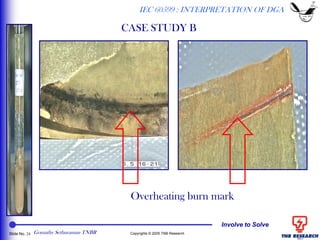
Overheating burn mark
IEC 60599 : INTERPRETATION OF DGA
CASE STUDY B
Gomathy Sethuraman TNBR
Involve to Solve
Slide No. 25 Copyrights © 2005 TNB Research
TEST Average
LIMIT (IEC 422)
Transformer Oil
1 Colour L 1.5 1.0 – 2.5
2 Density (g/cm3
) 0.8739 0.895 (max)
3
Dielectric
Breakdown (kV)
9 30kV (min)
4
A
Dissolved Moisture
Content (ppm)
61
30 (max)
B
Emulsified Moisture
Content (ppm)
613
5
Neutralization
Value( mgKOH/g)
0.035 0.3 (max)
6
Dissipation Factor
(Tan Delta)
0.0075 0.03 (max)
REMARK EVALUATION
GOOD
•High
concentration
moisture → Low
BDV value
•Two types of
moisture
→ Dissolved
→ Emulsified
NORMAL
LOW
HIGH
NORMAL
NORMAL
IEC 60599 : INTERPRETATION OF DGA
CASE STUDY C
Gomathy Sethuraman TNBR
Involve to Solve
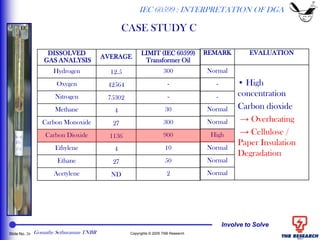
Slide No. 26 Copyrights © 2005 TNB Research
DISSOLVED
GAS ANALYSIS
AVERAGE
LIMIT (IEC 60599)
Transformer Oil
Hydrogen 12.5 300
Oxygen 42564 -
Nitrogen 75302 -
Methane 4 30
Carbon Monoxide 27 300
Carbon Dioxide 1136 900
Ethylene 4 10
Ethane 27 50
Acetylene ND 2
REMARK EVALUATION
Normal
• High
concentration
Carbon dioxide
→ Overheating
→ Cellulose /
Paper Insulation
Degradation
-
-
Normal
Normal
High
Normal
Normal
Normal
IEC 60599 : INTERPRETATION OF DGA
CASE STUDY C
Gomathy Sethuraman TNBR
Involve to Solve
Slide No. 27 Copyrights © 2005 TNB Research
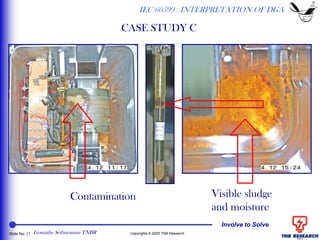
Visible sludge
and moisture
Contamination
IEC 60599 : INTERPRETATION OF DGA
CASE STUDY C
Gomathy Sethuraman TNBR
Involve to Solve
Slide No. 28 Copyrights © 2005 TNB Research
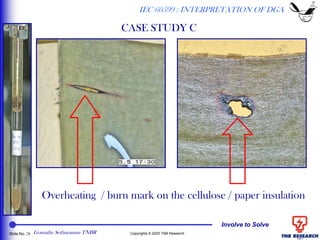
Overheating / burn mark on the cellulose / paper insulation
IEC 60599 : INTERPRETATION OF DGA
CASE STUDY C
Gomathy Sethuraman TNBR
Involve to Solve
Slide No. 29 Copyrights © 2005 TNB Research
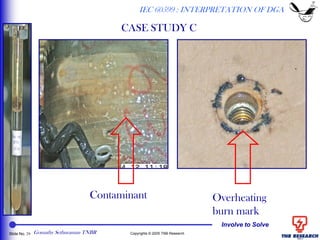
Contaminant Overheating
burn mark
IEC 60599 : INTERPRETATION OF DGA
CASE STUDY C
Gomathy Sethuraman TNBR
Involve to Solve
Slide No. 30 Copyrights © 2005 TNB Research
CONCLUSION
IEC 60599 : INTERPRETATION OF DGA
 Faults often start as incipient faults of low energy, which may develop
into more serious ones of higher energies, leading to possible gas alarms,
breakdowns and failures.
 When a fault is detected at any stage of development, it may be quite
informative to examine not only the increase in gas concentration, but also
the possible evolution with time towards a more dangerous high-energy
fault
 The RELIABILITY of a TRANSFORMER OIL depends on the BASIC
CHARACTER of the oil
BETTER THE OIL → BETTER THE PERFORMANCE
 The RELIABILITY of a TRANSFORMER very much depends on the
BASIC CONDITION MONITORING of the oil
BETTER THE MONITORING → BETTER THE RELIABILITY
Gomathy Sethuraman TNBR

Short Seminar

  • 1.
    Involve to Solve SlideNo. 1 Copyrights © 2005 TNB Research UNDERSTANDING IEC 60599 : GUIDE TO INTERPRETATION OF DISSOLVED AND FREE GASES ANALYSIS GOMATHY SETHURAMAN TRANFORMER OIL TESTING LABORATORY 29TH NOVEMBER 2007
  • 2.
    Involve to Solve SlideNo. 2 Copyrights © 2005 TNB Research IEC 60599 : INTERPRETATION OF DGA PRESENTATION OUTLINE  SCOPE OF IEC 60599  TRANFORMER OIL  CELLULOSE / PRESSBOARD SOLID INSULATION  MECHANISM OF GAS FORMATION  TYPE OF FAULTS vs TYPE OF GASES  DGA INTERPRETATION TABLE  CELLULOSE INSULATION DEGRADATION  IEEE DGA CONCENTRATION LIMIT  CASE STUDY Gomathy Sethuraman TNBR
  • 3.
    Involve to Solve SlideNo. 3 Copyrights © 2005 TNB Research SCOPE OF IEC 50699 • Dissolved and free gas analysis (DGA) is one of the most widely used diagnostic tools for detecting and evaluating faults in electrical equipment. • This guide is applicable to electrical equipment filled with mineral insulating oil and insulated with cellulose or pressboard-base solid insulation. • This guide facilitates the DGA interpretation describing how the concentration of DGA or free gases may be interpreted to diagnose the condition of the oil-filled electrical equipment in service and suggest future action. * Terms and conditions apply - In any case, the indication should be viewed only as a guidance and any resulting action should be undertaken only with proper engineering judgment. IEC 60599 : INTERPRETATION OF DGA Gomathy Sethuraman TNBR
  • 4.
    Involve to Solve SlideNo. 4 Copyrights © 2005 TNB Research TRANSFORMER OIL CnH2n+2 • Composition of Mineral Transformer Oil • Mixture of hydrocarbon compounds » Naphthenic – 5, 6 or 7 carbon bonded in ring form » Paraffin – carbon in straight chain » Aromatic – 6 carbon bonded in ring form » Heterocyclic – contains nitrogen, sulphur and oxygen IEC 60599 : INTERPRETATION OF DGA Gomathy Sethuraman TNBR
  • 5.
    Involve to Solve SlideNo. 5 Copyrights © 2005 TNB Research CELLULOSE / PRESSBOARD SOLID INSULATION (C6H10O5)n IEC 60599 : INTERPRETATION OF DGA n • Composition of Cellulose Insulation • It’s a organic compound with carbon, hydrogen and oxygen molecules » Plant origin » Polymerization of glucose molecules Gomathy Sethuraman TNBR
  • 6.
    Involve to Solve SlideNo. 6 Copyrights © 2005 TNB Research MECHANISM OF GAS FORMATION IEC 60599 : INTERPRETATION OF DGA Oil Decomposition Cellulose Decomposition Other Source Heat Oxygen Partial DischargeThermal Fault ArchingAcid Moisture PARAMETERS THAT AFFECT OIL DEGRADATION GASES PRODUCED Nitrogen Oxygen Hydrogen Carbon Dioxide Methane Acetylene Ethane Ethylene Carbon Monoxide Gomathy Sethuraman TNBR
  • 7.
    Involve to Solve SlideNo. 7 Copyrights © 2005 TNB Research TYPE OF FAULTS IN TRANSFORMER IEC 60599 : INTERPRETATION OF DGA Type Fault Examples PD Partial Discharge Corona - resulting in X-wax deposition on paper Sparking - resulting in pinhole, carbonized punctures on paper D1 Discharge of low energy In oil / paper - resulting in larger carbonized punctures, tracking or carbon particles in oil D2 Discharge of high energy In oil / paper - extensive destruction and carbonization of paper, metal fusion (in some case tripping) T1 Thermal Fault TC < 300C In oil / paper - colour of the insulation has turn brown T2 Thermal Fault 300C < TC < 700C In oil / paper - colour of the insulation has turn brown and very obvious carbonization T3 Thermal Fault T > 700C In oil / paper - strong evidence of carbonization, metal coloration or metal fusion. Gomathy Sethuraman TNBR
  • 8.
    Involve to Solve SlideNo. 8 Copyrights © 2005 TNB Research TYPE OF FAULTS vs TYPE OF GASES IEC 60599 : INTERPRETATION OF DGA Type of Fault Source Gases produced Corona Oil H2 Cellulose H2, CO, CO2 Pyrolysis or Over heating Low Temperature Oil CH4 , C2H6 Cellulose CO2 ( CO ) Pyrolysis or Over heating High Temperature Oil C2H4 , H2 ( CH4 , C2H6 ) Cellulose CO ( CO2 ) Arching Oil H2, C2H2 (CH4, C2H6, C2H4) Gomathy Sethuraman TNBR
  • 9.
    Involve to Solve SlideNo. 9 Copyrights © 2005 TNB Research DGA INTERPRETATION TABLE IEC 60599 : INTERPRETATION OF DGA CASE Characteristic Fault C2H2 ---------- C2H4 CH4 ---------- H2 C2H4 ---------- C2H6 PD Partial Discharge NS 1) < 0.1 < 0.2 D1 Discharge of low energy > 1 0.1 - 0.5 > 1 D2 Discharge of high energy 0.6 – 2.5 0.1 - 1 > 2 T1 Thermal fault TC < 300 C NS > 1 but NS < 1 T2 Thermal fault 300C < TC < 700C < 0.1 > 1 1 - 4 T3 Thermal fault T > 700C < 0.2 2) > 1 > 4 1) NS = Non – significant whatever the value 2) An increase value of the amount of C2H2 may indicate that the hot spot temperature is higher than 1000 C Gomathy Sethuraman TNBR
  • 10.
    Involve to Solve SlideNo. 10 Copyrights © 2005 TNB Research • Breakdown of cellulose insulation produce CO and CO2 • Extreme ratios of CO2/CO should be considered as unusual behaviour ©aizam Diagnosis Interpretation CO2 ---------- CO Overheating of the cellulose paper winding > 10 Degradation of cellulose caused by an electrical fault < 3 1) 2) CELLULOSE INSULATION DEGRADATION IEC 60599 : INTERPRETATION OF DGA 1) Ratio less than 3 (CO2/CO) are generally considered as an indication of probable paper involvement in a fault 2) When excessive paper degradation is suspected, it is advised to ask for a furanic compound test Gomathy Sethuraman TNBR
  • 11.
    Involve to Solve SlideNo. 11 Copyrights © 2005 TNB Research IEEE DGA CONCENTRATION LIMIT IEC 60599 : INTERPRETATION OF DGA Gases Generated Normal Caution Warning Hydrogen (H2) 100 101 – 700 700 Acetylene (C2H2) 35 36 – 45 45 Ethylene (C2H4) 50 51 - 100 100 Ethane (C2H6) 65 66 - 100 100 Methane (CH4) 120 121 - 400 400 Carbon Monoxide (CO) 350 351 - 570 570 Carbon Dioxide (CO2) 5000 5000 - 10000 10000 Gomathy Sethuraman TNBR
  • 12.
    Involve to Solve SlideNo. 12 Copyrights © 2005 TNB Research CSI OF TRANSFORMER OIL ? Failure Investigation Project 1. TRANSFORMER OIL : CASE STUDY A 2. TRANSFORMER OIL : CASE STUDY B 3. TRANSFORMER OIL : CASE STUDY C Executive Summary : A number of failed instruments were brought to TNB Research to be analyzed for the cause of failure. The failed instruments were subjected to • Electrical tests at the High Voltage Laboratory • Oil test at the Transformer Oil Testing Laboratory • Material and Visual test at the Advance Material Laboratory IEC 60599 : INTERPRETATION OF DGA Gomathy Sethuraman TNBR
  • 13.
    Involve to Solve SlideNo. 13 Copyrights © 2005 TNB Research TEST DETAILS : FAILURE CASES List of Test 1) Colour (ASTM 1500) 2) Density (ASTM D 4052) 3) Dielectric Breakdown (IEC 156) 4) Dissolved Gas Analysis (IEC 567) 5) Moisture Content (IEC 814) 6) Neutralization Value (IEC 296) 7) Dissipation Factor (IEC 247) 8) Interfacial Tension (ASTM D 971 – 99a) 9) Kinematic Viscosity 40 °C (ASTM D 445) 10) Carbon type (ASTM 2140) NOTE : 1) Three samples were taken from each failed unit. 2) All three samples were tested individually based on the International Testing Method 3) Test were conducted under the transformer oil testing guidelines / settings 4) Interpretation of test results are based on IEC 60422 and IEC 60599 IEC 60599 : INTERPRETATION OF DGA Gomathy Sethuraman TNBR
  • 14.
    Involve to Solve SlideNo. 14 Copyrights © 2005 TNB Research PROPERTY TEST Average (3 Samples) LIMIT (IEC 422) Transformer Oil 1 Colour L 1.5 1.0 – 2.5 2 Density 0.8881 0.895 (max) 3 Dielectric Breakdown 21.7 30kV (min) 4 Moisture Content 112 30 (max) 5 Neutralization Value 0.14 0.3 (max) 6 Dissipation Factor (Tan Delta) 0.0069 0.03 (max) 7 Interfacial Tension 15 24 (min) 8 Kinematic Viscosity 19.3 <11 9 Carbon Type Cp > Cn Cn > Cp REMARK EVALUATION GOOD •Oil does not meet the required limits of IEC 422 •High concentration moisture → Low BDV value •Low IFT value → Presence of contamination •High Viscosity → Poor heat insulation NORMAL LOW HIGH NORMAL NORMAL LOW HIGH Cp > Cn CASE STUDY A IEC 60599 : INTERPRETATION OF DGA Gomathy Sethuraman TNBR
  • 15.
    Involve to Solve SlideNo. 15 Copyrights © 2005 TNB Research DISSOLVED GAS ANALYSIS AVERAGE LIMIT (IEC 60599) Transformer Oil Hydrogen 260 300 Oxygen 7173 - Nitrogen 46243 - Methane 69 30 Carbon Monoxide 65 300 Carbon Dioxide 3796 900 Ethylene 30 10 Ethane 318 50 Acetylene 2 2 REMARK EVALUATION NORMAL • High concentration Ethane Methane Ethylene → Overheating Carbon dioxide → Cellulose / Paper Insulation Degradation - - High NORMAL High High High NORMAL IEC 60599 : INTERPRETATION OF DGA CASE STUDY A Gomathy Sethuraman TNBR
  • 16.
    Involve to Solve SlideNo. 16 Copyrights © 2005 TNB Research Visible sludge and moisture IEC 60599 : INTERPRETATION OF DGA CASE STUDY A Gomathy Sethuraman TNBR
  • 17.
    Involve to Solve SlideNo. 17 Copyrights © 2005 TNB Research SludgeContaminant IEC 60599 : INTERPRETATION OF DGA CASE STUDY A Gomathy Sethuraman TNBR
  • 18.
    Involve to Solve SlideNo. 18 Copyrights © 2005 TNB Research Overheating burn mark Rust mark due to moisture IEC 60599 : INTERPRETATION OF DGA CASE STUDY A Gomathy Sethuraman TNBR
  • 19.
    Involve to Solve SlideNo. 19 Copyrights © 2005 TNB Research Overheating burn mark Overheating marks IEC 60599 : INTERPRETATION OF DGA CASE STUDY A Gomathy Sethuraman TNBR
  • 20.
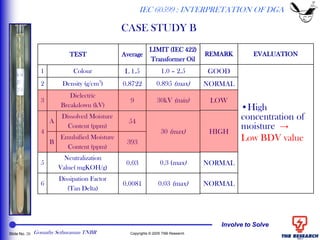
    Involve to Solve SlideNo. 20 Copyrights © 2005 TNB Research TEST Average LIMIT (IEC 422) Transformer Oil 1 Colour L 1.5 1.0 – 2.5 2 Density (g/cm3 ) 0.8722 0.895 (max) 3 Dielectric Breakdown (kV) 9 30kV (min) 4 A Dissolved Moisture Content (ppm) 54 30 (max) B Emulsified Moisture Content (ppm) 393 5 Neutralization Value( mgKOH/g) 0.03 0.3 (max) 6 Dissipation Factor (Tan Delta) 0.0081 0.03 (max) REMARK EVALUATION GOOD •High concentration of moisture → Low BDV value NORMAL LOW HIGH NORMAL NORMAL IEC 60599 : INTERPRETATION OF DGA CASE STUDY B Gomathy Sethuraman TNBR
  • 21.
    Involve to Solve SlideNo. 21 Copyrights © 2005 TNB Research DISSOLVED GAS ANALYSIS AVERAGE LIMIT (IEC 60599) Transformer Oil Hydrogen 8 300 Oxygen 46228 - Nitrogen 80877 - Methane 4 30 Carbon Monoxide 20 300 Carbon Dioxide 949 900 Ethylene 3 10 Ethane 20 50 Acetylene ND 2 REMARK EVALUATION Normal • High concentration Carbon dioxide → Overheating → Cellulose / Paper Insulation Degradation - - Normal Normal High Normal Normal Normal IEC 60599 : INTERPRETATION OF DGA CASE STUDY B Gomathy Sethuraman TNBR
  • 22.
    Involve to Solve SlideNo. 22 Copyrights © 2005 TNB Research Visible sludge and moisture IEC 60599 : INTERPRETATION OF DGA CASE STUDY B Gomathy Sethuraman TNBR
  • 23.
    Involve to Solve SlideNo. 23 Copyrights © 2005 TNB Research ContaminantOverheating burn mark IEC 60599 : INTERPRETATION OF DGA CASE STUDY B Gomathy Sethuraman TNBR
  • 24.
    Involve to Solve SlideNo. 24 Copyrights © 2005 TNB Research Overheating burn mark IEC 60599 : INTERPRETATION OF DGA CASE STUDY B Gomathy Sethuraman TNBR
  • 25.
    Involve to Solve SlideNo. 25 Copyrights © 2005 TNB Research TEST Average LIMIT (IEC 422) Transformer Oil 1 Colour L 1.5 1.0 – 2.5 2 Density (g/cm3 ) 0.8739 0.895 (max) 3 Dielectric Breakdown (kV) 9 30kV (min) 4 A Dissolved Moisture Content (ppm) 61 30 (max) B Emulsified Moisture Content (ppm) 613 5 Neutralization Value( mgKOH/g) 0.035 0.3 (max) 6 Dissipation Factor (Tan Delta) 0.0075 0.03 (max) REMARK EVALUATION GOOD •High concentration moisture → Low BDV value •Two types of moisture → Dissolved → Emulsified NORMAL LOW HIGH NORMAL NORMAL IEC 60599 : INTERPRETATION OF DGA CASE STUDY C Gomathy Sethuraman TNBR
  • 26.
    Involve to Solve SlideNo. 26 Copyrights © 2005 TNB Research DISSOLVED GAS ANALYSIS AVERAGE LIMIT (IEC 60599) Transformer Oil Hydrogen 12.5 300 Oxygen 42564 - Nitrogen 75302 - Methane 4 30 Carbon Monoxide 27 300 Carbon Dioxide 1136 900 Ethylene 4 10 Ethane 27 50 Acetylene ND 2 REMARK EVALUATION Normal • High concentration Carbon dioxide → Overheating → Cellulose / Paper Insulation Degradation - - Normal Normal High Normal Normal Normal IEC 60599 : INTERPRETATION OF DGA CASE STUDY C Gomathy Sethuraman TNBR
  • 27.
    Involve to Solve SlideNo. 27 Copyrights © 2005 TNB Research Visible sludge and moisture Contamination IEC 60599 : INTERPRETATION OF DGA CASE STUDY C Gomathy Sethuraman TNBR
  • 28.
    Involve to Solve SlideNo. 28 Copyrights © 2005 TNB Research Overheating / burn mark on the cellulose / paper insulation IEC 60599 : INTERPRETATION OF DGA CASE STUDY C Gomathy Sethuraman TNBR
  • 29.
    Involve to Solve SlideNo. 29 Copyrights © 2005 TNB Research Contaminant Overheating burn mark IEC 60599 : INTERPRETATION OF DGA CASE STUDY C Gomathy Sethuraman TNBR
  • 30.
    Involve to Solve SlideNo. 30 Copyrights © 2005 TNB Research CONCLUSION IEC 60599 : INTERPRETATION OF DGA  Faults often start as incipient faults of low energy, which may develop into more serious ones of higher energies, leading to possible gas alarms, breakdowns and failures.  When a fault is detected at any stage of development, it may be quite informative to examine not only the increase in gas concentration, but also the possible evolution with time towards a more dangerous high-energy fault  The RELIABILITY of a TRANSFORMER OIL depends on the BASIC CHARACTER of the oil BETTER THE OIL → BETTER THE PERFORMANCE  The RELIABILITY of a TRANSFORMER very much depends on the BASIC CONDITION MONITORING of the oil BETTER THE MONITORING → BETTER THE RELIABILITY Gomathy Sethuraman TNBR