IOSR Journal of Electrical and Electronics Engineering (IOSR-JEEE)
e-ISSN: 2278-1676,p-ISSN: 2320-3331, Volume 10, Issue 5 Ver. I (Sep – Oct. 2015), PP 48-52
www.iosrjournals.org
DOI: 10.9790/1676-10514852 www.iosrjournals.org 48 | Page
Case Study Of the Failed 15.75/220kV, 250MVA Generator
Transformer: An Overview
Laxman Rao Alur,
Asst Engineer(Elect)
Abstract: Transformer has vital role in the emerging electric Power Systems and is the one of the main
equipments in the Power System. So monitoring and maintaining their healthiness is very essential, by
monitoring Transformers periodically and taking required action results in increase of life of Transformers
and also we can avoid secondary damages, electrical/mechanical hazards to human beings working near
Transformers. If any problem is found while periodical testing /monitoring we can go for a planned shutdown
which can save huge Generation Loss due to failure of Transformers in case of Generating Station. In general
failure of Transformer can cause non availability of Generation/Transmission/ distribution for some time. So
it’s very necessary to monitor and take suitable action. Whenever any abnormalities are found in Transformers
else it leads to failure of equipment further affecting the Power System Stability. Failure of one of the Generator
Transformer has been discussed here.
Key words: Transformer, condition monitoring, healthiness, routine testing, Dissolved Gas Analysis
I. Introduction
A transformer is a static machine used for transforming power from one circuit to another without
changing frequency. Power transformers have an important role in power flow in large power systems. Their
better performance gives high efficiency and enhanced power transfer capability. However, various power
transformer failures in the recent past have acquired much attention towards failure analysis. Transformers are
reliable and offer trouble free service if they are monitored time to time by maintenance and operating
engineers. There are many different maintenance actions, to be performed on a power transformer some of them
are monthly basis, some other are quarterly, some are half-yearly basis, and some of them are yearly basis. by
doing these routine maintenance we can avoid failures to maximum extent which may be caused by internal
faults, but some time external faults can cause severe damage to the transformer. In this paper we can see one of
the methods of testing the given power transformer i.e. Dissolved Gas Analysis, wherein the transformer oil is
tested for its gas composition and thus the transformer condition can be known.
II. Dissolved Gas Analysis (Dga)
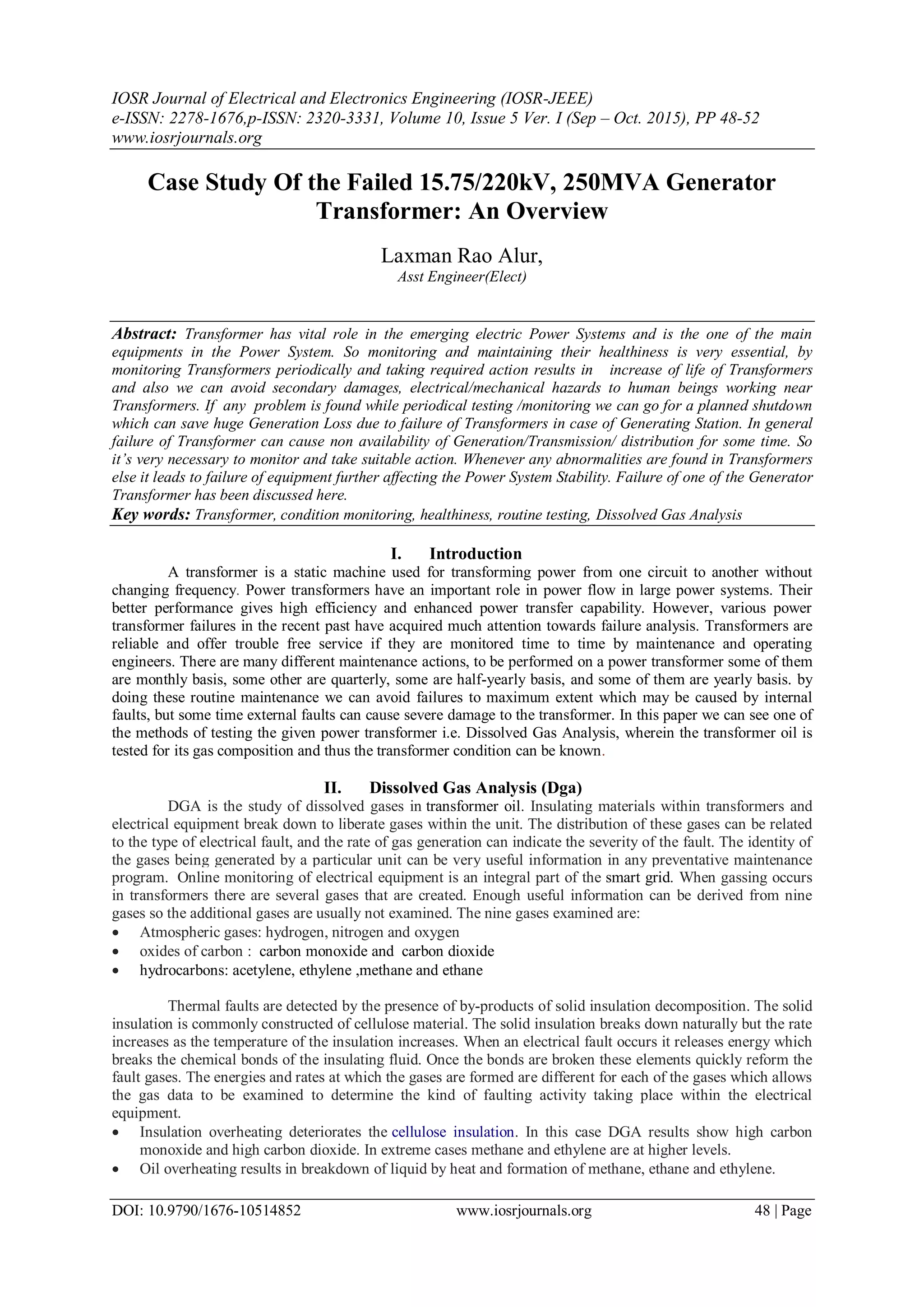
DGA is the study of dissolved gases in transformer oil. Insulating materials within transformers and
electrical equipment break down to liberate gases within the unit. The distribution of these gases can be related
to the type of electrical fault, and the rate of gas generation can indicate the severity of the fault. The identity of
the gases being generated by a particular unit can be very useful information in any preventative maintenance
program. Online monitoring of electrical equipment is an integral part of the smart grid. When gassing occurs
in transformers there are several gases that are created. Enough useful information can be derived from nine
gases so the additional gases are usually not examined. The nine gases examined are:
 Atmospheric gases: hydrogen, nitrogen and oxygen
 oxides of carbon : carbon monoxide and carbon dioxide
 hydrocarbons: acetylene, ethylene ,methane and ethane
Thermal faults are detected by the presence of by-products of solid insulation decomposition. The solid
insulation is commonly constructed of cellulose material. The solid insulation breaks down naturally but the rate
increases as the temperature of the insulation increases. When an electrical fault occurs it releases energy which
breaks the chemical bonds of the insulating fluid. Once the bonds are broken these elements quickly reform the
fault gases. The energies and rates at which the gases are formed are different for each of the gases which allows
the gas data to be examined to determine the kind of faulting activity taking place within the electrical
equipment.
 Insulation overheating deteriorates the cellulose insulation. In this case DGA results show high carbon
monoxide and high carbon dioxide. In extreme cases methane and ethylene are at higher levels.
 Oil overheating results in breakdown of liquid by heat and formation of methane, ethane and ethylene.
Case Study Of the Failed 15.75/220kV, 250MVA Generator Transformer: An Overview
DOI: 10.9790/1676-10514852 www.iosrjournals.org 49 | Page
 Corona is a partial discharge and detected in a DGA by elevated hydrogen.
 Arcing is the most severe condition in a transformer and indicated by even low levels of acetylene.
Interpretation of the results obtained for a particular transformer requires knowledge of the age of the
unit, the loading cycle, and the date of major maintenance such as filtering of the oil. The IEC standard 60599
and the ANSI IEEE standard C57.104 give guidelines for the assessment of equipment condition based on the
amount of gas present, and the ratios of the volumes of pairs of gases. After samples have been taken and
analyzed, the first step in evaluating DGA results is to consider the concentration levels (in ppm) of each key
gas. Values for each of the key gases are recorded over time so that the rate-of-change of the various gas
concentrations can be evaluated. Any sharp increase in key gas concentration is indicative of a potential problem
within the transformer.
Dissolved gas analysis as a diagnostic technique has several limitations. It cannot precisely localize a
fault. If the transformer has been refilled with fresh oil, results are not indicative of faults. These gases are to be
isolated from the sample and analyzed quantitatively using gas chromatography process. This technique enables
proper diagnosis of the transformer condition in service and can also suggest preventive measures. The
quantities of gases generated from the transformer oil and their types help in identifying the various fault
conditions. Now, the relative quantities of all these gases give the oil decomposition energy during a particular
fault. Each fault has its own characteristic amount of energy. Elevated concentrations of gases may signal
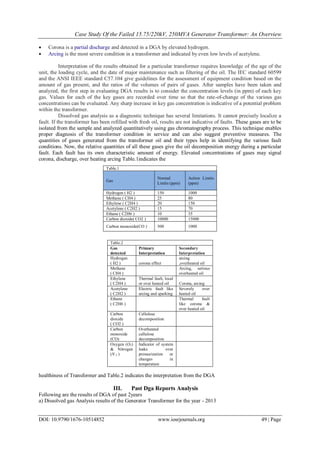
corona, discharge, over heating arcing Table.1indicates the
healthiness of Transformer and Table.2 indicates the interpretation from the DGA
III. Past Dga Reports Analysis
Following are the results of DGA of past 2years
a) Dissolved gas Analysis results of the Generator Transformer for the year - 2013
Table.1
Gas
Normal
Limits (ppm)
Action Limits
(ppm)
Hydrogen ( H2 ) 150 1000
Methane ( CH4 ) 25 80
Ethylene ( C2H4 ) 20 150
Acetylene ( C2H2 ) 15 70
Ethane ( C2H6 ) 10 35
Carbon dioxide( CO2 ) 10000 15000
Carbon monoxide(CO ) 500 1000
Table.2
Gas
detected
Primary
Interpretation
Secondary
Interpretation
Hydrogen
( H2 ) corona effect
arcing
,overheated oil
Methane
( CH4 )
Arcing, serious
overheated oil
Ethylene
( C2H4 )
Thermal fault, local
or over heated oil Corona, arcing
Acetylene
( C2H2 )
Electric fault like
arcing and sparking
Severely over
heated oil
Ethane
( C2H6 )
Thermal fault
like corona &
over heated oil
Carbon
dioxide
( CO2 )
Cellulose
decomposition
Carbon
monoxide
(CO)
Overheated
cellulose
decomposition
Oxygen (O2)
& Nitrogen
(N 2 )
Indicator of system
leaks over
pressurization or
changes in
temperature
Case Study Of the Failed 15.75/220kV, 250MVA Generator Transformer: An Overview
DOI: 10.9790/1676-10514852 www.iosrjournals.org 50 | Page
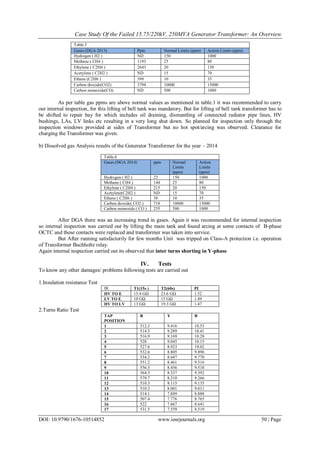
As per table gas ppms are above normal values as mentioned in table.1 it was recommended to carry
out internal inspection, for this lifting of bell tank was mandatory. But for lifting of bell tank transformer has to
be shifted to repair bay for which includes oil draining, dismantling of connected radiator pipe lines, HV
bushings, LAs, LV links etc resulting in a very long shut down. So planned for inspection only through the
inspection windows provided at sides of Transformer but no hot spot/arcing was observed. Clearance for
charging the Transformer was given.
b) Dissolved gas Analysis results of the Generator Transformer for the year – 2014
After DGA there was an increasing trend in gases. Again it was recommended for internal inspection
so internal inspection was carried out by lifting the main tank and found arcing at some contacts of B-phase
OCTC and these contacts were replaced and transformer was taken into service.
But After running satisfactorily for few months Unit was tripped on Class-A protection i.e. operation
of Transformer Buchholtz relay.
Again internal inspection carried out its observed that inter turns shorting in Y-phase
IV. Tests
To know any other damages/ problems following tests are carried out
1.Insulation resistance Test
IR T1(15s ) T2(60s) PI
HV TO E 15.4 GΩ 23.6 GΩ 1.52
LV TO E 10 GΩ 15 GΩ 1.49
HV TO LV 13 GΩ 19.3 GΩ 1.47
2.Turns Ratio Test
TAP
POSITION
R Y B
1 512.3 9.416 10.53
2 514.3 9.289 10.41
3 516.9 9.169 10.28
4 528 9.045 10.15
5 527.6 8.923 10.02
6 532.6 8.805 9.896
7 534.2 8.687 9.770
8 551.2 8.461 9.516
9 556.3 8.456 9.518
10 564.5 8.337 9.392
11 579.7 8.210 9.266
12 510.3 8.115 9.135
13 510.3 8.001 9.011
14 514.1 7.889 8.888
15 507.4 7.776 8.765
16 522 7.667 8.641
17 531.5 7.559 8.519
Table.3
Gases (DGA 2013) Ppm Normal Limits (ppm) Action Limits (ppm)
Hydrogen ( H2 ) ND 150 1000
Methane ( CH4 ) 1193 25 80
Ethylene ( C2H4 ) 2643 20 150
Acetylene ( C2H2 ) ND 15 70
Ethane (C2H6 ) 399 10 35
Carbon dioxide(CO2) 3794 10000 15000
Carbon monoxide(CO) ND 500 1000
Table.4
Gases (DGA 2014) ppm Normal
Limits
(ppm)
Action
Limits
(ppm)
Hydrogen ( H2 ) 22 150 1000
Methane ( CH4 ) 144 25 80
Ethylene ( C2H4 ) 215 20 150
Acetylene(C2H2 ) ND 15 70
Ethane ( C2H6 ) 38 10 35
Carbon dioxide( CO2 ) 718 10000 15000
Carbon monoxide ( CO ) 255 500 1000
Case Study Of the Failed 15.75/220kV, 250MVA Generator Transformer: An Overview
DOI: 10.9790/1676-10514852 www.iosrjournals.org 51 | Page
3.HV milli amps test
Applied 1Ǿ230V, 50Hz
Phase Tap1 line Tap1
RN 9.26mA RY 9.42mA
YN 133mA YB 133mA
BN 9.36mA BR 9.22mA
4.OC Test:
LV side applied : 415V
Phase Current
R 542mA
Y 1.8A
B 537mA
5. Magnetizing Balance Test
HV side applied: 415V
HV SIDE LV SIDE
RY YB BR ry yb br
427 48 54.3 45.5 0.38 45
214 9.56 429 23.03 0.017 23
420 430 850 45.4 0.38 45.7
6. Winding Resistance Test
(Vector Group Ynd1)
1 Amps applied mΩ 25 Amps applied μΩ
Tap RN YN BN Ry yb br
1 128.35 126.81 129.32
2 125.13 124.51 126.43
3 122.26 122.58 123.69
4 120.38 120.02 121.78
5 118.28 118.14 119.97
6 115.45 115.43 117.73
7 112.67 112.59 114.41
8 109.81 109.81 111.73
9a 106.81 106.87 108.89
9b 1002.1 1415.3 1136.9
9c 106.95 106.83 108.72
10 109.97 109.69 111.72
11 112.63 112.21 114.45
12 115.63 115.46 117.58
13 118.31 118.12 119.91
14 120.43 120.21 121.82
15 122.54 122.46 123.93
16 125.51 124.98 126.66
17 128.35 126.91 129.55
V. Conclusion:
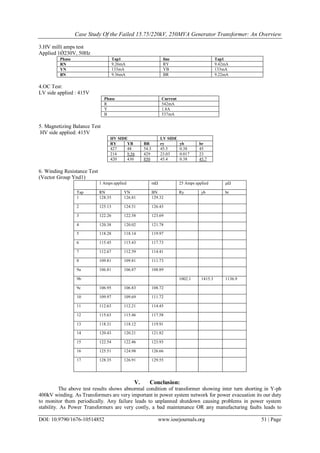
The above test results shows abnormal condition of transformer showing inter turn shorting in Y-ph
400kV winding. As Transformers are very important in power system network for power evacuation its our duty
to monitor them periodically. Any failure leads to unplanned shutdown causing problems in power system
stability. As Power Transformers are very costly, a bad maintenance OR any manufacturing faults leads to
Case Study Of the Failed 15.75/220kV, 250MVA Generator Transformer: An Overview
DOI: 10.9790/1676-10514852 www.iosrjournals.org 52 | Page
failure and in case of such failures with Generator transformers leads to loss of generation resulting in both
Generation Losses and equipment loss. Some times these failures may cause secondary damages also e.g.
damages to nearby equipments and humans. Therefore After samples have been taken and analyzed, the first
step in evaluating DGA results is to consider the concentration levels (in ppm) of each key gas , if we found any
gases present at higher levels we should take immediate actions to resolve the problems.
References
[1]. Herbert G. Erdman (ed.), Electrical insulating oils, ASTM International, 1988 ISBN 0-8031-1179-7, p. 108
[2]. "DISSOLVED GAS ANALYSIS OF MINERAL OIL INSULATING FLUIDS". Retrieved November 2, 2011.
[3]. "Dissolved Gas Analysis". 2005 [last update]≤. Retrieved November 21, 2011
[4]. "Using Dissolved Gas Analysis to Detect Active Faults in Oil-Insulated Electrical Equipment". Retrieved November 21, 2011.
[5]. "DISSOLVED GAS ANALYSIS (DGA) OF INSULATING FLUIDS". Retrieved November 21, 2011.
[6]. Martin J. Heathcote (ed)., The J&P Transformer Book Thirteenth Edition, Newnes, 2007 ISBN 978-0-7506-8164-3 pages 588-615
[7]. "Dissolved Gas Analysis for Transformers" (PDF). Retrieved November 21, 2011.,Lynn Hamrick, "Dissolved Gas Analysis for
Transformers"

H010514852

  • 1.
    IOSR Journal ofElectrical and Electronics Engineering (IOSR-JEEE) e-ISSN: 2278-1676,p-ISSN: 2320-3331, Volume 10, Issue 5 Ver. I (Sep – Oct. 2015), PP 48-52 www.iosrjournals.org DOI: 10.9790/1676-10514852 www.iosrjournals.org 48 | Page Case Study Of the Failed 15.75/220kV, 250MVA Generator Transformer: An Overview Laxman Rao Alur, Asst Engineer(Elect) Abstract: Transformer has vital role in the emerging electric Power Systems and is the one of the main equipments in the Power System. So monitoring and maintaining their healthiness is very essential, by monitoring Transformers periodically and taking required action results in increase of life of Transformers and also we can avoid secondary damages, electrical/mechanical hazards to human beings working near Transformers. If any problem is found while periodical testing /monitoring we can go for a planned shutdown which can save huge Generation Loss due to failure of Transformers in case of Generating Station. In general failure of Transformer can cause non availability of Generation/Transmission/ distribution for some time. So it’s very necessary to monitor and take suitable action. Whenever any abnormalities are found in Transformers else it leads to failure of equipment further affecting the Power System Stability. Failure of one of the Generator Transformer has been discussed here. Key words: Transformer, condition monitoring, healthiness, routine testing, Dissolved Gas Analysis I. Introduction A transformer is a static machine used for transforming power from one circuit to another without changing frequency. Power transformers have an important role in power flow in large power systems. Their better performance gives high efficiency and enhanced power transfer capability. However, various power transformer failures in the recent past have acquired much attention towards failure analysis. Transformers are reliable and offer trouble free service if they are monitored time to time by maintenance and operating engineers. There are many different maintenance actions, to be performed on a power transformer some of them are monthly basis, some other are quarterly, some are half-yearly basis, and some of them are yearly basis. by doing these routine maintenance we can avoid failures to maximum extent which may be caused by internal faults, but some time external faults can cause severe damage to the transformer. In this paper we can see one of the methods of testing the given power transformer i.e. Dissolved Gas Analysis, wherein the transformer oil is tested for its gas composition and thus the transformer condition can be known. II. Dissolved Gas Analysis (Dga) DGA is the study of dissolved gases in transformer oil. Insulating materials within transformers and electrical equipment break down to liberate gases within the unit. The distribution of these gases can be related to the type of electrical fault, and the rate of gas generation can indicate the severity of the fault. The identity of the gases being generated by a particular unit can be very useful information in any preventative maintenance program. Online monitoring of electrical equipment is an integral part of the smart grid. When gassing occurs in transformers there are several gases that are created. Enough useful information can be derived from nine gases so the additional gases are usually not examined. The nine gases examined are:  Atmospheric gases: hydrogen, nitrogen and oxygen  oxides of carbon : carbon monoxide and carbon dioxide  hydrocarbons: acetylene, ethylene ,methane and ethane Thermal faults are detected by the presence of by-products of solid insulation decomposition. The solid insulation is commonly constructed of cellulose material. The solid insulation breaks down naturally but the rate increases as the temperature of the insulation increases. When an electrical fault occurs it releases energy which breaks the chemical bonds of the insulating fluid. Once the bonds are broken these elements quickly reform the fault gases. The energies and rates at which the gases are formed are different for each of the gases which allows the gas data to be examined to determine the kind of faulting activity taking place within the electrical equipment.  Insulation overheating deteriorates the cellulose insulation. In this case DGA results show high carbon monoxide and high carbon dioxide. In extreme cases methane and ethylene are at higher levels.  Oil overheating results in breakdown of liquid by heat and formation of methane, ethane and ethylene.
  • 2.
    Case Study Ofthe Failed 15.75/220kV, 250MVA Generator Transformer: An Overview DOI: 10.9790/1676-10514852 www.iosrjournals.org 49 | Page  Corona is a partial discharge and detected in a DGA by elevated hydrogen.  Arcing is the most severe condition in a transformer and indicated by even low levels of acetylene. Interpretation of the results obtained for a particular transformer requires knowledge of the age of the unit, the loading cycle, and the date of major maintenance such as filtering of the oil. The IEC standard 60599 and the ANSI IEEE standard C57.104 give guidelines for the assessment of equipment condition based on the amount of gas present, and the ratios of the volumes of pairs of gases. After samples have been taken and analyzed, the first step in evaluating DGA results is to consider the concentration levels (in ppm) of each key gas. Values for each of the key gases are recorded over time so that the rate-of-change of the various gas concentrations can be evaluated. Any sharp increase in key gas concentration is indicative of a potential problem within the transformer. Dissolved gas analysis as a diagnostic technique has several limitations. It cannot precisely localize a fault. If the transformer has been refilled with fresh oil, results are not indicative of faults. These gases are to be isolated from the sample and analyzed quantitatively using gas chromatography process. This technique enables proper diagnosis of the transformer condition in service and can also suggest preventive measures. The quantities of gases generated from the transformer oil and their types help in identifying the various fault conditions. Now, the relative quantities of all these gases give the oil decomposition energy during a particular fault. Each fault has its own characteristic amount of energy. Elevated concentrations of gases may signal corona, discharge, over heating arcing Table.1indicates the healthiness of Transformer and Table.2 indicates the interpretation from the DGA III. Past Dga Reports Analysis Following are the results of DGA of past 2years a) Dissolved gas Analysis results of the Generator Transformer for the year - 2013 Table.1 Gas Normal Limits (ppm) Action Limits (ppm) Hydrogen ( H2 ) 150 1000 Methane ( CH4 ) 25 80 Ethylene ( C2H4 ) 20 150 Acetylene ( C2H2 ) 15 70 Ethane ( C2H6 ) 10 35 Carbon dioxide( CO2 ) 10000 15000 Carbon monoxide(CO ) 500 1000 Table.2 Gas detected Primary Interpretation Secondary Interpretation Hydrogen ( H2 ) corona effect arcing ,overheated oil Methane ( CH4 ) Arcing, serious overheated oil Ethylene ( C2H4 ) Thermal fault, local or over heated oil Corona, arcing Acetylene ( C2H2 ) Electric fault like arcing and sparking Severely over heated oil Ethane ( C2H6 ) Thermal fault like corona & over heated oil Carbon dioxide ( CO2 ) Cellulose decomposition Carbon monoxide (CO) Overheated cellulose decomposition Oxygen (O2) & Nitrogen (N 2 ) Indicator of system leaks over pressurization or changes in temperature
  • 3.
    Case Study Ofthe Failed 15.75/220kV, 250MVA Generator Transformer: An Overview DOI: 10.9790/1676-10514852 www.iosrjournals.org 50 | Page As per table gas ppms are above normal values as mentioned in table.1 it was recommended to carry out internal inspection, for this lifting of bell tank was mandatory. But for lifting of bell tank transformer has to be shifted to repair bay for which includes oil draining, dismantling of connected radiator pipe lines, HV bushings, LAs, LV links etc resulting in a very long shut down. So planned for inspection only through the inspection windows provided at sides of Transformer but no hot spot/arcing was observed. Clearance for charging the Transformer was given. b) Dissolved gas Analysis results of the Generator Transformer for the year – 2014 After DGA there was an increasing trend in gases. Again it was recommended for internal inspection so internal inspection was carried out by lifting the main tank and found arcing at some contacts of B-phase OCTC and these contacts were replaced and transformer was taken into service. But After running satisfactorily for few months Unit was tripped on Class-A protection i.e. operation of Transformer Buchholtz relay. Again internal inspection carried out its observed that inter turns shorting in Y-phase IV. Tests To know any other damages/ problems following tests are carried out 1.Insulation resistance Test IR T1(15s ) T2(60s) PI HV TO E 15.4 GΩ 23.6 GΩ 1.52 LV TO E 10 GΩ 15 GΩ 1.49 HV TO LV 13 GΩ 19.3 GΩ 1.47 2.Turns Ratio Test TAP POSITION R Y B 1 512.3 9.416 10.53 2 514.3 9.289 10.41 3 516.9 9.169 10.28 4 528 9.045 10.15 5 527.6 8.923 10.02 6 532.6 8.805 9.896 7 534.2 8.687 9.770 8 551.2 8.461 9.516 9 556.3 8.456 9.518 10 564.5 8.337 9.392 11 579.7 8.210 9.266 12 510.3 8.115 9.135 13 510.3 8.001 9.011 14 514.1 7.889 8.888 15 507.4 7.776 8.765 16 522 7.667 8.641 17 531.5 7.559 8.519 Table.3 Gases (DGA 2013) Ppm Normal Limits (ppm) Action Limits (ppm) Hydrogen ( H2 ) ND 150 1000 Methane ( CH4 ) 1193 25 80 Ethylene ( C2H4 ) 2643 20 150 Acetylene ( C2H2 ) ND 15 70 Ethane (C2H6 ) 399 10 35 Carbon dioxide(CO2) 3794 10000 15000 Carbon monoxide(CO) ND 500 1000 Table.4 Gases (DGA 2014) ppm Normal Limits (ppm) Action Limits (ppm) Hydrogen ( H2 ) 22 150 1000 Methane ( CH4 ) 144 25 80 Ethylene ( C2H4 ) 215 20 150 Acetylene(C2H2 ) ND 15 70 Ethane ( C2H6 ) 38 10 35 Carbon dioxide( CO2 ) 718 10000 15000 Carbon monoxide ( CO ) 255 500 1000
  • 4.
    Case Study Ofthe Failed 15.75/220kV, 250MVA Generator Transformer: An Overview DOI: 10.9790/1676-10514852 www.iosrjournals.org 51 | Page 3.HV milli amps test Applied 1Ǿ230V, 50Hz Phase Tap1 line Tap1 RN 9.26mA RY 9.42mA YN 133mA YB 133mA BN 9.36mA BR 9.22mA 4.OC Test: LV side applied : 415V Phase Current R 542mA Y 1.8A B 537mA 5. Magnetizing Balance Test HV side applied: 415V HV SIDE LV SIDE RY YB BR ry yb br 427 48 54.3 45.5 0.38 45 214 9.56 429 23.03 0.017 23 420 430 850 45.4 0.38 45.7 6. Winding Resistance Test (Vector Group Ynd1) 1 Amps applied mΩ 25 Amps applied μΩ Tap RN YN BN Ry yb br 1 128.35 126.81 129.32 2 125.13 124.51 126.43 3 122.26 122.58 123.69 4 120.38 120.02 121.78 5 118.28 118.14 119.97 6 115.45 115.43 117.73 7 112.67 112.59 114.41 8 109.81 109.81 111.73 9a 106.81 106.87 108.89 9b 1002.1 1415.3 1136.9 9c 106.95 106.83 108.72 10 109.97 109.69 111.72 11 112.63 112.21 114.45 12 115.63 115.46 117.58 13 118.31 118.12 119.91 14 120.43 120.21 121.82 15 122.54 122.46 123.93 16 125.51 124.98 126.66 17 128.35 126.91 129.55 V. Conclusion: The above test results shows abnormal condition of transformer showing inter turn shorting in Y-ph 400kV winding. As Transformers are very important in power system network for power evacuation its our duty to monitor them periodically. Any failure leads to unplanned shutdown causing problems in power system stability. As Power Transformers are very costly, a bad maintenance OR any manufacturing faults leads to
  • 5.
    Case Study Ofthe Failed 15.75/220kV, 250MVA Generator Transformer: An Overview DOI: 10.9790/1676-10514852 www.iosrjournals.org 52 | Page failure and in case of such failures with Generator transformers leads to loss of generation resulting in both Generation Losses and equipment loss. Some times these failures may cause secondary damages also e.g. damages to nearby equipments and humans. Therefore After samples have been taken and analyzed, the first step in evaluating DGA results is to consider the concentration levels (in ppm) of each key gas , if we found any gases present at higher levels we should take immediate actions to resolve the problems. References [1]. Herbert G. Erdman (ed.), Electrical insulating oils, ASTM International, 1988 ISBN 0-8031-1179-7, p. 108 [2]. "DISSOLVED GAS ANALYSIS OF MINERAL OIL INSULATING FLUIDS". Retrieved November 2, 2011. [3]. "Dissolved Gas Analysis". 2005 [last update]≤. Retrieved November 21, 2011 [4]. "Using Dissolved Gas Analysis to Detect Active Faults in Oil-Insulated Electrical Equipment". Retrieved November 21, 2011. [5]. "DISSOLVED GAS ANALYSIS (DGA) OF INSULATING FLUIDS". Retrieved November 21, 2011. [6]. Martin J. Heathcote (ed)., The J&P Transformer Book Thirteenth Edition, Newnes, 2007 ISBN 978-0-7506-8164-3 pages 588-615 [7]. "Dissolved Gas Analysis for Transformers" (PDF). Retrieved November 21, 2011.,Lynn Hamrick, "Dissolved Gas Analysis for Transformers"