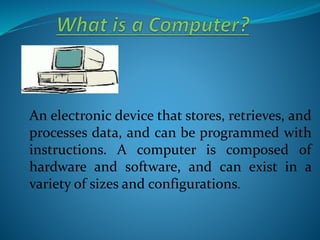
An electronic device that stores, retrieves, and
processes data, and can be programmed with
instructions. A computer is composed of
hardware and software, and can exist in a
variety of sizes and configurations.
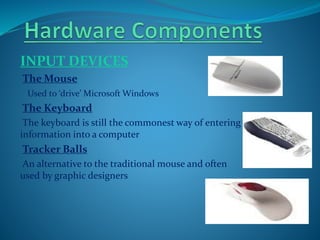
INPUT DEVICES
The Mouse
Used to ‘drive’ Microsoft Windows
The Keyboard
The keyboard is still the commonest way of entering
information into a computer
Tracker Balls
An alternative to the traditional mouse and often
used by graphic designers
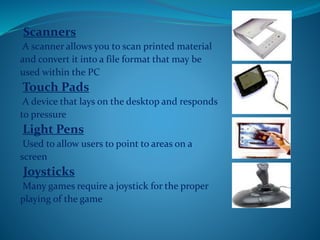
Scanners
A scanner allows you to scan printed material
and convert it into a file format that may be
used within the PC
Touch Pads
A device that lays on the desktop and responds
to pressure
Light Pens
Used to allow users to point to areas on a
screen
Joysticks
Many games require a joystick for the proper
playing of the game
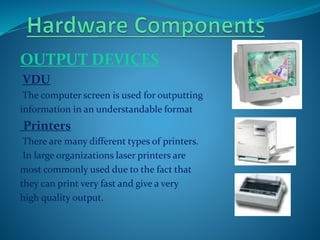
OUTPUT DEVICES
VDU
The computer screen is used for outputting
information in an understandable format
Printers
There are many different types of printers.
In large organizations laser printers are
most commonly used due to the fact that
they can print very fast and give a very
high quality output.
Plotters
A plotter is an output device similar to a
printer, but normally allows you to print
larger images.
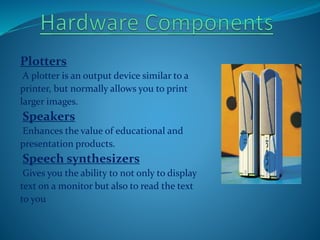
Speakers
Enhances the value of educational and
presentation products.
Speech synthesizers
Gives you the ability to not only to display
text on a monitor but also to read the text
to you
Storage Devices -- "How it saves
data and programs“
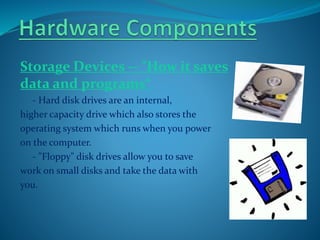
- Hard disk drives are an internal,
higher capacity drive which also stores the
operating system which runs when you power
on the computer.
- "Floppy" disk drives allow you to save
work on small disks and take the data with
you.
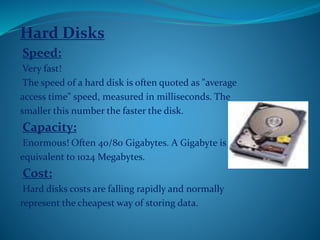
Hard Disks
Speed:
Very fast!
The speed of a hard disk is often quoted as "average
access time" speed, measured in milliseconds. The
smaller this number the faster the disk.
Capacity:
Enormous! Often 40/80 Gigabytes. A Gigabyte is
equivalent to 1024 Megabytes.
Cost:
Hard disks costs are falling rapidly and normally
represent the cheapest way of storing data.
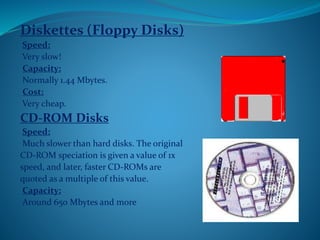
Diskettes (Floppy Disks)
Speed:
Very slow!
Capacity:
Normally 1.44 Mbytes.
Cost:
Very cheap.
CD-ROM Disks
Speed:
Much slower than hard disks. The original
CD-ROM speciation is given a value of 1x
speed, and later, faster CD-ROMs are
quoted as a multiple of this value.
Capacity:
Around 650 Mbytes and more
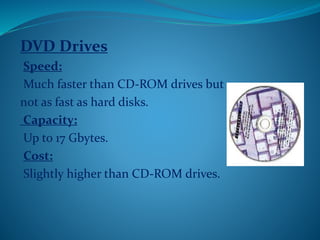
DVD Drives
Speed:
Much faster than CD-ROM drives but
not as fast as hard disks.
Capacity:
Up to 17 Gbytes.
Cost:
Slightly higher than CD-ROM drives.
Memory -- "How the processor stores and
uses immediate data“
RAM - Random Access Memory
‱ The main 'working' memory used by the computer.
‱ When the operating system loads from disk when
you first switch on the computer, it is copied into
RAM.
‱ As a rough rule, a Microsoft Windows based
computer will operate faster if you install more RAM.
Data and programs stored in RAM are volatile (i.e. the
information is lost when you switch off the
computer).
ROM – Read Only Memory
‱ Read Only Memory (ROM) as the name suggests is a special
type of memory chip that holds software that can be read
but not written to.
‱ A good example is the ROM-BIOS chip, which contains
read-only software.
‱ Often network cards and video cards also contain ROM
chips.
Bit
All computers work on a binary numbering system, i.e. they
process data in one's or zero's. This 1 or 0 level of storage is
called a bit.
Byte
A byte consists of eight bits.
Kilobyte
A kilobyte (KB) consists of 1024 bytes.
Megabyte
A megabyte (MB) consists of 1024 kilobytes.
Gigabyte
A gigabyte (GB) consists of 1024 megabytes.
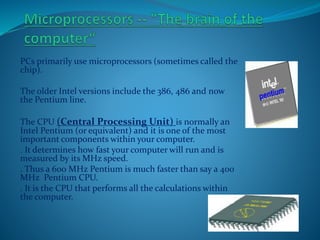
PCs primarily use microprocessors (sometimes called the
chip).
The older Intel versions include the 386, 486 and now
the Pentium line.
The CPU (Central Processing Unit) is normally an
Intel Pentium (or equivalent) and it is one of the most
important components within your computer.
. It determines how fast your computer will run and is
measured by its MHz speed.
. Thus a 600 MHz Pentium is much faster than say a 400
MHz Pentium CPU.
. It is the CPU that performs all the calculations within
the computer.
‱ CPU speed
‱ RAM size
‱ Hard disk speed and capacity
Operating systems software
The operating system is a special type of program that loads
automatically when you start your computer.
The operating system allows you to use the advanced features of
a modern computer without having to learn all the details of how
the hardware works
‱ The link between the hardware and you, the user
‱ Makes the computer easy to use without having to understand bits
and bytes!
‱ An application program is the type of program
that you use once the operating system has
been loaded.
‱ Examples include word-processing programs,
spreadsheets and databases
Word processing applications
Microsoft Word
Lotus Word Pro
WordPerfect
Spreadsheets
Microsoft Excel
Lotus 123
Database
Microsoft Access
Lotus Approach
Payroll
Sage software
Presentation tools
Microsoft PowerPoint
Lotus Freelance
Desktop publishing
Abode Photoshop
Multimedia applications
Microsoft's Encarta CD-ROM based encyclopedias
LAN
A LAN (Local Area Network) is a system whereby
individual PCs are connected together within a
company or organization
WAN
A WAN (Wide Area Network) as the name implies
allows you to connect to other computers over a
wider area (i.e. the whole world).
If ten people are working together within an office it
makes sense for them all to be connected.
‱ In this way the office can have a single printer
and all ten people can print to it.
‱ In a similar way other devices such as modems or
scanners can be shared.
‱ Even more useful is the ability to share
information when connected to a network.
Modem
‱ Short for “MODulate/DEModulate”. The modem sends
information from your computer across the telephone
system.
‱ The modem at the other end of the phone line, converts the
signal back into a format that can be used by the receiving
computer.
Common uses for the computer within the
home
‱ Computer games
‱ Working from Home
‱ Banking from Home
‱ Connecting to the Web
CBT (Computer Based Training)
‱ Computer Based Training (CBT) offers a low cost solution
to training needs where you need to train a large amount of
people on a single subject.
‱ These programs are normally supplied on CD-ROM and
combine text, graphics and sound.
‱ Packages range from general encyclopedias right through to
learning a foreign language.
Automated Production Systems
‱ Many car factories are almost completely automated and
the cars are assembled by computer-controlled robots.
‱ This automation is becoming increasingly common
throughout industry.
Design Systems
‱ Many products are designed using CAD (Computer Aided
Design) programs to produce exact specifications and
detailed drawings on the computer before producing
models of new products.
Stock Control
‱ Stock control is ideal for automation and in many
companies it is now completely computerized.
‱ The stock control system keeps track of the number of items
in stock and can automatically order replacement items
when required.
Accounts / Payroll
‱ In most large organizations the accounts are maintained by
a computerized system.
‱ Due to the repetitive nature of accounts a computer system
is ideally suited to this task and accuracy is guaranteed.
‱ Accounts
‱ Games
‱ Educational
‱ On-line banking
‱ Smart ID cards
‱ Supermarkets
‱ Working from home (Tele-working)
‱ Internet
What is a computer

What is a computer

  • 2.
    An electronic devicethat stores, retrieves, and processes data, and can be programmed with instructions. A computer is composed of hardware and software, and can exist in a variety of sizes and configurations.
  • 6.
    INPUT DEVICES The Mouse Usedto ‘drive’ Microsoft Windows The Keyboard The keyboard is still the commonest way of entering information into a computer Tracker Balls An alternative to the traditional mouse and often used by graphic designers
  • 7.
    Scanners A scanner allowsyou to scan printed material and convert it into a file format that may be used within the PC Touch Pads A device that lays on the desktop and responds to pressure Light Pens Used to allow users to point to areas on a screen Joysticks Many games require a joystick for the proper playing of the game
  • 8.
    OUTPUT DEVICES VDU The computerscreen is used for outputting information in an understandable format Printers There are many different types of printers. In large organizations laser printers are most commonly used due to the fact that they can print very fast and give a very high quality output.
  • 9.
    Plotters A plotter isan output device similar to a printer, but normally allows you to print larger images. Speakers Enhances the value of educational and presentation products. Speech synthesizers Gives you the ability to not only to display text on a monitor but also to read the text to you
  • 10.
    Storage Devices --"How it saves data and programs“ - Hard disk drives are an internal, higher capacity drive which also stores the operating system which runs when you power on the computer. - "Floppy" disk drives allow you to save work on small disks and take the data with you.
  • 11.
    Hard Disks Speed: Very fast! Thespeed of a hard disk is often quoted as "average access time" speed, measured in milliseconds. The smaller this number the faster the disk. Capacity: Enormous! Often 40/80 Gigabytes. A Gigabyte is equivalent to 1024 Megabytes. Cost: Hard disks costs are falling rapidly and normally represent the cheapest way of storing data.
  • 12.
    Diskettes (Floppy Disks) Speed: Veryslow! Capacity: Normally 1.44 Mbytes. Cost: Very cheap. CD-ROM Disks Speed: Much slower than hard disks. The original CD-ROM speciation is given a value of 1x speed, and later, faster CD-ROMs are quoted as a multiple of this value. Capacity: Around 650 Mbytes and more
  • 13.
    DVD Drives Speed: Much fasterthan CD-ROM drives but not as fast as hard disks. Capacity: Up to 17 Gbytes. Cost: Slightly higher than CD-ROM drives.
  • 14.
    Memory -- "Howthe processor stores and uses immediate data“ RAM - Random Access Memory ‱ The main 'working' memory used by the computer. ‱ When the operating system loads from disk when you first switch on the computer, it is copied into RAM. ‱ As a rough rule, a Microsoft Windows based computer will operate faster if you install more RAM. Data and programs stored in RAM are volatile (i.e. the information is lost when you switch off the computer).
  • 15.
    ROM – ReadOnly Memory ‱ Read Only Memory (ROM) as the name suggests is a special type of memory chip that holds software that can be read but not written to. ‱ A good example is the ROM-BIOS chip, which contains read-only software. ‱ Often network cards and video cards also contain ROM chips.
  • 16.
    Bit All computers workon a binary numbering system, i.e. they process data in one's or zero's. This 1 or 0 level of storage is called a bit. Byte A byte consists of eight bits. Kilobyte A kilobyte (KB) consists of 1024 bytes. Megabyte A megabyte (MB) consists of 1024 kilobytes. Gigabyte A gigabyte (GB) consists of 1024 megabytes.
  • 17.
    PCs primarily usemicroprocessors (sometimes called the chip). The older Intel versions include the 386, 486 and now the Pentium line. The CPU (Central Processing Unit) is normally an Intel Pentium (or equivalent) and it is one of the most important components within your computer. . It determines how fast your computer will run and is measured by its MHz speed. . Thus a 600 MHz Pentium is much faster than say a 400 MHz Pentium CPU. . It is the CPU that performs all the calculations within the computer.
  • 18.
    ‱ CPU speed ‱RAM size ‱ Hard disk speed and capacity
  • 19.
    Operating systems software Theoperating system is a special type of program that loads automatically when you start your computer. The operating system allows you to use the advanced features of a modern computer without having to learn all the details of how the hardware works ‱ The link between the hardware and you, the user ‱ Makes the computer easy to use without having to understand bits and bytes!
  • 20.
    ‱ An applicationprogram is the type of program that you use once the operating system has been loaded. ‱ Examples include word-processing programs, spreadsheets and databases
  • 21.
    Word processing applications MicrosoftWord Lotus Word Pro WordPerfect Spreadsheets Microsoft Excel Lotus 123 Database Microsoft Access Lotus Approach
  • 22.
    Payroll Sage software Presentation tools MicrosoftPowerPoint Lotus Freelance Desktop publishing Abode Photoshop Multimedia applications Microsoft's Encarta CD-ROM based encyclopedias
  • 23.
    LAN A LAN (LocalArea Network) is a system whereby individual PCs are connected together within a company or organization WAN A WAN (Wide Area Network) as the name implies allows you to connect to other computers over a wider area (i.e. the whole world).
  • 24.
    If ten peopleare working together within an office it makes sense for them all to be connected. ‱ In this way the office can have a single printer and all ten people can print to it. ‱ In a similar way other devices such as modems or scanners can be shared. ‱ Even more useful is the ability to share information when connected to a network.
  • 25.
    Modem ‱ Short for“MODulate/DEModulate”. The modem sends information from your computer across the telephone system. ‱ The modem at the other end of the phone line, converts the signal back into a format that can be used by the receiving computer.
  • 26.
    Common uses forthe computer within the home ‱ Computer games ‱ Working from Home ‱ Banking from Home ‱ Connecting to the Web
  • 27.
    CBT (Computer BasedTraining) ‱ Computer Based Training (CBT) offers a low cost solution to training needs where you need to train a large amount of people on a single subject. ‱ These programs are normally supplied on CD-ROM and combine text, graphics and sound. ‱ Packages range from general encyclopedias right through to learning a foreign language.
  • 28.
    Automated Production Systems ‱Many car factories are almost completely automated and the cars are assembled by computer-controlled robots. ‱ This automation is becoming increasingly common throughout industry. Design Systems ‱ Many products are designed using CAD (Computer Aided Design) programs to produce exact specifications and detailed drawings on the computer before producing models of new products.
  • 29.
    Stock Control ‱ Stockcontrol is ideal for automation and in many companies it is now completely computerized. ‱ The stock control system keeps track of the number of items in stock and can automatically order replacement items when required. Accounts / Payroll ‱ In most large organizations the accounts are maintained by a computerized system. ‱ Due to the repetitive nature of accounts a computer system is ideally suited to this task and accuracy is guaranteed.
  • 30.
    ‱ Accounts ‱ Games ‱Educational ‱ On-line banking ‱ Smart ID cards ‱ Supermarkets ‱ Working from home (Tele-working) ‱ Internet