
24/07/161
Systems Analysis
Methodologies
Bernie Fishpool
24/07/16
2
Methodologies
 SSADM
 Soft Systems/Multiview
 Information Engineering
 Yourdon Structured Method
 Merise
 RAD (Rapid Applications Development)
 UML
24/07/16
3
SSADM
 Low level of structuredness
 Has a medium requirement for user
involvement in the process
 Is usually applied to LARGE potential
systems
24/07/16
4
Soft Systems/Multiview
 Low in terms of it’s structuredness
 High to medium level of user involvement
 Aimed at SMALL projects
24/07/16
5
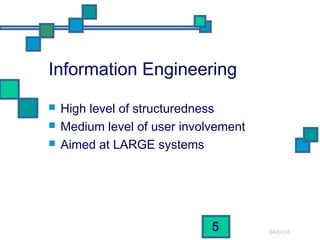
Information Engineering
 High level of structuredness
 Medium level of user involvement
 Aimed at LARGE systems
24/07/16
6
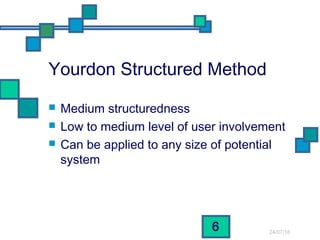
Yourdon Structured Method
 Medium structuredness
 Low to medium level of user involvement
 Can be applied to any size of potential
system
24/07/16
7
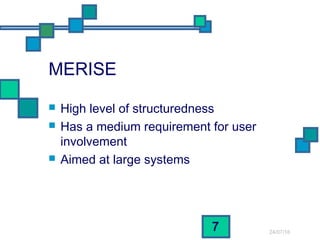
MERISE
 High level of structuredness
 Has a medium requirement for user
involvement
 Aimed at large systems
24/07/16
8
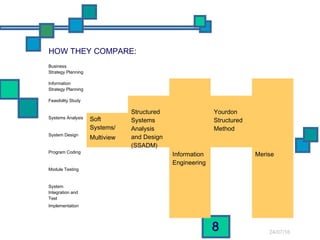
HOW THEY COMPARE:
Business
Strategy Planning
Information
Strategy Planning
Information
Engineering
Merise
Feasibility Study
Structured
Systems
Analysis
and Design
(SSADM)
Yourdon
Structured
Method
Systems Analysis Soft
Systems/
MultiviewSystem Design
Program Coding
Module Testing
System
Integration and
Test
Implementation
24/07/16
9
How they compare
 Apart from MERISE they all use dataflow
diagramming as a tool
 All methods use Entity Modelling
 All methods use Normalisation
 All methods formally include Prototyping
24/07/16
10
How they compare
 SSADM and Yourdon use Structure
diagrams/charts
 SSADM, IE, Yourdon and MERISE break
down a problem by using progressively
lower level diagrams to model the
situation
 Apart from notation, application of
diagrams is the same
24/07/16
11
Post Analysis………..
 RAD (Rapid Applications Development)
 UML (Unified Modeling Language)
24/07/16
12
RAD (Rapid Applications
Development)
 A development methodology that
relies on prototypes, working or
experimental models of a system.
24/07/16
13
RAD (Rapid Applications
Development)
1. Define the problem and identify
system requirements
2. Build the initial prototype
3. Use the prototype to refine existing
requirements
4. Revise and enhance the prototype
24/07/16
14
RAD (Rapid Applications
Development)
 Well suited for noncritical (or generic)
applications such as word processing,
financial analysis, inventory control,
scheduling project management
24/07/16
15
RAD (Rapid Applications
Development)
 Low in terms of its structuredness
 High level of user involvement in the
process
24/07/16
16
UML (Unified Modeling
Language)
 It is methodology-independent. Regardless of
the methodology that you use to perform your
analysis and design, you can use UML to
express the results.
 Modeling is the only way to visualize your
design and check it against requirements before
your crew starts to code
 Structural Diagrams include the Class
Diagram, Object Diagram, Component Diagram,
and Deployment Diagram

Systems analysis methodologies(white)