System Analysis and Design
Dr. G.Murugeswari
Asst. Prof. of CSE Dept.
MS University, Tirunelveli
2-Feb-18 1
System Analysis and Design
• Systems Development Life Cycle
• Planning
• Analysis
• Design
• Implementation
2-Feb-18 2
System Analysis and Design
• Systems Development Methodologies
• Process-Centered
• Data-Centered
Object oriented incorporates both into one model
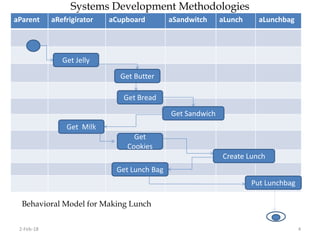
Example : Behavioral Model for Making Lunch
2-Feb-18 3
Systems Development Methodologies
aParent aRefrigirator aCupboard aSandwitch aLunch aLunchbag
Get Jelly
Get Butter
Get Bread
Get Sandwich
Get Milk
Create Lunch
Get
Cookies
Get Lunch Bag
Put Lunchbag
Behavioral Model for Making Lunch
2-Feb-18 4
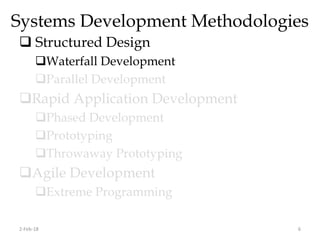
Systems Development Methodologies
 Structured Design
Waterfall Development
Parallel Development
Rapid Application Development
Phased Development
Prototyping
Throwaway Prototyping
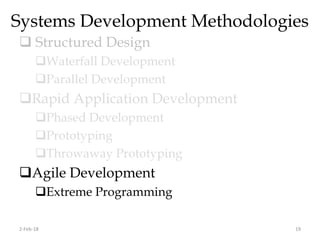
Agile Development
Extreme Programming
2-Feb-18 5
Systems Development Methodologies
 Structured Design
Waterfall Development
Parallel Development
Rapid Application Development
Phased Development
Prototyping
Throwaway Prototyping
Agile Development
Extreme Programming
2-Feb-18 6
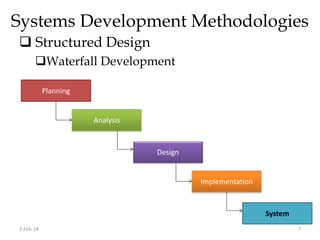
Systems Development Methodologies
 Structured Design
Waterfall Development
Planning
Analysis
Design
Implementation
System
2-Feb-18 7
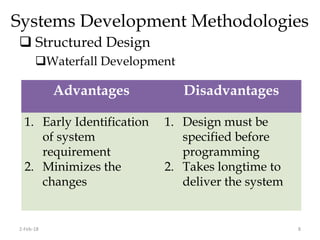
Systems Development Methodologies
 Structured Design
Waterfall Development
Advantages Disadvantages
1. Early Identification
of system
requirement
2. Minimizes the
changes
1. Design must be
specified before
programming
2. Takes longtime to
deliver the system
2-Feb-18 8
Systems Development Methodologies
 Structured Design
Waterfall Development
Parallel Development
Rapid Application Development
Phased Development
Prototyping
Throwaway Prototyping
Agile Development
Extreme Programming
2-Feb-18 9
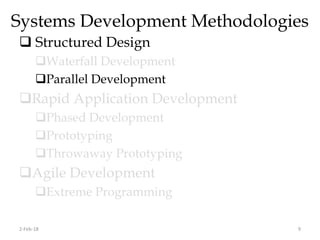
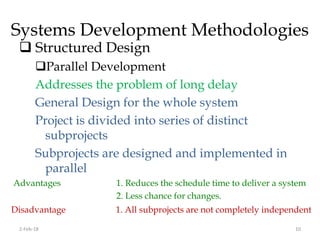
Systems Development Methodologies
 Structured Design
Parallel Development
Addresses the problem of long delay
General Design for the whole system
Project is divided into series of distinct
subprojects
Subprojects are designed and implemented in
parallel
Advantages 1. Reduces the schedule time to deliver a system
2. Less chance for changes.
Disadvantage 1. All subprojects are not completely independent
2-Feb-18 10
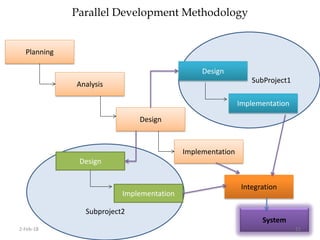
Subproject2
SubProject1
Parallel Development Methodology
Planning
Analysis
Design
Implementation
Integration
Design
Implementation
Design
Implementation
System
2-Feb-18 11
Systems Development Methodologies
 Structured Design
Waterfall Development
Parallel Development
Rapid Application Development
Phased Development
Prototyping
Throwaway Prototyping
Agile Development
Extreme Programming
2-Feb-18 12
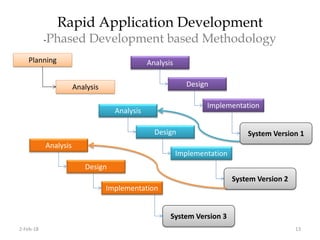
Rapid Application Development
-Phased Development based Methodology
Planning
Analysis
Analysis
Design
Implementation
Analysis
Design
Implementation
System Version 1
System Version 2
Analysis
Design
Implementation
System Version 3
2-Feb-18 13
Rapid Application Development
-Phased Development based Methodology
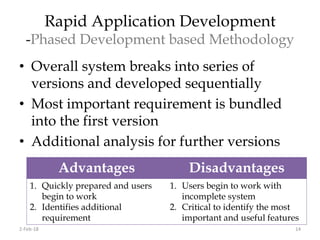
• Overall system breaks into series of
versions and developed sequentially
• Most important requirement is bundled
into the first version
• Additional analysis for further versions
Advantages Disadvantages
1. Quickly prepared and users
begin to work
2. Identifies additional
requirement
1. Users begin to work with
incomplete system
2. Critical to identify the most
important and useful features
2-Feb-18 14
Rapid Application Development
-Prototyping
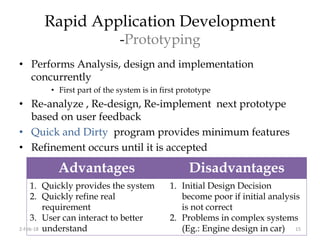
• Performs Analysis, design and implementation
concurrently
• First part of the system is in first prototype
• Re-analyze , Re-design, Re-implement next prototype
based on user feedback
• Quick and Dirty program provides minimum features
• Refinement occurs until it is accepted
Advantages Disadvantages
1. Quickly provides the system
2. Quickly refine real
requirement
3. User can interact to better
understand
1. Initial Design Decision
become poor if initial analysis
is not correct
2. Problems in complex systems
(Eg.: Engine design in car)2-Feb-18 15
Rapid Application Development
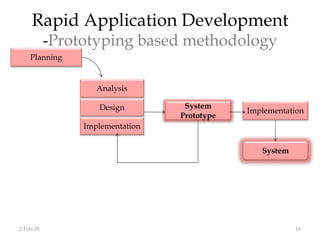
-Prototyping based methodology
2-Feb-18 16
Planning
Analysis
ImplementationDesign
Implementation
System
Prototype
System
Rapid Application Development
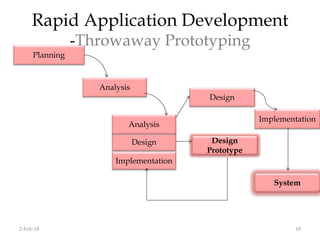
-Throwaway Prototyping
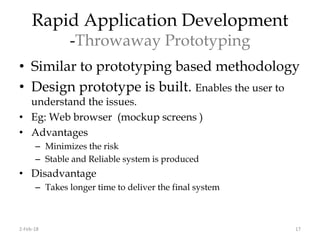
• Similar to prototyping based methodology
• Design prototype is built. Enables the user to
understand the issues.
• Eg: Web browser (mockup screens )
• Advantages
– Minimizes the risk
– Stable and Reliable system is produced
• Disadvantage
– Takes longer time to deliver the final system
2-Feb-18 17
Rapid Application Development
-Throwaway Prototyping
2-Feb-18 18
Planning
Analysis
Implementation
Design
System
Design
Implementation
Analysis
Design
Prototype
Systems Development Methodologies
 Structured Design
Waterfall Development
Parallel Development
Rapid Application Development
Phased Development
Prototyping
Throwaway Prototyping
Agile Development
Extreme Programming
2-Feb-18 19
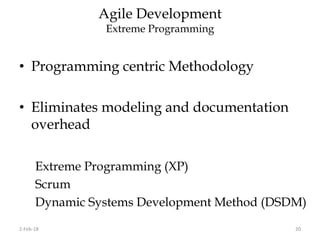
Agile Development
Extreme Programming
• Programming centric Methodology
• Eliminates modeling and documentation
overhead
Extreme Programming (XP)
Scrum
Dynamic Systems Development Method (DSDM)
2-Feb-18 20
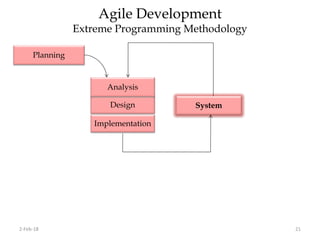
Agile Development
Extreme Programming Methodology
2-Feb-18 21
Design
Implementation
Analysis
Planning
System
Agile Development
Extreme Programming Methodology
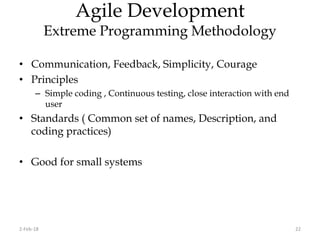
• Communication, Feedback, Simplicity, Courage
• Principles
– Simple coding , Continuous testing, close interaction with end
user
• Standards ( Common set of names, Description, and
coding practices)
• Good for small systems
2-Feb-18 22
Selection of Methodology
2-Feb-18 23
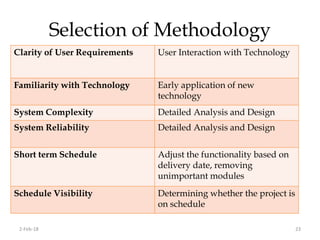
Clarity of User Requirements User Interaction with Technology
Familiarity with Technology Early application of new
technology
System Complexity Detailed Analysis and Design
System Reliability Detailed Analysis and Design
Short term Schedule Adjust the functionality based on
delivery date, removing
unimportant modules
Schedule Visibility Determining whether the project is
on schedule
Selection of Methodology
2-Feb-18 24
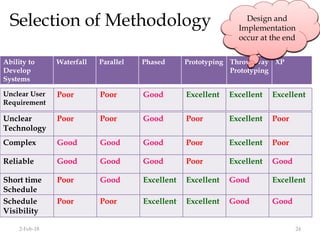
Ability to
Develop
Systems
Waterfall Parallel Phased Prototyping Throwaway
Prototyping
XP
Unclear User
Requirement
Poor Poor Good Excellent Excellent Excellent
Provides
Prototypes for
users to interact
early
Unclear
Technology
Poor Poor Good Poor Excellent Poor
Encourage the
developers to
develop design
for high risk
area
Complex Good Good Good Poor Excellent Poor
Provides
prototypes and
keys issues are
overlooked
Reliable Good Good Good Poor Excellent Good
Test many
approaches
through design
Short time
Schedule
Poor Good Excellent Excellent Good Excellent
Enable the
project team to
adjust the
functionalities
Schedule
Visibility
Poor Poor Excellent Excellent Good Good
Design and
Implementation
occur at the end
Project Team Roles and Skills
2-Feb-18 25
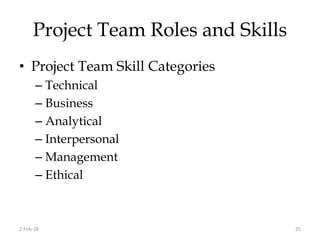
• Project Team Skill Categories
– Technical
– Business
– Analytical
– Interpersonal
– Management
– Ethical
Project Team Skills
2-Feb-18 26
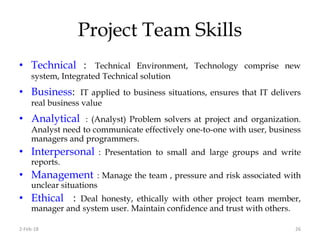
• Technical : Technical Environment, Technology comprise new
system, Integrated Technical solution
• Business: IT applied to business situations, ensures that IT delivers
real business value
• Analytical : (Analyst) Problem solvers at project and organization.
Analyst need to communicate effectively one-to-one with user, business
managers and programmers.
• Interpersonal : Presentation to small and large groups and write
reports.
• Management : Manage the team , pressure and risk associated with
unclear situations
• Ethical : Deal honesty, ethically with other project team member,
manager and system user. Maintain confidence and trust with others.
Project Team Roles
• Project Team Roles
– Business Analyst
– System Analyst
– Infrastructure Analyst
– Change Management Analyst
– Project Manager
2-Feb-18 27
Project Team Roles
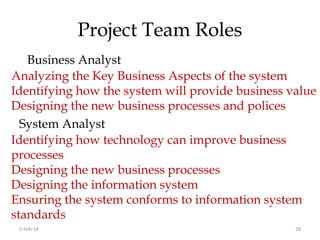
Business Analyst
2-Feb-18 28
Analyzing the Key Business Aspects of the system
Identifying how the system will provide business value
Designing the new business processes and polices
System Analyst
Identifying how technology can improve business
processes
Designing the new business processes
Designing the information system
Ensuring the system conforms to information system
standards
Project Team Roles
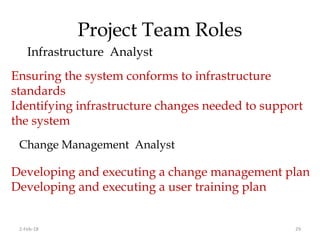
Infrastructure Analyst
2-Feb-18 29
Ensuring the system conforms to infrastructure
standards
Identifying infrastructure changes needed to support
the system
Change Management Analyst
Developing and executing a change management plan
Developing and executing a user training plan
Project Team Roles
Project Manager
2-Feb-18 30
Managing the team of analyst, programmers, technical
writers and other specialist
Developing and monitoring the project plan
Assigning resources
Serving as primary point of contact for the project
Reference
• System Analysis and Design with UML Version
2.0 Alan Dennis, Barbara Haley Wixom ,David Tegarden Wiley Publisher
2-Feb-18 31
Thank You
2-Feb-18 32

OOAD - System Analysis and Design

  • 1.
    System Analysis andDesign Dr. G.Murugeswari Asst. Prof. of CSE Dept. MS University, Tirunelveli 2-Feb-18 1
  • 2.
    System Analysis andDesign • Systems Development Life Cycle • Planning • Analysis • Design • Implementation 2-Feb-18 2
  • 3.
    System Analysis andDesign • Systems Development Methodologies • Process-Centered • Data-Centered Object oriented incorporates both into one model Example : Behavioral Model for Making Lunch 2-Feb-18 3
  • 4.
    Systems Development Methodologies aParentaRefrigirator aCupboard aSandwitch aLunch aLunchbag Get Jelly Get Butter Get Bread Get Sandwich Get Milk Create Lunch Get Cookies Get Lunch Bag Put Lunchbag Behavioral Model for Making Lunch 2-Feb-18 4
  • 5.
    Systems Development Methodologies Structured Design Waterfall Development Parallel Development Rapid Application Development Phased Development Prototyping Throwaway Prototyping Agile Development Extreme Programming 2-Feb-18 5
  • 6.
    Systems Development Methodologies Structured Design Waterfall Development Parallel Development Rapid Application Development Phased Development Prototyping Throwaway Prototyping Agile Development Extreme Programming 2-Feb-18 6
  • 7.
    Systems Development Methodologies Structured Design Waterfall Development Planning Analysis Design Implementation System 2-Feb-18 7
  • 8.
    Systems Development Methodologies Structured Design Waterfall Development Advantages Disadvantages 1. Early Identification of system requirement 2. Minimizes the changes 1. Design must be specified before programming 2. Takes longtime to deliver the system 2-Feb-18 8
  • 9.
    Systems Development Methodologies Structured Design Waterfall Development Parallel Development Rapid Application Development Phased Development Prototyping Throwaway Prototyping Agile Development Extreme Programming 2-Feb-18 9
  • 10.
    Systems Development Methodologies Structured Design Parallel Development Addresses the problem of long delay General Design for the whole system Project is divided into series of distinct subprojects Subprojects are designed and implemented in parallel Advantages 1. Reduces the schedule time to deliver a system 2. Less chance for changes. Disadvantage 1. All subprojects are not completely independent 2-Feb-18 10
  • 11.
  • 12.
    Systems Development Methodologies Structured Design Waterfall Development Parallel Development Rapid Application Development Phased Development Prototyping Throwaway Prototyping Agile Development Extreme Programming 2-Feb-18 12
  • 13.
    Rapid Application Development -PhasedDevelopment based Methodology Planning Analysis Analysis Design Implementation Analysis Design Implementation System Version 1 System Version 2 Analysis Design Implementation System Version 3 2-Feb-18 13
  • 14.
    Rapid Application Development -PhasedDevelopment based Methodology • Overall system breaks into series of versions and developed sequentially • Most important requirement is bundled into the first version • Additional analysis for further versions Advantages Disadvantages 1. Quickly prepared and users begin to work 2. Identifies additional requirement 1. Users begin to work with incomplete system 2. Critical to identify the most important and useful features 2-Feb-18 14
  • 15.
    Rapid Application Development -Prototyping •Performs Analysis, design and implementation concurrently • First part of the system is in first prototype • Re-analyze , Re-design, Re-implement next prototype based on user feedback • Quick and Dirty program provides minimum features • Refinement occurs until it is accepted Advantages Disadvantages 1. Quickly provides the system 2. Quickly refine real requirement 3. User can interact to better understand 1. Initial Design Decision become poor if initial analysis is not correct 2. Problems in complex systems (Eg.: Engine design in car)2-Feb-18 15
  • 16.
    Rapid Application Development -Prototypingbased methodology 2-Feb-18 16 Planning Analysis ImplementationDesign Implementation System Prototype System
  • 17.
    Rapid Application Development -ThrowawayPrototyping • Similar to prototyping based methodology • Design prototype is built. Enables the user to understand the issues. • Eg: Web browser (mockup screens ) • Advantages – Minimizes the risk – Stable and Reliable system is produced • Disadvantage – Takes longer time to deliver the final system 2-Feb-18 17
  • 18.
    Rapid Application Development -ThrowawayPrototyping 2-Feb-18 18 Planning Analysis Implementation Design System Design Implementation Analysis Design Prototype
  • 19.
    Systems Development Methodologies Structured Design Waterfall Development Parallel Development Rapid Application Development Phased Development Prototyping Throwaway Prototyping Agile Development Extreme Programming 2-Feb-18 19
  • 20.
    Agile Development Extreme Programming •Programming centric Methodology • Eliminates modeling and documentation overhead Extreme Programming (XP) Scrum Dynamic Systems Development Method (DSDM) 2-Feb-18 20
  • 21.
    Agile Development Extreme ProgrammingMethodology 2-Feb-18 21 Design Implementation Analysis Planning System
  • 22.
    Agile Development Extreme ProgrammingMethodology • Communication, Feedback, Simplicity, Courage • Principles – Simple coding , Continuous testing, close interaction with end user • Standards ( Common set of names, Description, and coding practices) • Good for small systems 2-Feb-18 22
  • 23.
    Selection of Methodology 2-Feb-1823 Clarity of User Requirements User Interaction with Technology Familiarity with Technology Early application of new technology System Complexity Detailed Analysis and Design System Reliability Detailed Analysis and Design Short term Schedule Adjust the functionality based on delivery date, removing unimportant modules Schedule Visibility Determining whether the project is on schedule
  • 24.
    Selection of Methodology 2-Feb-1824 Ability to Develop Systems Waterfall Parallel Phased Prototyping Throwaway Prototyping XP Unclear User Requirement Poor Poor Good Excellent Excellent Excellent Provides Prototypes for users to interact early Unclear Technology Poor Poor Good Poor Excellent Poor Encourage the developers to develop design for high risk area Complex Good Good Good Poor Excellent Poor Provides prototypes and keys issues are overlooked Reliable Good Good Good Poor Excellent Good Test many approaches through design Short time Schedule Poor Good Excellent Excellent Good Excellent Enable the project team to adjust the functionalities Schedule Visibility Poor Poor Excellent Excellent Good Good Design and Implementation occur at the end
  • 25.
    Project Team Rolesand Skills 2-Feb-18 25 • Project Team Skill Categories – Technical – Business – Analytical – Interpersonal – Management – Ethical
  • 26.
    Project Team Skills 2-Feb-1826 • Technical : Technical Environment, Technology comprise new system, Integrated Technical solution • Business: IT applied to business situations, ensures that IT delivers real business value • Analytical : (Analyst) Problem solvers at project and organization. Analyst need to communicate effectively one-to-one with user, business managers and programmers. • Interpersonal : Presentation to small and large groups and write reports. • Management : Manage the team , pressure and risk associated with unclear situations • Ethical : Deal honesty, ethically with other project team member, manager and system user. Maintain confidence and trust with others.
  • 27.
    Project Team Roles •Project Team Roles – Business Analyst – System Analyst – Infrastructure Analyst – Change Management Analyst – Project Manager 2-Feb-18 27
  • 28.
    Project Team Roles BusinessAnalyst 2-Feb-18 28 Analyzing the Key Business Aspects of the system Identifying how the system will provide business value Designing the new business processes and polices System Analyst Identifying how technology can improve business processes Designing the new business processes Designing the information system Ensuring the system conforms to information system standards
  • 29.
    Project Team Roles InfrastructureAnalyst 2-Feb-18 29 Ensuring the system conforms to infrastructure standards Identifying infrastructure changes needed to support the system Change Management Analyst Developing and executing a change management plan Developing and executing a user training plan
  • 30.
    Project Team Roles ProjectManager 2-Feb-18 30 Managing the team of analyst, programmers, technical writers and other specialist Developing and monitoring the project plan Assigning resources Serving as primary point of contact for the project
  • 31.
    Reference • System Analysisand Design with UML Version 2.0 Alan Dennis, Barbara Haley Wixom ,David Tegarden Wiley Publisher 2-Feb-18 31
  • 32.