Levels Of Testing
o Unit Testing
o Integration Testing
o System Testing
o User Acceptance Testing
 Software Testing is done at various stages of SDLC (comprising varied scope) to ensure
that the software/product meets the requirement specifications at each stage.
 Scope of testing at each level is different.
 Various Levels of Testing are:
– Unit Testing (Component Testing)
– Integration Testing
– System Testing
– User Acceptance Testing
Levels Of Testing
 Individual units of source code are tested to determine if it conforms to the technical
specification document.
 The smallest unit of code will be tested. For instance, individual program, function
stored procedure.
 In object-oriented programming, the smallest unit is a method, which belongs to
base/super class/abstract class/derived child class.
 The field validations, presence of menu controls & layout of the page are tested with
different inputs after coding /UI Design.
 Code is executed & tested to ensure that each line of code is run for the required unit test
cases.
Unit Testing
 Lowest level of testing
 Part of the construction phase of the SDLC
 Done once coding for the unit or program is completed
 Generally performed using White Box Testing
Unit Testing
 Who performs it?
 Unit Testing is generally performed by software developers themselves or their peers
 Test Artefacts created are:
– Unit Test case documents
– Unit Test Logs
– Unit Testing Defect report
Unit Testing
 Entry Criteria :
– Unit Test Plan is baseline
– Coding is completed
– Code is reviewed and baseline (optional)
 Exit Criteria :
– 100% statement coverage
– Acceptable (predetermined) levels of code coverage obtained
Unit Testing
 Integration testing is done to check the dataflow between the modules(components or units) or between the
systems.
 Integration testing is categorized into two:
– Unit Integration Testing
– System Integration Testing
Integration Testing
 The individual software modules/pages are integrated and tested for their functionalities
as one single unit.
 Ensures that the individual units work together as a whole and the data flows (back and
forth) across the units as per the requirement specification.
 Done after two or more programs or application components have been
successfully unit tested.
 Any black box, white box testing methodology can be used to test.
 Also referred to as Assembly Testing and API Testing.
Unit Integration Testing
 Entry Criteria
– Integration Test Plan is base-lined
– Code and unit testing is completed
– Unit test errors are fixed and verified
– Code is reviewed and base-lined
 Exit Criteria :
– 100% thread coverage achieved
 There are two types of integration testing
– Incremental testing
 Continuous testing of an application as new functionality is added
– Non-incremental testing
 Testing of combined parts of an application to determine if they function together correctly
Unit Integration Testing
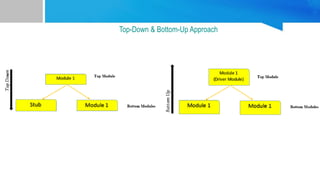
 Depends upon organization we have different approaches which are
– Top-Down Approach
– Bottom-Up Approach
– Sandwich Approach
– Big-Bang Approach
Unit Integration Testing - Approaches
Top-Down & Bottom-Up Approach
 Stubs are dummy pieces of code.
 On the other hand, drivers are the ones, which are the "calling" programs.
 Drivers are dummy code used in bottom up testing approach.
 Drivers are used when the sub modules are ready but the main module is still not ready.
Stubs And Drivers
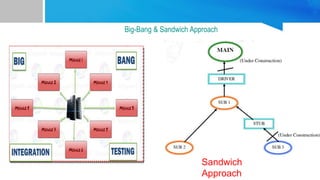
Big-Bang & Sandwich Approach
Sandwich
Approach
 Who performs it?
– Either Developers themselves or independent Testers
 Test Artefacts created are:
– Component Integration Test case documents
– Component Integration Test Logs
– Component Integration Testing Defect report
Unit Integration Testing
 Testing of Complete, integrated system/software.
 Performed on the entire system where the system is validated against the Functional
Requirement Specification(s) (FRS) and/or a System Requirement Specification
(SRS).
 Black box Testing is preferred to carry out the system testing.
 Defects that are missed to be caught in the unit, Assembly testing are uncovered.
 Some of the scenarios will be covered for test only during system testing.
 Individual modules may work as desired but may fail as a system – this can be
uncovered during system testing.
System Testing
 Who performs it?
– Performed by an independent Testing team
 Test artefacts created are :
– System Test case documents
– System Test Logs
– System Testing Defect report
System Testing
 Carried out to check if the system works in conjunction with the other
systems/interfaces(as below) and the data flows across them as desired:
 LAN/WAN, communications middleware
 Other internal systems (billing, stock, personnel, overnight batch, branch offices, other
countries)
 External systems (stock exchange, news, suppliers)
 Intranet, internet / www
 Third party packages
 Electronic data interchange (EDI)
 Printers
 Generally performed after System Testing or in parallel.
System Integration Testing
 Risk Based:
 Identify the System Integration points that are critical to the business
 Prioritize them and test sequentially
 “Divide and conquer”:
 Test the outside first (at the interface to your system, e.g. test a package on its own)
 Test the connections one at a time first (your system and one other)
 Combine incrementally - safer than “big bang” (non-incremental)
System Integration Testing - Approaches
 Who performs System Integration Testing?
 Independent testing team
 Test artefacts created are:
 System Integration Test cases
 System Integration Test logs
 System Integration Testing defect report
System Integration Testing—Methods
 Testing done by end users allowing them to verify day- to-day business scenarios and
validate if the system developments satisfies their needs.
 Validates if the software meets a set of agreed acceptance criteria.
 Validates if the application is fit for deployment.
 Performed generally in the customer’s(more close to the actual) environment.
 Performed after the ST, SIT, or in parallel.
 Helps assure that the Software application meets the needs of the end users/business
or not.
 Helps determine whether to accept a software product.
User Acceptance Testing
 Who performs Acceptance Testing?
 Customers/Business Users/independent testing team (with high business knowledge)
which is identified to augment the customer’s requirements.
 Test artefacts created are:
 Acceptance Test cases
 Acceptance Test logs
 Acceptance Testing defect report
User Acceptance Testing
 It will be performed in two ways
– Alpha Testing
– Beta Testing
User Acceptance Testing
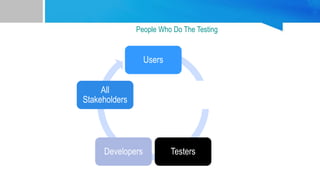
People Who Do The Testing
Users
Customers
Testers
Developers
All
Stakeholders
Unit Testing
Integration Testing
System Testing
User Acceptance Testing
1. Which of these levels of testing is typically done by an independent test team?
Levels Of Testing
Unit Testing
Integration Testing
System Testing
User Acceptance Testing
2. During which of these levels of testing, is the knowledge of programming
languages required?
Levels Of Testing
Unit Testing
Integration Testing
System Testing
User Acceptance Testing
Levels Of Testing
Unit Testing
Integration Testing
System Testing
User Acceptance Testing
Levels Of Testing
Unit Testing
Integration Testing
System Testing
Alpha Testing
Beta Testing
Levels Of Testing
o Unit Testing
o Integration Testing
o System Testing
o User Acceptance Testing

Levels Of Testing.pptx

  • 1.
  • 2.
    o Unit Testing oIntegration Testing o System Testing o User Acceptance Testing
  • 3.
     Software Testingis done at various stages of SDLC (comprising varied scope) to ensure that the software/product meets the requirement specifications at each stage.  Scope of testing at each level is different.  Various Levels of Testing are: – Unit Testing (Component Testing) – Integration Testing – System Testing – User Acceptance Testing Levels Of Testing
  • 4.
     Individual unitsof source code are tested to determine if it conforms to the technical specification document.  The smallest unit of code will be tested. For instance, individual program, function stored procedure.  In object-oriented programming, the smallest unit is a method, which belongs to base/super class/abstract class/derived child class.  The field validations, presence of menu controls & layout of the page are tested with different inputs after coding /UI Design.  Code is executed & tested to ensure that each line of code is run for the required unit test cases. Unit Testing
  • 5.
     Lowest levelof testing  Part of the construction phase of the SDLC  Done once coding for the unit or program is completed  Generally performed using White Box Testing Unit Testing
  • 6.
     Who performsit?  Unit Testing is generally performed by software developers themselves or their peers  Test Artefacts created are: – Unit Test case documents – Unit Test Logs – Unit Testing Defect report Unit Testing
  • 7.
     Entry Criteria: – Unit Test Plan is baseline – Coding is completed – Code is reviewed and baseline (optional)  Exit Criteria : – 100% statement coverage – Acceptable (predetermined) levels of code coverage obtained Unit Testing
  • 8.
     Integration testingis done to check the dataflow between the modules(components or units) or between the systems.  Integration testing is categorized into two: – Unit Integration Testing – System Integration Testing Integration Testing
  • 9.
     The individualsoftware modules/pages are integrated and tested for their functionalities as one single unit.  Ensures that the individual units work together as a whole and the data flows (back and forth) across the units as per the requirement specification.  Done after two or more programs or application components have been successfully unit tested.  Any black box, white box testing methodology can be used to test.  Also referred to as Assembly Testing and API Testing. Unit Integration Testing
  • 10.
     Entry Criteria –Integration Test Plan is base-lined – Code and unit testing is completed – Unit test errors are fixed and verified – Code is reviewed and base-lined  Exit Criteria : – 100% thread coverage achieved  There are two types of integration testing – Incremental testing  Continuous testing of an application as new functionality is added – Non-incremental testing  Testing of combined parts of an application to determine if they function together correctly Unit Integration Testing
  • 11.
     Depends uponorganization we have different approaches which are – Top-Down Approach – Bottom-Up Approach – Sandwich Approach – Big-Bang Approach Unit Integration Testing - Approaches
  • 12.
  • 13.
     Stubs aredummy pieces of code.  On the other hand, drivers are the ones, which are the "calling" programs.  Drivers are dummy code used in bottom up testing approach.  Drivers are used when the sub modules are ready but the main module is still not ready. Stubs And Drivers
  • 14.
    Big-Bang & SandwichApproach Sandwich Approach
  • 15.
     Who performsit? – Either Developers themselves or independent Testers  Test Artefacts created are: – Component Integration Test case documents – Component Integration Test Logs – Component Integration Testing Defect report Unit Integration Testing
  • 16.
     Testing ofComplete, integrated system/software.  Performed on the entire system where the system is validated against the Functional Requirement Specification(s) (FRS) and/or a System Requirement Specification (SRS).  Black box Testing is preferred to carry out the system testing.  Defects that are missed to be caught in the unit, Assembly testing are uncovered.  Some of the scenarios will be covered for test only during system testing.  Individual modules may work as desired but may fail as a system – this can be uncovered during system testing. System Testing
  • 17.
     Who performsit? – Performed by an independent Testing team  Test artefacts created are : – System Test case documents – System Test Logs – System Testing Defect report System Testing
  • 18.
     Carried outto check if the system works in conjunction with the other systems/interfaces(as below) and the data flows across them as desired:  LAN/WAN, communications middleware  Other internal systems (billing, stock, personnel, overnight batch, branch offices, other countries)  External systems (stock exchange, news, suppliers)  Intranet, internet / www  Third party packages  Electronic data interchange (EDI)  Printers  Generally performed after System Testing or in parallel. System Integration Testing
  • 19.
     Risk Based: Identify the System Integration points that are critical to the business  Prioritize them and test sequentially  “Divide and conquer”:  Test the outside first (at the interface to your system, e.g. test a package on its own)  Test the connections one at a time first (your system and one other)  Combine incrementally - safer than “big bang” (non-incremental) System Integration Testing - Approaches
  • 20.
     Who performsSystem Integration Testing?  Independent testing team  Test artefacts created are:  System Integration Test cases  System Integration Test logs  System Integration Testing defect report System Integration Testing—Methods
  • 21.
     Testing doneby end users allowing them to verify day- to-day business scenarios and validate if the system developments satisfies their needs.  Validates if the software meets a set of agreed acceptance criteria.  Validates if the application is fit for deployment.  Performed generally in the customer’s(more close to the actual) environment.  Performed after the ST, SIT, or in parallel.  Helps assure that the Software application meets the needs of the end users/business or not.  Helps determine whether to accept a software product. User Acceptance Testing
  • 22.
     Who performsAcceptance Testing?  Customers/Business Users/independent testing team (with high business knowledge) which is identified to augment the customer’s requirements.  Test artefacts created are:  Acceptance Test cases  Acceptance Test logs  Acceptance Testing defect report User Acceptance Testing
  • 23.
     It willbe performed in two ways – Alpha Testing – Beta Testing User Acceptance Testing
  • 24.
    People Who DoThe Testing Users Customers Testers Developers All Stakeholders
  • 25.
    Unit Testing Integration Testing SystemTesting User Acceptance Testing 1. Which of these levels of testing is typically done by an independent test team? Levels Of Testing
  • 26.
    Unit Testing Integration Testing SystemTesting User Acceptance Testing 2. During which of these levels of testing, is the knowledge of programming languages required? Levels Of Testing
  • 27.
    Unit Testing Integration Testing SystemTesting User Acceptance Testing Levels Of Testing
  • 28.
    Unit Testing Integration Testing SystemTesting User Acceptance Testing Levels Of Testing
  • 29.
    Unit Testing Integration Testing SystemTesting Alpha Testing Beta Testing Levels Of Testing
  • 30.
    o Unit Testing oIntegration Testing o System Testing o User Acceptance Testing

Editor's Notes

  • #13 Notes: Top-Down Approach:- An approach where top level units are tested first and lower level units are tested step by step after that. Used when top down development approach is followed. Test Stubs are needed to simulate lower level units which may not be available during the initial phases. Bottom-Up Approach:- An approach where bottom most units are tested first and then move upwards step by step. Used when bottom up development approach is followed. Test Drivers are needed to simulate higher level units which may not be available during the initial phases.
  • #15 Notes: Big-Bang Approach:- An approach where all or most of the units are combined together and tested at one go. Used when the testing team receives the entire software in a bundle. Most of the defects can be uncovered early in the test process. Sandwich Approach:- It is an approach to combine top down testing with bottom up testing. It requires both Stub & Driver
  • #24 Notes: Alpha Testing: Alpha Testing is done by the client at developers environment. It will be carried out with the help of virtual environment Beta Testing: It is carried out by the end users/ client at real environment(production environment) It will be get carried out at the place where application will be get deployed
  • #26 Answer: Integration Testing
  • #27 Answer: Unit Testing
  • #28 Answer: Integration Testing
  • #29 Answer: User Acceptance Testing
  • #30 Answer: Beta Testing