System Analysis, Design andSystem Analysis, Design and
DevelopmentDevelopment
Dr. Samir I. Mostafa
www.analysthome.com
An Introduction
Dr. Samir Iamail Mostafa © 2006. analysthome.com
2
1.Introducing System:
• Systems Concept
• Development Approaches
2. System Development:
• Planning for System Development
• Data Modeling & Management
3. Information & Management
• Process Modeling
•Information Management
System Analysis, Design andSystem Analysis, Design and
DevelopmentDevelopment
Dr. Samir Iamail Mostafa © 2006. analysthome.com
3
1.Introducing System
Why System Analysis?
To solve a problem we need to analyze it
Problems need to be defined first
We are surrounded by real life problems, it
take many shapes and forms, and we only see
its effects and consequences.
Organizational problems often handled by
managers and problems comes from within the
organization or from outside.
Dr. Samir Iamail Mostafa © 2006. analysthome.com
4
Why System Analysis?
Managers should rely on information, as
managers do not manage assets or people.
Managers manage the information related to
assets or people.
Information, comes from data and used to
build knowledge to make managers job easy.
It also brings the wisdom to help managers
predict problems before it happen.
Dr. Samir Iamail Mostafa © 2006. analysthome.com
5
Why System Analysis?
Solving a problem results in business
improvement.
Also improving the business requires solving
problems affecting its grow.
Computer is only a powerful tool to process data
and information, the rest still depends on how we
formulate the problem and make progress in
solving it.
Managers need to think in a better ways to solve
organization problems
Dr. Samir Iamail Mostafa © 2006. analysthome.com
6
System Concept:
System thinking: The way we formulate the
problem in order to deal with the “whole”
System practice: when system thinking is
applied on real world problems.
System approach: when we take a broad view
which takes all aspect of the problem into
account, with the interaction between parts.
Dr. Samir Iamail Mostafa © 2006. analysthome.com
7
System Concept:
System is a way of thinking about organization
and their problems. It also involve set of
techniques that help in solving problems.
A System is an orderly grouping of
interdependent components linked together
according to a plan to achieve a specific
objectives. No one way to consider these
components.
Dr. Samir Iamail Mostafa © 2006. analysthome.com
8
System Definition:
System:
– Must be designed to achieve a predetermined
objectives.
– Interrelationship and interdependent must exist
among components.
– Always, the objectives of the system as a whole
have a higher priority that objectives of
components. and their problems.
Dr. Samir Iamail Mostafa © 2006. analysthome.com
9
SYSTEM:
System is an abstraction for dealing with
problems
It is a conceptualization and formulation for
solutions and problems
It is a way of thinking
It is not limited our bounded by physical
constraints, only limited by human mind
Has its roots in the “General System Theory”
originated in 1940 by Bertalanffy.
Dr. Samir Iamail Mostafa © 2006. analysthome.com
10
SYSTEM:
To deal with system as a subject it is developed
through its:
– Definition
– Characteristics
– Elements
– Classifications
– Language
– Methodologies
Dr. Samir Iamail Mostafa © 2006. analysthome.com
11
System Characteristics:
System with its definition definition has six main
characteristics:
– Organization
– Interaction
– Interdependence
– Interaction
– Integration
– Central objectives
Dr. Samir Iamail Mostafa © 2006. analysthome.com
12
System Elements::
• Input / output
• Processor
• Control
• Feedback
• Environment
• Boundary and Interface
• Organization Culture (at the heart of social systems)
Dr. Samir Iamail Mostafa © 2006. analysthome.com
13
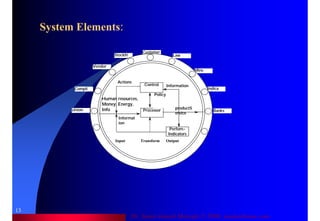
System Elements::
Banks
Indica
Mins
Customer
Vendor
Stockhl
Compit
Law
Union Processor
productS
ervice
Human resources,
Money, Energy,
Info
Informat
ion
Control
Policy
Perfom-
Indicators
Information
Actions
Input Transform Output
Dr. Samir Iamail Mostafa © 2006. analysthome.com
14
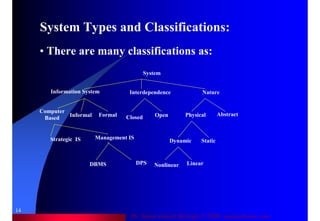
System Types and Classifications:
System
NatureInterdependence
AbstractPhysicalOpenFormalInformal
Computer
Based
StaticDynamic
LinearNonlinear
Management IS
DPSDBMS
Closed
Strategic IS
Information System
• There are many classifications as:
Dr. Samir Iamail Mostafa © 2006. analysthome.com
15
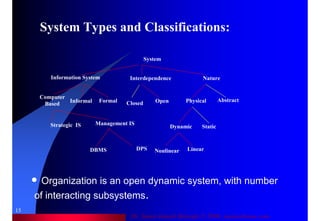
System Types and Classifications:
System
NatureInterdependence
AbstractPhysicalOpenFormalInformal
Computer
Based
StaticDynamic
LinearNonlinear
Management IS
DPSDBMS
Closed
Strategic IS
Information System
• Organization is an open dynamic system, with number
of interacting subsystems.
Dr. Samir Iamail Mostafa © 2006. analysthome.com
16
Information System:
System deals with three categories of
information
– Strategic: long term for planning and policy
– Managerial: for implementation and control
– Operational: short term daily control.
It also develops informal information which is
an employee-based system formed to meet
personnel and vocational needs, and to help
solve work related problems.
Dr. Samir Iamail Mostafa © 2006. analysthome.com
17
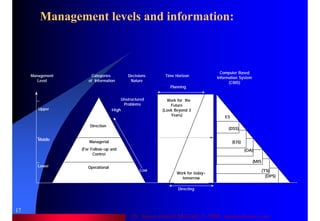
Management levels and information:
Low
Operational
(Detailed)
Managerial
(For Follow-up and
Control
Strategic
(Direction /
Vision)
Management
Level
Lower
Middle
Upper
Categories
of Information
Decisions
Nature
Time Horizon
Computer Based
Information System
(CBIS)
Planning
Directing
Unstructured
Problems
Work for the
Future
(Look Beyond 3
Years)
Work for today-
tomorrow
High
(DPS)
(TS)
(MIS)
(OA)
(EIS)
(DSS)
ES
Dr. Samir Iamail Mostafa © 2006. analysthome.com
18
System Language:
With the system movement number of methods were
used to describe systems. This brought the system
language through which models are used now.
The model is a way to express and describe the system,
but it needs tools. Tools may cover mathematical
relationship, drawings, and rules.
System analysis uses models extensively to express the
system components with its interactions, and behavior.
Models become more effective when they are
used methodologically.
Dr. Samir Iamail Mostafa © 2006. analysthome.com
19
Why Do We Need A Methodology?
Systems becomes more complex.
The integrated nature of information shows
itself with the emerging technologies.
Information adds value to the products, so
it needs to be accurately represented.
Information becomes one of the corporate
resources and needs to be managed.
Dr. Samir Iamail Mostafa © 2006. analysthome.com
20
Why Do We Need A Methodology?
High interest rate, and changing
environment put more pressure on
developers.
Maintenance cost becomes a major factor
and should not be ignored.
development is not an art any more, it is a
science (or the art of science!).
Dr. Samir Iamail Mostafa © 2006. analysthome.com
21
Why Do We Need A Methodology?
The cost of software becomes very high,
and system life cycle becomes a major
factor of concern.
In 1993 canceled projects represented
a waste of 14.3 billion and over
285000 effort year in USA.
We can see many development
approaches with many methodologies
emerging during the last 30 years.
Dr. Samir Iamail Mostafa © 2006. analysthome.com
22
More than one thousand methodologies exist in
the literature (in the last 20-30 years)
They can be divided among the following
number of broad approaches:
– Systems - Strategic
– Participative - Prototyping
– Structured - Data
– Object-Oriented - Multi-view
2. Systems Development Approaches:
Dr. Samir Iamail Mostafa © 2006. analysthome.com
23
What is Methodology?
Methodology is a collection of techniques
stemmed from a vision and philosophy, which
cuts through a set of methods covers different
fields of knowledge in order to select the best fit
to solve a problem or set of problems and to
achieve predetermined objectives.
It is also the practical implementation of System
Development Life Cycle (SDLC)
Systems analyst is the person who applies, uses,
and develops methodology suitable for the
circumstances.
Dr. Samir Iamail Mostafa © 2006. analysthome.com
24
What is Methodology?
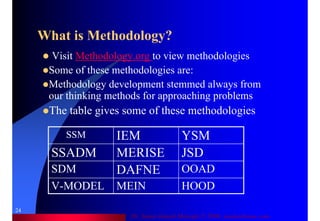
Visit Methodology.org to view methodologies
Some of these methodologies are:
Methodology development stemmed always from
our thinking methods for approaching problems
The table gives some of these methodologies
HOODMEINV-MODEL
OOADDAFNESDM
JSDMERISESSADM
YSMIEMSSM
Dr. Samir Iamail Mostafa © 2006. analysthome.com
25
Systems Engineering and Analysis
Building physical systems generated a great
needs to deal with its engineering which led to
the systems engineering discipline.
These engineering projects required some level
of analysis to justify its cost and economical
feasibility, which led to systems analysis
discipline.
We should remember that organization has
physical and social subsystems
Dr. Samir Iamail Mostafa © 2006. analysthome.com
26
Hard System thinking: Engineering Methodology
Systems engineering comprises set of activities
which lead to the creation of a complex man-
machine entity and/or procedures with its
information flow.
Systems analysis is the systematic appraisal of
the costs and other implications of meeting a
defined requirement in various ways.
Both are research strategy rather than methods
or techniques, and both require art from
practitioner when using scientific methods.
Dr. Samir Iamail Mostafa © 2006. analysthome.com
27
Soft System thinking: Soft Methodology
If a desired state S1 and a present state S0 systems
engineering (SE) defines the needs or objectives as
(S1-S0), and systems analysis (SA) provides an
ordered way to select the best among alternative
systems.
The belief that real-world problems can be
formulated in this way characterizes all ‘hard’
systems thinking whether it comes from SE or SA.
Social system cannot be defined as a goal oriented
system, and requirements cannot be taken as given
without providing a structure for a debate about
change.
Dr. Samir Iamail Mostafa © 2006. analysthome.com
28
Soft / Hard System thinking the Unified Methodology
The author presents a unified methodology to
handle the overall system development life cycle,
Total Unified Methodology (TUM) .
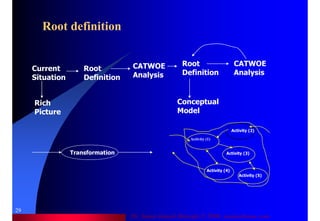
At the start we utilize the SSM with the system
thinking approach where the root definition and the
conceptual model are utilized.
Structured approach is adopted to define the logical
model
Reengineering is the key to develop the new logical
and physical model with the information mapping
Once the process and data model established with
system and process quality matrices, software
engineering is utilized for computerized solution.
Dr. Samir Iamail Mostafa © 2006. analysthome.com
29
Root definition
Current
Situation
Root
Definition
CATWOE
Analysis
Root
Definition
CATWOE
Analysis
Rich
Picture
Conceptual
Model
Transformation
Activity (1)
Activity (2)
Activity (3)
Activity (4)
Activity (5)
Dr. Samir Iamail Mostafa © 2006. analysthome.com
30
3. System development
System development starts with strategic
planning to ensure that system objectives
are congruent with corporate and
business objectives.
It includes strategic plan, master plan,
long term plan, medium term plan.
The aim of system planning is to produce
an integrated system, not separate and
isolated subsystems.
Dr. Samir Iamail Mostafa © 2006. analysthome.com
31
Planning for system development:
Strategic planing: is an on going process
of defining (changing) corporate
objectives for information management,
with strategies and policies of allocating
the resources to achieve these objectives.
Planing here concerns with business
requirements not technology or
departments requirements.
Dr. Samir Iamail Mostafa © 2006. analysthome.com
32
Planning for system development:
Long term planing: concerns with the future
requirements of information system departments.
It concentrates on changing concepts and skills of
users with the changing objectives of the
corporate.
Medium range planning is used to define
corporate needs from information processing
functions by adopting specific projects to be
completed within 3-5 years.
Dr. Samir Iamail Mostafa © 2006. analysthome.com
33
Planning for system development:
Through planing, corporate should answer the
following questions:
What are objectives of information
management?
What are strategies to achieve these objectives?
What is the optimum method to structure and
coordinate efforts to achieve these objectives?
How can we estimate the cost and assess risks in
implementing these efforts?
Dr. Samir Iamail Mostafa © 2006. analysthome.com
34
Planning for system development:
How should processing functions be distributed
among corporate subsystems?
How can business process be transformed (using
IT potentials)?
How can IT support business process?
How much integration is required?
What are direct and indirect impacts between
information management and business efficiency?
How can we evaluate the success of information
management projects in terms of profitability and
quality?
Dr. Samir Iamail Mostafa © 2006. analysthome.com
35
Planning for system development:
Answering these questions will provide a strong
guidance for management team through the
implementation phases of information
management projects.
It touches all aspects of corporate management as
its objectives, policies, structure, as well as
management procedures.
It is clear that early stages of planning is not, and
should not, driven by technical factors, or
technology.
Dr. Samir Iamail Mostafa © 2006. analysthome.com
36
Planning for system development:
One set of deliverables of strategic planning is
corporate model or architecture model, business
model with corporate main information elements
including the present information resources.
Business model includes business process model
and business data model with process/entity
matrix.
The model should reflect the present situation
with the projected new improvement and changes
on the corporate or subsystems levels.
Dr. Samir Iamail Mostafa © 2006. analysthome.com
37
4. Business model and IS models
Business model depicts:
Business process: interlinked activities that
deliver specific outputs to identified customers.
Activity: elements of the BP that the organization
undertakes to the benefits of its business.
Entities: those “things” which carry data or
information required for activity implementation.
Through business process model and entity data
model.
Dr. Samir Iamail Mostafa © 2006. analysthome.com
38
Business model and IS models
On the subsequent levels of modeling and
decomposition the entities become the focus of IS
database models.
IS model includes the following models/diagrams:
– process flow
– hierarchy activity
– data flow
– entity relation
– entity life history
with its supporting documentation.
Dr. Samir Iamail Mostafa © 2006. analysthome.com
39
Automated Tools:
There are wide varieties of (automated) tools
available to help in developing all models such as:
• RAD tools • CASE tools
• DD tools • DBMS tools
Some can automatically generate computer codes
(see tool links at: analyst_corner/analyst.html).
Their benefits include:
Increased productivity in development process,
Produce high quality of software,
Reduced maintenance cost.
Dr. Samir Iamail Mostafa © 2006. analysthome.com
40
IS modeling: Database approach:
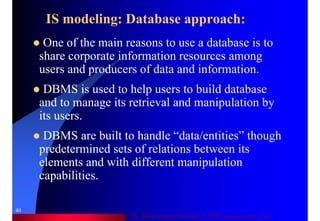
One of the main reasons to use a database is to
share corporate information resources among
users and producers of data and information.
DBMS is used to help users to build database
and to manage its retrieval and manipulation by
its users.
DBMS are built to handle “data/entities” though
predetermined sets of relations between its
elements and with different manipulation
capabilities.
Dr. Samir Iamail Mostafa © 2006. analysthome.com
41
IS modeling: Database approach:
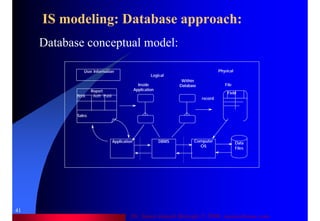
Database conceptual model:
Inside
Application
Within
Database
DBMS Computer
OS
Application Data
Files
Report
Book Auth Publi
Sales
File
record
Field
Logical
PhysicalUser Information
Dr. Samir Iamail Mostafa © 2006. analysthome.com
42
Development phases of Database:
Corporate database is one of the products of its
development efforts. It is produced through
number of development phases of SDLC.
Major development phases include:
– Analysis and logical model development
– Logical design of database
– Physical design of database
The purpose of data analysis is to identify data
required by business model in order to be
rationalized and streamlined between users.
Dr. Samir Iamail Mostafa © 2006. analysthome.com
43
Development phases of Database:
Logical data model development should be
linked and synchronized with BPR, ISO
certification, TQM, and any other improvement
program.
Based on the new and modified business/data
models we develop a logical design of database.
Logical database design goes into the details of
the logical model through:
– Entity relation diagram E-R
– Class- Object relation diagram
Physical design is concerned with the physical
representation of database on corporate network.
Dr. Samir Iamail Mostafa © 2006. analysthome.com
44
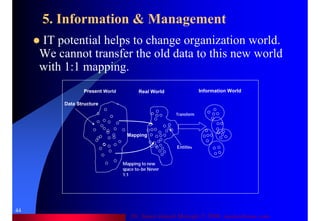
5. Information & Management
IT potential helps to change organization world.
We cannot transfer the old data to this new world
with 1:1 mapping.
Mapping
Mapping to new
space to-be Never
1:1
Present World Real World
Data Structure
Entities
Information World
Transform
Dr. Samir Iamail Mostafa © 2006. analysthome.com
45
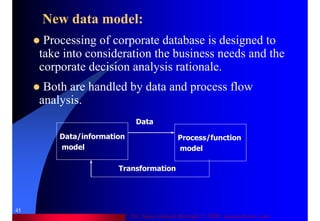
New data model:
Processing of corporate database is designed to
take into consideration the business needs and the
corporate decision analysis rationale.
Both are handled by data and process flow
analysis.
Data/information
model
Process/function
model
Data
Transformation
Dr. Samir Iamail Mostafa © 2006. analysthome.com
46
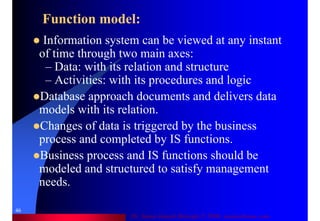
Function model:
Information system can be viewed at any instant
of time through two main axes:
– Data: with its relation and structure
– Activities: with its procedures and logic
Database approach documents and delivers data
models with its relation.
Changes of data is triggered by the business
process and completed by IS functions.
Business process and IS functions should be
modeled and structured to satisfy management
needs.
Dr. Samir Iamail Mostafa © 2006. analysthome.com
47
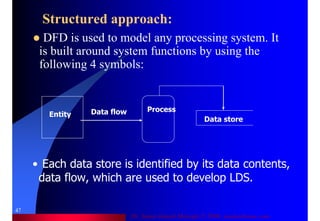
Structured approach:
DFD is used to model any processing system. It
is built around system functions by using the
following 4 symbols:
• Each data store is identified by its data contents,
data flow, which are used to develop LDS.
Entity Data flow Process
Data store
Dr. Samir Iamail Mostafa © 2006. analysthome.com
48
Structured approach:
Originally concerned with the functional
processing (of business) and the identification of
the data required for its activities.
DeMarco structured analysis starts at the logical
level with DFD to express data flow, process, data
store and external entities (outside system
boundary). The model defines data flow with its
data elements as it is processed though and stored
within the system.
Each data store is identified by its data contents
data flow and used to define LDS.
Dr. Samir Iamail Mostafa © 2006. analysthome.com
49
Structured approach:
Tools of structured analysis are:
– Data flow diagram DFD
– Data dictionary DD
– Decision table / Decision tree
– Structured English
Logical analysis starts by modeling the existing
system using DFD. DD is used to identify and
document all DFD elements with its data contents
(data elements), with no consideration of its
method of implementation.
Dr. Samir Iamail Mostafa © 2006. analysthome.com
50
6. Modern structured approach:
From DFD we reconstruct as-is business model,
which help to identify problems and difficulties to
be revised by those defined in the requirements
catalogue.
With business problem defined, business area
analysis gives us new requirements for
reengineering which analyzed further and used to
build new and modified model.
Based on the new business model detailed
analysis and evaluation of the new modified
(system) solution should be carried out.
Dr. Samir Iamail Mostafa © 2006. analysthome.com
51
Modern Structured approach:
Examination of the feasibility of solution should
take place continuously as the project grows.
Selecting a system solution requires building
physical DFD with its corresponding database
logical model and processing functions.
DFD are decomposed to give more functions and
process details with its corresponding data.
Now for each sub-process we split the DFD into:
– Data model
– Functional / process model
Dr. Samir Iamail Mostafa © 2006. analysthome.com
52
Modern Structured approach:
Process logic is defined from the corporate
policies and procedures which should be available
with the employees.
Process logic is expressed by using Structured
English, to facilitate the programming and coding
of the system functions.
All previous information with its corresponding
documentation and models represents system
requirements specifications or simply system
specifications, which triggers system design phase.
Dr. Samir Iamail Mostafa © 2006. analysthome.com
53
Modern Structured approach:
Tools of design include:
– Structure chart
– IPO, HIPO
– Event-driven structure
Design ends up with program structure, hardware
specifications and software system specifications
with testing plan with its procedures, training and
implementation plan.
Modern structured approach also accommodates
new trends of software engineering and
programming as Object-Oriented programming
Dr. Samir Iamail Mostafa © 2006. analysthome.com
54
Object-Oriented approach:
With object orientation we combine data and
function approach by building business classes and
objects. System is viewed as interacting objects.
Objects is defined by its data (entity) with a specific
behavior (method) as it reacts to other objets in the
system.
Objects with the same characteristics belong to a
class of objects or simply a class.
Different modeling notations are used with OOAD,
Unified Modeling Language (UML) is widely used.
Dr. Samir Iamail Mostafa © 2006. analysthome.com
55
Object-Oriented approach:
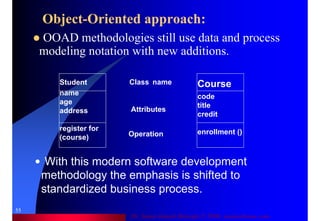
OOAD methodologies still use data and process
modeling notation with new additions.
Student
name
age
address
register for
(course)
Course
code
title
credit
enrollment ()
Class name
Attributes
Operation
• With this modern software development
methodology the emphasis is shifted to
standardized business process.
Dr. Samir Iamail Mostafa © 2006. analysthome.com
56
Manage by Information (MBI):
With these standardized business processes, called
core business processes, we can generate or
configure new business objects.
Repeated business objects will have a pattern.
Software industry is moving now to process pattern
and software factory.
The collection of methods and hardware and
software development tools may be considered as
production systems and plant of the system factory.
Dr. Samir Iamail Mostafa © 2006. analysthome.com
57
System factory is managed, planned and
scheduled, on the basis of decision criteria that
indicate the most appropriate production route to
take.
System factory is expected to be distributed
among the organization as most of its production
work will be carried out by the users.
Information production, with its continuous
evaluation, and maintenance of IS need new
managers with concepts of information
management.
Manage by Information (MBI):
Dr. Samir Iamail Mostafa © 2006. analysthome.com
58
ReferencesReferences::
For complete list of references see:
http:www. analysthome.com

Systems Analysis

  • 1.
    System Analysis, DesignandSystem Analysis, Design and DevelopmentDevelopment Dr. Samir I. Mostafa www.analysthome.com An Introduction
  • 2.
    Dr. Samir IamailMostafa © 2006. analysthome.com 2 1.Introducing System: • Systems Concept • Development Approaches 2. System Development: • Planning for System Development • Data Modeling & Management 3. Information & Management • Process Modeling •Information Management System Analysis, Design andSystem Analysis, Design and DevelopmentDevelopment
  • 3.
    Dr. Samir IamailMostafa © 2006. analysthome.com 3 1.Introducing System Why System Analysis? To solve a problem we need to analyze it Problems need to be defined first We are surrounded by real life problems, it take many shapes and forms, and we only see its effects and consequences. Organizational problems often handled by managers and problems comes from within the organization or from outside.
  • 4.
    Dr. Samir IamailMostafa © 2006. analysthome.com 4 Why System Analysis? Managers should rely on information, as managers do not manage assets or people. Managers manage the information related to assets or people. Information, comes from data and used to build knowledge to make managers job easy. It also brings the wisdom to help managers predict problems before it happen.
  • 5.
    Dr. Samir IamailMostafa © 2006. analysthome.com 5 Why System Analysis? Solving a problem results in business improvement. Also improving the business requires solving problems affecting its grow. Computer is only a powerful tool to process data and information, the rest still depends on how we formulate the problem and make progress in solving it. Managers need to think in a better ways to solve organization problems
  • 6.
    Dr. Samir IamailMostafa © 2006. analysthome.com 6 System Concept: System thinking: The way we formulate the problem in order to deal with the “whole” System practice: when system thinking is applied on real world problems. System approach: when we take a broad view which takes all aspect of the problem into account, with the interaction between parts.
  • 7.
    Dr. Samir IamailMostafa © 2006. analysthome.com 7 System Concept: System is a way of thinking about organization and their problems. It also involve set of techniques that help in solving problems. A System is an orderly grouping of interdependent components linked together according to a plan to achieve a specific objectives. No one way to consider these components.
  • 8.
    Dr. Samir IamailMostafa © 2006. analysthome.com 8 System Definition: System: – Must be designed to achieve a predetermined objectives. – Interrelationship and interdependent must exist among components. – Always, the objectives of the system as a whole have a higher priority that objectives of components. and their problems.
  • 9.
    Dr. Samir IamailMostafa © 2006. analysthome.com 9 SYSTEM: System is an abstraction for dealing with problems It is a conceptualization and formulation for solutions and problems It is a way of thinking It is not limited our bounded by physical constraints, only limited by human mind Has its roots in the “General System Theory” originated in 1940 by Bertalanffy.
  • 10.
    Dr. Samir IamailMostafa © 2006. analysthome.com 10 SYSTEM: To deal with system as a subject it is developed through its: – Definition – Characteristics – Elements – Classifications – Language – Methodologies
  • 11.
    Dr. Samir IamailMostafa © 2006. analysthome.com 11 System Characteristics: System with its definition definition has six main characteristics: – Organization – Interaction – Interdependence – Interaction – Integration – Central objectives
  • 12.
    Dr. Samir IamailMostafa © 2006. analysthome.com 12 System Elements:: • Input / output • Processor • Control • Feedback • Environment • Boundary and Interface • Organization Culture (at the heart of social systems)
  • 13.
    Dr. Samir IamailMostafa © 2006. analysthome.com 13 System Elements:: Banks Indica Mins Customer Vendor Stockhl Compit Law Union Processor productS ervice Human resources, Money, Energy, Info Informat ion Control Policy Perfom- Indicators Information Actions Input Transform Output
  • 14.
    Dr. Samir IamailMostafa © 2006. analysthome.com 14 System Types and Classifications: System NatureInterdependence AbstractPhysicalOpenFormalInformal Computer Based StaticDynamic LinearNonlinear Management IS DPSDBMS Closed Strategic IS Information System • There are many classifications as:
  • 15.
    Dr. Samir IamailMostafa © 2006. analysthome.com 15 System Types and Classifications: System NatureInterdependence AbstractPhysicalOpenFormalInformal Computer Based StaticDynamic LinearNonlinear Management IS DPSDBMS Closed Strategic IS Information System • Organization is an open dynamic system, with number of interacting subsystems.
  • 16.
    Dr. Samir IamailMostafa © 2006. analysthome.com 16 Information System: System deals with three categories of information – Strategic: long term for planning and policy – Managerial: for implementation and control – Operational: short term daily control. It also develops informal information which is an employee-based system formed to meet personnel and vocational needs, and to help solve work related problems.
  • 17.
    Dr. Samir IamailMostafa © 2006. analysthome.com 17 Management levels and information: Low Operational (Detailed) Managerial (For Follow-up and Control Strategic (Direction / Vision) Management Level Lower Middle Upper Categories of Information Decisions Nature Time Horizon Computer Based Information System (CBIS) Planning Directing Unstructured Problems Work for the Future (Look Beyond 3 Years) Work for today- tomorrow High (DPS) (TS) (MIS) (OA) (EIS) (DSS) ES
  • 18.
    Dr. Samir IamailMostafa © 2006. analysthome.com 18 System Language: With the system movement number of methods were used to describe systems. This brought the system language through which models are used now. The model is a way to express and describe the system, but it needs tools. Tools may cover mathematical relationship, drawings, and rules. System analysis uses models extensively to express the system components with its interactions, and behavior. Models become more effective when they are used methodologically.
  • 19.
    Dr. Samir IamailMostafa © 2006. analysthome.com 19 Why Do We Need A Methodology? Systems becomes more complex. The integrated nature of information shows itself with the emerging technologies. Information adds value to the products, so it needs to be accurately represented. Information becomes one of the corporate resources and needs to be managed.
  • 20.
    Dr. Samir IamailMostafa © 2006. analysthome.com 20 Why Do We Need A Methodology? High interest rate, and changing environment put more pressure on developers. Maintenance cost becomes a major factor and should not be ignored. development is not an art any more, it is a science (or the art of science!).
  • 21.
    Dr. Samir IamailMostafa © 2006. analysthome.com 21 Why Do We Need A Methodology? The cost of software becomes very high, and system life cycle becomes a major factor of concern. In 1993 canceled projects represented a waste of 14.3 billion and over 285000 effort year in USA. We can see many development approaches with many methodologies emerging during the last 30 years.
  • 22.
    Dr. Samir IamailMostafa © 2006. analysthome.com 22 More than one thousand methodologies exist in the literature (in the last 20-30 years) They can be divided among the following number of broad approaches: – Systems - Strategic – Participative - Prototyping – Structured - Data – Object-Oriented - Multi-view 2. Systems Development Approaches:
  • 23.
    Dr. Samir IamailMostafa © 2006. analysthome.com 23 What is Methodology? Methodology is a collection of techniques stemmed from a vision and philosophy, which cuts through a set of methods covers different fields of knowledge in order to select the best fit to solve a problem or set of problems and to achieve predetermined objectives. It is also the practical implementation of System Development Life Cycle (SDLC) Systems analyst is the person who applies, uses, and develops methodology suitable for the circumstances.
  • 24.
    Dr. Samir IamailMostafa © 2006. analysthome.com 24 What is Methodology? Visit Methodology.org to view methodologies Some of these methodologies are: Methodology development stemmed always from our thinking methods for approaching problems The table gives some of these methodologies HOODMEINV-MODEL OOADDAFNESDM JSDMERISESSADM YSMIEMSSM
  • 25.
    Dr. Samir IamailMostafa © 2006. analysthome.com 25 Systems Engineering and Analysis Building physical systems generated a great needs to deal with its engineering which led to the systems engineering discipline. These engineering projects required some level of analysis to justify its cost and economical feasibility, which led to systems analysis discipline. We should remember that organization has physical and social subsystems
  • 26.
    Dr. Samir IamailMostafa © 2006. analysthome.com 26 Hard System thinking: Engineering Methodology Systems engineering comprises set of activities which lead to the creation of a complex man- machine entity and/or procedures with its information flow. Systems analysis is the systematic appraisal of the costs and other implications of meeting a defined requirement in various ways. Both are research strategy rather than methods or techniques, and both require art from practitioner when using scientific methods.
  • 27.
    Dr. Samir IamailMostafa © 2006. analysthome.com 27 Soft System thinking: Soft Methodology If a desired state S1 and a present state S0 systems engineering (SE) defines the needs or objectives as (S1-S0), and systems analysis (SA) provides an ordered way to select the best among alternative systems. The belief that real-world problems can be formulated in this way characterizes all ‘hard’ systems thinking whether it comes from SE or SA. Social system cannot be defined as a goal oriented system, and requirements cannot be taken as given without providing a structure for a debate about change.
  • 28.
    Dr. Samir IamailMostafa © 2006. analysthome.com 28 Soft / Hard System thinking the Unified Methodology The author presents a unified methodology to handle the overall system development life cycle, Total Unified Methodology (TUM) . At the start we utilize the SSM with the system thinking approach where the root definition and the conceptual model are utilized. Structured approach is adopted to define the logical model Reengineering is the key to develop the new logical and physical model with the information mapping Once the process and data model established with system and process quality matrices, software engineering is utilized for computerized solution.
  • 29.
    Dr. Samir IamailMostafa © 2006. analysthome.com 29 Root definition Current Situation Root Definition CATWOE Analysis Root Definition CATWOE Analysis Rich Picture Conceptual Model Transformation Activity (1) Activity (2) Activity (3) Activity (4) Activity (5)
  • 30.
    Dr. Samir IamailMostafa © 2006. analysthome.com 30 3. System development System development starts with strategic planning to ensure that system objectives are congruent with corporate and business objectives. It includes strategic plan, master plan, long term plan, medium term plan. The aim of system planning is to produce an integrated system, not separate and isolated subsystems.
  • 31.
    Dr. Samir IamailMostafa © 2006. analysthome.com 31 Planning for system development: Strategic planing: is an on going process of defining (changing) corporate objectives for information management, with strategies and policies of allocating the resources to achieve these objectives. Planing here concerns with business requirements not technology or departments requirements.
  • 32.
    Dr. Samir IamailMostafa © 2006. analysthome.com 32 Planning for system development: Long term planing: concerns with the future requirements of information system departments. It concentrates on changing concepts and skills of users with the changing objectives of the corporate. Medium range planning is used to define corporate needs from information processing functions by adopting specific projects to be completed within 3-5 years.
  • 33.
    Dr. Samir IamailMostafa © 2006. analysthome.com 33 Planning for system development: Through planing, corporate should answer the following questions: What are objectives of information management? What are strategies to achieve these objectives? What is the optimum method to structure and coordinate efforts to achieve these objectives? How can we estimate the cost and assess risks in implementing these efforts?
  • 34.
    Dr. Samir IamailMostafa © 2006. analysthome.com 34 Planning for system development: How should processing functions be distributed among corporate subsystems? How can business process be transformed (using IT potentials)? How can IT support business process? How much integration is required? What are direct and indirect impacts between information management and business efficiency? How can we evaluate the success of information management projects in terms of profitability and quality?
  • 35.
    Dr. Samir IamailMostafa © 2006. analysthome.com 35 Planning for system development: Answering these questions will provide a strong guidance for management team through the implementation phases of information management projects. It touches all aspects of corporate management as its objectives, policies, structure, as well as management procedures. It is clear that early stages of planning is not, and should not, driven by technical factors, or technology.
  • 36.
    Dr. Samir IamailMostafa © 2006. analysthome.com 36 Planning for system development: One set of deliverables of strategic planning is corporate model or architecture model, business model with corporate main information elements including the present information resources. Business model includes business process model and business data model with process/entity matrix. The model should reflect the present situation with the projected new improvement and changes on the corporate or subsystems levels.
  • 37.
    Dr. Samir IamailMostafa © 2006. analysthome.com 37 4. Business model and IS models Business model depicts: Business process: interlinked activities that deliver specific outputs to identified customers. Activity: elements of the BP that the organization undertakes to the benefits of its business. Entities: those “things” which carry data or information required for activity implementation. Through business process model and entity data model.
  • 38.
    Dr. Samir IamailMostafa © 2006. analysthome.com 38 Business model and IS models On the subsequent levels of modeling and decomposition the entities become the focus of IS database models. IS model includes the following models/diagrams: – process flow – hierarchy activity – data flow – entity relation – entity life history with its supporting documentation.
  • 39.
    Dr. Samir IamailMostafa © 2006. analysthome.com 39 Automated Tools: There are wide varieties of (automated) tools available to help in developing all models such as: • RAD tools • CASE tools • DD tools • DBMS tools Some can automatically generate computer codes (see tool links at: analyst_corner/analyst.html). Their benefits include: Increased productivity in development process, Produce high quality of software, Reduced maintenance cost.
  • 40.
    Dr. Samir IamailMostafa © 2006. analysthome.com 40 IS modeling: Database approach: One of the main reasons to use a database is to share corporate information resources among users and producers of data and information. DBMS is used to help users to build database and to manage its retrieval and manipulation by its users. DBMS are built to handle “data/entities” though predetermined sets of relations between its elements and with different manipulation capabilities.
  • 41.
    Dr. Samir IamailMostafa © 2006. analysthome.com 41 IS modeling: Database approach: Database conceptual model: Inside Application Within Database DBMS Computer OS Application Data Files Report Book Auth Publi Sales File record Field Logical PhysicalUser Information
  • 42.
    Dr. Samir IamailMostafa © 2006. analysthome.com 42 Development phases of Database: Corporate database is one of the products of its development efforts. It is produced through number of development phases of SDLC. Major development phases include: – Analysis and logical model development – Logical design of database – Physical design of database The purpose of data analysis is to identify data required by business model in order to be rationalized and streamlined between users.
  • 43.
    Dr. Samir IamailMostafa © 2006. analysthome.com 43 Development phases of Database: Logical data model development should be linked and synchronized with BPR, ISO certification, TQM, and any other improvement program. Based on the new and modified business/data models we develop a logical design of database. Logical database design goes into the details of the logical model through: – Entity relation diagram E-R – Class- Object relation diagram Physical design is concerned with the physical representation of database on corporate network.
  • 44.
    Dr. Samir IamailMostafa © 2006. analysthome.com 44 5. Information & Management IT potential helps to change organization world. We cannot transfer the old data to this new world with 1:1 mapping. Mapping Mapping to new space to-be Never 1:1 Present World Real World Data Structure Entities Information World Transform
  • 45.
    Dr. Samir IamailMostafa © 2006. analysthome.com 45 New data model: Processing of corporate database is designed to take into consideration the business needs and the corporate decision analysis rationale. Both are handled by data and process flow analysis. Data/information model Process/function model Data Transformation
  • 46.
    Dr. Samir IamailMostafa © 2006. analysthome.com 46 Function model: Information system can be viewed at any instant of time through two main axes: – Data: with its relation and structure – Activities: with its procedures and logic Database approach documents and delivers data models with its relation. Changes of data is triggered by the business process and completed by IS functions. Business process and IS functions should be modeled and structured to satisfy management needs.
  • 47.
    Dr. Samir IamailMostafa © 2006. analysthome.com 47 Structured approach: DFD is used to model any processing system. It is built around system functions by using the following 4 symbols: • Each data store is identified by its data contents, data flow, which are used to develop LDS. Entity Data flow Process Data store
  • 48.
    Dr. Samir IamailMostafa © 2006. analysthome.com 48 Structured approach: Originally concerned with the functional processing (of business) and the identification of the data required for its activities. DeMarco structured analysis starts at the logical level with DFD to express data flow, process, data store and external entities (outside system boundary). The model defines data flow with its data elements as it is processed though and stored within the system. Each data store is identified by its data contents data flow and used to define LDS.
  • 49.
    Dr. Samir IamailMostafa © 2006. analysthome.com 49 Structured approach: Tools of structured analysis are: – Data flow diagram DFD – Data dictionary DD – Decision table / Decision tree – Structured English Logical analysis starts by modeling the existing system using DFD. DD is used to identify and document all DFD elements with its data contents (data elements), with no consideration of its method of implementation.
  • 50.
    Dr. Samir IamailMostafa © 2006. analysthome.com 50 6. Modern structured approach: From DFD we reconstruct as-is business model, which help to identify problems and difficulties to be revised by those defined in the requirements catalogue. With business problem defined, business area analysis gives us new requirements for reengineering which analyzed further and used to build new and modified model. Based on the new business model detailed analysis and evaluation of the new modified (system) solution should be carried out.
  • 51.
    Dr. Samir IamailMostafa © 2006. analysthome.com 51 Modern Structured approach: Examination of the feasibility of solution should take place continuously as the project grows. Selecting a system solution requires building physical DFD with its corresponding database logical model and processing functions. DFD are decomposed to give more functions and process details with its corresponding data. Now for each sub-process we split the DFD into: – Data model – Functional / process model
  • 52.
    Dr. Samir IamailMostafa © 2006. analysthome.com 52 Modern Structured approach: Process logic is defined from the corporate policies and procedures which should be available with the employees. Process logic is expressed by using Structured English, to facilitate the programming and coding of the system functions. All previous information with its corresponding documentation and models represents system requirements specifications or simply system specifications, which triggers system design phase.
  • 53.
    Dr. Samir IamailMostafa © 2006. analysthome.com 53 Modern Structured approach: Tools of design include: – Structure chart – IPO, HIPO – Event-driven structure Design ends up with program structure, hardware specifications and software system specifications with testing plan with its procedures, training and implementation plan. Modern structured approach also accommodates new trends of software engineering and programming as Object-Oriented programming
  • 54.
    Dr. Samir IamailMostafa © 2006. analysthome.com 54 Object-Oriented approach: With object orientation we combine data and function approach by building business classes and objects. System is viewed as interacting objects. Objects is defined by its data (entity) with a specific behavior (method) as it reacts to other objets in the system. Objects with the same characteristics belong to a class of objects or simply a class. Different modeling notations are used with OOAD, Unified Modeling Language (UML) is widely used.
  • 55.
    Dr. Samir IamailMostafa © 2006. analysthome.com 55 Object-Oriented approach: OOAD methodologies still use data and process modeling notation with new additions. Student name age address register for (course) Course code title credit enrollment () Class name Attributes Operation • With this modern software development methodology the emphasis is shifted to standardized business process.
  • 56.
    Dr. Samir IamailMostafa © 2006. analysthome.com 56 Manage by Information (MBI): With these standardized business processes, called core business processes, we can generate or configure new business objects. Repeated business objects will have a pattern. Software industry is moving now to process pattern and software factory. The collection of methods and hardware and software development tools may be considered as production systems and plant of the system factory.
  • 57.
    Dr. Samir IamailMostafa © 2006. analysthome.com 57 System factory is managed, planned and scheduled, on the basis of decision criteria that indicate the most appropriate production route to take. System factory is expected to be distributed among the organization as most of its production work will be carried out by the users. Information production, with its continuous evaluation, and maintenance of IS need new managers with concepts of information management. Manage by Information (MBI):
  • 58.
    Dr. Samir IamailMostafa © 2006. analysthome.com 58 ReferencesReferences:: For complete list of references see: http:www. analysthome.com