LECTURE 1
BASIC CONCEPT OF INFORMATION SYSTEM
COURSE INSTRUCTOR: Akram Ali Omar
Email: akram.ali.omar@gmail.com
Mobile: +255778695626
The State University Of Zanzibar 1
CS 1211: Information Systems Analysis and Design
Information Systems Analysis and Design
• A method used by companies to create and maintain systems that
perform basic business functions
• Main goal is to improve organizational systems by developing or
acquiring software(software solutions) and training employees in
its use
• Application software, or a system supports organizational
functions or processes
2
Information Systems Analysis and Design
• Systems Analyst performs analysis and design based upon:
– Understanding of organization’s objectives, structure and
processes
– Knowledge of how to exploit information technology for
advantage
3
System
• A system is an interrelated set of business procedures used
within one business unit working together for a purpose
• A system turns data into information
• A system exists within an environment
• A boundary separates a system from its environment
4
System
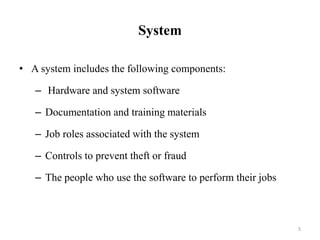
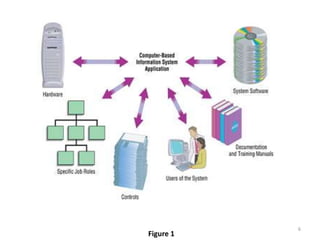
• A system includes the following components:
– Hardware and system software
– Documentation and training materials
– Job roles associated with the system
– Controls to prevent theft or fraud
– The people who use the software to perform their jobs
5
Figure 1
6
Characteristics of System
• Components: individual parts or elements that make up the system
• Interdependence: relationships and dependencies between them
• Integration: integrated in a specific way to achieve a specific goal or
function
• Boundary: defines the limits or scope of the system
• Purpose: intended function or goal
• Environment: internal and external factors that can influence the
system's operation
• Interfaces: points of interaction between the system and its environment
• Constraints
• Input-Process-Output
7
Important System Concepts
• Decomposition
– The process of breaking down a system into smaller
components
– Allows the systems analyst to:
• Break a system into small, manageable subsystems
• Focus on one area at a time
• Concentrate on component pertinent to one group of
users
• Build different components at independent times
8
Important System Concepts
• Modularity
– Process of dividing a system into module of a relatively
uniform size
– Modules simplify system design
• Coupling
– Subsystems that are dependent upon each other are coupled
• Cohesion
– Extent to which a subsystem performs a single function
9
A Modern Approach to Systems Analysis and
Design
• Systems Integration
– Allows hardware and software from different vendor to
work together
10
Information Systems
• Interrelated components working together to
– Collect(input) data
– Process(manipulate) data
– Store data
– Disseminate(give out) information(output)
– To support decision making, coordination, control,
analysis and visualization in an organization
11
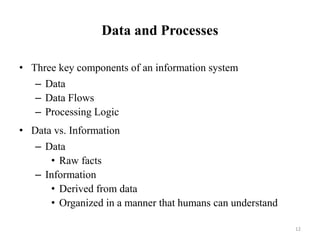
Data and Processes
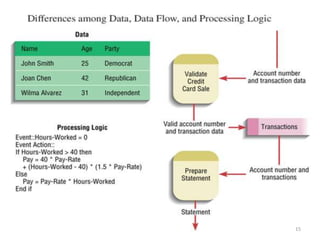
• Three key components of an information system
– Data
– Data Flows
– Processing Logic
• Data vs. Information
– Data
• Raw facts
– Information
• Derived from data
• Organized in a manner that humans can understand
12
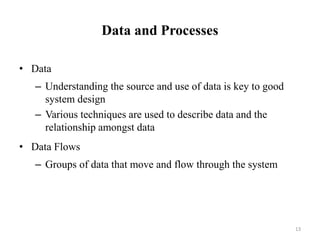
Data and Processes
• Data
– Understanding the source and use of data is key to good
system design
– Various techniques are used to describe data and the
relationship amongst data
• Data Flows
– Groups of data that move and flow through the system
13
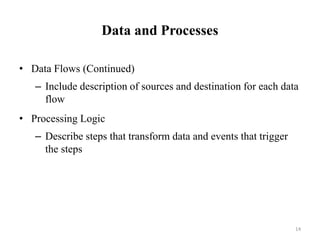
Data and Processes
• Data Flows (Continued)
– Include description of sources and destination for each data
flow
• Processing Logic
– Describe steps that transform data and events that trigger
the steps
14
15
Information Systems
• Basically based on the data processing
– Manual information System.
– Computerized Information System.
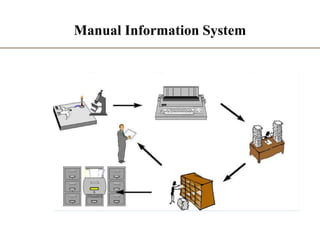
Manual Information System
• A manual-based information system does not use any computer
devices.
• All data would be kept in other ways, mainly paper. As a few
examples: Before accounts, payroll and spreadsheet applications,
people would have worked out this kind of information on paper.
• People would have handwritten letters or used typewriters instead of
word processors. Graphs and diagrams would have been drawn by
hand instead of using computer software to do them.
Manual Information System
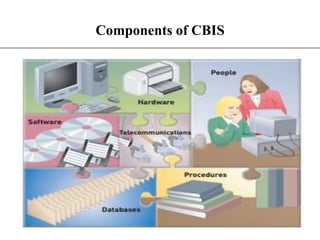
Computer Based IS
• Is a single set of hardware, software, databases, telecommunications,
people, and procedures that are configured to collect, manipulate,
store, and process data into information.
Components of CBIS
Information System Types
• Transaction Processing Systems (TPS)
– Automate handling of data about business activities (transactions)
• Management Information Systems (MIS)
– Converts raw data from transaction processing system into
meaningful form
• Decision Support Systems (DSS)
– Designed to help decision makers
– Provides interactive environment for decision making
21
Information System Types
• Expert Systems (ES)
– Replicates decision-making process
– Knowledge representation describes the way an expert would
approach the problem
– Expert System = Knowledge Base + Inference Engine
22
Stakeholders
• Players in the Systems Game
• A stakeholder is any person who has an interest in an existing or
new information system. Stakeholders can be technical or
nontechnical workers.
23
Stakeholders Classification
• For information systems, the stakeholders can be classified as:
– IS manager
– Systems analysts in systems development
– Programmers in systems development
– End user in systems development
– Supporting End user development
– Business managers in systems development
– Other IS mangers/Technicians in system development
24
Systems Analysts
• Systems analysts are the key individuals in the systems development process.
• A Systems Analyst is a professional who is responsible for analyzing, designing,
and implementing information systems to meet the business requirements of an
organization.
• They work with stakeholders from various departments and levels of an
organization to understand their needs and requirements, and then use their
technical and analytical skills to develop and implement solutions to meet those
needs.
• A systems analyst studies the problems and needs of an organization to determine
how people, data, processes, communications, and information technology can best
accomplish improvements for the business. 25
Role of the Systems Analyst
• Study problems and needs of an organization
• Determine best approach to improving organization through use of:
– People
– Methods
– Information technology
• Help system users and managers define their requirements for new
or enhanced systems
26
Skills of a Successful Systems Analyst
• Analytical skills
• Technical skills
• Managerial skills
• Interpersonal skills
27
Skills of a Successful Systems Analyst
• Analytical skills
– Understanding of organizations.
– Problem solving skills
– System thinking
• Ability to see organizations and information systems as
systems
• Technical skills
– Understanding of potential and limitations of technology.
28
Skills of a Successful Systems Analyst
• Managerial skills
– Ability to manage projects, resources, risk and change
• Interpersonal skills
– Effective written and oral communication skills
– Help analyst to work with end user as well as other system
analysts and programmers
29
System Analysis and Design
(SAD)
• System: organized set of related components established to
accomplish a certain task
• Analysis: defining the problem
– From requirements to specification
• Design: solving the problem
– From specification to implementation
30
System Analysis and Design
(SAD)
• System Analysis: understanding and specifying in detail what an
information system should do
• System Design: specifying in detail how the parts of an
information system should be implemented
• Definition of SAD:
– The complex organizational process whereby computer-based
information systems are developed and maintained.
31
END!
32

LECTURE 1-BASIC CONCEPT OF INFORMATION SYSTEM.pptx

  • 1.
    LECTURE 1 BASIC CONCEPTOF INFORMATION SYSTEM COURSE INSTRUCTOR: Akram Ali Omar Email: akram.ali.omar@gmail.com Mobile: +255778695626 The State University Of Zanzibar 1 CS 1211: Information Systems Analysis and Design
  • 2.
    Information Systems Analysisand Design • A method used by companies to create and maintain systems that perform basic business functions • Main goal is to improve organizational systems by developing or acquiring software(software solutions) and training employees in its use • Application software, or a system supports organizational functions or processes 2
  • 3.
    Information Systems Analysisand Design • Systems Analyst performs analysis and design based upon: – Understanding of organization’s objectives, structure and processes – Knowledge of how to exploit information technology for advantage 3
  • 4.
    System • A systemis an interrelated set of business procedures used within one business unit working together for a purpose • A system turns data into information • A system exists within an environment • A boundary separates a system from its environment 4
  • 5.
    System • A systemincludes the following components: – Hardware and system software – Documentation and training materials – Job roles associated with the system – Controls to prevent theft or fraud – The people who use the software to perform their jobs 5
  • 6.
  • 7.
    Characteristics of System •Components: individual parts or elements that make up the system • Interdependence: relationships and dependencies between them • Integration: integrated in a specific way to achieve a specific goal or function • Boundary: defines the limits or scope of the system • Purpose: intended function or goal • Environment: internal and external factors that can influence the system's operation • Interfaces: points of interaction between the system and its environment • Constraints • Input-Process-Output 7
  • 8.
    Important System Concepts •Decomposition – The process of breaking down a system into smaller components – Allows the systems analyst to: • Break a system into small, manageable subsystems • Focus on one area at a time • Concentrate on component pertinent to one group of users • Build different components at independent times 8
  • 9.
    Important System Concepts •Modularity – Process of dividing a system into module of a relatively uniform size – Modules simplify system design • Coupling – Subsystems that are dependent upon each other are coupled • Cohesion – Extent to which a subsystem performs a single function 9
  • 10.
    A Modern Approachto Systems Analysis and Design • Systems Integration – Allows hardware and software from different vendor to work together 10
  • 11.
    Information Systems • Interrelatedcomponents working together to – Collect(input) data – Process(manipulate) data – Store data – Disseminate(give out) information(output) – To support decision making, coordination, control, analysis and visualization in an organization 11
  • 12.
    Data and Processes •Three key components of an information system – Data – Data Flows – Processing Logic • Data vs. Information – Data • Raw facts – Information • Derived from data • Organized in a manner that humans can understand 12
  • 13.
    Data and Processes •Data – Understanding the source and use of data is key to good system design – Various techniques are used to describe data and the relationship amongst data • Data Flows – Groups of data that move and flow through the system 13
  • 14.
    Data and Processes •Data Flows (Continued) – Include description of sources and destination for each data flow • Processing Logic – Describe steps that transform data and events that trigger the steps 14
  • 15.
  • 16.
    Information Systems • Basicallybased on the data processing – Manual information System. – Computerized Information System.
  • 17.
    Manual Information System •A manual-based information system does not use any computer devices. • All data would be kept in other ways, mainly paper. As a few examples: Before accounts, payroll and spreadsheet applications, people would have worked out this kind of information on paper. • People would have handwritten letters or used typewriters instead of word processors. Graphs and diagrams would have been drawn by hand instead of using computer software to do them.
  • 18.
  • 19.
    Computer Based IS •Is a single set of hardware, software, databases, telecommunications, people, and procedures that are configured to collect, manipulate, store, and process data into information.
  • 20.
  • 21.
    Information System Types •Transaction Processing Systems (TPS) – Automate handling of data about business activities (transactions) • Management Information Systems (MIS) – Converts raw data from transaction processing system into meaningful form • Decision Support Systems (DSS) – Designed to help decision makers – Provides interactive environment for decision making 21
  • 22.
    Information System Types •Expert Systems (ES) – Replicates decision-making process – Knowledge representation describes the way an expert would approach the problem – Expert System = Knowledge Base + Inference Engine 22
  • 23.
    Stakeholders • Players inthe Systems Game • A stakeholder is any person who has an interest in an existing or new information system. Stakeholders can be technical or nontechnical workers. 23
  • 24.
    Stakeholders Classification • Forinformation systems, the stakeholders can be classified as: – IS manager – Systems analysts in systems development – Programmers in systems development – End user in systems development – Supporting End user development – Business managers in systems development – Other IS mangers/Technicians in system development 24
  • 25.
    Systems Analysts • Systemsanalysts are the key individuals in the systems development process. • A Systems Analyst is a professional who is responsible for analyzing, designing, and implementing information systems to meet the business requirements of an organization. • They work with stakeholders from various departments and levels of an organization to understand their needs and requirements, and then use their technical and analytical skills to develop and implement solutions to meet those needs. • A systems analyst studies the problems and needs of an organization to determine how people, data, processes, communications, and information technology can best accomplish improvements for the business. 25
  • 26.
    Role of theSystems Analyst • Study problems and needs of an organization • Determine best approach to improving organization through use of: – People – Methods – Information technology • Help system users and managers define their requirements for new or enhanced systems 26
  • 27.
    Skills of aSuccessful Systems Analyst • Analytical skills • Technical skills • Managerial skills • Interpersonal skills 27
  • 28.
    Skills of aSuccessful Systems Analyst • Analytical skills – Understanding of organizations. – Problem solving skills – System thinking • Ability to see organizations and information systems as systems • Technical skills – Understanding of potential and limitations of technology. 28
  • 29.
    Skills of aSuccessful Systems Analyst • Managerial skills – Ability to manage projects, resources, risk and change • Interpersonal skills – Effective written and oral communication skills – Help analyst to work with end user as well as other system analysts and programmers 29
  • 30.
    System Analysis andDesign (SAD) • System: organized set of related components established to accomplish a certain task • Analysis: defining the problem – From requirements to specification • Design: solving the problem – From specification to implementation 30
  • 31.
    System Analysis andDesign (SAD) • System Analysis: understanding and specifying in detail what an information system should do • System Design: specifying in detail how the parts of an information system should be implemented • Definition of SAD: – The complex organizational process whereby computer-based information systems are developed and maintained. 31
  • 32.