Mustafa Degerli
October, 2016 – METU II
Agenda
 Definition of system
 Types of system
 Systems thinking
 Habits of a systems thinker
 Structures and processes
 System environment
 Hierarchy and resolution
 Prediction and control
 Emergent properties
 System ownership
 World-view
Definition of system
 System
 something which operates in an organized
way
 take ingredients (inputs) through a procedure
(process) which is expected to convert them
into useful products (outputs)
 The input-process-output principle is essential
to all systems
Definition of system
 The effort of systems analysts towards making
the input-process-output procedure more
efficient
 Ends-and-means dominated
 Feedback loops and control typify an emphasis
on improvement of system
Definition of system
 Since the mid-1980s, there has also been a
steady development of systems thinking in
management
 The most notable application has been in the
three functionally related areas of quality
management, environmental management and
safety management
 Establish a cycle of continuous improvement in
aspects of management
Definition of system
 A system may be described as a recognizable
whole which consists of a number of parts
(called components or elements) that are
connected up in an organized way (the system's
structure)
Definition of system
 Characteristics
 A system does something
 Addition or removal of a component changes
the system
 A component is affected by its inclusion in
the system
 Components are perceived to be related in
hierarchical structures
Definition of system
 Characteristics
 There are means for control and
communication to promote system survival
 The system has emergent properties, some
of which are difficult to predict
 The system has a boundary
 Outside the boundary is a system
environment which affects the system
 A system is owned by someone
Types of system
 Natural systems (e.g. biological systems,
disease, the weather)
 Designed abstract systems (e.g. computer
programming languages, simulatory models,
signing systems)
 Engineered or designed technical systems (e.g.
process plant, computer systems)
 Human activity systems (e.g. work
organizations, a department, a committee
Types of system
 Information systems are often classified
separately, although they are likely to combine
aspects of abstract, engineered and human
activity systems
 Engineered systems, natural systems and
designed abstract systems are perceived by
them to be hard
 The properties of hard systems typically have
(or are perceived to have) a high degree of
predictability and attributes which are readily
quantifiable and measurable
Types of system
 Compared with soft systems, hard systems are
assumed to have fewer unpredictable
properties
 Soft systems have a much higher degree of
assumed unpredictability because they involve
(perceived) people's values attitudes and
behavior which are complex and variable
 Soft systems are perceived typically to have
properties which are difficult to quantify and
measure e.g. view-points, conflicts, vested
interests and other qualitative characteristics
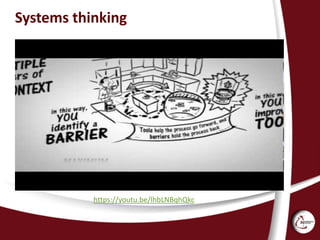
Systems thinking
https://youtu.be/lhbLNBqhQkc
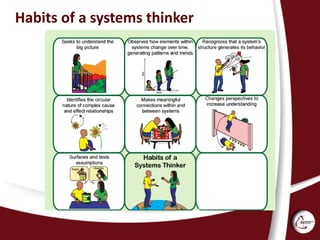
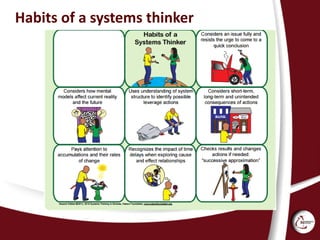
Habits of a systems thinker
Structures and processes
 Two kinds of system component - structural and
process components
 Systems structure is represented by relatively
stable, lasting components which either carry
out processes or are acted on by processes, i.e.
the “doers” and the “done-to”
 The processes within a system are represented
by transient, changing components, i.e. action,
change, growth, decline or “doing” of some
kind
System environment
 The system environment comprises
components which affect the system but which
the system is unable to control directly and is
unable to affect to any significant extent
 The environment of the overall management
system of an organization is likely to include
public policy, legislation, the economy,
technology, product markets and so on
Hierarchy and resolution
 Resolution and hierarchy concern the level of
detail appropriate to the analyst’s task
 It is common in systems practice to adjust levels
of resolution up and down as the work
progresses
 Hierarchy is allied to resolution in that some
components are considered by the analyst to be
subordinate to others in terms of authority,
time, sequence or some other characteristic
Prediction and control
 Prediction and control relate to the system’s
ability to head off dysfunction and survive when
things go wrong.
 Knowledge of a system’s structure, processes
and control characteristics enables its behavior
to be predicted in a range of circumstances
 Systems have a mixture of predictable
properties and properties which are difficult to
predict
Prediction and control
 In man-made systems, the job of system
specifiers and designers is to
 look beyond the expected, desirable
outcomes and
 try to identify undesirable possibilities so
that they can be designed out or their
consequences mitigated
 Monitoring performance against criteria is a key
control requirement and enables the system to
correct deviations from desired outputs
Emergent properties
 A system is not just a collection of
interconnected components
 Interactions as a whole, or “synergy,” produces
emergent properties or behavior
 not readily be predicted simply by examining
each component in isolation or even some of
the components together
Emergent properties
 Emergence is consistent with holism
 The whole is greater than the sum of its parts
 Systems designed with noble intentions
sometimes can have devastating consequences
for those who were meant to be helped
System ownership
 Persons interested in the particular systems for
the purposes of design, improvement,
implementation, problem-solving, study and so
on
 Who controls and maintains the system
 The system owners are likely to be particular
managers, possibly at a senior level
 Who can cause the system to change
significantly or cease to exist, while
stakeholding employees or operational
individuals cannot
World-view
https://youtu.be/VXnSE0uvwzM
World-view
 The complex set of perceptions, attitudes,
beliefs, values, assumptions and motivations
which characterize an individual or a group of
people
 World-view is a kind of perceptual window
through which each person interprets the world
and his or her relationship with it
 It has immense importance in systems work
because it concerns characteristic biases, not
only of key figures and other owners of the
particular system but also of the system analyst
World-view
 As world-views affects system behavior and
outcomes, the world-views both of the social
actors in the setting being examined and the
analyst need to be identified
 It should not be taken for granted that in a
given setting everyone holds the same views
about problems, issues, solutions and priorities
 It would be impractical to consider the world-
views of hundreds of individuals but it is
important to identify the world-views of key
individuals exerting particular influence
References
 Waring, A. (1996). Practical Systems Thinking,
International Thomson Business Press.
 Systems Thinking White Boarding
https://youtu.be/lhbLNBqhQkc
 Habits of a Systems Thinker
https://goo.gl/zzqqc1
 What’s your worldview?
https://youtu.be/VXnSE0uvwzM
MD@mustafadegerli.com

Mustafa Degerli - 2016 - Systems Ideas

  • 1.
  • 2.
    Agenda  Definition ofsystem  Types of system  Systems thinking  Habits of a systems thinker  Structures and processes  System environment  Hierarchy and resolution  Prediction and control  Emergent properties  System ownership  World-view
  • 3.
    Definition of system System  something which operates in an organized way  take ingredients (inputs) through a procedure (process) which is expected to convert them into useful products (outputs)  The input-process-output principle is essential to all systems
  • 4.
    Definition of system The effort of systems analysts towards making the input-process-output procedure more efficient  Ends-and-means dominated  Feedback loops and control typify an emphasis on improvement of system
  • 5.
    Definition of system Since the mid-1980s, there has also been a steady development of systems thinking in management  The most notable application has been in the three functionally related areas of quality management, environmental management and safety management  Establish a cycle of continuous improvement in aspects of management
  • 6.
    Definition of system A system may be described as a recognizable whole which consists of a number of parts (called components or elements) that are connected up in an organized way (the system's structure)
  • 7.
    Definition of system Characteristics  A system does something  Addition or removal of a component changes the system  A component is affected by its inclusion in the system  Components are perceived to be related in hierarchical structures
  • 8.
    Definition of system Characteristics  There are means for control and communication to promote system survival  The system has emergent properties, some of which are difficult to predict  The system has a boundary  Outside the boundary is a system environment which affects the system  A system is owned by someone
  • 9.
    Types of system Natural systems (e.g. biological systems, disease, the weather)  Designed abstract systems (e.g. computer programming languages, simulatory models, signing systems)  Engineered or designed technical systems (e.g. process plant, computer systems)  Human activity systems (e.g. work organizations, a department, a committee
  • 10.
    Types of system Information systems are often classified separately, although they are likely to combine aspects of abstract, engineered and human activity systems  Engineered systems, natural systems and designed abstract systems are perceived by them to be hard  The properties of hard systems typically have (or are perceived to have) a high degree of predictability and attributes which are readily quantifiable and measurable
  • 11.
    Types of system Compared with soft systems, hard systems are assumed to have fewer unpredictable properties  Soft systems have a much higher degree of assumed unpredictability because they involve (perceived) people's values attitudes and behavior which are complex and variable  Soft systems are perceived typically to have properties which are difficult to quantify and measure e.g. view-points, conflicts, vested interests and other qualitative characteristics
  • 12.
  • 13.
    Habits of asystems thinker
  • 14.
    Habits of asystems thinker
  • 15.
    Structures and processes Two kinds of system component - structural and process components  Systems structure is represented by relatively stable, lasting components which either carry out processes or are acted on by processes, i.e. the “doers” and the “done-to”  The processes within a system are represented by transient, changing components, i.e. action, change, growth, decline or “doing” of some kind
  • 16.
    System environment  Thesystem environment comprises components which affect the system but which the system is unable to control directly and is unable to affect to any significant extent  The environment of the overall management system of an organization is likely to include public policy, legislation, the economy, technology, product markets and so on
  • 17.
    Hierarchy and resolution Resolution and hierarchy concern the level of detail appropriate to the analyst’s task  It is common in systems practice to adjust levels of resolution up and down as the work progresses  Hierarchy is allied to resolution in that some components are considered by the analyst to be subordinate to others in terms of authority, time, sequence or some other characteristic
  • 18.
    Prediction and control Prediction and control relate to the system’s ability to head off dysfunction and survive when things go wrong.  Knowledge of a system’s structure, processes and control characteristics enables its behavior to be predicted in a range of circumstances  Systems have a mixture of predictable properties and properties which are difficult to predict
  • 19.
    Prediction and control In man-made systems, the job of system specifiers and designers is to  look beyond the expected, desirable outcomes and  try to identify undesirable possibilities so that they can be designed out or their consequences mitigated  Monitoring performance against criteria is a key control requirement and enables the system to correct deviations from desired outputs
  • 20.
    Emergent properties  Asystem is not just a collection of interconnected components  Interactions as a whole, or “synergy,” produces emergent properties or behavior  not readily be predicted simply by examining each component in isolation or even some of the components together
  • 21.
    Emergent properties  Emergenceis consistent with holism  The whole is greater than the sum of its parts  Systems designed with noble intentions sometimes can have devastating consequences for those who were meant to be helped
  • 22.
    System ownership  Personsinterested in the particular systems for the purposes of design, improvement, implementation, problem-solving, study and so on  Who controls and maintains the system  The system owners are likely to be particular managers, possibly at a senior level  Who can cause the system to change significantly or cease to exist, while stakeholding employees or operational individuals cannot
  • 23.
  • 24.
    World-view  The complexset of perceptions, attitudes, beliefs, values, assumptions and motivations which characterize an individual or a group of people  World-view is a kind of perceptual window through which each person interprets the world and his or her relationship with it  It has immense importance in systems work because it concerns characteristic biases, not only of key figures and other owners of the particular system but also of the system analyst
  • 25.
    World-view  As world-viewsaffects system behavior and outcomes, the world-views both of the social actors in the setting being examined and the analyst need to be identified  It should not be taken for granted that in a given setting everyone holds the same views about problems, issues, solutions and priorities  It would be impractical to consider the world- views of hundreds of individuals but it is important to identify the world-views of key individuals exerting particular influence
  • 26.
    References  Waring, A.(1996). Practical Systems Thinking, International Thomson Business Press.  Systems Thinking White Boarding https://youtu.be/lhbLNBqhQkc  Habits of a Systems Thinker https://goo.gl/zzqqc1  What’s your worldview? https://youtu.be/VXnSE0uvwzM
  • 27.