Chapter 1 Introduction to the Computer-Based Information System MANAGEMENT INFORMATION SYSTEMS 8/E Raymond McLeod, Jr. and George Schell Copyright 2001 Prentice-Hall, Inc. 1-
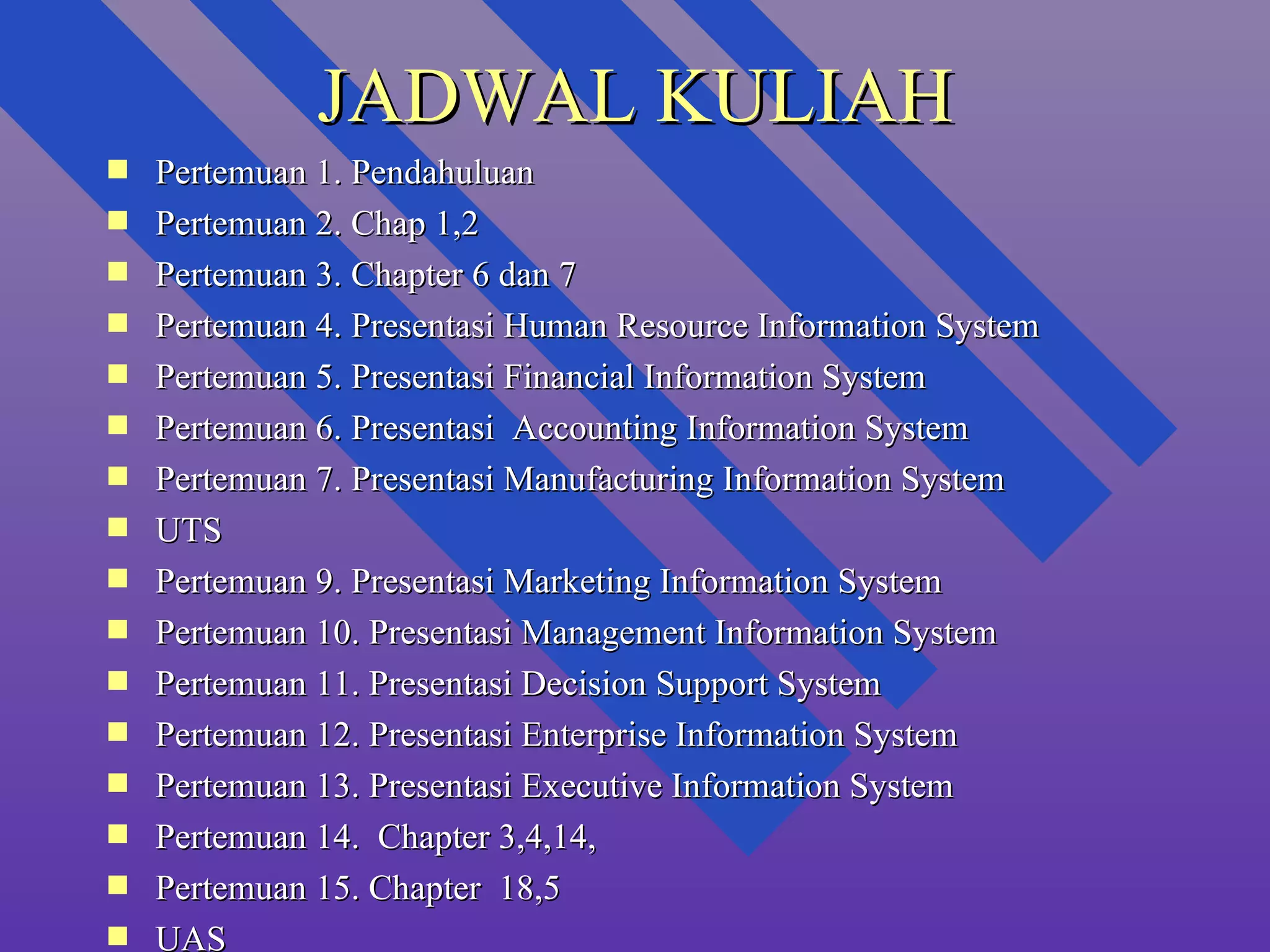
JADWAL KULIAH Pertemuan 1. Pendahuluan Pertemuan 2. Chap 1,2 Pertemuan 3. Chapter 6 dan 7 Pertemuan 4. Presentasi Human Resource Information System Pertemuan 5. Presentasi Financial Information System Pertemuan 6. Presentasi  Accounting Information System Pertemuan 7. Presentasi Manufacturing Information System  UTS Pertemuan 9. Presentasi Marketing Information System Pertemuan 10. Presentasi Management Information System Pertemuan 11. Presentasi Decision Support System Pertemuan 12. Presentasi Enterprise Information System Pertemuan 13. Presentasi Executive Information System Pertemuan 14.  Chapter 3,4,14, Pertemuan 15. Chapter  18,5 UAS
Information Management Information:   The most valuable resource  1-
Five Main Resources Personnel Material Machines (including facilities and energy) Money Information (and data) Physical Conceptual } 1-
How Resources are Managed Acquire Assemble, or prepare Maximize use Replace 1-
Factors Stimulating Interest in Information Management Increasing complexity of business activity International economy Worldwide competition Increasing complexity of technology Shrinking time frames Social constraints Improved computer capabilities Size Speed 1-
Who are the Users? Managers Nonmanagers Persons & organizations in the firm’s environment 1-
The Influence of Management Level on Information Source Strategic planning level Management control level Operational control level Internal Environmental 1-
The Influence of Management Level on Information Form Strategic planning level Management control level Operational control level Detail Summary 1-
Managers Can Be Found on All Levels and in All Functional  Areas of the Firm  Finance Function Human  Resources Function Information Services Function Manufacturing Function Marketing Function Strategic planning level Management Control Level Operational Control  Level 1-
What Managers do -- Fayol’s Functions Strategic  Planning Level Management  Control Level Operational  Control Level 1-
What Managers do --  Mintzberg’s Roles Interpersonal roles Figurehead Leader Liaison Informational roles Monitor Disseminator Spokesperson Decisional roles Entrepreneur Disturbance handler Resource allocator Negotiator 1-
Management Skills Communications Problem solving How can an information specialist help? 1-
Problem Solving Information Comes in Many Forms Computer Reports Noncomputer reports Electronic mail Periodicals Telephone Problem Solving Written Media Oral Media Internal Sources External Sources Scheduled Meetings Unscheduled Meetings Voice Mail Tours Business Meals Letters & Memos 1-
Management Knowledge Computer literacy Information literacy What’s the difference? 1-
System Components Component parts of a system that can control its own operations Objectives Control mechanism Transformation Input Output 1-
Open-Loop System Transformation Input Output 1-
Open versus Closed Systems Open system  Connected to its environment by means of resource flows Closed system Not connected to its environment 1-
Systems  Can Be Composed of Subsystems or Elemental Parts Subsystem A-2 Subsystem A-3 Subsystem B-2 Subsystem B-1 System Subsystem A Subsystem B Elemental Part C Subsystem A-1 Elemental part B1 1-
Physical and Conceptual Systems Physical system  The business firm  Composed of physical resources Conceptual system Represents  a physical system Uses conceptual resources   Information Data  1-
A Systems View Business operations are embedded within a larger environmental setting Reduces complexity Requires good objectives Emphasizes working together  Acknowledges interconnections Values feedback 1-
Data and Information Information processor Key element in the conceptual system Computer Noncomputer Combination Data is the raw material transformed into information 1-
Evolution of the CBIS Data Processing (DP) Management Information Systems (MIS) 1964 IBM promoted the concept as a means of selling disk files and terminals Decision Support Systems (DSS) 1971 Text book’s distinction: MIS: Organizational/group  -  general DSS: Individual  -  specific Office Automation (OA)  1964 Artificial Intelligence (AI)/ Expert Systems (ES)  -  1990s  Heavy investment by businesses 1-
The CBIS Model Computer-based  Information System (CBIS) Accounting  Information System Management Information System Decision Support Systems The Virtual Office Knowledge-based Systems Decisions Problem Information Problem Solution 1-
Information Services Information specialists  have  full-time responsibility for  developing and maintaining  computer-based systems 1-
Traditional Communication Chain Database Administrator User Systems Analyst Programmer Operator Computer Network Specialist 1-
End-User Computing (EUC) End-user computing  Development of all or part of applications Information specialists act as consultants Stimulants to EUC Increased computer literacy IS backlog Low-cost hardware (the PC) Prewritten software (electronic spreadsheets) 1-
IS and EUC The End-User Computing Communication Chain User Computer Information Specialists Support Communication 1-
Justifying the CBIS Justify in the same manner as any other large investment Economic Cost reduction Reduced inventory investment Increased productivity (CAD/CAM) Noneconomic Perceived value 1-
Achieving the CBIS 1-
Reengineering the CBIS Business Process Reengineering (BPR) Reworking systems Good system features retained  Becoming development methodology of choice 1-
Roles Played by the Manager and by the Information Specialist Implementation Phase Manager Information Specialist Control Control Control Control Planning Analysis Design Use Define problem Support System Study Design system Implement system Make available 1-
Summary Information is one of five main resources Computer output used by managers and nonmanagers A system is an integration of elements working toward an objective Physical  Conceptual Data vs. Information 1-
Summary [cont.] CBIS composed of various components AIS MIS DSS Virtual office Knowledge-based systems End-user computing trends CBIS development 1-
Topik Presentasi Human Resource Information System Financial Information System Manufacturing Information System Accounting Information System Marketing Information System Management Information System Decision Support System Enterprise Information System Executive Information System

Introduction to the Computer-Based Information System

  • 1.
    Chapter 1 Introductionto the Computer-Based Information System MANAGEMENT INFORMATION SYSTEMS 8/E Raymond McLeod, Jr. and George Schell Copyright 2001 Prentice-Hall, Inc. 1-
  • 2.
    JADWAL KULIAH Pertemuan1. Pendahuluan Pertemuan 2. Chap 1,2 Pertemuan 3. Chapter 6 dan 7 Pertemuan 4. Presentasi Human Resource Information System Pertemuan 5. Presentasi Financial Information System Pertemuan 6. Presentasi Accounting Information System Pertemuan 7. Presentasi Manufacturing Information System UTS Pertemuan 9. Presentasi Marketing Information System Pertemuan 10. Presentasi Management Information System Pertemuan 11. Presentasi Decision Support System Pertemuan 12. Presentasi Enterprise Information System Pertemuan 13. Presentasi Executive Information System Pertemuan 14. Chapter 3,4,14, Pertemuan 15. Chapter 18,5 UAS
  • 3.
    Information Management Information: The most valuable resource 1-
  • 4.
    Five Main ResourcesPersonnel Material Machines (including facilities and energy) Money Information (and data) Physical Conceptual } 1-
  • 5.
    How Resources areManaged Acquire Assemble, or prepare Maximize use Replace 1-
  • 6.
    Factors Stimulating Interestin Information Management Increasing complexity of business activity International economy Worldwide competition Increasing complexity of technology Shrinking time frames Social constraints Improved computer capabilities Size Speed 1-
  • 7.
    Who are theUsers? Managers Nonmanagers Persons & organizations in the firm’s environment 1-
  • 8.
    The Influence ofManagement Level on Information Source Strategic planning level Management control level Operational control level Internal Environmental 1-
  • 9.
    The Influence ofManagement Level on Information Form Strategic planning level Management control level Operational control level Detail Summary 1-
  • 10.
    Managers Can BeFound on All Levels and in All Functional Areas of the Firm Finance Function Human Resources Function Information Services Function Manufacturing Function Marketing Function Strategic planning level Management Control Level Operational Control Level 1-
  • 11.
    What Managers do-- Fayol’s Functions Strategic Planning Level Management Control Level Operational Control Level 1-
  • 12.
    What Managers do-- Mintzberg’s Roles Interpersonal roles Figurehead Leader Liaison Informational roles Monitor Disseminator Spokesperson Decisional roles Entrepreneur Disturbance handler Resource allocator Negotiator 1-
  • 13.
    Management Skills CommunicationsProblem solving How can an information specialist help? 1-
  • 14.
    Problem Solving InformationComes in Many Forms Computer Reports Noncomputer reports Electronic mail Periodicals Telephone Problem Solving Written Media Oral Media Internal Sources External Sources Scheduled Meetings Unscheduled Meetings Voice Mail Tours Business Meals Letters & Memos 1-
  • 15.
    Management Knowledge Computerliteracy Information literacy What’s the difference? 1-
  • 16.
    System Components Componentparts of a system that can control its own operations Objectives Control mechanism Transformation Input Output 1-
  • 17.
  • 18.
    Open versus ClosedSystems Open system Connected to its environment by means of resource flows Closed system Not connected to its environment 1-
  • 19.
    Systems CanBe Composed of Subsystems or Elemental Parts Subsystem A-2 Subsystem A-3 Subsystem B-2 Subsystem B-1 System Subsystem A Subsystem B Elemental Part C Subsystem A-1 Elemental part B1 1-
  • 20.
    Physical and ConceptualSystems Physical system The business firm Composed of physical resources Conceptual system Represents a physical system Uses conceptual resources Information Data 1-
  • 21.
    A Systems ViewBusiness operations are embedded within a larger environmental setting Reduces complexity Requires good objectives Emphasizes working together Acknowledges interconnections Values feedback 1-
  • 22.
    Data and InformationInformation processor Key element in the conceptual system Computer Noncomputer Combination Data is the raw material transformed into information 1-
  • 23.
    Evolution of theCBIS Data Processing (DP) Management Information Systems (MIS) 1964 IBM promoted the concept as a means of selling disk files and terminals Decision Support Systems (DSS) 1971 Text book’s distinction: MIS: Organizational/group - general DSS: Individual - specific Office Automation (OA) 1964 Artificial Intelligence (AI)/ Expert Systems (ES) - 1990s Heavy investment by businesses 1-
  • 24.
    The CBIS ModelComputer-based Information System (CBIS) Accounting Information System Management Information System Decision Support Systems The Virtual Office Knowledge-based Systems Decisions Problem Information Problem Solution 1-
  • 25.
    Information Services Informationspecialists have full-time responsibility for developing and maintaining computer-based systems 1-
  • 26.
    Traditional Communication ChainDatabase Administrator User Systems Analyst Programmer Operator Computer Network Specialist 1-
  • 27.
    End-User Computing (EUC)End-user computing Development of all or part of applications Information specialists act as consultants Stimulants to EUC Increased computer literacy IS backlog Low-cost hardware (the PC) Prewritten software (electronic spreadsheets) 1-
  • 28.
    IS and EUCThe End-User Computing Communication Chain User Computer Information Specialists Support Communication 1-
  • 29.
    Justifying the CBISJustify in the same manner as any other large investment Economic Cost reduction Reduced inventory investment Increased productivity (CAD/CAM) Noneconomic Perceived value 1-
  • 30.
  • 31.
    Reengineering the CBISBusiness Process Reengineering (BPR) Reworking systems Good system features retained Becoming development methodology of choice 1-
  • 32.
    Roles Played bythe Manager and by the Information Specialist Implementation Phase Manager Information Specialist Control Control Control Control Planning Analysis Design Use Define problem Support System Study Design system Implement system Make available 1-
  • 33.
    Summary Information isone of five main resources Computer output used by managers and nonmanagers A system is an integration of elements working toward an objective Physical Conceptual Data vs. Information 1-
  • 34.
    Summary [cont.] CBIScomposed of various components AIS MIS DSS Virtual office Knowledge-based systems End-user computing trends CBIS development 1-
  • 35.
    Topik Presentasi HumanResource Information System Financial Information System Manufacturing Information System Accounting Information System Marketing Information System Management Information System Decision Support System Enterprise Information System Executive Information System