
Topics Covered:
System
Types of system
Types of MIS
by Ranjeeta Swarnakar
System
A system is a set of elements in the form of
ideas, things and people which are
interrelated and part of a cohesive set up
that to achieve a specific goal of goals or
objectives.
by Ranjeeta Swarnakar
2
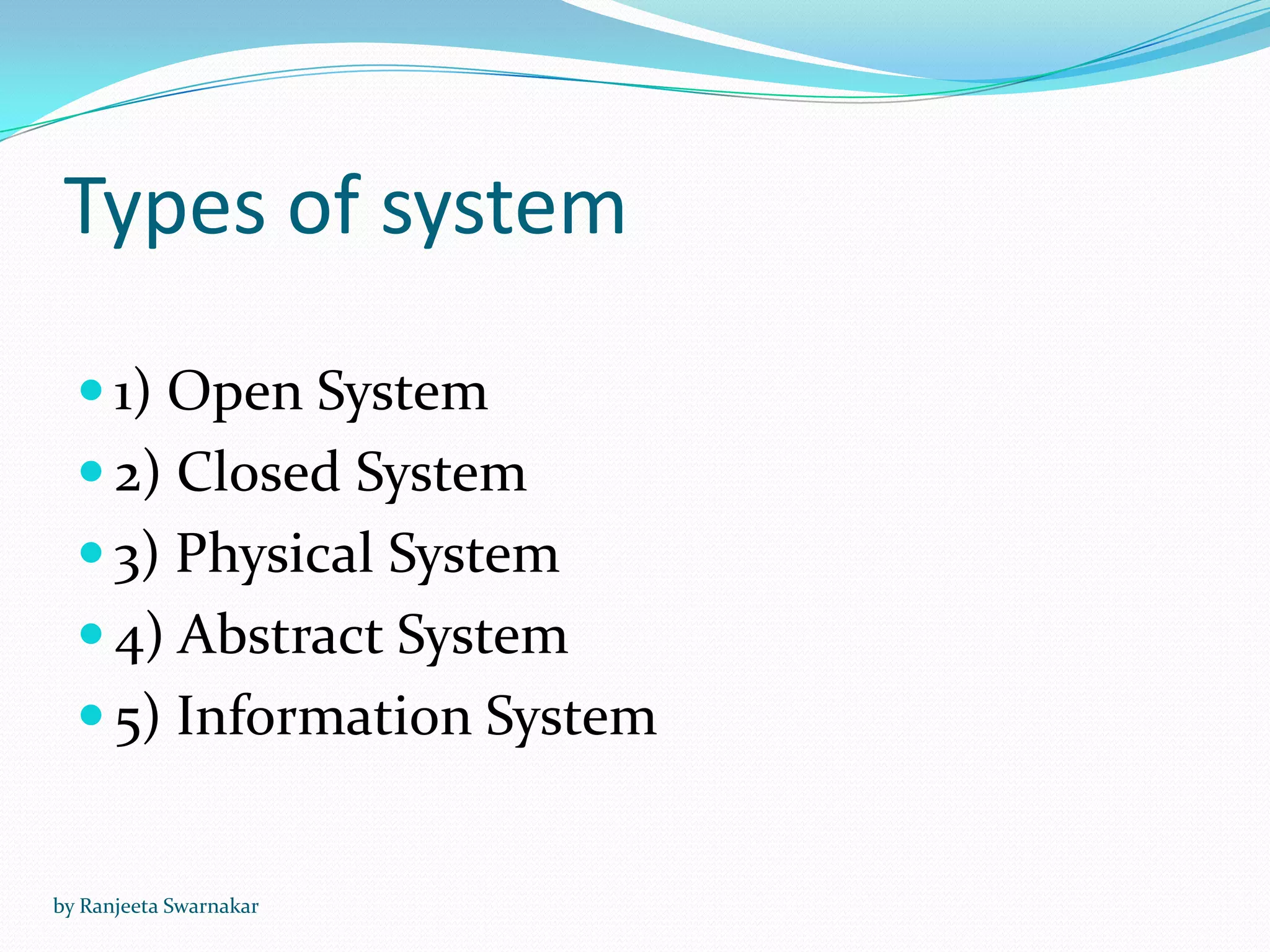
Types of system
 1) Open System
 2) Closed System
 3) Physical System
 4) Abstract System
 5) Information System
by Ranjeeta Swarnakar
Types of system continue…
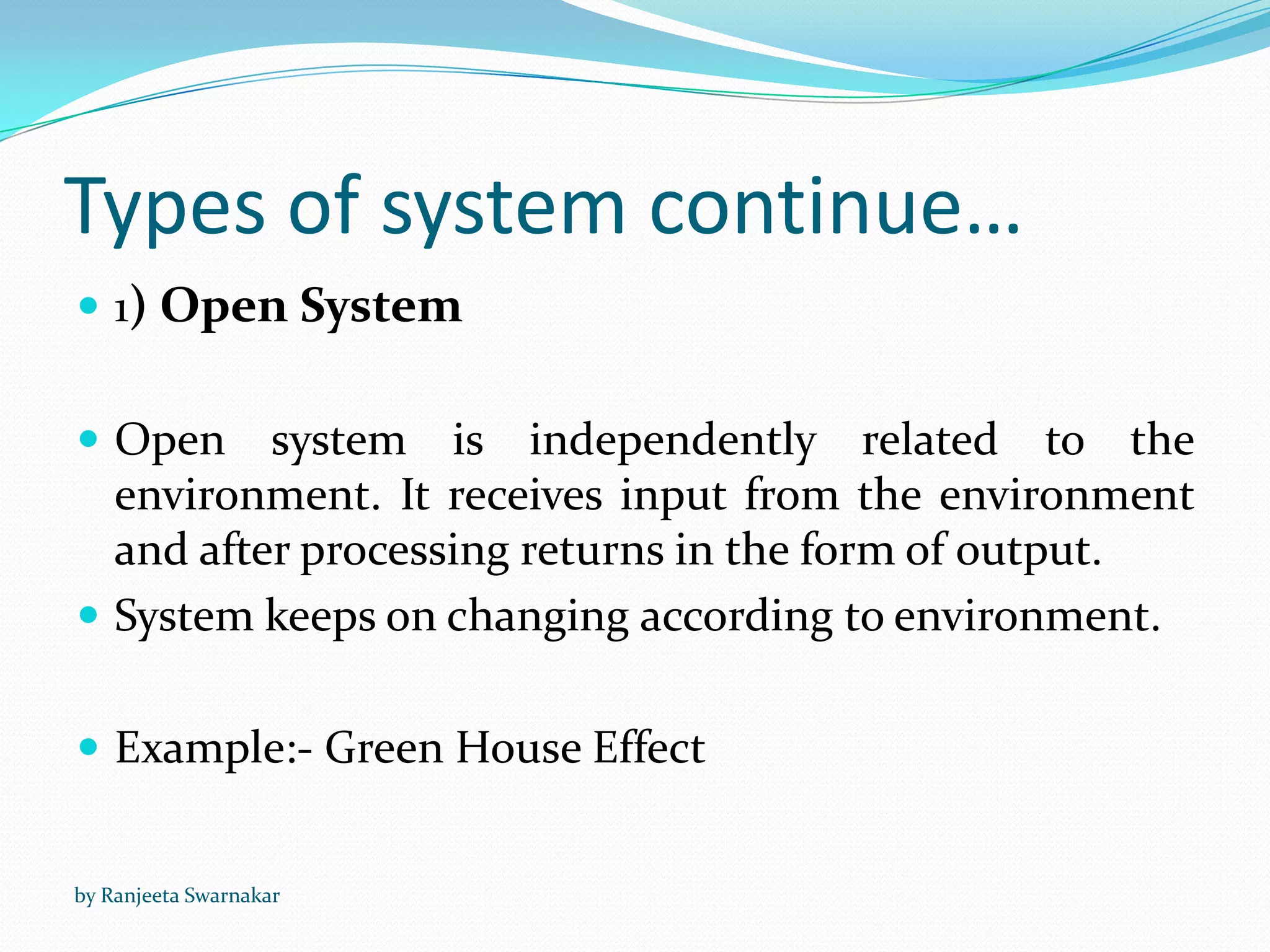
 1) Open System
 Open system is independently related to the
environment. It receives input from the environment
and after processing returns in the form of output.
 System keeps on changing according to environment.
 Example:- Green House Effect
by Ranjeeta Swarnakar
Types of system continue…
 2) Closed System:
 Closed system is not related to environment.
 The changes in environment do not effect the closed
system.
 Example: Water Pump.
by Ranjeeta Swarnakar
Types of system…
 3) Physical System
 Physical Systems are tangible.
 They can be movable or static.
 Example: Computer Hardware.
by Ranjeeta Swarnakar
Types of system…
 4) Abstract System
 This system are imaginary and intangible.
 Basically based on assumptions and imagination.
 Example: Computer Software, Computer Programme
by Ranjeeta Swarnakar
Types of system…
 5) Information System:
 Information system is a system which collects or
provides information either for operation of the
system or decision making.
 Example: Expert System, Office Automation System
by Ranjeeta Swarnakar
Management Information System
 MIS provide information to managers of an
organization. This relates to reports
statistics, stock inventories, payroll details,
budgets or any other details that assist
managers for running an organisation.
by Ranjeeta Swarnakar
MIS Continue…
 Types of MIS
 1) Transaction Processing System (TPS)
 2) Information Providing System (IPS)
 3) Decision Support System(DSS)
 4) Programmed Decision making system
by Ranjeeta Swarnakar
Types of MIS…
 1) TPS
 The system designed for processing day to day
transactions in an organisation. This system deals with
collecting and processing a large volume of data which
mainly helps junior level management in discharging
their responsibilities.
 Example: Accounting system (payroll system, sales
System, purchase system)
by Ranjeeta Swarnakar
Types of MIS…
 2) Information Providing System:
 This system is meant for processing information,
making a summary of information and providing
exception reports. The summary reports help in giving
at a glance the available information, while exception
reports indicate deviations and reason for shortfall of
performance.
 Example: Different types of Management Info Reports
like region wise monthly sales report, cash flow report
, material consumption report.
by Ranjeeta Swarnakar
Types of MIS…
 3) DSS
 DSS are created to help people make decisions by
providing access to information and analysis tools.
 Many stock brokers now use programmes that will
automatically put in requests to sell shares once they
reach a certain price (either high or low)
 A DSS depends upon the accuracy of the maths
involved in creating the model and ability of the user
to accurately interpret the resulting data.
by Ranjeeta Swarnakar
Types of MIS…
 4) Programmed Decision Making System:
 The word ‘program’ is derived from the jargon of the
computer field, where it is defined as a plan automatic
solution of a problem.
 Programs are simply a string of instructions to
accomplish a job or a task. In this information is the
system for programmed decisions are created so that
decisions are made by the system rather than a person.
 Example: JIT
by Ranjeeta Swarnakar
Thank You
by Ranjeeta Swarnakar

Management information system

  • 1.
    Topics Covered: System Types ofsystem Types of MIS by Ranjeeta Swarnakar
  • 2.
    System A system isa set of elements in the form of ideas, things and people which are interrelated and part of a cohesive set up that to achieve a specific goal of goals or objectives. by Ranjeeta Swarnakar 2
  • 3.
    Types of system 1) Open System  2) Closed System  3) Physical System  4) Abstract System  5) Information System by Ranjeeta Swarnakar
  • 4.
    Types of systemcontinue…  1) Open System  Open system is independently related to the environment. It receives input from the environment and after processing returns in the form of output.  System keeps on changing according to environment.  Example:- Green House Effect by Ranjeeta Swarnakar
  • 5.
    Types of systemcontinue…  2) Closed System:  Closed system is not related to environment.  The changes in environment do not effect the closed system.  Example: Water Pump. by Ranjeeta Swarnakar
  • 6.
    Types of system… 3) Physical System  Physical Systems are tangible.  They can be movable or static.  Example: Computer Hardware. by Ranjeeta Swarnakar
  • 7.
    Types of system… 4) Abstract System  This system are imaginary and intangible.  Basically based on assumptions and imagination.  Example: Computer Software, Computer Programme by Ranjeeta Swarnakar
  • 8.
    Types of system… 5) Information System:  Information system is a system which collects or provides information either for operation of the system or decision making.  Example: Expert System, Office Automation System by Ranjeeta Swarnakar
  • 9.
    Management Information System MIS provide information to managers of an organization. This relates to reports statistics, stock inventories, payroll details, budgets or any other details that assist managers for running an organisation. by Ranjeeta Swarnakar
  • 10.
    MIS Continue…  Typesof MIS  1) Transaction Processing System (TPS)  2) Information Providing System (IPS)  3) Decision Support System(DSS)  4) Programmed Decision making system by Ranjeeta Swarnakar
  • 11.
    Types of MIS… 1) TPS  The system designed for processing day to day transactions in an organisation. This system deals with collecting and processing a large volume of data which mainly helps junior level management in discharging their responsibilities.  Example: Accounting system (payroll system, sales System, purchase system) by Ranjeeta Swarnakar
  • 12.
    Types of MIS… 2) Information Providing System:  This system is meant for processing information, making a summary of information and providing exception reports. The summary reports help in giving at a glance the available information, while exception reports indicate deviations and reason for shortfall of performance.  Example: Different types of Management Info Reports like region wise monthly sales report, cash flow report , material consumption report. by Ranjeeta Swarnakar
  • 13.
    Types of MIS… 3) DSS  DSS are created to help people make decisions by providing access to information and analysis tools.  Many stock brokers now use programmes that will automatically put in requests to sell shares once they reach a certain price (either high or low)  A DSS depends upon the accuracy of the maths involved in creating the model and ability of the user to accurately interpret the resulting data. by Ranjeeta Swarnakar
  • 14.
    Types of MIS… 4) Programmed Decision Making System:  The word ‘program’ is derived from the jargon of the computer field, where it is defined as a plan automatic solution of a problem.  Programs are simply a string of instructions to accomplish a job or a task. In this information is the system for programmed decisions are created so that decisions are made by the system rather than a person.  Example: JIT by Ranjeeta Swarnakar
  • 15.