Organization & Business Ethics
Lesson 05
Lesson's Objectives
◦ Identify ethics with organizational
structures
◦ Identify corporate culture with ethics
◦ Leadership practices to ethical conduct of
business
Structure & Business Ethics
◦ Organizational structure is the typically
hierarchical arrangement of lines of
authority, communications, rights and
duties of an organization.
 In centralized organizations
 In decentralized organizations

◦ Each structure has a unique influence on
ethical decision making & behavior.
Centralized Organizations
◦ in centralized organizations, decisionmaking authority is concentrated in the
hands of top level managers & little
authority is delegated to lower levels.
◦ Stress formal rules, policies & procedures
supported with systematic control systems
◦ Codes of ethics may specify the
techniques for decision makers
◦ Tend to be very bureaucratic
◦ The division of labor is well defined
Ethical Issues
◦ Blame-shifting transferring blame for
ones' actions to others
◦ Specialization limits the ability of the
individual to understand how their actions
affect the overall organization
◦ Because of minimal upward
communication, top level managers may
not be aware of problems
Decentralized Organizations
◦ In decentralized organizations, decision
making authority is delegated as far down
the chain of command as possible
◦ Have few formal rules, and coordination
and control are usually informal and
personal
◦ Are adaptable and are very aware of
external change.
◦ Managers can react quickly to changes in
the external and internal environment
Ethical Issues
◦ Difficulty in responding quickly to change
in policy & procedures established by top
management
◦ Employees have extensive decision
making authority
◦ Some occasions consider only human
side instead of owner's profit
Corporate Culture in Ethical
Business
◦ Organizational culture is the values and
behaviors that contribute to the unique social
and psychological environment of an
organization
◦ Culture gives members of an organization
meaning & provides them with rules for
behaving within the organization
◦ A company's history & unwritten rules are a
part of its culture
◦ Some cultures are so strong they dictate the
character of the entire organization to
outsider
Corporate Culture in Ethical
Business
◦ It may be explicit statements of values,
beliefs, and customs coming through
memos, codes, handbooks, manuals,
forms & ceremonies.

◦ It may be expressed informally through
direct & indirect comments that convey
management's wishes: dress codes,
promotions, legends, extracurricular
activities.
Corporate Culture in Ethical
Business
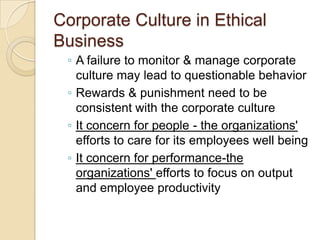
◦ A failure to monitor & manage corporate
culture may lead to questionable behavior
◦ Rewards & punishment need to be
consistent with the corporate culture
◦ It concern for people - the organizations'
efforts to care for its employees well being
◦ It concern for performance-the
organizations' efforts to focus on output
and employee productivity
Corporate Culture in Ethical
Business
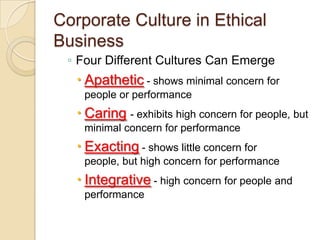
◦ Four Different Cultures Can Emerge

 Apathetic - shows minimal concern for
people or performance

 Caring - exhibits high concern for people, but
minimal concern for performance

 Exacting - shows little concern for
people, but high concern for performance

 Integrative - high concern for people and
performance
Leadership with Culture
◦ A leader must respect followers and
provide a standard of ethical conduct
◦ Managers can use rewards & punishment
to encourage employees in behaviors that
support the organization's goals
 An individual's hierarchy of needs may
influence motivation & ethical behavior
 Stick or Carrot approach to motivation
 Reinforcement theory
Leadership with Culture
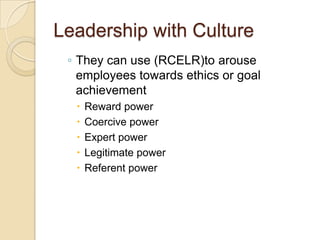
◦ They can use (RCELR)to arouse
employees towards ethics or goal
achievement






Reward power
Coercive power
Expert power
Legitimate power
Referent power
Ethic Vs. Stress
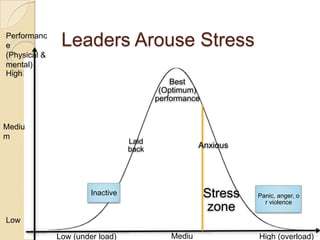
◦ Stress is your mind and body's response or
reaction to a rear or imagined threat, event or
change
◦ Eustress or positive stress occurs when your
level of stress is high enough to motivate you
to move into action to get things
accomplished.
◦ Distress or negative stress occurs when your
level of stress is either too high or too low
and your body and/or mind begin to respond
negatively to the stressors.
◦ Is it ethical
Performanc
e
(Physical &
mental)
High

Leaders Arouse Stress
Best
(Optimum)
performance

Mediu
m

Laid
back

Anxious

Stress
zone

Inactive

Panic, anger, o
r violence

Low
Low (under load)

Mediu

High (overload)
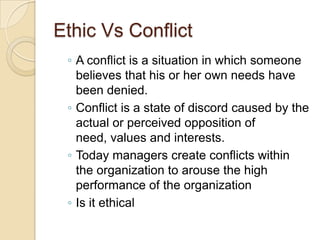
Ethic Vs Conflict
◦ A conflict is a situation in which someone
believes that his or her own needs have
been denied.
◦ Conflict is a state of discord caused by the
actual or perceived opposition of
need, values and interests.
◦ Today managers create conflicts within
the organization to arouse the high
performance of the organization
◦ Is it ethical
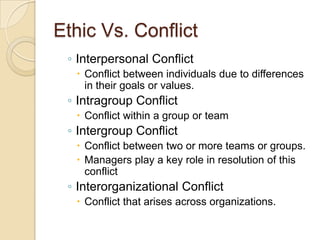
Ethic Vs. Conflict
◦ Interpersonal Conflict
 Conflict between individuals due to differences
in their goals or values.

◦ Intragroup Conflict
 Conflict within a group or team

◦ Intergroup Conflict
 Conflict between two or more teams or groups.
 Managers play a key role in resolution of this
conflict

◦ Interorganizational Conflict
 Conflict that arises across organizations.
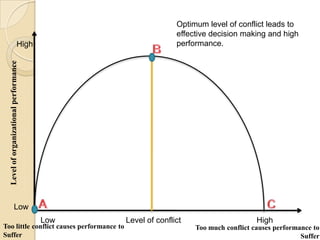
Optimum level of conflict leads to
effective decision making and high
performance.

Level of organizational performance

High

Low
Low

Too little conflict causes performance to
Suffer

Level of conflict

High
Too much conflict causes performance to
Suffer
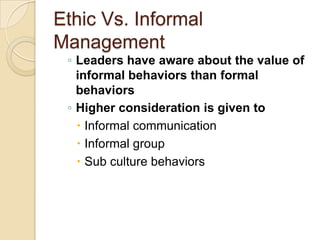
Ethic Vs. Informal
Management

◦ Leaders have aware about the value of
informal behaviors than formal
behaviors
◦ Higher consideration is given to
 Informal communication
 Informal group
 Sub culture behaviors
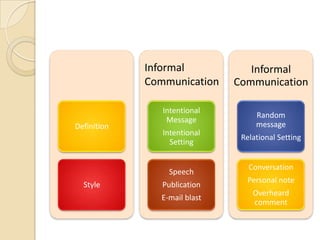
Informal
Communication

Definition

Intentional
Message
Intentional
Setting

Speech
Style

Publication
E-mail blast

Informal
Communication
Random
message
Relational Setting

Conversation
Personal note
Overheard
comment
05 organization & business ethics

05 organization & business ethics

  • 1.
    Organization & BusinessEthics Lesson 05
  • 2.
    Lesson's Objectives ◦ Identifyethics with organizational structures ◦ Identify corporate culture with ethics ◦ Leadership practices to ethical conduct of business
  • 3.
    Structure & BusinessEthics ◦ Organizational structure is the typically hierarchical arrangement of lines of authority, communications, rights and duties of an organization.  In centralized organizations  In decentralized organizations ◦ Each structure has a unique influence on ethical decision making & behavior.
  • 4.
    Centralized Organizations ◦ incentralized organizations, decisionmaking authority is concentrated in the hands of top level managers & little authority is delegated to lower levels. ◦ Stress formal rules, policies & procedures supported with systematic control systems ◦ Codes of ethics may specify the techniques for decision makers ◦ Tend to be very bureaucratic ◦ The division of labor is well defined
  • 5.
    Ethical Issues ◦ Blame-shiftingtransferring blame for ones' actions to others ◦ Specialization limits the ability of the individual to understand how their actions affect the overall organization ◦ Because of minimal upward communication, top level managers may not be aware of problems
  • 6.
    Decentralized Organizations ◦ Indecentralized organizations, decision making authority is delegated as far down the chain of command as possible ◦ Have few formal rules, and coordination and control are usually informal and personal ◦ Are adaptable and are very aware of external change. ◦ Managers can react quickly to changes in the external and internal environment
  • 7.
    Ethical Issues ◦ Difficultyin responding quickly to change in policy & procedures established by top management ◦ Employees have extensive decision making authority ◦ Some occasions consider only human side instead of owner's profit
  • 8.
    Corporate Culture inEthical Business ◦ Organizational culture is the values and behaviors that contribute to the unique social and psychological environment of an organization ◦ Culture gives members of an organization meaning & provides them with rules for behaving within the organization ◦ A company's history & unwritten rules are a part of its culture ◦ Some cultures are so strong they dictate the character of the entire organization to outsider
  • 9.
    Corporate Culture inEthical Business ◦ It may be explicit statements of values, beliefs, and customs coming through memos, codes, handbooks, manuals, forms & ceremonies. ◦ It may be expressed informally through direct & indirect comments that convey management's wishes: dress codes, promotions, legends, extracurricular activities.
  • 10.
    Corporate Culture inEthical Business ◦ A failure to monitor & manage corporate culture may lead to questionable behavior ◦ Rewards & punishment need to be consistent with the corporate culture ◦ It concern for people - the organizations' efforts to care for its employees well being ◦ It concern for performance-the organizations' efforts to focus on output and employee productivity
  • 11.
    Corporate Culture inEthical Business ◦ Four Different Cultures Can Emerge  Apathetic - shows minimal concern for people or performance  Caring - exhibits high concern for people, but minimal concern for performance  Exacting - shows little concern for people, but high concern for performance  Integrative - high concern for people and performance
  • 12.
    Leadership with Culture ◦A leader must respect followers and provide a standard of ethical conduct ◦ Managers can use rewards & punishment to encourage employees in behaviors that support the organization's goals  An individual's hierarchy of needs may influence motivation & ethical behavior  Stick or Carrot approach to motivation  Reinforcement theory
  • 13.
    Leadership with Culture ◦They can use (RCELR)to arouse employees towards ethics or goal achievement      Reward power Coercive power Expert power Legitimate power Referent power
  • 14.
    Ethic Vs. Stress ◦Stress is your mind and body's response or reaction to a rear or imagined threat, event or change ◦ Eustress or positive stress occurs when your level of stress is high enough to motivate you to move into action to get things accomplished. ◦ Distress or negative stress occurs when your level of stress is either too high or too low and your body and/or mind begin to respond negatively to the stressors. ◦ Is it ethical
  • 15.
    Performanc e (Physical & mental) High Leaders ArouseStress Best (Optimum) performance Mediu m Laid back Anxious Stress zone Inactive Panic, anger, o r violence Low Low (under load) Mediu High (overload)
  • 16.
    Ethic Vs Conflict ◦A conflict is a situation in which someone believes that his or her own needs have been denied. ◦ Conflict is a state of discord caused by the actual or perceived opposition of need, values and interests. ◦ Today managers create conflicts within the organization to arouse the high performance of the organization ◦ Is it ethical
  • 17.
    Ethic Vs. Conflict ◦Interpersonal Conflict  Conflict between individuals due to differences in their goals or values. ◦ Intragroup Conflict  Conflict within a group or team ◦ Intergroup Conflict  Conflict between two or more teams or groups.  Managers play a key role in resolution of this conflict ◦ Interorganizational Conflict  Conflict that arises across organizations.
  • 18.
    Optimum level ofconflict leads to effective decision making and high performance. Level of organizational performance High Low Low Too little conflict causes performance to Suffer Level of conflict High Too much conflict causes performance to Suffer
  • 19.
    Ethic Vs. Informal Management ◦Leaders have aware about the value of informal behaviors than formal behaviors ◦ Higher consideration is given to  Informal communication  Informal group  Sub culture behaviors
  • 20.