





Lesson 11
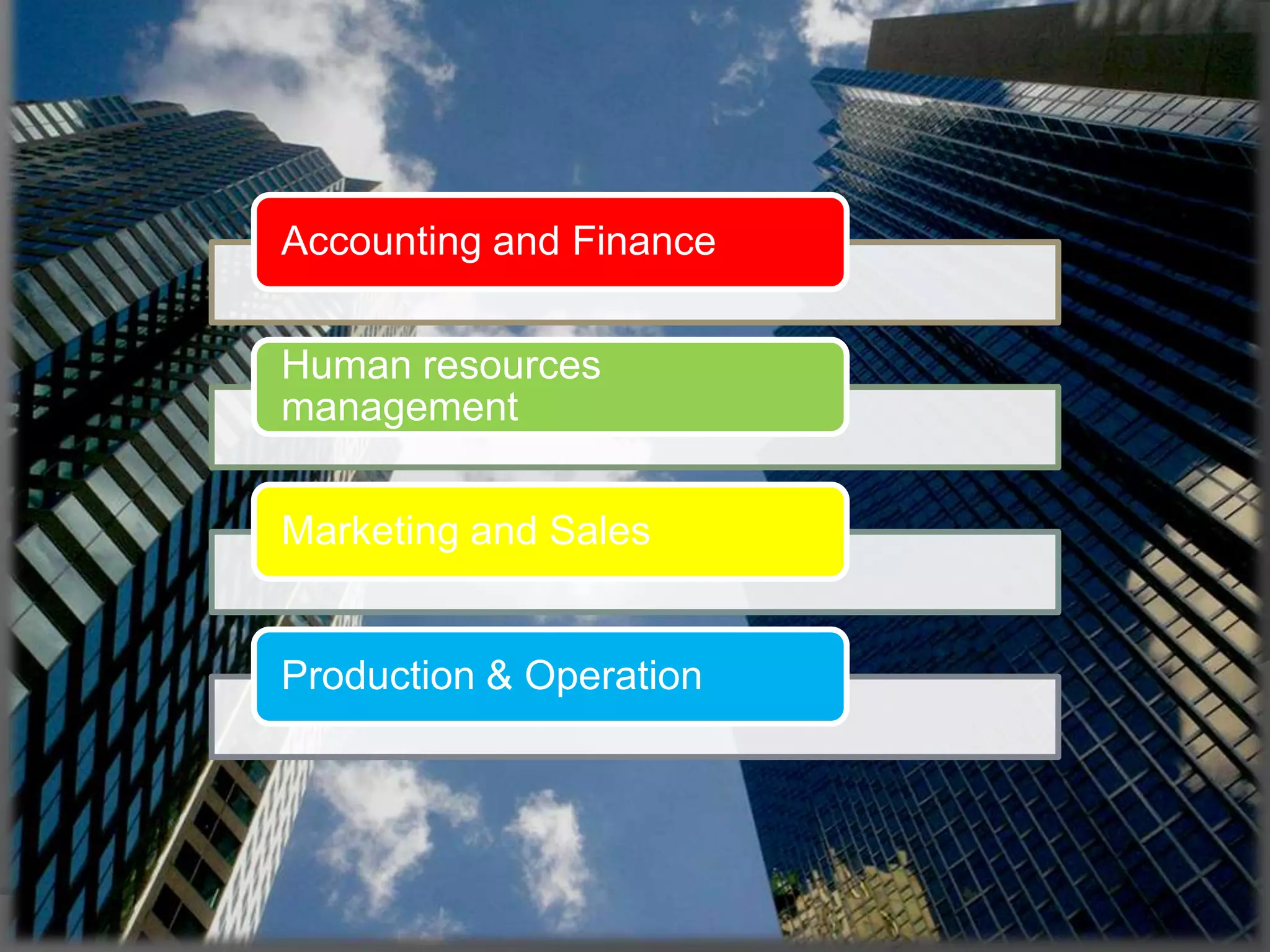
Accounting and Finance
Human resources
management
Marketing and Sales

Production & Operation
Ethics of Accounting
Accounting ethics is primarily a field of
applied ethics, the study of moral
values and judgments as they apply
to accountancy.
It is an example of professional ethics.
Accounting ethics were first introduced
by Luca Pacioli, and later expanded
by government groups, professional
organizations,
and
independent
companies.
Ethics are taught in accounting courses
at higher education institutions as well
as by companies training accountants
and auditors.
ISSUES
 Creative

accounting, earnings
management, misleading
financial analysis.
 Insider trading, securities fraud,
bucket shops, forex scams:
concerns (criminal) manipulation
of the financial markets.
ISSUES CONT..
 Executive compensation:

concerns excessive payments
made to corporate CEO's and
top management.
Ethics of Human Resource
Mgt.
The ethics of human resource
management (HRM) covers
those ethical issues arising
around the employer-employee
relationship, such as the rights
and duties owed between
employer and employee.
ISSUES
 Discrimination issues include

discrimination on the bases of
age (ageism), gender, race,
religion, disabilities, weight
and attractiveness, affirmative
action, sexual harassment.
ISSUES CONT..
 Issues

arising

from the
traditional
view
of
relationships
between
employers and employees,
also
known
as
At-will
employment.
ISSUES CONT..
 Issues surrounding the

representation of employees and
the democratization of the
workplace: union busting, strike
breaking.
 Issues affecting the privacy of the
employee: workplace
surveillance, drug testing.
 Issues affecting the privacy of the
employer: whistle-blowing.
ISSUES CONT..
 Issues relating to the fairness of

the employment contract and
the balance of power between
employer and employee:
slavery, indentured servitude,
employment law.
 Occupational safety and health.
Ethics of Sales and
Marketing
Marketing ethics is the area of
applied ethics which deals with the
moral
principles
behind
the
operation
and
regulation
of
marketing. Some areas of marketing
ethics (ethics of advertising and
promotion) overlap with media
ethics.
ISSUES
 Pricing: price fixing, price

discrimination, price skimming.
 Price skimming is a pricing strategy in

which a marketer sets a relatively high
price for a product or service at first,
then lowers the price over time.
ISSUES
 Anti-competitive practices: these

include but go beyond pricing tactics
to cover issues such as
manipulation of loyalty and supply
chains.
ISSUES
 Specific marketing strategies:

greenwash, bait and switch,
shill, viral marketing, spam
(electronic), pyramid scheme,
planned obsolescence.
ISSUES CONT..
 Content

of advertisements:
attack ads, subliminal
messages, sex in advertising,
products regarded as immoral or
harmful
 Children and marketing:
marketing in schools.
 Black markets, grey markets.
Ethics of Production
 This

area of business ethics
deals with the duties of a
company to ensure that products
and production processes do not
cause harm.
Ethics of Production
 Some

of the more acute
dilemmas in this area arise
out of the fact that there is
usually a degree of danger in
any product or production
Ethics of Production
 And

it is difficult to define a
degree of permissibility, or the
degree of permissibility may
depend on the changing state of
preventative
technologies
or
changing social perceptions of
acceptable risk.
 Defective, addictive and inherently

dangerous products and services
(e.g. tobacco, alcohol, weapons,
motor vehicles, chemical
manufacturing, bungee jumping).
 Ethical relations between the

company and the environment:
pollution, environmental ethics,
carbon emissions trading.
 Ethical problems arising out of

new technologies: genetically
modified food, mobile phone
radiation and health.
 Product testing ethics: animal

rights and animal testing, use of
economically disadvantaged
groups (such as students) as test
objects.
11 ethics and business functions

11 ethics and business functions

  • 1.
  • 3.
    Accounting and Finance Humanresources management Marketing and Sales Production & Operation
  • 5.
    Ethics of Accounting Accountingethics is primarily a field of applied ethics, the study of moral values and judgments as they apply to accountancy. It is an example of professional ethics.
  • 6.
    Accounting ethics werefirst introduced by Luca Pacioli, and later expanded by government groups, professional organizations, and independent companies. Ethics are taught in accounting courses at higher education institutions as well as by companies training accountants and auditors.
  • 7.
    ISSUES  Creative accounting, earnings management,misleading financial analysis.  Insider trading, securities fraud, bucket shops, forex scams: concerns (criminal) manipulation of the financial markets.
  • 8.
    ISSUES CONT..  Executivecompensation: concerns excessive payments made to corporate CEO's and top management.
  • 11.
    Ethics of HumanResource Mgt. The ethics of human resource management (HRM) covers those ethical issues arising around the employer-employee relationship, such as the rights and duties owed between employer and employee.
  • 12.
    ISSUES  Discrimination issuesinclude discrimination on the bases of age (ageism), gender, race, religion, disabilities, weight and attractiveness, affirmative action, sexual harassment.
  • 13.
    ISSUES CONT..  Issues arising fromthe traditional view of relationships between employers and employees, also known as At-will employment.
  • 14.
    ISSUES CONT..  Issuessurrounding the representation of employees and the democratization of the workplace: union busting, strike breaking.  Issues affecting the privacy of the employee: workplace surveillance, drug testing.  Issues affecting the privacy of the employer: whistle-blowing.
  • 15.
    ISSUES CONT..  Issuesrelating to the fairness of the employment contract and the balance of power between employer and employee: slavery, indentured servitude, employment law.  Occupational safety and health.
  • 18.
    Ethics of Salesand Marketing Marketing ethics is the area of applied ethics which deals with the moral principles behind the operation and regulation of marketing. Some areas of marketing ethics (ethics of advertising and promotion) overlap with media ethics.
  • 19.
    ISSUES  Pricing: pricefixing, price discrimination, price skimming.  Price skimming is a pricing strategy in which a marketer sets a relatively high price for a product or service at first, then lowers the price over time.
  • 20.
    ISSUES  Anti-competitive practices:these include but go beyond pricing tactics to cover issues such as manipulation of loyalty and supply chains.
  • 21.
    ISSUES  Specific marketingstrategies: greenwash, bait and switch, shill, viral marketing, spam (electronic), pyramid scheme, planned obsolescence.
  • 22.
    ISSUES CONT..  Content ofadvertisements: attack ads, subliminal messages, sex in advertising, products regarded as immoral or harmful  Children and marketing: marketing in schools.  Black markets, grey markets.
  • 25.
    Ethics of Production This area of business ethics deals with the duties of a company to ensure that products and production processes do not cause harm.
  • 26.
    Ethics of Production Some of the more acute dilemmas in this area arise out of the fact that there is usually a degree of danger in any product or production
  • 27.
    Ethics of Production And it is difficult to define a degree of permissibility, or the degree of permissibility may depend on the changing state of preventative technologies or changing social perceptions of acceptable risk.
  • 28.
     Defective, addictiveand inherently dangerous products and services (e.g. tobacco, alcohol, weapons, motor vehicles, chemical manufacturing, bungee jumping).  Ethical relations between the company and the environment: pollution, environmental ethics, carbon emissions trading.
  • 29.
     Ethical problemsarising out of new technologies: genetically modified food, mobile phone radiation and health.  Product testing ethics: animal rights and animal testing, use of economically disadvantaged groups (such as students) as test objects.