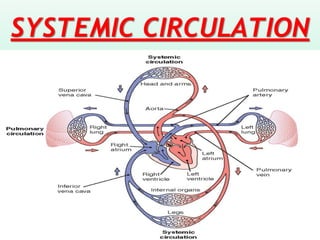
SYSTEMIC CIRCULATION
Systemic Arteries:
• It resembles a tree trunk that continue to branch
and re-branch forming arterioles and capillaries.
• Aorta is the major artery that serves as main trunk.
It consist of ascending aorta, arch of aorta and
descending aorta.
• The descending aorta when it pass through thoracic
cavity and abdominal cavity it is called as thoracic
aorta and abdominal aorta respectively.
• The branches of arch of the aorta is different in
right and left.
MAJOR
SYSTEMIC
ARTERIES
THE AORTA
• The Ascending
aorta:
• Short section of
aorta, 5 cms –
located behind
the sternum.
• Branches are the
R and L Coronary
Arteries.
• They arise at the
level of the aortic
valve
The Arch of Aorta:
• Lies behind the Manubrium of the sternum.
Runs upwards, backwards and to the left in
front of the trachea.
• 3 Main Branches of the Aortic Arch deliver
blood to head and neck:
1. Brachio-cephalic artery
2. Left common carotid artery
3. Left subclavian artery
Major branches of arch of aorta
• The Brachiocephalic Artery 5 cms long - at
the level of the sterno-clavicular joint it
divides into Branches to form:
– Right subclavian artery
– Right common carotid artery
• The Subclavian Arteries branches within
thoracic cavity:
– Internal thoracic artery
– Vertebral artery
– Thyro-cervical trunk
Arteries of the Head and Neck
All the blood supply to head and neck arise
from arch of aorta.
The major branches of arch of aorta are;
1. Brachiocephalic artery (innominate)
a. Right Common Carotid (right internal carotid
and right external carotid arteries)
b. Right Subclavian (right vertebral, right axillary
and right brachial.)
2. Left Common carotid artery (left internal carotid
and left external carotid)
3. Left Subclavian artery (left vertebral, left axillary
and left brachial.)
The Vertebral Arteries
▪ Also supply brain with
blood
• Left and right vertebral
arteries:
– arise from subclavian
arteries
– enter cranium through
foramen magnum
– fuse to form basilar
artery
The Common Carotid Arteries
• Carry blood to head and neck (Left and right
common carotid artery)
• At the upper border of the Thyroid gland -
common carotid divides into:
– External carotid artery- Supplies Neck,
lower jaw, face.
- Internal carotid artery- Enters skull and
divides into: ophthalmic artery and
cerebral artery.
External Carotid Artery
It supplies superficial tissues of the neck and
face. Branches are
• Superior thyroid artery
• Ascending pharyngeal artery
• Lingual artery
• Facial artery
• Occipital artery
• Posterior auricular
• Maxillary artery
• Superficial temporal artery
Internal carotid artery
• Major contributor of the Circle of
Willis.
• It enters skull and divides into:
ophthalmic artery and cerebral
artery
Internal Carotid Artery
The Circulus Arteriosus
The Circle of Willis is the
joining area of several
arteries at the bottom
(inferior) side of the brain.
At the Circle of Willis, the
internal carotid arteries
branch into smaller
arteries that supply
oxygenated blood to over
80% of the cerebrum.
Carotid Body/ Carotid Sinus
• The carotid body is a
chemoreceptor located in the
bifurcation of the common
carotid artery and senses for
pCO2, and pO2.
• The carotid sinus is a
baroreceptor that senses
changes in systemic blood
pressure and is located in the
carotid bulb of the internal
carotid artery.
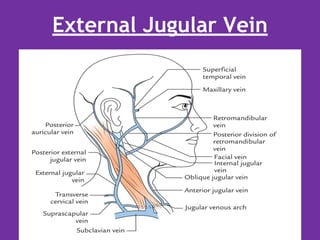
Veins of the Head and neck
• Venous drainage from the face is entirely
superficial and it drains to external jugular veins
which further joins to subclavian vein.
• Venous drainage from the head and neck
terminate in the internal jugular vein which join
the subclavian vein to form the brachio-cephalic
vein.
• Two brachio-cephalic veins unite to form superior
vena cava.
Veins of the Head and neck
Internal Jugular Vein
➢ The internal jugular vein receives blood
from the head & neck.
➢ It descends through the neck in the carotid
sheath & unites with the subclavian vein to
form the brachiocephalic vein.
➢ The main branches of internal jugular veins
are Pharyngeal vein, lingual veins, Facial
veins and veins of larynx and thyroid.
Internal Jugular Vein
External Jugular Vein
➢It drains mainly scalp and face.
➢It is formed by the union of posterior
division of the retro-mandibular vein with
the posterior auricular vein.
➢It descends obliquely superficial to the
sterno-cleidomastoid (muscle lateral to
neck) to the root of the neck and then it
ends in the subclavian vein.
External Jugular Vein
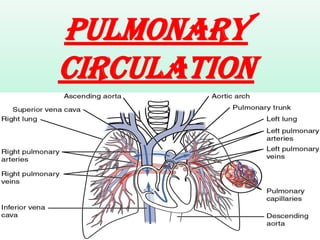
Pulmonary
CIRCULATION
The Pulmonary Circuit
• Deoxygenated blood arrives at heart from
systemic circuit:
– passes through right atrium and ventricle
– enters pulmonary trunk
• At the lungs:
– CO2 is removed
– O2 is added
• Oxygenated blood:
– returns to the heart via pulmonary veins and
distributed to systemic circuit
Pulmonary Vessels
• Pulmonary arteries: Carry deoxygenated blood
• The Pulmonary trunk branches to left and right
pulmonary arteries.
• The Pulmonary arteries branch into pulmonary
arterioles and further into capillary networks
that surround alveoli.
• Pulmonary veins carry oxygenated blood to the
heart. Capillary networks around alveoli join to
form venules. Venules join to form 4 pulmonary
veins. Pulmonary veins empty into left atrium.
MAJOR BLOOD VESSELS
Upper Limb & Thorax
(Descending Aorta in thorax)
• The Subclavian Arteries Branches in thoracic
cavity:
– internal thoracic artery or mammary artery.
– vertebral artery
– thyrocervical trunk (cervical artery & thyroid
artery)
• Leaving the thoracic cavity:
– become axillary artery in arm and brachial
artery distally
– Further divides into radial artery and ulnar
artery and then Superficial Palmar arch is
formed
Arteries of the upper limb
• Axillary artery- it is a continuation of subclavian
artery from lateral margin of first rib.
• Brachial artery- it is continuation of the axillary
artery and supplies arm.
• Radial artery- it lies along the radial side of
forearm. It enters the palm and supplies thumb and
radial side of index finger.
• Ulnar artery- it begins at the level of the neck of
radius. It runs downwards and reaches the medial
side of forearm midway between the elbow and the
wrist.
Arteries of the upper limb
Arterial arcs of the palm-
1. Deep palmer arch- it is mainly formed by radial
artery, completed by the deep branch of the ulnar
artery.
2. Superficial palmer arch- it is mainly formed by the
ulnar artery and completed by the superficial
branch of radial artery.
ARTERIES OF THE TRUNK
Descending Aorta –
is divided by
diaphragm into:
thoracic aorta and
abdominal aorta
Arteries of the Thorax
Thoracic Aorta branches are anatomically grouped
into visceral and parietal arteries.
Visceral arteries Supply visceral organs:
– Two bronchial arteries: blood supply to
bronchial tree and surrounding lung tissues.
– Two pericardial arteries: blood supply to
pericardial sac.
– Two esophageal arteries: Blood supply to all
tissues of esophagus.
– Two mediastinal arteries: Blood supply to
connective tissues in mediastinum
Arteries of the Thorax
Parietal arteries:
- Posterior intercostal arteries: 3rd to 11th
intercoastal spaces
- Subcostal arteries: below 12th rib
- Superior phrenic arteries: supply the diaphragm
Veins of the Upper Limb
The veins of the upper limb is divided into deep
veins and superficial veins.
1. Deep veins
a. Subclavian veins: skin, muscles bones, shoulder
and neck.
b. Axillary veins: skin, muscles bones, shoulder and
axilla.
c. Brachial veins: muscles and bones of elbow and
brachial regions.
d. Ulnar vein: muscles and bones of medial aspects
of forearm.
e. Radial vein: muscles and bones of lateral aspects
of forearm.
Veins of the Upper Limb
2. Superficial veins
a. Cephalic veins: superficial aspects of upper
limb.
b. Basilic vein: skin and superficial aspects of
upper limb.
c. Median ante brachial veins: drain from palmar
venous plexus and palmar digital veins.
Veins of the Upper Limb
INTRAVENOUS INJECTION
• Intravenous injections provide the
introduction of the drug directly into the
bloodstream.
Veins used for IV injection
Veins of the Thorax
• Brachiocephalic veins: It is the union of
subclavian and internal jugular veins. This
ultimately forms superior vena cava. It drains
head, neck, upper limbs, mammary glands and
thorax.
• Azygos vein: It is present anterior to vertebral
column. It includes esophageal, mediastinal,
pericardial and bronchial veins.
• Hemiazygos vein: Present anterior to vertebral
column and joins with Azygos vein.
Major Blood Vessels
Abdominal Aorta
Pelvis
Lower Limb
The Abdominal Aorta
• The abdominal aorta begins at the level of
the diaphragm, crossing it via the aortic
hiatus.
• It runs parallel to the inferior vena cava,
which is located just to the right of the
abdominal aorta.
• It becomes smaller in diameter as it gives
off branches.
Branches of the Abdominal
Aorta
The abdominal aorta is branched into two
categories such as
1. Unpaired branches
2. Paired branches
Unpaired Branches
1. Celiac artery: The major branch called as
celiac trunk/artery arise from abdominal aorta
anteriorly which further divides into three as
follows;
❖ Left gastric artery: supplies stomach
❖ Splenic artery: largest branch of celiac trunk.
Supplies stomach, spleen and pancreas
❖ Common hepatic artery: Three sub branches:
proper hepatic artery (supplies liver and gall
bladder), right gastric artery (supplies
stomach), gastro-duodenal artery (stomach
and duodenum).
Cont..
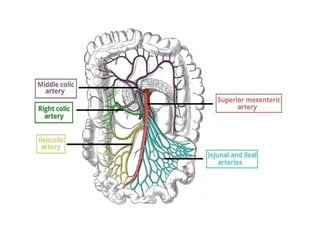
2. Superior mesenteric arteries: arteries
pertaining to intestine. It mainly posses five
branches
❖ Inferior pancreatic-duodenal artery: Pancreas
& Duodenum
❖ Jejunal artery: Jejunum, ileum
❖ Ileocolic artery: ileum, cecum, appendix,
ascending colon
❖ Right colic artery: ascending colon, transverse
colon
❖ Middle colic artery: tarnsverse colon
Cont..
3. Inferior mesenteric arteries:
❖ Left colic artery: supplies descending
colon
❖ Sigmoid arteries: supplies sigmoid colon
❖ Superior rectal arteries: supplies rectum
Cont..
3. Sacral artery:
Sacrum, Coccyx
Paired Branches
1.Inferior Phrenic arteries: Diaphragm
2.Suprarenal arteries: suprarenal areas such as
adrenal glands.
3.Renal arteries: supplies Kidneys
4.Gonadal arteries: testicular arteries(males:
testis, epididymis, ductus deferens, ureters),
ovarian arteries (female: ovaries, fallopian
tubes and ureters) and uterine arteries
(uterus).
5.Lumbar arteries: Lumbar vertebrae
Arteries of Pelvis and lower
limbs
The abdominal aorta ends by dividing into left
and right common iliac arteries. It give rise
two branches such as internal iliac arteries and
external iliac arteries.
1. Internal iliac arteries: it supplies all the
pelvic viscera, buttocks, external genitals,
and muscles of thighs. In females it give rise
to uterine and vaginal arteries.
2. External iliac arteries: larger than internal
iliac arteries. It starts at sacroiliac joint and
passes to form femoral artery.
Arteries of lower limbs.
❖Femoral arteries: continuation of external
iliac arteries. Muscles of thigh, femur,
ligaments and tendons around the knee joint.
❖Popliteal arteries: continuation of femoral
arteries pass through popliteal fossa (space
behind knee joint). Knee, tibia, fibula, skin
and muscles.
❖Further it divides into anterior tibial and
posterior tibial arteries. This further forms
plantar arch and metatarsal arteries &
plantar digital arteries. The dorsal arteries at
ankle is also called as dorsalis pedis.
Veins of the Abdomen and
Pelvis
The venous supply of the abdomen and pelvis
reaches the heart through inferior vena cava. It
has the following branches
1. Inferior Phrenic veins: inferior diaphragm and
adjacent peritoneum.
2. Hepatic veins: mainly three branches:
superior mesenteric vein, the inferior
mesenteric vein, the splenic vein and gastric
vein.
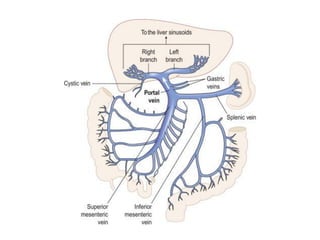
The Hepatic Portal Circulation
• The hepatic portal system is the venous
system that returns blood from the digestive tract
and spleen to the liver (where raw nutrients in
blood are processed before the blood returns to
the heart).
• It consists of the hepatic portal vein and other
veins that drain into the hepatic portal vein, i.e.,
the superior mesenteric vein, the inferior
mesenteric vein, the splenic vein and gastric
vein.
Cont..
• Since blood received from the hepatic
portal vein may be contaminated with
pathogens such as bacteria, the liver is rich
in specialized immune cells called Kupffer
cells that detect and destroy foreign
organisms.
• Following processing, blood collects into
the hepatic vein and finally through
inferior vena cava to the right atria of the
heart.
Veins of the Abdomen and
Pelvis
3. Lumbar veins: lumbar vertebrae, spinal cord
4. Suprarenal veins: adrenal glands
5. Renal veins: kidneys.
6. Gonadal veins: testes, ovaries, ureters.
7. Common iliac veins: internal (pelvis,
gluteal, external genitalia) and external
(lower limbs, lower abdominal wall)
The veins of lower limbs
a. Deep veins: They are branches of external
iliac veins. The main branches are;
1. Femoral veins: skin, bones and muscles of the
thigh.
2. Popliteal veins: skin, muscle, and bones of
the knee joint.
3. Posterior tibial veins: posterior and lateral
aspects of leg.
4. Anterior tibial veins: anterior aspects of leg
such as foot, ankle, tibio-fibular joint.
The veins of lower limbs
b. Superficial veins:
1. Great Saphenous veins: longest vein in the
body. It starts from metatarsal veins to groin
region. It drains blood from muscles of lower
limbs, groin and lower abdomen.
2. Small Saphenous vein: It begins from the
venous arch of the foot and ends in popliteal
veins. Posterior aspects of leg is also drained
with this vein.
s

systemic and pulmonary circulation.pdf

  • 1.
  • 2.
    Systemic Arteries: • Itresembles a tree trunk that continue to branch and re-branch forming arterioles and capillaries. • Aorta is the major artery that serves as main trunk. It consist of ascending aorta, arch of aorta and descending aorta. • The descending aorta when it pass through thoracic cavity and abdominal cavity it is called as thoracic aorta and abdominal aorta respectively. • The branches of arch of the aorta is different in right and left.
  • 3.
  • 4.
    THE AORTA • TheAscending aorta: • Short section of aorta, 5 cms – located behind the sternum. • Branches are the R and L Coronary Arteries. • They arise at the level of the aortic valve
  • 5.
    The Arch ofAorta: • Lies behind the Manubrium of the sternum. Runs upwards, backwards and to the left in front of the trachea. • 3 Main Branches of the Aortic Arch deliver blood to head and neck: 1. Brachio-cephalic artery 2. Left common carotid artery 3. Left subclavian artery
  • 6.
    Major branches ofarch of aorta
  • 7.
    • The BrachiocephalicArtery 5 cms long - at the level of the sterno-clavicular joint it divides into Branches to form: – Right subclavian artery – Right common carotid artery • The Subclavian Arteries branches within thoracic cavity: – Internal thoracic artery – Vertebral artery – Thyro-cervical trunk
  • 8.
    Arteries of theHead and Neck
  • 9.
    All the bloodsupply to head and neck arise from arch of aorta. The major branches of arch of aorta are; 1. Brachiocephalic artery (innominate) a. Right Common Carotid (right internal carotid and right external carotid arteries) b. Right Subclavian (right vertebral, right axillary and right brachial.) 2. Left Common carotid artery (left internal carotid and left external carotid) 3. Left Subclavian artery (left vertebral, left axillary and left brachial.)
  • 10.
    The Vertebral Arteries ▪Also supply brain with blood • Left and right vertebral arteries: – arise from subclavian arteries – enter cranium through foramen magnum – fuse to form basilar artery
  • 12.
    The Common CarotidArteries • Carry blood to head and neck (Left and right common carotid artery) • At the upper border of the Thyroid gland - common carotid divides into: – External carotid artery- Supplies Neck, lower jaw, face. - Internal carotid artery- Enters skull and divides into: ophthalmic artery and cerebral artery.
  • 14.
    External Carotid Artery Itsupplies superficial tissues of the neck and face. Branches are • Superior thyroid artery • Ascending pharyngeal artery • Lingual artery • Facial artery • Occipital artery • Posterior auricular • Maxillary artery • Superficial temporal artery
  • 15.
    Internal carotid artery •Major contributor of the Circle of Willis. • It enters skull and divides into: ophthalmic artery and cerebral artery
  • 16.
  • 17.
    The Circulus Arteriosus TheCircle of Willis is the joining area of several arteries at the bottom (inferior) side of the brain. At the Circle of Willis, the internal carotid arteries branch into smaller arteries that supply oxygenated blood to over 80% of the cerebrum.
  • 19.
    Carotid Body/ CarotidSinus • The carotid body is a chemoreceptor located in the bifurcation of the common carotid artery and senses for pCO2, and pO2. • The carotid sinus is a baroreceptor that senses changes in systemic blood pressure and is located in the carotid bulb of the internal carotid artery.
  • 20.
    Veins of theHead and neck • Venous drainage from the face is entirely superficial and it drains to external jugular veins which further joins to subclavian vein. • Venous drainage from the head and neck terminate in the internal jugular vein which join the subclavian vein to form the brachio-cephalic vein. • Two brachio-cephalic veins unite to form superior vena cava.
  • 21.
    Veins of theHead and neck
  • 22.
    Internal Jugular Vein ➢The internal jugular vein receives blood from the head & neck. ➢ It descends through the neck in the carotid sheath & unites with the subclavian vein to form the brachiocephalic vein. ➢ The main branches of internal jugular veins are Pharyngeal vein, lingual veins, Facial veins and veins of larynx and thyroid.
  • 23.
  • 24.
    External Jugular Vein ➢Itdrains mainly scalp and face. ➢It is formed by the union of posterior division of the retro-mandibular vein with the posterior auricular vein. ➢It descends obliquely superficial to the sterno-cleidomastoid (muscle lateral to neck) to the root of the neck and then it ends in the subclavian vein.
  • 25.
  • 27.
  • 29.
    The Pulmonary Circuit •Deoxygenated blood arrives at heart from systemic circuit: – passes through right atrium and ventricle – enters pulmonary trunk • At the lungs: – CO2 is removed – O2 is added • Oxygenated blood: – returns to the heart via pulmonary veins and distributed to systemic circuit
  • 30.
    Pulmonary Vessels • Pulmonaryarteries: Carry deoxygenated blood • The Pulmonary trunk branches to left and right pulmonary arteries. • The Pulmonary arteries branch into pulmonary arterioles and further into capillary networks that surround alveoli. • Pulmonary veins carry oxygenated blood to the heart. Capillary networks around alveoli join to form venules. Venules join to form 4 pulmonary veins. Pulmonary veins empty into left atrium.
  • 32.
    MAJOR BLOOD VESSELS UpperLimb & Thorax (Descending Aorta in thorax)
  • 33.
    • The SubclavianArteries Branches in thoracic cavity: – internal thoracic artery or mammary artery. – vertebral artery – thyrocervical trunk (cervical artery & thyroid artery) • Leaving the thoracic cavity: – become axillary artery in arm and brachial artery distally – Further divides into radial artery and ulnar artery and then Superficial Palmar arch is formed
  • 36.
    Arteries of theupper limb • Axillary artery- it is a continuation of subclavian artery from lateral margin of first rib. • Brachial artery- it is continuation of the axillary artery and supplies arm. • Radial artery- it lies along the radial side of forearm. It enters the palm and supplies thumb and radial side of index finger. • Ulnar artery- it begins at the level of the neck of radius. It runs downwards and reaches the medial side of forearm midway between the elbow and the wrist.
  • 37.
    Arteries of theupper limb Arterial arcs of the palm- 1. Deep palmer arch- it is mainly formed by radial artery, completed by the deep branch of the ulnar artery. 2. Superficial palmer arch- it is mainly formed by the ulnar artery and completed by the superficial branch of radial artery.
  • 38.
    ARTERIES OF THETRUNK Descending Aorta – is divided by diaphragm into: thoracic aorta and abdominal aorta
  • 39.
    Arteries of theThorax Thoracic Aorta branches are anatomically grouped into visceral and parietal arteries. Visceral arteries Supply visceral organs: – Two bronchial arteries: blood supply to bronchial tree and surrounding lung tissues. – Two pericardial arteries: blood supply to pericardial sac. – Two esophageal arteries: Blood supply to all tissues of esophagus. – Two mediastinal arteries: Blood supply to connective tissues in mediastinum
  • 40.
    Arteries of theThorax Parietal arteries: - Posterior intercostal arteries: 3rd to 11th intercoastal spaces - Subcostal arteries: below 12th rib - Superior phrenic arteries: supply the diaphragm
  • 41.
    Veins of theUpper Limb The veins of the upper limb is divided into deep veins and superficial veins. 1. Deep veins a. Subclavian veins: skin, muscles bones, shoulder and neck. b. Axillary veins: skin, muscles bones, shoulder and axilla. c. Brachial veins: muscles and bones of elbow and brachial regions. d. Ulnar vein: muscles and bones of medial aspects of forearm. e. Radial vein: muscles and bones of lateral aspects of forearm.
  • 42.
    Veins of theUpper Limb 2. Superficial veins a. Cephalic veins: superficial aspects of upper limb. b. Basilic vein: skin and superficial aspects of upper limb. c. Median ante brachial veins: drain from palmar venous plexus and palmar digital veins.
  • 43.
    Veins of theUpper Limb
  • 44.
    INTRAVENOUS INJECTION • Intravenousinjections provide the introduction of the drug directly into the bloodstream.
  • 45.
    Veins used forIV injection
  • 46.
    Veins of theThorax • Brachiocephalic veins: It is the union of subclavian and internal jugular veins. This ultimately forms superior vena cava. It drains head, neck, upper limbs, mammary glands and thorax. • Azygos vein: It is present anterior to vertebral column. It includes esophageal, mediastinal, pericardial and bronchial veins. • Hemiazygos vein: Present anterior to vertebral column and joins with Azygos vein.
  • 48.
    Major Blood Vessels AbdominalAorta Pelvis Lower Limb
  • 49.
    The Abdominal Aorta •The abdominal aorta begins at the level of the diaphragm, crossing it via the aortic hiatus. • It runs parallel to the inferior vena cava, which is located just to the right of the abdominal aorta. • It becomes smaller in diameter as it gives off branches.
  • 51.
    Branches of theAbdominal Aorta The abdominal aorta is branched into two categories such as 1. Unpaired branches 2. Paired branches
  • 52.
    Unpaired Branches 1. Celiacartery: The major branch called as celiac trunk/artery arise from abdominal aorta anteriorly which further divides into three as follows; ❖ Left gastric artery: supplies stomach ❖ Splenic artery: largest branch of celiac trunk. Supplies stomach, spleen and pancreas ❖ Common hepatic artery: Three sub branches: proper hepatic artery (supplies liver and gall bladder), right gastric artery (supplies stomach), gastro-duodenal artery (stomach and duodenum).
  • 53.
    Cont.. 2. Superior mesentericarteries: arteries pertaining to intestine. It mainly posses five branches ❖ Inferior pancreatic-duodenal artery: Pancreas & Duodenum ❖ Jejunal artery: Jejunum, ileum ❖ Ileocolic artery: ileum, cecum, appendix, ascending colon ❖ Right colic artery: ascending colon, transverse colon ❖ Middle colic artery: tarnsverse colon
  • 55.
    Cont.. 3. Inferior mesentericarteries: ❖ Left colic artery: supplies descending colon ❖ Sigmoid arteries: supplies sigmoid colon ❖ Superior rectal arteries: supplies rectum
  • 57.
  • 58.
    Paired Branches 1.Inferior Phrenicarteries: Diaphragm 2.Suprarenal arteries: suprarenal areas such as adrenal glands. 3.Renal arteries: supplies Kidneys 4.Gonadal arteries: testicular arteries(males: testis, epididymis, ductus deferens, ureters), ovarian arteries (female: ovaries, fallopian tubes and ureters) and uterine arteries (uterus). 5.Lumbar arteries: Lumbar vertebrae
  • 60.
    Arteries of Pelvisand lower limbs The abdominal aorta ends by dividing into left and right common iliac arteries. It give rise two branches such as internal iliac arteries and external iliac arteries. 1. Internal iliac arteries: it supplies all the pelvic viscera, buttocks, external genitals, and muscles of thighs. In females it give rise to uterine and vaginal arteries. 2. External iliac arteries: larger than internal iliac arteries. It starts at sacroiliac joint and passes to form femoral artery.
  • 61.
    Arteries of lowerlimbs. ❖Femoral arteries: continuation of external iliac arteries. Muscles of thigh, femur, ligaments and tendons around the knee joint. ❖Popliteal arteries: continuation of femoral arteries pass through popliteal fossa (space behind knee joint). Knee, tibia, fibula, skin and muscles. ❖Further it divides into anterior tibial and posterior tibial arteries. This further forms plantar arch and metatarsal arteries & plantar digital arteries. The dorsal arteries at ankle is also called as dorsalis pedis.
  • 63.
    Veins of theAbdomen and Pelvis The venous supply of the abdomen and pelvis reaches the heart through inferior vena cava. It has the following branches 1. Inferior Phrenic veins: inferior diaphragm and adjacent peritoneum. 2. Hepatic veins: mainly three branches: superior mesenteric vein, the inferior mesenteric vein, the splenic vein and gastric vein.
  • 64.
    The Hepatic PortalCirculation • The hepatic portal system is the venous system that returns blood from the digestive tract and spleen to the liver (where raw nutrients in blood are processed before the blood returns to the heart). • It consists of the hepatic portal vein and other veins that drain into the hepatic portal vein, i.e., the superior mesenteric vein, the inferior mesenteric vein, the splenic vein and gastric vein.
  • 66.
    Cont.. • Since bloodreceived from the hepatic portal vein may be contaminated with pathogens such as bacteria, the liver is rich in specialized immune cells called Kupffer cells that detect and destroy foreign organisms. • Following processing, blood collects into the hepatic vein and finally through inferior vena cava to the right atria of the heart.
  • 67.
    Veins of theAbdomen and Pelvis 3. Lumbar veins: lumbar vertebrae, spinal cord 4. Suprarenal veins: adrenal glands 5. Renal veins: kidneys. 6. Gonadal veins: testes, ovaries, ureters. 7. Common iliac veins: internal (pelvis, gluteal, external genitalia) and external (lower limbs, lower abdominal wall)
  • 68.
    The veins oflower limbs a. Deep veins: They are branches of external iliac veins. The main branches are; 1. Femoral veins: skin, bones and muscles of the thigh. 2. Popliteal veins: skin, muscle, and bones of the knee joint. 3. Posterior tibial veins: posterior and lateral aspects of leg. 4. Anterior tibial veins: anterior aspects of leg such as foot, ankle, tibio-fibular joint.
  • 69.
    The veins oflower limbs b. Superficial veins: 1. Great Saphenous veins: longest vein in the body. It starts from metatarsal veins to groin region. It drains blood from muscles of lower limbs, groin and lower abdomen. 2. Small Saphenous vein: It begins from the venous arch of the foot and ends in popliteal veins. Posterior aspects of leg is also drained with this vein.
  • 70.